
|
시장보고서
상품코드
2100001
인도의 프로젝트 물류 시장 : 점유율 분석, 업계 동향 및 통계, 성장 예측(2026-2031년)India Project Logistics - Market Share Analysis, Industry Trends & Statistics, Growth Forecasts (2026 - 2031) |
||||||
 Mordor Intelligence
Mordor Intelligence에 의하면, 인도 프로젝트 물류 시장 규모는 2025년 241억 9,000만 달러에서 2026년에는 265억 1,000만 달러로 확대되어 2031년까지 404억 5,000만 달러에 이를 것으로 예상되고 있어 2026년부터 2031년까지 CAGR 8.95%로 성장할 전망입니다.
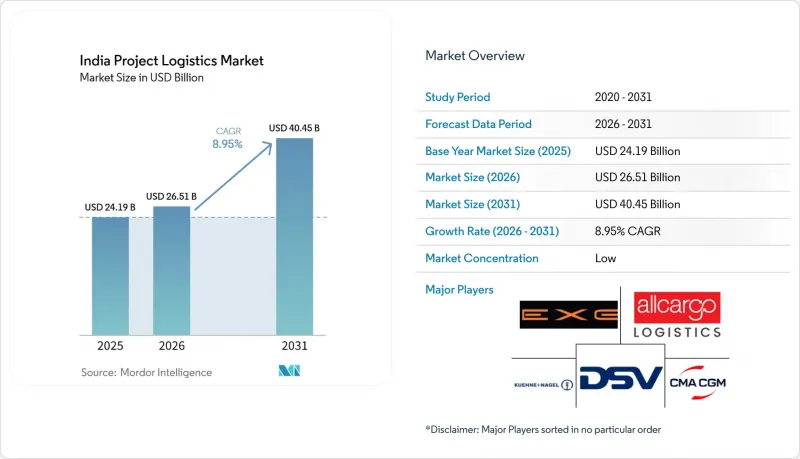
본 보고서는 서비스별(운송, 창고, 유통·재고 관리, 부가가치 서비스, 기타), 화물 유형별(초대형 화물, 중량 화물 등), 최종 사용자 산업별(석유 및 가스·광업·채석업, 발전·송전, 건설 및 인프라 등)로 분류되어 있습니다. 시장 전망은 금액(달러) 기준으로 제시되어 있습니다.
인도 프로젝트 물류 시장 동향과 인사이트
인프라 주도형 프로젝트 물류 수요 증가
2026년에도 인도 중앙 정부의 프로젝트 파이프라인은 여전히 대규모이며, 2026년 4월 속보 보고서에 따르면 총액 42.78락· 크롤(4,761억 3,000만 달러)에 해당하는 1,981건의 프로젝트가 집계되었으며, 17개 중앙 부처에 걸친 누적 지출액은 이미 20.36락 크롤(2,266억 달러)을 초과했습니다. 프로젝트의 신규 추가도 2026 회계연도 4분기에 급격히 가속화되어, 6.01 라크 크롤(668억 9,000만 달러) 상당의 신규 프로젝트 483건이 추가되었으며, 그중 도로 및 고속도로만 439건을 차지했습니다. 이는 인도의 프로젝트 물류 시장에 중요한 의미를 지닙니다. 주요 도로, 정유시설, 철도, 항만 프로젝트는 모두 현장 작업을 진행하기 전에 중장비, 모듈, 구조 부재, 설치 시스템의 운송에 대한 병행 수요를 창출하기 때문입니다. 인도의 프로젝트 물류 시장은 가동 시작 훨씬 전부터 혜택을 보고 있습니다. 이는 물류 팀이 실제 리프팅 작업이 시작되기 몇 달 전에 크레인이나 운송 시스템을 동원하고 경로 승인을 받아야 하는 경우가 많기 때문입니다. 이러한 경향은 2025년 1월에도 뚜렷하게 나타났습니다. 당시 마모에트(Mamoet)사는 구자라트주 및 라자스탄주 정유시설 설치 공사를 위해 5,000톤급 PTC210-DS를 포함한 초대형 크레인 3대를 인도에 투입했습니다.
재생에너지 및 산업 분야의 설비 투자 파이프라인
인도의 프로젝트 물류 시장은 재생에너지의 확대, 특히 긴 블레이드나 대형 나셀이 필요하며 항구에서 현장까지의 운송 계획 수립이 어려운 풍력 발전 설비의 운송으로 인해 더욱 탄력을 받고 있습니다. V.O. 치단바라날 항구에서는 2026-27 회계연도 1분기에 풍력 발전용 블레이드 취급량이 전년 동기 대비 117.72% 증가를 기록했습니다. 동시에, 딘다야르 항만청은 2025년, 선박 1척을 통해 풍력 터빈 블레이드 153장(총량 167,675입방미터)을 운송하며 사상 최고 기록을 세웠습니다. 신·재생에너지부는 2026년, ALMM 체계 하에서 풍력 터빈 공급망 구성 부품을 추적하기 위한 'WT-MARUT' 포털 사이트를 개설했습니다. 이는 물류 추적성이 재생에너지 조달 및 배송 체계와 더욱 밀접하게 연결되어 있음을 보여줍니다. 풍력 터빈 및 그 부품의 수출액은 2026 회계연도에 12,000 카롤 루피(13억 3,000만 달러)를 돌파하여 전년 대비 약 50% 증가했습니다. 이로 인해 초대형 화물 증가에 대응하기 위해 항만 및 내륙 운송 회랑에 대한 부담이 커지고 있습니다. 취급량이 확대됨에 따라 인도의 프로젝트 물류 시장은 표준 화물 운송 네트워크로는 효율적으로 처리할 수 없는 화물을 위한 전용 하역 시스템, 집적 구역 및 라스트 마일 운송 솔루션에 대한 수요로 인해 혜택을 볼 것으로 예측됩니다.
야간 운송 규제 및 도로 구조상의 제약
인도의 프로젝트 물류 시장은 여전히 많은 주 및 국가 운송 노선에서 엄격한 시간 제한이나 호송 관리 없이는 초대형 화물을 운송할 수 없다는 심각한 제약에 직면해 있습니다. 야간 운송 규제는 주, 노선, 화물의 치수에 따라 다르며, 이러한 규정으로 인해 연속적으로 운행하면 훨씬 짧은 시간에 끝날 수 있는 운송에 1일에서 3일 분량의 지연이 발생할 가능성이 있습니다. 교량의 최저 높이가 낮거나, 칼버트의 폭이 좁거나, 선회 반경이 제한되는 경우, 더 긴 경로로 우회할 수밖에 없게 되어 운송 비용이 증가하고 각 운송 시 허가 취득 절차가 복잡해집니다. 이 문제의 심각성은 2025년 NTC 로지스틱스가 NHAI 당국자 및 재생에너지 부문 관계자들과 합동 회의를 개최하여 국도에서의 풍력 발전용 블레이드 및 기타 초대형 부품 운송의 실현 가능성을 평가했을 때 드러났습니다. 동일한 운송 경로상에서 철도, 연안 또는 내륙 수로를 통한 대체 경로가 이용 가능해질 때까지는 인도의 프로젝트 물류 시장에서 화물의 가용성뿐만 아니라 도로의 물리적 제약으로 인해 프로젝트 일정이 계속 지연될 것입니다.
부문 분석
2025년, 인도의 프로젝트 물류 시장에서 운송 부문은 61.67%의 점유율을 차지하며 다른 서비스 부문을 확실히 앞질렀습니다. 이는 대부분의 프로젝트 물류가 설치를 시작하기 전에 여전히 상당한 물리적 운송을 필요로 하기 때문입니다. 많은 프로젝트 현장이 여전히 철도 터미널이나 내륙 수로와 완전히 연결되어 있지 않기 때문에 도로 운송은 여전히 중심적인 역할을 수행하고 있습니다. 동시에, 서부 및 동부 회랑에서는 대형 공정 장비를 운송하는 연안 항로와 바지선 운송이 중요해졌습니다. 또한 적재량이 많고 전용 화물 운송망을 활용하여 도로 혼잡이나 허가 취득의 부담을 줄일 수 있는 지역에서는 철도도 계속해서 중요한 역할을 수행했습니다. 창고 보관, 배송, 재고 관리는 규모는 작지만 필수적인 역할을 담당했습니다. 이는 단계적인 프로젝트 납품 과정에서 건설 공정에 맞추어 일시 보관, 집하 및 시기적절한 출하가 필요하기 때문입니다. 이러한 구조로 인해 인도의 프로젝트 물류 시장에서는 여전히 운송 업무 수행이 수익의 대부분을 차지하고 있습니다. 다만, 대형 사업자들은 물리적 운송에 부수되는 서비스를 확충함으로써 이익률 유지를 도모하고 있습니다.
'부가가치 서비스 및 기타' 부문은 2031년까지 연평균 성장률(CAGR) 9.05%를 나타낼 것으로 예측되며, 이는 시장 전체보다 약간 빠른 속도로, 노선 조사, 디지털 추적, 통관 절차, 시운전 전 지원에 대한 수요를 반영하고 있습니다. Express Global Logistics사의 사례에 따르면, 2025년 시점에서 번들형 운영이 이미 입지를 다지고 있으며, 이 회사는 30축 SPMT 편성을 활용해 인도 서해안을 따라 초대형 ODC 운송 열차를 처리하고, 단일 운영 범위 내에서 바지선 운송 조정도 수행하고 있습니다. 또한, ‘자동차법’에 근거한 노선별 ODC 허가 제도는 엔지니어링 및 운송 계획과 허가 준수를 양립할 수 있는 사업자에게 유리하게 작용하며, 통합형 서비스 모델을 통한 재계약 확보를 뒷받침하고 있습니다. 그 결과, 인도의 프로젝트 물류 업계는 운송 업무 그 자체에서 멀어지는 것이 아니라, 오히려 운송이 서비스 제공의 일부에 불과한 계약 형태로 명확히 전환되고 있습니다.
기타 혜택:
- 엑셀 형식 시장 예측(ME) 시트
- 3개월간의 애널리스트 지원
자주 묻는 질문
목차
제1장 서론
제2장 조사 방법
제3장 주요 요약
제4장 시장 구도
제5장 시장 규모와 성장 예측
제6장 경쟁 구도
제7장 시장 기회와 향후 전망
JHS 26.08.11According to Mordor Intelligence, the India project logistics market size is expected to increase from USD 24.19 billion in 2025 to USD 26.51 billion in 2026 and reach USD 40.45 billion by 2031, growing at a CAGR of 8.95% over 2026-2031.
This report is Segmented by Service (Transportation, Warehousing, Distribution and Inventory Management, Value-Added Services, and Others), by Cargo Type (Oversized Cargo, Heavy-Lift Cargo, and More), and by End-User Industry (Oil and Gas Mining and Quarrying, Energy Generation and Transmission, Construction and Infrastructure, and More). The Market Forecasts are Provided in Terms of Value (USD).
India Project Logistics Market Trends and Insights
Infrastructure-Led Project Cargo Buildout
India's central project pipeline remained large in 2026, with 1,981 projects worth INR 42.78 lakh crore (USD 476.13 billion) in the April 2026 flash report, and cumulative expenditure had already crossed INR 20.36 lakh crore (USD 226.60 billion) across 17 central ministries. Project additions also accelerated sharply in Q4 FY26, when 483 new projects worth INR 6.01 lakh crore (USD 66.89 billion) were added, and roads and highways alone accounted for 439 of them. This matters to the India project logistics market because every major road, refinery, rail, or port project creates parallel demand for moving heavy equipment, modules, structural sections, and installation systems before work at the site can advance. The India project logistics market also benefits well before commissioning, as logistics teams often need to mobilize cranes and transport systems and obtain route approvals months before the actual lift window. That pattern was visible in January 2025, when Mammoet deployed 3 very high-capacity cranes in India, including a 5,000-ton PTC210-DS, for refinery installations in Gujarat and Rajasthan.
Renewable Energy and Industrial Capex Pipeline
The India project logistics market is gaining additional support from the renewable energy buildout, especially from wind equipment movements that require long blades, large nacelles, and difficult port-to-site delivery planning. V.O. Chidambaranar Port recorded a 117.72% year-on-year rise in windmill blade handling in Q1 FY2026-27. At the same time, Deendayal Port Authority set a record with a single-vessel consignment of 153 wind turbine blades totaling 167,675 cubic meters in 2025. The Ministry of New and Renewable Energy launched the WT-MARUT portal in 2026 to track wind turbine supply chain components under the ALMM framework, demonstrating that logistics traceability is now more closely tied to renewable procurement and delivery discipline. Wind turbine and component exports crossed INR 12,000 crore (USD 1.33 billion) in FY26, nearly 50% higher year on year, which keeps pressure on ports and inland corridors to handle a larger flow of outsized cargo. As volumes scale, the India project logistics market stands to benefit from demand for purpose-built handling systems, staging areas, and final-mile transport solutions for cargo that standard freight networks cannot efficiently absorb.
Night Movement Restrictions and Road Geometry Constraints
The India project logistics market still faces hard movement constraints on many state and national corridors where over-dimensional cargo cannot move without strict timing and escort controls. Night movement restrictions differ by state, route, and cargo dimensions, and these rules can add 1 to 3 days to a movement that would otherwise be much shorter if it ran continuously. Low bridge clearances, narrow culverts, and turning radius limits also force rerouting to longer corridors, which increases transport costs and the complexity of permits for each movement. The scale of this issue was clear in 2025, when NTC Logistics held a joint meeting with NHAI officials and participants from the renewable energy sector to assess the feasibility of moving wind blades and other oversized components on national highways. Until alternate rail, coastal, or inland water routes are available on the same corridor, the India project logistics market will continue to see project schedules slowed by physical road limits rather than by cargo availability alone.
Other drivers and restraints analyzed in the detailed report include:
- Shift Toward Multimodal Movement for Heavy Cargo
- Early-Stage Logistics Planning for Scarce Heavy-Lift Assets
- Delayed Statutory Permits and Multi-Agency Clearances
For complete list of drivers and restraints, kindly check the Table Of Contents.
Segment Analysis
Transportation held 61.67% of the India project logistics market share in 2025, keeping it clearly ahead of other service categories, as most project cargo still requires a significant physical movement component before installation can begin. Road transport remained central because many project sites are still not fully connected to railheads or inland waterways. At the same time, coastal shipping and barge legs became important on western and eastern corridors, carrying large process equipment. Rail also remained relevant where payloads were high and dedicated freight connectivity could be used to reduce pressure on roads and permits. Warehousing, distribution, and inventory management served a smaller but necessary role because phased project deliveries often require staging, consolidation, and timed release to match the construction sequence. That structure means the India project logistics market still takes most of its value from movement execution. Still, larger operators are trying to protect margins by adding services around the physical move.
Value-added Services and Others is forecast to grow at a 9.05% CAGR through 2031, slightly faster than the overall market and reflecting demand for route studies, digital tracking, customs handling, and pre-commissioning support. Express Global Logistics showed that bundled execution is already gaining ground in 2025, handling super ODC columns along India's western coast with 30-axle SPMT lines and coordinating barge movements under a single operating scope. Route-specific ODC authorizations under the Motor Vehicles Act also favor operators who can pair engineering and transport planning with permit compliance, helping integrated service models win repeat business. As a result, the India project logistics industry is not moving away from transportation; rather, it is clearly moving toward contracts in which transportation is only one part of the offer.
Complete Report Scope:
- By Service
- Transportation
- Road
- Rail
- Air
- Sea/Barge
- Warehousing, Distribution and Inventory Management
- Value-added Services and Others
- Transportation
- By Cargo Type
- Oversized (Out-of-Gauge) Cargo
- Heavy-Lift Cargo
- Breakbulk Cargo
- Others
- By End-User Industry
- Oil and Gas, Mining and Quarrying
- Energy Generation and Transmission (Includes Renewable Energy)
- Construction and Infrastructure
- Manufacturing and Industrial Plants
- Aerospace and Defense
- Others (Maritime and Shipbuilding, Telecommunications, etc.)
List of Companies Covered in this Report:
- A.P. Moller - Maersk
- Allcargo Logistics Limited
- CMA CGM Group (Including CEVA Logistics)
- C.H. Robinson Worldwide, Inc.
- DHL Group
- DSV A/S
- Express Global Logistics Private Limited
- GEODIS
- Hellmann Worldwide Logistics
- Kuehne+Nagel
- Mammoet Group
- NMT Global Project Logistics
- Rhenus Group
- Rohlig Logistics GmbH and Co. KG
- Transport Corporation of India Limited
- Transworld Group
- NYK Line
- Total Movements Pvt. Ltd.
- CJ Logistics
- DEUGRO, Ltd.
- Procam Logistics Pvt. Ltd.
- SARR Freights
Additional Benefits:
- The market estimate (ME) sheet in Excel format
- 3 months of analyst support
TABLE OF CONTENTS
1 Introduction
- 1.1 Study Assumptions and Market Definition
- 1.2 Scope of the Study
2 Research Methodology
3 Executive Summary
4 Market Landscape
- 4.1 Market Overview
- 4.2 Market Drivers
- 4.2.1 Infrastructure-Led Project Cargo Buildout
- 4.2.2 Shift Toward Multimodal Movement For Heavy Cargo
- 4.2.3 Renewable Energy and Industrial Capex Pipeline
- 4.2.4 Early-Stage Logistics Planning for Scarce Heavy-Lift Assets
- 4.2.5 Digital Surveying, Route Simulation, and Permit Acceleration
- 4.2.6 Port, Rail, and Inland Waterway Integration for ODC Movements
- 4.3 Market Restraints
- 4.3.1 Night Movement Restrictions and Road Geometry Constraints
- 4.3.2 Delayed Statutory Permits and Multi-Agency Clearances
- 4.3.3 Underdeveloped MMLP and First-Mile Last-Mile Connectivity
- 4.3.4 Weather Sensitivity and Monsoon-Linked Disruption Risk
- 4.4 Value / Supply-Chain Analysis
- 4.5 Regulatory Landscape
- 4.6 Technological Outlook
- 4.7 Porter's Five Forces Analysis
- 4.7.1 Bargaining Power of Suppliers
- 4.7.2 Bargaining Power of Buyers
- 4.7.3 Threat of New Entrants
- 4.7.4 Threat of Substitutes
- 4.7.5 Industry Rivalry
- 4.8 Impact of Geopolitical Events on the Market
5 Market Size and Growth Forecasts (Value, USD)
- 5.1 By Service
- 5.1.1 Transportation
- 5.1.1.1 Road
- 5.1.1.2 Rail
- 5.1.1.3 Air
- 5.1.1.4 Sea/Barge
- 5.1.2 Warehousing, Distribution and Inventory Management
- 5.1.3 Value-added Services and Others
- 5.1.1 Transportation
- 5.2 By Cargo Type
- 5.2.1 Oversized (Out-of-Gauge) Cargo
- 5.2.2 Heavy-Lift Cargo
- 5.2.3 Breakbulk Cargo
- 5.2.4 Others
- 5.3 By End-User Industry
- 5.3.1 Oil and Gas, Mining and Quarrying
- 5.3.2 Energy Generation and Transmission (Includes Renewable Energy)
- 5.3.3 Construction and Infrastructure
- 5.3.4 Manufacturing and Industrial Plants
- 5.3.5 Aerospace and Defense
- 5.3.6 Others (Maritime and Shipbuilding, Telecommunications, etc.)
6 Competitive Landscape
- 6.1 Market Concentration
- 6.2 Strategic Moves
- 6.3 Market Share Analysis
- 6.4 Company Profiles (includes Global Level Overview, Market Level Overview, Core Segments, Financials as available, Strategic Information, Market Rank/Share, Products and Services, Recent Developments)
- 6.4.1 A.P. Moller - Maersk
- 6.4.2 Allcargo Logistics Limited
- 6.4.3 CMA CGM Group (Including CEVA Logistics)
- 6.4.4 C.H. Robinson Worldwide, Inc.
- 6.4.5 DHL Group
- 6.4.6 DSV A/S
- 6.4.7 Express Global Logistics Private Limited
- 6.4.8 GEODIS
- 6.4.9 Hellmann Worldwide Logistics
- 6.4.10 Kuehne+Nagel
- 6.4.11 Mammoet Group
- 6.4.12 NMT Global Project Logistics
- 6.4.13 Rhenus Group
- 6.4.14 Rohlig Logistics GmbH and Co. KG
- 6.4.15 Transport Corporation of India Limited
- 6.4.16 Transworld Group
- 6.4.17 NYK Line
- 6.4.18 Total Movements Pvt. Ltd.
- 6.4.19 CJ Logistics
- 6.4.20 DEUGRO, Ltd.
- 6.4.21 Procam Logistics Pvt. Ltd.
- 6.4.22 SARR Freights
7 Market Opportunities and Future Outlook
- 7.1 White-Space and Unmet-Need Assessment