

|
시장보고서
상품코드
2100014
MRI 대응 정맥내 주입 펌프 시장 : 점유율 분석, 업계 동향 및 통계, 성장 예측(2026-2031년)MRI-Compatible IV Infusion Pump - Market Share Analysis, Industry Trends & Statistics, Growth Forecasts (2026 - 2031) |
||||||
 Mordor Intelligence
Mordor Intelligence에 의하면, 2026년 MRI 대응 정맥내 주입 펌프 시장 규모는 4억 1,278만 달러로 추정되고 있어 2025년 3억 8,116만 달러에서 확대해, 2031년에는 6억 1,498만 달러에 이를 것으로 예측됩니다.
2026년부터 2031년까지 연평균 성장률(CAGR) 8.30%로 성장할 것으로 전망됩니다.
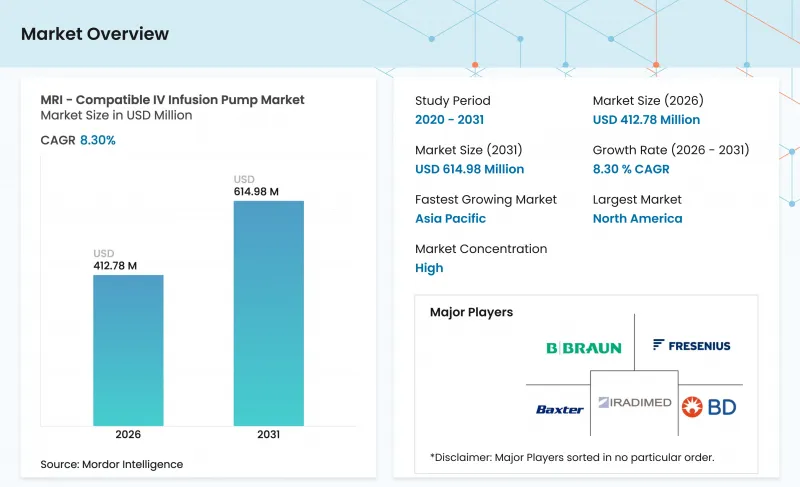
본 보고서는 유형(비자기 펌프 시스템 등), 자기장 호환성(1.5 T 이하 시스템, 3 T 시스템 등), 제품의 휴대성(휴대용/병상용 등), 최종 사용자(병원, 전문 클리닉 등), 지역(북미, 유럽, 아시아태평양 등)별로 분류되어 있습니다. 시장 전망은 금액(달러) 기준으로 제시되어 있습니다.
전 세계 MRI 대응 정맥 내 주입 펌프 시장 동향 및 인사이트
만성 질환 부담 증가와 MRI 검사 건수 증가
심혈관 질환, 신경계 질환 및 종양성 질환의 유병률 상승에 따라, 약물의 연속 투여가 필요한 MRI 검사 건수가 증가하고 있습니다. FDA가 갱신한 MRI 장비 안전성 지침에 따라 제조업체들은 승인 획득을 위한 로드맵이 명확해졌으며, 제품 출시가 가속화되고 있습니다. 3차 의료기관에서는 복잡한 수액 요법을 환자를 이동시키지 않고 시행할 수 있도록 통합형 MRI 스위트 도입이 진행되고 있습니다. 다중 질환 병존으로 인해 영상 진단과 치료를 동시에 시행해야 하는 경우가 많아, 고령화가 진행됨에 따라 이러한 수요는 더욱 높아지고 있습니다.
증가하는 MRI 유도 하의 저침습 수술
실시간 신경외과, 심장외과 및 집속 초음파 치료에는 1.5 T, 3 T, 그리고 새롭게 등장한 7 T 자기장 내에서 작동하는 펌프가 필요합니다. GE 헬스케어의 ‘SIGNA MAGNUS 3.0 T’ 헤드 전용 스캐너는 수액 제조업체들을 더 높은 자기장 대응으로 이끄는 생태계의 좋은 사례입니다. 영상 유도 정확도 향상으로 입원 일수가 단축되고 재입원 위험이 감소함에 따라, 병원의 설비 투자 예산에서 MRI 업그레이드와 펌프 구매를 함께 진행하는 사례가 늘고 있습니다.
높은 설비 투자 및 유지 관리 비용
특수한 설계로 인해 단가가 급등하고 있어, 소규모 의료 기관에서는 업그레이드를 미루는 경우가 많습니다. 인도의 공공 부문이 추진하는 MRI 프로그램은 현행 수입 가격의 절반에 스캐너를 제공하겠다고 약속하고 있어, 비용 절감 압박을 여실히 보여주고 있습니다. 총 소유 비용에는 유지보수 계약 및 자석실 검증 비용도 포함되기 때문에 투자 회수 기간이 장기화되고 있습니다.
부문 분석
2025년, MRI 대응 정맥 내 주입 펌프 시장에서 비자성 펌프의 점유율은 64.12%를 차지했습니다. 이는 철분을 포함하지 않는 구조로 인해 차폐 제약이 해소되기 때문입니다. 대규모 의료 기관에서는 환자의 체위 제한이 없고 워크플로우가 간소화되는 점을 우선시하고 있어, 이 부문이 현재 MRI 대응 정맥 내 주입 펌프 시장의 기반을 이루고 있습니다. 비자성 유닛과 관련된 MRI 대응 정맥 내 주입 펌프 시장 규모는 새로운 고자기장 스캐너의 도입에 따라 확대될 것으로 예측됩니다. 자기 차폐 기능이 있는 펌프는 소형 차폐재를 통해 본체의 부피를 줄일 수 있어, 연평균 성장률(CAGR) 10.96%로 시장 점유율을 확대되고 있습니다. B. Braun사의 ‘Space MRI Station’은 뮤메탈로 제작된 차폐 내부에 8대의 기존 펌프를 수납한 제품으로, 이미 B. Braun사의 소프트웨어를 표준으로 채택하고 있는 병원들로부터 지지를 얻고 있습니다. 일회용 튜브 제조업체들은 무균 기준을 충족하면서도 1회당 비용을 절감하기 위해 BioDur 108 합금의 채택을 모색하고 있습니다.
자석 보어 내부에서의 초저소음 운전 실현은 비자성 제품의 주요 판매 포인트입니다. 임상의들로부터는 경보 발생이 줄어들고 스캔 중단이 감소했다는 보고가 있습니다. 한편, 실드 모델은 익숙한 펌프 인터페이스를 채택하고 있어, MRI실과 일반 수액실을 오가는 직원들에게 조작 습득의 부담이 줄어듭니다. 일부 3차 의료기관에서는 두 유형을 병용하고 있습니다. 예를 들어, 암 치료의 장기 점적 주사에는 차폐형 랙을, 마취나 조영제의 볼루스 투여에는 비자성 휴대용 모델을 사용하고 있습니다.
현재 1.5T 이하 스캐너는 MRI 대응 정맥 내 주입 펌프 시장의 42.75%를 차지하고 있으며, 이는 도입 실적을 반영한 것입니다. 그러나 신경과학 및 심장 연구 기관들이 7T 자석을 채택하고 있어, 초고자기장 시스템은 11.35%라는 가장 높은 연평균 성장률(CAGR)을 보이고 있습니다. 이 초고자기장이라는 틈새 시장에서 MRI 대응 정맥 내 주입 펌프 시장 규모는 두부 전용 및 사지 전용 스캐너가 연구 용도에서 임상 현장으로 전환되고 청구 코드가 증가함에 따라 확대될 것으로 예측됩니다. 기술적 과제로는 와전류 노이즈 제거와 강력한 자기장 구배 하에서도 블루투스 원격 측정 기능이 확실하게 작동하도록 보장하는 것을 들 수 있습니다. 제조업체들은 코일 공급업체와 협력하여 펌프 설치 구역을 공동으로 검증하고 있으며, 이를 통해 조달 주기가 단축되고 있습니다.
중거리 대역의 3T 장비는 여전히 방사선과에서 주력 장비로 자리 잡고 있으며, 꾸준한 교체 수요를 뒷받침하고 있습니다. 1.5T에서 3T로 업그레이드하는 병원에서는 대개 동일한 설비 투자 주기 내에서 펌프 교체도 함께 이루어지고 있으며, 공급업체들은 이러한 추세를 활용하여 서비스 계약을 패키지화하고 있습니다. 유럽의 보험사들은 난치성 간질 진단에 사용되는 7T 신경 스캔 비용을 점점 더 많이 보상하고 있으며, 이러한 정책적 지원에 힘입어 더 많은 의료 기관이 초고자기장 대응 펌프를 도입할 것으로 보입니다.
지역별 분석
2025년, 북미는 MRI 대응 정맥 내 주입 펌프 시장 규모의 44.10%를 차지했습니다. 미국에서는 FDA의 조기 승인 및 MRI 장비를 보유한 대학 병원이 집중되어 있어 도입의 대부분을 차지하고 있습니다. 캐나다의 주립 의료 제도에서는 수술 중 MRI 실에 대한 설비 투자 보조금이 지급되고 있으며, 이것이 교체 주기를 뒷받침하고 있습니다. 멕시코의 민간 병원 체인은 의료 관광객을 유치하기 위해 턴키 방식의 수술용 영상 진단실에 투자하고 있어, 펌프 수요를 더욱 끌어올리고 있습니다. 유럽은 엄격하고 예측 가능한 CE 마크 취득 절차를 갖춘 성숙한 도입 시장으로 자리 잡고 있습니다. 독일, 프랑스, 영국에서는 의료기기 데이터와 관련하여 GDPR(EU 개인정보보호규정)을 준수하는 네트워크 지원 펌프가 선호되고 있습니다. 스칸디나비아 국가들에서는 3T 뇌신경외과 수술실 내에서 폐쇄형 순환 수액 요법 프로토콜의 시범 운영이 진행 중이며, 이 모델은 현재 EU 의료기술평가기관에 의해 검토되고 있습니다. 러시아의 신경과학 연구소에서는 광범위한 장비 제재에도 불구하고 초고자기장 대응 펌프의 수입을 지속하고 있으며, 규모는 작지만 견고한 틈새 시장을 유지하고 있습니다.
아시아태평양은 12.98%라는 가장 높은 연평균 성장률(CAGR)을 기록하고 있습니다. 중국 국가위생건강위원회는 현급 수준의 MRI 확충을 위한 자금을 배정했으며, 이에 따라 현지 수탁 제조업체들이 서유럽 펌프의 지적재산권(IP) 라이선스를 취득하고 수입 관세를 인하하려는 움직임이 가속화되고 있습니다. 인도 정부가 지원하는 1.5T 스캐너 도입 계획은 자석 가격을 절반으로 낮추는 것을 목표로 하고 있어, 간접적으로 펌프의 가격 경쟁력을 높이고 있습니다. 일본은 IoT 통합의 선구자로서, 주입 펌프를 방사선과 예약 시스템과 연동하여 약물 라이브러리를 자동으로 입력하고 있습니다. 태국과 인도네시아가 주도하는 동남아시아 시장에서는 민간 병원 그룹이 MRI 유도 하 통증 절제술을 프리미엄 패키지의 차별화 요소로 삼아 펌프 도입을 촉진하고 있습니다.
중동에서는 고자기장 MRI가 수술 중 혈관 매핑을 지원하는 플래그십 이식 센터에 대한 투자가 진행되고 있습니다. 사우디아라비아의 ‘비전 2030’ 병원 프로젝트에는 비자성 펌프용 배선이 사전에 설치된 하이브리드 수술실이 포함되어 있습니다. 남미의 진전은 비교적 완만하지만, 브라질의 주요 종양학 연구소에서는 펌프 간 상호 운용성이 필요한 AI 지원형 3T 치료 워크플로우 시험이 진행되고 있어 향후 확대 가능성을 시사하고 있습니다.
기타 혜택:
- 엑셀 형식 시장 예측(ME) 시트
- 3개월간의 애널리스트 지원
자주 묻는 질문
목차
제1장 서론
제2장 조사 방법
제3장 주요 요약
제4장 시장 구도
제5장 시장 규모와 성장 예측
제6장 경쟁 구도
제7장 시장 기회와 향후 전망
JHS 26.08.11According to Mordor Intelligence, the MRI-Compatible IV infusion pump market size in 2026 is estimated at USD 412.78 million, growing from 2025 value of USD 381.16 million with 2031 projections showing USD 614.98 million, growing at 8.30% CAGR over 2026-2031.
This report is Segmented by Type (Non-Magnetic Pump Systems, and More), Magnetic-Field Compatibility (<=1. 5 T Systems, 3 T Systems, and More), Product Portability (Portable/Bedside Units, and More), End User (Hospitals, Specialty Clinics, and More) and Geography (North America, Europe, Asia-Pacific, and More). The Market Forecasts are Provided in Terms of Value (USD).
Global MRI-Compatible IV Infusion Pump Market Trends and Insights
Rising Burden of Chronic Diseases & MRI Scan Volumes
Higher prevalence of cardiovascular, neurological, and oncological disorders raises the number of MRI studies that require uninterrupted drug infusion. The FDA's updated MRI-device safety guidance gives manufacturers clearer routes to clearance, accelerating product launches. Tertiary hospitals are aggregating integrated MRI suites so that complex infusion regimens proceed without patient relocation. The aging demographic intensifies this demand, as multimorbidity often necessitates simultaneous imaging and therapy.
Growing MRI-Guided Minimally Invasive Surgeries
Real-time neuro, cardiac, and focused-ultrasound procedures need pumps that function inside 1.5 T, 3 T, and emerging 7 T magnets. GE HealthCare's SIGNA MAGNUS 3.0 T head-only scanner exemplifies the ecosystem pulling infusion makers toward higher-field compatibility. Hospital capital budgets increasingly pair MRI upgrades with pump purchases because better image guidance shortens length of stay and lowers readmission risk.
High Capital & Maintenance Costs
Specialized engineering spikes unit prices, and smaller centers often delay upgrades. India's public-sector MRI program illustrates cost-containment pressure by promising scanners at half prevailing import prices. Total ownership cost also includes maintenance contracts and magnet-room validation, prolonging payback periods.
Other drivers and restraints analyzed in the detailed report include:
- Advances in Wireless Non-Magnetic Pump Platforms
- IoT-Enabled Closed-Loop MRI Infusion Ecosystems
- Limited Reimbursement for MRI Disposables
For complete list of drivers and restraints, kindly check the Table Of Contents.
Segment Analysis
Non-magnetic pumps accounted for 64.12% of the MRI-compatible IV infusion pump market share in 2025, as their ferrous-free architecture eliminates shielding constraints. This segment anchors the current MRI-compatible IV infusion pump market as large centers prioritize unrestricted patient positioning and workflow simplicity. The MRI-compatible IV infusion pump market size tied to non-magnetic units is forecasted to expand in parallel with the installation of new high-field scanners. Magnetic-shielded pumps are gaining traction, advancing at a 10.96% CAGR as compact shielding materials reduce cabinet bulk. B. Braun's Space MRI Station features eight conventional pumps housed within a mu-metal cloak, appealing to hospitals that have already standardized on B. Braun software. Disposable tubing manufacturers are experimenting with BioDur 108 alloy to reduce the per-procedure cost while meeting sterility standards.
Achieving ultra-quiet operation inside the magnet bore is a core non-magnetic selling point. Clinicians report fewer alarms, reducing scan interruptions. Meanwhile, shielded models utilize familiar pump interfaces, thereby flattening the learning curve for staff who rotate between MRI and standard infusion rooms. Some tertiary centers mix both types: shielded racks for long oncology infusions and non-magnetic portables for anesthesia and contrast bolus work.
Scanners at <=1.5 T currently account for 42.75% of the MRI-compatible IV infusion pump market share, mirroring installed base realities. However, ultra-high-field systems exhibit the fastest 11.35% CAGR because neuroscience and cardiac research institutes adopt 7 T magnets. The MRI-compatible IV infusion pump market size in this ultra-high-field niche is expected to grow as head-only and extremity scanners transition from research to clinical settings, leading to increased billing codes. Engineering challenges include eliminating eddy-current noise and ensuring Bluetooth telemetry survives intense gradients. Manufacturers collaborate with coil vendors to co-validate pump placement zones, shortening procurement cycles.
Mid-range 3 T machines remain radiology workhorses, sustaining steady replacement demand. Hospitals upgrading from 1.5 T to 3 T often bundle pump refreshes in the same capital cycle, a pattern vendors exploit by packaging service contracts. Payers in Europe are increasingly reimbursing 7T neuro scans for refractory epilepsy diagnostics, a policy catalyst that will nudge more centers toward ultra-high-field compatible pumps.
Complete Report Scope:
- By Type
- Non-Magnetic Pump Systems
- Magnetic-Shielded Pump Systems
- Tubing & Disposables
- By Magnetic-Field Compatibility
- <=1.5 T Systems
- 3 T Systems
- Ultra-High-Field Systems
- By Product Portability
- Portable/Bedside Units
- Stationary Rack-mount Units
- By End User
- Hospitals
- Specialty Clinics
- Ambulatory Surgical Centers
- Diagnostic & Imaging Centers
- Research Institutes
- By Geography
- North America
- United States
- Canada
- Mexico
- Europe
- Germany
- United Kingdom
- France
- Italy
- Spain
- Rest of Europe
- Asia-Pacific
- China
- Japan
- India
- Australia
- South Korea
- Rest of Asia-Pacific
- Middle East & Africa
- GCC
- South Africa
- Rest of Middle East & Africa
- South America
- Brazil
- Argentina
- Rest of South America
- North America
Geography Analysis
North America retained 44.10% of the MRI-compatible IV infusion pump market size in 2025. The United States drives most placements thanks to early FDA clearances and a concentration of magnet-stocked academic medical centers. Canada's provincial health systems fund capital grants for intra-operative MRI suites, sustaining replacement cycles. Mexico's private hospital chains invest in turnkey surgical imaging theaters to attract medical tourists, creating incremental pump demand.Europe remains a mature adopter with stringent, predictable CE-mark pathways. Germany, France, and the United Kingdom favor network-ready pumps that comply with GDPR for device data. Scandinavian countries pilot closed-loop infusion protocols inside 3 T neurosurgical theaters, a model under review by EU health technology assessment bodies. Russia's neuroscience institutes continue to import ultra-high-field capable pumps despite broader equipment sanctions, sustaining a small but resilient niche.
Asia-Pacific posts the strongest 12.98% CAGR. China's National Health Commission earmarked funds for county-level MRI expansion, spurring local contract manufacturers to license Western pump IP and reduce import tariffs. India's government-backed 1.5 T scanner line aspires to halve magnet pricing, indirectly lifting pump affordability. Japan pioneers IoT integration, linking infusion pumps with radiology scheduling systems to auto-populate drug libraries. Southeast Asian markets, led by Thailand and Indonesia, see private hospital groups differentiate premium packages with MRI-guided pain ablation services, fueling pump uptake.
The Middle East invests in flagship transplant centers where high-field MRI supports intra-op vascular mapping. Saudi Arabia's Vision 2030 hospital projects include hybrid suites pre-wired for non-magnetic pumps. South America advances more slowly; however, Brazil's top oncology institutes trial AI-assisted 3 T therapy workflows that require pump interoperability, hinting at future scale.
- IRadimed Corp.
- B. Braun
- Baxter
- Fresenius
- Becton Dickinson & Co.
- Medtronic
- ICU Medical
- Eitan Medical
- Arcomed AG
- Flowonix Medical Inc.
- Smiths Medical (ICU)
- Avanos Medical
- Moog Inc. (Curlin)
- Terumo Corp.
- Nipro Corp.
- Zyno Medical
- Shenzhen Mindray Bio-Medical
- CME-McKinley
- Bayer AG (MEDRAD)
- InfuSystem Holdings
Additional Benefits:
- The market estimate (ME) sheet in Excel format
- 3 months of analyst support
TABLE OF CONTENTS
1 Introduction
- 1.1 Study Assumptions & Market Definition
- 1.2 Scope of the Study
2 Research Methodology
3 Executive Summary
4 Market Landscape
- 4.1 Market Overview
- 4.2 Market Drivers
- 4.2.1 Rising Burden of Chronic Diseases & MRI Scan Volumes
- 4.2.2 Growing MRI-Guided Minimally-Invasive Surgeries
- 4.2.3 Advances in Wireless Non-Magnetic Pump Platforms
- 4.2.4 Iot-Enabled Closed-Loop MRI Infusion Ecosystems
- 4.2.5 Expansion of Intra-Operative MRI Suites
- 4.2.6 Hospital Policies Eliminating Long IV-Line Workarounds
- 4.3 Market Restraints
- 4.3.1 High Capital & Maintenance Costs
- 4.3.2 Limited Reimbursement for MRI Disposables
- 4.3.3 Non-Ferrous Component Supply Bottlenecks
- 4.3.4 MRI-Safety Workforce Training Gaps
- 4.4 Technological Outlook
- 4.5 Porter's Five Forces Analysis
- 4.5.1 Threat of New Entrants
- 4.5.2 Bargaining Power of Buyers
- 4.5.3 Bargaining Power of Suppliers
- 4.5.4 Threat of Substitutes
- 4.5.5 Intensity of Competitive Rivalry
5 Market Size & Growth Forecasts (Value in USD)
- 5.1 By Type
- 5.1.1 Non-Magnetic Pump Systems
- 5.1.2 Magnetic-Shielded Pump Systems
- 5.1.3 Tubing & Disposables
- 5.2 By Magnetic-Field Compatibility
- 5.2.1 <=1.5 T Systems
- 5.2.2 3 T Systems
- 5.2.3 Ultra-High-Field Systems
- 5.3 By Product Portability
- 5.3.1 Portable/Bedside Units
- 5.3.2 Stationary Rack-mount Units
- 5.4 By End User
- 5.4.1 Hospitals
- 5.4.2 Specialty Clinics
- 5.4.3 Ambulatory Surgical Centers
- 5.4.4 Diagnostic & Imaging Centers
- 5.4.5 Research Institutes
- 5.5 By Geography
- 5.5.1 North America
- 5.5.1.1 United States
- 5.5.1.2 Canada
- 5.5.1.3 Mexico
- 5.5.2 Europe
- 5.5.2.1 Germany
- 5.5.2.2 United Kingdom
- 5.5.2.3 France
- 5.5.2.4 Italy
- 5.5.2.5 Spain
- 5.5.2.6 Rest of Europe
- 5.5.3 Asia-Pacific
- 5.5.3.1 China
- 5.5.3.2 Japan
- 5.5.3.3 India
- 5.5.3.4 Australia
- 5.5.3.5 South Korea
- 5.5.3.6 Rest of Asia-Pacific
- 5.5.4 Middle East & Africa
- 5.5.4.1 GCC
- 5.5.4.2 South Africa
- 5.5.4.3 Rest of Middle East & Africa
- 5.5.5 South America
- 5.5.5.1 Brazil
- 5.5.5.2 Argentina
- 5.5.5.3 Rest of South America
- 5.5.1 North America
6 Competitive Landscape
- 6.1 Market Concentration
- 6.2 Market Share Analysis
- 6.3 Company Profiles (includes Global level Overview, Market level overview, Core Segments, Financials as available, Strategic Information, Market Rank/Share for key companies, Products & Services, and Recent Developments)
- 6.3.1 IRadimed Corp.
- 6.3.2 B. Braun SE
- 6.3.3 Baxter International Inc.
- 6.3.4 Fresenius SE & Co. KGaA
- 6.3.5 Becton Dickinson & Co.
- 6.3.6 Medtronic plc
- 6.3.7 ICU Medical Inc.
- 6.3.8 Eitan Medical Ltd.
- 6.3.9 Arcomed AG
- 6.3.10 Flowonix Medical Inc.
- 6.3.11 Smiths Medical (ICU)
- 6.3.12 Avanos Medical
- 6.3.13 Moog Inc. (Curlin)
- 6.3.14 Terumo Corp.
- 6.3.15 Nipro Corp.
- 6.3.16 Zyno Medical
- 6.3.17 Shenzhen Mindray Bio-Medical
- 6.3.18 CME-McKinley
- 6.3.19 Bayer AG (MEDRAD)
- 6.3.20 InfuSystem Holdings
7 Market Opportunities & Future Outlook
- 7.1 White-space & Unmet-need Assessment


