|
시장보고서
상품코드
2123717
정맥내 주입 펌프 시장 : 시장 점유율 분석, 업계 동향 및 통계, 성장 예측(2026-2031년)Intravenous Infusion Pump - Market Share Analysis, Industry Trends & Statistics, Growth Forecasts (2026 - 2031) |
||||||
 Mordor Intelligence
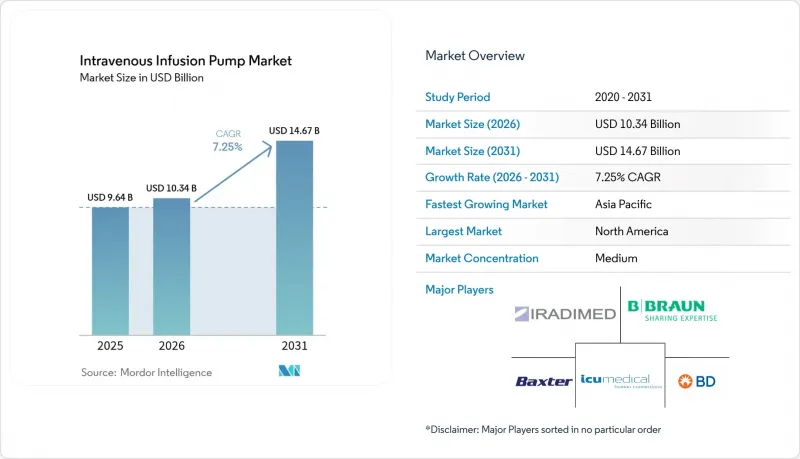
Mordor Intelligence에 의하면, 2026년 정맥내 주입 펌프 시장 규모는 103억 4,000만 달러로 추정되고, 2025년 96억 4,000만 달러에서 성장하여, 2031년에는 146억 7,000만 달러에 이를 것으로 예측됩니다.
2026-2031년 연평균 성장률(CAGR)은 7.25%를 나타낼 전망입니다.

본 보고서에서는 시장을 펌프 유형별(용적식 펌프, 주사기 펌프, 환자 자가 조절 진통 펌프, 기타), 용도별(종양학·화학요법, 진통, 기타), 최종 사용자별(병원, 재택치료, 기타), 지역별(북미, 유럽, 아시아태평양, 중동 및 아프리카, 남미)로 분류하고 있습니다. 시장 예측은 금액(달러) 기준으로 제시되어 있습니다.
세계의 정맥내 주입 펌프 시장 동향 및 인사이트
만성 질환 유병률 증가
당뇨병, 암 및 기타 장기 질환의 전 세계 유병률 증가로 인해, 정맥내 주입 펌프 시장 전반에서 약물 투여에 대한 기대가 변화하고 있습니다. 2024년에는 5억 3,700만 명 이상의 성인이 당뇨병을 앓고 있어, 펌프의 정밀도와 실시간 혈당 측정을 결합한 지속 인슐린 주입에 대한 수요가 증가하고 있습니다. 현재 종양학 치료 프로토콜에서는 몇 초 만에 유량을 조절할 수 있는 프로그래밍 가능한 펌프가 필수적이며, 이를 통해 항암제가 엄격한 치료 범위 내에 머물도록 보장하는 동시에 약물 낭비를 최소화하고 있습니다. 각 의료기기 제조업체들은 심박 변이도 및 기타 바이오마커를 추적하는 센서를 통합하고 있으며, 이를 통해 알고리즘이 임상의의 개입 없이 주입 프로파일을 동적으로 변경할 수 있게 되었습니다. 이러한 단계적인 안전 대책은 유해 사건을 줄일 뿐만 아니라, 가격에 민감한 입찰 과정에서 프리미엄 제품 라인의 차별화에도 기여하고 있습니다. 예측 분석 기능을 갖춘 펌웨어 개발을 추진하는 제조업체들은 의료 시스템이 성과 기반 구매 모델로 전환됨에 따라, 새롭게 떠오르는 서비스 수익을 확보할 준비를 갖추고 있습니다.
가정 및 대체 시설에서의 정맥 주사 요법 보급
입원 기간 단축을 장려하는 정책적 인센티브와 환자의 수용 확대가 맞물려, 재택 수액 요법은 미래 성장의 핵심으로 자리 잡고 있습니다. 임상 연구에 따르면, 스마트펌프를 가정에서 사용하는 환자의 만족도는 100%에 달하며, 환자 스스로 경보의 97%를 자율적으로 해결하고 있는 것으로 보고되었습니다. 이는 복잡한 투여 계획이라도 병동을 떠나서도 안전하게 시행할 수 있게 된 사용 편의성의 진보를 입증합니다. 며칠간의 사용에 최적화된 배터리 구동식 경량 기기를 통해 병원 밖에서도 화학요법, 비경구 영양 공급, 항생제 요법이 가능해집니다. 이와 병행하여 원격 상담 포털을 통해 펌프 데이터가 지속적으로 임상의에게 전송되어 조기 개입이 가능해짐으로써, 비용이 많이 드는 재입원을 피할 수 있습니다. 규제 당국은 현재 시설 외부 사용에 대한 개별 지침을 발표하고 있으며, 잠금 기능, 변조 방지 카트리지, 일반인도 이해할 수 있는 설명 인터페이스를 갖춘 휴대용 시스템의 승인 기간을 단축하고 있습니다.
스마트펌프의 높은 도입 및 유지 비용
스마트펌프의 단가는 대당 3,000달러에서 15,000달러에 달하며, 많은 의료 기관에서는 구매 가격의 10-15%를 연간 유지보수비로 예산에 반영해야 합니다. 병원의 영업이익률이 낮은 상황에서는 재무위원회가 장비 교체를 미루는 경우가 많아, 그 결과 최소한의 안전 기준만 충족하는 기능으로 제한된 용적식 모델에 대한 수요가 유지되고 있습니다. 총 소유 비용을 산정할 때는 직원 교육, 소프트웨어 라이선스, 교체용 배터리 비용도 고려해야 합니다. 이를 종합해 보면, 많은 지역 의료기관에서 투자 회수 기간이 3년을 초과하게 됩니다. 공동 구매 조직은 정가 인하 협상을 진행하고 있지만, 자원이 부족한 지역에서는 도입 격차가 여전히 존재하고 있습니다. 각 제조업체는 리스 프로그램이나 단계적 업그레이드 경로를 도입함으로써 이러한 장벽을 완화하기 위해 노력하고 있으며, 이를 통해 예산을 확보한 단계에서 기본 기기 유형에 나중에 연결 모듈을 추가할 수 있게 되었습니다.
부문 분석
2025년, 용적식 장치는 정맥내 주입 펌프 시장 점유율의 36.12%를 차지했으며, 유지 요법용 수액, 항생제, 혈액 제제에 대한 그 범용성을 재차 입증했습니다. 용적식 정맥 주입 펌프 시장 규모는 2025년에 34억 8,000만 달러에 달한 것으로 평가되었으며, 교체 주기가 엄격해진 경보 관리 기준에 부합함에 따라 꾸준한 속도로 확대될 것으로 전망됩니다. 병원 측에서는 특히 중증 환자 병동에서 이 장치의 견고한 구조와 직관적인 사용자 인터페이스를 높이 평가했습니다. 그럼에도 불구하고, Wi-Fi 및 양방향 전자건강기록(EMR) 연동 기능을 갖춘 스마트펌프는 수액 데이터를 실시간으로 수집해야 한다는 요구가 높아짐에 따라 연평균 성장률(CAGR) 13.07%라는 강력한 성장세를 보일 것으로 예측됩니다. 시스템 통합을 통해 약물 라이브러리를 일원화하여 업데이트할 수 있게 되어, 투약 오류 발생률을 낮추고 간호사의 업무 흐름을 전자의무기록 도입 요건에 부합시킬 수 있게 됩니다.
플랫폼의 진화 측면에서는 현재 모듈성이 중시되고 있습니다. 각 벤더사는 용적식, 주사기식, PCA(환자 자가 조절) 모듈에 대응하는 컨트롤러를 판매하고 있으며, 이를 통해 직원의 교육 시간을 단축하고 의료기기 팀이 여러 기기 제품군을 유지 관리하는 부담을 줄이고 있습니다. 휴대용 유닛은 환자의 이동성을 고려한 경량 설계가 요구되는 외래수술센터(ASC)나 재택 수액 서비스 제공업체들 사이에서 지지를 얻고 있습니다. 이식형 펌프는 틈새 시장이지만, 만성 통증이나 척수강 내 화학요법 투여에 있어 중요한 역할을 수행하고 있습니다. 정맥 펌프는 비정맥 분야에 속하지만, 핵심 엔지니어링 노하우를 공유하고 있어 제조업체는 공통공급망을 활용할 수 있습니다. 이러한 시너지 효과 덕분에, 정맥내 주입 펌프 시장 전체에서 부품 비용 상승 및 사이버 보안 규정 준수 관련 지출이 증가하는 상황에서도 이익률 유지가 뒷받침되고 있습니다.
지역별 분석
북미는 2025년 전 세계 매출의 38.30%를 차지했습니다. 이러한 위상은 스마트펌프 도입을 재정적으로 지원하는 상환 모델과, 고위험 약물에 대해 투여 오차 감소 소프트웨어 사용을 규정하는 임상 지침 덕분입니다. 또한, 이 지역에서는 시판 후 조사가 엄격하게 실시되어 기준을 충족하지 못하는 수입품을 배제하는 한편, 사이버 보안 내성을 입증할 수 있는 공급업체에게 유리하게 작용하고 있습니다. 의료 시스템 간의 통합으로 인해 대규모 다중 거점에 걸친 입찰이 증가하고 있으며, 단일 계약 하에 통합된 제품 포트폴리오, 교육 및 분석 서비스를 제공할 수 있는 공급업체에게 협상상의 우위가 생기고 있습니다.
아시아태평양의 정맥내 주입 펌프 시장은 각국의 의료 현대화 노력과 급성장하는 의료 관광에 힘입어 연평균 성장률(CAGR) 9.66%로 확대되고 있습니다. 중국의 ‘중국 제조 2025’ 계획과 인도의 생산 연계형 인센티브는 리드 타임을 단축하고 관세를 회피할 수 있는 현지 조립 파트너십을 촉진하고 있습니다. 태국, 말레이시아, 필리핀의 병원에서는 국제적으로 인증된 종양학 프로토콜을 채택하는 움직임이 확대되고 있으며, 이는 해외 환자를 유치하고 의료기기에 대한 기대감을 높이고 있습니다. 경쟁력 있는 가격 책정은 여전히 중요하지만, 구매자들은 가동 시간을 유지하기 위해 예비 부품 공급 및 이중 언어 교육이 가능한 애프터서비스 네트워크를 중시하고 있습니다.
유럽에서는 성장 속도가 둔화되고 있지만, 회원국 대다수에서 의료기기 규정이 통일된 혜택을 받아 여전히 대규모 도입 기반을 유지하고 있습니다. 영국의 브렉시트 이후 독자적인 행보는 이중 규정 준수의 복잡성을 야기하고 있지만, NHS 트러스트를 대상으로 하는 공급업체의 경우 새로운 승인 경로를 통해 승인까지 걸리는 기간이 단축되는 사례도 간혹 나타나고 있습니다. 중동 및 아프리카에서는 석유 자원이 풍부한 걸프협력회의(GCC) 국가들이 미국 또는 EU 인증을 받은 주입 펌프를 갖춘 3차 암 치료 센터에 투자하고 있어, 보급률은 낮지만 상승 추세를 보이고 있습니다. 남미에서는 과거 경기 침체에서 회복됨에 따라, 노후화된 용적식 주입 펌프를 네트워크 지원 모델로 교체하려는 공립 및 사립 병원 모두에서 조달 예산이 다시 확보되고 있습니다.
기타 혜택
- 엑셀 형식 시장 예측(ME) 시트
- 3개월간의 애널리스트 지원
자주 묻는 질문
목차
제1장 서론
제2장 조사 방법
제3장 주요 요약
제4장 시장 구도
제5장 시장 규모 및 성장 예측
제6장 경쟁 구도
제7장 시장 기회 및 향후 전망
AJY 26.09.11According to Mordor Intelligence, intravenous infusion pump market size in 2026 is estimated at USD 10.34 billion, growing from 2025 value of USD 9.64 billion with 2031 projections showing USD 14.67 billion, growing at 7.25% CAGR over 2026-2031.
This report Segments the Industry Into by Pump Type (Volumetric Pumps, Syringe Pumps, Patient-Controlled Analgesia Pumps, and More), Application (Oncology & Chemotherapy, Analgesia, and More), End User (Hospitals, Home Care Settings, and More), and Geography (North America, Europe, Asia-Pacific, Middle East and Africa, South America). The Market Forecasts are Provided in Terms of Value (USD).
Global Intravenous Infusion Pump Market Trends and Insights
Rising Prevalence of Chronic Diseases
Escalating global incidence of diabetes, cancer, and other long-duration illnesses is transforming medication delivery expectations across the intravenous infusion pump market. More than 537 million adults lived with diabetes in 2024, driving continuous insulin infusion demand that links pump accuracy to real-time glucose readings. Oncology protocols now depend on programmable pumps that adjust flow rates in seconds, ensuring chemotherapeutics remain within tight therapeutic windows while minimizing drug wastage. Device makers are embedding sensors that track heart-rate variability and other biomarkers so algorithms can dynamically shift infusion profiles without clinician intervention. These incremental safeguards not only reduce adverse events but also differentiate premium product lines in price-sensitive tender processes. Manufacturers advancing predictive-analytics firmware position themselves to capture emerging service revenues as health systems move toward outcome-based purchasing models.
Adoption of Home and Alternate-Site Infusion Therapy
Policy incentives that reward reduced inpatient length of stay, combined with widening patient acceptance, place home infusion at the core of future growth. Clinical studies report 100% satisfaction among home users of smart pumps, with patients resolving 97% of alarms on their own, underscoring usability advances that allow complex regimens to leave the ward safely. Battery-powered, lightweight devices calibrated for multi-day operation enable chemotherapy, parenteral nutrition, and antibiotic therapy outside hospitals. In parallel, tele-consult portals feed continuous pump data to clinicians who can intervene early, avoiding costly readmission episodes. Regulatory agencies now release tailored guidance for non-institutional use, shortening clearance timelines for portable systems furnished with lock-out features, tamper-evident cartridges, and instructional interfaces written for laypersons.
High Capital and Maintenance Costs of Smart Pumps
Smart pumps range from USD 3,000 to USD 15,000 per unit, and many providers must also budget 10-15% of purchase price annually for service. When hospitals operate on thin operating margins, finance committees often delay upgrades, sustaining demand for stripped-down volumetric models that still meet minimum safety regulations. Total ownership calculations must factor staff training, software licenses, and replacement batteries, which collectively extend the payback horizon beyond three years for many community facilities. Group purchasing organizations negotiate lower list prices, yet adoption gaps persist in low-resource geographies. Manufacturers strive to soften barriers through leasing programs and step-wise upgrade paths that allow basic devices to receive connectivity modules later when budgets allow.
Other drivers and restraints analyzed in the detailed report include:
- Integration with Electronic Medical Records (EMR) with Smart Pump
- Healthcare Infrastructure Growth in Emerging Markets
- Cybersecurity and Product Recall Risks
For complete list of drivers and restraints, kindly check the Table Of Contents.
Segment Analysis
Volumetric units accounted for 36.12% of intravenous infusion pump market share in 2025, reaffirming their versatility for maintenance fluids, antibiotics, and blood products. The intravenous infusion pump market size for volumetric devices reached USD 3.48 billion in 2025 and is forecast to expand at a steady pace as replacement cycles align with tightened alarm-management standards. Hospitals value their robust build and straightforward user interface, especially in high-acuity wards. Nevertheless, smart pumps equipped with Wi-Fi and bidirectional EMR links are projected to post a vigorous 13.07% CAGR, reflecting mounting pressure to capture infusion data in real time. Integration enables centralized drug-library updates, lowering medication error incidence and aligning nurse workflows with digital charting mandates.
Platform evolution now emphasizes modularity. Vendors market controllers that accept volumetric, syringe, and PCA modules, thereby trimming staff training hours and sparing biomedical teams from maintaining multiple device families. Portable units gain traction among ambulatory surgery centers and home infusion providers that require lightweight designs attentive to patient mobility. Implantable pumps, though niche, fill critical roles in chronic pain and intrathecal chemotherapeutic delivery. Enteral pumps, while outside the parenteral domain, share core engineering know-how, allowing manufacturers to leverage common supply chains. Such synergies support margin defense amid rising component costs and cybersecurity compliance spend across the intravenous infusion pump market.
Complete Report Scope:
- By Type
- Volumetric Pumps
- Syringe Pumps
- Patient-Controlled Analgesia (PCA) Pumps
- Portable Pumps
- Implantable Pumps
- Enteral Pumps
- Insulin IV Pumps
- Smart/Connected IV Pumps
- By Application
- Oncology & Chemotherapy
- Analgesia
- Parenteral Nutrition
- Gastroenterology
- Pediatrics
- Hematology
- Diabetes Management
- By End User
- Hospitals
- Home Care Settings
- Ambulatory Surgical & Oncology Centers
- Specialty Clinics
- By Geography
- North America
- United States
- Canada
- Mexico
- Europe
- Germany
- United Kingdom
- France
- Italy
- Spain
- Rest of Europe
- Asia-Pacific
- China
- Japan
- India
- Australia
- South Korea
- Rest of Asia-Pacific
- Middle East & Africa
- GCC
- South Africa
- Rest of Middle East & Africa
- South America
- Brazil
- Argentina
- Rest of South America
- North America
Geography Analysis
North America secured 38.30% of global revenue in 2025, a position attributed to reimbursement models that finance smart pump rollouts and clinical guidelines that prescribe dose-error-reduction software for high-risk medications. The region also benefits from vigorous enforcement of post-market surveillance, which weeds out substandard imports and rewards vendors able to document cybersecurity resilience. Consolidation among health systems yields larger, multi-site tenders, creating leverage for suppliers that can supply integrated product portfolios, training, and analytics services under a single contract.
Asia-Pacific's intravenous infusion pump market is advancing at a 9.66% CAGR, underpinned by national healthcare modernization drives and burgeoning medical tourism. China's "Made in China 2025" program and India's production-linked incentives foster local assembly partnerships that compress lead times and sidestep tariffs. Hospitals in Thailand, Malaysia, and the Philippines increasingly adopt internationally accredited oncology protocols, drawing overseas patients and elevating device expectations. Competitive pricing remains vital, yet buyers emphasize after-sales service networks capable of supplying spare parts and bilingual training to sustain uptime.
Europe maintains a sizeable installed base despite slower growth, benefitting from harmonized Medical Device Regulation across most member states. The United Kingdom's distinct post-Brexit pathway creates dual-compliance complexity, yet novel approval routes occasionally shorten timelines for suppliers targeting NHS trusts. Middle East and Africa exhibit low but rising penetration rates as oil-rich Gulf Cooperation Council nations invest in tertiary oncology centers equipped with US or EU-certified IV pumps. South America's recovery from prior recessions reopens procurement budgets for both public and private hospitals seeking to replace aging volumetric fleets with networkable models.
- B. Braun
- Baxter
- Beckton Dickinson
- ICU Medical
- Smiths Group
- Terumo
- Mindray
- Fresenius
- Medtronic
- IRadimed
- Moog
- Zyno Medical
- Micrel Medical Devices
- Advanced Instrumentations
- InfuSystem Holdings Inc.
- Sino Medical-Device Technology
- Plenum Tech Pvt Ltd
- Nipro
- JMS
- Q-Core Medical
Additional Benefits:
- The market estimate (ME) sheet in Excel format
- 3 months of analyst support
TABLE OF CONTENTS
1 Introduction
- 1.1 Study Assumptions & Market Definition
- 1.2 Scope of the Study
2 Research Methodology
3 Executive Summary
4 Market Landscape
- 4.1 Market Overview
- 4.2 Market Drivers
- 4.2.1 Rising Prevalence of Chronic Diseases
- 4.2.2 Adoption of Home and Alternate-Site Infusion Therapy
- 4.2.3 Integration with Electronic Medical Records (EMR) with Smart Pump
- 4.2.4 Healthcare Infrastructure Growth in Emerging Markets
- 4.2.5 Rising Use of Specialty Biologics
- 4.2.6 Increased Venture Funding and Innovation
- 4.3 Market Restraints
- 4.3.1 High Capital and Maintenance Costs of Smart Pumps
- 4.3.2 Cybersecurity and Product Recall Risks
- 4.3.3 Stringent Regulatory Oversight
- 4.3.4 Supply Chain Disruptions
- 4.4 Porter's Five Forces Analysis
- 4.4.1 Bargaining Power of Buyers
- 4.4.2 Bargaining Power of Suppliers
- 4.4.3 Threat of New Entrants
- 4.4.4 Threat of Substitutes
- 4.4.5 Intensity of Rivalry
5 Market Size & Growth Forecasts (Value in USD)
- 5.1 By Type
- 5.1.1 Volumetric Pumps
- 5.1.2 Syringe Pumps
- 5.1.3 Patient-Controlled Analgesia (PCA) Pumps
- 5.1.4 Portable Pumps
- 5.1.5 Implantable Pumps
- 5.1.6 Enteral Pumps
- 5.1.7 Insulin IV Pumps
- 5.1.8 Smart/Connected IV Pumps
- 5.2 By Application
- 5.2.1 Oncology & Chemotherapy
- 5.2.2 Analgesia
- 5.2.3 Parenteral Nutrition
- 5.2.4 Gastroenterology
- 5.2.5 Pediatrics
- 5.2.6 Hematology
- 5.2.7 Diabetes Management
- 5.3 By End User
- 5.3.1 Hospitals
- 5.3.2 Home Care Settings
- 5.3.3 Ambulatory Surgical & Oncology Centers
- 5.3.4 Specialty Clinics
- 5.4 By Geography
- 5.4.1 North America
- 5.4.1.1 United States
- 5.4.1.2 Canada
- 5.4.1.3 Mexico
- 5.4.2 Europe
- 5.4.2.1 Germany
- 5.4.2.2 United Kingdom
- 5.4.2.3 France
- 5.4.2.4 Italy
- 5.4.2.5 Spain
- 5.4.2.6 Rest of Europe
- 5.4.3 Asia-Pacific
- 5.4.3.1 China
- 5.4.3.2 Japan
- 5.4.3.3 India
- 5.4.3.4 Australia
- 5.4.3.5 South Korea
- 5.4.3.6 Rest of Asia-Pacific
- 5.4.4 Middle East & Africa
- 5.4.4.1 GCC
- 5.4.4.2 South Africa
- 5.4.4.3 Rest of Middle East & Africa
- 5.4.5 South America
- 5.4.5.1 Brazil
- 5.4.5.2 Argentina
- 5.4.5.3 Rest of South America
- 5.4.1 North America
6 Competitive Landscape
- 6.1 Market Concentration
- 6.2 Market Share Analysis
- 6.3 Company Profiles (includes Global level Overview, Market level overview, Core Segments, Financials as available, Strategic Information, Market Rank/Share for key companies, Products & Services, and Recent Developments)
- 6.3.1 B. Braun Melsungen AG
- 6.3.2 Baxter International Inc.
- 6.3.3 Becton, Dickinson and Company
- 6.3.4 ICU Medical Inc.
- 6.3.5 Smiths Medical
- 6.3.6 Terumo Corporation
- 6.3.7 Shenzhen Mindray Bio-Medical Electronics Co. Ltd
- 6.3.8 Fresenius Kabi AG
- 6.3.9 Medtronic
- 6.3.10 IRadimed Corporation
- 6.3.11 Moog Inc.
- 6.3.12 Zyno Medical
- 6.3.13 Micrel Medical Devices SA
- 6.3.14 Advanced Instrumentations
- 6.3.15 InfuSystem Holdings Inc.
- 6.3.16 Sino Medical-Device Technology Co. Ltd
- 6.3.17 Plenum Tech Pvt Ltd
- 6.3.18 Nipro Corporation
- 6.3.19 JMS Co. Ltd
- 6.3.20 Q-Core Medical
7 Market Opportunities & Future Outlook
- 7.1 White-space & Unmet-Need Assessment