

|
시장보고서
상품코드
2100016
6G 시장 : 점유율 분석, 업계 동향 및 통계, 성장 예측(2025-2030년)6G - Market Share Analysis, Industry Trends & Statistics, Growth Forecasts (2025 - 2030) |
||||||
 Mordor Intelligence
Mordor Intelligence에 의하면, 6G 시장 규모는 2025년에 2억 6,000만 달러로 평가되고 있어 2030년까지 38억 8,000만 달러에 이를 것으로 예측됩니다.
이는 연평균 성장률(CAGR) 72.6%에 해당합니다.
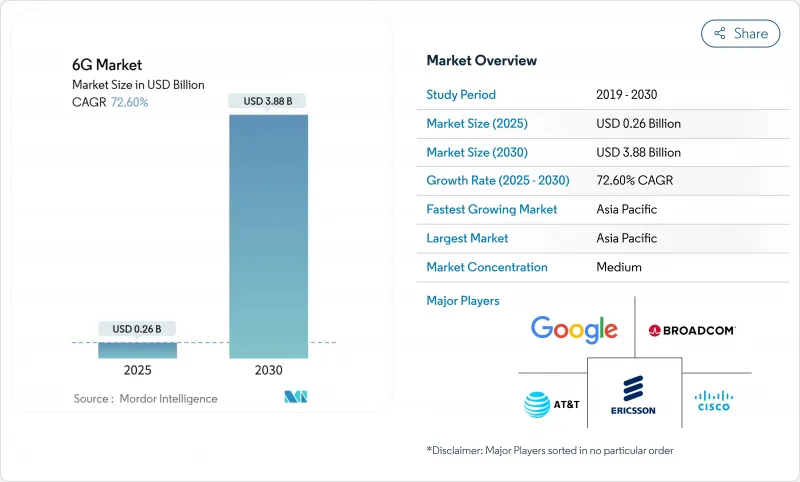
(1) IEEE 스태프, ‘6G용 테라헤르츠 통신’, IEEE Xplore, ieeexplore.ieee.org 이러한 급속한 성장은 테라헤르츠 대역의 주파수 대역, 네트워크 스택 전반에 걸친 인공지능(AI)의 통합, 그리고 기존 기지국의 범위를 넘어 커버리지를 확대하는 비지상파 네트워크의 조기 상용화에 의해 주도되고 있습니다. 본 보고서는 기기별(모바일 기기, IoT 및 엣지 기기 등), 구성 요소별(하드웨어, 소프트웨어, 서비스), 최종 사용자 산업별(자동차 및 운송, 제조·산업 등), 주파수 대역별(서브테라헤르츠(sub-THz) 및 테라헤르츠), 지역별로 분류되어 있습니다.
전 세계 6G 시장 동향 및 인사이트
폭발적으로 증가하는 데이터 수요와 초저지연 활용 사례
테라비트급 확장 현실(XR) 워크로드는 현재 100 Gbps를 초과하여, 통신 사업자들은 백홀 및 프론트홀 토폴로지를 재설계할 수밖에 없는 상황입니다. NTT 도코모가 2024년에 실시한 실험에서는 테라헤르츠 대역에서 280 Gbps를 달성하여, 산업용 디지털 트윈 및 홀로그래픽 회의를 위한 주파수 대역의 성숙도가 입증되었습니다. 제조 분야에서는 존 디어(John Deere)사의 저지연 프라이빗 네트워크를 통해 예측 유지보수 주기와 로봇의 연동이 개선되어, 인더스트리 4.0 환경에서의 6G 벤치마크가 확립되었습니다. 의료 분야의 요구 사항도 마찬가지로 엄격합니다. 5G를 활용한 왕복 99밀리초의 원격 수술 시연은 이미 6G 의료 통신 링크의 성능 기준을 확립했습니다. 엣지에서의 AI 모델 학습은 처리량에 대한 부하를 더욱 가중시키고 있습니다. 이는 대규모 매개변수 업데이트를 수천 개의 노드 간에 실시간으로 동기화해야 하기 때문이며, 분산 학습에서는 결정론적 지연이 필수 조건이 됩니다.
AI 지원 에지 및 IoT 기기의 보급
NVIDIA의 'AI Aerial' 플랫폼은 실시간 머신러닝 추론을 무선 계층에 도입하여, 네트워크 전반에 걸친 분산형 인텔리전스로의 전환을 촉진하고 있습니다. 경량 트랜스포머 모델은 현재 라즈베리 파이(Raspberry Pi) 클러스터에서 초당 5-12 토큰을 생성하고 있으며, 이는 클라우드에 의존하지 않는 로컬 추론의 실현 가능성을 입증하고 있습니다. 2030년까지 전 세계 IoT 엔드포인트가 750억 대에 육박할 것으로 예상되는 가운데, 주변 RF 파장을 활용하는 에너지 수확 무선 기술은 배터리 없이 운영하기 위해 필수적이며, 지속적인 연결 모델을 뒷받침하고 있습니다(ResearchGate). 엣지 컴퓨팅은 장거리 트래픽을 줄여주지만, 현실 세계에서 수백만 대의 자율형 기기가 안전하게 연동되기 위해서는 마이크로초 단위로 합의 형성을 도모해야 하므로 신뢰성 요구 사항이 높아집니다.
수십억 달러 규모의 테라헤르츠(THz) 인프라 및 백홀 분야의 CAPE
자본 집약성이 가장 큰 장벽으로 작용하고 있습니다. 통신 사업자들은 대규모 5G 구축 이후 지출을 줄이고 있으며, 고밀도 테라헤르츠(THz) 스몰 셀 네트워크 도입을 승인하기 전에 소프트웨어 오버레이를 우선시하고 있습니다. 테라헤르츠파의 전파 특성으로 인해 5G보다 1제곱킬로미터당 기지국 수가 많아지므로, 부지 취득비와 전력 비용이 상승하고 있습니다. 오픈 RAN은 벤더 종속성을 완화하는 한편, 통합의 복잡성을 증가시켜 투자 수익률(ROI)을 지연시키고 있습니다(MDPI). 클라우드 네이티브 코어는 자본 지출에서 종량제 모델로의 전환을 통해 비용을 장기적으로 분산시키지만, 그 경제적 이점이 표면화되는 것은 도입 규모가 확대된 이후입니다.
부문 분석
2024년, 스마트폰이 시장을 독점하고 있는 것을 배경으로 모바일 부문은 6G 시장 점유율의 46%를 차지했으나, IoT 및 엣지 디바이스는 업계 최고 수준인 연평균 성장률(CAGR) 73.22%로 확대되고 있어, 기계 중심의 트래픽 패턴으로의 전환이 두드러지고 있습니다. 고정 무선 액세스 장비의 출하 대수 증가로 인해 지방 가구에서도 광섬유 수준의 속도를 실현할 수 있게 되었으며, 휴대 단말기의 대규모 보급에 앞서 통신 사업자에게는 잠정적인 수익원이 되고 있습니다.
엣지 디바이스에는 로컬 AI 칩이 내장되어 있어, 데이터 발생원에서 데이터를 선별함으로써 분석 정확도를 저하시키지 않으면서 스펙트럼 효율을 향상시킵니다. 삼성이 7GHz 대역에서 개발한 X-MIMO 프로토타입은 휴대전화 안테나 기술의 혁신이 도시 지역의 ‘캐니언 효과’로 인한 고주파 전송 손실을 어떻게 상쇄할 수 있는지를 보여주고 있습니다. 한편, 내환경성이 뛰어난 산업용 센서나 차량용 통신 모듈에는 내장형 에너지 하베스터 등의 내장애성 기능이 추가되어 이용 사례의 다양성이 확대되고 있습니다.
자율형 드론, 농업용 로봇, AR 헤드셋의 보급으로 노드 밀도가 기하급수적으로 증가하며, 인프라 요구 사항의 추가 확대를 주도하고 있습니다. 대부분의 경우, IoT 게이트웨이를 핵심으로 하는 프라이빗 6G 네트워크에 대한 기업 수요는 기기의 다양성을 서비스 제공업체에게 기술적 과제인 동시에 수익 확대의 요인으로 간주하고 있습니다. AI 워크로드가 엣지로 이동함에 따라 펌웨어 업데이트 및 보안 패치가 트래픽에서 차지하는 비중이 증가하여, 제로 터치형 디바이스 관리 플랫폼의 중요성이 더욱 높아질 것입니다.
2024년 기준에서도 6G 시장 규모의 54%는 여전히 하드웨어가 차지하고 있으며, 여기에는 무선 프런트엔드, 위상 배열 안테나, 화합물 반도체 칩셋 등이 포함됩니다. 그러나 통신 사업자가 클라우드 네이티브 코어 및 AI 기반 오케스트레이션을 도입함에 따라, 하드웨어 교체 없이 무선 경로를 통해 기능을 활성화할 수 있게 되었으며, 소프트웨어 스택은 연평균 성장률(CAGR) 77.10%로 확대되고 있습니다.
Open RAN은 베이스밴드 기능과 무선 기능을 분리함으로써, 소프트웨어 벤더가 스케줄링, 빔포밍, 네트워크 슬라이싱을 지속적으로 개선할 수 있도록 합니다. NVIDIA의 'AI Aerial' 제품군은 실시간 강화 학습 에이전트가 변조 방식을 즉석에서 조정함으로써 밀리초 단위로 셀 처리량을 최적화하는 메커니즘을 보여줍니다. 계획, 통합, 라이프사이클 관리를 아우르는 서비스 부문은 통신 사업자들이 네트워크 기능의 구독 기반 과금 모델로 전환함에 따라 지속적인 수익의 혜택을 누리고 있습니다.
테라헤르츠 대역 전력 증폭기의 전력 효율을 향상시키기 위해서는 복합 반도체의 발전이 여전히 필수적입니다. 그러나 가치는 1헤르츠당 더 많은 용량을 끌어내는 알고리즘 제어 쪽으로 이동하고 있습니다. 그 결과, 벤더 간의 차별화는 실리콘의 리드타임이 아닌 업데이트 속도에 달려 있으며, 기존 장비 제조업체, 하이퍼스케일러, 소프트웨어 스타트업 간의 생태계 제휴 구도가 재편되고 있습니다.
지역별 분석
아시아태평양은 2024년에 6G 시장의 36%를 차지하며 선두에 올랐으며, 2030년까지 연평균 성장률(CAGR) 74.08%라는 가장 빠른 성장세를 보이고 있습니다. 중국은 2024년에 최초의 6G 시험 위성을 발사할 예정이며, 한편 한국의 관민 공동 로드맵에서는 2028년 6G 상용화를 목표로 하고 있습니다. 일본의 ‘Beyond 5G 추진 컨소시엄’은 이미 100 Gbps를 초과하는 테라헤르츠 대역의 전송 실증에 성공했으며, 이는 해당 지역 내 기기 제조와 현장 시험이 통합된 생태계를 뒷받침하고 있습니다. 인구 밀도가 높은 도시권은 1인당 인프라 비용을 절감하고 얼리 어답터(early adopter)를 통한 수익원을 창출함으로써 투자 주기를 더욱 가속화하고 있습니다.
북미는 막대한 연방 정부 보조금과 클라우드 네이티브 분야에서의 리더십 혜택을 누리고 있습니다. 4억 2,000만 달러 규모의 연방 혁신 기금은 오픈소스 RAN 도입을 촉진하고, 국내 벤더들에게 표준화 과정에서 발언권을 부여하고 있습니다. 실리콘밸리의 AI 분야 리더십 덕분에 미국 기업들은 네트워크 인텔리전스 프레임워크를 정의하는 입장에 있지만, 수입에 의존하는 갈륨 및 인듐 인화물 칩은 여전히 공급망의 취약점으로 남아 있습니다. 캐나다 및 멕시코와의 국경을 초월한 주파수 대역 조화를 통해 로밍 격차가 줄어들고, 대상 가입자 기반이 확대되고 있습니다.
유럽에서는 정책의 중점을 지속가능성과 규제 조화에 두고 있습니다. ‘스마트 네트워크 및 서비스 합작 사업체(Smart Networks and Services Joint Undertaking)’는 5억 유로를 투자하여 친환경 무선 기기 및 에너지 수확 기기 개발을 추진하고 있습니다. 독일과 영국은 위성·지상파 네트워크의 테스트베드를 주도하고 있는 반면, 프랑스와 이탈리아는 항공우주 분야의 전문 지식을 활용하여 위성 간 광링크 개선에 힘쓰고 있습니다. 국가별 규제의 차이로 인해 범유럽적 전개가 지연되고 있지만, 공통 연구 과제와 로밍 지침을 통해 이러한 격차는 완화되고 있습니다. 중동 및 아프리카는 현재 규모는 작지만, LEO 위성을 이용한 백홀에 의존하여 광섬유 격차를 뛰어넘고, 휴대전화 단말기 가격이 대중 시장 진입 기준선을 밑돌게 되는 시점에 급속한 추격이 가능하도록 체제를 갖추고 있습니다.
기타 혜택:
- 엑셀 형식 시장 예측(ME) 시트
- 3개월간의 애널리스트 지원
자주 묻는 질문
목차
제1장 서론
제2장 조사 방법
제3장 주요 요약
제4장 시장 구도
제5장 시장 규모와 성장 예측
제6장 경쟁 구도
제7장 시장 기회와 향후 전망
JHS 26.08.11According to Mordor Intelligence, the 6G market is valued at USD 0.26 billion in 2025 and is projected to reach USD 3.88 billion by 2030, reflecting a compound annual growth rate (CAGR) of 72.6%.
[1] IEEE Staff, "Terahertz Communications for 6G," IEEE Xplore, ieeexplore.ieee.org The surge is propelled by terahertz-band spectrum, artificial intelligence (AI) integration across the network stack, and the early commercialisation of non-terrestrial networks that extend coverage beyond traditional cell sites. This report is Segmented by Devices (Mobile Devices, Iot and Edge Devices, and More), Component (Hardware, Software, and Services), End-User Vertical (Automotive and Transportation, Manufacturing and Industrial, and More), Frequency Band (Sub-Terahertz (sub-THz) and Terahertz), and Geography.
Global 6G Market Trends and Insights
Exploding Data Demand and Ultra-Low Latency Use-Cases
Terabit-class extended-reality workloads now exceed 100 Gbps, forcing operators to redesign back-haul and fronthaul topologies. NTT DOCOMO's 2024 lab trials delivered 280 Gbps in the terahertz band, validating spectral maturity for industrial digital twins and holographic conferencing. In manufacturing, John Deere's low-latency private network improved predictive maintenance cycles and robotic coordination, setting a benchmark for 6G in Industry 4.0 settings. Healthcare demands are equally stringent; telesurgery demos over 5G at a 99-millisecond round-trip have already shaped the performance baseline for 6G medical links. AI model training at the edge compounds throughput pressure because large parameter updates must synchronise across thousands of nodes in real time, making deterministic latency a pre-requisite for distributed learning.
AI-Enabled Edge and IoT Device Proliferation
NVIDIA's AI Aerial platform brings real-time machine-learning inference into the radio layer, driving a network-wide shift toward distributed intelligence. Lightweight transformer models now generate 5-12 tokens per second on Raspberry Pi clusters, underscoring the feasibility of local inference without cloud dependency. As global IoT endpoints approach 75 billion by 2030, energy-harvesting radios using ambient RF are essential for battery-free operation, underpinning continuous connectivity models ResearchGate. Edge computing cuts long-haul traffic but heightens reliability needs, since millions of autonomous devices must reach consensus in microseconds to collaborate safely in real-world environments.
Multi-Billion-Dollar THz Infrastructure and Back-Haul CAPE
Capital intensity is the primary headwind. Operators are trimming spend after heavy 5G roll-outs, prioritising software overlays before green-lighting dense THz small-cell grids. Terahertz propagation limits demand more base stations per square kilometre than 5G, pushing site-acquisition and power costs upward. Open RAN reduces vendor lock-in yet raises integration complexity, delaying return on investment MDPI. Cloud-native cores spread cost over time by shifting from capital expenditure to consumption-based models, but the financial benefit only materialises once adoption scales.
Other drivers and restraints analyzed in the detailed report include:
- Government R&D Grants and Early Spectrum Policies
- Integration with Non-Terrestrial / Satellite Networks
- Spectrum Allocation Uncertainty in Sub-THz and THz Bands
For complete list of drivers and restraints, kindly check the Table Of Contents.
Segment Analysis
The mobile segment commanded 46% of 6G market share in 2024 on the back of smartphone dominance, but IoT and edge devices are expanding at a sector-leading 73.22% CAGR, underscoring a shift toward machine-centric traffic patterns. Rising shipments of fixed wireless access units enable rural households to achieve fibre-like speeds, creating an interim revenue stream for operators before handheld mass adoption.
Edge devices embed local AI chips that prune data at the source, improving spectral efficiency without sacrificing insight accuracy. X-MIMO prototypes in the 7 GHz band from Samsung demonstrate how handset antenna innovations will offset high-frequency path loss in urban canyons. Meanwhile, ruggedised industrial sensors and vehicle communication modules add resilience features such as built-in energy harvesters, widening use-case diversity.
The proliferation of autonomous drones, agricultural robots, and AR headsets increases node density by orders of magnitude, driving incremental infrastructure requirements. Enterprise demand for private 6G networks, often anchored by IoT gateways, positions device diversity as both a technical challenge and a revenue multiplier for service providers. As AI workloads migrate to the edge, firmware updates and security patches will account for a growing share of traffic, reinforcing the primacy of zero-touch device-management platforms.
Hardware still represented 54% of the 6G market size in 2024, covering radio front-ends, phased-array antennas, and compound-semiconductor chipsets. However, the software stack is scaling at 77.10% CAGR as operators deploy cloud-native cores and AI-driven orchestration that permit over-the-air feature activation without hardware swaps.
Open RAN splits baseband and radio functions, allowing software vendors to iterate on scheduling, beamforming, and network slicing. NVIDIA's AI Aerial suite illustrates how real-time reinforcement-learning agents optimise cell throughput in milliseconds by tuning modulation schemes on the fly. Service segments-covering planning, integration, and lifecycle management-benefit from recurring revenue as carriers move to subscription pricing for network functions.
Compound-semiconductor advances remain critical for power efficiency in terahertz power amplifiers. Yet value is tilting toward algorithmic control that extracts more capacity from each hertz. Consequently, vendor differentiation hinges on update velocity, not silicon lead-time, reconfiguring ecosystem alliances among traditional equipment makers, hyperscalers and software start-ups.
Complete Report Scope:
- By Devices
- Mobile Devices
- IoT and Edge Devices
- Fixed Wireless Access CPE
- Network Infrastructure Equipment
- Other Devices
- By Component
- Hardware
- Software
- Services
- By End-user Vertical
- Automotive and Transportation
- Manufacturing and Industrial
- Healthcare and Life Sciences
- Agriculture and Smart Farming
- Government and Public Safety
- Media and Entertainment
- Other Verticals
- By Frequency Band
- Sub-terahertz (sub-THz) (100-300 GHz)
- Terahertz (above 300 GHz)
- By Geography
- North America
- United States
- Canada
- Mexico
- South America
- Brazil
- Argentina
- Rest of South America
- Europe
- Germany
- United Kingdom
- France
- Italy
- Spain
- Russia
- Rest of Europe
- Asia Pacific
- China
- Japan
- South Korea
- India
- Australia
- Rest of Asia Pacific
- Middle East and Africa
- Saudi Arabia
- United Arab Emirates
- South Africa
- Rest of Middle East and Africa
- North America
Geography Analysis
Asia-Pacific led with 36% of the 6G market in 2024 and is scaling fastest at a 74.08% CAGR through 2030. China launched the first 6G test satellite in 2024, while South Korea's public-private roadmap aims for commercial 6G in 2028. Japan's Beyond 5G Promotion Consortium has already demonstrated terahertz transmissions above 100 Gbps, underscoring the region's integrated device-fabrication and field-trial ecosystem. Dense urban clusters reduce per-capita infrastructure cost and create early-adopter revenue pools that further accelerate investment cycles.
North America benefits from substantial federal grants and cloud-native leadership. The USD 420 million federal innovation fund catalyses open-source RAN deployments, giving domestic vendors a seat at the standards table. Silicon Valley's AI leadership positions U.S. firms to define network-intelligence frameworks, though reliance on imported gallium and indium phosphide chips remains a supply-chain weak spot. Cross-border spectrum alignment with Canada and Mexico narrows roaming gaps and enlarges the addressable subscriber base.
Europe channels policy energy into sustainability and harmonised regulation. The Smart Networks and Services Joint Undertaking deploys EUR 500 million to nurture green radios and energy-harvesting devices. Germany and the United Kingdom spearhead testbeds for satellite-terrestrial networks, while France and Italy exploit aerospace expertise to refine optical inter-satellite links. Fragmented national rules slow pan-European roll-outs, yet common research agendas and roaming directives mitigate divergence. The Middle East and Africa, though smaller today, rely on LEO satellite back-haul to leapfrog fibre gaps, positioning those regions for rapid catch-up once handset prices fall below mass-market thresholds.
- AT&T
- Broadcom
- Cisco
- Ericsson
- Huawei
- Nokia
- NTT Docomo
- Orange
- NEC Corporation
- Samsung
- Qualcomm
- Intel
- ZTE
- China Mobile
- Verizon
- SK Telecom
- Keysight Technologies
- Rohde & Schwarz
- MediaTek
- Telefonica
- Vodafone
Additional Benefits:
- The market estimate (ME) sheet in Excel format
- 3 months of analyst support
TABLE OF CONTENTS
1 INTRODUCTION
- 1.1 Study Assumptions and Market Definition
- 1.2 Scope of the Study
2 RESEARCH METHODOLOGY
3 EXECUTIVE SUMMARY
4 MARKET LANDSCAPE
- 4.1 Market Overview
- 4.2 Market Drivers
- 4.2.1 Exploding data demand and ultra-low latency use-cases
- 4.2.2 Proliferation of AI-enabled edge and IoT devices
- 4.2.3 Government R&D grants and early spectrum policies
- 4.2.4 Integration with non-terrestrial / satellite networks
- 4.2.5 Programmable Reconfigurable Intelligent Surfaces (RIS) deployment
- 4.2.6 Green communications mandates for energy-harvesting THz radios
- 4.3 Market Restraints
- 4.3.1 Multi-billion-dollar THz infrastructure and back-haul CAPEX
- 4.3.2 Spectrum allocation uncertainty in sub-THz and THz bands
- 4.3.3 Public-health pushback on continuous THz exposure
- 4.3.4 Compound-semiconductor (InP, GaN) supply-chain bottlenecks
- 4.4 Value Chain Analysis
- 4.5 Regulatory Landscape
- 4.6 Technological Outlook
- 4.7 Porter's Five Forces Analysis
- 4.7.1 Bargaining Power of Buyers
- 4.7.2 Bargaining Power of Suppliers
- 4.7.3 Threat of New Entrants
- 4.7.4 Threat of Substitutes
- 4.7.5 Intensity of Competitive Rivalry
5 MARKET SIZE AND GROWTH FORECASTS (VALUE)
- 5.1 By Devices
- 5.1.1 Mobile Devices
- 5.1.2 IoT and Edge Devices
- 5.1.3 Fixed Wireless Access CPE
- 5.1.4 Network Infrastructure Equipment
- 5.1.5 Other Devices
- 5.2 By Component
- 5.2.1 Hardware
- 5.2.2 Software
- 5.2.3 Services
- 5.3 By End-user Vertical
- 5.3.1 Automotive and Transportation
- 5.3.2 Manufacturing and Industrial
- 5.3.3 Healthcare and Life Sciences
- 5.3.4 Agriculture and Smart Farming
- 5.3.5 Government and Public Safety
- 5.3.6 Media and Entertainment
- 5.3.7 Other Verticals
- 5.4 By Frequency Band
- 5.4.1 Sub-terahertz (sub-THz) (100-300 GHz)
- 5.4.2 Terahertz (above 300 GHz)
- 5.5 By Geography
- 5.5.1 North America
- 5.5.1.1 United States
- 5.5.1.2 Canada
- 5.5.1.3 Mexico
- 5.5.2 South America
- 5.5.2.1 Brazil
- 5.5.2.2 Argentina
- 5.5.2.3 Rest of South America
- 5.5.3 Europe
- 5.5.3.1 Germany
- 5.5.3.2 United Kingdom
- 5.5.3.3 France
- 5.5.3.4 Italy
- 5.5.3.5 Spain
- 5.5.3.6 Russia
- 5.5.3.7 Rest of Europe
- 5.5.4 Asia Pacific
- 5.5.4.1 China
- 5.5.4.2 Japan
- 5.5.4.3 South Korea
- 5.5.4.4 India
- 5.5.4.5 Australia
- 5.5.4.6 Rest of Asia Pacific
- 5.5.5 Middle East and Africa
- 5.5.5.1 Saudi Arabia
- 5.5.5.2 United Arab Emirates
- 5.5.5.3 South Africa
- 5.5.5.4 Rest of Middle East and Africa
- 5.5.1 North America
6 COMPETITIVE LANDSCAPE
- 6.1 Market Concentration
- 6.2 Strategic Moves
- 6.3 Market Share Analysis
- 6.4 Company Profiles (includes Global level Overview, Market level overview, Core Segments, Financials as available, Strategic Information, Market Rank/Share for key companies, Products and Services, and Recent Developments)
- 6.4.1 AT&T
- 6.4.2 Broadcom
- 6.4.3 Cisco
- 6.4.4 Ericsson
- 6.4.5 Google
- 6.4.6 Huawei
- 6.4.7 Nokia
- 6.4.8 NTT Docomo
- 6.4.9 Orange
- 6.4.10 NEC Corporation
- 6.4.11 Samsung
- 6.4.12 Qualcomm
- 6.4.13 Intel
- 6.4.14 ZTE
- 6.4.15 China Mobile
- 6.4.16 Verizon
- 6.4.17 SK Telecom
- 6.4.18 Keysight Technologies
- 6.4.19 Rohde & Schwarz
- 6.4.20 MediaTek
- 6.4.21 Telefonica
- 6.4.22 Vodafone
7 MARKET OPPORTUNITIES AND FUTURE OUTLOOK
- 7.1 White-space and Unmet-need Assessment


