|
시장보고서
상품코드
2100021
비침습적 혈당 모니터링 디바이스 시장 : 점유율 분석, 업계 동향 및 통계, 성장 예측(2026-2031년)Non-Invasive Glucose Monitoring Device - Market Share Analysis, Industry Trends & Statistics, Growth Forecasts (2026 - 2031) |
||||||
 Mordor Intelligence
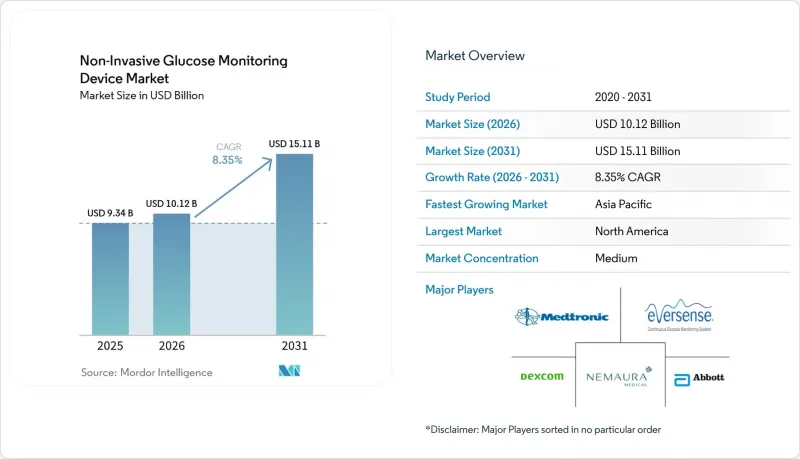
Mordor Intelligence에 의하면, 2026년 비침습적 혈당 모니터링 디바이스 시장 규모는 101억 2,000만 달러로 추정되고 있어 2025년 93억 4,000만 달러에서 확대해, 2031년에는 151억 1,000만 달러에 이를 것으로 예측됩니다.
2026년부터 2031년까지 연평균 성장률(CAGR) 8.35%로 성장할 것으로 전망됩니다.
본 보고서는 기기 유형(웨어러블, 비웨어러블), 착용 부위(상완·손목, 귓불, 집게손가락, 엄지손가락, 각막, 기타 대체 부위), 환자 연령대(성인, 고령자, 소아), 최종 사용자(병원 및 진료소, 가정·개인 이용 등), 지역(북미 등)별로 분류되어 있습니다. 시장 전망은 금액(달러) 기준으로 제시되어 있습니다.
전 세계 비침습적 혈당 모니터링 기기 시장 동향 및 인사이트
당뇨병 유병률 증가와 조기 진단
당뇨병 환자 수는 2021년에 성인 5억 3,700만 명에 달했으며, 2045년까지 7억 8,300만 명을 넘어설 것으로 예측됩니다. 이러한 급증은 생활 방식의 변화와 고령화가 겹치는 신흥 경제국에서 특히 두드러집니다. 중국만 해도 유병률은 2005년 7.53%에서 2023년에는 13.67%로 상승했으며, 확장성이 뛰어나고 통증이 없는 모니터링 수단의 도입이 시급하다는 점이 부각되고 있습니다. 도쿄대학의 학술 연구에 따르면, 지속적이고 비침습적인 혈당 수치 추이를 파악함으로써 공복 시 혈액 검사보다 더 조기에 당뇨병 전단계의 위험을 특정할 수 있으며, 적극적인 생활 습관 개선을 촉진할 수 있는 것으로 나타났습니다. 선별 검사가 진료소에서 약국이나 직장으로 확대됨에 따라, 비침습적 혈당 모니터링 기기 시장은 더욱 광범위한 대상층을 확보해 가고 있습니다. 보험사 측은 조기 발견이 후속 합병증에 대한 비용 억제책이 될 것으로 보고 있으며, 이것이 보험 급여 전망을 뒷받침하고 있습니다.
무침 모니터링에 대한 규제 측면의 호재
미국 FDA는 2024년, Dexcom사의 'Stelo'를 최초의 시판용 연속 혈당 모니터로 승인하며, 소비자용 솔루션에 대해 보다 우호적인 태도를 보였습니다. 로슈(Roche)사의 AI 탑재 'Accu-Chek SmartGuide' 등 광학 시스템을 둘러싼 유럽 내 CE 마크 획득 움직임도 규제 조화가 진행되고 있음을 보여줍니다. AI 탑재 기기에 관한 지침 업데이트를 통해 데이터 투명성 규칙이 명확해졌으며, 광학 정밀도를 향상시키는 알고리즘의 규정 준수 위험이 감소하고 있습니다. 통합형 연속 혈당 모니터링(iCGM)의 제품 코드에는 비침습형 기기 공급업체가 벤치마크로 활용할 수 있는 명확한 성능 목표가 정해져 있습니다. 이러한 프레임워크를 통해 시장 출시까지의 기간이 단축되고, 진단 분야의 선도 기업과 센서 분야의 스타트업 간의 전략적 제휴가 촉진되고 있습니다.
침습형 CGM과의 정확도 격차
주요 침습형 CGM의 MARD 값은 8.0% 수준인 반면, 비침습형 제품의 대부분은 여전히 11.1%에서 18.2% 범위에 머물러 있습니다. 비교 평가에 따르면, FreeStyle Libre 3의 MARD는 8.9%, Dexcom G7은 8.0%로, 광학식이나 무선 주파수(RF) 방식의 솔루션에 있어 높은 장벽이 설정되어 있습니다. 규제 당국과 임상의들은 단일 수치인 MARD보다 합의 오차 그리드 분석을 더 중요하게 여기고 있지만, 보험사들은 더 넓은 오차 범위에 기반한 치료 조정 결정에 대해서는 여전히 신중한 태도를 보이고 있습니다. 이러한 격차를 해소하기 위해서는 스펙트럼 알고리즘의 고도화, 다중 모드 센싱, 그리고 더 대규모의 검증 코호트가 필요하지만, 이 모든 요소는 개발 기간을 연장하고 자금 소모율을 높이는 결과를 초래합니다.
부문 분석
2025년에도 비웨어러블 시스템은 매출의 61.45%를 계속 차지할 것으로 보이며, 그 배경에는 더 대형의 광학 시스템이나 진동 격리가 가능한 병원용 카트 및 진료소용 데스크톱형 장치가 있습니다. 그러나 24시간 데이터 수집에 적합한 스마트 워치나 패치형 디자인에 힘입어 웨어러블 제품은 연평균 성장률(CAGR) 9.08%로 급속히 성장하고 있습니다. 비침습적 혈당 모니터링 기기 시장에서는 배터리 수명을 희생하지 않으면서도 레이저 드라이버를 스마트 워치 메인보드에 소형화할 수 있는 칩셋 통합이 진행되고 있습니다.
삼성과 덱스콤의 공동 개발은 이러한 융합의 좋은 사례이며, 한편 바이오링크는 1억 달러 규모의 시리즈 C 자금을 피내 마이크로어레이 생체 센서 개발에 투입하고 있습니다. 데스크톱형 플랫폼은 내분비과 클리닉에서 여전히 고가대를 유지하고 있지만, 판매 대수 증가세는 가전 제조업체가 유통 측면에서 영향력을 발휘하는 손목이나 상완부로 결정적으로 이동하고 있습니다.
2025년에는 팔이나 손목에 착용하는 기기가 비침습적 혈당 모니터링 기기 시장의 39.74%를 차지했습니다. 이는 기존 CGM(연속 혈당 모니터링) 사용자들의 익숙함과 조직 특성의 안정성에 기인합니다. 손가락 끝 측정 방식은 풍부한 모세혈관망과 스마트폰과의 원활한 연동에 힘입어 연평균 성장률(CAGR) 9.05%로 확대될 것으로 예측됩니다.
Know Labs사의 고주파 유전체 센서는 200명의 자원자를 대상으로 한 손가락 끝 측정에서 11.1%의 MARD를 달성하여, 한 자릿수 수준의 정확도 달성을 향한 진전을 보여주고 있습니다. 귀볼이나 엄지손가락용 센서는 틈새 인체공학적 요구를 충족시키고 있지만, 각막이나 호기 분석의 경우 편안함이나 규제상의 우려로 인해 여전히 연구 단계에 머물러 있습니다. 측정 부위의 다양화를 통해 공급업체는 사용자층별로 정확도, 편안함, 미관을 최적화하기 위한 설계의 자유도를 높일 수 있습니다.
지역별 분석
북미는 유리한 환급 코드, 민간 보험의 광범위한 도입, 그리고 FDA의 조기 지침 명확화에 힘입어 2025년 매출의 39.98%를 차지했습니다. 기기 제조업체는 증거 창출을 가속화하는 밀집된 임상시험 네트워크를 활용할 수 있는 한편, 캘리포니아주와 매사추세츠주의 벤처 허브로부터 사업 확장을 위한 자금을 공급받고 있습니다. 유럽에서는 CE 마크 체계가 AI의 설명 가능성과 사이버 보안 조항을 조화시키고 있어 꾸준한 보급이 이어지고 있습니다. 독일, 프랑스, 북유럽 국가들의 국민건강보험 제도는 무침 요법을 도입한 통합적인 당뇨병 치료 경로에 자금을 지원하고 있지만, 예산 상한선으로 인해 총 판매 대수는 제한되고 있습니다.
아시아태평양은 급성장 지역으로, 당뇨병 발병률의 급증과 제조 비용 측면에서의 우위를 배경으로 2031년까지 연평균 성장률(CAGR)이 9.45%를 나타낼 것으로 전망됩니다. 중국의 당뇨병 환자 수는 2010년 9,200만 명에서 2024년에는 추정 1억 4,900만 명으로 증가하여, 소비자용 웨어러블 기기를 위한 막대한 잠재 시장을 형성하고 있습니다. 현지 광학 부품 공급업체들이 부품 원가 구조를 절감하고 있어, 이를 통해 지역 OEM 제조업체들은 가격 경쟁력을 확보하고 있습니다. 한국의 i-SENS사는 자사의 광학식 CGM 시스템에 대해 유럽 및 일본의 승인을 획득하여, 설계의 신뢰성을 국경을 넘어 수출하고 있습니다. QCL 링 공진기의 획기적인 발전으로 상징되는 일본의 포토닉스 연구개발 역량은 기술적 리더십을 유지하고 있으며, 공급업체들은 이를 인근 제조 거점에서 산업화하고 있습니다.
중동 및 아프리카에서는 2형 당뇨병을 앓고 있는 외국인 거주자를 대상으로 한 원격 모니터링을 시범적으로 도입하는 걸프 국가 보건 당국의 시범 사업을 선구로 하여, 도입이 초기 단계에 있습니다. 남미의 성장은 브라질과 멕시코의 현지 제조 장려 정책과 연동되어 있으며, 이들 국가에서는 규제 승인 절차가 CE 마크 신청 서류와 유사하여 심사 기간이 단축되고 있습니다. 이러한 신흥 시장 전반에 걸쳐 스마트폰 보급률은 앱 기반 모니터링 기능의 유통 기반 역할을 수행하며, 소비자의 진입 장벽을 낮추고 의료 종사자의 도입을 용이하게 하고 있습니다.
기타 혜택:
- 엑셀 형식 시장 예측(ME) 시트
- 3개월간의 애널리스트 지원
자주 묻는 질문
목차
제1장 서론
제2장 조사 방법
제3장 주요 요약
제4장 시장 구도
제5장 시장 규모와 성장 예측
제6장 경쟁 구도
제7장 시장 기회와 향후 전망
JHS 26.08.11According to Mordor Intelligence, the non-invasive glucose monitoring device market size in 2026 is estimated at USD 10.12 billion, growing from 2025 value of USD 9.34 billion with 2031 projections showing USD 15.11 billion, growing at 8.35% CAGR over 2026-2031.
This report is Segmented by Device Type (Wearable, Non-Wearable), Device Placement (Arm and Wrist, Ear Lobe, Forefinger, Thumb, Cornea, Other Alternate Sites), Patient Age Group (Adults, Geriatric, Pediatric), End User (Hospitals and Clinics, Home and Personal Use, and More), and Geography (North America, and More). The Market Forecasts are Provided in Terms of Value (USD).
Global Non-Invasive Glucose Monitoring Device Market Trends and Insights
Rising Diabetes Prevalence & Earlier Diagnosis
Diabetes cases climbed to 537 million adults in 2021 and are projected to surpass 783 million by 2045. The surge is most acute in emerging economies where lifestyle shifts converge with ageing populations. China's prevalence alone rose from 7.53% in 2005 to 13.67% in 2023, underlining the urgency for scalable, painless monitoring options . Academic evidence from the University of Tokyo shows that continuous, non-invasive glucose trends reveal pre-diabetes risk earlier than fasting blood tests, encouraging proactive lifestyle interventions. As screening shifts beyond clinics to pharmacies and workplaces, the non-invasive glucose monitoring device market gains a broader addressable base. Payers view earlier detection as a cost buffer against downstream complications, reinforcing reimbursement prospects.
Regulatory Tailwinds for Needle-Free Monitoring
The US FDA cleared Dexcom's Stelo as the first over-the-counter continuous glucose monitor in 2024, signalling a friendlier stance toward consumer-grade solutions. Parallel European CE-mark activity around optical systems such as Roche's AI-enabled Accu-Chek SmartGuide illustrates a harmonising regulatory agenda . Updated guidance on AI-enabled devices clarifies data transparency rules, lowering compliance risk for algorithms that refine optical accuracy. The integrated continuous glucose monitoring (iCGM) product code provides explicit performance targets that non-invasive vendors can benchmark. These frameworks shorten time-to-market and spur strategic alliances between diagnostics leaders and sensor start-ups.
Accuracy Gaps vs. Invasive CGMs
Leading invasive CGMs post MARD figures near 8.0%, whereas most non-invasive contenders still register between 11.1% and 18.2%. Comparative assessments place FreeStyle Libre 3 at 8.9% and Dexcom G7 at 8.0% MARD, setting a high bar for optical or radio-frequency solutions. Regulators and clinicians emphasise consensus error grid analysis over single-number MARD, yet payers remain cautious about therapy-adjustment decisions based on broader error margins. Bridging this gap requires enhanced spectral algorithms, multimodal sensing, and larger validation cohorts, all of which extend development timelines and burn rates.
Other drivers and restraints analyzed in the detailed report include:
- Miniaturization of NIR/Raman Photonics Modules
- Big-Tech Integration into Smart-Watch Form Factors
- Lengthy Multi-Site Clinical-Validation Cycles
For complete list of drivers and restraints, kindly check the Table Of Contents.
Segment Analysis
Non-wearable systems retained 61.45% revenue in 2025, rooted in hospital carts and clinic desktops that permit larger optics and vibration isolation. Yet wearables are racing ahead with a 9.08% CAGR, guided by smartwatch and patch designs that suit round-the-clock data capture. The non-invasive glucose monitoring device market is witnessing chipset integrations that shrink laser drivers to smartwatch motherboards without sacrificing battery life.
Samsung's and Dexcom's joint efforts epitomise convergence, while Biolinq channels its USD 100 million Series C into intradermal micro-array biosensors. Desktop platforms still claim premium pricing in endocrinology clinics, but unit growth is tilting decisively toward wrists and upper arms where consumer electronics firms wield distribution clout.
Arm and wrist deployments commanded 39.74% of the non-invasive glucose monitoring device market share in 2025, owing to prior CGM user familiarity and stable tissue characteristics. Finger-tip modalities are predicted to climb at a 9.05% CAGR, helped by rich capillary beds and seamless smartphone coupling.
Know Labs' radio-frequency dielectric sensor reached 11.1% MARD on finger measurements across 200 volunteers, indicating progress toward single-digit accuracy. Ear-lobe and thumb sensors serve niche ergonomics, while corneal and breath analyses remain exploratory due to comfort and regulatory concerns. The diversification of sites grants suppliers more design latitude to optimise accuracy, comfort, and aesthetics across user cohorts.
Complete Report Scope:
- By Device Type
- Wearable
- Non-Wearable
- By Device Placement
- Arm and Wrist
- Ear Lobe
- Forefinger
- Thumb
- Cornea
- Other Alternate Sites
- By Patient Age Group
- Adults
- Geriatric
- Pediatric
- By End User
- Hospitals and Clinics
- Home and Personal Use
- Ambulatory Surgical Centers
- Others
- By Geography
- North America
- United States
- Canada
- Mexico
- Europe
- Germany
- United Kingdom
- France
- Italy
- Spain
- Rest of Europe
- Asia-Pacific
- China
- Japan
- India
- Australia
- South Korea
- Malaysia
- Indonesia
- Thailand
- Philippines
- Vietnam
- Rest of Asia-Pacific
- Middle East and Africa
- GCC
- South Africa
- Rest of Middle East and Africa
- South America
- Brazil
- Argentina
- Rest of South America
- North America
Geography Analysis
North America accounted for 39.98% of 2025 revenue thanks to favourable reimbursement codes, broad commercial insurance uptake, and early FDA guidance clarity. Device makers enjoy dense clinical-trial networks that accelerate evidence generation, while venture hubs in California and Massachusetts supply scale-up capital. Europe maintains steady adoption as CE-mark frameworks harmonise AI explainability and cybersecurity clauses. National health systems in Germany, France, and the Nordics finance integrated diabetes pathways that embrace needle-free modalities, though budget ceilings temper headline volumes.
Asia-Pacific is the breakout geography, clocking a 9.45% CAGR through 2031 on the back of surging diabetes incidence and manufacturing cost advantages. China's diabetic population climbed from 92 million in 2010 to an estimated 149 million in 2024, creating a vast potential pool for consumer wearables. Local optical-component suppliers compress bill-of-materials cost structures, giving regional OEMs a pricing edge. South Korean firm i-SENS won European and Japanese approvals for its optical CGM system, exporting design credibility beyond domestic borders. Japan's depth in photonics R&D, underscored by QCL ring-resonator breakthroughs, sustains technology leadership that suppliers then industrialise in neighbouring fabrication hubs.
Middle East and Africa show early-stage adoption, led by Gulf health-authority pilots that test remote monitoring for expatriate populations with type 2 diabetes. South American growth aligns with local manufacturing incentives in Brazil and Mexico, where regulatory pathways mirror CE-mark dossiers and shorten review cycles. Across these emerging markets, smartphone penetration serves as the distribution spine for app-based visualisations, lowering entry friction for consumers and easing clinician onboarding.
- Abbott Laboratories
- Dexcom
- Medtronic
- Senseonics Holdings
- Nemaura Medical
- OrSense Ltd.
- DiaMonTech GmbH
- MediWise / Occuity Ltd.
- Know Labs Inc.
- Integrity Applications (GlucoTrack)
- OptiScan Biomedical
- CNOGA Medical
- Biolinq Inc.
- Movano Health
- Verily Life Sciences
- GlucoSense Diagnostics
- Apple
- Scanbo Corp.
- DiaMonTech GmbH
- RSP Systems
Additional Benefits:
- The market estimate (ME) sheet in Excel format
- 3 months of analyst support
TABLE OF CONTENTS
1 Introduction
- 1.1 Study Assumptions & Market Definition
- 1.2 Scope of the Study
2 Research Methodology
3 Executive Summary
4 Market Landscape
- 4.1 Market Overview
- 4.2 Market Drivers
- 4.2.1 Rising Diabetes Prevalence & Earlier Diagnosis
- 4.2.2 Regulatory Tailwinds for Needle-Free Monitoring
- 4.2.3 Miniaturization Of NIR/Raman Photonics Modules
- 4.2.4 Big-Tech Integration into Smart-Watch Form Factors
- 4.2.5 Continuous Metabolic-Data Monetisation Models
- 4.2.6 VC Funding Pivot to Non-Invasive Biosensing Start-Ups
- 4.3 Market Restraints
- 4.3.1 Accuracy Gaps Vs. Invasive CGMs
- 4.3.2 Lengthy Multi-Site Clinical-Validation Cycles
- 4.3.3 High Component Cost of Mid-IR Lasers
- 4.3.4 Data-Privacy Backlash on Cloud Analytics
- 4.4 Regulatory Landscape
- 4.5 Technological Outlook
- 4.6 Porters Five Forces Analysis
- 4.6.1 Bargaining Power of Suppliers
- 4.6.2 Bargaining Power of Buyers
- 4.6.3 Threat of New Entrants
- 4.6.4 Threat of Substitute Products & Services
- 4.6.5 Intensity of Competitive Rivalry
5 Market Size & Growth Forecasts (Value, USD)
- 5.1 By Device Type
- 5.1.1 Wearable
- 5.1.2 Non-Wearable
- 5.2 By Device Placement
- 5.2.1 Arm and Wrist
- 5.2.2 Ear Lobe
- 5.2.3 Forefinger
- 5.2.4 Thumb
- 5.2.5 Cornea
- 5.2.6 Other Alternate Sites
- 5.3 By Patient Age Group
- 5.3.1 Adults
- 5.3.2 Geriatric
- 5.3.3 Pediatric
- 5.4 By End User
- 5.4.1 Hospitals and Clinics
- 5.4.2 Home and Personal Use
- 5.4.3 Ambulatory Surgical Centers
- 5.4.4 Others
- 5.5 By Geography
- 5.5.1 North America
- 5.5.1.1 United States
- 5.5.1.2 Canada
- 5.5.1.3 Mexico
- 5.5.2 Europe
- 5.5.2.1 Germany
- 5.5.2.2 United Kingdom
- 5.5.2.3 France
- 5.5.2.4 Italy
- 5.5.2.5 Spain
- 5.5.2.6 Rest of Europe
- 5.5.3 Asia-Pacific
- 5.5.3.1 China
- 5.5.3.2 Japan
- 5.5.3.3 India
- 5.5.3.4 Australia
- 5.5.3.5 South Korea
- 5.5.3.6 Malaysia
- 5.5.3.7 Indonesia
- 5.5.3.8 Thailand
- 5.5.3.9 Philippines
- 5.5.3.10 Vietnam
- 5.5.3.11 Rest of Asia-Pacific
- 5.5.4 Middle East and Africa
- 5.5.4.1 GCC
- 5.5.4.2 South Africa
- 5.5.4.3 Rest of Middle East and Africa
- 5.5.5 South America
- 5.5.5.1 Brazil
- 5.5.5.2 Argentina
- 5.5.5.3 Rest of South America
- 5.5.1 North America
6 Competitive Landscape
- 6.1 Market Concentration
- 6.2 Market Share Analysis
- 6.3 Company Profiles (includes Global level Overview, Market level overview, Core Segments, Financials as available, Strategic Information, Market Rank/Share for key companies, Products & Services, and Recent Developments)
- 6.3.1 Abbott Laboratories
- 6.3.2 Dexcom Inc.
- 6.3.3 Medtronic plc
- 6.3.4 Senseonics Holdings
- 6.3.5 Nemaura Medical
- 6.3.6 OrSense Ltd.
- 6.3.7 DiaMonTech GmbH
- 6.3.8 MediWise / Occuity Ltd.
- 6.3.9 Know Labs Inc.
- 6.3.10 Integrity Applications (GlucoTrack)
- 6.3.11 OptiScan Biomedical
- 6.3.12 CNOGA Medical
- 6.3.13 Biolinq Inc.
- 6.3.14 Movano Health
- 6.3.15 Verily Life Sciences
- 6.3.16 GlucoSense Diagnostics
- 6.3.17 Apple Inc.
- 6.3.18 Scanbo Corp.
- 6.3.19 DiaMonTech GmbH
- 6.3.20 RSP Systems
7 Market Opportunities & Future Outlook
- 7.1 White-space & Unmet-Need Assessment