

|
시장보고서
상품코드
2097117
혈당 모니터링 : 시장 점유율 분석, 업계 동향 및 통계, 성장 예측(2026-2031년)Blood Glucose Monitoring - Market Share Analysis, Industry Trends & Statistics, Growth Forecasts (2026 - 2031) |
||||||
 Mordor Intelligence
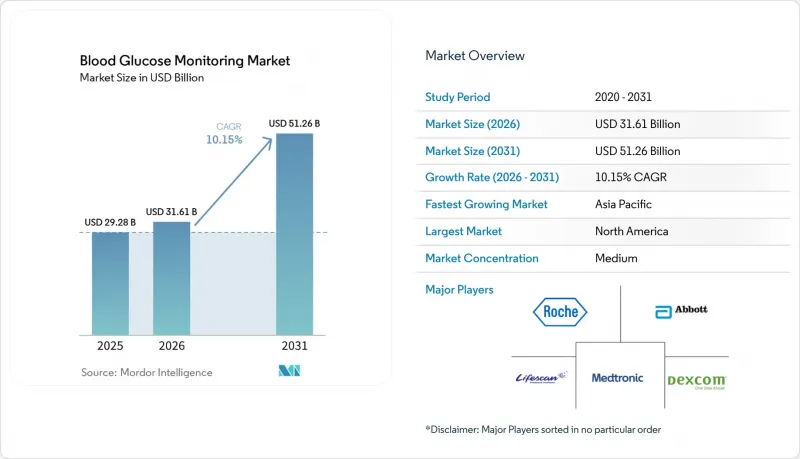
Mordor Intelligence에 의하면, 혈당 모니터링 시장 규모는 2025년에 292억 8,000만 달러로 평가되었습니다. 2026년에 316억 1,000만 달러에 달하고, 2031년까지 512억 6,000만 달러에 이를 것으로 예측되며, 2026년부터 2031년에 걸쳐 CAGR 10.15%로 성장할 전망입니다.
본 보고서는 기기별(자가 혈당 측정(혈당 측정기 등) 및 연속 혈당 모니터링), 최종 사용자별(병원 등), 환자 유형별(1형 당뇨병 등), 유통 채널별(의료 기관 대상 판매 등), 지역별(북미 등)로 분류되어 있습니다. 시장 전망은 금액(달러) 기준으로 제시되어 있습니다.
세계의 혈당 모니터링 시장 동향 및 인사이트
간헐적인 자가 혈당 측정(SMBG)에서 연속 혈당 모니터링(CGM) 및 커넥티드 혈당 모니터링으로의 전환이 가속화되고 있습니다.
CGM 도입이 가속화되고 있는 이유는 조기 도입을 통해 장기적인 저혈당 사건이 감소할 뿐만 아니라, 인슐린 조절 프로토콜이 효율화되기 때문입니다. 영국의 소아 1형 당뇨병 환자 코호트에서는 2024년까지 진단 후 36개월 이내에 CGM 도입률이 95%에 달했으며, 이는 국가 지침이 표준 치료를 어떻게 재정의할 수 있는지를 보여줍니다. Dexcom이 2024년에 Apple Watch와의 직접 연동을 실현함으로써 별도의 수신기가 필요 없어졌고, 1억 명의 사용자에게 실시간 알림이 전송되면서 혈당 수치에 대한 정보가 일상생활에 자연스럽게 통합되었습니다. 2024년, 메디케어가 인슐린을 사용하는 2형 당뇨병 환자에 대한 CGM 보험 적용을 결정함에 따라, 미국의 대상자 수는 350만 명 증가했습니다. 그러나 SMBG(자가 혈당 측정) 분야의 기존 기업들은 상품화(commoditization)에 직면해 있습니다. 브라질과 인도에서는 0.20달러 미만의 제네릭 측정 스트립이 입찰 시장을 휩쓸며 브랜드 제품의 이익률을 압박하고 있습니다. 따라서 이러한 변화는 센서 포트폴리오와 데이터 기반 서비스 계층을 갖춘 기업에는 혜택을 가져다주는 반면, 기존의 측정 스트립 전문 기업에게는 타격을 줄 것입니다.
신흥 경제국에서의 당뇨병 유병률 급증과 조기 선별 검사
2024년, 전 세계 당뇨병 환자 수는 성인 8억 2,800만 명에 달하고, 1990년 대비 4배 증가했습니다. 이 중 4억 4,500만 명은 아직 진단받지 못한 상태입니다. 중국에서는 1억 4,000만 명, 인도에서는 1억 100만 명의 환자가 진단받았으며, 지역 밀착형 선별 검사가 활성화됨에 따라 합리적인 가격의 모니터링 솔루션에 대한 수요가 발생하고 있습니다. 인도 의학연구위원회(ICMR)의 2024년 지침에서는 대사 위험 요인을 하나 이상 가진 30세 이상의 모든 성인에게 혈당 검사를 권장했으며, 이로 인해 수백만 명이 모니터링 대상 인구에 포함될 것입니다. 걸프협력회의(GCC) 회원국들은 연령 조정 유병률이 세계 최고 수준을 보이고 있으며, 약물 복용 준수 상황을 추적하기 위해 등록 시스템의 디지털화를 추진하고 있어, 유가에 연동되는 예산 변동에도 불구하고 CGM 도입 대수를 늘리고 있습니다. 그럼에도 불구하고, 합리적인 가격에 대한 격차는 여전히 존재합니다. 브라질에서 실시된 비용 대비 효과 연구에 따르면, FreeStyle Libre는 중증 저혈당을 43% 감소시켰으나, 27개 주 중 18개 주에서는 그 비용이 1인당 연간 의료비를 초과했습니다.
저소득층에서 나타나는 CGM 기기의 지속적인 경제적 격차
CGM 시스템의 연간 비용은 일반적으로 1,200-3,000달러로, 인도, 브라질 및 아프리카 대부분 지역의 가구 소득 중앙값을 크게 상회합니다. 브라질의 통합 보건 시스템(Unified Health System)은 테스트 스트립 비용만 부담하고 있으며, 2023년 연구에서 중증 저혈당이 43% 감소한 것으로 입증되었음에도 불구하고, Libre의 도입은 자비로 비용을 지불할 수 있는 엘리트 계층으로 제한되어 있습니다. 인도의 공립 병원 중 센서를 갖춘 곳은 2% 미만에 불과하며, 고위험 환자에게 CGM 사용을 권장하는 ICMR(인도 의학 연구 위원회)의 최신 지침이 있음에도 불구하고 이용 기회는 제한적입니다. 중국에서는 환급 상한선이 50%로 설정되어 있어, 농촌 지역의 보급은 도시 지역보다 뒤처져 있습니다. 애보트사는 2024년 인도에서 30달러의 저가형 ‘Libre’(10일분)를 출시했으나, 수요는 대도시권의 민간 클리닉에 집중된 상태입니다. 이러한 경제적 요인으로 인해 0.30달러 미만으로 가격 책정된 SMBG 테스트 스트립에 대한 수요가 유지되고 있으며, 많은 환자가 손가락 채혈이라는 일상적인 절차에서 벗어나지 못하는 상황이 지속되고 있습니다.
부문 분석
2025년, SMBG는 혈당 모니터링 시장의 53.01%를 차지했으며, 혈당 측정기 사용자 도입 대수는 2억 대 이상에 달했습니다. 그러나 가치 창출을 주도하고 있는 것은 CGM입니다. 미국에서는 ‘FreeStyle Libre 3’ 센서가 14일 분량에 70달러에 판매되고 있으며, ‘Dexcom G7’은 Apple Watch와 직접 연동함으로써 생태계의 시너지 효과를 통해 프리미엄 가격 책정을 정당화하고 있습니다. 지적 재산권은 현재 테스트 스트립의 화학 성분이 아닌 알고리즘, 접착제, 소형화된 전자 기기에 중점을 두고 있으며, 이로 인해 연구개발 예산은 더욱 CGM 쪽으로 이동하고 있습니다.
CGM의 예상 연평균 성장률(CAGR)은 15.09%이며, 혈당 측정 시장 내 점유율은 해마다 확대되고 있는 반면, SMBG의 매출은 제네릭 제품의 압박으로 인해 정체 상태를 보이고 있습니다. 스마트폰 디스플레이가 그 기능을 흡수함에 따라 송신기는 점차 사라지고 있으며, 하드웨어 비용은 감소하는 반면 앱의 보급률은 향상되고 있습니다. 메드트로닉(Medtronic)사의 MiniMed 780G와 같이 펌프와 CGM을 통합한 루프 시스템은 5분마다 인슐린 투여를 자동화하여, 손가락 채혈을 통한 투여량 조절과는 임상적으로 큰 차이를 만들어내고 있습니다. 상용화 전의 비침습형 프로토타입은 벤처 자금을 조달하고 있지만, 강력한 보험 환급 장벽 뒤에 뿌리 깊게 자리 잡은 침습형 기존 제품을 대체하기까지의 일정은 불투명합니다.
2025년에는 현장 진단(Point-of-Care) 검사의 의무화로 인해 병원 및 진료소의 매출 점유율이 31.45%를 차지했으나, 재택 간호 환경의 매출 점유율은 59.10%를 차지했으며, 원격 모니터링의 코드화가 진행됨에 따라 연결형 기기 도입이 가속화됨에 따라 2031년까지 연평균 성장률(CAGR) 11.21%를 기록할 전망입니다. 이러한 변화로 인해 물류, 도입 지원, 가상 코칭을 제공하는 소비자 지향 브랜드 및 플랫폼의 혈당 모니터링 시장 점유율이 높아지고 있습니다.
영국 NHS가 도입한 하이브리드형 폐쇄 루프 시스템 덕분에 진료소 방문 횟수가 감소하고, 재택 관리로의 행동 변화가 더욱 강화되고 있습니다. CGM의 보급으로 분기별 A1c 검사의 중요성이 낮아짐에 따라, 진단 검사 기관의 존재 의의는 점차 희미해지고 있습니다. 중국의 지역 보건 센터와 인도의 원격의료 규제로 인해 모니터링은 더욱 분산화되고 있으며, 소비자에게 직접 배송할 수 있는 능력과 클라우드 대시보드를 갖춘 공급업체가 유리한 입지를 점하고 있습니다.
지역별 분석
북미는 메디케어에 의한 CGM 확대와 민간 보험의 높은 보급률을 배경으로, 2025년 전 세계 매출의 41.96%를 차지했습니다. 미국에서는 1형 당뇨병 환자층의 보급률이 포화 상태에 가까워지고 있어, 향후 성장은 2형 당뇨병 환자로의 적용 확대와 고용주의 웰니스 프로그램에 좌우될 것입니다. 캐나다에서는 2024년에 모든 1형 당뇨병 환자를 대상으로 ‘Libre’ 도입이 확대되면서, 온타리오주, 앨버타주, 브리티시컬럼비아주에서 센서 출하 대수가 증가했습니다. 멕시코에서는 성인의 유병률이 16%로 시장 규모가 크지만, 가격 부담으로 인해 CGM 이용은 도시 지역의 민간 클리닉으로 한정되어 있습니다.
아시아태평양은 중국의 1억 4,000만 명에 달하는 진단 환자 수와 인도에서 확대되고 있는 보험 환급 시범 사업에 힘입어 연평균 성장률(CAGR) 12.75%를 달성할 것으로 예측됩니다. 중국의 보험 급여는 센서 비용의 절반만 충당하고 있어 농촌 지역으로의 보급은 제한적이지만, 도시 지역의 성장을 견인하고 있습니다. 일본은 2024년에 간헐적 스캔형 CGM의 보험 코드를 공식 인정하여, 고령의 2형 당뇨병 환자들 사이에서 급속한 보급이 진행되고 있습니다. 호주의 의약품 급여 제도(PBS)에서는 현재 집중 치료가 필요한 2형 당뇨병 환자를 위한 CGM에 보조금이 지급되고 있으며, 이로 인해 입원 일수가 30% 감소했습니다.
유럽에서는 보급률이 성숙 단계에 도달했으나, 독일이 인슐린 집중 치료형 2형 당뇨병 환자에 대한 CGM 비용을 지원하고, 영국이 하이브리드형 폐쇄 루프 시스템의 도입을 의무화하고 있어 계속해서 확대되고 있습니다. 중동의 유병률은 세계 최고 수준이며, 사우디아라비아의 디지털 등록 제도는 치료 순응도 향상과 치료 성과 파악을 목표로 하고 있습니다. 라틴아메리카에서는 가격적인 장벽에 직면해 있습니다. 브라질에서는 제네릭 측정 스트립을 0.18달러에 조달하고 있지만, 도시 지역의 사립 병원을 제외하면 CGM 보급률은 여전히 5% 미만에 머물고 있습니다.
기타 혜택 :
- 엑셀 형식 시장 예측(ME) 시트
- 3개월간의 애널리스트 지원
자주 묻는 질문
목차
제1장 서론
제2장 조사 방법
제3장 주요 요약
제4장 시장 구도
제5장 시장 규모 및 성장 예측
제6장 경쟁 구도
제7장 시장 기회 및 향후 전망
KTH 26.08.05According to Mordor Intelligence, the blood glucose monitoring market size is projected to be USD 29.28 billion in 2025, USD 31.61 billion in 2026, and reach USD 51.26 billion by 2031, growing at a CAGR of 10.15% from 2026 to 2031.
This report is Segmented by Device (Self-Monitoring Blood Glucose [Glucometers, and More], and Continuous Glucose Monitoring), End User (Hospitals, and More), Patient Type (Type-1 Diabetes, and More), Distribution Channel (Institutional Sales, and More), and Geography (North America, and More). The Market Forecasts are Provided in Terms of Value (USD).
Global Blood Glucose Monitoring Market Trends and Insights
Accelerating Shift From Intermittent SMBG to Continuous & Connected Glucose Monitoring
CGM adoption is accelerating because early initiation lowers long-term hypoglycemia events and streamlines insulin titration protocols. Pediatric Type 1 cohorts in the United Kingdom reached 95% CGM uptake within 36 months of diagnosis by 2024, illustrating how national guidelines can redefine standard of care. Dexcom's 2024 direct integration with Apple Watch eliminates a separate receiver and delivers real-time alerts to 100 million users, embedding glucose insights into daily routines. Medicare's 2024 decision to reimburse CGM for insulin-using Type 2 patients widened the U.S. addressable base by 3.5 million beneficiaries. However, SMBG incumbents face commoditization: generic strips priced below USD 0.20 now dominate tenders in Brazil and India, eroding branded margins. The migration therefore rewards firms with sensor portfolios and data-driven service layers while punishing legacy strip pure-plays.
Rapid Expansion of Diabetes Prevalence and Earlier Screening in Emerging Economies
Global diabetes prevalence hit 828 million adults in 2024, quadrupling since 1990 and leaving 445 million undiagnosed. China's 140 million diagnosed cases and India's 101 million patients galvanize community-based screening and create demand for affordable monitoring solutions. The Indian Council of Medical Research's 2024 guidelines now advise glucose testing for all adults over 30 with one metabolic risk factor, bringing millions into the monitored population. Gulf Cooperation Council states show the world's highest age-adjusted prevalence and are digitizing registries to track adherence, bolstering CGM volumes despite oil-linked budget swings. Still, affordability gaps persist: a Brazilian cost-effectiveness study found that FreeStyle Libre reduced severe hypoglycemia by 43% but cost more than annual per-capita health spending in 18 of 27 states.
Persisting Affordability Gap for CGM Devices in Low-Income Segments
CGM systems typically cost USD 1,200-3,000 annually, well above median household incomes in India, Brazil, and much of Africa. Brazil's Unified Health System pays only for strips, leaving Libre adoption to private-pay elites despite a 43% reduction in severe hypoglycemia demonstrated in a 2023 study. India's public hospitals stock sensors in fewer than 2% of facilities, limiting access despite updated ICMR guidelines that endorse CGM for high-risk patients. China caps reimbursement at 50%, and rural uptake lags urban centers. Abbott introduced a lower-cost 10-day Libre at USD 30 in India in 2024, yet demand remains concentrated in metropolitan private clinics. These economics sustain SMBG strip demand priced below USD 0.30 and lock many patients into fingerstick routines.
Other drivers and restraints analyzed in the detailed report include:
- Miniaturization & Wearable Sensor Innovations Enhancing User Convenience
- Integration of Glucose Data Into Digital Therapeutics & Remote Patient Monitoring
- Competitive Price Compression in SMBG Consumables From Generic Strip Proliferation
For complete list of drivers and restraints, kindly check the Table Of Contents.
Segment Analysis
SMBG accounted for 53.01% of the blood glucose monitoring market in 2025, reflecting an installed base of more than 200 million glucometer users. However, CGM drives value creation; FreeStyle Libre 3 sensors retail for USD 70 per 14 days in the United States, and Dexcom G7 integrates directly with Apple Watch, justifying premium pricing through ecosystem synergies. Intellectual property now centers on algorithms, adhesives, and miniaturized electronics rather than strip chemistry, further tilting R&D budgets to CGM.
CGM's 15.09% forecast CAGR raises its slice of blood glucose monitoring market size each year, while SMBG revenues flatten under generic pressure. Transmitters are disappearing as smartphone displays absorb that function, lowering hardware bills yet boosting app stickiness. Integrated pump-CGM loops like Medtronic's MiniMed 780G automate insulin every five minutes and widen clinical distance from fingerstick-driven titration. Pre-commercial non-invasive prototypes garner venture funding but face an uncertain timeline to displace invasive incumbents entrenched behind strong reimbursement walls.
Hospitals and clinics held 31.45% revenue share in 2025 thanks to point-of-care testing mandates, but home-care settings held 59.10% revenue share and will post a 11.21% CAGR through 2031 as remote monitoring codes accelerate connected device deployment. The shift elevates blood glucose monitoring market share for consumer-centric brands and platforms that provide logistics, onboarding, and virtual coaching.
Hybrid closed-loop systems distributed by the U.K.'s NHS are reducing clinic visits, reinforcing the behavioral shift toward at-home management. Diagnostic laboratories lose relevance as CGM makes quarterly A1c draws less critical. China's community health centers and India's telemedicine rules further decentralize monitoring, favoring vendors with direct-to-consumer logistics capacity and cloud dashboards.
Complete Report Scope:
- By Device
- Self-Monitoring Blood Glucose
- Glucometers
- Test Strips
- Lancets & Lancing Devices
- Continuous Glucose Monitoring
- Sensors
- Transmitters & Receivers
- Self-Monitoring Blood Glucose
- By End User
- Hospitals & Clinics
- Homecare Settings
- Diagnostic Laboratories
- By Patient Type
- Type-1 Diabetes
- Type-2 Diabetes
- Gestational & Other Types
- By Distribution Channel
- Institutional Sales
- Retail Pharmacies
- Online Sales
- Geography
- North America
- United States
- Canada
- Mexico
- Europe
- Germany
- United Kingdom
- France
- Italy
- Spain
- Rest of Europe
- Asia-Pacific
- China
- Japan
- India
- South Korea
- Australia
- Rest of Asia-Pacific
- Middle East & Africa
- GCC
- South Africa
- Rest of Middle East & Africa
- South America
- Brazil
- Argentina
- Rest of South America
- North America
Geography Analysis
North America retained 41.96% of global revenue in 2025 on the back of Medicare's CGM expansion and high private-insurance penetration. U.S. uptake is approaching saturation in Type 1 cohorts, so incremental growth hinges on wider Type 2 coverage and employer wellness programs. Canada added Libre for all Type 1 patients in 2024, boosting sensor volumes in Ontario, Alberta, and British Columbia. Mexico's 16% adult prevalence presents scale, yet affordability constrains CGM to private urban clinics.
Asia-Pacific is forecast to deliver a 12.75% CAGR, propelled by China's 140 million diagnosed cases and India's growing reimbursement pilots. China's reimbursement covers only half the sensor cost, limiting rural penetration but driving urban growth. Japan formalized intermittently scanned CGM codes in 2024, sparking rapid uptake among elderly Type 2 patients. Australia's Pharmaceutical Benefits Scheme now subsidizes CGM for intensive Type 2 regimens, trimming hospital days by 30%.
Europe shows mature penetration but keeps expanding as Germany funds CGM for insulin-intensive Type 2 cases and the United Kingdom mandates hybrid closed-loop systems. Prevalence in the Middle East is highest globally; Saudi Arabia's digital registry seeks to improve adherence and capture outcomes. Latin America faces affordability hurdles: Brazil procures generic strips at USD 0.18 and CGM penetration remains under 5% outside private urban hospitals.
- Abbott Laboratories (Diabetes Care)
- Acon Laboratories
- Agamatrix Holdings
- Arkray
- Ascensia
- Biolinq Incorporated
- Bionime
- Dexcom
- Roche
- Insulet
- Lifescan
- Medtronic
- MicroPort Life Sciences
- Nipro
- Nova Biomedical
- Rossmax
- Senseonics Holdings
- Sinocare
- Tandem Diabetes Care
- Trividia Health
- WaveForm Technologies
- Ypsomed
Additional Benefits:
- The market estimate (ME) sheet in Excel format
- 3 months of analyst support
TABLE OF CONTENTS
1 Introduction
- 1.1 Study Assumptions & Market Definition
- 1.2 Scope of the Study
2 Research Methodology
3 Executive Summary
4 Market Landscape
- 4.1 Market Overview
- 4.2 Market Drivers
- 4.2.1 Accelerating shift from intermittent SMBG to continuous & connected glucose monitoring
- 4.2.2 Rapid expansion of diabetes prevalence and earlier screening in emerging economies
- 4.2.3 Miniaturization & wearable sensor innovations enhancing user convenience
- 4.2.4 Integration of glucose data into digital therapeutics & remote patient monitoring
- 4.2.5 Strategic pharma-med-tech-big-tech collaborations for end-to-end platforms
- 4.2.6 Multi-payer alignment toward outcomes-based reimbursement
- 4.3 Market Restraints
- 4.3.1 Persisting affordability gap for CGM devices in low-income segments
- 4.3.2 Competitive price compression in SMBG consumables from generic strip proliferation
- 4.3.3 Interoperability & cyber-security concerns hindering device-app data exchange
- 4.3.4 Stringent evidence requirements for factory-calibrated non-invasive sensors
- 4.4 Supply-Chain Analysis
- 4.5 Reimbursement Outlook
- 4.6 Technological Outlook
- 4.7 Porter's Five Forces
- 4.7.1 Bargaining Power of Suppliers
- 4.7.2 Bargaining Power of Buyers
- 4.7.3 Threat of New Entrants
- 4.7.4 Threat of Substitutes
- 4.7.5 Intensity of Competitive Rivalry
5 Market Size & Growth Forecasts (Value, USD)
- 5.1 By Device
- 5.1.1 Self-Monitoring Blood Glucose
- 5.1.1.1 Glucometers
- 5.1.1.2 Test Strips
- 5.1.1.3 Lancets & Lancing Devices
- 5.1.2 Continuous Glucose Monitoring
- 5.1.2.1 Sensors
- 5.1.2.2 Transmitters & Receivers
- 5.1.1 Self-Monitoring Blood Glucose
- 5.2 By End User
- 5.2.1 Hospitals & Clinics
- 5.2.2 Homecare Settings
- 5.2.3 Diagnostic Laboratories
- 5.3 By Patient Type
- 5.3.1 Type-1 Diabetes
- 5.3.2 Type-2 Diabetes
- 5.3.3 Gestational & Other Types
- 5.4 By Distribution Channel
- 5.4.1 Institutional Sales
- 5.4.2 Retail Pharmacies
- 5.4.3 Online Sales
- 5.5 Geography
- 5.5.1 North America
- 5.5.1.1 United States
- 5.5.1.2 Canada
- 5.5.1.3 Mexico
- 5.5.2 Europe
- 5.5.2.1 Germany
- 5.5.2.2 United Kingdom
- 5.5.2.3 France
- 5.5.2.4 Italy
- 5.5.2.5 Spain
- 5.5.2.6 Rest of Europe
- 5.5.3 Asia-Pacific
- 5.5.3.1 China
- 5.5.3.2 Japan
- 5.5.3.3 India
- 5.5.3.4 South Korea
- 5.5.3.5 Australia
- 5.5.3.6 Rest of Asia-Pacific
- 5.5.4 Middle East & Africa
- 5.5.4.1 GCC
- 5.5.4.2 South Africa
- 5.5.4.3 Rest of Middle East & Africa
- 5.5.5 South America
- 5.5.5.1 Brazil
- 5.5.5.2 Argentina
- 5.5.5.3 Rest of South America
- 5.5.1 North America
6 Competitive Landscape
- 6.1 Market Concentration
- 6.2 Market Share Analysis
- 6.3 Company Profiles (includes Global level Overview, Market level overview, Core Business Segments, Financials, Headcount, Key Information, Market Rank, Market Share, Products & Services, and Recent Developments)
- 6.3.1 Abbott Laboratories (Diabetes Care)
- 6.3.2 ACON Laboratories Inc.
- 6.3.3 Agamatrix Holdings
- 6.3.4 ARKRAY Inc.
- 6.3.5 Ascensia Diabetes Care
- 6.3.6 Biolinq Incorporated
- 6.3.7 Bionime Corporation
- 6.3.8 Dexcom Inc.
- 6.3.9 F. Hoffmann-La Roche Ltd
- 6.3.10 Insulet Corporation
- 6.3.11 LifeScan Inc.
- 6.3.12 Medtronic plc
- 6.3.13 MicroPort Life Sciences
- 6.3.14 Nipro Corporation
- 6.3.15 Nova Biomedical
- 6.3.16 Rossmax International Ltd
- 6.3.17 Senseonics Holdings
- 6.3.18 Sinocare Inc.
- 6.3.19 Tandem Diabetes Care
- 6.3.20 Trividia Health
- 6.3.21 WaveForm Technologies
- 6.3.22 Ypsomed Holding AG
7 Market Opportunities & Future Outlook
- 7.1 White-Space & Unmet-Need Assessment


