

|
시장보고서
상품코드
2100264
독립계 소프트웨어 벤더(ISV) 시장 : 시장 점유율 분석, 업계 동향 및 통계, 성장 예측(2026-2031년)Independent Software Vendors (ISV) - Market Share Analysis, Industry Trends & Statistics, Growth Forecasts (2026 - 2031) |
||||||
 Mordor Intelligence
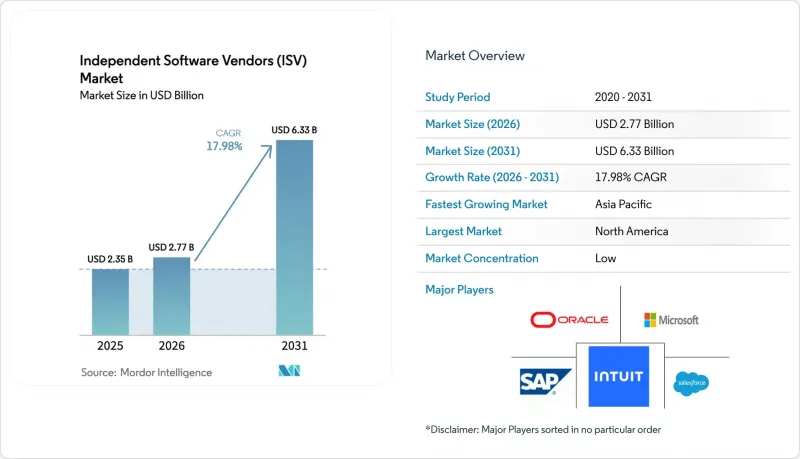
Mordor Intelligence에 의하면, 2026년 독립계 소프트웨어 벤더(ISV) 시장 규모는 27억 7,000만 달러로 추정되고, 2025년 23억 5,000만 달러에서 확대해, 2031년에는 63억 3,000만 달러에 이를 것으로 예측됩니다.
2026-2031년 연평균 성장률(CAGR)은 17.98%를 나타낼 전망입니다.
본 보고서는 도입 형태별(온프레미스 및 클라우드), 최종 사용자 기업 규모별(대기업 및 중소기업(SME)), 최종 사용자 산업별(IT 및 통신, BFSI), 그리고 지역별로 분류되어 있습니다. 시장 예측은 금액(달러)으로 제시되어 있습니다.
세계의 독립계 소프트웨어 벤더(ISV) 시장 동향 및 인사이트
기본 엔터프라이즈 아키텍처로서의 클라우드/SaaS
SaaS(Software-as-a-Service) 형태는 새로운 엔터프라이즈 용도의 표준 아키텍처로 자리 잡았으며, ISV의 계약 구조와 수익 발생 시기에 큰 변화를 가져오고 있습니다. 마이크로소프트의 클라우드 매출은 2024 회계연도에 1374억 달러에 달하고, 전년 대비 23% 증가를 기록했습니다. 이는 ‘클라우드 퍼스트’ 유통 모델이 가져오는 규모의 경제를 여실히 보여줍니다. 구독 방식의 가격 책정을 통해 고객의 비용 예측 가능성이 향상되고, 자동 갱신을 통해 관리상의 부담이 경감됩니다. 공공 부문의 조달 방침도 이러한 전환을 뒷받침하고 있으며, 영국의 G-Cloud 프로그램에서는 기존 조달 메커니즘에 비해 평균 50%의 비용 절감이 기록되었습니다. 이러한 요인들이 맞물려 도입 속도가 빨라지고 있으며, 독립계 소프트웨어 벤더(ISV) 시장의 성장을 뒷받침하고 있습니다.
산업 특화형 ‘버티컬 SaaS’ 수요 급증
기업들은 자사의 규제 체계와 워크플로우의 세부 사항을 고려하여 설계된 용도를 선택하고 있습니다. eClinicalWorks는 의료 분야에 특화된 전자건강기록(EHR) 제품군의 강점을 바탕으로 2024년 매출 11억 달러를 돌파했습니다. 한편, ServiceTitan은 현장 서비스 관리 부문에서 연간 경상 수익 8억 4,000만 달러를 달성했습니다. 깊은 전문 지식은 자연스러운 전환 비용을 발생시켜, 공급업체가 더 높은 평균 판매 가격과 견고한 갱신율을 유지할 수 있게 해줍니다. 아시아태평양은 규제 및 언어의 복잡성으로 인해 맞춤형 솔루션의 가치가 높아지고 있어, 독립계 소프트웨어 벤더(ISV) 시장에서 수직형 SaaS가 지속적인 성장의 원동력이 되는 중요한 시장으로 부상하고 있습니다.
레거시 시스템의 통합 부채
ServiceNow의 2024년 워크플로우 현대화 조사에 따르면, 기업들은 레거시 시스템 1인스턴스당 평균 4만 달러의 유지보수 비용을 부담하고 있으며, IT 생산성 측면에서 주당 17시간의 손실을 입고 있습니다. 제조업 분야만 보더라도 여전히 미션 크리티컬한 프로세스를 담당하고 있는 감가상각 중인 기술 자산이 2조 6,500억 달러에 달하며, 이로 인해 시스템 폐기가 복잡해지고 있습니다. 통합 실패는 많은 경우 호환되지 않는 데이터 형식에서 기인하며, 이는 프로젝트 기간을 연장하고 ISV의 총 도입 비용을 증가시켜 결과적으로 독립계 소프트웨어 벤더(ISV) 시장의 성장을 둔화시키고 있습니다.
부문 분석
2025년에는 클라우드 도입이 독립계 소프트웨어 벤더(ISV) 시장 점유율의 68.12%를 차지한 것으로 평가되었으며, 2031년까지 연평균 성장률(CAGR) 14.25%로 성장할 전망입니다. 고객 입장에서는 구독형 가격 책정을 통해 자본 지출이 예측 가능한 운영 비용으로 전환되는 한편, 자동 갱신을 통해 보안 체계가 강화됩니다. 데이터 주권에 관한 규제로 인해 완전한 클라우드 도입이 제한되는 상황에서는 하이브리드 모델이 여전히 존재하지만, 그 흐름은 SaaS로 한 방향으로 나아가고 있습니다. SAP는 이러한 전환을 반영하여, 2024년 클라우드 매출이 171억 4,000만 유로로 26% 증가했으며, 클라우드 ERP 성장률은 33%에 달했습니다.
비용 절감은 보급의 이유 중 일부에 불과하며, 기능 제공 속도가 더 결정적인 요인으로 작용하고 있습니다. 지속적 통합(CI) 파이프라인을 통해 ISV(독립계 소프트웨어 벤더)는 매주 기능 강화 버전을 출시할 수 있게 되었으며, 고객은 시스템에 지장을 주는 버전 업그레이드를 거치지 않고도 최신 AI, 분석, 보안 기능을 활용할 수 있게 되었습니다. 이러한 속도는 고객 유지율 향상으로 이어집니다. 다른 플랫폼으로 전환하는 것은 신속한 혁신의 흐름을 포기하는 것을 의미하기 때문입니다. 규제가 엄격한 산업에서도 SaaS 환경에 대한 인증이 진행됨에 따라 클라우드에 대한 거부감이 줄어들고 있으며, 독립계 소프트웨어 벤더 시장의 확대가 더욱 가속화되고 있습니다.
지역별 분석
북미는 2025년, 성숙한 엔터프라이즈용 클라우드 예산과 주요 하이퍼스케일러 본사와의 근접성을 바탕으로 전 세계 매출의 42.21%를 차지했습니다. 연방 정부의 클라우드 지출은 2023 회계연도에 62억 달러 증가하여 200억 달러에 달했습니다. 이는 공공 부문 수요가 여전히 상승 추세를 보이고 있음을 명확히 보여줍니다. AI 지원 인프라 및 사이버 보안 프레임워크에 대한 지속적인 투자가 ISV 도입에 유리한 환경을 유지하고 있습니다. 또한, 기업들이 생성형 AI를 통한 차별화를 중심으로 사업 전략을 재구축하는 가운데, 경쟁 환경의 변화가 교체 주기를 촉진하고 있어 개발자용 도구 및 미들웨어 도입 기반이 확대되고 있습니다.
아시아태평양은 가장 빠르게 성장하는 시장으로, 2031년까지 연평균 성장률(CAGR) 15.62%를 기록할 전망입니다. 인도의 SaaS 부문은 연간 30%의 속도로 성장하고 있으며, 2028년까지 전 세계 시장 점유율의 8%를 차지할 가능성이 있어, 이는 370억 달러의 매출에 해당합니다. 디지털 공공 인프라의 성공, 특히 UPI를 통한 연간 830억 건의 결제 거래는 정부가 지원하는 API 생태계가 민간 부문의 소프트웨어 도입을 어떻게 가속화하는지를 보여줍니다. 인도네시아와 베트남 등 시장도 국가 차원의 디지털 ID 및 결제 인프라에 대한 투자를 통해 유사한 추세를 보이고 있으며, 이로 인해 수직형 SaaS 공급업체 시장 진입 장벽이 낮아지고 있습니다.
유럽에서는 온프레미스 ERP 및 CRM 시스템이 꾸준히 SaaS로 대체되고 있습니다. GDPR(EU 개인정보보호규정) 준수에 드는 비용으로 인해 기업들은 ‘프라이버시 바이 디자인’ 기능을 통합한 솔루션을 도입하고 있으며, 이는 간접적으로 독립계 소프트웨어 벤더(ISV) 시장에 혜택을 주고 있습니다. 라틴아메리카, 중동 및 아프리카에서는 광대역 보급이 확대되고, 정부가 ‘클라우드 퍼스트’ 조달 방침을 내세움에 따라 도입은 초기 단계이지만 가속화되고 있습니다. 환율 변동과 인력 부족은 여전히 장벽으로 작용하고 있지만, 스마트폰 보급 확대와 핀테크 혁신으로 인해 모듈식 및 모바일 퍼스트 솔루션을 제공하는 ISV에게는 충분한 성장 여지가 생기고 있습니다.
기타 혜택
- 엑셀 형식 시장 예측(ME) 시트
- 3개월간의 애널리스트 지원
자주 묻는 질문
목차
제1장 서론
제2장 조사 방법
제3장 주요 요약
제4장 시장 구도
제5장 시장 규모 및 성장 예측
제6장 경쟁 구도
제7장 시장 기회 및 향후 전망
AJY 26.08.11According to Mordor Intelligence, independent software vendors market size in 2026 is estimated at USD 2.77 billion, growing from 2025 value of USD 2.35 billion with 2031 projections showing USD 6.33 billion, growing at 17.98% CAGR over 2026-2031.
This report is Segmented by Deployment (On-Premise and Cloud), End-User Enterprise Size (Large Enterprises and Small and Medium Enterprises (SMEs)), End-User Industry (IT and Telecommunication, BFSI) and by Geography. The Market Forecasts are Provided in Terms of Value (USD).
Global Independent Software Vendors (ISV) Market Trends and Insights
Cloud/SaaS as Default Enterprise Architecture
Software-as-a-Service formats have become the standard architecture for new enterprise applications, materially changing contract structures and revenue timing for ISVs. Microsoft's cloud revenue grew to USD 137.4 billion in fiscal 2024, a 23% year-over-year increase, illustrating the scale advantages of cloud-first distribution. Subscription pricing improves customer predictability, and automated updates reduce administrative overhead. Public-sector procurement policies reinforce the shift, with the United Kingdom's G-Cloud programme recording average savings of 50% against traditional sourcing mechanisms. Together these factors are raising adoption velocity and underpinning growth in the Independent Software Vendors market.
Industry-specific "Vertical SaaS" Demand Surge
Enterprises are choosing applications engineered for their regulatory frameworks and workflow nuances. eClinicalWorks surpassed USD 1.1 billion revenue in 2024 on the strength of healthcare-focused EHR suites, while ServiceTitan reached USD 840 million annual recurring revenue in field-service management. Deep domain knowledge embeds natural switching costs, letting providers sustain higher average selling prices and stronger renewal metrics. Asia-Pacific is emerging as a pivotal theatre because regulatory and language complexity increases the value of tailored solutions, making vertical SaaS a durable growth vector for the Independent Software Vendors market.
Legacy-system Integration Debt
Enterprises shoulder average maintenance expenses of USD 40,000 per legacy instance and lose 17 hours weekly in IT productivity, according to ServiceNow's 2024 workflow modernisation study. Manufacturing alone sits on USD 2.65 trillion of depreciating technology that still houses mission-critical processes, complicating decommissioning. Integration failures often stem from incompatible data formats, extending project timelines and swelling total implementation cost for ISVs, thereby tempering growth in the Independent Software Vendors market.
Other drivers and restraints analyzed in the detailed report include:
- Hyperscaler Marketplace Co-sell and Credits Programs
- Rapid Gen-AI Toolkits Lowering Product-Launch Cost
- Escalating Cloud Egress and Marketplace Fees
For complete list of drivers and restraints, kindly check the Table Of Contents.
Segment Analysis
Cloud implementations accounted for 68.12% of Independent Software Vendors market share in 2025 and are projected to expand at 14.25% CAGR to 2031. For customers, subscription pricing converts capital outlays to predictable operating spend, while automatic updates harden security posture. Hybrid models persist where data-sovereignty mandates restrict full cloud adoption, but the direction of travel remains unidirectional toward SaaS. SAP reflects this transition: its cloud revenue climbed to EUR 17.14 billion in 2024, a 26% increase, with cloud-ERP growth at 33%.
Cost savings only partially explain uptake; feature velocity is more decisive. Continuous integration pipelines let ISVs release enhancements weekly, giving clients access to emerging AI, analytics and security features without disruptive version upgrades. This cadence improves retention because switching to another platform means forfeiting a rapid innovation stream. As more regulated industries certify SaaS environments, resistance to cloud wanes, reinforcing expansion of the Independent Software Vendors market.
Complete Report Scope:
- By Deployment
- Cloud
- On-premise
- By End-user Enterprise Size
- Large Enterprises
- Small and Medium Enterprises
- By End-Use Industry
- IT and Telecommunication
- BFSI
- Healthcare and Life Sciences
- Retail and E-Commerce
- Manufacturing
- Government and Public Sector
- Education
- By Geography
- North America
- United States
- Canada
- Mexico
- South America
- Brazil
- Rest of South America
- Europe
- Germany
- United Kingdom
- France
- Russia
- Rest of Europe
- Asia-Pacific
- China
- Japan
- India
- South Korea
- Australia and New Zealand
- Rest of Asia-Pacific
- Middle East and Africa
- Middle East
- United Arab Emirates
- Saudi Arabia
- Turkey
- Rest of Middle East
- Africa
- Middle East
- South Africa
- Nigeria
- Rest of Africa
- Middle East
- North America
Geography Analysis
North America retained 42.21% of global revenue in 2025, anchored by mature enterprise cloud budgets and proximity to major hyperscaler headquarters. Federal cloud outlays climbed by USD 6.2 billion in fiscal 2023 to reach USD 20 billion, a clear signal that public-sector demand remains on the upswing. Ongoing investments in AI-ready infrastructure and cybersecurity frameworks sustain a fertile environment for ISV uptake. Competitive dynamics also spur refresh cycles as companies reposition around generative AI differentiation, expanding the installed base for developer tooling and middleware.
Asia-Pacific is the fastest-growing theatre, registering a 15.62% CAGR to 2031. India's SaaS sector is expanding 30% annually and could command 8% of worldwide share by 2028, equivalent to USD 37 billion revenue. Success of digital-public infrastructure, notably UPI's 83 billion annual payment transactions, illustrates how government-backed API ecosystems accelerate private-sector software adoption. Markets such as Indonesia and Vietnam mirror this pattern by investing in national digital-ID and payments rails, lowering onboarding friction for vertical SaaS vendors.
Europe follows with steady replacement of on-premise ERP and CRM estates in favour of SaaS deployments. GDPR compliance costs have prompted companies to adopt solutions that embed privacy-by-design features, indirectly benefiting the Independent Software Vendors market. Latin America and the Middle East and Africa show nascent but accelerating uptake as broadband penetration expands and governments publish cloud-first procurement policies. Currency volatility and skills shortages remain hurdles, yet rising smartphone adoption and fintech innovation create ample whitespace for ISVs offering modular, mobile-first solutions.
- Microsoft
- Oracle
- Salesforce
- SAP
- Intuit
- BMC Software
- Dynatrace
- Systemware
- Beta Systems Software
- Informatica
- Veeva Systems
- Commvault
- VMware
- SAS Institute
- Atlassian
- Adobe
- ServiceNow
- Snowflake
- Databricks
- HubSpot
Additional Benefits:
- The market estimate (ME) sheet in Excel format
- 3 months of analyst support
TABLE OF CONTENTS
1 INTRODUCTION
- 1.1 Study Assumptions and Market Definition
- 1.2 Scope of the Study
2 RESEARCH METHODOLOGY
3 EXECUTIVE SUMMARY
4 MARKET LANDSCAPE
- 4.1 Market Overview
- 4.2 Market Drivers
- 4.2.1 Cloud/SaaS as Default Enterprise Architecture
- 4.2.2 Industry-specific "Vertical SaaS" demand surge
- 4.2.3 Hyperscaler marketplace co-sell and credits programs
- 4.2.4 Rapid Gen-AI toolkits lowering product-launch cost
- 4.2.5 Low-code / no-code platforms expanding ISV reach
- 4.2.6 Emerging-market digital-public-goods (DPG) APIs
- 4.3 Market Restraints
- 4.3.1 Legacy-system integration debt
- 4.3.2 Escalating cloud egress and marketplace fees
- 4.3.3 Heightened industry-specific compliance hurdles
- 4.3.4 IP differentiation squeeze in crowded SaaS niches
- 4.4 Value Chain Analysis
- 4.5 Pricing and Cost Analysis
- 4.6 Regulatory Landscape
- 4.7 Technological Outlook
- 4.8 Porter's Five Forces
- 4.8.1 Bargaining Power of Suppliers
- 4.8.2 Bargaining Power of Buyers
- 4.8.3 Threat of New Entrants
- 4.8.4 Threat of Substitutes
- 4.8.5 Intensity of Competitive Rivalry
5 MARKET SIZE and GROWTH FORECASTS (VALUE)
- 5.1 By Deployment
- 5.1.1 Cloud
- 5.1.2 On-premise
- 5.2 By End-user Enterprise Size
- 5.2.1 Large Enterprises
- 5.2.2 Small and Medium Enterprises
- 5.3 By End-Use Industry
- 5.3.1 IT and Telecommunication
- 5.3.2 BFSI
- 5.3.3 Healthcare and Life Sciences
- 5.3.4 Retail and E-Commerce
- 5.3.5 Manufacturing
- 5.3.6 Government and Public Sector
- 5.3.7 Education
- 5.4 By Geography
- 5.4.1 North America
- 5.4.1.1 United States
- 5.4.1.2 Canada
- 5.4.1.3 Mexico
- 5.4.2 South America
- 5.4.2.1 Brazil
- 5.4.2.2 Rest of South America
- 5.4.3 Europe
- 5.4.3.1 Germany
- 5.4.3.2 United Kingdom
- 5.4.3.3 France
- 5.4.3.4 Russia
- 5.4.3.5 Rest of Europe
- 5.4.4 Asia-Pacific
- 5.4.4.1 China
- 5.4.4.2 Japan
- 5.4.4.3 India
- 5.4.4.4 South Korea
- 5.4.4.5 Australia and New Zealand
- 5.4.4.6 Rest of Asia-Pacific
- 5.4.5 Middle East and Africa
- 5.4.5.1 Middle East
- 5.4.5.1.1 United Arab Emirates
- 5.4.5.1.2 Saudi Arabia
- 5.4.5.1.3 Turkey
- 5.4.5.1.4 Rest of Middle East
- 5.4.5.2 Africa
- 5.4.5.3 Middle East
- 5.4.5.3.1 South Africa
- 5.4.5.3.2 Nigeria
- 5.4.5.3.3 Rest of Africa
- 5.4.5.1 Middle East
- 5.4.1 North America
6 COMPETITIVE LANDSCAPE
- 6.1 Market Concentration
- 6.2 Strategic Moves
- 6.3 Market Share Analysis
- 6.4 Company Profiles (includes Global level Overview, Market level overview, Core Segments, Financials as available, Strategic Information, Market Rank/Share for key companies, Products and Services, and Recent Developments)
- 6.4.1 Microsoft
- 6.4.2 Oracle
- 6.4.3 Salesforce
- 6.4.4 SAP
- 6.4.5 Intuit
- 6.4.6 BMC Software
- 6.4.7 Dynatrace
- 6.4.8 Systemware
- 6.4.9 Beta Systems Software
- 6.4.10 Informatica
- 6.4.11 Veeva Systems
- 6.4.12 Commvault
- 6.4.13 VMware
- 6.4.14 SAS Institute
- 6.4.15 Atlassian
- 6.4.16 Adobe
- 6.4.17 ServiceNow
- 6.4.18 Snowflake
- 6.4.19 Databricks
- 6.4.20 HubSpot
7 MARKET OPPORTUNITIES and FUTURE OUTLOOK
- 7.1 White-space and Unmet-Need Assessment


