
|
시장보고서
상품코드
2117991
양자 소프트웨어 개발 키트 시장 : 시장 점유율 분석, 업계 동향 및 통계, 성장 예측(2026-2031년)Quantum Software Development Kit - Market Share Analysis, Industry Trends & Statistics, Growth Forecasts (2026 - 2031) |
||||||
 Mordor Intelligence
Mordor Intelligence에 의하면, 양자 소프트웨어 개발 키트 시장 규모는 2025년 5억 4,000만 달러로 평가되었고, 2026년에는 6억 4,000만 달러로 추정되고, 2026-2031년 CAGR 23.92%로 성장을 지속할 전망이며, 2031년에는 18억 7,000만 달러에 이를 것으로 예측됩니다.
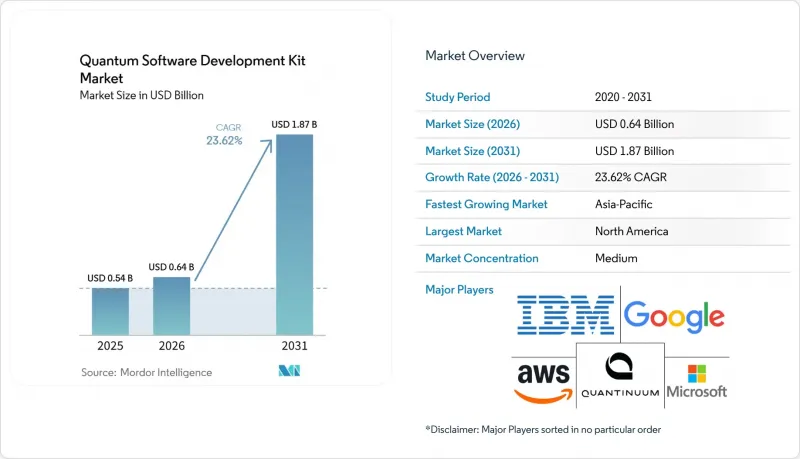
본 보고서는 소프트웨어 개발 키트 유형별(핵심 양자 개발, 하드웨어 전용, 기타), 배포 모드별(클라우드 기반, 온프레미스, 하이브리드), 용도별(최적화, 양자 머신러닝, 기타), 최종 사용자 산업별(IT 및 통신, 헬스케어 및 생명과학, 기타), 지역별로 분류되어 있습니다. 시장 예측은 금액(달러) 기준으로 제시되어 있습니다.
세계의 양자 소프트웨어 개발 키트 시장 동향 및 인사이트
하이브리드 양자·고전 워크로드의 확대
오크리지, 아르곤, 리켄, 율리히, 바르셀로나 슈퍼컴퓨팅 센터와 같은 Tier 1 슈퍼컴퓨팅 센터들은 2028년까지 QPU의 코로케이션 통합을 실현할 것을 약속하고 있습니다. 이를 통해 양자 소프트웨어 개발 키트 시장에서 개별 플랫폼의 애플리케이션 프로그래밍 인터페이스(API)를 상위 계층의 미들웨어 및 오케스트레이션 툴로 연결하는 명확한 조달 경로가 확립될 것입니다. 상업적 경쟁은 하이브리드 워크플로우 오케스트레이션의 주도권을 둘러싸고 점점 더 치열해지고 있으며, NVIDIA CUDA-Q와 IBM Quantum Compute Service가 주요 시장 진출기업으로 부상하고 있습니다. CUDA-Q 벤치마크에서는 하이브리드 알고리즘이 CPU 전용 최적화 루프에 비해 최대 5배 빠르게 수렴하는 것으로 나타났으나, 이 결과는 기업 측의 정보를 바탕으로 한 것입니다. 클리블랜드 클리닉(Cleveland Clinic)과 IBM은 2026년 3월, IBM Quantum Heron r2 하드웨어를 사용하여 303개 원자로 구성된 Trp-cage 미니 단백질의 전자 구조에 관한 하이브리드 워크플로우를 발표했습니다. 이 성과를 통해 예상되는 워크플로가 QPU 전용 회로에서 CPU-GPU-QPU 환경으로 확대됨에 따라, 기존의 고성능 컴퓨팅 및 데이터 사이언스 팀이 양자 기술 도입에 있어 보다 직접적인 역할을 수행할 수 있게 되었습니다.
정부 주도의 양자 컴퓨팅 프로그램 및 연구 자금
정부 프로그램은 자금 지원이 특정 하드웨어나 생태계의 이정표와 연계되어 있기 때문에 제품 로드맵을 형성하고 있습니다. 2026년 5월, 미국 상무부는 9개 양자 기업을 대상으로 ‘CHIPS and Science Act’에 근거한 20억 1,300만 달러의 인센티브에 관한 의향서에 서명했습니다. 이 배분에는 IBM에 10억 달러, Atom Computing, Infleqtion, Quantinuum, D-Wave, Rigetti에 각각 1억 달러가 포함되었습니다. 에너지부는 2026년 6월 ‘Quantum Genesis’를 발표하며, 2028년까지 과학적으로 의미 있는 내결함성 컴퓨팅을 실현하고, 양자 컴퓨팅과 고성능 컴퓨팅 자원을 통합한 사용자 시설 구축을 목표로 하고 있습니다. 포즈난, 오스트라바, 뮌헨에서 가동을 시작한 EuroHPC 시스템 역시 과학 분야 사용자를 위해 호환 가능한 소프트웨어 계층이 필요합니다. 새롭게 대두되고 있는 상호 운용성 요구 사항은 양자 소프트웨어 개발 키트 시장에서 규정 준수 부담을 가중시킬 가능성이 있지만, 한편으로는 얼리 어답터들이 공통된 기술 관행에 영향을 미칠 수 있는 기회도 제공합니다.
양자 하드웨어의 가용성 제한 및 성능 편차
양자 소프트웨어 개발 키트 시장은 여전히 공급이 제한적이며, 벤더마다 성능에 편차가 있는 하드웨어에 의존하고 있습니다. 2 큐비트 게이트의 충실도는 Rigetti의 Cepheus-1-108Q 시스템에서 99.1%였던 반면, Quantinuum의 Helios 트랩 이온 시스템에서는 99.9% 이상을 기록했습니다. 따라서 컴파일러 및 트랜스파일러 도구는 하드웨어 세대마다 지속적인 조정이 필요합니다. 이로 인해 클라우드 액세스를 통해 기대되는 이식성이 저해됩니다. 하드웨어 조달은 대개 수년에 걸친 공공 예산을 바탕으로 이루어지는 반면, 소프트웨어 릴리스는 분기별로 이루어지는 경우가 있습니다. 이러한 시기 차이로 인해 상용화에 필요한 하드웨어보다 소프트웨어 기능이 앞서 나갈 가능성이 있으며, 이로 인해 기업의 실제 도입 결정이 지연될 수 있습니다.
부문 분석
2025년, Core Quantum Development는 양자 소프트웨어 개발 키트 시장에서 24.81%의 점유율을 차지했습니다. 이는 기초적인 회로 프로그래밍 프레임워크가 여전히 많은 개발자에게 출발점이었기 때문입니다. IBM Qiskit과 Google Cirq는 이 부문에서 계속해서 중요한 도구로 자리매김했습니다. Qiskit v2.5에서는 다중 표현 컴파일러 프레임워크가 도입되어, 코어 개발과 전용 컴파일 기능 간의 구분이 점차 모호해지기 시작했습니다. IQM, Pasqal Pulser, Quantinuum 등 백엔드용 도구를 포함한 하드웨어 전용 SDK는 특정 시스템에 대한 직접적인 접근이 필요한 사용자에게 서비스를 제공합니다. 공급업체들이 내결함성 실증을 진행함에 따라, 양자 오류 정정, 양자 제어, 양자 보정 도구가 널리 활용되기 시작했습니다. 이러한 도구의 추가적인 보급은 2027년과 2028년에 설정된 하드웨어 준비 상태 목표에 좌우될 것입니다.
컴파일러 및 트랜스파일러 SDK는 2031년까지 연평균 성장률(CAGR) 27.14%를 나타낼 것으로 예측되며, 이는 SDK 유형 중 가장 높은 성장률입니다. 범용 회로 컴파일러에는 여전히 하드웨어별 튜닝이 필요하기 때문에 모든 QPU 아키텍처에서 개별적으로 최적화된 컴파일 처리가 요구됩니다. Amazon Braket은 2026년 2월, Qiskit-Braket 프로바이더 v0.11을 출시했습니다. 이를 통해 Rigetti의 Cepheus-1-108Q를 포함한 Braket 네이티브 백엔드에서 최적화된 회로를 실행하는 Qiskit 사용자를 위해 유연한 회로 컴파일이 가능해졌습니다. 도메인 특화형 및 하이브리드 양자·고전형 SDK는 금융 모델링,신약 개발, 재료 시뮬레이션 등의 이용 사례를 지원합니다. 이러한 도입은 각 분야의 기업 수요에 따라 달라집니다. ‘기타’ 카테고리에는 전문적인 시뮬레이션 및 시각화 도구가 포함됩니다. 컴파일러나 수직형 소프트웨어 계층과 같은 수요 촉진요인은 부족하지만, 꾸준히 성장하고 있습니다.
2025년 양자 소프트웨어 개발 키트 시장에서 클라우드 기반 배포는 시장 점유율의 72.36%를 차지했습니다. 대부분의 사용자는 IBM Quantum, Amazon Braket, Microsoft Azure Quantum, IonQ Cloud 등의 관리형 서비스를 통해 양자 하드웨어에 접근했습니다. 로컬 배포에는 설비 투자 외에도 극저온 인프라, 마이크로파 제어 전자기기, 전문적인 유지보수가 필요합니다. 따라서 많은 사용자에게 클라우드 접근이 기본적인 선택지가 되고 있습니다. 온프레미스 시스템은 국립 연구소, 방위 관련 기업, 데이터 상주 요건을 갖춘 금융 기관에 있어 여전히 중요한 역할을 수행하고 있습니다. IBM은 2026년 9월까지 인도 최초의 양자 컴퓨터 중 하나를 아마라바티에 설치할 계획이며, 이는 인프라 관리 강화를 원하는 국가들에게 온프레미스 접근 모델이 유망함을 시사합니다.
하이브리드 배포는 2031년까지 연평균 성장률(CAGR) 26.83%로 확대될 것으로 예측됩니다. 이러한 환경에서는 회로 깊이, 노이즈 프로파일, 실행 비용을 기반으로 로컬 시뮬레이터, 로컬 QPU, 클라우드 백엔드 간에 회로를 라우팅합니다. 이는 단순한 액세스 방식의 조합 그 이상이며, 서로 다른 컴퓨팅 환경 간의 신뢰할 수 있는 연동이 필요하기 때문입니다. NVIDIA CUDA-Q는 이러한 역할을 수행하고자 하며, 해당 기업의 벤치마크에 따르면 CPU 전용 최적화 루프와 비교했을 때 하이브리드 알고리즘의 수렴 속도가 최대 5배 더 빠른 것으로 나타났습니다. 2028년까지 Tier-1 슈퍼컴퓨팅 센터에 QPU 설치가 예정되어 있는 만큼, 하이브리드 지원 인터페이스에 대한 수요가 증가할 것으로 예측됩니다. 이러한 인터페이스는 과학 분야 및 기업 사용자에게 기존 워크플로우와 양자 워크플로우 모두에서 일관된 접근성을 제공해야 합니다.
지역별 분석
2025년, 북미는 양자 소프트웨어 개발 키트 시장 점유율의 36.42%를 차지했습니다. 이 지역은 탄탄한 공급업체 기반, 깊이 있는 자본 시장, 국립 연구소 및 주요 연구 기관을 모두 갖추고 있습니다. 2026년 5월, 미국 상무부가 총액 20억 1,300만 달러 규모의 의향서(LOI)를 발표함에 따라 국내 시스템 및 소프트웨어 로드맵이 강화되었습니다. 에너지부의 ‘Quantum Genesis’ 이니셔티브는 2028년까지 내결함성 컴퓨팅과 통합 사용자 시설을 실현하는 것을 목표로 삼았습니다. 캐나다의 노력에는 Xanadu와 워털루 연구 클러스터가 포함됩니다. 멕시코는 여전히 초기 단계에 있으며, 수요는 학술 분야에 집중되어 있습니다.
유럽에서는 양자 소프트웨어 개발 키트 시장에서 정책 주도형 개발 경로가 채택되었습니다. EuroHPC는 2025년 6월 포즈난, 2025년 9월 오스트라바, 2026년 2월 뮌헨에서 양자 컴퓨터 운영을 시작했으며, 과학 분야 사용자를 위한 호환 가능한 소프트웨어가 필요했습니다. 독일은 프라운호퍼 협회와 독일 항공우주센터(DLR)의 위탁을 통해 상업 활동을 주도했습니다. 영국에는 컴파일, 오류 정정, 제어를 위한 차별화된 도구를 제공하는 Quantinuum, Riverlane, Q-CTRL이 거점을 두고 있었습니다. 남미는 상업 개발의 초기 단계에 머물러 있었습니다. 브라질은 CBPF와 상파울루 대학교를 통해 해당 지역에서 가장 발전된 학술 인프라를 보유하고 있었으나, 자금 조달의 어려움과 하드웨어 접근 제한으로 인해 더 광범위한 도입이 저해되고 있었습니다.
아시아태평양은 2031년까지 연평균 성장률(CAGR) 29.16%로 확대될 것으로 예상되며, 이는 지역별로는 가장 높은 성장률입니다. 중국은 3개의 지역 양자 펀드에 총 1,218억 위안(175억 달러 상당)을 배정하는 한편, 일본은 국내 양자 기술의 산업화를 위해 500억 엔(3억 3,500만 달러 상당)을 투입했습니다. 일본의 프로그램에는 후지쯔(Fujitsu), KDDI, 스타트업 기업 Jij에 대한 지원이 포함되었습니다. IBM은 2026년 9월 아마라바티에 시설을 설립할 계획이며, 이를 통해 인도의 제약, 소프트웨어, 금융 서비스 기업을 위한 현지 접근 거점이 제공될 것입니다. 한국의 KAIST와 국가 연구 프로그램은 양자 소프트웨어 개발 키트 산업에서 반도체 및 소재에 대한 새로운 상업적 관심이 높아지는 가운데, 학문적 수요를 지속적으로 지원하고 있습니다. 중동 및 아프리카에서는 아랍에미리트 기술 혁신연구소(AETRI)와 사우디아라비아의 KAUST에서 초기 수요가 나타나고 있으나, 인력 확보가 제한적이어서 상용화 진전이 지연될 가능성이 있습니다.
기타 혜택
- 엑셀 형식 시장 예측(ME) 시트
- 3개월간의 애널리스트 지원
자주 묻는 질문
목차
제1장 서론
제2장 조사 방법
제3장 주요 요약
제4장 시장 구도
제5장 시장 규모 및 성장 예측
제6장 경쟁 구도
제7장 시장 기회 및 향후 전망
AJY 26.09.03According to Mordor Intelligence, the quantum software development kit market size is expected to grow from USD 0.54 billion in 2025 to USD 0.64 billion in 2026 and is forecast to reach USD 1.87 billion by 2031 at 23.92% CAGR over 2026-2031.
This report is Segmented by Software Development Kit Type (Core Quantum Development, Hardware-Specific, and More), Deployment Mode (Cloud-Based, On-Premises, and Hybrid), Application (Optimization, Quantum Machine Learning, and More), End-User Industry (IT and Telecommunication, Healthcare and Life Sciences, and More), and Geography. The Market Forecasts are Provided in Terms of Value (USD).
Global Quantum Software Development Kit Market Trends and Insights
Expansion of Hybrid Quantum-Classical Workloads
Tier-1 supercomputing centers, including Oak Ridge, Argonne, RIKEN, Julich, and the Barcelona Supercomputing Center, have committed to co-located QPU integration by 2028. This creates a defined procurement path for middleware and orchestration tools above individual platform application programming interfaces in the quantum software development kit market. The commercial contest is increasingly focused on control of hybrid workflow orchestration, where NVIDIA CUDA-Q and IBM Quantum Compute Service are key participants. CUDA-Q benchmarks showed that a hybrid algorithm converged up to 5x faster than CPU-only optimization loops, although this result comes from a company source. Cleveland Clinic and IBM published a hybrid workflow for the electronic structure of the 303-atom Trp-cage miniprotein in March 2026, using IBM Quantum Heron r2 hardware. The work broadens the expected workflow from QPU-only circuits to CPU-GPU-QPU environments, giving classical high-performance computing and data science teams a more direct role in adoption.
Government-Led Quantum Computing Programs and Research Funding
Government programs are shaping product roadmaps because their funding is linked to specific hardware and ecosystem milestones. In May 2026, the U.S. Department of Commerce signed letters of intent for USD 2.013 billion in CHIPS and Science Act incentives across 9 quantum companies. The allocation included USD 1 billion for IBM and USD 100 million each for Atom Computing, Infleqtion, Quantinuum, D-Wave, and Rigetti. The Department of Energy announced Quantum Genesis in June 2026, targeting scientifically relevant fault-tolerant computing by 2028 and a user facility that integrates quantum and high-performance computing resources. EuroHPC systems inaugurated in Poznan, Ostrava, and Munich also require compatible software layers for scientific users. Emerging interoperability requirements may increase compliance work in the quantum software development kit market, but they also allow early adopters to influence common technical practices.
Limited Quantum Hardware Availability and Performance Variability
The quantum software development kit market depends on hardware that remains scarce and has uneven performance across vendors. Two-qubit gate fidelity ranged from 99.1% on Rigetti's Cepheus-1-108Q system to above 99.9% on Quantinuum Helios trapped-ion systems. Compiler and transpiler tools, therefore, need continuing adjustment for each hardware generation. This reduces the portability that cloud access is expected to provide. Hardware procurement often follows multi-year public budgets, while software releases can occur each quarter. The timing difference can leave software functions ahead of the hardware required for commercial deployment, delaying enterprise production decisions.
Other drivers and restraints analyzed in the detailed report include:
- Rising Enterprise Demand for Quantum Algorithm Development Platforms
- Growth of Open-Source Quantum Software Ecosystems
- Shortage of Quantum Software Engineering and Algorithm Development Talent
For complete list of drivers and restraints, kindly check the Table Of Contents.
Segment Analysis
Core Quantum Development held 24.81% of the Quantum Software Development Kit Market share in 2025 because foundational circuit programming frameworks remained the starting point for many developers. IBM Qiskit and Google Cirq remained important tools in this category. Qiskit v2.5 introduced a multi-representation compiler framework that has begun to narrow the distinction between core development and dedicated compilation functions. Hardware-specific SDKs, including tools for IQM, Pasqal Pulser, and Quantinuum backends, serve users who need direct access to specific systems. Quantum Error Correction, Quantum Control, and Quantum Calibration tools have gained widespread use as providers pursue fault-tolerant demonstrations. Wider adoption of these tools depends on the hardware readiness targets linked to 2027 and 2028.
Compiler and Transpiler SDKs are projected to record a 27.14% CAGR through 2031, the fastest rate across SDK types. Every QPU architecture needs tailored compilation optimization because general circuit compilers still require hardware-specific tuning. Amazon Braket released Qiskit-Braket provider v0.11 in February 2026 with flexible circuit compilation for Qiskit users running optimized circuits on Braket-native backends, including Rigetti's Cepheus-1-108Q. Domain-Specific and Hybrid Quantum-Classical SDKs support use cases such as financial modeling, drug discovery, and materials simulation. Their adoption is tied to enterprise demand in those fields. The Others category includes specialized simulation and visualization tools. It is growing steadily, though it lacks the same demand drivers as compiler and vertical software layers.
Cloud-Based deployment accounted for 72.36% of the Quantum Software Development Kit Market share in 2025. Most users accessed quantum hardware through managed offerings such as IBM Quantum, Amazon Braket, Microsoft Azure Quantum, and IonQ Cloud. A local deployment requires cryogenic infrastructure, microwave control electronics, and specialized maintenance in addition to capital spending. Cloud access is therefore the default option for many users. Local systems remain relevant for national laboratories, defense contractors, and financial institutions with data residency requirements. IBM planned to install one of India's first quantum computers in Amaravati by September 2026, indicating a potential local-access model for countries seeking greater infrastructure control.
Hybrid deployment is projected to expand at a 26.83% CAGR through 2031. These environments route circuits across local simulators, local QPUs, and cloud backends based on circuit depth, noise profiles, and execution cost. This is more than a combination of access methods because it requires reliable coordination across different computing environments. NVIDIA CUDA-Q has sought this role, with company benchmarks showing up to 5x faster hybrid-algorithm convergence than CPU-only optimization loops. The expected co-location of QPUs at Tier-1 supercomputing centers by 2028 supports demand for hybrid-capable interfaces. Such interfaces will need to give scientific and enterprise users consistent access across classical and quantum workflows.
Complete Report Scope:
- By Software Development Kit Type
- Core Quantum Development
- Hardware-Specific
- Compiler and Transpiler
- Quantum Error Correction
- Quantum Control and Calibration
- Hybrid Quantum-Classical
- Domain-Specific
- Other Software Development Kit Types
- By Deployment Mode
- Cloud-Based
- On-Premises
- Hybrid
- By Application
- Optimization
- Quantum Machine Learning
- Chemistry and Materials Simulation
- Drug Discovery
- Financial Modeling
- Cryptography and Security
- Quantum NLP
- Other Applications
- By End-User Industry
- IT and Telecommunication
- BFSI
- Healthcare and Life Sciences
- Retail and E-Commerce
- Industrial Manufacturing
- Education and Research Institutions
- Media and Entertainment
- Government and Administration
- Energy and Utilities
- Other End-User Industries
- By Geography
- North America
- United States
- Canada
- Mexico
- South America
- Brazil
- Argentina
- Rest of South America
- Europe
- Germany
- United Kingdom
- France
- Russia
- Spain
- Rest of Europe
- Asia-Pacific
- China
- Japan
- India
- South Korea
- Southeast Asia
- Rest of Asia-Pacific
- Middle East and Africa
- Middle East
- Saudi Arabia
- United Arab Emirates
- Rest of Middle East
- Africa
- South Africa
- Nigeria
- Rest of Africa
- Middle East
- North America
Geography Analysis
North America held 36.42% of the Quantum Software Development Kit Market share in 2025. The region combined a dense supplier base, deep capital markets, national laboratories, and major research institutions. U.S. Department of Commerce letters of intent totaling USD 2.013 billion in May 2026 strengthened domestic system and software roadmaps. The Department of Energy's Quantum Genesis initiative provided a 2028 target for fault-tolerant computing and an integrated user facility. Canada's role includes Xanadu and the Waterloo research cluster. Mexico remained at an earlier stage, with demand concentrated in academic settings.
Europe had a policy-led development path in the Quantum Software Development Kit Market. EuroHPC inaugurated quantum computers in Poznan in June 2025, Ostrava in September 2025, and Munich in February 2026, requiring compatible software for scientific users. Germany led commercial activity through mandates from Fraunhofer and DLR. The United Kingdom hosted Quantinuum, Riverlane, and Q-CTRL, which offer differentiated tools for compilation, error correction, and control. South America remained at an early stage of commercial development. Brazil had the region's most developed academic infrastructure through the CBPF and the University of Sao Paulo, but limited capital availability and access to hardware hindered broader adoption.
Asia-Pacific is projected to expand at a 29.16% CAGR through 2031, the fastest regional rate. China allocated RMB 121.8 billion, equivalent to USD 17.5 billion, across 3 regional quantum funds, while Japan directed JPY 50 billion, equivalent to USD 335 million, toward domestic quantum technology industrialization. Japan's program included support for Fujitsu, KDDI, and startup Jij. IBM planned its Amaravati installation for September 2026, which would provide a local access point for Indian pharmaceutical, software, and financial services organizations. South Korea's KAIST and national research programs continued to support academic demand with emerging commercial interest in semiconductors and materials in the quantum software development kit industry. The Middle East and Africa had early demand from the United Arab Emirates Technology Innovation Institute and Saudi Arabia's KAUST, but limited talent availability could delay commercial uptake.
- IBM Corporation
- Google LLC
- Amazon Web Services, Inc.
- Microsoft Corporation
- Quantinuum Ltd.
- D-Wave Quantum Inc.
- IonQ, Inc.
- Rigetti Computing, Inc.
- Xanadu Quantum Technologies Inc.
- Pasqal SAS
- Classiq Technologies Ltd.
- Quantum Computing Inc.
- Riverlane Ltd.
- Q-CTRL Pty Ltd
- QuEra Computing Inc.
- qBraid Inc
- Oxford Quantum Circuits plc
- 1QB Information Technologies
- Quantum Machines
- Infleqtion, Inc.
- QC Ware Corp.
- Strangeworks, Inc.
- BlueQubit, Inc.
- Multiverse Computing S.L.
- Terra Quantum AG
- Algorithmiq S.r.l.
Additional Benefits:
- The market estimate (ME) sheet in Excel format
- 3 months of analyst support
TABLE OF CONTENTS
1 INTRODUCTION
- 1.1 Study Assumptions and Market Definition
- 1.2 Scope of the Study
2 RESEARCH METHODOLOGY
3 EXECUTIVE SUMMARY
4 MARKET LANDSCAPE
- 4.1 Market Overview
- 4.2 Market Drivers
- 4.2.1 Expansion of Hybrid Quantum-Classical Workloads
- 4.2.2 Government-Led Quantum Computing Programs and Research Funding
- 4.2.3 Growth of Open-Source Quantum Software Ecosystems
- 4.2.4 Rising Enterprise Demand for Quantum Algorithm Development Platforms
- 4.2.5 Hardware-Portability Requirements Across Fragmented QPU Architectures
- 4.2.6 Real-Time Error-Correction Software Requirements for Utility-Scale Quantum Systems
- 4.3 Market Restraints
- 4.3.1 Limited Quantum Hardware Availability and Performance Variability
- 4.3.2 Shortage of Quantum Software Engineering and Algorithm Development Talent
- 4.3.3 SDK Fragmentation and Incomplete Interoperability Standards
- 4.3.4 High Cost of Maintaining Hardware-Specific Compilation and Control Stacks
- 4.4 Impact of Macroeconomic Factors on the Market
- 4.5 Industry Value-Chain Analysis
- 4.6 Technology Outlook
- 4.7 Regulatory Landscape
- 4.8 Porter's Five Forces Analysis
- 4.8.1 Threat of New Entrants
- 4.8.2 Bargaining Power of Suppliers
- 4.8.3 Bargaining Power of Buyers
- 4.8.4 Threat of Substitutes
- 4.8.5 Intensity of Competitive Rivalry
5 MARKET SIZE AND GROWTH FORECASTS (VALUE)
- 5.1 By Software Development Kit Type
- 5.1.1 Core Quantum Development
- 5.1.2 Hardware-Specific
- 5.1.3 Compiler and Transpiler
- 5.1.4 Quantum Error Correction
- 5.1.5 Quantum Control and Calibration
- 5.1.6 Hybrid Quantum-Classical
- 5.1.7 Domain-Specific
- 5.1.8 Other Software Development Kit Types
- 5.2 By Deployment Mode
- 5.2.1 Cloud-Based
- 5.2.2 On-Premises
- 5.2.3 Hybrid
- 5.3 By Application
- 5.3.1 Optimization
- 5.3.2 Quantum Machine Learning
- 5.3.3 Chemistry and Materials Simulation
- 5.3.4 Drug Discovery
- 5.3.5 Financial Modeling
- 5.3.6 Cryptography and Security
- 5.3.7 Quantum NLP
- 5.3.8 Other Applications
- 5.4 By End-User Industry
- 5.4.1 IT and Telecommunication
- 5.4.2 BFSI
- 5.4.3 Healthcare and Life Sciences
- 5.4.4 Retail and E-Commerce
- 5.4.5 Industrial Manufacturing
- 5.4.6 Education and Research Institutions
- 5.4.7 Media and Entertainment
- 5.4.8 Government and Administration
- 5.4.9 Energy and Utilities
- 5.4.10 Other End-User Industries
- 5.5 By Geography
- 5.5.1 North America
- 5.5.1.1 United States
- 5.5.1.2 Canada
- 5.5.1.3 Mexico
- 5.5.2 South America
- 5.5.2.1 Brazil
- 5.5.2.2 Argentina
- 5.5.2.3 Rest of South America
- 5.5.3 Europe
- 5.5.3.1 Germany
- 5.5.3.2 United Kingdom
- 5.5.3.3 France
- 5.5.3.4 Russia
- 5.5.3.5 Spain
- 5.5.3.6 Rest of Europe
- 5.5.4 Asia-Pacific
- 5.5.4.1 China
- 5.5.4.2 Japan
- 5.5.4.3 India
- 5.5.4.4 South Korea
- 5.5.4.5 Southeast Asia
- 5.5.4.6 Rest of Asia-Pacific
- 5.5.5 Middle East and Africa
- 5.5.5.1 Middle East
- 5.5.5.1.1 Saudi Arabia
- 5.5.5.1.2 United Arab Emirates
- 5.5.5.1.3 Rest of Middle East
- 5.5.5.2 Africa
- 5.5.5.2.1 South Africa
- 5.5.5.2.2 Nigeria
- 5.5.5.2.3 Rest of Africa
- 5.5.5.1 Middle East
- 5.5.1 North America
6 COMPETITIVE LANDSCAPE
- 6.1 Market Concentration
- 6.2 Strategic Moves
- 6.3 Market Share Analysis
- 6.4 Company Profiles (includes Global Level Overview, Market Level Overview, Core Segments, Financials as available, Strategic Information, Market Rank/Share, Products and Services, Recent Developments)
- 6.4.1 IBM Corporation
- 6.4.2 Google LLC
- 6.4.3 Amazon Web Services, Inc.
- 6.4.4 Microsoft Corporation
- 6.4.5 Quantinuum Ltd.
- 6.4.6 D-Wave Quantum Inc.
- 6.4.7 IonQ, Inc.
- 6.4.8 Rigetti Computing, Inc.
- 6.4.9 Xanadu Quantum Technologies Inc.
- 6.4.10 Pasqal SAS
- 6.4.11 Classiq Technologies Ltd.
- 6.4.12 Quantum Computing Inc.
- 6.4.13 Riverlane Ltd.
- 6.4.14 Q-CTRL Pty Ltd
- 6.4.15 QuEra Computing Inc.
- 6.4.16 qBraid Inc
- 6.4.17 Oxford Quantum Circuits plc
- 6.4.18 1QB Information Technologies
- 6.4.19 Quantum Machines
- 6.4.20 Infleqtion, Inc.
- 6.4.21 QC Ware Corp.
- 6.4.22 Strangeworks, Inc.
- 6.4.23 BlueQubit, Inc.
- 6.4.24 Multiverse Computing S.L.
- 6.4.25 Terra Quantum AG
- 6.4.26 Algorithmiq S.r.l.
7 MARKET OPPORTUNITIES AND FUTURE OUTLOOK
- 7.1 White-Space and Unmet-Need Assessment