

|
시장보고서
상품코드
2100488
부직포 시장 : 시장 점유율 분석, 업계 동향 및 통계, 성장 예측(2026-2031년)Non-Woven Fabric - Market Share Analysis, Industry Trends & Statistics, Growth Forecasts (2026 - 2031) |
||||||
 Mordor Intelligence
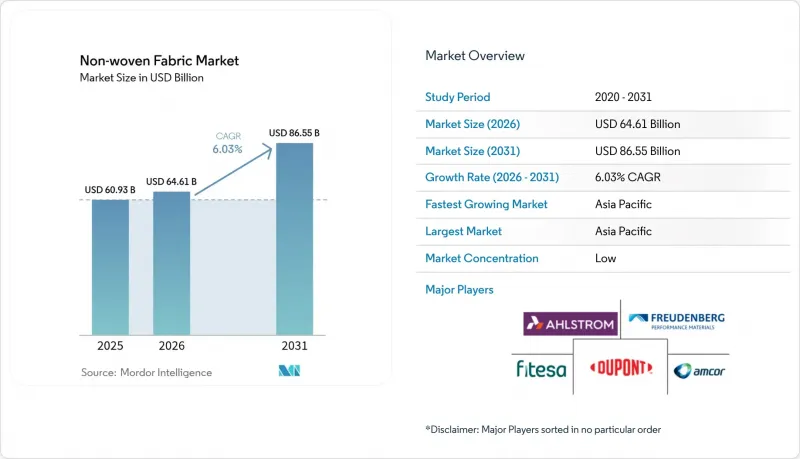
Mordor Intelligence에 의하면, 부직포 시장 규모는 2025년에 609억 3,000만 달러로 평가되었고, 2026년 646억 1,000만 달러에서 2031년까지 865억 5,000만 달러에 이를 것으로 예측되며, 예측 기간(2026-2031년) CAGR은 6.03%를 나타낼 전망입니다.
본 보고서는 기술별(스펀본드, 습식, 건식, 기타), 소재별(폴리에스터, 폴리프로필렌, 폴리에틸렌, 레이온(비스코스), 기타), 최종 사용자 산업별(건설, 섬유, 헬스케어, 기타), 지역별(아시아태평양, 북미, 유럽, 남미, 중동 및 아프리카)로 분류되어 있습니다. 시장 전망은 금액(달러) 기준으로 제시되어 있습니다.
세계의 부직포 시장 동향 및 인사이트
일회용 위생용품 수요 급증
아시아태평양 일부 지역의 출산율 급증과 북미 및 유럽의 꾸준한 인구 고령화로 인해, 가볍고 흡수성이 뛰어난 부직포를 기반으로 한 기저귀, 성인용 요실금 패드, 여성용 위생용품의 판매량이 증가하고 있습니다. 수증기 투과성을 제어하는 필름과 고흡수성 코어를 결합한 스마트 상처 관리용 기재는 시범 생산 단계에서 양산 단계로 전환되고 있으며, 치료 환경 개선 및 붕대 교체 횟수 감소에 기여하고 있습니다. 각 제조업체는 스펀본드 층과 멜트블로운 층을 조합하여 평량(g/㎡)을 낮게 유지하면서도 액체 처리 성능을 최적화하고 있으며, 이러한 구성 덕분에 컨버터는 성능을 희생하지 않고도 가격 목표를 달성할 수 있게 되었습니다. 또한, 브랜드 소유사들도 소매업체의 지속가능성 평가 기준에 부합하기 위해 염소 무첨가 플러프 펄프나 바이오 결합제를 선호하여 채택하고 있습니다. 이러한 동향들이 맞물려 2020년대 중반에 걸쳐 위생 부문 내 부직포 시장의 성장 궤도를 뒷받침하고 있습니다.
의료용 PPE 및 상처 관리 부문에서의 급속한 보급
팬데믹 기간 동안 공급 부족을 겪었던 병원 공급망에서는 인증된 차단 성능을 갖춘 마스크, 가운, 드레이프에 대한 재고 요건이 확대되고 있습니다. NIOSH의 2020-2030년 목표에서는 국내 비상 생산 능력 강화가 중시되고 있으며, 실시간 품질 모니터링 기능을 갖춘 고생산성 스펀-멜트 복합 소재에 대한 투자가 촉진되고 있습니다. 폴리이미드 및 PEEK를 기반으로 한 일렉트로스피닝 공법으로 제조된 나노섬유는 높은 내열성을 발휘하므로, 동력식 공기 정화 호흡기 및 이식형 의료기기에 사용할 수 있습니다. 은 나노 입자나 성장 인자를 접목한 다기능 상처 피복재는 전임상시험에서 99.99% 이상의 세균 감소율과 더 빠른 상피화를 보여주고 있습니다. 입원 기간 단축을 장려하는 보험 환급 제도 개혁 또한 감염 위험과 치료 기간을 단축하는 첨단 부직포에 대한 수요를 더욱 부추기고 있습니다.
PP와 PET의 가격 변동
정유시설의 예기치 못한 가동 중단과 프로파일렌 신규 생산 능력의 가동 지연으로 인해 공급이 압박되어, 2025년 초에는 남아시아 지역의 폴리프로필렌 계약 가격이 톤당 10-20달러 상승했습니다. 동시에, 홍해 항로를 우회함에 따른 운임 할증료로 인해 주요 가공 거점으로의 납품 비용이 상승하고 있습니다. PET 시장도 유사한 경향을 보이고 있는데, 이는 중국 및 유럽의 생산자들이 스프레드 악화에 따라 구형 폴리머 생산 라인을 중단하고 있기 때문입니다. 이러한 가격 변동으로 인해 위생용품 브랜드 소유자와 체결한 고정 가격 공급 계약에 묶여 있는 가공업체의 이익률이 압박받고 있으며, 수지 헤지나 소재 대체 전략을 검토해야 하는 상황에 몰리고 있습니다.
부문 분석
2025년, 스펀본드 부문은 부직포 시장 전체의 52.88%를 차지했습니다. 이는 높은 처리 능력과 위생용 라미네이트, 의료용 가운, 지오텍스타일에 대한 적합성이 입증되었음을 반영합니다. 현재 차세대 설비로의 교체가 진행 중이며, 중량 관리 스캐너와 폐쇄 루프식 공기 재순환 시스템이 탑재되어 에너지 소비를 억제하고 있습니다. 차단 성능을 저해하지 않으면서 천과 같은 촉감을 높이는 초부드러운 탑시트나 3층 SMX 베이스 복합재 분야에서 성장 기회가 창출되고 있습니다.
기타 기술은 2031년까지 연평균 성장률(CAGR) 8.74%로 확대될 전망이며, 일렉트로스피닝, 원심 방사, 고밀도 니들링과 같은 플랫폼을 통해 나노파이버 웹, 밀도 구배 매트, 3D 로프트 펠트 등을 생산함으로써 부직포 시장 규모에 대한 기여도를 높여갈 것으로 예측됩니다. PAN/PS/PMMA 혼합물을 이용한 일렉트로스피닝 분리막은 75.87%의 다공도와 150°C에서 3% 이하의 수축률을 실현하고 있으며, 이러한 특성은 높은 안전성을 요구하는 배터리 팩 분야에서 높이 평가받고 있습니다. 멜트블로우 제조업체는 일렉트로렛 대전과 나노 입자 도핑을 결합하여 0.3 마이크로미터 에어로졸에 대해 97% 이상의 포집률을 유지함으로써, 공기 여과 및 호흡용 보호구 수주를 확보하고 있습니다.
지역별 분석
아시아태평양은 2025년에 부직포 시장 점유율의 48.10%를 차지한 것으로 평가되었으며, 중국, 인도, 인도네시아에서 증가하는 기저귀 및 마스크 소비에 대응하기 위해 가공업체들이 사업을 확대하고 있어 2031년까지 연평균 성장률(CAGR) 7.50%를 나타낼 것으로 예측됩니다. 각 지역공급망에서는 프로파일렌 크래커, 섬유 방적, 최종 제품 조립이 인근에 통합되어 있어 물류 비용을 최소화하고 있습니다. 중국의 생산 라인에서는 국내 전기차(EV) 공장용 방음·단열재 전용 니들펀치 생산 능력을 강화하고 있는 반면, 인도의 생산자들은 물티슈 수출업체에 공급하기 위해 스펀레이스 설비의 규모를 확대되고 있습니다.
북미에서는 중요한 의료용 PPE 및 배터리 분리막공급이 리쇼어링의 혜택을 받고 있으며, AI를 활용한 물류 시스템을 갖춘 오하이오주와 사우스캐롤라이나주의 시설에서 킴벌리 클라크(Kimberly-Clark)사가 20억 달러를 투자해 진행하는 확장 계획이 이를 뒷받침하고 있습니다. 캐나다에서는 Asahi Kasei(Asahi Kasei Corp.)가 건설을 예정하고 있는 분리막 공장이 2027년부터 미국 전기차(EV) 생태계에 공급을 시작할 전망입니다. 노동 시장 부족으로 인해 고도로 자동화된 스펀본드 생산 라인 도입이 진행되고 있어, 공급업체에게 비즈니스 기회가 창출되고 있습니다.
유럽의 엄격한 규제로 인해 생분해성 섬유 및 폐쇄형 재활용 시범 사업에 대한 투자가 촉진되고 있습니다. 프로이덴베르크의 헤이텍스 인수는 코팅 처리된 산업용 섬유 부문으로의 진출을 더욱 심화시키는 한편, 렌징의 리요셀 생산 능력 확충은 바이오 유래 원료의 장기적인 공급을 확보할 것입니다. 중동 및 아프리카에서는 해안 보호 및 위생용품의 현지 생산과 관련된 새로운 수요가 나타나는 반면, 라틴아메리카에서는 니어쇼어링을 활용하여 북미 위생용품 브랜드에 경쟁력 있는 가격의 복합 소재를 공급하고 있습니다.
기타 혜택
- 엑셀 형식 시장 예측(ME) 시트
- 3개월간의 애널리스트 지원
자주 묻는 질문
목차
제1장 서론
제2장 조사 방법
제3장 주요 요약
제4장 시장 구도
제5장 시장 규모 및 성장 예측
제6장 경쟁 구도
제7장 시장 기회 및 향후 전망
AJY 26.08.11According to Mordor Intelligence, the non-Woven fabric market size was valued at USD 60.93 billion in 2025 and estimated to grow from USD 64.61 billion in 2026 to reach USD 86.55 billion by 2031, at a CAGR of 6.03% during the forecast period (2026-2031).
This report is Segmented by Technology (Spun-Bond, Wet Laid, Dry Laid, and Other Technologies), Material (Polyester, Polypropylene, Polyethylene, Rayon (Viscose), and Others), End-User Industry (Construction, Textiles, Healthcare, and More), and Geography (Asia-Pacific, North America, Europe, South America, and Middle-East and Africa). The Market Forecasts are Provided in Terms of Value (USD).
Global Non-Woven Fabric Market Trends and Insights
Exploding Demand for Disposable Hygiene Products
Soaring birth rates in parts of Asia-Pacific and steadily aging populations in North America and Europe are lifting unit sales of diapers, adult incontinence pads, and feminine hygiene articles that rely on lightweight, absorbent non-wovens. Smart wound-care substrates incorporating controlled vapor transmission films and super-absorbent cores are moving from pilot to high-volume production, improving healing environments and reducing dressing changes. Producers are pairing spun-bond and melt-blown layers to optimize fluid handling while keeping basis weight low, a configuration that helps converters meet price points without sacrificing performance. Brand owners also favor chlorine-free fluff pulps and bio-based binders to align with retailer sustainability scorecards. Together, these trends reinforce the Non-Woven Fabric Market trajectory in hygiene through mid-decade.
Rapid Adoption in Medical PPE and Wound-Care
Hospital supply chains that experienced shortages during the pandemic have expanded stocking requirements for masks, gowns, and drapes with certified barrier performance. NIOSH targets for 2020-2030 emphasize domestic surge capacity, prompting investment in high-output spun-melt composites equipped with real-time quality monitoring. Electrospun nanofibers based on polyimide or PEEK deliver elevated heat resistance, allowing their use in powered air-purifying respirators and implantable devices. Multifunctional wound dressings integrating silver nanoparticles or growth factors show more than 99.99% bacterial reduction and faster epithelialization in pre-clinical trials. Reimbursement reforms that reward shorter hospital stays further support demand for advanced non-wovens that cut infection risk and healing time.
PP and PET Price Volatility
Unplanned refinery outages and delayed new propylene capacities have tightened supply, lifting polypropylene contract prices in South Asia by USD 10-20 per ton in early 2025. At the same time, freight surcharges tied to Red Sea rerouting inflate delivered costs into key converting hubs. PET markets mirror the pattern as producers in China and Europe shut older polymer lines amid negative spreads. Such swings compress margins for converters locked into fixed-price supply contracts with hygiene brand owners, prompting them to explore resin hedging or material substitution strategies.
Other drivers and restraints analyzed in the detailed report include:
- Infrastructure Boom Driving Geotextile Uptake
- Cost Advantage Over Woven and Knitted Fabrics
- Microplastic and Landfill Regulations Tightening
For complete list of drivers and restraints, kindly check the Table Of Contents.
Segment Analysis
The spun-bond segment accounted for 52.88% of the Non-Woven Fabric Market in 2025, reflecting its high throughput and proven suitability for hygiene laminates, medical gowns, and geotextiles. Generational upgrades now integrate weight-control scanners and closed-loop air recirculation to curb energy use. Growth opportunities emerge in ultra-soft topsheets and 3-layer SMX-based composites that enhance cloth-like feel without sacrificing barrier integrity.
Other technologies are set to expand at an 8.74% CAGR to 2031, lifting their contribution to the Non-Woven Fabric Market size through electrospinning, centrifugal spinning, and intense needling platforms that deliver nanofiber webs, gradient density mats, and 3D lofted felts. Electrospun separators using PAN/PS/PMMA blends achieve 75.87% porosity and less than 3% shrinkage at 150 °C, features valued in high-safety battery packs. Melt-blown producers combine electret charging with nanoparticle doping to maintain more than 97% capture of 0.3 µm aerosols, securing air-filtration and respirator contracts.
Complete Report Scope:
- By Technology
- Spun-bond
- Wet Laid
- Dry Laid
- Other Technologies
- By Material
- Polyester
- Polypropylene
- Polyethylene
- Rayon (Viscose)
- Others
- By End-user Industry
- Construction
- Textiles
- Healthcare
- Automotive
- Other End-user Industries
- By Geography
- Asia-Pacific
- China
- India
- Japan
- South Korea
- Malaysia
- Thailand
- Indonesia
- Vietnam
- Rest of Asia-Pacific
- North America
- United States
- Canada
- Mexico
- Europe
- Germany
- United Kingdom
- France
- Italy
- Spain
- Turkey
- Russia
- Nordic Countries
- Rest of Europe
- South America
- Brazil
- Argentina
- Colombia
- Rest of South America
- Middle-East and Africa
- Saudi Arabia
- South Africa
- Nigeria
- Egypt
- Qatar
- United Arab Emirates
- Rest of Middle-East and Africa
- Asia-Pacific
Geography Analysis
Asia-Pacific commanded 48.10% of Non-Woven Fabric Market share in 2025 and is on course for a 7.50% CAGR to 2031 as converters expand in China, India, and Indonesia to serve growing diaper and mask consumption. Regional supply chains integrate propylene crackers, fiber spinning, and end-product assembly within close proximity, minimizing logistics cost. Chinese lines add needlepunch capacity dedicated to acoustic and thermal insulation for domestic EV factories, while Indian producers scale spun-lace installations to supply wipes exporters.
North America benefits from reshoring of critical medical-PPE and battery-separator supply, supported by Kimberly-Clark's USD 2 billion expansion across Ohio and South Carolina facilities that feature AI-enabled logistics. Canada's forthcoming separator plant from Asahi Kasei will feed the U.S. EV ecosystem beginning in 2027. Tight labor markets push the adoption of high-automation spun-bond lines, creating opportunities for equipment vendors.
Europe's stringent regulations spur investment in biodegradable fibers and closed-loop recycling pilots. Freudenberg's acquisition of Heytex deepens exposure to coated technical textiles, while Lenzing's lyocell upgrades secure long-term supply of bio-based inputs. Middle East and Africa show emerging demand linked to coastal protection and sanitary product localization, whereas Latin America leverages nearshoring to supply North American hygiene brands with competitively priced composites.
- Ahlstrom
- Amcor plc
- Asahi Kasei Advance Corporation
- Autotech Nonwovens Pvt Ltd
- Avgol Industries 1953 Ltd
- Cygnus Group
- DuPont
- Eximius Innovative Pvt. Ltd.
- Fibertex Nonwovens A/S
- Fitesa SA and Affiliates
- Freudenberg Performance Materials
- Hollingsworth & Vose
- Indorama Ventures Public Company Limited
- Johns Manville
- KCWW
- Lydall, Inc.
- Magnera
- Mitsui Chemicals, Inc.
- paramountnonwoven
- PFNonwovens Holding s.r.o.
- Toray Industries Inc.
- TWE GmbH & Co. KG
Additional Benefits:
- The market estimate (ME) sheet in Excel format
- 3 months of analyst support
TABLE OF CONTENTS
1 Introduction
- 1.1 Study Assumptions and Market Definition
- 1.2 Scope of the Study
2 Research Methodology
3 Executive Summary
4 Market Landscape
- 4.1 Market Overview
- 4.2 Market Drivers
- 4.2.1 Exploding demand for disposable hygiene products
- 4.2.2 Rapid adoption in medical PPE and wound-care
- 4.2.3 Infrastructure boom driving geotextile uptake
- 4.2.4 Cost-advantage over woven and knitted fabrics
- 4.2.5 Solid-state EV battery separators
- 4.3 Market Restraints
- 4.3.1 PP and PET price volatility
- 4.3.2 Micro-plastic / landfill regulations tightening
- 4.3.3 Inferior tensile and tear strength vs woven fabric
- 4.4 Value Chain Analysis
- 4.5 Porter's Five Forces
- 4.5.1 Bargaining Power of Suppliers
- 4.5.2 Bargaining Power of Buyers
- 4.5.3 Threat of New Entrants
- 4.5.4 Threat of Substitutes
- 4.5.5 Degree of Competition
5 Market Size and Growth Forecasts (Value)
- 5.1 By Technology
- 5.1.1 Spun-bond
- 5.1.2 Wet Laid
- 5.1.3 Dry Laid
- 5.1.4 Other Technologies
- 5.2 By Material
- 5.2.1 Polyester
- 5.2.2 Polypropylene
- 5.2.3 Polyethylene
- 5.2.4 Rayon (Viscose)
- 5.2.5 Others
- 5.3 By End-user Industry
- 5.3.1 Construction
- 5.3.2 Textiles
- 5.3.3 Healthcare
- 5.3.4 Automotive
- 5.3.5 Other End-user Industries
- 5.4 By Geography
- 5.4.1 Asia-Pacific
- 5.4.1.1 China
- 5.4.1.2 India
- 5.4.1.3 Japan
- 5.4.1.4 South Korea
- 5.4.1.5 Malaysia
- 5.4.1.6 Thailand
- 5.4.1.7 Indonesia
- 5.4.1.8 Vietnam
- 5.4.1.9 Rest of Asia-Pacific
- 5.4.2 North America
- 5.4.2.1 United States
- 5.4.2.2 Canada
- 5.4.2.3 Mexico
- 5.4.3 Europe
- 5.4.3.1 Germany
- 5.4.3.2 United Kingdom
- 5.4.3.3 France
- 5.4.3.4 Italy
- 5.4.3.5 Spain
- 5.4.3.6 Turkey
- 5.4.3.7 Russia
- 5.4.3.8 Nordic Countries
- 5.4.3.9 Rest of Europe
- 5.4.4 South America
- 5.4.4.1 Brazil
- 5.4.4.2 Argentina
- 5.4.4.3 Colombia
- 5.4.4.4 Rest of South America
- 5.4.5 Middle-East and Africa
- 5.4.5.1 Saudi Arabia
- 5.4.5.2 South Africa
- 5.4.5.3 Nigeria
- 5.4.5.4 Egypt
- 5.4.5.5 Qatar
- 5.4.5.6 United Arab Emirates
- 5.4.5.7 Rest of Middle-East and Africa
- 5.4.1 Asia-Pacific
6 Competitive Landscape
- 6.1 Market Concentration
- 6.2 Strategic Moves
- 6.3 Market Share (%)/Ranking Analysis
- 6.4 Company Profiles {(includes Global level Overview, Market level overview, Core Segments, Financials as available, Strategic Information, Market Rank/Share for key companies, Products and Services, and Recent Developments)}
- 6.4.1 Ahlstrom
- 6.4.2 Amcor plc
- 6.4.3 Asahi Kasei Advance Corporation
- 6.4.4 Autotech Nonwovens Pvt Ltd
- 6.4.5 Avgol Industries 1953 Ltd
- 6.4.6 Cygnus Group
- 6.4.7 DuPont
- 6.4.8 Eximius Innovative Pvt. Ltd.
- 6.4.9 Fibertex Nonwovens A/S
- 6.4.10 Fitesa SA and Affiliates
- 6.4.11 Freudenberg Performance Materials
- 6.4.12 Hollingsworth & Vose
- 6.4.13 Indorama Ventures Public Company Limited
- 6.4.14 Johns Manville
- 6.4.15 KCWW
- 6.4.16 Lydall, Inc.
- 6.4.17 Magnera
- 6.4.18 Mitsui Chemicals, Inc.
- 6.4.19 paramountnonwoven
- 6.4.20 PFNonwovens Holding s.r.o.
- 6.4.21 Toray Industries Inc.
- 6.4.22 TWE GmbH & Co. KG
7 Market Opportunities and Future Outlook
- 7.1 White-space and Unmet-need Assessment


