

|
시장보고서
상품코드
2100514
북미의 자동차용 에어 필터 시장 : 시장 점유율 분석, 업계 동향 및 통계, 성장 예측(2026-2031년)North America Automotive Air Filters - Market Share Analysis, Industry Trends & Statistics, Growth Forecasts (2026 - 2031) |
||||||
 Mordor Intelligence
Mordor Intelligence에 의하면, 북미의 자동차용 에어 필터 시장 규모는 2025년에 52억 9,000만 달러로 평가되었고, 2026년 56억 1,000만 달러에서 2031년까지 75억 1,000만 달러에 이를 것으로 예측되며, 예측 기간(2026-2031년) CAGR은 6.02%를 나타낼 전망입니다.
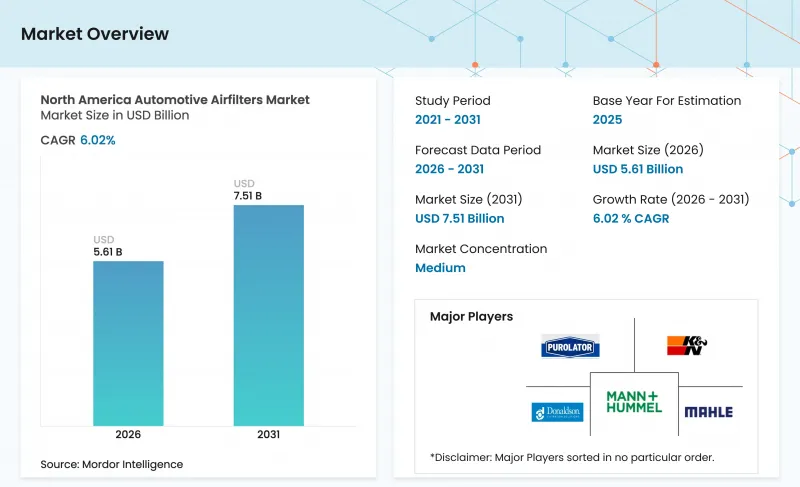
본 보고서는 소재 유형별(종이/셀룰로오스, 합성 거즈/면 등), 필터 유형별(흡기 필터 및 실내 공기 필터), 차종별(승용차, 소형 상용차 등), 판매 채널별(OEM 및 애프터마켓), 국가별(미국, 캐나다, 멕시코)로 분류되어 있습니다. 시장 전망은 금액(달러) 및 수량(단위)으로 제시되어 있습니다.
북미의 자동차용 에어 필터 시장 동향 및 인사이트
미국 및 캐나다의 PM 및 NOx 배출 기준 강화가 필터 교체 주기의 단축을 촉진하고 있습니다.
미국 환경보호청(EPA)이 정한 2027-2032년 모델 연도 소형·중형차 기준에 따라, 차량군의 평균 CO2 배출량 목표가 85 g/mile로 상향 조정됨에 따라, 자동차 제조업체들은 기류를 방해하지 않으면서 미세 입자를 포집할 수 있는 고효율 엔진 및 실내 필터 매체의 채택을 피할 수 없게 되었습니다. 2024년 12월에 승인된 캘리포니아주의 ‘Advanced Clean Cars II’ 면제 조치에 따라 지역 기준이 더욱 엄격해졌으며, 조만간 북미 자동차용 에어필터 시장 전체로 파급될 것입니다. 나노섬유 복합 소재는 필요한 포집 효율을 낮은 압력 손실로 실현하고 연비를 유지할 수 있기 때문에 이러한 추세의 수혜를 받고 있습니다. 더 엄격해진 PM2.5 기준치(9µg/m3) 하에서 여과 성능을 입증할 수 있는 공급업체는 가격 결정력을 확보할 수 있는 반면, 기존의 셀룰로오스 제품 라인은 이익률 압박에 직면하고 있습니다. 2027년부터 시행되는 대형차 기준에 따라 내구성과 보증 기준이 상향 조정되고, 소형차 구매자들에게도 장수명 필터가 표준적인 가치로 인식됨에 따라 북미 자동차용 에어필터 시장의 프리미엄 부문이 강화될 전망입니다.
산불 시즌 이후 차량 내 공기질에 대한 인식이 급속히 높아지고 있음
2024년 기록적인 산불 연기가 캘리포니아주, 오리건주, 브리티시컬럼비아주를 수 주간 뒤덮었고, 미세먼지 농도가 건강 경보 기준치를 초과함에 따라 HEPA 등급 차량용 필터에 대한 소비자 수요가 급증했습니다. 현재 주 정부의 정책 재검토에 따라, 연기 유입에 노출되는 건물에는 고효율 여과가 의무화되었습니다. 이러한 인식은 차량 내부로도 확산되어, 통근자들은 차량을 ‘이동식 대피소’로 간주하며 바이러스, 알레르기 유발 물질, 연기를 제거하는 효과를 내세우는 필터를 찾고 있습니다. 대량 생산 자동차 제조업체들은 과거에는 고급차 사양으로만 제한되었던 다층 구조의 실내 필터 카트리지를 제공함으로써 이에 대응하고 있으며, 한편 애프터마켓 제조업체들은 구형 차량용 개조 키트를 판매하고 있습니다. 프로모션 캠페인에서는 세계보건기구(WHO)의 PM2.5 관련 지침과 어린이의 호흡기 건강을 강조함으로써 고가 제품으로의 업셀링을 정당화하고 있습니다. 내비게이션 앱이 연기 분포도를 표시하고, 운전자에게 실내 순환 모드 작동을 권장하거나 필터 교체를 알림으로써, 이러한 피드백 루프는 더욱 공고해지고 있습니다. 이처럼 인간의 건강을 중시하는 스토리 전개를 통해 ‘캐빈 미디어’는 북미 자동차용 에어 필터 시장의 중심적 존재로서의 입지를 확고히 하고 있습니다.
수명이 긴 세척 가능한 면 거즈 필터가 교체용 필터 시장을 잠식하고 있습니다.
퍼포먼스 브랜드가 판매하는 재사용 가능한 면 거즈 필터는 수명을 12개월에서 5년 가까이까지 연장합니다. 애호가들은 특히 모래먼지로 인해 기존에는 빈번한 교체가 불가피했던 사막 지역에서 통기성 향상과 지속가능성에 대한 메시지를 높이 평가했습니다. 소매업체들은 5만 마일 보증과 평생 비용 절감을 강조하며, 기존의 종이 필터 제품 라인에서 시장 점유율을 빼앗고 있습니다. 그러나 높은 초기 비용과, 공기 유량 센서를 오염시킬 우려가 있는 번거로운 오일 보충 과정이 여전히 일반 시장에서의 보급을 저해하고 있습니다. 그럼에도 불구하고, 비록 전환율이 미미하더라도 북미 자동차용 에어필터 시장의 애프터마켓 부문 판매량을 감소시키고 있습니다. 이에 대응하여 각 제조업체들은 항균 라이닝이 적용된 드롭인 방식의 세척 가능한 실내 필터를 출시함으로써, 순환 경제의 목표에 부합하면서도 수익을 회복하고 있습니다.
부문 분석
나노섬유 복합재는 2025년에는 미미한 점유율에 그쳤으나, 규제 당국이 PM2.5 포집에 주력하고 있는 만큼 모든 소재 중 가장 높은 연평균 성장률(CAGR) 8.03%를 기록할 전망입니다. 종이/셀룰로오스는 여전히 북미 자동차용 에어필터 시장의 42.88%를 차지하고 있지만, 종이나 셀룰로오스로는 공기 흐름을 방해하는 주름을 두껍게 하지 않고서는 새로운 효율 목표를 달성하기 어렵습니다. 일렉트로스피닝 공법을 이용한 나노섬유는 낮은 압력 손실로 300-500 nm 크기의 입자를 99.9998% 제거합니다. 이 수치는 『Macromolecular Materials and Engineering』 저널의 연구를 통해 입증되었습니다. 각 공급업체들은 비용을 적정 수준으로 억제하고 기존 생산 라인을 활용하기 위해 셀룰로오스 코어에 나노섬유 코팅을 결합하고 있습니다. 지속가능성에 대한 압박으로 인해 상황은 더욱 복잡해지고 있습니다. OEM 업체들이 탄소 중립적인 공급망을 추구하는 가운데, 식물 유래 폴리머와 재생 셀룰로오스에 대한 연구 개발 자금이 투입되고 있습니다. 산화 그래핀으로 보강된 셀룰로오스 나노섬유는 실험실 테스트에서 99.98%의 포집률을 달성함과 동시에 토양 내에서 생분해되는 것이 확인되어, 향후 주류화될 수 있는 길을 제시하고 있습니다.
폴리프로필렌 및 펄프의 가격 변동은 헤지 전략이 취약한 중소기업에게 걸림돌이 되고 있으며, 이들 기업은 수탁 제조나 특수한 틈새 시장으로의 진출을 강요받고 있습니다. 펄프 플랜테이션이나 수지 공장을 보유한 수직 통합형 다국적 기업은 비용 면에서 우위를 점하고 있어, 멜트블로우, 스펀본드, 일렉트로스핀 층을 조합한 하이브리드 구조에 대한 실험을 수행할 수 있습니다. 2026-2031년 나노파이버의 적용은 터보 가솔린 SUV에서 소형 상용 밴으로 점차 확대될 전망이며, 이 소재가 차지하는 북미 자동차용 에어필터 시장 규모는 10년 말까지 한 자릿수에서 10%대 중반으로 확대될 것으로 예측됩니다.
실내 필터는 이미 매출의 54.62%를 차지했습니다. 이 제품은 엔진 흡기 필터와 매출 증가분을 놓고 치열한 경쟁을 벌이고 있으며, 북미 자동차용 에어 필터 시장에서 쾌적성 향상을 위한 기능이 구동계 부품을 능가하는 드문 사례가 되고 있습니다. 캐빈 필터는 산불 연기와 팬데믹, HEPA 필터로서의 위상이 뒷받침되어 연평균 성장률(CAGR) 7.29%로 성장하고 있습니다. 엔진 필터는 판매되는 내연기관 차량에 여전히 필수적이지만, BEV(배터리식 전기차)의 보급에 따라 교체 주기의 장기화와 판매 대수의 점진적 감소에 직면해 있습니다. 미국 에너지부의 조사에 따르면, 에어 클리너에 대한 에너지 효율 기준이 설정되어 있어, 간접적으로 자동차 엔지니어들에게 더 높은 CADR(청정 공기 공급률) 목표 달성을 촉진하고 있습니다. 자동차용 캐빈 필터는 가정용 공기청정기의 마케팅 용어를 도입하고 있습니다. 구체적으로는 다층 구조의 미립자·활성탄·항균 필터, 스마트폰을 통한 재순환 제어, LED 수명 표시기 등이 있습니다. 각 공급업체는 활성탄에 구리 이온이나 은 이온을 함침시켜 차별화를 꾀하며, 수 분 이내에 바이러스를 불활성화한다고 홍보하고 있습니다. 이러한 주장은 ISO 18184 시험을 통해 입증되었습니다. 이러한 기술적 전환을 통해 캐빈 필터는 북미 자동차용 에어 필터 시장에서 경제 성장의 원동력으로서의 입지를 확고히 하고 있습니다.
HEPA 필터에 대한 관심이 높아지고 있음에도 불구하고, 대중차에는 여전히 비용 상한선에 부합하는 미립자 전용 캐빈 필터가 계속 장착되고 있습니다. 이 격차를 메우고 있는 것이 애프터마켓입니다. 2025년에 온라인으로 판매되는 교체용 캐빈 필터의 30%는 활성탄 또는 HEPA 필터로 업그레이드된 제품입니다. 그 결과, 유통업체은 판매 수량 구성비가 변화하는 가운데 평균 판매 가격의 상승을 목격하고 있으며, BEV(배터리 전기자동차)로 인해 엔진 필터가 불필요해지더라도 이익률 향상으로 이어지고 있습니다.
기타 혜택 :
- 엑셀 형식 시장 예측(ME) 시트
- 3개월간의 애널리스트 지원
자주 묻는 질문
목차
제1장 서론
제2장 조사 방법
제3장 주요 요약
제4장 시장 구도
제5장 시장 규모 및 성장 예측
제6장 경쟁 구도
제7장 시장 기회 및 향후 전망
AJY 26.08.07According to Mordor Intelligence, the North America automotive air filters market size was valued at USD 5.29 billion in 2025 and estimated to grow from USD 5.61 billion in 2026 to reach USD 7.51 billion by 2031, at a CAGR of 6.02% during the forecast period (2026-2031).
This report is Segmented by Material Type (Paper / Cellulose, Synthetic Gauze / Cotton, and More), Filter Type (Intake Filters and Cabin Filters), by Vehicle Type (Passenger Cars, Light Commercial Vehicles, and More), Sales Channel (OEMs and Aftermarket) and Country (United States, Canada, and Mexico). The Market Forecasts are Provided in Terms of Value (USD) and Volume (Units).
North America Automotive Air Filters Market Trends and Insights
Stricter U.S.-Canada PM & NOx Emission Norms Drive Filter Upgrade Cycles
U.S. EPA light- and medium-duty standards for model years 2027-2032 push fleet average CO2 targets to 85 g/mile, compelling automakers to specify higher-efficiency engines and cabin media that capture finer particulates without throttling airflow.California's Advanced Clean Cars II waiver, approved in December 2024, further tightens regional benchmarks that sooner or later cascade across the North American automotive air filters market. Nanofiber composites benefit by delivering the required capture efficiency with lower pressure drop, preserving fuel economy. Suppliers capable of documenting filtration performance under the tougher PM2.5 limit of 9 µg/m3 secure pricing power, whereas legacy cellulose lines suffer margin compression. Heavy-duty standards effective from 2027 raise durability and warranty thresholds, nudging light-duty buyers to perceive long-life filters as baseline value, reinforcing premium tiers within the North America automotive air filters market.
Rapid Cabin-Air Quality Awareness Post-Wildfire Seasons
Record wildfire smoke in 2024 blanketed California, Oregon, and British Columbia for weeks, pushing particulate readings above health-alert thresholds and igniting consumer demand for HEPA-grade cabin filters. State policy reviews now mandate high-efficiency filtration for buildings exposed to smoke plumes.That same mindset spills onto driveways: commuters treat vehicles as rolling shelters and seek filters with viral, allergen, and smoke removal claims. Mass-market OEMs respond by offering multi-layer cabin cartridges once limited to luxury trims, while aftermarket players package retrofit kits for older models. Promotional campaigns highlight World Health Organization PM2.5 guidance and children's respiratory health to justify a premium upsell. The feedback loop tightens as navigation apps overlay smoke maps, nudging drivers to activate recirculation and reminding them to change filters. This human-health narrative cements Cabin Media as the North American automotive air filter market's heartbeat.
Long-Life Washable Cotton Gauze Filters Cannibalizing Replacements
Reusable cotton-gauze filters marketed by performance brands extend service life from 12 months to nearly 5 years. Enthusiasts appreciate airflow gains and sustainability messaging, especially in desert states where dust traditionally forces frequent swaps. Retailers emphasize 50,000-mile warranties and lifetime cost savings, pulling value away from conventional paper lines. Mainstream uptake remains capped by a higher upfront price and the messy oil-recharge process that can foul mass-airflow sensors. Nevertheless, even modest conversion rates shave volumes in the aftermarket segment of the North America automotive air filters market. Manufacturers counter by launching drop-in washable cabin filters with antimicrobial linings, recapturing revenue while aligning with circular-economy goals.
Other drivers and restraints analyzed in the detailed report include:
- EV/HV Platforms Adopting Dedicated HEPA Cabin Filters
- Integration of IoT-Enabled Smart Filters With Predictive Replacement Apps
- BEV Adoption: Eliminating Engine-Intake Filter Demand By 2035
For complete list of drivers and restraints, kindly check the Table Of Contents.
Segment Analysis
Nanofiber composites held a modest slice in 2025 yet are on course for 8.03% CAGR, the fastest of any material, as regulators focus on PM2.5 capture. While Paper/Cellulose still accounts for 42.88% of the North American automotive air filters market, paper and cellulose struggle to meet new efficiency targets without thickening pleats that choke airflow. Electrospun nanofibers remove 99.9998% of 300-500 nm particles at low pressure drop, a metric validated in Macromolecular Materials and Engineering studies. Suppliers blend nanofiber coatings with cellulose cores to keep costs palatable and to use existing production lines. Sustainability pressures add complexity: plant-based polymers and recycled cellulose draw R&D funding as OEMs pursue carbon-neutral supply chains. Graphene-oxide-reinforced cellulose nanofibers delivered 99.98% capture in laboratory tests while biodegrading in soil, signaling pathways for future mainstream deployment.
Price volatility in polypropylene and pulp hampers smaller firms with weak hedging strategies, pushing them toward contract manufacturing or specialty niches. Vertically integrated multinationals with pulp plantations and resin plants enjoy cost leverage and can experiment with hybrid stacks mixing melt-blown, spunbond and electrospun layers. Over 2026-2031, nanofiber adoption trickles down from turbo-gasoline SUVs into light commercial vans, raising the North America automotive air filters market size captured by the material from single digits to mid-teens by decade's end.
Cabin filters already control 54.62% of revenue. They are fighting engine-intake filters for every incremental dollar, a rare instance where a comfort feature outranks a drivetrain component in the North America automotive air filters market. Cabin units grow 7.29% CAGR, boosted by wildfire smoke, pandemics, and HEPA positioning. Engine filters remain essential for sold internal-combustion vehicles but confront longer service intervals and gradual volume attrition as BEVs scale. Research from the U.S. Department of Energy sets energy factors for air cleaners, indirectly nudging automotive engineers toward higher CADR (clean air delivery rate) targets. Automotive cabins copy home-air-purifier marketing language: multi-layer particulate-carbon-antimicrobial stacks, smartphone-controlled recirculation, and LED life indicators. Suppliers differentiate by impregnating activated carbon with copper or silver ions, promising viral inactivation within minutes, a claim validated by ISO 18184 tests. This technology shift cements cabin filters as the North America automotive air filter market's economic growth engine.
Despite the glamour around HEPA, mass-market vehicles continue to ship with particulate-only cabin filters that comply with cost ceilings. The aftermarket fills the gap: 30% of replacement cabin filters sold online in 2025 carry carbon or HEPA upgrades. As a result, distributors watch average selling price climb while the volume mix changes, improving margin contribution even as BEVs delete engine filters.
Complete Report Scope:
- By Material Type
- Paper/Cellulose
- Synthetic Gauze/Cotton
- Foam
- Nanofiber Composite
- Others (Activated Carbon, Metal Mesh)
- By Filter Type
- Intake (Engine) Air Filters
- Cabin Air Filters
- By Vehicle Type
- Passenger Cars
- Light Commercial Vehicles (LCV)
- Medium and Heavy Commercial Vehicles (MHCV)
- By Sales Channel
- OEM
- Aftermarket
- Independent Aftermarket
- Authorized Service Centers
- Online Retail
- By Country
- United States
- Canada
- Mexico
- Rest of North America
List of Companies Covered in this Report:
- Mann+Hummel
- Donaldson Company
- Purolator Filters LLC
- K&N Engineering
- AIRAID (Truck Hero)
- S&B Filters Inc.
- Mahle GmbH
- Bosch Automotive Aftermarket
- Denso Corporation
- Cummins Filtration
- Fram Group
- Clarcor (Part of Parker-Hannifin)
- ACDelco (GM)
- AFE Power
- Wix Filters
- Sogefi Group
- H&V (Engineered Media)
- Roki Co., Ltd.
- Champion Laboratories
- Luber-finer
Additional Benefits:
- The market estimate (ME) sheet in Excel format
- 3 months of analyst support
TABLE OF CONTENTS
1 Introduction
- 1.1 Study Assumptions & Market Definition
- 1.2 Scope of the Study
2 Research Methodology
3 Executive Summary
4 Market Landscape
- 4.1 Market Overview
- 4.2 Market Drivers
- 4.2.1 Stricter U.S.-Canada PM & NOx emission norms (EPA Tier-3, CARB LEV III)
- 4.2.2 Rapid cabin-air quality awareness post-wildfire seasons
- 4.2.3 Ageing light-vehicle parc greater than 12.5 yrs fueling aftermarket volumes
- 4.2.4 EV/HV platforms adopting dedicated HEPA cabin filters
- 4.2.5 Integration of IoT-enabled smart filters with predictive replacement apps
- 4.2.6 OEM shift toward low-restriction nanofiber engine media for turbo-gasoline SUVs
- 4.3 Market Restraints
- 4.3.1 Long-life washable cotton gauze filters cannibalising replacements
- 4.3.2 BEV adoption eliminating engine-intake filter demand by ~2035
- 4.3.3 Polypropylene & cellulose pulp price volatility squeezing margins
- 4.3.4 Proliferation of counterfeit e-commerce filters undermining branded share
- 4.4 Value/Supply-Chain Analysis
- 4.5 Regulatory Landscape
- 4.6 Technological Outlook
- 4.7 Porter's Five Forces
- 4.7.1 Threat of New Entrants
- 4.7.2 Bargaining Power of Buyers
- 4.7.3 Bargaining Power of Suppliers
- 4.7.4 Threat of Substitutes
- 4.7.5 Competitive Rivalry
5 Market Size & Growth Forecasts (Value (USD) and Volume (Units))
- 5.1 By Material Type
- 5.1.1 Paper/Cellulose
- 5.1.2 Synthetic Gauze/Cotton
- 5.1.3 Foam
- 5.1.4 Nanofiber Composite
- 5.1.5 Others (Activated Carbon, Metal Mesh)
- 5.2 By Filter Type
- 5.2.1 Intake (Engine) Air Filters
- 5.2.2 Cabin Air Filters
- 5.3 By Vehicle Type
- 5.3.1 Passenger Cars
- 5.3.2 Light Commercial Vehicles (LCV)
- 5.3.3 Medium and Heavy Commercial Vehicles (MHCV)
- 5.4 By Sales Channel
- 5.4.1 OEM
- 5.4.2 Aftermarket
- 5.4.2.1 Independent Aftermarket
- 5.4.2.2 Authorized Service Centers
- 5.4.2.3 Online Retail
- 5.5 By Country
- 5.5.1 United States
- 5.5.2 Canada
- 5.5.3 Mexico
- 5.5.4 Rest of North America
6 Competitive Landscape
- 6.1 Market Concentration
- 6.2 Strategic Moves
- 6.3 Market Share Analysis
- 6.4 Company Profiles (includes Global level Overview, Market level overview, Core Segments, Financials as available, Strategic Information, Market Rank/Share for key companies, Products & Services, and Recent Developments)
- 6.4.1 Mann+Hummel
- 6.4.2 Donaldson Company
- 6.4.3 Purolator Filters LLC
- 6.4.4 K&N Engineering
- 6.4.5 AIRAID (Truck Hero)
- 6.4.6 S&B Filters Inc.
- 6.4.7 Mahle GmbH
- 6.4.8 Bosch Automotive Aftermarket
- 6.4.9 Denso Corporation
- 6.4.10 Cummins Filtration
- 6.4.11 Fram Group
- 6.4.12 Clarcor (Part of Parker-Hannifin)
- 6.4.13 ACDelco (GM)
- 6.4.14 AFE Power
- 6.4.15 Wix Filters
- 6.4.16 Sogefi Group
- 6.4.17 H&V (Engineered Media)
- 6.4.18 Roki Co., Ltd.
- 6.4.19 Champion Laboratories
- 6.4.20 Luber-finer
7 Market Opportunities & Future Outlook
- 7.1 White-space & Unmet-Need Assessment


