

|
시장보고서
상품코드
2121988
미국의 자동차용 에어 필터 시장 : 점유율 분석, 업계 동향과 통계, 성장 예측(2026-2031년)United States Automotive Air Filters - Market Share Analysis, Industry Trends & Statistics, Growth Forecasts (2026 - 2031) |
||||||
 Mordor Intelligence
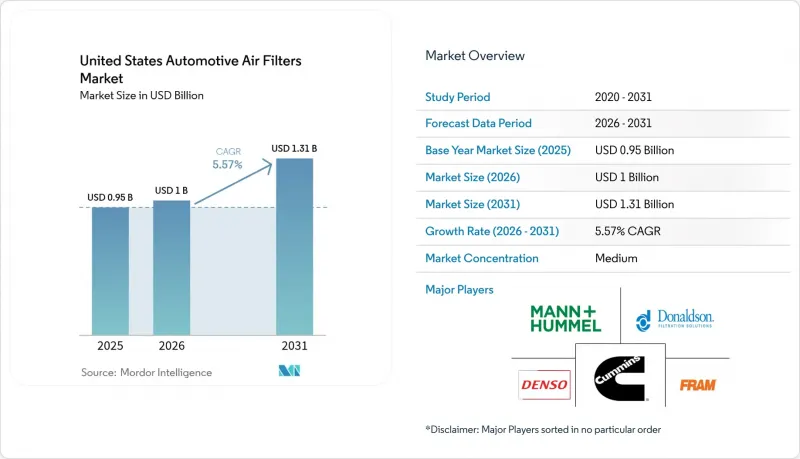
Mordor Intelligence에 의하면, 미국 자동차용 에어 필터 시장 규모는 2025년에 9억 5,000만 달러로 평가되었고 2026년 10억 달러에서 2031년까지 13억 1,000만 달러에 이를 것으로 예측되며, 예측 기간(2026-2031년) CAGR은 5.57%를 나타낼 전망입니다.
본 보고서는 소재 유형(종이, 합성섬유 등), 필터 유형(흡기 필터(셀룰로오스제 흡기 필터 등) 및 캐빈 필터(미세 입자용 등)),차종(승용차, 소형 상용차 등), 판매 채널(OEM 및 애프터마켓), 유통 채널(온라인 소매업체 등)별로 분류되어 있습니다. 시장 예측은 금액(달러) 기준으로 제시되어 있습니다.
미국 자동차용 에어 필터 시장 동향 및 인사이트
자동차 생산 증가 및 보유 대수 확대
자동차 생산 회복과 보유 대수 확대가 맞물려 수요가 두 배로 급증하고 있습니다. 정비에 가장 적합한 시기를 맞이한 6-14년 차 차량은 약 1억 1,000만 대로, 이는 전체 차량의 38%를 차지하며 필터 교체 빈도 증가로 이어지고 있습니다. 소비자들이 신차 구매를 미루고 그 지출을 정비용 부품으로 돌리고 있는 것이 애프터마켓의 강력한 성장을 뒷받침하고 있습니다. 또한, 공급망 정상화에 따라 미국의 조립 공장이 생산을 확대함에 따라 OEM 수요도 증가하고 있습니다. 이러한 동향이 맞물려 공장 장착용 필터와 교체용 필터 모두에서 안정적인 판매량 증가가 뒷받침되고 있습니다.
엄격한 EPA 배기가스 기준
2027-2032년 모델 연도의 소형차에 관한 EPA의 최종 규정에서는 차량군 전체의 평균 온실가스 배출량을 절반으로 줄이는 동시에, 미국 전역에서 최초로 0.5 mg/mi의 입자상 물질 배출 상한치가 설정되었습니다. 따라서 자동차 제조업체는 직접 분사 엔진에 가솔린 미립자 필터를 장착해야 하며, 사실상 완전히 새로운 대량 생산형 필터 제품 라인이 추가되는 셈입니다. 규정 준수에 대한 압박은 역사적으로 더 엄격한 기준을 채택해 온 캘리포니아주와 기타 섹션 177 주에서 가장 높으며, 이는 조기 조달 주기를 촉진하여 전체 공급업체 기반에 파급 효과를 미치고 있습니다.
BEV로의 전환이 내연기관용 필터 수요를 억제
배터리 전기자동차(BEV) 모델에서는 연료 필터와 오일 필터가 필요 없어지며, 흡기 필터 수요도 감소합니다. 미국 환경보호청(EPA)은 2032년까지 소형차 판매 대수의 30%-56%가 전기차가 될 것으로 예측하고 있으며, 이는 내연기관(ICE) 전용 제품 카테고리에 구조적인 역풍이 될 것입니다. 신규로 등장한 BEV용 열 관리 필터가 판매량의 일정 부분을 보완할 수는 있겠지만, 2030년까지의 감소분을 완전히 상쇄할 수는 없어 기존 부품 제조업체들의 전반적인 성장 전망을 둔화시키고 있습니다.
부문 분석
2025년에도 종이 필터는 저렴한 비용과 접근 용이성 덕분에 미국 자동차용 에어 필터 시장 점유율의 41.72%를 계속 차지하고 있습니다. 이 부문은 확립된 금형 기반과 대량 생산 규모를 갖추고 있어, DIY 애호가나 차량 관리자에게 단가는 여전히 매력적인 수준을 유지하고 있습니다. 그럼에도 불구하고, 자동차 제조업체와 1차 공급업체들이 압력 손실을 증가시키지 않으면서도 뛰어난 미립자 포집 성능을 발휘하는 필터 재료를 지정하고 있기 때문에 나노섬유 복합 소재는 2031년까지 연평균 성장률(CAGR) 8.15%를 나타낼 것으로 예측되며, 이는 모든 기질 중 가장 빠른 성장 속도입니다. 합성 멜트블로우 블렌드는 내구성과 수용 가능한 효율을 겸비한 중가대 틈새 시장을 차지하고 있는 반면, 거즈와 폼은 고성능을 추구하는 애호가나 특수한 오프로드 장비용으로 제공되고 있습니다.
각 제조업체가 국내 생산 라인을 개조하고 나노 기술을 적용한 롤 제품의 양산에 나서면서 시장 동향은 변화하고 있습니다. 이에 따라 수입 의존도가 낮아지고, 관세 경감 전략과의 일관성이 확보되고 있습니다. 지속가능성에 대한 압력도 소재 선정에 영향을 미치고 있으며, PFAS 프리 코팅 및 재생 섬유는 신규 견적 요청(RFQ)에서 선택 사항에서 기본 요건으로 전환되고 있습니다. 환경 성능과 여과 성능의 균형을 유지할 수 있는 공급업체는 미국 자동차용 에어 필터 시장에서 우위를 점하고 있습니다. 예측 기간 동안 첨단 소재로의 가치 전환이 진행됨에 따라, 기존 종이 필터의 출하량이 정체되는 상황에서도 가격 적정화가 뒷받침될 것입니다.
2025년 매출의 55.48%를 차량 실내용 유닛이 차지하고 있으며, 이는 차량 내 웰니스 기능에 대한 소비자의 관심이 높아지고 있음을 뒷받침합니다. 입자 포집용 캐빈 필터는 여전히 판매량에서 선두를 유지하고 있지만, 알레르기 유발 물질, 산불 연기, 공기 중 바이러스에 대한 인식이 높아지는 것을 배경으로 HEPA 및 항바이러스형 필터는 2031년까지 연평균 성장률(CAGR) 12.57%로 확대되고 있습니다. 내연기관(ICE)에 여전히 필수적인 흡기 필터는 BEV의 점유율 확대에 따라 판매량이 점차 감소하는 추세이지만, 중형 트럭 및 오프로드 기계에서는 수요가 유지되고 있습니다. 연료 필터, 오일 필터, 변속기 필터는 애프터마켓에서 견조한 실적을 보이고 있으나, OEM 채널에서는 출고 시 장착되는 유닛이 장수명 설계를 채택함에 따라 정체 상태를 보이고 있습니다.
또한, 프리미엄 차량 실내용 필터는 기존 엔진용 에어 엘리먼트의 판매 감소를 상쇄할 만큼 높은 이익률을 가져오고 있습니다. 자동차 제조업체들은 현재 공기질 기술을 경쟁적 차별화 요인으로 삼아, 교체 시기를 운전자에게 알리는 커넥티드 센서와 첨단 필터를 결합한 제품을 출시하고 있습니다. 규제 당국은 실내 공기질 기준 제정을 검토하고 있어, 이 카테고리의 정당성을 더욱 높이고 있습니다. 이러한 요인들이 복합적으로 작용함에 따라, 차량 실내용 제품은 미국 자동차용 에어 필터 시장에서 계속해서 주요 성장 동력으로 자리매김할 것으로 확실시되고 있습니다.
기타 혜택:
- 엑셀 형식 시장 예측(ME) 시트
- 3개월간의 애널리스트 지원
자주 묻는 질문
목차
제1장 서론
제2장 조사 방법
제3장 주요 요약
제4장 시장 구도
제5장 시장 규모와 성장 예측
제6장 경쟁 구도
제7장 시장 기회와 향후 전망
JHS 26.09.11According to Mordor Intelligence, the United States automotive air filters market size was valued at USD 0.95 billion in 2025 and estimated to grow from USD 1 billion in 2026 to reach USD 1.31 billion by 2031, at a CAGR of 5.57% during the forecast period (2026-2031).
This report is Segmented by Material Type (Paper, Synthetic, and More), Filter Type (Intake Filters [Cellulose Intake and More] and Cabin Filters [Particulate and More]), Vehicle Type (Passenger Cars, Light Commercial Vehicles, and More), Sales Channel (OEM and Aftermarket), and Distribution Channel (Online Retailers and More). The Market Forecasts are Provided in Terms of Value (USD).
United States Automotive Air Filters Market Trends and Insights
Rise in Vehicle Production and Parc Growth
Vehicle production recovery and an expanding parc create a dual-demand surge. About 110 million units sit in the 6-14-year sweet spot for service, representing 38% of the total fleet and translating into higher filter-replacement frequency. Robust aftermarket expansion is supported by consumers deferring new-car purchases, which channels spending toward maintenance parts. OEM demand also rises as U.S. assembly plants ramp up output following supply-chain normalization. Together, these trends underpin stable volume increases across both factory-installed and replacement filters.
Stringent EPA Emission Standards
The EPA final rule for model-year 2027-2032 light-duty vehicles cuts fleet-average greenhouse-gas emissions in half and sets the first nationwide 0.5 mg/mi particulate limit. Automakers must therefore fit gasoline particulate filters on direct-injection engines, effectively adding an entirely new high-volume filter line. Compliance pressure is highest in California and other Section 177 states that historically adopt more aggressive thresholds, driving early procurement cycles that ripple through the supplier base.
Shift Toward BEVs Curbing ICE Filter Volumes
Battery-electric models eliminate fuel and oil filters and cut intake-air filter demand. The EPA forecasts that 30%-56% of light-duty sales will be electric by 2032, producing a structural headwind for ICE-specific categories. Although emerging BEV thermal-management filters offer partial volume substitution, they cannot fully offset the decline through 2030, tempering overall growth prospects for legacy component makers.
Other drivers and restraints analyzed in the detailed report include:
- Aging Fleet Boosting Aftermarket Demand
- Rising Adoption of Cabin Filters for In-Car Air Quality
- Raw-Material Price Volatility
For complete list of drivers and restraints, kindly check the Table Of Contents.
Segment Analysis
Paper still commands 41.72% of the United States automotive air filters market share in 2025, owing to low cost and wide availability. The segment's entrenched tooling base and mass-production scale keep unit prices attractive for do-it-yourself shoppers and fleet managers alike. Nevertheless, nanofiber composites are forecast to grow at an 8.15% CAGR through 2031, the fastest among all substrates, as automakers and tier-ones specify media that deliver superior particulate capture without boosting pressure drop. Synthetic melt-blown blends occupy a mid-price niche, marrying durability with acceptable efficiency, while gauze and foam serve performance enthusiasts and specialty off-highway equipment.
Momentum is shifting as manufacturers retrofit domestic lines to mass-produce nano-enabled rolls, reducing import exposure and aligning with tariff-mitigation strategies. Sustainability pressures also influence material choice: PFAS-free coatings and recycled fibers are moving from optional to baseline requirements in new RFQs. Suppliers able to balance environmental credentials with filtration performance gain an edge in the United States automotive air filters market. Over the forecast horizon, value migration toward advanced materials supports price realization even as traditional paper volumes plateau.
Cabin units generated 55.48% of 2025 revenue, underscoring the consumer pivot toward wellness features inside the vehicle. Particulate cabin filters remain the volume leader, yet HEPA and antiviral variants are advancing at a 12.57% CAGR to 2031, driven by heightened sensitivity to allergens, wildfire smoke, and airborne viruses. Intake-air filters, still essential for ICE engines, face gradual volume erosion as BEVs gain share, although medium-duty trucks and off-highway machinery sustain demand. Fuel, oil, and transmission filters hold steady in the aftermarket but plateau in OEM channels as factory-filled units adopt extended-life designs.
Premium cabin media also deliver higher margins that offset sliding sales of traditional engine-air elements. Automakers now market air-quality technology as a competitive differentiator, bundling advanced filters with connected sensors that alert drivers when replacements are due. Regulatory bodies are exploring indoor-air-quality standards, further legitimizing the category. Collectively, these forces ensure cabin products remain the principal growth engine within the United States automotive air filters market.
Complete Report Scope:
- By Material Type
- Paper
- Synthetic
- Gauze
- Foam
- Nanofiber / Composite
- Others
- By Filter Type
- Intake Filters
- Cellulose Intake
- Synthetic Intake
- Nanofiber / Composite Intake
- Cabin Filters
- Particulate
- Activated Carbon
- HEPA / Antiviral
- Intake Filters
- By Vehicle Type
- Passenger Cars
- Light Commercial Vehicles
- Medium and Heavy Commercial Vehicles
- Off-Highway (Construction and Agriculture)
- Two-Wheelers
- By Sales Channel
- OEM
- Aftermarket
- By Distribution Channel
- Online Retailers
- Brick and Mortar Retail
- Service Centers and Dealerships
List of Companies Covered in this Report:
- KandN Engineering Inc.
- Mahle GmbH
- AL Group Ltd.
- Parker-Hannifin Corp.
- MANN+HUMMEL Group
- Denso Corporation
- Robert Bosch GmbH
- ACDelco (General Motors)
- First Brands Group LLC
- Cummins Filtration Inc.
- Donaldson Company Inc.
- Sogefi Filtration USA
- Fram Group
- Baldwin Filters
- Ahlstrom-Munksjo
- Hengst North America
- WIX Filters
- Fleetguard
- Freudenberg Filtration Technologies
Additional Benefits:
- The market estimate (ME) sheet in Excel format
- 3 months of analyst support
TABLE OF CONTENTS
1 Introduction
- 1.1 Study Assumptions and Market Definition
- 1.2 Scope of the Study
2 Research Methodology
3 Executive Summary
4 Market Landscape
- 4.1 Market Overview
- 4.2 Market Drivers
- 4.2.1 Rise in vehicle production and parc growth
- 4.2.2 Stringent EPA / CARB emission standards
- 4.2.3 Aging fleet boosting aftermarket demand
- 4.2.4 Rising adoption of cabin filters for in-car air quality
- 4.2.5 Electrified powertrains need advanced thermal-air management
- 4.2.6 Nanofiber and antiviral media enter mass production
- 4.3 Market Restraints
- 4.3.1 Shift toward BEVs curbing ICE filter volumes
- 4.3.2 Raw-material (cellulose, synthetics) price volatility
- 4.3.3 Extended OEM service intervals lower replacement frequency
- 4.3.4 Growth of washable / reusable filters
- 4.4 Value / Supply-Chain Analysis
- 4.5 Regulatory Landscape
- 4.6 Technological Outlook
- 4.7 Porter's Five Forces
- 4.7.1 Bargaining Power of Suppliers
- 4.7.2 Bargaining Power of Buyers/Consumers
- 4.7.3 Threat of New Entrants
- 4.7.4 Threat of Substitute Products
- 4.7.5 Intensity of Competitive Rivalry
5 Market Size and Growth Forecasts (Value, USD)
- 5.1 By Material Type
- 5.1.1 Paper
- 5.1.2 Synthetic
- 5.1.3 Gauze
- 5.1.4 Foam
- 5.1.5 Nanofiber / Composite
- 5.1.6 Others
- 5.2 By Filter Type
- 5.2.1 Intake Filters
- 5.2.1.1 Cellulose Intake
- 5.2.1.2 Synthetic Intake
- 5.2.1.3 Nanofiber / Composite Intake
- 5.2.2 Cabin Filters
- 5.2.2.1 Particulate
- 5.2.2.2 Activated Carbon
- 5.2.2.3 HEPA / Antiviral
- 5.2.1 Intake Filters
- 5.3 By Vehicle Type
- 5.3.1 Passenger Cars
- 5.3.2 Light Commercial Vehicles
- 5.3.3 Medium and Heavy Commercial Vehicles
- 5.3.4 Off-Highway (Construction and Agriculture)
- 5.3.5 Two-Wheelers
- 5.4 By Sales Channel
- 5.4.1 OEM
- 5.4.2 Aftermarket
- 5.5 By Distribution Channel
- 5.5.1 Online Retailers
- 5.5.2 Brick and Mortar Retail
- 5.5.3 Service Centers and Dealerships
6 Competitive Landscape
- 6.1 Market Concentration
- 6.2 Strategic Moves
- 6.3 Market Share Analysis
- 6.4 Company Profiles (includes Global level Overview, Market level overview, Core Segments, Financials as available, Strategic Information, Market Rank/Share for key companies, Products and Services, and Recent Developments)
- 6.4.1 KandN Engineering Inc.
- 6.4.2 Mahle GmbH
- 6.4.3 AL Group Ltd.
- 6.4.4 Parker-Hannifin Corp.
- 6.4.5 MANN+HUMMEL Group
- 6.4.6 Denso Corporation
- 6.4.7 Robert Bosch GmbH
- 6.4.8 ACDelco (General Motors)
- 6.4.9 First Brands Group LLC
- 6.4.10 Cummins Filtration Inc.
- 6.4.11 Donaldson Company Inc.
- 6.4.12 Sogefi Filtration USA
- 6.4.13 Fram Group
- 6.4.14 Baldwin Filters
- 6.4.15 Ahlstrom-Munksjo
- 6.4.16 Hengst North America
- 6.4.17 WIX Filters
- 6.4.18 Fleetguard
- 6.4.19 Freudenberg Filtration Technologies
7 Market Opportunities and Future Outlook
- 7.1 White-space and unmet-need assessment


