

|
시장보고서
상품코드
2100524
포토닉스 시장 : 시장 점유율 분석, 업계 동향 및 통계, 성장 예측(2026-2031년)Photonics - Market Share Analysis, Industry Trends & Statistics, Growth Forecasts (2026 - 2031) |
||||||
 Mordor Intelligence
Mordor Intelligence에 의하면, 포토닉스 시장 규모는 2026년에 1조 4,600억 달러에 이를 것으로 추정되고, 2031년까지 1조 7,900억 달러로 확대될 것으로 예측되며, 이것은 예측 기간 중 CAGR이 4.16%에 상당할 것으로 전망됩니다.
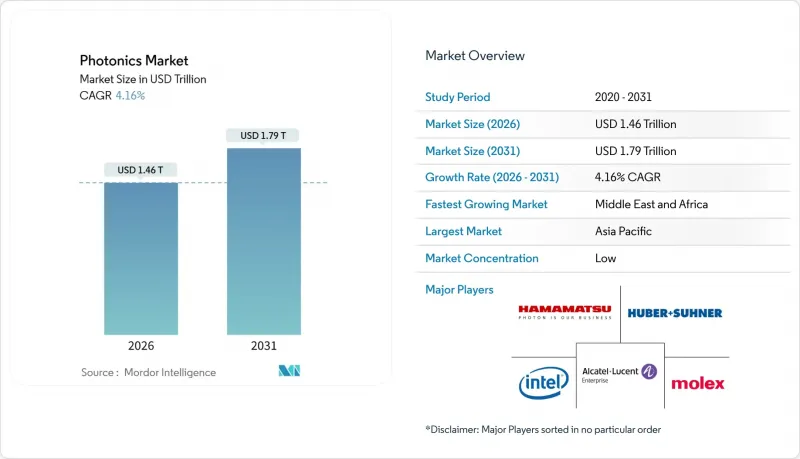
본 보고서는 제품별(레이저, LED, 센서·검출기, 광섬유·도파관, 변조기·스위치, 기타), 소재별(실리콘, 유리·실리카, 기타), 파장별(자외선, 가시광선, 적외선), 최종 사용자 산업별(소비자 가전, 항공우주 및 방위, 기타), 지역별로 분류되어 있습니다. 시장 전망은 금액(달러) 기준으로 제시되어 있습니다.
세계의 포토닉스 시장 동향 및 인사이트
데이터센터 상호 연결의 확산이 실리콘 포토닉스 트랜시버 수요를 견인
하이퍼스케일 사업자들은 AI 트레이닝 클러스터의 지연 시간과 전력 소비를 줄이기 위해, 400기가비트 플러그인형 광 모듈에서 800기가비트 및 1.6테라비트 코패키지형 모듈로 업그레이드를 진행하고 있습니다. 인텔은 2024년 실리콘 포토닉스 매출이 전년 대비 40% 증가했다고 보고했으며, 그 원동력은 홀당 1만 대가 넘는 가속기를 탑재한 GPU 포드로의 출하입니다. (2) 루멘텀의 1.6테라비트 클라우드 AI 플랫폼은 15와트의 열설계전력(TDP)을 실현하고 있으며, 데이터센터 설계자들은 디스크리트형 트랜시버를 온보드 광모듈로 대체하도록 권장받고 있습니다. 이에 따라 기존 모듈 공급업체들은 매출 총이익률을 유지하기 위해 포토닉 IC 설계 회사를 인수하고 있습니다. 이러한 생산 확대에 따라 인듐 인화물(InP) 게인 칩 공급 부족이 두드러지고 있으며, 일본과 미국에서는 기판 생산 능력이 여전히 100mm 웨이퍼로 제한되어 있습니다.
중국 자동차 제조업체의 LiDAR 기반 ADAS 도입 현황
중국의 전기차(EV) 브랜드는 2025년에 120만 대의 승용차에 LiDAR 센서를 탑재했습니다. 그 보급률은 18%에 달했고, 유럽 및 북미의 7%를 크게 상회했습니다. BYD의 'Seal'·'Han' 모델은 Hesai가 제조한 500달러짜리 솔리드 스테이트 유닛을 채택하여, 이를 통해 기계식 스캔 방식의 대체품에 비해 비용을 절반으로 줄였습니다. NIO는 Innovusion이 제조한 1,550나노미터 파이버 레이저 유닛과 장거리 감지 기능을 결합한 시스템을 채택하고 있으며, EU 규제 당국은 이를 레벨 3 자율주행 인증 대상으로 평가했습니다. 급속한 보급으로 인해 갈륨비소 에지 에미팅 레이저의 비용 곡선이 압축되고 있으며, Tier 2 공급업체는 2026년 말까지 300달러 미만의 모듈을 시장에 출시할 수 있게 될 것입니다. 이러한 동향은 실리콘 어벌란시 포토다이오드 및 고주파 드라이버 IC에 대한 파급 수요를 창출하고 있습니다.
화합물 반도체 웨이퍼의 병목 현상(InP, GaN: 150mm 미만)
인듐 인화물 및 갈륨 질화물 기판은 여전히 100mm·150mm 크기로 제한되어 있으며, 웨이퍼 가격은 각각 1,500달러·800달러에 머물고 있습니다. 이에 비해 300mm 실리콘의 가격은 50달러입니다. 2025년에는 코히런트 트랜시버 수요가 급증함에 따라 리드타임이 26주까지 늘어났습니다. 미국의 금속 유기 화학 기상 증착(MOCVD) 장비에 대한 수출 규제로 인해 공급은 더욱逼迫되었고, 중국의 팹은 국산 장비 인증을 받을 수밖에 없었습니다. 200mm로 규모를 확대할 경우, 10? cm?2를 초과하는 결함 밀도가 발생하여 수율이 저하되고 있습니다. 이러한 제약은 실리콘으로 대체할 수 없는 고주파 파워 앰프나 고출력 레이저 분야에서 가장 심각합니다.
부문 분석
2025년 제품 매출액 중 레이저가 38.32%를 차지했으며, 포토닉스 시장에서 최대 점유율을 차지하는 위상을 입증하고 있습니다. IPG사와 Trumpf사의 파이버 레이저 시스템은 금속 절단, 용접, 적층 가공 분야를 휩쓸고 있습니다. Coherent사는 2024년에 센싱 및 펌핑 용도로 200만 개의 에지 에미팅 다이오드 바를 출하하여, LiDAR 및 의료용 펌핑 분야로의 깊은 침투를 두드러지게 보여주고 있습니다. 2031년까지의 연평균 성장률(CAGR)은 4.91%로 예측됩니다. 이는 51.2테라비트 스위치에서 코패키지드 옵틱스가 플러그인식 모듈을 대체하고 있기 때문입니다. 일반 조명용 LED는 이익률 압박에 직면해 있지만, 증강현실(AR) 및 자동차용 헤드업 디스플레이용 마이크로 LED 디스플레이에는 AMS OSRAM과 Plessey로부터 미화 규모의 투자가 몰리고 있습니다.
센서, 검출기, 광섬유, 포토닉스 부품의 ‘롱테일’ 제품군은 시스템 성능에 있어 여전히 필수적입니다. 하마마츠 포토닉스는 바이오 센싱 및 자율주행차 수요에 힘입어 2024년 검출기 출하량이 25% 증가했습니다. 코닝(Corning)사의 굽힘에 강한 광섬유는 5G 프론트홀의 굽힘 반경 요건을 충족하며, 2024년에는 1억 광섬유 킬로미터 이상을 출하했습니다. 아이솔레이터나 서큘레이터와 같은 마이크로 옵틱스는 계속해서 통신 등급의 신뢰성을 실현하고 있습니다. 각 틈새 시장 규모는 작지만, 이들이 종합적으로 포토닉스 시장 전체의 성장을 뒷받침하고 있습니다.
실리콘은 실리콘 포토닉스 트랜시버 및 CMOS 이미지 센서에서의 압도적인 사용량 덕분에 2025년에도 매출 점유율 34.52%를 유지했습니다. 그러나 복합 반도체는 그 성능이 직접 밴드갭 및 광대역 갭 특성에 의존하기 때문에 더 높은 매출 총이익률을 실현하고 있습니다. 인듐 인화물은 레이저 선폭이 100 kHz 미만인, 실리콘 단독으로는 달성할 수 없는 파라미터를 실현하는 코히런트 400G·800G 트랜시버의 기반이 되고 있습니다. 질화갈륨은 전기차용 인버터에서 1,200V 이상의 전압 영역에서 실리콘 카바이드를 대체하고 있으며, 인피니온과 울프스피드는 구동 시스템용으로 200mm 웨이퍼를 출하하고 있습니다. 폴리머와 플라스틱은 틈새 시장이지만, 유연한 도파관이 웨어러블 생체 센서나 폴더블 디스플레이에 채택됨에 따라 연평균 성장률(CAGR) 4.67%로 성장을 지속하고, 있습니다.
다이아몬드·사파이어 기판은 방위·레이저 시장의 극한 열적·기계적 요구 사항을 충족하고 있습니다. 유리 및 실리카는 광섬유, 리소그래피용 미러, 정밀 렌즈의 주력 소재로 계속 사용되고 있으며, 샷(Schott)과 오하라(Ohara)는 심자외선 스캐너용 초저팽창 등급 제품을 공급하고 있습니다. 이러한 소재 구성의 진화는 복합 소재 및 특수 용도 플랫폼으로의 꾸준한 전환을 보여주고 있으며, 이는 광범위한 포토닉스 시장의 핵심 테마가 되고 있습니다.
지역별 분석
아시아태평양은 2025년 매출의 41.37%를 차지했으며, 포토닉스 시장에서 가장 규모가 큰 지역 블록으로서의 입지를 공고히 했습니다. 중국의 LiDAR 생태계, 일본의 정밀 포토닉스 기기, 한국의 디스플레이용 백라이트가 긴밀한 공급망 네트워크를 형성하고 있습니다. 2025년에는 중국 alone이 전 세계 LiDAR 출하량의 60%를 차지했으며, 그중 Hesai와 RoboSense가 65%를 독점했습니다. 인도의 ‘생산 연계 인센티브(PLI)’ 정책에 따라 동남아시아에서 벵갈루루와 하이데라바드로 조립 라인이 이전되고 있으며, 이러한 움직임으로 인해 2031년까지 인도의 포토닉스 시장 점유율이 완만하게 확대될 것으로 예측됩니다. 각 주 정부는 수출 규제와 국내 조달률 목표 간의 균형을 지속적으로 유지하며, 포토닉스 시장의 발전 방향을 형성하고 있습니다.
북미는 실리콘 포토닉스, 트랜시버, 방위용 포토닉스의 설계 거점으로서의 위상을 유지하고 있습니다. 2024년에는 인텔, 브로드컴, 팹리스 스타트업 그룹이 데이터센터용 광모듈 매출의 약 55%를 차지했습니다. 방위 관련 계약으로 인해 미국의 수출 허가 요건을 준수해야 하는 야간 투시 장치 및 미사일 유도용 포토닉스 시스템에 대한 안정적인 수요가 발생하고 있습니다. 이러한 우위에도 불구하고, 비용 중심의 제조는 조립 및 시험 공정에서 점차 멕시코로 이전되고 있습니다. 유럽은 ASML, 트럼프, 칼 자이스와 같은 장비 공급업체를 활용하여 포토닉스 밸류체인 내 부가가치 거점으로서의 입지를 확고히 하고 있습니다.
중동은 가장 빠르게 성장하는 지역으로, 2031년까지 연평균 성장률(CAGR)이 5.23%를 나타낼 것으로 예측됩니다. 아랍에미리트(UAE)와 사우디아라비아의 정부계 펀드는 각각 수백 페타비트의 광 연결이 필요한 하이퍼스케일 데이터센터에 30억 달러를 배정하고 있습니다. 50년간의 면세 조치 및 데이터 상주 요건 완화 등 규제상의 우대 조치로 인해, 그동안 유럽에 집중되어 있던 클라우드 플랫폼이 유치되고 있습니다. 남미와 아프리카는 여전히 발전 단계에 있지만, FTTH(Fiber-to-the-Home) 및 5G 백홀 분야에서 기회가 예상되며, 향후 10년 동안 포토닉스 시장 규모를 단계적으로 확대할 것으로 보입니다.
기타 혜택 :
- 엑셀 형식 시장 예측(ME) 시트
- 3개월간의 애널리스트 지원
자주 묻는 질문
목차
제1장 서론
제2장 조사 방법
제3장 주요 요약
제4장 시장 구도
제5장 시장 규모 및 성장 예측
제6장 경쟁 구도
제7장 시장 기회 및 향후 전망
AJY 26.08.11According to Mordor Intelligence, the photonics market size reached USD 1.46 trillion in 2026 and is projected to climb to USD 1.79 trillion by 2031, translating into a 4.16% CAGR over the forecast period.
This report is Segmented by Product (Lasers, Leds, Sensors and Detectors, Optical Fibers and Waveguides, Modulators and Switches, and Other Products), Material (Silicon, Glass and Silica, and More), Wavelength (Ultraviolet, Visible, and Infrared), End-User Industry (Consumer Electronics, Aerospace and Defense, and More), and Geography. The Market Forecasts are Provided in Terms of Value (USD).
Global Photonics Market Trends and Insights
Proliferation Of Data-Center Interconnect Spurring Silicon-Photonics Transceiver Demand
Hyperscale operators are upgrading from 400-gigabit pluggable optics to 800-gigabit and 1.6-terabit co-packaged modules to lower latency and power budgets in AI training clusters. Intel reported 40% year-over-year silicon-photonics revenue growth in 2024, anchored by shipments into GPU pods exceeding 10,000 accelerators per hall.[2] Lumentum's 1.6-terabit Cloud AI platform delivers 15-watt thermal envelopes, encouraging data-center architects to replace discrete transceivers with on-board optics. Traditional module vendors are therefore acquiring photonic-IC design houses to protect gross margins. The ramp is exposing a shortage of indium-phosphide gain chips, where substrate capacity remains limited to 100 mm wafers in Japan and the United States.
Adoption Of LiDAR-Based ADAS Across Chinese Automotive OEMs
Chinese electric-vehicle brands integrated LiDAR sensors into 1.2 million passenger cars during 2025, an 18% penetration rate that dwarfed the 7% seen in Europe and North America. BYD's Seal and Han models employ USD 500 solid-state units from Hesai, halving the cost of mechanically scanned alternatives. NIO pairs Innovusion 1,550-nanometer fiber-laser units with long-range detection that EU regulators are evaluating for Level 3 autonomy certification. Rapid uptake is compressing cost curves for gallium-arsenide edge-emitting lasers, enabling tier-two suppliers to introduce sub-USD 300 modules by late 2026. The trend is creating spill-over demand for silicon avalanche photodiodes and high-frequency driver ICs.
Compound-Semiconductor Wafer Bottlenecks (InP, GaN <150 mm)
Indium-phosphide and gallium-nitride substrates remain confined to 100 mm and 150 mm sizes, keeping wafer prices at USD 1,500 and USD 800 respectively versus USD 50 for 300 mm silicon. Lead times stretched to 26 weeks in 2025 as coherent-transceiver demand spiked. Trade controls imposed by the United States on metal-organic chemical-vapor-deposition tools further tightened supply, forcing Chinese fabs to qualify domestic equipment. Scaling to 200 mm faces defect densities above 10^4 cm^-2 that degrade yield. The constraint is most acute in radio-frequency power amplifiers and high-power lasers where silicon substitutes are infeasible.
Other drivers and restraints analyzed in the detailed report include:
- EU Green-Deal Incentives for Micro-LED And GaN Photonics Fabs
- India's PLI Scheme Catalyzing Domestic Photonics Clusters
- Thermal-Management Limits On >10 kW Diode Lasers
For complete list of drivers and restraints, kindly check the Table Of Contents.
Segment Analysis
Lasers generated 38.32% of 2025 product revenue, underscoring their status as the largest slice of the photonics market. Fiber-laser systems from IPG and Trumpf dominate metal cutting, welding, and additive manufacturing. Coherent shipped 2 million edge-emitting diode bars in 2024 for sensing and pumping, highlighting deep penetration into LiDAR and medical pumping tasks. Modulators and switches are slated for a 4.91% CAGR through 2031 as co-packaged optics displace pluggable modules in 51.2-terabit switches. Although general-illumination LEDs face margin pressure, micro-LED displays for augmented reality and automotive head-up systems are drawing USD-scale investments from AMS OSRAM and Plessey.
The long tail of sensors, detectors, fibers, and optical components remains essential for system performance. Hamamatsu recorded 25% shipment growth in detectors during 2024, driven by biosensing and autonomous-vehicle demand. Corning's bend-insensitive fiber met 5G fronthaul bend-radius requirements, shipping more than 100 million fiber-kilometers in 2024. Micro-optics such as isolators and circulators continue to enable telecom-grade reliability. While each niche is small, collectively they support the broader rise of the photonics market.
Silicon retained 34.52% revenue share in 2025 due to dominant use in silicon-photonics transceivers and CMOS image sensors. Yet compound semiconductors fetch higher gross margins because performance hinges on direct bandgap and wide-bandgap attributes. Indium-phosphide underpins coherent 400G and 800G transceivers with laser linewidths below 100 kHz, an unattainable parameter for silicon alone. Gallium-nitride is replacing silicon carbide above 1,200 V in electric-vehicle inverters, with Infineon and Wolfspeed shipping 200 mm wafers into traction platforms. Polymers and plastics, while only a niche, are registering a 4.67% CAGR as flexible waveguides enter wearable biosensors and foldable displays.
Diamond and sapphire substrates address extreme thermal or mechanical demands in defense and laser markets. Glass and silica remain workhorses for optical fibers, lithography mirrors, and precision lenses, with Schott and Ohara supplying ultra-low-expansion grades for deep-ultraviolet scanners. The evolving material mix signals a steady shift toward compound and specialty platforms, a core theme inside the wider photonics market.
Complete Report Scope:
- By Product
- Lasers
- Diode Lasers
- Fiber Lasers
- Solid-State and Others
- LEDs
- Sensors and Detectors
- Optical Fibers and Waveguides
- Modulators and Switches
- Other Products
- Lasers
- By Material
- Silicon
- Glass and Silica
- Compound Semiconductors (InP, GaAs, GaN)
- Polymers and Plastics
- Other Materials
- By Wavelength
- Ultraviolet (UV)
- Visible
- Infrared
- By End-User Industry
- Consumer Electronics
- Aerospace and Defense
- Display and Imaging
- Solar Photovoltaics
- LED Lighting
- Medical and Bio-Instrumentation
- Industrial and Manufacturing
- Automotive (incl. LiDAR)
- Data and Telecom
- Other End-User Industries
- By Geography
- North America
- United States
- Canada
- Mexico
- Europe
- Germany
- United Kingdom
- France
- Italy
- Spain
- Rest of Europe
- Asia Pacific
- China
- Japan
- South Korea
- India
- South-East Asia
- Rest of Asia Pacific
- South America
- Brazil
- Rest of South America
- Middle East
- United Arab Emirates
- Saudi Arabia
- Rest of Middle East
- Africa
- South Africa
- Rest of Africa
- North America
Geography Analysis
Asia Pacific commanded 41.37% of 2025 revenue, confirming its position as the largest regional block within the photonics market. China's LiDAR ecosystem, Japan's precision optics, and South Korea's display backlights create a dense supplier network. China alone shipped 60% of global LiDAR units in 2025, with Hesai and RoboSense controlling 65% of that volume. India's Production-Linked Incentive policy is drawing assembly lines from Southeast Asia into Bengaluru and Hyderabad, a shift expected to raise India's photonics market share modestly by 2031. Regional governments continue to balance export controls with domestic content targets, shaping how the photonics market evolves.
North America remains the design nucleus for silicon-photonics transceivers and defense photonics. Intel, Broadcom, and a cluster of fabless startups claimed roughly 55% of data-center optical-module sales in 2024. Defense contracting funnels steady demand for night-vision and missile-seeker optics that require U.S. export-license compliance. Despite these advantages, cost-sensitive manufacturing is gradually migrating toward Mexico for assembly and test operations. Europe leverages equipment suppliers ASML, Trumpf, and Carl Zeiss, positioning the region as a value-added node in the photonics supply chain.
The Middle East is the fastest-growing geography, forecast for a 5.23% CAGR through 2031. Sovereign wealth funds in the United Arab Emirates and Saudi Arabia have earmarked USD 3 billion for hyperscale data centers that each require hundreds of petabits of optical connectivity. Regulatory incentives include 50-year tax holidays and relaxed data-residency mandates, attracting cloud platforms previously concentrated in Europe. South America and Africa remain nascent but show fiber-to-the-home and 5G backhaul opportunities that will incrementally enlarge the photonics market size over the next decade.
- Hamamatsu Photonics KK
- Intel Corporation
- Nokia Corporation
- Coherent Corp.
- AMS OSRAM AG
- IPG Photonics Corp.
- Signify NV
- Lumentum Holdings Inc.
- Infinera Corp.
- NEC Corp.
- Corning Inc.
- Schott AG
- Thorlabs Inc.
- Jenoptik AG
- Trumpf Photonics GmbH
- Molex, LLC
- Rockley Photonics Ltd.
- Innolume GmbH
- Aeva Technologies Inc.
- Broadcom Inc. (Silicon Photonics)
- Carl Zeiss AG
- Nikon Corp.
- Teledyne Technologies Inc.
Additional Benefits:
- The market estimate (ME) sheet in Excel format
- 3 months of analyst support
TABLE OF CONTENTS
1 INTRODUCTION
- 1.1 Study Assumptions and Market Definition
- 1.2 Scope of the Study
2 RESEARCH METHODOLOGY
3 EXECUTIVE SUMMARY
4 MARKET LANDSCAPE
- 4.1 Market Overview
- 4.2 Market Drivers
- 4.2.1 Proliferation of Data-Center Interconnect Spurring Silicon Photonics Transceiver Demand
- 4.2.2 Adoption of LiDAR-Based ADAS Across Chinese Automotive OEMs
- 4.2.3 EU Green-Deal Incentives for Micro-LED and GaN Photonics Fabs
- 4.2.4 India's PLI Scheme Catalyzing Domestic Photonics Clusters
- 4.2.5 Point-of-Care Biosensing Surge in United States and Europe
- 4.2.6 Satellite Mega-Constellation Investments in Space-Qualified Photonics
- 4.3 Market Restraints
- 4.3.1 Compound-Semiconductor Wafer Bottlenecks (InP, GaN <150 mm)
- 4.3.2 Thermal-Management Limits on >10 kW Diode Lasers
- 4.3.3 Interoperability Gaps Among Integrated Photonic IC Standards
- 4.3.4 U.S.- China Trade Controls Elevating Cap-Ex Risk for Tool Makers
- 4.4 Industry Value-Chain Analysis
- 4.5 Regulatory Landscape
- 4.6 Technological Outlook
- 4.7 Impact of Macroeconomic Factors on the Market
- 4.8 Porter's Five Forces Analysis
- 4.8.1 Bargaining Power of Suppliers
- 4.8.2 Bargaining Power of Buyers
- 4.8.3 Threat of New Entrants
- 4.8.4 Threat of Substitutes
- 4.8.5 Intensity of Competitive Rivalry
5 MARKET SIZE AND GROWTH FORECASTS (VALUE)
- 5.1 By Product
- 5.1.1 Lasers
- 5.1.1.1 Diode Lasers
- 5.1.1.2 Fiber Lasers
- 5.1.1.3 Solid-State and Others
- 5.1.2 LEDs
- 5.1.3 Sensors and Detectors
- 5.1.4 Optical Fibers and Waveguides
- 5.1.5 Modulators and Switches
- 5.1.6 Other Products
- 5.1.1 Lasers
- 5.2 By Material
- 5.2.1 Silicon
- 5.2.2 Glass and Silica
- 5.2.3 Compound Semiconductors (InP, GaAs, GaN)
- 5.2.4 Polymers and Plastics
- 5.2.5 Other Materials
- 5.3 By Wavelength
- 5.3.1 Ultraviolet (UV)
- 5.3.2 Visible
- 5.3.3 Infrared
- 5.4 By End-User Industry
- 5.4.1 Consumer Electronics
- 5.4.2 Aerospace and Defense
- 5.4.3 Display and Imaging
- 5.4.4 Solar Photovoltaics
- 5.4.5 LED Lighting
- 5.4.6 Medical and Bio-Instrumentation
- 5.4.7 Industrial and Manufacturing
- 5.4.8 Automotive (incl. LiDAR)
- 5.4.9 Data and Telecom
- 5.4.10 Other End-User Industries
- 5.5 By Geography
- 5.5.1 North America
- 5.5.1.1 United States
- 5.5.1.2 Canada
- 5.5.1.3 Mexico
- 5.5.2 Europe
- 5.5.2.1 Germany
- 5.5.2.2 United Kingdom
- 5.5.2.3 France
- 5.5.2.4 Italy
- 5.5.2.5 Spain
- 5.5.2.6 Rest of Europe
- 5.5.3 Asia Pacific
- 5.5.3.1 China
- 5.5.3.2 Japan
- 5.5.3.3 South Korea
- 5.5.3.4 India
- 5.5.3.5 South-East Asia
- 5.5.3.6 Rest of Asia Pacific
- 5.5.4 South America
- 5.5.4.1 Brazil
- 5.5.4.2 Rest of South America
- 5.5.5 Middle East
- 5.5.5.1 United Arab Emirates
- 5.5.5.2 Saudi Arabia
- 5.5.5.3 Rest of Middle East
- 5.5.6 Africa
- 5.5.6.1 South Africa
- 5.5.6.2 Rest of Africa
- 5.5.1 North America
6 COMPETITIVE LANDSCAPE
- 6.1 Market Concentration
- 6.2 Strategic Moves
- 6.3 Market Share Analysis
- 6.4 Company Profiles (includes Global Level Overview, Market Level Overview, Core Segments, Financials as Available, Strategic Information, Market Rank, Products and Services, Recent Developments)
- 6.4.1 Hamamatsu Photonics KK
- 6.4.2 Intel Corporation
- 6.4.3 Nokia Corporation
- 6.4.4 Coherent Corp.
- 6.4.5 AMS OSRAM AG
- 6.4.6 IPG Photonics Corp.
- 6.4.7 Signify NV
- 6.4.8 Lumentum Holdings Inc.
- 6.4.9 Infinera Corp.
- 6.4.10 NEC Corp.
- 6.4.11 Corning Inc.
- 6.4.12 Schott AG
- 6.4.13 Thorlabs Inc.
- 6.4.14 Jenoptik AG
- 6.4.15 Trumpf Photonics GmbH
- 6.4.16 Molex, LLC
- 6.4.17 Rockley Photonics Ltd.
- 6.4.18 Innolume GmbH
- 6.4.19 Aeva Technologies Inc.
- 6.4.20 Broadcom Inc. (Silicon Photonics)
- 6.4.21 Carl Zeiss AG
- 6.4.22 Nikon Corp.
- 6.4.23 Teledyne Technologies Inc.
7 MARKET OPPORTUNITIES AND FUTURE OUTLOOK
- 7.1 White-Space and Unmet-Need Assessment


