

|
시장보고서
상품코드
2100531
인도의 페인트 및 코팅 시장 : 시장 점유율 분석, 업계 동향 및 통계, 성장 예측(2026-2031년)India Paints and Coatings - Market Share Analysis, Industry Trends & Statistics, Growth Forecasts (2026 - 2031) |
||||||
 Mordor Intelligence
Mordor Intelligence에 의하면, 인도의 페인트 및 코팅 시장 규모는 2025년 114억 5,000만 달러로 평가되었고, 2026년에는 125억 1,000만 달러로 확대될 것으로 추정되고, 2031년까지 195억 달러에 이를 것으로 예상되며, 2026-2031년 CAGR 9.28%로 성장할 전망입니다.
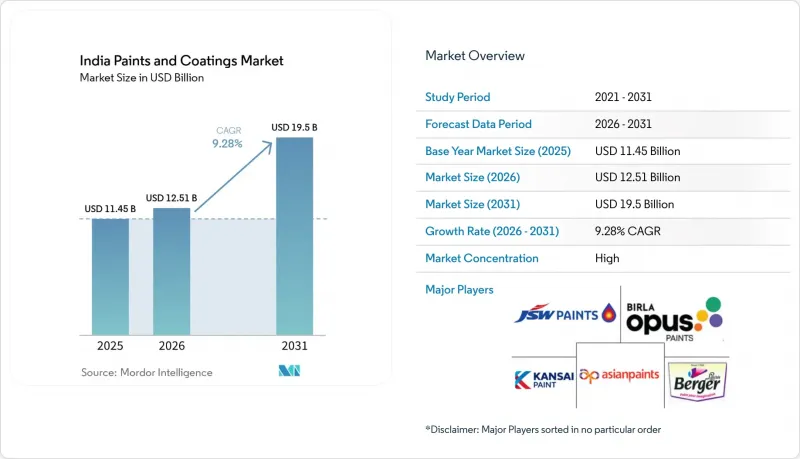
본 보고서는 기술별(수성, 용제계, 분체 도료, 기타 기술), 수지 유형별(아크릴, 알키드, 폴리우레탄, 에폭시, 폴리에스터, 기타), 최종 사용자 산업별(건축, 자동차, 목재, 보호 코팅, 일반 산업, 운송, 포장)로 분류되어 있습니다. 시장 전망은 금액(달러) 기준으로 제시되어 있습니다.
인도의 페인트 및 코팅 시장 동향 및 인사이트
활기를 띠고 있는 건설 프로젝트(주택 및 인프라)
2023-24 회계연도, 정부의 자본 지출은 급증하여 2015 회계연도 대비 3배에 달했습니다. '스마트 시티 미션', 바라트-마라 회랑, 지하철망 확장 등의 사업이 보호용 도료, 바닥용 도료, 건축용 도료에 대한 지속적인 수요를 뒷받침하고 있습니다. 농촌 지역에 상수도 공급을 실현한 ‘잘 지반 미션’은 정수장 및 배관 분야의 부식 방지 도료 수요 증가를 뒷받침하고 있습니다. '프라단 만트리 아와스 요자나 어반(PMAY-Urban)'은 2024년까지 주택 공급에 성공하여, 장식용 도료 판매량에 직접적인 혜택을 가져다주고 있습니다. 한편, 국도에 대한 정기적인 유지 관리 수요로 인해 산업 용도료 수요도 증가하고 있습니다.
도시 지역 주택 소유자의 장식용 도장 주기 단축
가처분 소득 증가와 디지털 색상 시각화 도구의 등장으로 2031년까지 평균 재도장 주기가 단축될 전망입니다. 저취 고품질 에멀젼 도료를 사용하면 시공 당일 재입주가 가능해져, 고부가가치 제품의 비중 확대를 뒷받침하고 있습니다. 국내 제조업체들은 도급업체 대상 연수 프로그램을 통해 수성 도료를 ‘도장 주기 전체를 고려할 때 비용 대비 효과가 높다’고 포지셔닝하며, 지역 업체들의 ‘가격만을 강조하는 영업’에 대응하고 있습니다.
원유 가격에 연동되는 원자재 가격 변동
2024-2025년, 도료 배합 비용의 대부분을 차지하는 주요 성분인 이산화티타늄(TiO2)의 가격이 변동했습니다. 이러한 변동은 주로 전 세계적인 공급 차질과 원유 가격 변동의 영향을 받은 것으로, 이는 결국 석유화학 유래 바인더와 용제에도 영향을 미치고 있습니다. 원자재 인플레이션으로 인해 이익률이 압박받았고, 각사는 판매 점유율을 유지하기 위해 상승하는 투입 비용을 흡수한 결과, 매출 총이익률이 하락했습니다. 또한, 경쟁 심화로 인해 업계 전체의 이익률도 축소되고 있어, 상승한 원가분을 완전히 전가하기가 어려워지고 있습니다. 게다가 아연 및 알루미늄 가격 변동은 지붕재와 외벽재에 널리 사용되는 컬러 강판의 코팅에도 영향을 미치고 있습니다. 이 문제를 더욱 심각하게 만드는 것은 수입품이 국내 제품보다 저렴한 가격에 공급된다는 점이며, 이로 인해 현지 제조업체의 이익률은 더욱 압박받고 있습니다. 해당 업계는 원자재 가격 급등분을 전가해야 하는 과제에 직면해 있습니다. 특히 빌라 오퍼스(Billa Opus)나 JSW 페인트(JSW Paints)와 같은 신규 진출기업들의 치열한 경쟁으로 인해, 각사는 영업 레버리지를 유지하기 위해 배합 최적화, 포장 비용 절감, 자동화 추진에 힘쓰고 있습니다.
부문 분석
2025년 기준, 인도 페인트 및 코팅 시장에서 수성 제품은 45.41%의 점유율을 차지했으며, 2031년까지 연평균 성장률(CAGR) 9.72%를 나타낼 것으로 예측됩니다. 규제적 압박에 더해, 용제형 제품과 비교해 도막 특성이 동등한 수준에 도달한 점이 장식용 및 일반 산업용 모두에서 수성 제품의 채택을 촉진하고 있습니다. 수성 UV 경화형 우레탄·아크릴레이트계 도료는 목재 마감 분야에서 점유율을 확대하고 있는 반면, 분체 도료는 가전제품 및 자동차 외장 트림 분야에서 지속적으로 점유율을 늘리고 있습니다. 급속한 경화와 극히 높은 내화학성이 요구되는 선박용 및 중공업용 부문에서는 여전히 용제형 도료가 주류를 이루고 있지만, 촉매 산화 장치에 대한 투자가 운영 비용을 상승시키고 있어 OEM 각사는 하이브리드형이나 고고형분형 대체품으로의 전환을 추진하고 있습니다.
2세대 수성 에멀전은 코어-쉘 기술 및 재분산성 분말 기술을 채택함으로써 내마모성과 습도에 의한 경화 제한을 극복하고, 인도 도료 업계 전반에 걸쳐 열대 기후 하에서 재도장 주기를 단축하고 있습니다. 분체 도료는 델리·NCR 주변의 가전 산업 클러스터 확장에 힘입어 북부 제조 회랑 지역에서 성장을 이루고 있습니다. 고고형분 알키드 도료와 방사선 경화형 잉크는 금속 포장 및 플렉서블 필름 라미네이션 분야의 특수 용도 수요를 충족시키며, 기술 포트폴리오의 다양화에 기여하고 있습니다.
기타 혜택 :
- 엑셀 형식 시장 예측(ME) 시트
- 3개월간의 애널리스트 지원
자주 묻는 질문
목차
제1장 서론
제2장 조사 방법
제3장 주요 요약
제4장 시장 구도
제5장 시장 규모 및 성장 예측
제6장 경쟁 구도
제7장 시장 기회 및 향후 전망
AJY 26.08.07According to Mordor Intelligence, the India paints and Coatings Market size is expected to increase from USD 11.45 billion in 2025 to USD 12.51 billion in 2026 and reach USD 19.5 billion by 2031, growing at a CAGR of 9.28% over 2026-2031.
This report is Segmented by Technology (Water-Borne, Solvent-Borne, Powder Coatings, and Other Technologies), Resin Type (Acrylic, Alkyd, Polyurethane, Epoxy, Polyester, and Others), and End-User Industry (Architectural, Automotive, Wood, Protective Coatings, General Industrial, Transportation, and Packaging). The Market Forecasts are Provided in Terms of Value (USD).
India Paints and Coatings Market Trends and Insights
Booming Construction Pipeline (Housing and Infrastructure)
In 2023-24, government capital expenditure surged, marking a threefold increase from FY 2015. Initiatives like the Smart Cities Mission, Bharatmala corridors, and metro-rail expansions are fueling a consistent demand for protective, floor, and architectural coatings. The Jal Jeevan Mission, which has provided rural tap-water connections, is spurring a heightened need for anti-corrosive coatings in treatment plants and pipelines. The Pradhan Mantri Awas Yojana-Urban (PMAY-Urban) has successfully delivered houses by 2024, directly benefiting decorative coating volumes. Meanwhile, industrial coatings are in demand due to the regular maintenance needs of national highways.
Shortening Decorative Re-paint Cycle among Urban Homeowners
Disposable-income gains and digital color-visualization tools are reducing the average repaint interval by 2031. Premium low-odor emulsions allow same-day reoccupation, supporting higher-value product mixes. National manufacturers are using contractor-training programs to position water-borne offerings as cost-effective over a full repaint cycle, countering price-only pitches from local players.
Crude-Linked Raw-Material Price Volatility
In 2024-2025, titanium dioxide (TiO2), a key component constituting a significant portion of paint formulation costs, saw its prices fluctuate. These swings were largely influenced by global supply disruptions and fluctuations in crude oil prices, which in turn impact petrochemical-derived binders and solvents. Inflation in raw materials led to margin compression, with gross margins declining as companies absorbed rising input costs to maintain their volume share. Industry margins also contracted due to heightened competitive intensity, which hampers the industry's ability to fully pass on cost increases. Additionally, volatility in zinc and aluminum prices impacts color-coated steel coatings, commonly used in roofing and cladding. Compounding the challenge, import competition prices these products lower than domestic offerings, further squeezing margins for local manufacturers. The sector grapples with the challenge of passing on raw material inflation. Intense price competition, especially from new entrants like Birla Opus and JSW Paints, has led companies to optimize formulations, trim packaging costs, and ramp up automation efforts to maintain their operating leverage.
Other drivers and restraints analyzed in the detailed report include:
- Post-COVID Recovery in Automotive and Industrial Production
- Emergence of Organised Waterproofing After-market
- Stricter BIS/CPCB VOC and Lead Regulations
For complete list of drivers and restraints, kindly check the Table Of Contents.
Segment Analysis
Water-borne products held 45.41% of India's paints and coatings market share in 2025 and are projected to grow at a 9.72% CAGR through 2031. Regulatory pressure, coupled with improved film-property parity versus solvent systems, underpins adoption in both decorative and general industrial applications. Water-based UV-curable urethane-acrylate systems are gaining a foothold in wood finishes, while powder coatings continue to build in appliance and automotive exterior trims. Solvent solutions still dominate marine and heavy-duty segments that require rapid curing and extreme chemical resistance, but investments in catalytic-oxidation units raise operating costs, nudging OEMs toward hybrid or high-solid alternatives.
Second-generation water-borne emulsions use core-shell and redispersible-powder technologies to overcome scrub-resistance and humidity-cure limitations, enabling faster re-coat windows in tropical climates across the Paint Industry in India. Powder coatings are enjoying growth in the northern manufacturing corridor, supported by appliance cluster expansion around Delhi-NCR. High-solid alkyd and radiation-curable inks fill specialty gaps in metal packaging and flexible-film lamination, diversifying technology portfolios.
Complete Report Scope:
- By Technology
- Water-Borne
- Solvent-borne
- Powder Coatings
- Other Technologies
- By Resin Type
- Acrylic
- Alkyd
- Polyurethane
- Epoxy
- Polyester
- Others
- By End-user Industry
- Architectural
- Automotive
- Wood
- Protective Coatings
- General Industrial
- Transportation
- Packaging
List of Companies Covered in this Report:
- Asian Paints
- Berger Paints India Limited
- Birla Opus
- GEM PAINTS PVT. LTD
- Grand Polycoats Company Pvt. Ltd
- Hempel A/S
- Indigo Paints Ltd
- JKMaxx Paints Ltd
- Jotun
- JSW
- Kansai Paint Co., Ltd. (Kansai Nerolac Paints Limited)
- KCCL
- Nippon Paint Holdings Co. Ltd
- PPG Asian Paints
- Shalimar Paints
- Sheenlac Paints Ltd
- Sirca
- Snowcem Paints
- Surfa Coats India Private Limited
Additional Benefits:
- The market estimate (ME) sheet in Excel format
- 3 months of analyst support
TABLE OF CONTENTS
1 Introduction
- 1.1 Study Assumptions and Market Definition
- 1.2 Scope of the Study
2 Research Methodology
3 Executive Summary
4 Market Landscape
- 4.1 Market Overview
- 4.2 Market Drivers
- 4.2.1 Booming Construction Pipeline (Housing and Infrastructure)
- 4.2.2 Shortening Decorative Re-paint Cycle among Urban Homeowners
- 4.2.3 Post-COVID Recovery in Automotive and Industrial Production
- 4.2.4 Emergence of Organised Waterproofing After-market
- 4.2.5 Capacity-Doubling Plans up to FY-27 Creating Economies of Scale
- 4.3 Market Restraints
- 4.3.1 Crude-Linked Raw-Material Price Volatility
- 4.3.2 Stricter BIS/CPCB VOC and Lead Regulations
- 4.3.3 Margin Compression from Intensifying Price-Based Competition
- 4.4 Value Chain Analysis
- 4.5 Porter's Five Forces
- 4.5.1 Bargaining Power of Suppliers
- 4.5.2 Bargaining Power of Buyers
- 4.5.3 Threat of New Entrants
- 4.5.4 Threat of Substitutes
- 4.5.5 Degree of Competition
5 Market Size and Growth Forecasts (Value)
- 5.1 By Technology
- 5.1.1 Water-Borne
- 5.1.2 Solvent-borne
- 5.1.3 Powder Coatings
- 5.1.4 Other Technologies
- 5.2 By Resin Type
- 5.2.1 Acrylic
- 5.2.2 Alkyd
- 5.2.3 Polyurethane
- 5.2.4 Epoxy
- 5.2.5 Polyester
- 5.2.6 Others
- 5.3 By End-user Industry
- 5.3.1 Architectural
- 5.3.2 Automotive
- 5.3.3 Wood
- 5.3.4 Protective Coatings
- 5.3.5 General Industrial
- 5.3.6 Transportation
- 5.3.7 Packaging
6 Competitive Landscape
- 6.1 Market Concentration
- 6.2 Strategic Moves
- 6.3 Market Share (%)/Ranking Analysis
- 6.4 Company Profiles (includes Global level Overview, Market level overview, Core Segments, Financials as available, Strategic Information, Products and Services, and Recent Developments)
- 6.4.1 Asian Paints
- 6.4.2 Berger Paints India Limited
- 6.4.3 Birla Opus
- 6.4.4 GEM PAINTS PVT. LTD
- 6.4.5 Grand Polycoats Company Pvt. Ltd
- 6.4.6 Hempel A/S
- 6.4.7 Indigo Paints Ltd
- 6.4.8 JKMaxx Paints Ltd
- 6.4.9 Jotun
- 6.4.10 JSW
- 6.4.11 Kansai Paint Co., Ltd. (Kansai Nerolac Paints Limited)
- 6.4.12 KCCL
- 6.4.13 Nippon Paint Holdings Co. Ltd
- 6.4.14 PPG Asian Paints
- 6.4.15 Shalimar Paints
- 6.4.16 Sheenlac Paints Ltd
- 6.4.17 Sirca
- 6.4.18 Snowcem Paints
- 6.4.19 Surfa Coats India Private Limited
7 Market Opportunities and Future Outlook
- 7.1 White-space and Unmet-need Assessment


