

|
시장보고서
상품코드
2100577
시뮬레이터 시장 : 점유율 분석, 업계 동향 및 통계, 성장 예측(2026-2031년)Simulator - Market Share Analysis, Industry Trends & Statistics, Growth Forecasts (2026 - 2031) |
||||||
 Mordor Intelligence
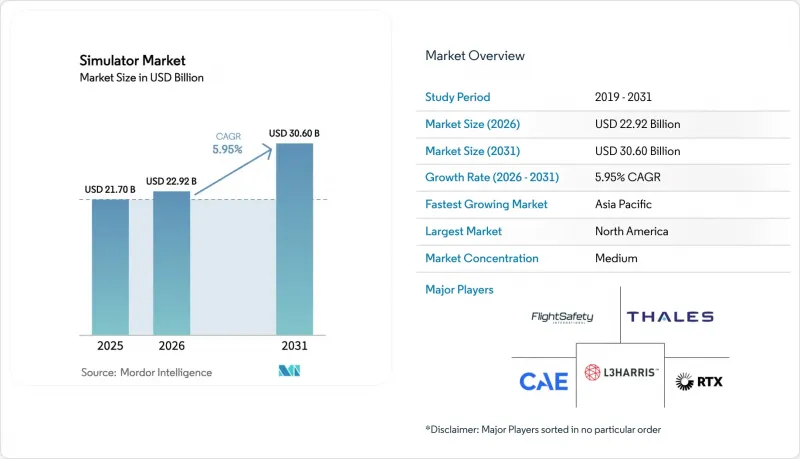
에 의하면, 시뮬레이터 시장 규모는 2025년 217억 달러에서 2026년에는 229억 2,000만 달러로 확대되어 2026년부터 2031년까지 CAGR 5.95%로 성장을 지속하여, 2031년에는 306억 달러에 이를 것으로 예측됩니다.
본 보고서는 플랫폼(항공, 육상, 해상), 기술(LVC 시뮬레이션 등), 솔루션(하드웨어, 소프트웨어, 서비스), 용도(민간 조종사·승무원 훈련, 군 및 방위 훈련, 연구·시험), 최종 사용자(민간, 군사), 지역(북미 등)별로 분류되어 있습니다. 시장 전망은 금액(달러) 기준으로 제시되어 있습니다.
전 세계 시뮬레이터 시장 동향 및 인사이트
NATO·인도-태평양 지역의 현대화 프로그램이 LVC 네트워크를 의무화
동맹국 군은 대규모 부대를 전개하지 않고도 다영역 작전을 재현하기 위해 LVC 아키텍처를 일상적인 전투 준비 활동에 통합하고 있습니다. STANAG 4603에 따라 회원국은 시뮬레이터 연동을 의무화하고 있습니다. 동시에, 미국 인도태평양군은 ‘태평양 억제 이니셔티브’의 일환으로 99억 달러를 배정하여, 일본에 있는 F-35 조종석과 괌의 이지스 구축함 트레이너를 연동시켰습니다. 영국 국방부는 2025년, J-20 및 Su-57의 새로운 레이더 시그니처를 반영한 합성 위협 라이브러리를 활용해 ‘타이푼’ 시뮬레이터를 업그레이드하기 위해 약 8,500만 파운드(1억 700만 달러)를 투자했습니다. 호주의 국방 전략 재검토 과정에서 육군, 해군, 공군의 시뮬레이터를 새로운 ‘고수준 아키텍처(HLA)’ 연합 하에 통합하는 ‘국립 합성 훈련 센터’에 2027년까지 12억 호주 달러(8억 달러)를 지원하기로 약속했습니다. 이러한 프로그램은 상호 운용 가능한 장비의 구매를 가속화하지만, IEEE 1516-2010 표준과 HLA 4 표준 모두에 대한 인증이 필요하기 때문에 소규모 공급업체의 경우 통합 비용이 증가하게 됩니다.
EASA/FAA의 증거 기반 훈련 규정에 따라 레벨 D 시뮬레이터에서의 훈련 시간이 더욱 필요해집니다.
규제 당국은 현재 업셋 복구 훈련 및 수동 조종 훈련을 6축 모션과 파노라마 영상을 갖춘 레벨 D 시뮬레이터 내에서만 실시하도록 의무화하고 있습니다. 에어 인디아는 2024년 구르가온의 훈련 거점을 확장하고, CAE사의 A320neo 및 787 시뮬레이터 6대를 추가로 도입했습니다. 이를 통해 연간 500명의 신규 조종사를 양성할 수 있게 되어 시뮬레이터 시장 수요가 더욱 높아지고 있습니다. 말레이시아 항공 그룹은 12개의 베이(bay)를 갖춘 세팡 센터를 개설하고, 정기 점검에 콜린스 에어로스페이스사의 ‘Pro Line Fusion’ 항공전자장비를 채택하고 있습니다. 피지 에어웨이즈와 케냐 에어웨이즈는 플라이트 세이프티 인터내셔널(Flight Safety International) 및 L3 해리스(L3 Harris)로부터 시뮬레이터 이용 시간을 임대하고 있으며, 이는 웨트리스(wet lease) 계약이 신흥 시장의 항공사들에게 진입 비용을 절감해 준다는 사실을 입증하고 있습니다. EBT 의무화로 인해 연간 시뮬레이터 가동률이 약 15% 상승했으며, 아시아 및 중동 전역에 걸친 시설 확충은 이러한 부하를 흡수하기 위한 것입니다.
NATO의 DIS, HLA, 아시아태평양 지역의 FOM 아키텍처 간 상호 운용성 격차
합동 훈련에서는 여전히 프로토콜 불일치 문제가 드러나고 있습니다. BALTOPS 2024에서는 한국과 일본의 시뮬레이터가 미국의 이지스 시스템과 항적 데이터를 교환할 수 있도록, 18개국 해군이 6개월이라는 추가 기간을 들여 미들웨어 개발에 매진했습니다. IEEE는 2024년에 HLA 4를 출시했으나, 이로 인해 하위 호환성이 상실되어 벤더들은 병행된 코드베이스를 지원해야만 했습니다. 호주의 DSTG는 2025년, 파이브 아이즈(Five Eyes) 시뮬레이션 네트워크를 통합하는 데 소프트웨어 개발 비용으로 2억 호주 달러(1억 3,300만 달러)가 소요될 것으로 추산했습니다. 참조 구현이 등장하기 전까지는 연합체가 복잡성을 제한하는 요소와 지연을 초래하는 게이트웨이에 의존하게 될 것입니다.
부문 분석
2025년 시뮬레이터 시장에서 항공기용 하위 부문이 45.50%라는 최대 점유율을 차지했습니다. 이러한 위상은 전 세계적으로 계속 확대되는 민간 항공기 기단과 국방 예산의 상당 부분을 차지하는 전투기의 정비 주기에 의해 확고히 자리 잡았습니다. 아시아태평양의 항공사만 해도 2024년부터 2025년까지 650대 이상의 신형 제트기를 발주했으며, 그 결과 초급 훈련(ab-initio) 및 기종 인증(type-rating) 세션이 급증하여 레벨 D 시뮬레이터 베이는 24시간 체제로 계속 가동되고 있습니다. 공군 또한 혼잡한 공역에서는 안전하게 훈련할 수 없는 레이더 요격, 공중 급유 랑데부, 전자전 대응 등을 연습시키기 위해 고충실도 조종석에서 조종사들을 순환 배치하고 있습니다. 그 결과, 성장 전망은 완만하지만 항공기용 시뮬레이터는 예측 가능한 업그레이드 수요를 뒷받침하고 있습니다.
해상 시뮬레이터는 가장 빠른 성장세를 기록하고 있으며, 조선사들이 전투 시스템에 합성 훈련 루프를 직접 통합하고 있는 만큼 2031년까지 연평균 성장률(CAGR) 7.13%로 확대될 것으로 예측됩니다. 모든 유형 26 프리깃, 알라후라급 초계함, 향후 취역 예정인 DDG(X) 구축함은 육상 허브에 연결하여 분산형 훈련을 실시할 수 있도록 함교, 레이더, 무기 콘솔이 통합된 상태로 조선소에서 출하됩니다. 남중국해, 북극해, 홍해에서의 긴장 고조로 인해 가상 환경에서의 대잠전, 기뢰 대책, 전자전 훈련에 대한 수요가 증가하고 있습니다. 이러한 능력 요건에 더해 해군의 이산화탄소 배출 감축 의무화까지 맞물리면서, 해상 플랫폼의 성장률은 항공 및 지상 플랫폼을 확실히 상회하고 있습니다.
2025년, LVC 네트워크는 시뮬레이터 시장에서 37.25%라는 최대 매출 점유율을 차지했습니다. 이는 NATO의 STANAG 4603이 회원국들에게 항공, 지상, 해상 훈련 시스템을 단일 합성 전장으로 통합할 것을 의무화하고 있기 때문입니다. 북미 및 유럽의 예산 범위 내에서 F-35의 센서 데이터, 챌린저 3의 장갑 분석 데이터, 이지스 전투 시스템의 데이터를 표준 작전 상황 화면에 통합하는 업그레이드에 자금이 지원되고 있습니다. 이러한 멀티도메인 그리드(Multi-Domain Grid)를 통해 지휘관은 제트 연료를 소모하거나 함정을 동원하지 않고도 복합 항공 작전이나 항공모함 타격군의 방어 훈련을 수행할 수 있게 되어, 예산 절감과 즉각적인 대응 능력 향상이라는 두 가지 목표를 모두 달성할 수 있습니다. 지속적인 현대화 예산 덕분에 LVC의 매출에서 주도적인 지위는 확보되고 있지만, 그 성장률은 더욱 급속한 기술 성장률에는 미치지 못하는 상황입니다.
게임 및 시리어스 게임을 통한 시뮬레이션은 상용 게임 엔진이 군사 등급의 훈련 도구로 성숙해감에 따라 연평균 성장률(CAGR) 8.10%를 기록하며 가장 빠른 성장을 보이고 있습니다. 미 육군의 ‘합성 훈련 환경(Synthetic Training Environment)’은 VBS4 및 Unity 라이선스를 취득하여, 병사들이 2,000달러 미만의 노트북으로 접속할 수 있는 사진처럼 실감 나는 시가지, 정글, 고층 빌딩 내부 환경을 제공합니다. 이를 통해 기존의 건설적 훈련용 워크스테이션에 비해 1석당 비용을 대폭 절감하고 있습니다. 경찰 학교, 재난 대응 기관, 민간 항공 학교에서는 동일한 엔진을 사용하여 공유 클라우드 서버상에서 인질 사건, 산불 확산, 조종실 고장 등을 시뮬레이션하고 있습니다. 이러한 분야를 아우르는 수요와 지속적인 컨텐츠 업데이트가 맞물려, 게임 기술은 시장에서 가장 빠르게 성장하는 분야로서의 입지를 공고히 하고 있습니다.
지역별 분석
2025년 매출액 중 북미가 39.60%를 차지했습니다. 미국 국방부(DoD)는 2026 회계연도에 '시험·평가 과학기술'에 1억 9,940만 달러를 배정했습니다. CAE사는 캐나다에 세계 본사를 두고 전 세계에 70개의 센터를 운영하고 있습니다. 2024년에 발행된 FAA 자문 회보 120-EBT는 전 세계 능력 기반 조종사 기술 시험의 기준이 되었습니다. 멕시코의 볼라리스(Volaris)사는 협폭기 기종 확충을 지원하기 위해 2026년 납품을 목표로 A320neo 시뮬레이터 2대를 발주했습니다. 미 육군의 게임 엔진에 대한 투자는 해당 지역의 기술적 우위를 공고히 하고 있습니다.
아시아태평양은 연평균 성장률(CAGR) 6.78%를 기록하며 가장 빠르게 성장하는 지역입니다. 에어 인디아의 제트기 500대 발주, 세부 퍼시픽 항공의 수주 잔고, 말레이시아의 세팡 훈련 기지 등이 민간 부문의 성장 요인으로 주목받고 있습니다. 인도의 HTT-40 훈련기 및 일본의 미쓰비시 F-X 프로그램에서는 기본 설계에 시뮬레이터가 통합되어 있습니다. 중국의 2024년 국방 백서에서는 합동 작전을 위한 건설적 시뮬레이션에 23억 달러가 배정되었습니다. 한국의 KF-21 프로그램에서는 레이더와 미사일의 사정거리를 재현하는 1억 2,000만 달러 규모의 시뮬레이터 스위트가 도입되었습니다.
유럽은 매출액 기준으로 2위를 차지하고 있습니다. 영국의 ‘타이푼’ 업그레이드, 독일 라인메탈사의 ‘배틀 랩’, 프랑스의 ‘라팔 F4’ 리허설 시스템은 모두 2024년부터 2025년까지 각각 1억 달러 이상을 합성 훈련에 투자했습니다. 중동에서는 자국에서 개발한 전투기 및 해군 프로그램에 대응할 수 있는 역량을 구축하고 있으며, 튀르키예 TAI의 ‘Hurjet’에는 4,500만 미 달러 규모의 시뮬레이터 스위트가 포함되어 있습니다. 아프리카와 남미는 설비 투자 장벽 및 규제상의 미비점으로 인해 뒤처지고 있지만, 로메와 파나마시티에서는 웨트리스 센터가 등장하고 있습니다.
기타 혜택:
- 엑셀 형식 시장 예측(ME) 시트
- 3개월간의 애널리스트 지원
자주 묻는 질문
목차
제1장 서론
제2장 조사 방법
제3장 주요 요약
제4장 시장 구도
제5장 시장 규모와 성장 예측
제6장 경쟁 구도
제7장 시장 기회와 향후 전망
JHS 26.08.11According to Mordor Intelligence, the simulator market size is expected to grow from USD 21.70 billion in 2025 to USD 22.92 billion in 2026 and is forecasted to reach USD 30.60 billion by 2031 at a 5.95% CAGR over 2026-2031.
This report is Segmented by Platform (Airborne, Land, and Maritime), Technique (Live Virtual and Constructive Simulation, and More), Solution (Hardware, Software, and Services), Application (Commercial Pilot Training, Military Training, and Research and Testing), End-User (Commercial, and Military), and Geography (North America, and More). Market Forecasts are Provided in Terms of Value (USD).
Global Simulator Market Trends and Insights
NATO and Indo-Pacific Modernization Programs Mandate LVC Networking
Allied militaries embed LVC architectures into daily readiness routines to replicate multi-domain operations without deploying large formations. STANAG 4603 now obliges member states to federate simulators. At the same time, the US Indo-Pacific Command allocated USD 9.9 billion under the Pacific Deterrence Initiative to link F-35 cockpits in Japan with Aegis destroyer trainers in Guam. The UK Ministry of Defence invested approximately GBP 85 million (USD 107 million) in 2025 to upgrade Typhoon simulators with synthetic threat libraries that reflect emerging radar signatures of the J-20 and Su-57. Australia's Defence Strategic Review pledged AUD 1.2 billion (USD 800 million) through 2027 for a National Synthetic Training Centre that unifies Army, Navy, and Air Force simulators under a fresh High-Level Architecture federation. Such programs accelerate the purchase of interoperable devices; however, the need to certify both IEEE 1516-2010 and the HLA 4 standards inflates integration costs for smaller vendors.
EASA/FAA Evidence-Based Training Rules Require More Level-D Simulator Hours
Regulators now require that upset-recovery and manual-handling drills be conducted only inside Level-D simulators equipped with 6-axis motion and panoramic visuals. Air India's 2024 training expansion in Gurugram added six CAE A320neo and 787 devices to support 500 new pilots annually, strengthening demand in the Simulator Market. Malaysia Aviation Group has opened a 12-bay Sepang center, utilizing Collins Aerospace Pro Line Fusion avionics for recurrent checks. Fiji Airways and Kenya Airways lease hours from FlightSafety International and L3Harris, proving that wet-lease contracts reduce entry cost for emerging-market carriers. Mandatory EBT inflates annual simulator utilization by roughly 15%; build-outs across Asia and the Middle East aim to absorb this load.
Interoperability Gaps Between NATO DIS, HLA, and Asia-Pacific FOM Architectures
Combined exercises keep exposing protocol mismatches. BALTOPS 2024 saw 18 navies spend six extra months building middleware so South Korean and Japanese simulators could exchange tracks with US Aegis systems. IEEE released HLA 4 in 2024, breaking backward compatibility and compelling vendors to support parallel codebases. Australia's DSTG estimated in 2025 that unifying Five Eyes simulation networks would cost AUD 200 million (USD 133 million) in software work. Until reference implementations emerge, federations will rely on latency-inducing gateways that limit complexity.
Other drivers and restraints analyzed in the detailed report include:
- Asia's UAV-Logistics Boom Lifts Demand for Low-Cost Drone-Pilot Simulators
- Global Defense Ministries Target 25% Cost Reduction in Live Training
- Precision Servomotor and UHD-Projector Shortages Inflate Hardware Lead Times
For complete list of drivers and restraints, kindly check the Table Of Contents.
Segment Analysis
The airborne sub-segment held the largest 45.50% share of the simulator market in 2025, a position cemented by the ever-expanding global civil fleet and the fighter-aircraft readiness cycles that dominate defense budgets. Airlines in the Asia-Pacific region alone ordered more than 650 new jets between 2024 and 2025, resulting in a surge of ab-initio and type-rating sessions that keep Level-D bays occupied around the clock. Air forces also rotate pilots through high-fidelity cockpits to practice radar intercepts, refueling rendezvous, and electronic-warfare countermeasures that cannot be safely rehearsed in congested airspace. Consequently, airborne simulators underwrite predictable upgrade demand despite slower growth prospects.
Maritime simulators record the fastest trajectory, projected to expand at a 7.13% CAGR through 2031 as shipbuilders design synthetic-training loops directly into combat systems. Every Type 26 frigate, Arafura-class patrol vessel, and forthcoming DDG(X) destroyer leaves the yard with embedded bridge, radar, and weapons consoles that can plug into shore hubs for distributed drills. Rising tensions in the South China Sea, the Arctic, and the Red Sea are elevating demand for anti-submarine, mine-countermeasure, and electronic warfare training in virtual settings. These capability demands, coupled with navies' carbon-reduction mandates, keep maritime growth comfortably ahead of airborne and land platforms.
LVC networks captured the largest 37.25% revenue block of the simulator market in 2025 because NATO's STANAG 4603 obliges member states to federate air, land, and sea trainers into a single synthetic battlespace. North American and European spending lines fund upgrades that stream F-35 sensor data, Challenger 3 armor analytics, and Aegis combat system data into a standard operational view. These multi-domain grids enable commanders to rehearse composite air operations or carrier-strike protection without burning jet fuel or mobilizing ships, resulting in both budget savings and readiness gains. Sustained modernization budgets ensure LVC's revenue leadership, even though its growth rate lags behind those of faster techniques.
Gaming and serious-games simulation is enjoying the fastest climb, posting an 8.10% CAGR as commercial game engines mature into military-grade rehearsal tools. The US Army's Synthetic Training Environment licensed VBS4 and Unity to deliver photorealistic urban blocks, jungles, and high-rise interiors that soldiers can access from laptop PCs costing under USD 2,000, thereby slashing per-seat costs compared to legacy constructive workstations. Police academies, disaster-response agencies, and civil-aviation schools use the same engines to model hostage crises, wildfire spread, or cockpit malfunctions on shared cloud servers. This cross-sector pull, combined with continuous content updates, solidifies gaming techniques as the market's fastest-growing lane.
Complete Report Scope:
- By Platform
- Airborne
- Land
- Maritime
- By Technique
- Live, Virtual, and Constructive (LVC) Simulation
- Synthetic Environment Simulation
- Gaming/Serious-Games Simulation
- By Solution
- Hardware
- Software
- Services
- By Application
- Commercial Pilot and Crew Training
- Military and Defense Training
- Research and Testing/R&D
- By End-User
- Commercial
- Military
- By Geography
- North America
- United States
- Canada
- Mexico
- Europe
- United Kingdom
- France
- Germany
- Rest of Europe
- Asia-Pacific
- China
- Japan
- South Korea
- India
- Rest of Asia-Pacific
- South America
- Brazil
- Rest of South America
- Middle East and Africa
- Middle East
- Saudi Arabia
- United Arab Emirates
- Turkey
- Rest of Middle East
- Africa
- South Africa
- Rest of Africa
- Middle East
- North America
Geography Analysis
North America accounted for 39.60% of the 2025 revenue. The US DoD allocated USD 199.4 million to Test and Evaluation Science and Technology in FY 2026. CAE operates its global headquarters in Canada, with 70 centers worldwide. FAA Advisory Circular 120-EBT, issued in 2024, became the template for global competency-based pilot checks. Mexico's Volaris has ordered two A320neo simulators for delivery in 2026 to support its narrow-body expansion. The US Army's gaming-engine investments cement the region's technical lead.
Asia-Pacific is the fastest-growing region, advancing at a 6.78% CAGR. Air India's 500-jet order, Cebu Pacific's backlog, and Malaysia's Sepang training hub spotlight civil drivers. India's HTT-40 trainer and Japan's Mitsubishi F-X programs incorporate simulators into their base designs. China's 2024 defense white paper allocated USD 2.3 billion to constructive simulation for joint ops. South Korea's KF-21 program features a USD 120 million simulator suite reproducing radar and missile envelopes.
Europe ranks second in revenue. The UK's Typhoon upgrades, Germany's Rheinmetall BattleLab, and France's Rafale F4 rehearsal systems all channeled more than USD 100 million each into synthetic training between 2024 and 2025. The Middle East builds capacity to match indigenous fighter and naval programs; Turkey's TAI Hurjet includes a USD 45 million simulator suite. Africa and South America trail due to CAPEX barriers and regulatory gaps, though wet-lease centers are emerging in Lome and Panama City.
- CAE, Inc.
- Collins Aerospace (RTX Corporation)
- FlightSafety International Inc.
- L3Harris Technologies, Inc.
- Thales Group
- Rheinmetall AG
- Kongsberg Gruppen ASA
- BAE Systems plc
- Lockheed Martin Corporation
- KNDS N.V.
- FAAC Incorporated
- Exail SAS
- Moog Inc.
- Siemens Digital Industries (Siemens AG)
- Frasca International, Inc.
- Pacific Simulators 2010 Ltd.
- Indra Sistemas, S.A.
- TRU Simulation + Training Inc.
- Zen Technologies Limited
- Motion Systems
- HAVELSAN A.S.
Additional Benefits:
- The market estimate (ME) sheet in Excel format
- 3 months of analyst support
TABLE OF CONTENTS
1 INTRODUCTION
- 1.1 Study Assumptions and Market Definition
- 1.2 Scope of the Study
2 RESEARCH METHODOLOGY
3 EXECUTIVE SUMMARY
4 MARKET LANDSCAPE
- 4.1 Market Overview
- 4.2 Market Drivers
- 4.2.1 NATO and Indo-Pacific modernization programs mandate LVC networking
- 4.2.2 EASA/FAA Evidence-Based Training rules require more Level-D simulator hours
- 4.2.3 Asia's UAV-logistics boom lifts demand for low-cost drone-pilot simulators
- 4.2.4 Global defense ministries target 25% cost-reduction in live training
- 4.2.5 Digital-twin and AI-based debrief tools penetrate operator-training simulators
- 4.2.6 Emerging-market airlines adopt wet-lease sim-as-a-service models
- 4.3 Market Restraints
- 4.3.1 Interoperability gaps between NATO DIS, HLA, and Asia-Pacific FOM architectures
- 4.3.2 Precision servomotor and UHD-projector shortages inflate hardware lead times
- 4.3.3 Conflict-zone governments reallocate training funds to live munitions
- 4.3.4 High CAPEX inhibits small flight schools in South America and Africa
- 4.4 Value Chain Analysis
- 4.5 Regulatory and Technological Outlook
- 4.6 Porter's Five Forces Analysis
- 4.6.1 Bargaining Power of Suppliers
- 4.6.2 Bargaining Power of Buyers
- 4.6.3 Threat of New Entrants
- 4.6.4 Threat of Substitute Products
- 4.6.5 Intensity of Competitive Rivalry
5 MARKET SIZE AND GROWTH FORECASTS (VALUE)
- 5.1 By Platform
- 5.1.1 Airborne
- 5.1.2 Land
- 5.1.3 Maritime
- 5.2 By Technique
- 5.2.1 Live, Virtual, and Constructive (LVC) Simulation
- 5.2.2 Synthetic Environment Simulation
- 5.2.3 Gaming/Serious-Games Simulation
- 5.3 By Solution
- 5.3.1 Hardware
- 5.3.2 Software
- 5.3.3 Services
- 5.4 By Application
- 5.4.1 Commercial Pilot and Crew Training
- 5.4.2 Military and Defense Training
- 5.4.3 Research and Testing/R&D
- 5.5 By End-User
- 5.5.1 Commercial
- 5.5.2 Military
- 5.6 By Geography
- 5.6.1 North America
- 5.6.1.1 United States
- 5.6.1.2 Canada
- 5.6.1.3 Mexico
- 5.6.2 Europe
- 5.6.2.1 United Kingdom
- 5.6.2.2 France
- 5.6.2.3 Germany
- 5.6.2.4 Rest of Europe
- 5.6.3 Asia-Pacific
- 5.6.3.1 China
- 5.6.3.2 Japan
- 5.6.3.3 South Korea
- 5.6.3.4 India
- 5.6.3.5 Rest of Asia-Pacific
- 5.6.4 South America
- 5.6.4.1 Brazil
- 5.6.4.2 Rest of South America
- 5.6.5 Middle East and Africa
- 5.6.5.1 Middle East
- 5.6.5.1.1 Saudi Arabia
- 5.6.5.1.2 United Arab Emirates
- 5.6.5.1.3 Turkey
- 5.6.5.1.4 Rest of Middle East
- 5.6.5.2 Africa
- 5.6.5.2.1 South Africa
- 5.6.5.2.2 Rest of Africa
- 5.6.5.1 Middle East
- 5.6.1 North America
6 COMPETITIVE LANDSCAPE
- 6.1 Market Concentration
- 6.2 Strategic Moves
- 6.3 Market Share Analysis
- 6.4 Company Profiles (includes Global level Overview, Market level overview, Core Segments, Financials as available, Strategic Information, Market Rank/Share for key companies, Products and Services, and Recent Developments)
- 6.4.1 CAE, Inc.
- 6.4.2 Collins Aerospace (RTX Corporation)
- 6.4.3 FlightSafety International Inc.
- 6.4.4 L3Harris Technologies, Inc.
- 6.4.5 Thales Group
- 6.4.6 Rheinmetall AG
- 6.4.7 Kongsberg Gruppen ASA
- 6.4.8 BAE Systems plc
- 6.4.9 Lockheed Martin Corporation
- 6.4.10 KNDS N.V.
- 6.4.11 FAAC Incorporated
- 6.4.12 Exail SAS
- 6.4.13 Moog Inc.
- 6.4.14 Siemens Digital Industries (Siemens AG)
- 6.4.15 Frasca International, Inc.
- 6.4.16 Pacific Simulators 2010 Ltd.
- 6.4.17 Indra Sistemas, S.A.
- 6.4.18 TRU Simulation + Training Inc.
- 6.4.19 Zen Technologies Limited
- 6.4.20 Motion Systems
- 6.4.21 HAVELSAN A.S.
7 MARKET OPPORTUNITIES AND FUTURE OUTLOOK
- 7.1 White-Space and Unmet-Need Assessment


