

|
시장보고서
상품코드
2119667
아메리카의 인터벤션 영상의학 : 시장 점유율 분석, 업계 동향과 통계, 성장 예측(2026-2031년)Americas Interventional Radiology - Market Share Analysis, Industry Trends & Statistics, Growth Forecasts (2026 - 2031) |
||||||
 Mordor Intelligence
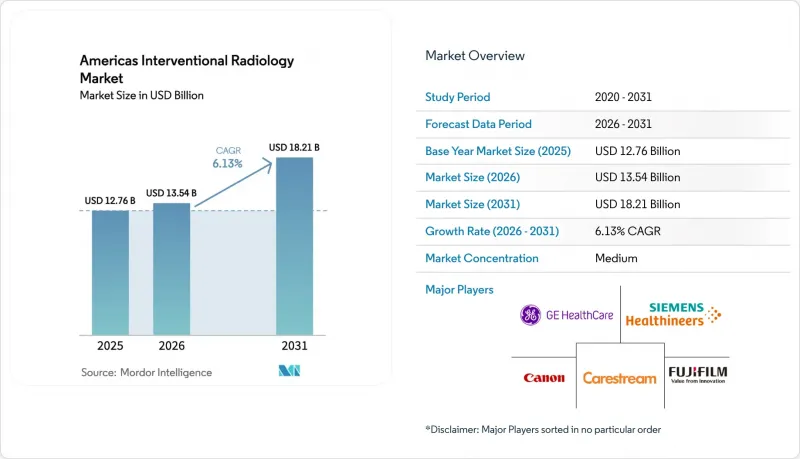
Mordor Intelligence에 따르면 2026년 아메리카의 인터벤션 영상의학 시장 규모는 135억 4,000만 달러로 추정되며, 2025년 127억 6,000만 달러에서 확대되어 2031년에는 182억 1,000만 달러에 달할 것으로 예측됩니다.
2026년부터 2031년까지의 연평균 성장률(CAGR)은 6.13%가 될 것으로 전망됩니다.
본 보고서는 제품(영상 진단기기, 중재시술용 소모품·의료기기), 용도(순환기내과, 종양학, 비뇨기·신장내과, 소화기내과, 신경학), 최종사용자(병원, 진료소 내 검사실/외래 수술 센터, 전문 클리닉), 및 지역별(아메리카)로 분류되어 있습니다. 시장 전망은 금액(달러) 기준으로 제시되어 있습니다.
아메리카 인터벤션 영상의학 시장의 동향 및 인사이트
만성 심혈관질환 및 암의 부담 증가
고혈압 유병률은 2050년까지 51.2%에서 61.0%로, 당뇨병은 16.3%에서 26.8%로 상승할 것으로 예측되며, 카테터를 이용한 중재술에 적합한 복잡한 사례가 꾸준히 증가하고 있습니다. 고령화로 인해 질환 발생률은 높아지는 한편, 환자들이 회복 기간 단축을 원하는 경향은 입원 기간 단축을 목표로 하는 병원의 노력과 부합합니다. 이러한 요인들이 복합적으로 작용하여 말초혈관성형술, 신장 신경 차단술 및 종양 색전술의 사례 수가 증가하고 있습니다. 그 결과, 아메리카의 인터벤션 영상의학 시장은 시술에 대한 수요를 지속적으로 자극하는 구조적인 호재의 혜택을 받고 있습니다.
IR 영상 분야의 기술적 진보(광자 계수 CT, AI, AR)
광자 계수형 CT는 더 높은 공간 분해능과 고유한 스펙트럼 분리를 실현합니다. 이를 통해 에너지 적분형 시스템에 비해 조직의 콘트라스트를 향상시키면서 방사선 피폭량을 감소시켜, 복잡한 혈관 중재술에서 진단의 정확성을 높입니다. 임상 연구에 따르면, 혈관 선명도 평가치는 기존 스캐너의 100.9 HU/mm에 비해 134.7 HU/mm에 달하여, 관상동맥 및 신경혈관 시술 시 장치를 정확하게 배치할 수 있게 해줍니다. AI가 탑재된 로봇 플랫폼은 실시간 경로 안내를 중첩하고, 와이어 조작을 자동화하며, 투시 시간을 최대 56% 단축함으로써 의료진과 환자의 방사선 피폭에 대한 우려를 완화합니다. 증강 현실(AR)을 지원하는 헤드 마운트 디스플레이는 복잡한 절제술이나 색전술 시 숙련 기간을 더욱 단축시킵니다. 조기 도입 기관들은 합병증 발생률 감소와 처리 능력 향상을 통해 경쟁 우위를 확보하고 있으며, 이는 시장 내 기술 경쟁을 더욱 격화시키고 있습니다.
인터벤션 영상의학(IR) 수술실 및 첨단 영상 진단 장비의 고액 도입 비용
광자 계수식 CT 스캐너, 로봇식 C-암, 하이브리드 수술실은 각각 200만 달러 이상의 지출이 필요하며, 스위트 전체의 구축 비용은 500만 달러에 달하기도 합니다. 이는 이미 영업이익률 중앙값이 1.2%인 상황에서 운영되고 있는 병원의 재무 상황을 압박하고 있습니다. 연간 유지보수 계약 비용은 구매 가격의 15-20%를 차지하며, 소프트웨어 업그레이드에 따른 추가 비용은 소규모 의료 기관에게는 감당하기 어려운 부담이 되고 있습니다. 남미의 병원들은 수입 관세와 환율 변동으로 인해 30-40%의 가격 프리미엄에 직면해 있으며, 이것이 도입의 장벽이 되고 있습니다. 지불 유예형 리스나 재생 장비 프로그램은 확대되고 있지만, 고액의 금융 수수료가 투자 수익률을 끌어내리고 있습니다. 그 결과, 시장에서는 자본 집약도가 임상 수요를 상회하는 지역에서 국지적인 성장 둔화가 나타나고 있습니다.
부문 분석
2025년, 시장에서 소모품 및 의료기기는 시장 점유율의 52.22%를 차지했습니다. 이는 높은 시술 빈도와 교체 주기를 가속화하는 일회용 의무화 조치에 힘입은 결과입니다. 스텐트, 카테터,가이드와이어, 색전제가 병원 조달 목록의 대부분을 차지하고 있는데, 이는 다각적인 시술 과정에서 1건의 사례당 여러 SKU가 필요하기 때문입니다. 애보트(Abbott)사가 무릎 아래 질환용 용해형 스텐트 ‘Esprit BTK’에 대해 FDA 승인을 획득함에 따라, 스텐트 하위 부문은 더욱 탄력을 받았습니다. 이는 말초혈관 재관류 치료의 선택지를 혁신적으로 바꾸는 획기적인 사건입니다. 또한, 뇌졸중 및 종양학 프로토콜에서 조기 개입이 중요시됨에 따라 생검 키트와 혈전제거 키트 시장도 확대되고 있습니다.
영상 진단 장비는 2031년까지 연평균 성장률(CAGR)이 6.73%로 가장 빠르게 성장하는 카테고리입니다. 이는 의료 기관들이 방사선과 전문의 부족을 완화하고 업무 흐름을 개선하기 위해 광자 계수 CT, 자율주행 C-암, AI 통합형 MRI로 업그레이드를 추진하고 있기 때문입니다. 병원에서는 자금 조달 파트너십을 활용하여 스캐너, 소프트웨어, 분석 서비스를 통합한 종합적인 플랫폼을 도입함으로써 수명주기 가치를 높이고 있습니다. 풍부한 AI 기능을 갖춘 초음파 진단 장비는 휴대성이 뛰어나고 단기간에 숙달할 수 있다는 점 때문에 진료소 내 검사실에서도 보급이 확대되고 있으며, 한편 혈관조영실에서는 방사선을 사용하지 않는 광 기반 내비게이션이 채택되어 투시 검사로 인한 피폭량을 절반 이상 줄일 수 있게 되었습니다. 이러한 동향이 시장의 장기적인 확장을 뒷받침하는 프리미엄급 교체 주기를 주도하고 있습니다.
기타 혜택:
- 엑셀 형식의 시장 예측(ME) 시트
- 3개월간의 애널리스트 지원
자주 묻는 질문
목차
제1장 소개
제2장 조사 방법
제3장 주요 요약
제4장 시장 구도
제5장 시장 규모와 성장 예측
제6장 경쟁 구도
제7장 시장 기회와 향후 전망
KSM 26.09.03According to Mordor Intelligence, americas interventional radiology market size in 2026 is estimated at USD 13.54 billion, growing from 2025 value of USD 12.76 billion with 2031 projections showing USD 18.21 billion, growing at 6.13% CAGR over 2026-2031.
This report is Segmented by Product (Imaging Equipment, Interventional Consumables & Devices), Application (Cardiology, Oncology, Urology & Nephrology, Gastroenterology, Neurology), End User (Hospitals, Office-Based Labs/ASCs, Specialty Clinics), and Geography (North America, South America). The Market Forecasts are Provided in Terms of Value (USD).
Americas Interventional Radiology Market Trends and Insights
Increasing Burden of Chronic Cardiovascular & Oncological Diseases
Hypertension prevalence is projected to climb from 51.2% to 61.0% by 2050, and diabetes from 16.3% to 26.8%, adding a steady pipeline of complex cases amenable to catheter-based interventions. The aging population magnifies disease incidence, while patient preference for shorter recovery dovetails with hospital efforts to lower length of stay. Together these factors increase case volumes for peripheral angioplasty, renal denervation, and tumor embolization. Consequently, America's interventional radiology market benefits from structural tailwinds that consistently replenish procedural demand.
Technological Advances in IR Imaging (Photon-Counting CT, AI, AR)
Photon-counting detector CT enables higher spatial resolution and intrinsic spectral separation, which improves tissue contrast while cutting radiation dose compared to energy-integrating systems, thereby elevating diagnostic certainty in complex vascular interventions. Clinical studies show vessel-sharpness ratings of 134.7 HU/mm versus 100.9 HU/mm on conventional scanners, facilitating precise device deployment in coronary and neurovascular procedures. AI-enabled robotic platforms overlay real-time trajectory guidance, automate wire manipulation, and reduce fluoroscopy time by up to 56%, which eases radiation safety concerns for staff and patients. Augmented-reality head-mounted displays further shorten learning curves for complex ablation or embolization. Early adopters realize competitive gains through lower complication rates and higher throughput, reinforcing the technological arms race within America's interventional radiology market.
High Capital Cost of IR Suites & Advanced Imaging Modalities
Photon-counting CT scanners, robotic C-arms, and hybrid operating rooms each require outlays above USD 2 million, with entire suite buildouts reaching USD 5 million, which strains hospital balance sheets already operating at 1.2% median operating margins. Annual service contracts consume 15 - 20% of purchase price, while software upgrades add incremental costs that small systems struggle to absorb. Latin American hospitals face 30 - 40% price premiums driven by import tariffs and currency volatility, raising barriers to adoption. Deferred-payment leasing and refurbished equipment programs are expanding, yet premium financing charges dilute investment returns. As a result, America's interventional radiology market encounters localized slowdowns where capital intensity outweighs clinical demand.
Other drivers and restraints analyzed in the detailed report include:
- Rapid Expansion of Office-Based Labs (OBLs) & ASCs in the Americas
- Shift to Value-Based Care Favoring Minimally-Invasive IR Over Surgery
- Shortage of Trained Interventional Radiologists in Latin America
For complete list of drivers and restraints, kindly check the Table Of Contents.
Segment Analysis
Consumables and devices accounted for 52.22% of America's interventional radiology market share in 2025, buoyed by high procedure frequency and single-use mandates that accelerate replacement cycles. Stents, catheters, guidewires, and embolic agents dominate hospital procurement lists because multifaceted procedures require multiple SKUs per case. The stent subsegment gained further traction after Abbott secured FDA clearance for its dissolving Esprit BTK scaffold for below-the-knee disease, a milestone that reshapes peripheral revascularization options. Biopsy and thrombectomy kits also expand as stroke and oncology protocols emphasize early intervention.
Imaging equipment represents the fastest-growing category at a 6.73% CAGR through 2031 as facilities upgrade to photon-counting CT, self-driving C-arms, and AI-integrated MRI that mitigate radiologist shortages and enhance workflow. Hospitals leverage financing partnerships to acquire comprehensive platforms that bundle scanners, software, and analytics services, improving lifetime value. AI-rich ultrasound systems are penetrating office-based labs due to portability and rapid learning curves, while angiography suites adopt radiation-free light-based navigation that can slash fluoroscopy exposure by over half. These trends drive a premium replacement cycle that anchors long-term expansion in America's interventional radiology market.
Complete Report Scope:
- By Product
- Imaging Equipment
- MRI Systems
- CT Scanners
- Ultrasound Imaging Systems
- Angiography Systems
- Fluoroscopy Systems
- Interventional Consumables & Devices
- Stents
- Catheters & Guidewires
- Angioplasty Balloons
- Embolization & Thrombectomy Devices
- Biopsy Devices
- IVC Filters & Accessories
- Imaging Equipment
- By Application
- Cardiology
- Oncology
- Urology & Nephrology
- Gastroenterology
- Neurology
- By End User
- Hospitals
- Office-Based Labs (OBLs) / Ambulatory Surgical Centers (ASCs)
- Specialty Clinics
- Geography
- North America
- United States
- Canada
- Mexico
- South America
- Brazil
- Argentina
- Rest of South America
- North America
List of Companies Covered in this Report:
- Boston Scientific
- Medtronic
- Abbott Laboratories
- GE Healthcare
- Koninklijke Philips
- Siemens Healthineers
- Fujifilm Holdings Corp.
- Stryker Corporation (Neurovascular)
- Terumo
- Beckton Dickinson
- AngioDynamics
- Penumbra
- Cook Group
- Merit Medical Systems
- Cardinal Health Inc. (Cordis)
- Canon
- Ziehm Imaging
- IMBiotechnologies Ltd. (Canada)
Additional Benefits:
- The market estimate (ME) sheet in Excel format
- 3 months of analyst support
TABLE OF CONTENTS
1 Introduction
- 1.1 Study Assumptions & Market Definition
- 1.2 Scope of the Study
2 Research Methodology
3 Executive Summary
4 Market Landscape
- 4.1 Market Overview
- 4.2 Market Drivers
- 4.2.1 Increasing burden of chronic cardiovascular & oncological diseases
- 4.2.2 Technological advances in IR imaging (photon-counting CT, AI, AR)
- 4.2.3 Rapid expansion of office-based labs (OBL) & ASCs in the Americas (under-reported)
- 4.2.4 Favorable reimbursement revisions for IR codes in U.S. and Brazil
- 4.2.5 Shift to value-based care favouring minimally-invasive IR over surgery (under-reported)
- 4.3 Market Restraints
- 4.3.1 High capital cost of IR suites & advanced imaging modalities
- 4.3.2 Shortage of trained interventional radiologists in Latin America
- 4.3.3 Stringent ANVISA-level approval timelines delaying device launches
- 4.3.4 Post-COVID capex deferrals by hospitals (under-reported)
- 4.4 Value / Supply-Chain Analysis
- 4.5 Regulatory Landscape
- 4.6 Technological Outlook
- 4.7 Porter's Five Forces
- 4.7.1 Threat of New Entrants
- 4.7.2 Bargaining Power of Suppliers
- 4.7.3 Bargaining Power of Buyers
- 4.7.4 Threat of Substitutes
- 4.7.5 Competitive Rivalry
5 Market Size & Growth Forecasts (Value, USD)
- 5.1 By Product
- 5.1.1 Imaging Equipment
- 5.1.1.1 MRI Systems
- 5.1.1.2 CT Scanners
- 5.1.1.3 Ultrasound Imaging Systems
- 5.1.1.4 Angiography Systems
- 5.1.1.5 Fluoroscopy Systems
- 5.1.2 Interventional Consumables & Devices
- 5.1.2.1 Stents
- 5.1.2.2 Catheters & Guidewires
- 5.1.2.3 Angioplasty Balloons
- 5.1.2.4 Embolization & Thrombectomy Devices
- 5.1.2.5 Biopsy Devices
- 5.1.2.6 IVC Filters & Accessories
- 5.1.1 Imaging Equipment
- 5.2 By Application
- 5.2.1 Cardiology
- 5.2.2 Oncology
- 5.2.3 Urology & Nephrology
- 5.2.4 Gastroenterology
- 5.2.5 Neurology
- 5.3 By End User
- 5.3.1 Hospitals
- 5.3.2 Office-Based Labs (OBLs) / Ambulatory Surgical Centers (ASCs)
- 5.3.3 Specialty Clinics
- 5.4 Geography
- 5.4.1 North America
- 5.4.1.1 United States
- 5.4.1.2 Canada
- 5.4.1.3 Mexico
- 5.4.2 South America
- 5.4.2.1 Brazil
- 5.4.2.2 Argentina
- 5.4.2.3 Rest of South America
- 5.4.1 North America
6 Competitive Landscape
- 6.1 Market Concentration
- 6.2 Market Share Analysis
- 6.3 Company Profiles (includes Global level Overview, Market level overview, Core Segments, Financials as available, Strategic Information, Market Rank/Share, Products & Services, and Recent Developments)
- 6.3.1 Boston Scientific Corporation
- 6.3.2 Medtronic plc
- 6.3.3 Abbott Laboratories
- 6.3.4 GE HealthCare
- 6.3.5 Philips Healthcare
- 6.3.6 Siemens Healthineers AG
- 6.3.7 Fujifilm Holdings Corp.
- 6.3.8 Stryker Corporation (Neurovascular)
- 6.3.9 Terumo Corporation
- 6.3.10 Becton, Dickinson and Company (BD)
- 6.3.11 AngioDynamics Inc.
- 6.3.12 Penumbra Inc.
- 6.3.13 Cook Medical LLC
- 6.3.14 Merit Medical Systems Inc.
- 6.3.15 Cardinal Health Inc. (Cordis)
- 6.3.16 Canon Medical Systems Corp.
- 6.3.17 Ziehm Imaging
- 6.3.18 IMBiotechnologies Ltd. (Canada)
7 Market Opportunities & Future Outlook
- 7.1 White-Space & Unmet-Need Assessment


