|
시장보고서
상품코드
2100598
자동차용 DC-DC 컨버터 시장 : 점유율 분석, 업계 동향 및 통계, 성장 예측(2026-2031년)Automotive DC-DC Converter - Market Share Analysis, Industry Trends & Statistics, Growth Forecasts (2026 - 2031) |
||||||
 Mordor Intelligence
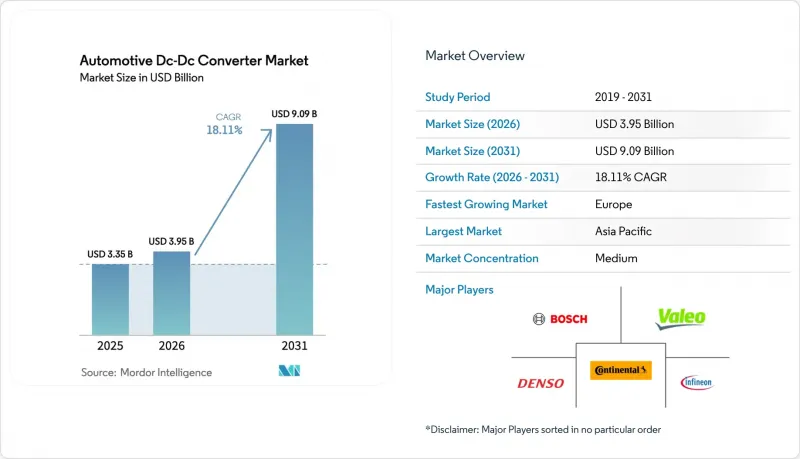
자동차용 DC-DC 컨버터 시장 규모는 2025년 33억 5,000만 달러에서 2026년에는 39억 5,000만 달러로 확대되어 2026년부터 2031년까지 CAGR 18.11%로 성장을 지속하여, 2031년에는 90억 9,000만 달러에 이를 것으로 예측됩니다.
본 보고서는 차종, 구동 방식(BEV, PHEV 등), 제품 유형(절연형 등), 입력 전압, 출력 전력, 용도(12V 보조 전원 등), 최종 사용자(OEM 및 애프터마켓), 지역별로 분류되어 있습니다. 시장 전망은 금액(달러) 및 수량(대수)으로 제시되어 있습니다.
전 세계 자동차용 DC-DC 컨버터 시장 동향 및 인사이트
BEV 및 PHEV 생산 대수의 급증
2025년, 중국의 구매세 면제 조치 연장 및 EU의 차량 CO2 배출량 규제 강화를 배경으로, 배터리 전기자동차(BEV) 및 플러그인 하이브리드 차량의 세계 생산 대수는 대폭 증가했습니다. BEV 1대당 여러 개의 컨버터가 필요하기 때문에 이러한 모듈에 대한 연간 수요는 매우 큰 규모를 보이고 있습니다. 테슬라의 '사이버트럭'이나 개선형 '모델 3'에서는 V2L(차량에서 부하로의 전력 공급)을 통한 캠핑 모드 전원 공급 등, 첨단 기능을 갖춘 양방향 유닛의 채택이 주목받고 있습니다. 현대자동차와 포드도 브랜드 차별화를 꾀하기 위해 이 기능을 기본 사양으로 적용하고 있습니다. 여전히 12V 시동 회로에 의존하고 있는 플러그인 하이브리드차(PHEV)에는 절연형 강압 컨버터가 탑재되어 있습니다. 이로 인해 차량 1대당 탑재되는 전자 부품의 양이 증가하고 있습니다. 각 공급업체들은 현지 생산을 급속히 추진하고 있으며, 예를 들어 보쉬는 2025년 초 성도에서 대규모 공장을 개설하고, 수년 이내에 생산 능력을 대폭 확대할 계획입니다.
전 세계 48V 마일드 하이브리드 의무화
2025년 초부터 유로 7 규제에 따라 주류 차종에는 모두 저전압 레일로 구동되는 전동 터보차저와 전기 가열식 촉매의 탑재가 의무화됩니다. 마찬가지로, 중국의 CAFC 크레딧안도 동등한 인센티브를 제공하고 있으며, 인도의 FAME III 제도에서는 연료 소비량을 대폭 절감하는 저전압 시스템에 대해 보상이 지급됩니다. 그 결과, 폭스바겐 골프, 푸조 308, 마르티 스즈키 브레차 등의 모델에는 현재 벨트 일체형 스타터 제너레이터와 저전압 컨버터가 탑재되어 있습니다. 일본은 가까운 미래를 위한 야심 찬 차종 평균 연비 목표를 설정하여, 도요타와 혼다 양사 모두 마일드 하이브리드 기술 도입을 서두르고 있습니다. 그러나 이러한 기준을 충족하는 것은 쉽지 않습니다. UNECE의 ASIL-C 적합 요건으로 인해 개발 기간이 대폭 연장되고, 막대한 비반복적 엔지니어링 비용이 발생하기 때문입니다.
열 관리에 따른 출력 밀도 제약
고온 기후에서는 온도 상승으로 인해 커패시터의 수명이 단축되어 정격 하향이 필요할 수 있습니다. 수냉식 콜드 플레이트는 이 문제를 효과적으로 해결하지만, 중량과 단가를 대폭 증가시킵니다. 소형 승용차의 경우, 패키징상의 제약으로 인해 고출력 컨버터의 채택이 저해되고 있어, 일부 양방향 V2G 프로그램에서 지연이 발생하고 있습니다. 각 공급업체들은 손실 밀도를 줄이기 위해 평면형 자기 소자나 갭을 최적화한 페라이트를 활용하는 혁신적인 노력을 기울이고 있지만, 양산화까지는 아직 시간이 걸립니다. 이 과제는 중동의 택시나 인도의 차량 함대에서 특히 두드러지는데, 이러한 차량들은 에어컨을 가동한 채로 장시간 공회전 상태에 머무르는 경우가 많기 때문입니다.
부문 분석
2025년 매출액 중 승용차가 67.71%를 차지했습니다. 상용차용 자동차 DC-DC 컨버터 시장 규모는 규제 당국의 대형 차량 CO₂ 배출 제한 강화 및 플릿 사업자가 차량에서 차고지로 에너지를 재판매하여 수익화를 추진함에 따라 연평균 성장률(CAGR) 18.13%로 확대될 것으로 예측됩니다. 유럽에서는 ‘eActros 600’에 9kW 컨버터가 탑재되어 전력망으로의 송전을 지원함으로써, 트럭 1대당 연간 약 1,200유로의 수익을 창출하고 있습니다.
승용차는 여전히 판매 대수 면에서 우위를 점하고 있지만, 전력 공급 능력의 향상이 요구되고 있습니다. 1.5 kW의 ADAS(첨단 운전자 지원 시스템) 연산 부하, 전기 히트 펌프, 오디오 앰프 등이 기존의 12V 전원 시스템에 부하를 주고 있습니다. 그 결과, 각 OEM 업체들은 3 kW의 강압 컨버터를 탑재하여 액세서리 전원이 메인 배터리의 주행 거리를 압박하지 않도록 하고 있습니다. 따라서 자동차용 DC-DC 컨버터 시장에서는 양산 비용 목표와 더 높은 피크 정격 간의 균형이 잡혀 있으며, 이 분야에서 하이브리드 페라이트 코어와 SiC 스위치를 통해 B부문 차량의 모듈 공급업체가 150달러의 가격 상한선을 밑돌 수 있게 되었습니다.
2025년 컨버터 매출액 중 BEV가 77.14%를 차지했으나, 마일드 하이브리드 차량의 확대 속도는 더 빠릅니다. 마일드 하이브리드 차량의 48V 배터리는 연비를 소폭 향상시키며, 48V/12V 양방향 브리지가 필요하기 때문에 컨버터의 부품 원가는 180달러로 상승합니다. 48V 마일드 하이브리드 차량용 DC-DC 컨버터 시장은 2031년까지 연평균 성장률(CAGR) 18.21%로 확대될 것으로 예측됩니다.
PHEV나 연료전지차의 경우, 갈바닉 절연을 통한 안전성을 확보하기 위해 절연형 컨버터가 추가되므로, 차량 1대당 탑재 비용은 300달러를 초과합니다. 그럼에도 불구하고, 각 OEM 업체들은 섀시 하네스의 재설계가 필요 없이 신속하게 규제 요건을 충족할 수 있다는 점에서 마일드 하이브리드를 선호하고 있습니다. 이에 따라 2031년까지 48V 부문에서 자동차용 DC-DC 컨버터 시장 점유율은 견조한 추세를 보일 것이며, 실리콘 MOSFET 기반 설계의 높은 판매량이 유지될 전망입니다.
ISO 6469-3의 갈바닉 절연 규정에 따라, 2025년 매출액 중 절연형 컨버터가 52.44%를 차지했습니다. 그러나 가정용 230V로의 전력 공급이 브랜드 차별화의 요인이 됨에 따라, 양방향형 유닛 시장 규모는 연평균 성장률(CAGR) 18.24%로 확대되고 있습니다. 이러한 양방향 모듈과 관련된 자동차용 DC-DC 컨버터 시장 규모는 이미 10억 달러를 넘어섰습니다.
비절연형 백-부스트 설계는 48V 마일드 하이브리드 차량의 비용을 절감하는 역할을 하고 있지만, 구동용 배터리 시장에서는 피크 효율 96%를 달성하는 절연형 듀얼 액티브 브리지 회로가 요구되고 있습니다. 각 공급업체들은 향후 V2G 요금을 액세서리 수익으로 전환할 수 있도록 IEEE 1547 표준을 준수하는 그리드 동기화 펌웨어를 번들로 제공합니다. 이러한 생태계의 변화에 따라, 자동차용 DC-DC 컨버터 시장은 구동 및 에너지 서비스를 모두 처리하기 위한 적응형 디지털 컨트롤러와 보안 부팅 마이크로우코드로 전환되고 있습니다.
지역별 분석
아시아태평양은 중국의 NEV 판매 호조에 힘입어 2025년 매출의 44.53%를 차지했습니다. 이 지역의 컨버터 공장은 배터리 및 SiC 웨이퍼 생산 라인 근처에 전략적으로 위치해 있습니다. 이러한 근접성 덕분에 BYD Semiconductor 및 Delta Electronics와 같은 공급업체들은 단위당 비용 경쟁력을 유지할 수 있습니다. 전 세계 48V 양방향 컨버터 생산 능력에서 상당한 점유율을 차지하는 일본에서는 덴소(Denso)와 파나소닉(Panasonic)이 수십 년에 걸친 하이브리드 기술 노하우를 활용하여 높은 평균 고장 간격(MTBF)을 실현하고 있습니다.
유럽은 유로 7 규제, 에코디자인 지침에 기반한 엄격한 효율 기준, 그리고 다가오는 내연기관 차량 판매 금지를 배경으로 연평균 성장률(CAGR) 18.18%로 가장 빠르게 성장할 전망입니다. 보쉬, 발레오, 인피니온과 같은 주요 기업들은 엄격한 대기 전력 제한을 준수하면서도 경쟁력을 유지하기 위해 SiC 분야에서의 수직 통합을 강화하고 있습니다. 한편, 자동차 대기업인 포르쉐, 현대, 기아는 유럽 전용 라인업에서 첨단 승용차를 출시하고 있어, 최첨단 SiC MOSFET을 신속하게 인증한 모듈 공급업체에 혜택을 주고 있습니다.
북미는 2025년 매출에서 두드러진 점유율을 차지했습니다. ‘인플레이션 억제법’에서는 소비자 대상 세액 공제 적용에 국내 조달률 요건이 부과되고 있습니다. 이에 대응하여 보그워너와 마그나는 오번힐스와 온타리오에 컨버터 공장을 건설 중이며, 향후 몇 년 동안 생산량을 대폭 확대할 계획입니다. 남미와 중동은 시장 점유율이 아직 낮은 편이지만, 두 지역 모두 견조한 성장률을 보이고 있습니다. 이러한 급속한 성장은 현지 조립에 대한 우대 조치 덕분이지만, 걸프 지역의 극심한 더위로 인해 수냉식 설계가 필요해지면서 단위당 BOM 비용이 증가하고 있습니다.
기타 혜택:
- 엑셀 형식 시장 예측(ME) 시트
- 3개월간의 애널리스트 지원
자주 묻는 질문
목차
제1장 서론
제2장 조사 방법
제3장 주요 요약
제4장 시장 구도
제5장 시장 규모와 성장 예측
제6장 경쟁 구도
제7장 시장 기회와 향후 전망
JHS 26.08.11According to Mordor Intelligence, the automotive DC-DC converter market size is expected to grow from USD 3.35 billion in 2025 to USD 3.95 billion in 2026 and is forecast to reach USD 9.09 billion by 2031 at 18.11% CAGR over 2026-2031.
This report is Segmented by Vehicle Type, Propulsion (BEV, PHEV, and More), Product Type (Isolated and More), Input Voltage, Output Power, Application (12V Auxiliary and More), End-User (OEM and Aftermarket), and Geography. The Market Forecasts in Value (USD) and Volume (Units).
Global Automotive DC-DC Converter Market Trends and Insights
Surging BEV and PHEV Production
In 2025, global output of battery electric vehicles (BEVs) and plug-in hybrids experienced significant growth, driven by China's extension of purchase-tax exemptions and the EU's implementation of stricter fleet CO2 limits . Each BEV requires multiple converters, resulting in a substantial annual demand for these modules. Tesla's Cybertruck and the refreshed Model 3 highlight the use of bi-directional units with advanced capabilities, such as powering V2L camping modes. Hyundai and Ford are now standardizing this feature to enhance their brand differentiation. Plug-in hybrid electric vehicles (PHEVs), which still rely on a 12 V starter circuit, include an isolated step-down converter. This addition increases the electronics content per vehicle. Suppliers are rapidly localizing their operations; for example, Bosch inaugurated a large-scale plant in Chengdu in early 2025, with plans to achieve significant production capacity within a few years .
Global 48 V Mild-Hybrid Mandates
Starting early 2025, Euro 7 regulations mandate that mainstream vehicle models incorporate electrified turbochargers and electrically heated catalysts, both powered by low-voltage rails. Similarly, China's draft CAFC credits offer comparable incentives, and India's FAME III scheme provides rewards for low-voltage systems that achieve significant reductions in fuel consumption. Consequently, models like the Volkswagen Golf, Peugeot 308, and Maruti Suzuki Brezza are now equipped with belt-integrated starter-generators and low-voltage converters. Japan has set an ambitious fleet fuel-economy target for the near future, pushing both Toyota and Honda to adopt mild-hybrid technologies. However, meeting these standards isn't easy; UNECE's ASIL-C compliance requirement adds considerable development time and significant non-recurring engineering costs.
Thermal-Management Limits on Power Density
In hot climates, elevated temperatures can shorten capacitor life and necessitate derating. While liquid-cooled cold plates effectively address this issue, they add significant weight and unit cost. In compact passenger cars, packaging constraints hinder the adoption of high-power converters, causing delays in some bidirectional V2G programs. Suppliers are innovating with planar magnetics and gap-optimized ferrites to reduce loss density, yet mass production is still some time away. This challenge is particularly pronounced in taxis across the Middle East and in fleet cars in India, which often idle with the air conditioner running for extended periods.
Other drivers and restraints analyzed in the detailed report include:
- Lower SiC/GaN Device Costs
- Shift to Zonal E/E Architectures
- Automotive-Grade Passive-Component Shortages
For complete list of drivers and restraints, kindly check the Table Of Contents.
Segment Analysis
Passenger cars accounted for 67.71% of 2025 revenue. The automotive DC-DC converter market size for commercial vehicles is projected to advance at an 18.13% CAGR as regulators cut heavy-duty CO2 limits and fleet operators monetize vehicle-to-depot energy resale. In Europe, the eActros 600 fields a 9 kW converter that supports grid export, recovering around EUR 1,200 per truck each year.
Passenger cars keep the volume edge but must raise power capability. ADAS compute loads of 1.5 kW, electric heat pumps, and audio amplifiers stretch legacy 12 V rails. Consequently, OEMs fit 3 kW step-downs so that accessory power no longer drags the main battery range. The auto DC-DC converter market, therefore, balances mass-production cost targets with higher peak ratings, an area where hybrid ferrite cores and SiC switches help module suppliers stay below the USD 150 price ceiling in B-segment cars.
BEVs seized 77.14% of 2025 converter revenue, but mild hybrids show faster expansion. Their 48 V battery boosts fuel economy by a minimal amount yet requires a 48 V/12 V bidirectional bridge, raising the converter bill of materials to USD 180. The 48-volt mild-hybrid auto DC-DC converter is expected to grow at a 18.21% CAGR by 2031.
PHEVs and fuel-cell vehicles add isolated converters for galvanic safety, so per-car content tops USD 300. Even so, OEMs favor mild-hybrids for quick regulatory compliance without re-architecting the chassis harness. That keeps the auto DC-DC converter market share of the 48 V segment solid through 2031, preserving high unit volumes for silicon MOSFET-based designs.
Isolated converters owned 52.44% of 2025 sales due to ISO 6469-3 galvanic rules. Yet bi-directional units are scaling at 18.24% CAGR as household-grade 230 V export becomes a brand differentiator. The auto DC-DC converter market size tied to these reversible modules already passes USD 1 billion.
Non-isolated buck-boost designs keep cost down for 48 V mild-hybrids, but traction-battery markets demand isolated dual-active-bridge circuits hitting 96% peak efficiency. Suppliers bundle IEEE 1547 grid-sync firmware so that future V2G tariffs can be converted into accessory revenue. That ecosystem shift is why the auto DC-DC converter market is tilting toward adaptive digital controllers and secure-boot microcode to handle both propulsion and energy services.
Complete Report Scope:
- By Vehicle Type
- Passenger Vehicle
- Commercial Vehicle
- By Propulsion Type
- Battery Electric Vehicle (BEV)
- Plug-in Hybrid EV (PHEV)
- Fuel-Cell EV (FCEV)
- Mild-Hybrid (48 V MHEV)
- By Product Type
- Isolated Converter
- Non-Isolated Converter
- Bi-directional Converter
- By Input-Voltage Range
- Below 40 V
- 40 - 70 V
- Above 70 V
- By Output-Power Rating
- Below 3 kW
- 3 - 6 kW
- Above 6 kW
- By Application
- 12 V Auxiliary Loads
- 48 V/12 V Bidirectional Systems
- High-Voltage Traction Support
- ADAS and Infotainment Power
- Thermal-Management Systems
- By End-User
- OEM Factory-Fit
- Aftermarket Retrofit
- By Geography
- North America
- United States
- Canada
- Rest of North America
- South America
- Brazil
- Argentina
- Rest of South America
- Europe
- Germany
- United Kingdom
- France
- Italy
- Spain
- Russia
- Rest of Europe
- Asia Pacific
- China
- Japan
- India
- South Korea
- Rest of Asia Pacific
- Middle East and Africa
- Saudi Arabia
- United Arab Emirates
- Turkey
- South Africa
- Rest of Middle East and Africa
- North America
Geography Analysis
Asia Pacific generated 44.53% of 2025 revenue, driven by strong NEV sales in China. Converter factories in the region are strategically located near battery and SiC wafer lines. This proximity allows suppliers, such as BYD Semiconductor and Delta Electronics, to maintain competitive per-unit costs. Japan, which holds a substantial share of the global 48 V bidirectional capacity, sees Denso and Panasonic harnessing decades of hybrid expertise to achieve high mean time between failures.
Europe will advance fastest, with an 18.18% CAGR, driven by Euro 7, stringent efficiency mandates under the Ecodesign Directive, and the impending combustion ban. Major players like Bosch, Valeo, and Infineon are amplifying their SiC vertical integration to remain competitive, all while adhering to strict standby-power limits. Meanwhile, automotive giants Porsche, Hyundai, and Kia have debuted advanced passenger cars from exclusive European lines, benefiting module suppliers who swiftly qualified cutting-edge SiC MOSFETs.
North America captured a notable share of the 2025 revenue. The Inflation Reduction Act ties consumer tax credits to a stipulation of domestic content. In response, BorgWarner and Magna are establishing converter plants in Auburn Hills and Ontario, targeting significant production volumes in the coming years. While South America and the Middle East lag with modest shares, both regions are witnessing robust growth rates. This surge is attributed to local assembly incentives, although the intense heat in the Gulf necessitates liquid-cooled designs, increasing the BOM cost per unit.
- Robert Bosch GmbH
- Denso Corporation
- Valeo SA
- Continental AG
- Infineon Technologies
- BorgWarner Inc.
- Toyota Industries Corporation
- TDK Corporation
- Panasonic Corporation
- Hella, Inc.
- Aptiv Plc.
- Alps Alpine
- Marelli Holdings Co., Ltd.
- Hyundai Mobis Company
- Vicor
- Delta Electronics
- ZF Friedrichshafen AG
- onsemi
- Texas Instruments
- Littelfuse
Additional Benefits:
- The market estimate (ME) sheet in Excel format
- 3 months of analyst support
TABLE OF CONTENTS
1 Introduction
- 1.1 Study Assumptions & Market Definition
- 1.2 Scope of the Study
2 Research Methodology
3 Executive Summary
4 Market Landscape
- 4.1 Market Overview
- 4.2 Market Drivers
- 4.2.1 Surging BEV and PHEV Production
- 4.2.2 Global 48 V Mild-Hybrid Mandates
- 4.2.3 Lower Sic / Gan Device Costs
- 4.2.4 Shift To Zonal E/E Architectures.
- 4.2.5 Vehicle-To-Load (V2L) Functionality
- 4.2.6 On-Board E-Power (ePTO) Demand in Commercial EVs
- 4.3 Market Restraints
- 4.3.1 Thermal-Management Limits on Power Density
- 4.3.2 Automotive-Grade Passive-Component Shortages
- 4.3.3 Cyber-Security Homologation Overheads
- 4.3.4 Electromagnetic-Interference (EMI) Compliance At 400 Khz
- 4.4 Value / Supply-Chain Analysis
- 4.5 Regulatory Landscape
- 4.6 Technological Outlook
- 4.7 Porter's Five Forces
- 4.7.1 Threat of New Entrants
- 4.7.2 Bargaining Power of Suppliers
- 4.7.3 Bargaining Power of Buyers
- 4.7.4 Threat of Substitutes
- 4.7.5 Competitive Rivalry
5 Market Size & Growth Forecasts (Value (USD) and Volume (Units))
- 5.1 By Vehicle Type
- 5.1.1 Passenger Vehicle
- 5.1.2 Commercial Vehicle
- 5.2 By Propulsion Type
- 5.2.1 Battery Electric Vehicle (BEV)
- 5.2.2 Plug-in Hybrid EV (PHEV)
- 5.2.3 Fuel-Cell EV (FCEV)
- 5.2.4 Mild-Hybrid (48 V MHEV)
- 5.3 By Product Type
- 5.3.1 Isolated Converter
- 5.3.2 Non-Isolated Converter
- 5.3.3 Bi-directional Converter
- 5.4 By Input-Voltage Range
- 5.4.1 Below 40 V
- 5.4.2 40 - 70 V
- 5.4.3 Above 70 V
- 5.5 By Output-Power Rating
- 5.5.1 Below 3 kW
- 5.5.2 3 - 6 kW
- 5.5.3 Above 6 kW
- 5.6 By Application
- 5.6.1 12 V Auxiliary Loads
- 5.6.2 48 V/12 V Bidirectional Systems
- 5.6.3 High-Voltage Traction Support
- 5.6.4 ADAS and Infotainment Power
- 5.6.5 Thermal-Management Systems
- 5.7 By End-User
- 5.7.1 OEM Factory-Fit
- 5.7.2 Aftermarket Retrofit
- 5.8 By Geography
- 5.8.1 North America
- 5.8.1.1 United States
- 5.8.1.2 Canada
- 5.8.1.3 Rest of North America
- 5.8.2 South America
- 5.8.2.1 Brazil
- 5.8.2.2 Argentina
- 5.8.2.3 Rest of South America
- 5.8.3 Europe
- 5.8.3.1 Germany
- 5.8.3.2 United Kingdom
- 5.8.3.3 France
- 5.8.3.4 Italy
- 5.8.3.5 Spain
- 5.8.3.6 Russia
- 5.8.3.7 Rest of Europe
- 5.8.4 Asia Pacific
- 5.8.4.1 China
- 5.8.4.2 Japan
- 5.8.4.3 India
- 5.8.4.4 South Korea
- 5.8.4.5 Rest of Asia Pacific
- 5.8.5 Middle East and Africa
- 5.8.5.1 Saudi Arabia
- 5.8.5.2 United Arab Emirates
- 5.8.5.3 Turkey
- 5.8.5.4 South Africa
- 5.8.5.5 Rest of Middle East and Africa
- 5.8.1 North America
6 Competitive Landscape
- 6.1 Market Concentration
- 6.2 Strategic Moves
- 6.3 Market Share Analysis
- 6.4 Company Profiles (includes Global Level Overview, Market Level Overview, Core Segments, Financials as Available, Strategic Information, Market Rank/Share for Key Companies, Products and Services, SWOT Analysis, and Recent Developments)
- 6.4.1 Robert Bosch GmbH
- 6.4.2 Denso Corporation
- 6.4.3 Valeo SA
- 6.4.4 Continental AG
- 6.4.5 Infineon Technologies
- 6.4.6 BorgWarner Inc.
- 6.4.7 Toyota Industries Corporation
- 6.4.8 TDK Corporation
- 6.4.9 Panasonic Corporation
- 6.4.10 Hella, Inc.
- 6.4.11 Aptiv Plc.
- 6.4.12 Alps Alpine
- 6.4.13 Marelli Holdings Co., Ltd.
- 6.4.14 Hyundai Mobis Company
- 6.4.15 Vicor
- 6.4.16 Delta Electronics
- 6.4.17 ZF Friedrichshafen AG
- 6.4.18 onsemi
- 6.4.19 Texas Instruments
- 6.4.20 Littelfuse
7 Market Opportunities & Future Outlook
- 7.1 White-space & unmet-need assessment