

|
시장보고서
상품코드
2100649
목재 펠릿 : 시장 점유율 분석, 업계 동향 및 통계, 성장 예측(2026-2031년)Wood Pellet - Market Share Analysis, Industry Trends & Statistics, Growth Forecasts (2026 - 2031) |
||||||
 Mordor Intelligence
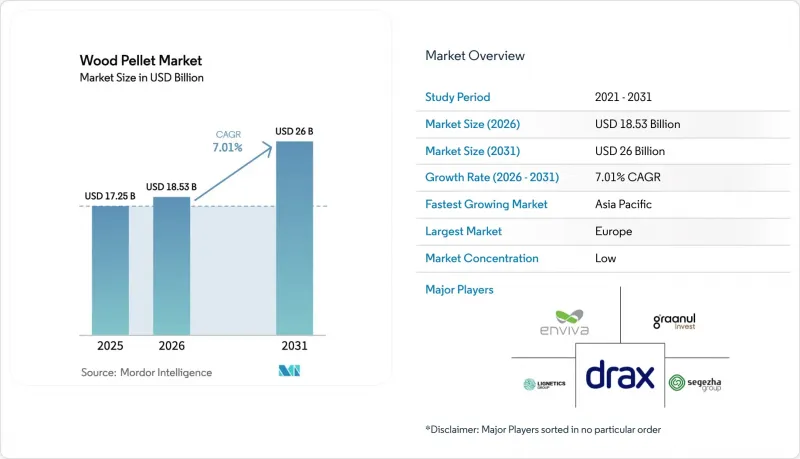
Mordor Intelligence에 의하면, 목재 펠릿 시장 규모는 2025년에 172억 5,000만 달러로 평가되었습니다. 2026년 185억 3,000만 달러에서 2031년까지 260억 달러에 이를 것으로 예상되며, 예측 기간(2026-2031년) CAGR은 7.01%를 나타낼 전망입니다.
본 보고서는 원료(산림·목재 잔재물, 농업 잔재물, 에너지 작물 및 톱밥 혼합물), 등급(유틸리티 등급, 프리미엄 등급, 스탠다드 등급 및 열처리 블랙 펠릿), 용도(난방, 발전, 열전병급), 최종 사용자(주거용, 상업용, 기타), 지역(북미, 유럽, 아시아태평양, 남미, 중동 및 아프리카)별로 분류되어 있습니다.
세계의 목재 펠릿 시장 동향과 인사이트
일본·한국의 바이오매스 혼소 의무화가 산업용 수입을 가속화
일본의 전력 회사는 국가의 고정가격임베디드제도(FIT)에 따라 매년 약 300만 톤의 산업용 펠릿을 수입하고 있으며, 한국의 발전 사업자도 2024년 보조금 삭감에도 불구하고 재생에너지 포트폴리오 기준(RPS)을 통해 인증된 바이오매스를 조달할 의무를 지고 있습니다. 미국 및 캐나다 공급업체와 체결된 장기 테이크-오어-페이(Take-or-Pay) 계약을 통해 2029년까지 공급량이 확보되어 있으며, 이러한 확실한 수익 전망은 멕시코만 연안 및 대서양 연안의 신규 제재소 투자를 뒷받침하고 있습니다. 엔화와 원화는 여전히 달러 대비 변동성이 크기 때문에 지역 구매자들은 운임 및 환율 리스크를 헤지하기 위한 유연한 조항을 요구하고 있습니다. 수입량은 또한 팜 핵 껍질과 암모니아의 상대적 가격에 따라 좌우됩니다. 이 두 가지는 2030년 탈탄소화 로드맵을 수립 중인 아시아의 전력 회사들이 검토하고 있는 서로 경쟁하는 두 가지 대체 연료입니다. 만약 혼소 의무가 2027년에 예정된 정책 재검토를 무사히 통과한다면, 목재 펠릿 시장은 유럽의 경기 순환적 수요 부진을 완화해 줄 지속 가능한 아시아 수요의 하한선을 확보할 가능성이 있습니다.
EU의 RED III 지속가능성 기준이 인증된 프리미엄 펠릿 수요를 뒷받침
재생에너지 지침 III(RED III)에는 생물다양성 및 토지 이용 변화에 따른 위험을 줄이기 위한 엄격한 생산 이력 관리 의무가 포함되어 있어, 이에 따라 공급은 사실상 인증 제품과 비인증 제품의 두 가지 흐름으로 양분되고 있습니다. '지속 가능한 바이오매스 프로그램(SBP)' 및 '산림관리협의회(FSC)' 인증을 취득한 수직 통합형 생산자는 현재 5%-10%의 가격 프리미엄을 확보하고 있으며, 이러한 마진 증대를 통해 물류 비용 및 규정 준수 비용의 상승을 상쇄하고 있습니다. 유럽의 전력 회사들은 공급업체가 규정 준수 위반에 빠졌을 경우 벌금을 회수하는 ‘패스스루 조항’을 도입하고 있으며, 이로 인해 양극화된 조달 생태계가 더욱 강화되고 있습니다. 이에 반해 북미의 제재소는 새로운 대서양 횡단 입찰 요건을 충족하기 위해 모니터링 기술 업그레이드나 조달 지역의 감사 범위 확대와 같은 대응을 추진하고 있습니다. 문서화 기준 강화에는 막대한 자본이 필요하지만, 한편으로는 소규모 비인증 사업자를 장기 계약에서 배제하고 주요 기업 5곳 사이에 거래량을 집중시키는 효과도 낳고 있습니다.
라이프사이클 배출량에 대한 우려로 영국·네덜란드에서 보조금 삭감
영국은 2024년 4월 바이오매스에 대한 직접 보조금을 폐지하여 연간 약 5억 파운드의 지원이 중단됨에 따라, 2024년 하반기 펠릿 수입량은 15% 감소했습니다. Drax사는 2027년 이후 탄소 포집 인프라가 가동될 때까지 연간 300만 톤의 생산 능력을 갖춘 공장의 가동을 유지하기 위해 과도기적 차액결제계약(CFD)에 대한 협상을 진행 중이지만, 정책의 불확실성으로 인해 투자 심리가 위축되면서 자금 조달 수단의 선택지가 좁아지고 있습니다. 네덜란드 규제 당국은 단기적인 탄소 집약도를 중점적으로 검토하는 병행 재검토를 진행 중이며, 초기 초안에 따르면 산림 유래 펠릿에 대한 더 엄격한 제한이 2027년에 발효될 가능성이 있습니다. 한때 베네룩스 국가의 전력 회사에 의존하던 발트해 연안 국가의 생산자들은 현재 판매량에 대한 위험에 직면해 있으며, 대신 한국과 일본의 구매자들을 대상으로 한 노력을 강화하고 있습니다. 보조금 변경으로 인해 지역별 수요가 세분화되면서 목재 펠릿 시장의 장기적인 생산 능력 계획이 복잡해지고 있습니다.
부문 분석
2025년 공급량의 57.2%는 산림 및 목재 잔여물이 차지했습니다. 이는 미국 남동부 및 브리티시컬럼비아주의 광범위한 원료 공급원에 힘입은 것으로, 이 지역에서는 저품질 원목과 제재소 칩이 다년 계약을 바탕으로 공급되고 있습니다. 농업 잔여물, 특히 밀짚, 벼 껍질, 옥수수 줄기와 잎의 경우, 미국 중서부, 동유럽, 인도의 펠릿 제조업체들이 더 높은 실리카 함량을 처리할 수 있는 고밀도화 생산 라인을 상용화하고 있어, 2031년까지 연평균 성장률(CAGR) 7.2%를 나타낼 것으로 예측됩니다. 농업 잔여물을 이용한 목재 펠릿 시장 규모는 2031년까지 1,200만 톤에 육박할 것으로 예상되며, 지역별 공급 회복력이 향상될 전망입니다.
실제로 짚을 원료로 하는 펠릿은 화실 내 온도가 높을 경우 슬래그가 발생하는 문제를 안고 있으며, 이에 대응하기 위해 설비 제조업체들은 내화 라이닝 및 자동 그을음 제거 시스템을 도입하고 있습니다. 이로 인해 설비 투자는 증가하지만, 목재 펠릿 업계에서 보일러의 가동 시간을 유지할 수 있게 됩니다. 생산자들은 농장이 집중된 지역 근처에 공장을 입지시킴으로써 부피 밀도가 낮은 단점을 보완하고, 반입 물류를 효율화하고 있습니다. 산림 잔재물은 에너지 밀도나 회분의 화학적 특성 면에서 본질적인 우위를 유지하고 있지만, 그 성장 한계는 생물 다양성 보호 조치나 펄프 공장에서의 경쟁 수요에 의해 제약받고 있습니다. 따라서 농작물 잔여물 펠릿의 점유율 확대는 위험 분산으로 이어질 뿐만 아니라, 검증 가능한 폐기물 유효 활용을 주장하는 기업 구매자들의 공감을 불러일으키는 순환형 경제의 이념에도 부합합니다.
2025년에는 유럽 및 일본의 발전 사업자와의 장기 공급 계약에 따라 발전용 화이트 펠릿이 출하량의 56.7%를 차지했습니다. ENplus A1 인증을 획득한 프리미엄 주택용 펠릿은 틈새 시장으로서 18%의 점유율을 확보했으며, 상품 가격 변동 국면에서도 이익률을 유지할 수 있는 10%-15%의 가격 프리미엄을 확보하고 있습니다. 가장 높은 성장이 예상되는 것은 열처리된 블랙 펠릿으로, 2031년까지의 연평균 성장률(CAGR)은 9.0%로 예측됩니다. 이 예측의 배경에는 새로운 분쇄기를 도입하지 않고도 바이오매스 대체율 향상을 목표로 하는 아시아 석탄 화력 발전소의 개보수 수요가 있습니다. 열처리 펠릿의 처리량은 2031년까지 600만 톤을 넘어설 것으로 예상되며, 이는 전 세계 목재 펠릿 시장 규모의 약 3%에 해당합니다.
시장에서의 수용 여부는 파일럿 플랜트를 25만 톤 규모의 상업용 모듈로 확장할 수 있느냐에 달려 있으며, 이를 통해 고정비를 분산시키고 열분해에 내재된 20%-30%의 원료 질량 손실을 경감할 수 있게 됩니다. 엄격한 회분 기준 덕분에 굴뚝 오염을 방지하고 도시 지역의 배출 규제를 충족할 수 있으므로, 프리미엄 등급의 화이트 펠릿은 여전히 주거용 수요의 기반을 이루고 있습니다. 스탠다드 등급 펠릿은 비용과 성능의 균형을 중시하는 소규모 산업용 보일러나 지역 난방 네트워크에 활용되고 있습니다. 유틸리티 등급의 우위는 지속되고 있지만, 유럽의 정책 주도형 석탄 단계적 폐지 조치로 인해 열처리 솔루션이 더 널리 정착되지 않는 한 그 성장은 둔화될 가능성이 있습니다.
지역별 분석
2025년, 유럽은 세계 수요의 72.4%를 차지했습니다. 이는 영국의 기존 석탄에서 바이오매스로의 전환, 스웨덴 및 덴마크의 지역 난방 인프라, 그리고 독일의 보조금을 통한 난로 설치가 뒷받침한 결과입니다. 2024년 영국이 바이오매스 보조금을 종료하고, 네덜란드 규제 당국이 수명 주기 배출량 재검토를 시작함에 따라 정책 리스크는 높아졌으나, 인증된 공급은 여전히 EU의 REDIII 하에서 규정 준수 측면에서 우위를 누리고 있습니다. 유럽 내 목재 펠릿 시장 점유율은 수입량이 정점에 도달함에 따라 소폭 하락할 것으로 예상되지만, 그 절대량은 2031년까지 세계 최대 규모를 유지할 전망입니다.
아시아태평양은 가장 빠르게 성장하고 있으며, 일본의 바이오매스 혼소에 대한 20년간의 고정가격 임베디드 제도와 한국의 재생에너지 포트폴리오 입찰에 힘입어 연평균 성장률(CAGR) 14.3%로 확대될 것으로 예측됩니다. 일본은 2024년에 약 300만 톤을 수입한 반면, 한국의 전력사는 보조금 삭감에도 불구하고 180만 톤을 조달했습니다. 중국 연안 지역의 석탄 화력 발전소에서 진행 중인 시범 프로젝트와 인도의 농업 잔여물 고밀도화 이니셔티브는 정책 지원이 성숙해지면 장기적인 성장 여지를 가져올 것입니다. 팜 핵 껍질과의 경쟁으로 인해 인도네시아와 말레이시아에서 시장 침투는 정체되어 있지만, 열처리 제품이 상업적 규모에 도달하면 상황은 일변할 가능성이 있습니다.
북미는 주로 수출 거점으로 기능하고 있으며, 2024년 연간 생산 능력은 1,200만 톤이었습니다. 엔비바(Enviva)사의 사업 재편으로 레버리지 리스크가 주목받았지만, 캐나다 브리티시컬럼비아주 및 앨버타주의 제재소는 제재 잔재물과 프린스루퍼트 및 밴쿠버 항구로의 철도 접근성이라는 이점을 계속해서 누리고 있습니다. 멕시코의 현재 소비량은 극히 미미하지만, 풍부한 옥수수 줄기와 잎은 지원적인 규제가 마련된다면 잠재적인 공급원이 될 가능성이 있습니다. 미국 내 수요는 틈새 시장인 열병합 발전(CHP) 시설을 제외하면 제한적이지만, 캘리포니아주와 뉴욕주의 탈탄소 크레딧 제도 덕분에 이번 10년 후반에는 지역적인 수요 거점이 생겨날 가능성이 있습니다.
기타 혜택 :
- 엑셀 형식 시장 예측(ME) 시트
- 3개월간의 애널리스트 지원
자주 묻는 질문
목차
제1장 서론
제2장 조사 방법
제3장 주요 요약
제4장 시장 구도
제5장 시장 규모 및 성장 예측
제6장 경쟁 구도
제7장 시장 기회 및 향후 전망
KTH 26.08.07According to Mordor Intelligence, the wood pellet market was valued at USD 17.25 billion in 2025 and expected to grow from USD 18.53 billion in 2026 to reach USD 26 billion by 2031, at a CAGR of 7.01% during the forecast period (2026-2031).
This report is Segmented by Feedstock (Forest/Wood Residue, Agricultural Residue, and Energy-Crop and Sawdust Mix), Grade (Utility-Grade, Premium-Grade, Standard-Grade, and Torrefied Black Pellets), Application (Heating, Power Generation, and Combined Heat and Power), End-User (Residential, Commercial, and More), and Geography (North America, Europe, Asia-Pacific, South America, and Middle East and Africa).
Global Wood Pellet Market Trends and Insights
Japan-South Korea Biomass Co-Firing Mandates Accelerating Industrial Imports
Japanese utilities import nearly 3 million t of industrial pellets each year under the national feed-in tariff, and South Korean generators are obligated to source certified biomass through the renewable portfolio standard despite a 2024 subsidy haircut. Long-term, take-or-pay contracts signed with U.S. and Canadian suppliers lock in volumes to 2029, providing revenue certainty that underpins new mill investments along the Gulf and Atlantic coasts. Regional buyers are demanding flexible clauses that hedge freight and currency risk because the yen and won remain volatile against the U.S. dollar. Import volumes also hinge on the relative price of palm-kernel shells and ammonia, two competing alternatives under review by Asian utilities planning 2030 decarbonization pathways. If the co-firing mandates survive scheduled policy reviews in 2027, the wood pellet market could secure a durable Asian demand floor that buffers any cyclical softness in Europe.
EU REDIII Sustainability Criteria Fueling Demand for Certified Premium Pellets
The Renewable Energy Directive III embeds strict chain-of-custody obligations that de-risk biodiversity and land-use change, effectively bifurcating supply into certified and non-certified streams. Vertically integrated producers holding Sustainable Biomass Program and Forest Stewardship Council credentials now command 5%-10% price premiums, a margin uplift that offsets higher logistics and compliance costs. European utilities are inserting pass-through provisions that claw back penalties if suppliers fall out of compliance, reinforcing a two-tier procurement ecosystem. North American mills have responded by upgrading monitoring technology and expanding catchment-area audits to meet new transatlantic tender requirements. The higher bar for documentation is capital-intensive, but it also locks smaller, non-certified operators out of long-term contracts, consolidating volume among the top five players.
Subsidy Rollbacks in U.K./NL over Lifecycle-Emission Concerns
The United Kingdom scrapped direct biomass subsidies in April 2024, removing roughly GBP 500 million in annual support and triggering a 15% drop in pellet imports during H2 2024. Drax is negotiating a bridging contract-for-difference to keep its 3 million tons per year plant running until carbon-capture infrastructure is commissioned post-2027, but policy uncertainty has depressed investor sentiment and narrowed refinancing options. Dutch regulators are conducting a parallel review focused on near-term carbon intensity, and early drafts suggest stricter limits on forest-sourced pellets could take effect in 2027. Baltic producers that once relied on Benelux utilities now face volume risk, prompting them to court Korean and Japanese buyers instead. The subsidy changes fragment regional demand and complicate long-range capacity planning for the wood pellet market.
Other drivers and restraints analyzed in the detailed report include:
- Corporate Net-Zero Contracts Boosting U.S. Export-Grade Production
- District-Heating Build-Out in Nordics Propelling Pellet Boiler Adoption
- Competition from Palm-Kernel-Shell Biomass in ASEAN Power Mix
For complete list of drivers and restraints, kindly check the Table Of Contents.
Segment Analysis
Forest and wood residue generated 57.2% of the 2025 volume, bolstered by expansive fiber baskets in the U.S. Southeast and British Columbia that supply low-grade roundwood and sawmill chips on multi-year contracts. Agricultural residues, notably wheat straw, rice husks, and corn stover, are forecast to post a 7.2% CAGR to 2031 as pelletizers in the U.S. Midwest, Eastern Europe, and India commercialize densification lines that handle higher silica content. The wood pellet market size for agricultural residues is expected to approach 12 million t by 2031, improving regional supply resilience.
In practice, straw-based pellets suffer from slagging at high furnace temperatures, prompting equipment makers to install refractory linings and automated soot-blowing systems that add capex but preserve boiler uptime in the wood pellet industry. Producers offset lower bulk density by co-locating mills near farm clusters, trimming inbound logistics. Forest residue retains an intrinsic advantage in energy density and ash chemistry, yet its growth ceiling is constrained by biodiversity safeguards and competing demand from pulp mills. A rising share of crop-waste pellets, therefore, diversifies risk and aligns with circular-economy narratives that resonate with corporate buyers seeking verifiable waste valorization claims.
Utility-grade white pellets held 56.7% of shipments in 2025 under long-term supply deals with European and Japanese generators. Premium residential pellets, certified to ENplus A1, captured a niche 18% slice, commanding a 10%-15% price uplift that shields margins during commodity cycles. The highest growth resides in torrefied black pellets, slated for a 9.0% CAGR through 2031, a forecast underpinned by Asian coal-fleet retrofits eager to raise biomass substitution ratios without new pulverizers. Torrefied throughput is expected to surpass 6 million t by 2031, equal to about 3% of the global wood pellet market size.
Market acceptance hinges on scaling pilot plants into 250,000-t commercial modules that spread fixed costs and mitigate the 20%-30% feedstock mass loss intrinsic to torrefaction. Premium-grade white pellets still anchor residential demand because strict ash thresholds avoid chimney fouling and meet urban emission caps. Standard-grade pellets service small industrial boilers and district-heating grids that balance cost and performance. Utility-grade dominance persists, yet policy-driven coal phase-outs in Europe could flatten growth unless torrefied solutions gain a wider footing.
Complete Report Scope:
- By Feedstock
- Forest/Wood Residue
- Agricultural Residue
- Energy-Crop and Sawdust Mix
- By Grade
- Utility-Grade (White)
- Premium-Grade
- Standard-Grade
- Torrefied "Black" Pellets
- By Application
- Heating
- Power Generation
- Combined Heat and Power (CHP)
- By End-user
- Residential
- Commercial
- Industrial and Utility
- Animal Bedding
- By Geography
- North America
- United States
- Canada
- Mexico
- Europe
- United Kingdom
- Germany
- France
- Italy
- Spain
- NORDIC Countries
- Russia
- Rest of Europe
- Asia-Pacific
- China
- India
- Japan
- South Korea
- ASEAN Countries
- Rest of Asia-Pacific
- South America
- Brazil
- Argentina
- Colombia
- Rest of South America
- Middle East and Africa
- United Arab Emirates
- Saudi Arabia
- South Africa
- Rest of Middle East and Africa
- North America
Geography Analysis
Europe controlled 72.4% of global demand in 2025, supported by legacy coal-to-biomass conversions in the U.K., Sweden's and Denmark's district-heating backbone, and Germany's subsidy-backed stove installations. Policy risk rose after the U.K. ended biomass subsidies in 2024 and Dutch regulators launched a lifecycle-emission review, but certified supply still enjoys compliance advantages under EU REDIII. The wood pellet market share for Europe is projected to slip modestly as imports plateau, yet its absolute volume remains the world's largest through 2031.
Asia-Pacific is the fastest riser, forecast to expand at a 14.3% CAGR, propelled by Japan's 20-year feed-in tariff for biomass co-firing and South Korea's renewable-portfolio auctions. Japan imported roughly 3 million t in 2024, while Korean utilities sought 1.8 million t despite subsidy cuts. Pilot projects in China's coastal coal fleet and India's ag-residue densification initiatives add long-tail upside if policy support matures. Competition from palm-kernel shells caps penetration in Indonesia and Malaysia, but torrefied products could alter the equation once commercial volumes scale.
North America acts chiefly as an export platform, operating 12 million t of annual capacity in 2024. Enviva's restructuring cast a spotlight on leverage risk, yet Canadian mills in British Columbia and Alberta continue to benefit from sawmill residuals and railway access to Prince Rupert and Vancouver ports. Mexican consumption is negligible today, though abundant corn stover offers latent supply potential pending supportive regulation. Domestic U.S. demand is limited outside niche CHP sites, but decarbonization credits in California and New York could birth regional offtake hubs later in the decade.
- Enviva Inc.
- Drax Group PLC
- AS Graanul Invest
- Lignetics Inc.
- Segezha Group JSC
- Fram Renewable Fuels LLC
- Pinnacle Renewable Energy Inc.
- Pacific BioEnergy Corp.
- Viridis Energy Inc.
- Georgia Biomass LLC
- Rentech Inc.
- German Pellets GmbH
- Pannonia Bio Zrt.
- PT South Pacific Viscose
- Asia Biomass Public Co. Ltd.
- Energex Inc.
- Highland Pellets LLC
- Pfeifer Group
- Nova Pellet Srl
Additional Benefits:
- The market estimate (ME) sheet in Excel format
- 3 months of analyst support
TABLE OF CONTENTS
1 Introduction
- 1.1 Study Assumptions & Market Definition
- 1.2 Scope of the Study
2 Research Methodology
3 Executive Summary
4 Market Landscape
- 4.1 Market Overview
- 4.2 Market Drivers
- 4.2.1 Japan-South Korea Biomass Co-Firing Mandates Accelerating Industrial Pellet Imports
- 4.2.2 EU REDIII Sustainability Criteria Fueling Demand for Certified Premium Pellets
- 4.2.3 Corporate Net-Zero Contracts Boosting U.S. Export-Grade Production
- 4.2.4 District-Heating Build-out in Nordics Propelling Pellet Boiler Adoption
- 4.2.5 Volatile European Gas Prices Driving Residential Stove Conversions
- 4.2.6 Emergence of Torrefied "Black Pellets" for Coal-Plant Retrofits
- 4.3 Market Restraints
- 4.3.1 Subsidy Rollbacks in U.K./NL over Lifecycle-Emission Concerns
- 4.3.2 Sustainable Feedstock Bottlenecks in U.S. Southeast
- 4.3.3 Competition from Palm-Kernel-Shell Biomass in ASEAN Power Mix
- 4.3.4 High-Interest-Rate Capex Burden for New Pellet Mills
- 4.4 Supply-Chain Analysis
- 4.5 Regulatory Outlook
- 4.6 Technological Outlook
- 4.7 Porter's Five Forces
- 4.7.1 Bargaining Power of Suppliers
- 4.7.2 Bargaining Power of Consumers
- 4.7.3 Threat of New Entrants
- 4.7.4 Threat of Substitutes
- 4.7.5 Intensity of Competitive Rivalry
5 Market Size & Growth Forecasts
- 5.1 By Feedstock
- 5.1.1 Forest/Wood Residue
- 5.1.2 Agricultural Residue
- 5.1.3 Energy-Crop and Sawdust Mix
- 5.2 By Grade
- 5.2.1 Utility-Grade (White)
- 5.2.2 Premium-Grade
- 5.2.3 Standard-Grade
- 5.2.4 Torrefied "Black" Pellets
- 5.3 By Application
- 5.3.1 Heating
- 5.3.2 Power Generation
- 5.3.3 Combined Heat and Power (CHP)
- 5.4 By End-user
- 5.4.1 Residential
- 5.4.2 Commercial
- 5.4.3 Industrial and Utility
- 5.4.4 Animal Bedding
- 5.5 By Geography
- 5.5.1 North America
- 5.5.1.1 United States
- 5.5.1.2 Canada
- 5.5.1.3 Mexico
- 5.5.2 Europe
- 5.5.2.1 United Kingdom
- 5.5.2.2 Germany
- 5.5.2.3 France
- 5.5.2.4 Italy
- 5.5.2.5 Spain
- 5.5.2.6 NORDIC Countries
- 5.5.2.7 Russia
- 5.5.2.8 Rest of Europe
- 5.5.3 Asia-Pacific
- 5.5.3.1 China
- 5.5.3.2 India
- 5.5.3.3 Japan
- 5.5.3.4 South Korea
- 5.5.3.5 ASEAN Countries
- 5.5.3.6 Rest of Asia-Pacific
- 5.5.4 South America
- 5.5.4.1 Brazil
- 5.5.4.2 Argentina
- 5.5.4.3 Colombia
- 5.5.4.4 Rest of South America
- 5.5.5 Middle East and Africa
- 5.5.5.1 United Arab Emirates
- 5.5.5.2 Saudi Arabia
- 5.5.5.3 South Africa
- 5.5.5.4 Rest of Middle East and Africa
- 5.5.1 North America
6 Competitive Landscape
- 6.1 Market Concentration
- 6.2 Strategic Moves (M&A, Partnerships, PPAs)
- 6.3 Market Share Analysis (Market Rank/Share for key companies)
- 6.4 Company Profiles (includes Global level Overview, Market level overview, Core Segments, Financials as available, Strategic Information, Products & Services, and Recent Developments)
- 6.4.1 Enviva Inc.
- 6.4.2 Drax Group PLC
- 6.4.3 AS Graanul Invest
- 6.4.4 Lignetics Inc.
- 6.4.5 Segezha Group JSC
- 6.4.6 Fram Renewable Fuels LLC
- 6.4.7 Pinnacle Renewable Energy Inc.
- 6.4.8 Pacific BioEnergy Corp.
- 6.4.9 Viridis Energy Inc.
- 6.4.10 Georgia Biomass LLC
- 6.4.11 Rentech Inc.
- 6.4.12 German Pellets GmbH
- 6.4.13 Pannonia Bio Zrt.
- 6.4.14 PT South Pacific Viscose
- 6.4.15 Asia Biomass Public Co. Ltd.
- 6.4.16 Energex Inc.
- 6.4.17 Highland Pellets LLC
- 6.4.18 Pfeifer Group
- 6.4.19 Nova Pellet Srl
7 Market Opportunities & Future Outlook
- 7.1 White-Space & Unmet-Need Assessment


