
|
시장보고서
상품코드
2100663
캐러밴 및 캠핑카 시장 : 점유율 분석, 업계 동향 및 통계, 성장 예측(2026-2031년)Caravan And Motor Home - Market Share Analysis, Industry Trends & Statistics, Growth Forecasts (2026 - 2031) |
||||||
 Mordor Intelligence
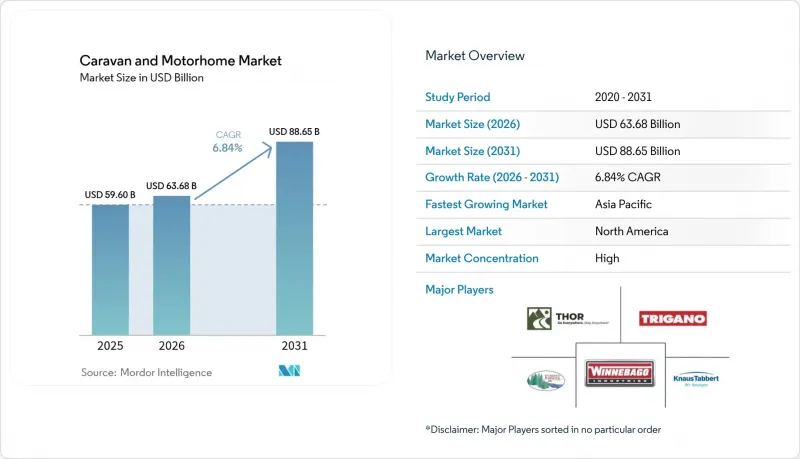
Mordor Intelligence에 의하면, 2026년 캐러밴 및 캠핑카 시장 규모는 636억 8,000만 달러로 추정되고 있어 2025년 596억 달러에서 확대해, 2031년에는 886억 5,000만 달러에 이를 것으로 예측됩니다.
2026년부터 2031년까지 연평균 성장률(CAGR) 6.84%로 성장할 것으로 전망됩니다.
본 보고서는 제품 유형(캐러밴 및 모터홈), 구동 방식(내연기관, 하이브리드, 배터리식 전기차), 전장(6m 미만, 6-8m, 8m 이상), 최종 사용자(개인 구매자 및 플릿 소유자), 판매 채널(프랜차이즈 딜러, 직영점, 온라인 직접 판매), 그리고 지역별로 분류되어 있습니다. 시장 전망은 금액(달러) 및 수량(대)으로 제시되어 있습니다.
전 세계 캐러밴 및 모터홈 시장 동향과 인사이트
코로나19 팬데믹 이후 국내 여행 및 아웃도어 여행에 대한 선호도 증가
최근 업계 조사에 따르면, 계획적인 캠핑 및 로드 트립에 대한 선호도가 높아지고 있는 것으로 드러났으며, 이는 해외 여행에서 국내 여행으로의 전환을 반영합니다. 안전에 대한 우려, 국경 통과 절차의 복잡성, 그리고 지역 탐방의 높은 비용 대비 효과가 이러한 추세를 뒷받침하고 있습니다. RV 캠핑의 인기는 계속해서 높아지고 있으며, 광범위한 경제적 불확실성 속에서도 캐러밴 및 모터홈 시장의 안정에 기여하고 있습니다. 북미와 유럽의 잘 정비된 캠핑장 네트워크는 호텔에 필적하는 편의성을 제공하여 RV 여행의 매력을 높이고 있습니다. 많은 가족에게 RV 소유는 예측 불가능한 여행 비용을 관리하기 위한 전략적 수단이며, 이는 장기적인 수요를 뒷받침하고 있습니다.
밀레니얼 세대와 Z세대의 RV 소유율 급증
밀레니얼 세대와 Z세대 소비자들이 자산 형성보다 모험 여행을 더 중요하게 여기게 된 결과, RV 구매자의 평균 연령은 53세에서 49세로 낮아졌으며, 젊은 세대가 디자인과 마케팅 전략에 영향을 미치는 입장에 서게 되었습니다. 35세에서 54세 사이의 소유자 대부분은 연결성, 지속가능성, 유연한 실내 공간을 중시하고 있으며, 제조업체들은 경량 소재, 태양광 시스템 통합, 모듈식 가구 도입으로 방향을 전환하고 있습니다. 소셜 미디어는 사용자 리뷰와 인플루언서의 컨텐츠를 통해 풀타임 또는 하이브리드형 노마드 라이프스타일을 대중화시켜 수요를 더욱 확대되고 있습니다. 금융 기관은 자동차 대출과 유사한 상환 조건을 제시함으로써 이에 대응하고 있으며, 첫 구매자가 높은 구매 가격을 감당할 수 있도록 지원하고 있습니다. 업그레이드 및 디지털 기능을 통한 지속적인 참여는 고객 유지율을 높이고 재구매를 촉진하여, 캐러밴 및 모터홈 시장의 지속적인 성장을 뒷받침하고 있습니다.
높은 초기 구매 비용 및 소유 비용
신차 및 중고 RV(레크리에이션 차량)의 구매 자금 조달은 가계에 큰 부담을 주고 있습니다. 보험, 정비, 보관료 등의 추가 비용이 조기 재판매로 이어지는 경우가 많아, 고객 만족도를 저하시키고 긍정적인 입소문을 감소시키고 있습니다. RV 여행과 라이프스타일의 친화성은 높지만, 가처분 소득이 제한적인 젊은 구매자층은 가격에 민감한 경향이 있습니다. 일부 시장에서는 공급 과잉으로 인해 현저한 가격 조정이 발생하고 있으며, 가격 급등이 시장의 변동성을 증폭시킬 가능성이 부각되고 있습니다. 업계는 수익성을 해치지 않으면서 합리적인 가격을 유지해야 하는 과제에 계속해서 직면해 있습니다.
부문 분석
2025년, 캐러밴은 ‘캐러밴 및 모터홈 시장’ 매출의 61.34%를 차지했습니다. 이는 가성비를 중시하는 구매자들이 낮은 구매 비용과 견인차를 일상적인 이동 수단으로 활용할 수 있는 유연성을 선호했기 때문입니다. 이 부문 내에서 트래블 트레일러는 저가대에서 고급 가격대까지 폭넓게 전개되며 그 매력을 높이는 한편, 피프스 휠은 주거 공간으로서의 쾌적함을 추구하는 상시 이용자들을 끌어들이고 있습니다. 접이식 캠핑카는 경량이라 차고에 보관하기에도 적합하지만, 단열성과 보안성이 뛰어난 하드사이드 모델로의 전환이 진행됨에 따라 시장 점유율이 하락하고 있습니다. 반면, 모터홈은 2031년까지 연평균 성장률(CAGR)이 8.08%로 예측되며, 즉흥적인 여행을 용이하게 하는 거주 공간과 운전석이 일체화된 레이아웃 덕분에 카반 및 모터홈 시장 전체의 성장 속도를 상회할 것으로 전망됩니다. 클래스 B 밴은 주차 편의성 덕분에 도시 지역의 모험가들에게 인기가 있는 반면, 클래스 A 코치는 널찍한 실내 공간에 투자를 아끼지 않는 은퇴자나 디지털 노마드를 끌어들이고 있습니다.
밀레니얼 세대 사이에서 ‘턴키 솔루션’에 대한 관심이 높아지고 있는 것은 모터홈 시장에 호재가 되고 있습니다. 캠핑카는 견인식 모델보다 운전 보조 기술, 태양광 패널, 스마트 홈 제어 시스템을 더 쉽게 통합할 수 있기 때문입니다. Thor Industries사의 하이브리드 클래스 A 프로토타입과 Jayco사의 46만 달러짜리 ‘Embark EV’는 통합형 추진 시스템과 주거 시스템을 프리미엄급으로 적용한 사례를 보여줍니다. 이에 반해, 캐러밴 제조업체들은 혁신성의 격차를 줄이기 위해 더 가벼운 복합 소재 벽체와 모듈식 인테리어를 도입하며 대응하고 있습니다. 캠핑장 예약용 API와 태양광 발전·축전 패키지가 표준화되는 가운데, 제품의 차별화는 평면 배치와 마찬가지로 디지털 생태계에 달려 있습니다. 그 결과, 캐러밴은 판매 대수에서 선두를 유지할 것이며, 모터홈이 ‘캐러밴 및 모터홈 시장’의 기술적 방향성을 결정짓게 될 것입니다.
2025년, 내연기관 모델은 ‘캐러밴 및 모터홈 시장’ 매출의 91.74%를 차지하며, 이는 확립된 연료 공급망과 입증된 내구성을 반영한 것입니다. 그러나 환경 규제 강화와 배터리 비용 하락에 따라 배터리식 전기 RV는 2031년까지 연평균 성장률(CAGR) 8.94%를 나타낼 것으로 예측되며, 이는 ‘캐러밴 및 모터홈 시장’ 전체의 성장 궤도를 크게 상회하는 수치입니다. Lightship사의 공기역학적 설계를 채택한 트래블 트레일러와 같은 초기 진입 제품들은 조용한 주행과 낮은 운영 비용에 대한 수요를 부각시키고 있습니다. 하이브리드 시스템은 주행 거리를 확보하기 위한 내연기관과 캠핑장에서의 기동성 및 조용한 야간 전력 공급을 실현하는 전기 모터를 결합하여 과도기적인 역할을 수행하고 있습니다.
플릿 렌탈 기업들은 예측 가능한 경로와 거점에서의 충전을 활용해 인프라 부족을 보완하며, 가장 신속하게 전기차를 도입하고 있습니다. 일반 소비자의 도입은 국립공원의 충전 제한이나 초기 비용의 영향을 받기 쉬운 상황이 지속되고 있지만, 주 및 지방 자치단체의 인센티브 덕분에 투자 수익률(ROI)은 해마다 개선되고 있습니다. 각 제조업체는 포드의 ‘E-Transit’이나 메르세데스의 ‘eSprinter’와 같은 상용 전기차 섀시를 활용하여 개발 주기 단축을 도모하고 있습니다. 배터리 밀도 향상으로 배터리 팩이 경량화되면서 차량 내 공간이 확보되어, 전장 규제와 관련된 문제도 완화되고 있습니다. 전반적으로, 향후 10년 동안 내연기관이 주류를 이루겠지만, 캐러밴 및 모터홈 시장의 혁신 흐름은 전동화가 주도하게 될 것입니다.
지역별 분석
북미는 2025년, 뿌리 깊은 RV 문화, 광대한 공유지, 고가 구매를 용이하게 하는 자금 조달 구조에 힘입어 캐러밴 및 모터홈 시장 매출의 53.25%를 차지했습니다. 미국에서는 2025년 출하 대수가 증가했으며, 향후 몇 년간도 성장이 예상되어 금리 상승에도 불구하고 내수 수요가 견조함을 보여주고 있습니다. 캐나다는 전문 복합 패널 공급업체와 증가하는 풀타임 디지털 노마드 계층을 보유하고 있어 지역 애프터마켓 생태계를 강화하고 있습니다. 국립공원 입장료와 캠핑장 개보수를 통해 공공 자금이 시설 확장에 투입되어 이용 확대를 뒷받침하고 있습니다. 또한, 도시 지역의 주차 규제에 적합한 클래스 B 개조 차량의 보급도 캐러밴 및 모터홈 시장에 긍정적인 영향을 미치고 있습니다.
유럽에서는 독일을 필두로 꾸준한 성장이 관찰됩니다. 도로가 좁고 배기가스 규제 구역이 엄격하기 때문에 컴팩트한 레이아웃은 여전히 필수적입니다. 이탈리아와 스페인에서는 RV를 수용하는 농업 관광 시설에 주력하고 있어, 상업용 캠핑장 이외의 숙박 선택지가 다양해지고 있습니다. 스칸디나비아 국가들에서는 재생에너지에 대한 우대 조치의 뒷받침을 받아 전기차 보급률이 높아지고 있으며, 이는 해당 지역의 캐러밴 및 모터홈 시장에 기술적 우위를 가져다주고 있습니다.
아시아태평양은 가처분 소득 증가와 관광 정책의 발전에 힘입어 2031년까지 연평균 성장률(CAGR)이 8.55%로 가장 높은 성장세를 기록하고 있습니다. 일본의 RV 시장은 성장을 이어가고 있으며, 차고 높이 제한을 준수하는 전동 팝업 루프와 같은 혁신적인 기능이 특징입니다. 중국의 중산층은 정부의 국내 관광 루트 추진에 힘입어 관심이 높아지고 있지만, 서부 지방에서는 여전히 인프라 격차가 남아 있습니다. 호주의 성숙한 캐러밴 시장에서는 개인 간 렌탈이 활기를 띠고 있으며, Camplify를 통한 차량 수 확대가 이용률 향상을 주도하고 있습니다. 한국이나 인도 등의 신흥 시장에서는 RV용 연결 설비를 갖춘 도로변 휴게소에 대한 투자가 진행되면서 초기 단계 수요가 형성되고 있습니다. 전반적으로 인프라 정비와 라이프스타일의 변화에 힘입어, 아시아태평양은 앞으로도 캐러밴 및 모터홈 시장 규모 확대에 있어 매우 중요한 역할을 계속해 나갈 것입니다.
기타 혜택:
- 엑셀 형식 시장 예측(ME) 시트
- 3개월간의 애널리스트 지원
자주 묻는 질문
목차
제1장 서론
제2장 조사 방법
제3장 주요 요약
제4장 시장 구도
제5장 시장 규모와 성장 예측
제6장 경쟁 구도
제7장 시장 기회와 향후 전망
JHS 26.08.11According to Mordor Intelligence, the caravan and motor home market size in 2026 is estimated at USD 63.68 billion, growing from 2025 value of USD 59.60 billion with 2031 projections showing USD 88.65 billion, growing at 6.84% CAGR over 2026-2031.
This report is Segmented by Product Type (Caravan and Motorhome), Propulsion (Internal Combustion Engine, Hybrid, and Battery-Electric), Length (Below 6m, 6-8m, and Above 8m), End User (Direct Buyers and Fleet Owners), Sales Channel (Franchise Dealerships, Company-Owned Stores, and Online Direct-To-Consumer), and Geography. The Market Forecasts are Provided in Terms of Value (USD) and Volume (Units).
Global Caravan And Motor Home Market Trends and Insights
Growing Preference for Domestic and Outdoor Travel Post-COVID
The recent industry survey highlights a growing preference for planned camping and road trips, reflecting a shift from international to domestic travel. Safety concerns, border complexities, and the cost-effectiveness of local exploration drive this trend. RV camping continues to gain popularity, helping stabilize the Caravan And Motor Home Market amid broader economic uncertainties. Well-developed campground networks in North America and Europe offer convenience comparable to hotels, enhancing the appeal of RV travel. For many families, owning an RV is a strategic way to manage unpredictable travel costs, reinforcing long-term demand.
Surging Millennial and Gen-Z RV Ownership
The average RV buyer's age fell from 53 to 49 years as millennials and Gen-Z consumers elevated adventure travel over asset accumulation, positioning younger cohorts to influence design and marketing strategies . Most owners aged 35-54 prioritize connectivity, sustainability, and flexible interiors, steering manufacturers toward lighter materials, solar integration, and modular furniture. Social media further amplifies demand, as peer reviews and influencer content normalize full-time or hybrid nomadic lifestyles. Lenders have responded with term structures that mirror auto financing, helping first-time buyers surmount high ticket prices. Continuous engagement through upgrades and digital features improves retention and feeds repeat purchases, supporting sustained Caravan And Motor Home Market growth.
High Initial Purchase and Ownership Cost
The cost of financing new and used RV units is placing significant pressure on household budgets. Additional expenses like insurance, maintenance, and storage often lead to early resale, dampening customer satisfaction and reducing positive word-of-mouth. Despite strong lifestyle alignment with RV travel, younger buyers are susceptible to pricing due to limited disposable income. Oversupply in some markets has led to notable price corrections, underscoring how elevated prices can amplify volatility. The industry continues to face the challenge of managing affordability without compromising profitability.
Other drivers and restraints analyzed in the detailed report include:
- Rise in Remote-Work-Enabled "Work-From-RV" Lifestyle
- Emergence of Modular, Upgradable RV Platforms
- Competition From DIY Van Conversions and Peer-To-Peer Rentals
For complete list of drivers and restraints, kindly check the Table Of Contents.
Segment Analysis
Caravans captured 61.34% of the Caravan And Motor Home Market revenue in 2025 as value-minded buyers favored lower acquisition costs and the flexibility of using the tow vehicle for daily transit. Within this segment, travel trailers span budget to luxury price points, broadening appeal, while fifth-wheel units attract full-time users seeking residential comfort. Folding campers, though lighter and garage-friendly, lose share as customers graduate to hard-sided models that offer better insulation and security. Motorhomes, however, are forecast for an 8.08% CAGR through 2031, eclipsing the broader Caravan And Motor Home Market pace thanks to integrated living-driving layouts that ease spontaneous travel. Class B vans stand out among urban adventurers for parking convenience, whereas Class A coaches draw retirees and digital nomads willing to invest in spacious interiors.
Growing millennial interest in turnkey solutions benefits motorhomes, incorporating driver-assistance tech, solar arrays, and smart-home controls more readily than towables. Thor Industries' hybrid Class A prototype and Jayco's USD 460,000 Embark EV illustrate premium adoption of integrated propulsion and living systems. Caravan makers counter with lighter composite walls and modular interiors to close the innovation gap. As campsite booking APIs and solar-storage packages become standard, product differentiation hinges on digital ecosystems as much as floor plans. Consequently, caravans will retain volume leadership, but motorhomes will set the technological agenda of the Caravan And Motor Home Market.
Internal combustion engine models retained 91.74% of the Caravan And Motor Home Market revenue in 2025, reflecting well-established fueling networks and proven durability. Yet battery-electric RVs are projected for a 8.94% CAGR through 2031, well above the overall Caravan And Motor Home Market size trajectory, as environmental regulations tighten and battery costs fall. Early entrants like Lightship's aerodynamic travel trailer highlight demand for silent operation and low running costs. Hybrid systems serve as a bridge, pairing combustion engines for range with electric motors for campground maneuverability and quiet overnight power.
Fleet rental firms adopt electrics fastest, using predictable routes and depot charging to mitigate infrastructure gaps. Consumer adoption remains sensitive to national park charging restrictions and upfront pricing, but state and provincial incentives improve ROI metrics annually. Manufacturers leverage commercial EV chassis from Ford E-Transit or Mercedes eSprinter platforms to shorten development cycles. Lighter packs free interior space as battery density rises, easing the length-regulation tension. Overall, combustion will dominate this decade, yet electrification sets the innovation narrative for the Caravan And Motor Home Market.
Complete Report Scope:
- By Product Type
- Caravan
- Travel Trailers
- Fifth-Wheel Trailers
- Folding Camp Trailers
- Truck Campers
- Motorhome
- Class A
- Class B (Van Conversions)
- Class C
- Caravan
- By Propulsion
- Internal-Combustion Engine (ICE)
- Hybrid (Parallel / Series)
- Battery-Electric RV
- By Length
- Below 6 meters
- 6-8 meters
- Above 8 meters
- By End User
- Direct Buyers
- Fleet Owners - Rental and Subscription Platforms
- By Sales Channel
- Franchise Dealerships
- Company-Owned Stores
- Online Direct-to-Consumer
- By Geography
- North America
- United States
- Canada
- Rest of North America
- South America
- Brazil
- Argentina
- Rest of South America
- Europe
- Germany
- United Kingdom
- France
- Italy
- Spain
- Rest of Europe
- Asia-Pacific
- China
- Japan
- Australia
- South Korea
- India
- Rest of Asia-Pacific
- Middle East and Africa
- United Arab Emirates
- Saudi Arabia
- Turkey
- Egypt
- South Africa
- Rest of Middle East and Africa
- North America
Geography Analysis
North America controlled 53.25% of the Caravan And Motor Home Market revenue in 2025, underpinned by deep-rooted RV culture, vast public lands, and financing structures that ease high-ticket purchases. The United States shipments climbed in 2025 and are projected to grow in the coming years, signaling resilient domestic demand despite higher interest rates. Canada contributes specialized composite-panel suppliers and a growing cohort of full-time digital nomads, strengthening regional aftermarket ecosystems. National park entry fees and campground upgrades funnel public funds into site expansion, supporting usage growth. The Caravan And Motor Home Market also benefits from the widespread availability of Class B conversions that suit urban storage restrictions.
Europe advanced steadily, led by Germany. Compact layouts remain essential due to narrow roads and stringent emission zones. Italy and Spain focus on agri-tourism sites that welcome RVs, diversifying overnight options beyond commercial campgrounds. Scandinavian countries see higher electric adoption spurred by renewable energy incentives, adding a technology edge to the region's Caravan And Motor Home Market.
Asia-Pacific records the fastest 8.55% CAGR through 2031, propelled by rising disposable income and evolving tourism policies. Japan's RV market is growing, featuring innovations like electric pop-up roofs that preserve garage height limits. China's middle class shows growing interest, supported by government promotion of domestic tourism corridors, yet infrastructure gaps persist in western provinces. Australia's mature caravan scene benefits from peer-to-peer rentals, with Camplify's fleet expansion driving utilization. Emerging markets like South Korea and India invest in roadway rest areas with RV hookups, establishing early-stage demand. Overall, infrastructural progress and lifestyle shifts keep the Asia-Pacific pivotal to future Caravan And Motor Home Market size growth.
- Thor Industries Inc.
- Forest River Inc.
- Winnebago Industries Inc.
- Trigano SA
- Knaus Tabbert AG
- Swift Group
- Erwin Hymer Group
- Jayco Inc.
- Burstner GmbH & Co. KG
- Dethleffs GmbH and Co. KG
- Triple E Recreational Vehicles
- Tiffin Motorhomes Inc.
- Coachmen RV
- REV Group
- Leisure Travel Vans
- Airstream Inc.
- Adria Mobil d.o.o
- Hobby-Wohnwagenwerk
- Westfalia Mobil GmbH
Additional Benefits:
- The market estimate (ME) sheet in Excel format
- 3 months of analyst support
TABLE OF CONTENTS
1 Introduction
- 1.1 Study Assumptions and Market Definition
- 1.2 Scope of the Study
2 Research Methodology
3 Executive Summary
4 Market Landscape
- 4.1 Market Overview
- 4.2 Market Drivers
- 4.2.1 Surging Millennial and Gen-Z RV Ownership
- 4.2.2 Rise in Remote-Work-Enabled "Work-From-RV" Lifestyle
- 4.2.3 Growing Preference for Domestic and Outdoor Travel Post-COVID
- 4.2.4 Emergence Of Modular, Upgradable RV Platforms
- 4.2.5 Adoption of 48-V DC Electrical Architectures for Off-Grid Capability
- 4.2.6 OEM-Campground API Integrations Enabling Real-Time Site Booking
- 4.3 Market Restraints
- 4.3.1 High Initial Purchase and Ownership Cost
- 4.3.2 Interest-Rate-Sensitive Financing Environment
- 4.3.3 Competition From DIY Van Conversions and Peer-To-Peer Rentals
- 4.3.4 Grid-Access Restrictions for High-Capacity Battery RVs in National Parks
- 4.4 Value / Supply-Chain Analysis
- 4.5 Regulatory Landscape
- 4.6 Technological Outlook
- 4.7 Porter's Five Forces
- 4.7.1 Threat of New Entrants
- 4.7.2 Bargaining Power of Buyers
- 4.7.3 Bargaining Power of Suppliers
- 4.7.4 Threat of Substitutes
- 4.7.5 Intensity of Competitive Rivalry
5 Market Size and Growth Forecasts (Value (USD), Volume (Units))
- 5.1 By Product Type
- 5.1.1 Caravan
- 5.1.1.1 Travel Trailers
- 5.1.1.2 Fifth-Wheel Trailers
- 5.1.1.3 Folding Camp Trailers
- 5.1.1.4 Truck Campers
- 5.1.2 Motorhome
- 5.1.2.1 Class A
- 5.1.2.2 Class B (Van Conversions)
- 5.1.2.3 Class C
- 5.1.1 Caravan
- 5.2 By Propulsion
- 5.2.1 Internal-Combustion Engine (ICE)
- 5.2.2 Hybrid (Parallel / Series)
- 5.2.3 Battery-Electric RV
- 5.3 By Length
- 5.3.1 Below 6 meters
- 5.3.2 6-8 meters
- 5.3.3 Above 8 meters
- 5.4 By End User
- 5.4.1 Direct Buyers
- 5.4.2 Fleet Owners - Rental and Subscription Platforms
- 5.5 By Sales Channel
- 5.5.1 Franchise Dealerships
- 5.5.2 Company-Owned Stores
- 5.5.3 Online Direct-to-Consumer
- 5.6 By Geography
- 5.6.1 North America
- 5.6.1.1 United States
- 5.6.1.2 Canada
- 5.6.1.3 Rest of North America
- 5.6.2 South America
- 5.6.2.1 Brazil
- 5.6.2.2 Argentina
- 5.6.2.3 Rest of South America
- 5.6.3 Europe
- 5.6.3.1 Germany
- 5.6.3.2 United Kingdom
- 5.6.3.3 France
- 5.6.3.4 Italy
- 5.6.3.5 Spain
- 5.6.3.6 Rest of Europe
- 5.6.4 Asia-Pacific
- 5.6.4.1 China
- 5.6.4.2 Japan
- 5.6.4.3 Australia
- 5.6.4.4 South Korea
- 5.6.4.5 India
- 5.6.4.6 Rest of Asia-Pacific
- 5.6.5 Middle East and Africa
- 5.6.5.1 United Arab Emirates
- 5.6.5.2 Saudi Arabia
- 5.6.5.3 Turkey
- 5.6.5.4 Egypt
- 5.6.5.5 South Africa
- 5.6.5.6 Rest of Middle East and Africa
- 5.6.1 North America
6 Competitive Landscape
- 6.1 Market Concentration
- 6.2 Strategic Moves
- 6.3 Market Share Analysis
- 6.4 Company Profiles (Includes Global level Overview, Market level overview, Core Segments, Financials as available, Strategic Information, Market Rank/Share for key companies, Products and Services, and Recent Developments)
- 6.4.1 Thor Industries Inc.
- 6.4.2 Forest River Inc.
- 6.4.3 Winnebago Industries Inc.
- 6.4.4 Trigano SA
- 6.4.5 Knaus Tabbert AG
- 6.4.6 Swift Group
- 6.4.7 Erwin Hymer Group
- 6.4.8 Jayco Inc.
- 6.4.9 Burstner GmbH & Co. KG
- 6.4.10 Dethleffs GmbH and Co. KG
- 6.4.11 Triple E Recreational Vehicles
- 6.4.12 Tiffin Motorhomes Inc.
- 6.4.13 Coachmen RV
- 6.4.14 REV Group
- 6.4.15 Leisure Travel Vans
- 6.4.16 Airstream Inc.
- 6.4.17 Adria Mobil d.o.o
- 6.4.18 Hobby-Wohnwagenwerk
- 6.4.19 Westfalia Mobil GmbH