

|
시장보고서
상품코드
2100740
인도의 이륜차 시장 : 점유율 분석, 업계 동향 및 통계, 성장 예측(2026-2031년)India Two Wheeler - Market Share Analysis, Industry Trends & Statistics, Growth Forecasts (2026 - 2031) |
||||||
 Mordor Intelligence
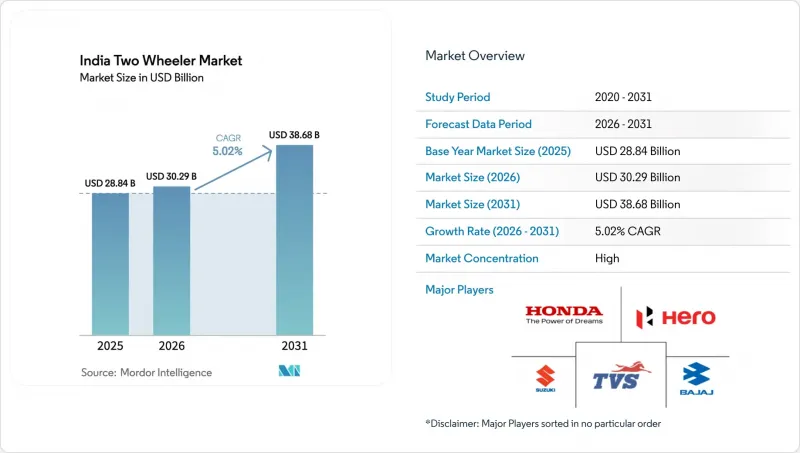
Mordor Intelligence에 의하면, 인도 이륜차 시장 규모는 2025년에 288억 4,000만 달러로 평가되었고 2026년 302억 9,000만 달러에서 2031년까지 386억 8,000만 달러에 이를 것으로 예측되며, 예측 기간(2026-2031년) CAGR은 5.02%를 나타낼 전망입니다.
본 보고서는 차종(이륜차 및 스쿠터), 구동 방식(내연기관 및 전기), 배기량/출력(110cc 이하, 기타), 가격대(1,000달러 이하, 기타), 최종 사용자(B2C 및 B2B), 유통 채널(온라인 및 오프라인) 및 주별로 분류되어 있습니다. 시장 전망은 금액(달러)과 수량(대)으로 제시되어 있습니다.
인도 이륜차 시장 동향 및 인사이트
FAME-II 보조금 연장 및 각 주의 전기차 인센티브
정부의 인센티브가 전기 이륜차의 급속한 보급을 뒷받침하고 있습니다. 국가 차원의 노력으로는 구매 보조금 제공 및 인프라 투자가 이루어지고 있으며, 지속적인 수요를 확보함과 동시에 종합적인 충전 및 배터리 교체 네트워크 구축이 진행되고 있습니다. 주 차원에서는 현금 인센티브나 자본 보조금을 통해 구매 부담을 경감시키고 있습니다. 또한, 전기차 전용 주차장 확충은 장기적인 노력을 뒷받침하는 조치입니다. 이러한 일관된 전략은 각 OEM 기업의 비즈니스 사례를 강화하고, 시장에서 전기화로의 대대적인 전환을 위한 토대를 마련하고 있습니다.
도시 지역의 교통 체증이 이륜차 선호를 부추기고 있습니다.
델리나 뭄바이의 출퇴근 시간대 평균 속도는 시속 20km 미만이지만, 이륜차의 경우 자동차에 비해 시내를 횡단하는 일반적인 이동을 40% 더 빨리 완료할 수 있으며, 주차 공간 점유도 85%나 적게 듭니다. 혁신적인 도시 프로젝트에서는 이륜차 전용 차선과 안전한 주차 공간을 확보하게 되면서, 교통 정체 완화에서 이륜차가 수행하는 역할이 제도화되고 있습니다. 배송 차량 역시 스쿠터나 소형 이륜차를 이용해 30분 이내 배송을 약속함으로써 이러한 이점을 더욱 뒷받침하고 있으며, 인도 도시 지역에서 이륜차가 실용적인 이동 수단이라는 소비자의 인식을 강화하고 있습니다.
배터리 원자재 가격 변동
국내 배터리 제조업체들은 리튬 가격의 극심한 변동과 수입 리튬 및 코발트에 대한 과도한 의존으로 인해 환율 리스크와 공급 차질에 직면해 있습니다. 이러한 압박은 이익률을 압박하고, 나아가 OEM의 가격 책정에 영향을 미칩니다. 그 결과, 전기차와 내연기관 차량 간의 비용 격차가 때때로 확대되어, 보조금 지원이 있더라도 구매 결정이 주춤할 수 있습니다.
부문 분석
2025년, 이륜차는 도시나 지방의 도로를 불문하고 범용성이 높기 때문에 인도 이륜차 시장 점유율의 74.05%를 유지했습니다. 그러나 정지 및 재출발이 잦은 교통 상황에 적합한 자동 변속기와 여성 라이더 증가에 힘입어 스쿠터는 2031년까지 연평균 성장률(CAGR) 6.05%라는 더 빠른 속도로 성장하고 있습니다. 상업용 배송 업체들은 평평한 발판과 시트 아래 수납 공간을 높이 평가하고 있으며, 기업 수요까지 더해지면서 스쿠터에 대한 수요는 더욱 확대되고 있습니다. 또한, 필요한 출력이 낮아 소형 배터리 팩으로도 충분한 전기 기술은 스쿠터에 최적이며, 합리적인 가격과 가벼운 차량 중량을 실현하고 있습니다. 이에 대응하여 유서 깊은 브랜드들은 전기 스쿠터 라인업을 발표하는 한편, 내륙 지역 시장 점유율을 지키기 위해 100-125cc 이륜차 모델의 개편에도 주력하고 있습니다.
스쿠터의 위험 요소는 고속 주행 시 안정성이 제한적이라는 점에 있으며, 이로 인해 고속도로 이용자나 장거리를 이동하는 지방 통근자들에게는 매력이 떨어집니다. 노면 상황이 복잡한 교외 지역에서는 높은 최저 지상고와 견고한 서스펜션이 요구되기 때문에 이륜차가 주류를 이루고 있습니다. 투어링이나 어드벤처와 같은 하위 부문이 이륜차 판매 대수를 지탱하고 있는데, 이는 부유층 젊은 층 사이에서 취미나 레저로서의 라이딩이 인기를 끌고 있기 때문입니다. 전반적으로 인도의 이륜차 시장은 스쿠터의 성장세와 이륜차의 기존 입지 간 균형을 이루고 있으며, 지역을 불문하고 두 차종이 공존할 여지가 남아 있습니다.
2025년 시점에서 인도 이륜차 시장 규모의 88.15%를 내연기관 플랫폼이 차지하고 있으며, 이는 주유소의 보편화와 낮은 구매 비용을 반영한 것입니다. 보조금에 의한 가격 억제, BaaS(Battery-as-a-Service), 저렴한 재생에너지를 통한 전력 공급이 전기 이륜차 판매 대수를 끌어올려, 2031년까지 연평균 성장률(CAGR) 7.02%라는 견실한 성장이 예상됩니다. 하루 80-100km를 주행하는 플릿 사업자들은 18-24개월 이내에 손익분기점에 도달할 수 있어 전동화로의 전환이 가속화되고 있습니다. 각 OEM 업체의 제품 라인업은 현재 두 가지 파워트레인을 모두 아우르고 있습니다. 히어로 모토코프와 TVS 모터는 48V 아키텍처 스쿠터에 투자하는 한편, 강화되는 배기가스 규제에 대응하기 위해 BS-VI 엔진 개량을 추진하고 있습니다. 이러한 전략적 헤지 전략을 통해 기술의 분기점에서도 경쟁력을 유지하며, 인도 이륜차 시장이 점차 전기화되는 가운데 수익을 보호하고 있습니다.
여전히 과제는 남아 있습니다. 배터리 폐기에 관한 규제, 3등급 지역의 송전망 용량, 실제 주행 거리에 대한 소비자의 인식 등이 그 예입니다. 내연기관(ICE)은 거의 즉시 주유가 가능하다는 이점을 계속해서 누리고 있습니다. 그러나 배터리 팩 가격은 연 20%의 속도로 하락하고 있으며, 인도의 PLI-ACC 제도를 통한 국내 셀 생산으로 인해 비용 격차는 더욱 좁혀질 전망입니다. 장기적으로는 경제성의 수렴과 인프라 개선에 힘입어 2028년경 전환점이 도래하여, 도시 지역에서의 판매가 전기차로 대폭 전환될 것으로 예측됩니다.
기타 혜택
- 엑셀 형식 시장 예측(ME) 시트
- 3개월간의 애널리스트 지원
자주 묻는 질문
목차
제1장 서론
제2장 조사 방법
제3장 주요 요약
제4장 주요 산업 동향
제5장 시장 구도
제6장 시장 규모와 성장 예측
제7장 경쟁 구도
제8장 시장 기회와 향후 전망
제9장 CEO가 직면하는 중요 전략적 과제
JHS 26.08.11According to Mordor Intelligence, the India two-wheeler market size was valued at USD 28.84 billion in 2025 and estimated to grow from USD 30.29 billion in 2026 to reach USD 38.68 billion by 2031, at a CAGR of 5.02% during the forecast period (2026-2031).
This report is Segmented by Vehicle Type (Motorcycles and Scooters), Propulsion (ICE and Electric), Engine Capacity/Motor Power (Up To 110cc, and More), Price Band (Up To USD 1, 000, and More), End User (B2C and B2B), Sales Channel (Online and Offline), and by State. The Market Forecasts are Provided in Terms of Value (USD) and Volume (Units).
India Two Wheeler Market Trends and Insights
FAME-II Subsidy Extension and State EV Incentives
Government incentives are driving the swift adoption of electric two-wheelers. National initiatives offer purchase subsidies and invest in infrastructure, guaranteeing sustained demand and establishing a comprehensive charging and swapping network. On the state level, programs boost affordability with cash incentives and capital subsidies. Additionally, the establishment of dedicated EV parks underscores a long-term commitment. This cohesive strategy bolsters OEM business cases and sets the stage for a significant move towards electrification in the market.
Urban Congestion Driving 2W Preference
Peak-hour speeds in Delhi and Mumbai fall below 20 km/h, yet a two-wheeler completes typical cross-town trips 40% quicker than a car while occupying 85% less parking space. Innovative city projects now earmark dedicated lanes and secure parking for two-wheelers, institutionalizing their role in reducing traffic congestion. Delivery fleets further validate the advantage by meeting 30-minute delivery promises via scooters and small motorcycles, reinforcing consumer perception that two-wheelers are the pragmatic mobility choice in urban India.
Battery-Raw-Material Price Volatility
Domestic battery manufacturers face currency risks and supply disruptions due to extreme swings in lithium prices and a heavy reliance on imported lithium and cobalt. These pressures compress profit margins, which in turn influence OEM pricing. As a result, the cost gap between electric vehicles and internal combustion vehicles occasionally widens, stalling purchase decisions even with subsidy support .
Other drivers and restraints analyzed in the detailed report include:
- Swappable-battery Business Models Lowering TCO
- Digital Lending Expanding Credit to Informal Riders
- Sparse Charging and Swapping Infrastructure Outside Metros
For complete list of drivers and restraints, kindly check the Table Of Contents.
Segment Analysis
Motorcycles sustained 74.05% of the India two-wheeler market share in 2025, owing to their versatility across city and rural roads. Yet scooters are growing faster at a 6.05% CAGR through 2031, aided by automatic transmissions that suit stop-start traffic and rising female ridership. Commercial delivery firms value the flat floorboard and under-seat storage, adding corporate volumes that further widen scooter demand. Electric technology also fits scooters well because lower power needs align with smaller battery packs, ensuring reasonable prices and curb weights. In response, legacy brands unveil electric scooter lines while doubling down on 100-125 cc motorcycle refreshes to defend share in hinterland districts.
Risks for scooters lie in limited high-speed stability, which restricts appeal for highway users and rural commuters travelling longer distances. Motorcycles dominate semi-urban zones where mixed road surfaces require higher ground clearance and robust suspension. Tourer and adventure sub-segments anchor motorcycle volumes, as hobby and leisure riding are popular among affluent youth segments. Overall, the India two-wheeler market thus balances scooter momentum with motorcycle incumbency, leaving room for both formats to co-exist across geographies.
Internal combustion engine platforms accounted for 88.15% of the India two-wheeler market size in 2025, reflecting entrenched fuel stations and lower purchase costs. Subsidized pricing, battery-as-a-service, and cheaper renewables electricity push electric volumes forward, delivering a robust 7.02% CAGR to 2031. Fleet operators with 80-100 km daily realize break-even within 18-24 months, accelerating conversions. OEM portfolios now straddle both powertrains; Hero MotoCorp and TVS Motor invest in 48 V architecture scooters while upgrading BS-VI engines to meet tightening emission rules. Strategic hedging ensures relevance across the technology divide and shields revenues as the India two-wheeler market gradually electrifies.
Challenges remain: battery disposal norms, grid capacity in tier-III regions, and consumer awareness of real-world range. ICE continues to enjoy near-instant refueling advantages. However, pack prices fall at a 20% annual clip, and domestic cell manufacturing under India's PLI-ACC scheme will narrow cost gaps further. Long-term, converging economics and improved infrastructure suggest a tipping point around 2028 when urban sales tilt materially toward electric.
Complete Report Scope:
- By Vehicle Type
- Motorcycles
- Scooters
- By Propulsion
- Internal Combustion Engine
- Electric
- By Engine Capacity / Motor Power
- Internal Combustion Engine
- Up to110 cc
- 111-125 cc
- 126-150 cc
- 151-200 cc
- 201-250 cc
- 250-350 cc
- 350-500 cc
- Above 500 cc
- Electric
- Up to 1.0 kW
- 1.1-3.0 kW
- 3.1-5.0 kW
- Above 5.0 kW
- Internal Combustion Engine
- By Price Band
- Up to USD 1,000
- USD 1,000-1,500
- USD 1,501-2,000
- USD 2,001-3,000
- USD 3,001-5,000
- Above USD 5,000
- By End User
- B2C
- B2B
- Ride-hail / Bike-Taxi / Rental / Tourism
- Delivery and Logistics
- Corporate and SME Fleets
- Others (Govt, Institutional, NGO)
- Sales Channel
- Online
- Offline
- By State
- Uttar Pradesh
- Maharashtra
- Tamil Nadu
- Karnataka
- Gujarat
- Rajasthan
- Andhra Pradesh
- Bihar
- West Bengal
- Telangana
- Kerala
- Madhya Pradesh
- Haryana
- Punjab
- Delhi
- Rest of India
List of Companies Covered in this Report:
- Hero MotoCorp Ltd.
- Honda Motorcycle and Scooter India Pvt. Ltd.
- TVS Motor Company Ltd.
- Bajaj Auto Ltd.
- Suzuki Motorcycle India Pvt. Ltd.
- Royal Enfield
- Yamaha Motor India Pvt. Ltd.
- Piaggio Vehicles Pvt. Ltd.
- Mahindra Two Wheelers Ltd.
- India Kawasaki Motors Pvt. Ltd.
- Ampere Vehicles Pvt. Ltd.
- Ather Energy Pvt. Ltd.
- Okinawa Autotech Pvt. Ltd.
- Ola Electric Mobility Pvt. Ltd.
- Revolt Intellicorp Pvt. Ltd.
- Kinetic Green Energy and Power Solutions Ltd.
- Simple Energy Pvt. Ltd.
Additional Benefits:
- The market estimate (ME) sheet in Excel format
- 3 months of analyst support
TABLE OF CONTENTS
1 Introduction
- 1.1 Study Assumptions and Market Definition
- 1.2 Scope of the Study
2 Research Methodology
3 Executive Summary
4 Key Industry Trends
- 4.1 Population and Urbanization Rate
- 4.2 GDP per Capita (PPP) and Median Disposable Income
- 4.3 Consumer Spend on Vehicle Purchase/Transport (CVP)
- 4.4 Fuel Prices
- 4.5 Interest Rate for 2W/Auto Loans and Credit Access
- 4.6 2W Penetration (units per 1,000) and Parc
- 4.7 Dealer/Service Network Density
- 4.8 Two-Wheeler Trade and Revenue (Imports/Exports)
- 4.9 Electrification Readiness (Infra and Power)
- 4.10 Battery Pack Price and Chemistry Mix
- 4.11 Battery Swapping Stations (Network Density and Utilization)
- 4.12 New Model Pipeline and OEM Coverage
- 4.13 Value-Chain Localization and Assembly Capacity
- 4.14 Regulatory Framework
- 4.14.1 Vehicle Standards, Safety and Roadworthiness
- 4.14.2 CBU/CKD/SKD Duties and VAT; Local-content Rules; Assembly Incentives
- 4.14.3 Electrification, Energy and Environmental Policy
- 4.14.4 Bike-Taxi, Delivery-Fleet, Platform and Financing Rules
5 Market Landscape
- 5.1 Market Overview
- 5.2 Market Drivers
- 5.2.1 FAME-II Subsidy Extension and State-EV Incentives
- 5.2.2 Urban Congestion Driving 2W Preference
- 5.2.3 Swappable-Battery Business Models Lowering TCO
- 5.2.4 Tier-II/III E-Commerce Boom Boosting Last-Mile Demand
- 5.2.5 Digital Lending Expanding Credit to Informal Riders
- 5.2.6 ICE Export Demand Sustaining Domestic Scale
- 5.3 Market Restraints
- 5.3.1 Battery-Raw-Material Price Volatility
- 5.3.2 Sparse Charging/Swapping Infra Outside Metros
- 5.3.3 Policy Uncertainty on GST and Import Duties
- 5.3.4 Rising Insurance Premiums for Road-Safety Compliance
- 5.4 Value / Supply-Chain Analysis
- 5.5 Regulatory Landscape
- 5.6 Technological Outlook
- 5.7 Porter's Five Forces
- 5.7.1 Threat of New Entrants
- 5.7.2 Bargaining Power of Suppliers
- 5.7.3 Bargaining Power of Buyers
- 5.7.4 Threat of Substitutes
- 5.7.5 Competitive Rivalry
6 Market Size and Growth Forecasts (Value (USD) and Volume (Units))
- 6.1 By Vehicle Type
- 6.1.1 Motorcycles
- 6.1.2 Scooters
- 6.2 By Propulsion
- 6.2.1 Internal Combustion Engine
- 6.2.2 Electric
- 6.3 By Engine Capacity / Motor Power
- 6.3.1 Internal Combustion Engine
- 6.3.1.1 Up to110 cc
- 6.3.1.2 111-125 cc
- 6.3.1.3 126-150 cc
- 6.3.1.4 151-200 cc
- 6.3.1.5 201-250 cc
- 6.3.1.6 250-350 cc
- 6.3.1.7 350-500 cc
- 6.3.1.8 Above 500 cc
- 6.3.2 Electric
- 6.3.2.1 Up to 1.0 kW
- 6.3.2.2 1.1-3.0 kW
- 6.3.2.3 3.1-5.0 kW
- 6.3.2.4 Above 5.0 kW
- 6.3.1 Internal Combustion Engine
- 6.4 By Price Band
- 6.4.1 Up to USD 1,000
- 6.4.2 USD 1,000-1,500
- 6.4.3 USD 1,501-2,000
- 6.4.4 USD 2,001-3,000
- 6.4.5 USD 3,001-5,000
- 6.4.6 Above USD 5,000
- 6.5 By End User
- 6.5.1 B2C
- 6.5.2 B2B
- 6.5.2.1 Ride-hail / Bike-Taxi / Rental / Tourism
- 6.5.2.2 Delivery and Logistics
- 6.5.2.3 Corporate and SME Fleets
- 6.5.2.4 Others (Govt, Institutional, NGO)
- 6.6 Sales Channel
- 6.6.1 Online
- 6.6.2 Offline
- 6.7 By State
- 6.7.1 Uttar Pradesh
- 6.7.2 Maharashtra
- 6.7.3 Tamil Nadu
- 6.7.4 Karnataka
- 6.7.5 Gujarat
- 6.7.6 Rajasthan
- 6.7.7 Andhra Pradesh
- 6.7.8 Bihar
- 6.7.9 West Bengal
- 6.7.10 Telangana
- 6.7.11 Kerala
- 6.7.12 Madhya Pradesh
- 6.7.13 Haryana
- 6.7.14 Punjab
- 6.7.15 Delhi
- 6.7.16 Rest of India
7 Competitive Landscape
- 7.1 Market Concentration
- 7.2 Strategic Moves
- 7.3 Market Share Analysis
- 7.4 Company Landscape
- 7.5 Company Profiles (Includes Global level Overview, Market level overview, Core Segments, Financials, Strategic Info, Market Rank/Share, Products and Services, Recent Developments)
- 7.5.1 Hero MotoCorp Ltd.
- 7.5.2 Honda Motorcycle and Scooter India Pvt. Ltd.
- 7.5.3 TVS Motor Company Ltd.
- 7.5.4 Bajaj Auto Ltd.
- 7.5.5 Suzuki Motorcycle India Pvt. Ltd.
- 7.5.6 Royal Enfield
- 7.5.7 Yamaha Motor India Pvt. Ltd.
- 7.5.8 Piaggio Vehicles Pvt. Ltd.
- 7.5.9 Mahindra Two Wheelers Ltd.
- 7.5.10 India Kawasaki Motors Pvt. Ltd.
- 7.5.11 Ampere Vehicles Pvt. Ltd.
- 7.5.12 Ather Energy Pvt. Ltd.
- 7.5.13 Okinawa Autotech Pvt. Ltd.
- 7.5.14 Ola Electric Mobility Pvt. Ltd.
- 7.5.15 Revolt Intellicorp Pvt. Ltd.
- 7.5.16 Kinetic Green Energy and Power Solutions Ltd.
- 7.5.17 Simple Energy Pvt. Ltd.


