
|
시장보고서
상품코드
2117465
태국의 이륜차 시장 : 점유율 분석, 산업 동향 및 통계 데이터, 성장 예측(2026-2031년)Thailand Two Wheeler - Market Share Analysis, Industry Trends & Statistics, Growth Forecasts (2026 - 2031) |
||||||
 Mordor Intelligence
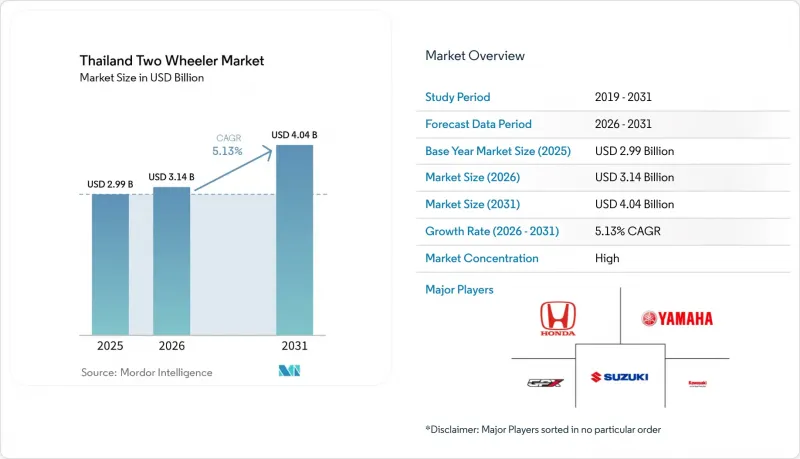
Mordor Intelligence에 의하면, 태국 이륜차 시장 규모는 2025년에 29억 9,000만 달러로 평가되었고 2026년 31억 4,000만 달러에서 2031년까지 40억 4,000만 달러에 이를 것으로 예측되며, 예측 기간(2026-2031년) CAGR은 5.13%를 나타낼 전망입니다.
본 보고서는 차종(오토바이, 스쿠터, 기타), 추진 방식(ICE(100cc 미만, 101-125cc, 기타), E2W(1kW 미만, 1-3kW, 기타), 기타 대체 연료(CNG/LPG)),구동 방식(체인 구동, 벨트 구동, 기타), 용도(개인용, 상업용, 기타), 판매 채널 및 지역별로 분류되어 있습니다. 시장 예측은 금액(달러) 및 수량(대)으로 제시되어 있습니다.
태국 이륜차 시장 동향 및 인사이트
라스트 마일 배송용 오토바이 수요 증가
전자상거래 물류 사업자들은 연료비와 공회전 시간을 줄이고, 유지보수 부담이 적은 전동 차량을 중심으로 차량 전략을 재검토하고 있습니다. 태국 우정공사는 2025년에 2만 5,000대 규모의 차량 군의 일환으로 여러 대의 전기 오토바이를 실증 시험하고, 탄소 중립 목표와 연계된 보다 광범위한 도입을 계획하고 있습니다. Grab은 2026년 4월까지 자사 플랫폼에 3만 대 이상의 전기차를 추가하여, 전기차에 의한 배차 건수를 35% 증가시켰습니다. 또한, 하루 100-150km를 주행하는 운전자에게 전기차의 비용 경쟁력을 확보할 수 있도록 경쟁력 있는 일일 요금을 설정했습니다. 음식 배달 분야는 연중 내내 큰 성장을 기록했으며, 잦은 정차와 출발이 필요한 오토바이 수요가 견조하게 유지되고 있는 가운데, 이 분야에서는 전기자동차의 토크가 뚜렷한 우위를 보이고 있습니다. ‘GrabBike Saver’ 이용 횟수가 대폭 증가하며, 전동 모빌리티로의 전환이 진행되고 있음이 부각되었습니다. 방콕이 이 전환의 최전선에 계속 서 있지만, 향후 몇 년 동안 이 추세는 렘차반 항구나 우타파오 공항과 같은 거점으로도 확대될 것으로 예측됩니다.
정부의 전기차 보조금 제도가 E2W의 초기 비용을 경감
‘EV3.5’ 프레임워크에서는 특정 가격대의 전기 오토바이에 대해 리베이트가 제공되며, 2027년까지 등록 대수를 대폭 늘리는 것을 목표로 하고 있습니다. 2025년에 이루어진 개정으로 기한이 연장되고 수출 크레딧이 확충됨에 따라 조립 제조업체들의 신뢰도가 높아졌습니다. 혼다의 ‘UC3’는 이 보조금 대상에 포함되며, 대중 시장을 겨냥한 가격대보다 낮은 위치에 자리 잡고 있습니다. 한편, 국내 브랜드들은 이 우대 조치를 활용하기 위해 몇 가지 신형 모델을 발표하는 동시에 2026년 배터리 공장 건설 계획을 밝혔습니다. 이러한 혜택은 2020년대 중반에 집중되어 있어, 정책이 종료되기 전에 처음으로 전기차를 구매하는 사람들을 뒷받침하고 있습니다.
할부 구매 신용 심사 기준 강화
2025년, 가계 부채가 상당한 수준에 도달함에 따라 금융 기관들은 신중한 태도를 강화했습니다. 크룬실리 오토는 금리를 인상하고 계약금을 증액하도록 요구했기 때문에 많은 보급형 구매자들이 대상에서 제외되었습니다. 이온(Aeon)은 경쟁력 있는 금리를 제공한 반면, 시암 디지털(Siam Digital)은 가격을 높게 책정하여 더 좁은 고객층을 타겟으로 삼았습니다. 이러한 영향은 방콕 등 도시 지역에 비해 소득이 현저히 낮은 농업 지역에서 가장 심각합니다. 그 결과, 예측 기간 동안 소비자들은 차량 보유 기간을 연장하고, 차량 교체를 미루며, 신차 구매를 자제하는 경향을 보이고 있습니다.
부문 분석
스쿠터는 시장 전체의 성장률을 상회하며, 2031년까지 태국 이륜차 시장에서 점유율을 확대할 것으로 예측됩니다. 2025년 시점에서는 지방에서 수동 변속기에 대한 선호도가 영향을 미쳐 오토바이가 72.33%의 점유율을 차지했으나, 방콕의 교통 체증으로 인해 자동 변속 및 시트 하부 수납 공간과 같은 스쿠터의 장점이 두드러지고 있습니다. 혼다의 한정 모델인 ‘스쿠피’와 ‘ADV160’의 모델 체인지는 이미지를 중시하는 밀레니얼 세대에게 어필하고 있는 반면, 야마하의 ‘NMAX Connected’는 ‘블루 코어’ 기술에 의한 연비 효율로 경쟁하고 있습니다. 패션성이 뛰어난 디자인과 스마트폰 연동 기능의 도입으로, 기존에는 수동 변속기 차량 부문에서 존재감이 미미했던 여성 라이더 층이 확대되고 있습니다.
관광 산업의 회복에 따라 푸켓과 치앙마이에서 스쿠터 대여가 급증하고 있습니다. 하루 200바트부터 시작하는 요금제는 태국의 교통 상황에 익숙하지 않은 관광객을 끌어들이고 있으며, Skoot의 보험이 포함된 앱이 신뢰를 쌓아가고 있습니다. 배송량 증가 또한 대형 리어 박스를 장착할 수 있는 스텝스루 프레임에 대한 수요를 뒷받침하고 있습니다. 태국 이륜차 시장에서 스쿠터 시장 규모는 연평균 성장률(CAGR) 6.48%로 확대될 것으로 예상되며, 혼다는 차세대 가격대에서 스쿠터의 편의성과 오토바이의 스타일을 융합한 전기 콘셉트 모델 ‘WN7’을 포지셔닝하고 있습니다.
2025년 시점에서도 내연기관 오토바이는 여전히 91.25%의 점유율을 차지하고 있지만, 그 우위는 서서히 약화되고 있습니다. 101-125cc 클래스는 39,000-48,800바트라는 합리적인 가격대를 유지하며 지방 수요를 뒷받침하고 있습니다. 존테스는 2026년 초, 일본 경쟁사보다 저렴한 가격 전략을 통해 큰 성장을 이뤘습니다. 동시에 배터리 교환 서비스와 보조금 덕분에 전기 오토바이 판매는 연평균 성장률(CAGR) 11.25%의 성장 궤도에 올랐습니다. 출력 6kW, 주행 거리 122km인 혼다의 ‘UC3’는 1만 바트 환급 대상인 대중형 전기 오토바이의 대표적인 예입니다.
하루 100-150km를 주행하는 배송용 차량의 경우, 연료비 절감과 정비 주기 단축을 고려하면 18개월 이내에 투자 회수가 가능합니다. 발표된 배터리 공장이 현재의 셀 공급 부족을 해소할 수 있다면, 2031년까지 태국의 전동 이륜차 시장 규모는 더욱 확대될 가능성이 있습니다. 정책의 중점 및 인프라 예산이 배터리 중심 방향으로 배분되고 있기 때문에 대체 연료의 점유율은 여전히 극히 미미합니다.
기타 혜택:
- Excel 형식 시장 예측(ME) 시트
- 3개월간의 애널리스트 지원
자주 묻는 질문
목차
제1장 서론
제2장 분석 방법
제3장 주요 요약
제4장 시장 구도
제5장 시장 규모·성장률 예측
제6장 경쟁 구도
제7장 시장 기회와 향후 전망
JHS 26.09.03According to Mordor Intelligence, the Thailand two-wheeler market size was valued at USD 2.99 billion in 2025 and estimated to grow from USD 3.14 billion in 2026 to reach USD 4.04 billion by 2031, at a CAGR of 5.13% during the forecast period (2026-2031).
This report is Segmented by Vehicle Type (Motorcycles, Scooters, and More), Propulsion Type (ICE (Below 100 Cc, 101-125 Cc, and More), E2W (Below 1 KW, 1-3 KW, and More), Other Alternative Fuels (CNG/LPG)), Drive Type (Chain Drive, Belt Drive, and More), End Use (Personal Use, Commercial Use, and More), Sales Channel, and Region. Market Forecasts are Provided in Value (USD) and Volume (Units).
Thailand Two Wheeler Market Trends and Insights
Rising Demand for Last-Mile Delivery Motorcycles
E-commerce logistics operators are rewriting fleet strategies around low-maintenance electric units that cut fuel spend and idle time. Thailand Post field-tested several electric bikes as part of a 25,000-unit fleet in 2025 and plans wider rollouts tied to carbon-neutral goals. Grab added more than 30,000 electric vehicles to its platform by April 2026, achieved a 35% rise in EV rides, and offered competitive daily pricing, which makes electrics cost-competitive for drivers covering 100-150 km per day . The food delivery segment experienced substantial growth during the year, maintaining strong demand for stop-and-go bikes, where electric torque offers distinct advantages. GrabBike Saver trips saw a significant increase, highlighting the growing shift toward electric mobility. While Bangkok remains at the forefront of this transition, the trend is expected to expand to Laem Chabang port and U-Tapao airport hubs over the coming years.
Government EV Subsidy Scheme Reducing Upfront Cost of E2Ws
The EV3.5 framework provides rebates on electric bikes within a specific price range, aiming to achieve significant registrations by 2027. Amendments made in 2025 extended deadlines and introduced enhanced export credits, strengthening assembler confidence. Honda's UC3 qualifies for the subsidy, positioning it below the mass-market threshold. Meanwhile, a domestic brand announced several new models to leverage the incentive and outlined plans for a battery plant in 2026. The benefits are concentrated in the mid-decade period, encouraging first-time EV buyers before the policy concludes.
Tightening of Hire-Purchase Credit Approval Criteria
In 2025, lenders grew cautious as household debt reached significant levels. Krungsri Auto increased rates and required larger down payments, excluding many entry-level buyers. While AEON offered competitive rates, Siam Digital targeted a smaller customer base with higher pricing. The impact is most severe in farming provinces, where incomes are considerably lower compared to urban areas like Bangkok. Consequently, consumers are extending ownership cycles, delaying upgrades, and reducing new unit purchases over the forecast period.
Other drivers and restraints analyzed in the detailed report include:
- Expansion of Battery-Swap Station Networks by Oil and Energy Majors
- Rapid Adoption of Digital Motorcycle Financing Via Mobile Apps
- Limited Public Fast-Charging Infrastructure Outside Urban Cores
For complete list of drivers and restraints, kindly check the Table Of Contents.
Segment Analysis
Scooters are forecast to outpace overall growth and lift their slice of the Thailand two-wheeler market by 2031. Motorcycles controlled 72.33% share in 2025, a legacy of rural manual-shift preference, yet Bangkok congestion amplifies scooter advantages such as automatic gearing and under-seat storage. Honda's limited-edition Scoopy and ADV160 refreshes appeal to image-conscious millennials, while Yamaha's NMAX Connected competes on Blue Core efficiency. The push into fashion-forward designs plus smartphone pairing is expanding female ridership, historically underrepresented in manual segments.
Tourism recovery multiplies scooter rentals in Phuket and Chiang Mai. Daily rates from THB 200 attract visitors unfamiliar with Thai traffic, and Skoot's insurance-bundled app builds trust. Rising delivery volumes also favor step-through frames that accept large rear boxes. The Thailand two-wheeler market size for scooters is projected to climb at a 6.48% CAGR, with Honda positioning its WN7 electric concept to merge scooter convenience and motorcycle styling at next-generation price points.
Internal-combustion bikes still account for 91.25% share in 2025, but their grip is loosening. The 101-125 cc bracket anchors affordability at THB 39,000-48,800, underpinning rural demand. Zontes gained significant growth in early 2026 by undercutting Japanese rivals. Concurrently, battery swaps and subsidies create an 11.25% CAGR runway for electric sales. Honda's UC3 at 6 kW and 122 km range exemplifies mass-market electrics that qualify for the THB 10,000 rebate.
Delivery fleets running 100-150 km daily see payback inside 18 months once fuel savings and lower service intervals are tallied. The Thailand two-wheeler market size for electric models could rise further by 2031 if announced battery plants bridge the present cell-supply gap. Alternative fuels remain negligible, as policy focus and infrastructure budgets stay aligned with battery paths.
Complete Report Scope:
- By Vehicle Type
- Motorcycles
- Scooters
- Mopeds
- By Propulsion Type
- Internal Combustion Engine (ICE)
- Below 100 cc
- 101-125 cc
- 126-250 cc
- Above 250 cc
- Electric Two-Wheelers (E2W)
- Below 1 kW
- 1 kW - 3 kW
- 3 kW - 7.5 kW
- Above 7.5 kW
- Other Alternative Fuels
- CNG/LPG
- Internal Combustion Engine (ICE)
- By Drive Type
- Chain Drive
- Belt Drive
- Shaft Drive
- By End Use
- Personal Use
- Commercial Use
- Delivery and Fleet Services
- By Sales Channel
- Online
- Offline
- By Region
- Bangkok and Central Thailand
- Eastern Economic Corridor
- Northern Thailand
- Northeastern Thailand
- Southern Thailand
List of Companies Covered in this Report:
- Honda Motor Co., Ltd.
- Yamaha Motor Co., Ltd.
- GP Motor Thailand Company Limited
- Kawasaki Motors, Ltd.
- Suzuki Motor Corporation
- Piaggio & C. SpA
- Triumph Motorcycles Ltd.
- Ducati Motor Holding S.p.A.
- Harley-Davidson, Inc.
- Royal Enfield (Eicher Motors Ltd.)
- Bajaj Auto Ltd.
- TVS Motor Company
- Deco Green Energy Co. Ltd.
- Edison Motors (Thailand)
- Yadea Group Holdings Ltd.
- Arun Plus Co., Ltd.
Additional Benefits:
- The market estimate (ME) sheet in Excel format
- 3 months of analyst support
TABLE OF CONTENTS
1 Introduction
- 1.1 Study Assumptions and Market Definition
- 1.2 Scope of the Study
2 Research Methodology
3 Executive Summary
4 Market Landscape
- 4.1 Market Overview
- 4.2 Market Drivers
- 4.2.1 Rising Demand for Last-Mile Delivery Motorcycles
- 4.2.2 Government EV Subsidy Scheme Reducing Upfront Cost of E2Ws
- 4.2.3 Expansion of Battery-Swap Station Networks by Oil and Energy Majors
- 4.2.4 Rapid Adoption of Digital Motorcycle Financing Via Mobile Apps
- 4.2.5 Tourism Rebound Boosting Rental Motorcycle Demand in Resort Provinces
- 4.2.6 Emergence of Subscription-Based Motorcycle Leasing for Urban Millennials
- 4.3 Market Restraints
- 4.3.1 Tightening of Hire-Purchase Credit Approval Criteria
- 4.3.2 Limited Public Fast-Charging Infrastructure Outside Urban Cores
- 4.3.3 High Motorcycle Fatality Rate Prompting Stricter Safety Regulations
- 4.3.4 Domestic Lithium-Ion Cell Supply Gap Increasing Input Costs for E2W Assemblers
- 4.4 Value / Supply-Chain Analysis
- 4.5 Regulatory Landscape
- 4.6 Technological Outlook
- 4.7 Porter's Five Forces
- 4.7.1 Threat of New Entrants
- 4.7.2 Bargaining Power of Suppliers
- 4.7.3 Bargaining Power of Buyers
- 4.7.4 Threat of Substitutes
- 4.7.5 Industry Rivalry
5 Market Size and Growth Forecasts (Value(USD) and Volume(Units))
- 5.1 By Vehicle Type
- 5.1.1 Motorcycles
- 5.1.2 Scooters
- 5.1.3 Mopeds
- 5.2 By Propulsion Type
- 5.2.1 Internal Combustion Engine (ICE)
- 5.2.1.1 Below 100 cc
- 5.2.1.2 101-125 cc
- 5.2.1.3 126-250 cc
- 5.2.1.4 Above 250 cc
- 5.2.2 Electric Two-Wheelers (E2W)
- 5.2.2.1 Below 1 kW
- 5.2.2.2 1 kW - 3 kW
- 5.2.2.3 3 kW - 7.5 kW
- 5.2.2.4 Above 7.5 kW
- 5.2.3 Other Alternative Fuels
- 5.2.3.1 CNG/LPG
- 5.2.1 Internal Combustion Engine (ICE)
- 5.3 By Drive Type
- 5.3.1 Chain Drive
- 5.3.2 Belt Drive
- 5.3.3 Shaft Drive
- 5.4 By End Use
- 5.4.1 Personal Use
- 5.4.2 Commercial Use
- 5.4.3 Delivery and Fleet Services
- 5.5 By Sales Channel
- 5.5.1 Online
- 5.5.2 Offline
- 5.6 By Region
- 5.6.1 Bangkok and Central Thailand
- 5.6.2 Eastern Economic Corridor
- 5.6.3 Northern Thailand
- 5.6.4 Northeastern Thailand
- 5.6.5 Southern Thailand
6 Competitive Landscape
- 6.1 Market Concentration
- 6.2 Strategic Moves
- 6.3 Market Share Analysis
- 6.4 Company Profiles (includes Global Level Overview, Market Level Overview, Core Segments, Financials as Available, Strategic Information, Market Rank/Share for Key Companies, Products and Services, SWOT Analysis, and Recent Developments)
- 6.4.1 Honda Motor Co., Ltd.
- 6.4.2 Yamaha Motor Co., Ltd.
- 6.4.3 GP Motor Thailand Company Limited
- 6.4.4 Kawasaki Motors, Ltd.
- 6.4.5 Suzuki Motor Corporation
- 6.4.6 Piaggio & C. SpA
- 6.4.7 Triumph Motorcycles Ltd.
- 6.4.8 Ducati Motor Holding S.p.A.
- 6.4.9 Harley-Davidson, Inc.
- 6.4.10 Royal Enfield (Eicher Motors Ltd.)
- 6.4.11 Bajaj Auto Ltd.
- 6.4.12 TVS Motor Company
- 6.4.13 Deco Green Energy Co. Ltd.
- 6.4.14 Edison Motors (Thailand)
- 6.4.15 Yadea Group Holdings Ltd.
- 6.4.16 Arun Plus Co., Ltd.