|
시장보고서
상품코드
2113233
아시아태평양의 콜라겐 : 시장 점유율 분석, 업계 동향과 통계, 성장 예측(2026-2031년)Asia Pacific Collagen - Market Share Analysis, Industry Trends & Statistics, Growth Forecasts (2026 - 2031) |
||||||
 Mordor Intelligence
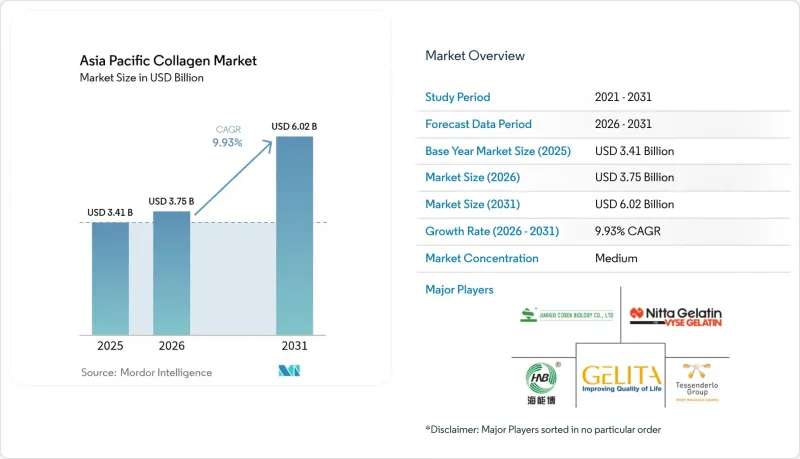
Mordor Intelligence에 의하면, 아시아태평양의 콜라겐 시장 규모는 2025년에 34억 1,000만 달러로 평가되었고 2026년 37억 5,000만 달러에서 2031년까지 60억 2,000만 달러에 달할 것으로 예측되며, 예측 기간(2026년-2031년) CAGR은 9.93%를 나타낼 전망입니다.
본 보고서는 원료별(동물 유래, 해양 유래), 최종 사용자/용도별(식품 및 음료, 영양 보조 식품, 퍼스널케어 및 화장품, 의약품, 동물사료), 지역별(일본, 중국, 인도, 호주, 기타 아시아태평양)로 분류되어 있습니다. 시장 예측은 금액(미 달러)으로 표시되어 있습니다.
아시아태평양의 콜라겐 시장 동향 및 인사이트
건강 및 웰니스 제품에 대한 소비자 수요 증가
아시아태평양 전체에서 웰니스 경제가 지속적으로 확대되는 가운데, 콜라겐은 기능성 영양 분야에서 활용이 확대되고 있으며, 그 용도는 기존의 미용 관련 용도를 넘어 확장되고 있습니다. 또한, 이 지역의 1인당 소득은 크게 증가할 것으로 예상되며, 2024년 1만 7,440달러에서 2029년까지 2만 3,260달러에 달할 것으로 전망됩니다. 이러한 경제 성장은 예방 의료에 대한 투자로의 전환을 촉진하고 있으며, 프리미엄 콜라겐 제품의 보급을 위한 견고한 기반을 마련하고 있습니다. 이 제품들은 관절 건강, 피부 탄력, 골밀도 유지와 같은 주요 건강 문제에 대처하기 위해 특별히 설계되었습니다. 소비자들은 확고한 과학적 근거로 뒷받침되는 콜라겐 제제에 대해 더 높은 가격을 지불할 의향을 점점 더 보이고 있습니다. 이러한 추세는 동료 심사를 거친 연구를 통해 제품의 임상적 유효성을 효과적으로 입증하고, 규제상의 건강 표시 준수를 보장할 수 있는 공급업체에게 상당한 이익률 확대의 기회를 제공합니다.
관절 관리 솔루션을 찾는 고령화 사회
아시아태평양의 선진 시장에서 현저한 인구 통계학적 변화가 관찰되는 가운데, 관절 관리를 목적으로 한 콜라겐 제품에 대한 수요는 꾸준히 증가하고 있습니다. 2024년 세계은행 데이터에 따르면, 일본의 65세 이상 인구는 전체 인구의 30%를 차지했습니다. 고도 고령화 사회를 특징으로 하는 일본은 혁신적인 솔루션의 시험 및 개발 측면에서 매우 중요한 시장이 되고 있습니다. 예를 들어, 로토제약의 ‘MOCOLA(모콜라)’ 브랜드는 20ml 콜라겐 음료와 비타민 정제를 독창적으로 조합한 제품을 출시하여 고령 소비자의 기호에 효과적으로 부응하고 있습니다. 이러한 접근 방식은 고령화 사회에 대응하는 데 있어 제품 형태의 혁신이 얼마나 중요한지를 여실히 보여주고 있습니다. 일본 외에도 중국과 한국에서는 유사한 추세가 나타나고 있으며, 고령화되는 베이비붐 세대가 시장 성장의 주요 원동력이 되고 있습니다. 이 소비자들은 막대한 축적 자산을 보유하고 있으며 건강과 웰빙을 매우 중요하게 여겨 프리미엄 시장 부문의 발전을 뒷받침하고 있습니다. 이 지역들에서 임상적으로 효능이 입증된 관절 건강 지원 제품에 대한 수요는 이 인구 집단의 특정 요구에 부응하는 것이 점점 더 중요해지고 있음을 보여줍니다.
대체 단백질 분야의 경쟁
Rawga와 같은 기업들은 식물 세포벽의 엑스턴신에서 추출한 식물성 콜라겐 ‘VC-H1’을 개발함으로써 콜라겐 조달에 있어 큰 혁신을 주도하고 있습니다. 이 제품은 동물성 콜라겐의 트리펩타이드 구조와 분자량을 재현하도록 특별히 설계되어, 천연 콜라겐에 매우 가까운 식물 유래 대체품을 제공합니다. 한편, 에보닉(Evonik)은 생명공학 분야에 대한 막대한 투자와 기술 혁신을 통해 정밀 발효 기술 분야에서 큰 진전을 이루고 있습니다. 이러한 노력을 통해 기존 콜라겐을 대체할 수 있는 확장 가능하고 지속 가능한 대체품이 탄생하고 있으며, 환경에 미치는 영향과 식단 제한에 대한 높아지는 우려에 대응하고 있습니다. 또한, 이러한 기술은 대규모로 도입될 경우 생산 비용을 절감할 가능성을 내포하고 있어 경제적으로도 실현 가능한 수준에 이르렀습니다. 그 결과, 기존 콜라겐 공급업체들은 대응을 서둘러야 한다는 압박을 점점 더 크게 받고 있습니다. 이들은 뛰어난 생체 이용률을 강조하고, 임상적 유효성을 입증하며, 특수한 용도를 겨냥함으로써 자사 제품의 차별화에 주력하고 있습니다. 이러한 분야들은 천연 콜라겐의 고유한 장점, 특히 합성 대체품으로는 아직 완전히 재현되지 않은 그 복잡한 매트릭스 특성을 부각시키고 있습니다.
부문 분석
해양 유래 콜라겐은 2031년까지 연평균 성장률(CAGR) 10.28%로 성장을 가속화하여, 2025년에는 시장을 주도하는 동물 유래 부문의 점유율 62.55%를 넘어설 전망입니다. 이는 지속 가능하고 알레르기 유발 가능성이 낮은 대체품으로의 소비자 선호도 변화를 반영한 것입니다. 플로리다 대학 IFAS EDIS에 따르면, 타이 유니온(Thai Union)의 해양 유래 콜라겐에 대한 투자 및 순환 경제에 대한 노력은 수산업계가 지속가능성에 대한 우려를 해결하면서 부가가치 있는 수익원을 창출할 수 있음을 보여줍니다. 동물 유래 콜라겐은 확립된 밸류체인과 비용 측면의 우위 덕분에, 특히 기능적 이점이 지속가능성에 대한 프리미엄을 상회하는 가격에 민감한 시장 부문에서 지배적인 위치를 유지하고 있습니다.
해양성 콜라겐 분야는 어피 가공 기술 및 탈세포화 기술의 발전으로 혜택을 받고 있으며, 이러한 기술은 생체 이용률을 높이는 동시에 소나 돼지 유래 대체품에 비해 알레르기 유발 위험을 줄여줍니다. 특히 인도네시아나 말레이시아와 같이 무슬림이 다수를 차지하는 시장에서는 질병 전파 위험이 낮고 종교적 식단 제한도 적기 때문에 규제 체계가 해양 유래 원료를 점점 더 우호적으로 다루고 있습니다. 그러나 해양성 콜라겐은 어업 규제나 계절적 공급 상황에 따른 공급망상의 제약에 직면해 있으며, 가격 변동이 발생하고 있어 안정적으로 공급되는 동물 유래 대체품에 비해 대중 시장으로의 보급이 제한되고 있습니다.
기타 혜택:
- 엑셀 형식 시장 예측(ME) 시트
- 3개월간의 애널리스트 지원
자주 묻는 질문
목차
제1장 서론
제2장 조사 방법
제3장 주요 요약
제4장 시장 구도
제5장 시장 규모와 성장 예측
제6장 경쟁 구도
제7장 시장 기회와 향후 전망
LSH 26.08.24According to Mordor Intelligence, the Asia Pacific collagen market size was valued at USD 3.41 billion in 2025 and estimated to grow from USD 3.75 billion in 2026 to reach USD 6.02 billion by 2031, at a CAGR of 9.93% during the forecast period (2026-2031).
This report is Segmented by Source (Animal-Based, Marine-Based), End User/Application (Food & Beverages, Dietary Supplements, Personal Care & Cosmetics, Pharmaceuticals, Animal Nutrition), and Geography (Japan, China, India, Australia, Rest of Asia Pacific). The Market Forecasts are Provided in Terms of Value (USD).
Asia Pacific Collagen Market Trends and Insights
Increasing Consumer Demand for Health and Wellness Products
As the wellness economy continues to expand across the Asia Pacific region, collagen is increasingly being utilized in functional nutrition, extending its applications beyond traditional beauty-related uses. Furthermore, per capita income in the region is expected to grow significantly, rising from USD 17,440 in 2024 to a projected USD 23,260 by 2029. This economic growth is driving a shift toward preventive health investments, creating a strong foundation for the adoption of premium collagen products. These products are specifically designed to address key health concerns such as joint health, skin elasticity, and bone density maintenance. Consumers are demonstrating a growing willingness to pay higher prices for collagen formulations that are supported by robust scientific evidence. This trend offers substantial margin expansion opportunities for suppliers who can effectively demonstrate the clinical efficacy of their products through peer-reviewed research and ensure compliance with regulatory health claims.
Ageing Population Seeking Joint-Care Solutions
As developed APAC markets experience significant demographic shifts, the demand for joint-care collagen applications continues to grow steadily. According to the World Bank data from 2024, 30% of people in Japan were above the age of 65. Japan, characterized by its advanced aging society, serves as a pivotal market for testing and developing innovative solutions. For instance, Rohto Pharmaceutical's MOCOLA brand has introduced a unique combination of 20ml collagen drinks and vitamin tablets, effectively addressing the consumption preferences of elderly consumers. This approach highlights the importance of format innovation in catering to the aging population. Beyond Japan, similar trends are emerging in China and South Korea, where aging baby boomers are becoming key drivers of market growth. These consumers, equipped with substantial accumulated wealth and a strong focus on health and wellness, are fostering the development of premium market segments. The demand for clinically-validated joint health formulations in these regions underscores the growing importance of addressing the specific needs of this demographic group.
Competition from Alternative Proteins
Companies like Rawga are driving significant innovation in collagen sourcing by developing VC-H1, a vegetable collagen derived from plant cell wall extensin. This product is specifically designed to replicate the tripeptide structure and molecular weight of animal collagen, offering a plant-based alternative that closely mimics its natural counterpart. At the same time, Evonik is making strides in precision fermentation through substantial investments and advancements in biotechnology. These efforts are creating scalable and sustainable alternatives to traditional collagen, addressing growing concerns about environmental impact and dietary restrictions. Additionally, these technologies hold the potential to reduce production costs when implemented at scale, making them economically viable. Consequently, traditional collagen suppliers are facing mounting pressure to adapt. They are focusing on differentiating their offerings by emphasizing superior bioavailability, securing clinical validation, and targeting specialized applications. These areas highlight the unique advantages of natural collagen, particularly its complex matrix properties, which synthetic alternatives have yet to fully replicate.
Other drivers and restraints analyzed in the detailed report include:
- Rising Applications in Anti-Aging Creams and Other Beauty Products
- Technological Advancements in Extraction, Processing, and Formulation
- Stringent Regulatory Compliance and Certification Requirements
For complete list of drivers and restraints, kindly check the Table Of Contents.
Segment Analysis
Marine-based collagen accelerates at a 10.28% CAGR through 2031, outpacing the animal-based segment's market-leading 62.55% share in 2025, reflecting consumer preference shifts toward sustainable and hypoallergenic alternatives. Thai Union's marine collagen investments and circular economy initiatives demonstrate how fishing industry byproducts create value-added revenue streams while addressing sustainability concerns, according to the University of Florida IFAS EDIS. Animal-based collagen maintains dominance through established supply chains and cost advantages, particularly in price-sensitive market segments where functional benefits outweigh sustainability premiums.
The marine collagen segment benefits from technological advances in fish skin processing and decellularization techniques that enhance bioavailability while reducing allergenicity risks compared to bovine and porcine alternatives. Regulatory frameworks increasingly favor marine sources due to lower disease transmission risks and reduced religious dietary restrictions, particularly in Muslim-majority markets like Indonesia and Malaysia. However, marine collagen faces supply chain constraints from fishing industry regulations and seasonal availability, creating price volatility that limits mass-market penetration compared to consistently available animal-based alternatives.
Complete Report Scope:
- By Source
- Animal-based
- Marine-based
- By End User / Application
- Food & Beverages
- Dietary Supplements
- Personal Care & Cosmetics
- Pharmaceuticals
- Animal Nutrition
- By Geography
- Japan
- China
- India
- Australia
- Rest of Asia Pacific
List of Companies Covered in this Report:
- Gelita AG
- Rousselot / Peptan
- Nitta Gelatin Inc.
- Darling Ingredients
- Thai Union Ingredients
- Nestle Health Science (Vital Proteins)
- TCI Co. Ltd.
- Titan Biotech Ltd.
- Hangzhou Nutrition Biotechnology
- Shiseido Co. Ltd.
- AmorePacific Corp.
- Weishardt Group
- Cargill - Beauty & Health Solutions
- Ori Bionature (Malaysia)
- Nature's Bounty (Co. of The Bountiful Co.)
- Optimum Nutrition (Glambia)
- GNC Holdings
- The Clorox Company (NeoCell)
- Verisol / Gelita brand
- Collagen Solutions plc
Additional Benefits:
- The market estimate (ME) sheet in Excel format
- 3 months of analyst support
TABLE OF CONTENTS
1 INTRODUCTION
- 1.1 Study Assumptions & Market Definition
- 1.2 Scope of the Study
2 RESEARCH METHODOLOGY
3 EXECUTIVE SUMMARY
4 MARKET LANDSCAPE
- 4.1 Market Overview
- 4.2 Market Drivers
- 4.2.1 Increasing consumer demand for health and wellness products,
- 4.2.2 Ageing population seeking joint-care solutions
- 4.2.3 Rising Applications in Anti-Aging Creams and Other Beauty Products
- 4.2.4 Technological advancements in extraction, processing, and formulation
- 4.2.5 Shift toward sustainable marine collagen sources
- 4.2.6 Rising Innovation in research and production
- 4.3 Market Restraints
- 4.3.1 Competition from alternative proteins
- 4.3.2 Stringent regulatory compliance and certification requirements
- 4.3.3 Concerns over allergenicity and religious dietary restrictions
- 4.3.4 High costs of sourcing and processing high-quality collagen raw materials
- 4.4 Supply Chain Analysis
- 4.5 Regulatory Outlook
- 4.6 Porter's Five Forces
- 4.6.1 Threat of New Entrants
- 4.6.2 Bargaining Power of Buyers/Consumers
- 4.6.3 Bargaining Power of Suppliers
- 4.6.4 Threat of Substitute Products
- 4.6.5 Intensity of Competitive Rivalry
5 MARKET SIZE AND GROWTH FORECAST
- 5.1 By Source
- 5.1.1 Animal-based
- 5.1.2 Marine-based
- 5.2 By End User / Application
- 5.2.1 Food & Beverages
- 5.2.2 Dietary Supplements
- 5.2.3 Personal Care & Cosmetics
- 5.2.4 Pharmaceuticals
- 5.2.5 Animal Nutrition
- 5.3 By Geography
- 5.3.1 Japan
- 5.3.2 China
- 5.3.3 India
- 5.3.4 Australia
- 5.3.5 Rest of Asia Pacific
6 COMPETITIVE LANDSCAPE
- 6.1 Market Concentration
- 6.2 Strategic Moves
- 6.3 Market Ranking Analysis
- 6.4 Company Profiles (includes Global-level Overview, Market-level Overview, Core Segments, Financials (if available), Strategic Information, Market Rank/Share, Products & Services, Recent Developments)
- 6.4.1 Gelita AG
- 6.4.2 Rousselot / Peptan
- 6.4.3 Nitta Gelatin Inc.
- 6.4.4 Darling Ingredients
- 6.4.5 Thai Union Ingredients
- 6.4.6 Nestle Health Science (Vital Proteins)
- 6.4.7 TCI Co. Ltd.
- 6.4.8 Titan Biotech Ltd.
- 6.4.9 Hangzhou Nutrition Biotechnology
- 6.4.10 Shiseido Co. Ltd.
- 6.4.11 AmorePacific Corp.
- 6.4.12 Weishardt Group
- 6.4.13 Cargill - Beauty & Health Solutions
- 6.4.14 Ori Bionature (Malaysia)
- 6.4.15 Nature's Bounty (Co. of The Bountiful Co.)
- 6.4.16 Optimum Nutrition (Glambia)
- 6.4.17 GNC Holdings
- 6.4.18 The Clorox Company (NeoCell)
- 6.4.19 Verisol / Gelita brand
- 6.4.20 Collagen Solutions plc