|
시장보고서
상품코드
2120294
유럽의 콜라겐 : 시장 점유율 분석, 업계 동향과 통계, 성장 예측(2026-2031년)Europe Collagen - Market Share Analysis, Industry Trends & Statistics, Growth Forecasts (2026 - 2031) |
||||||
 Mordor Intelligence
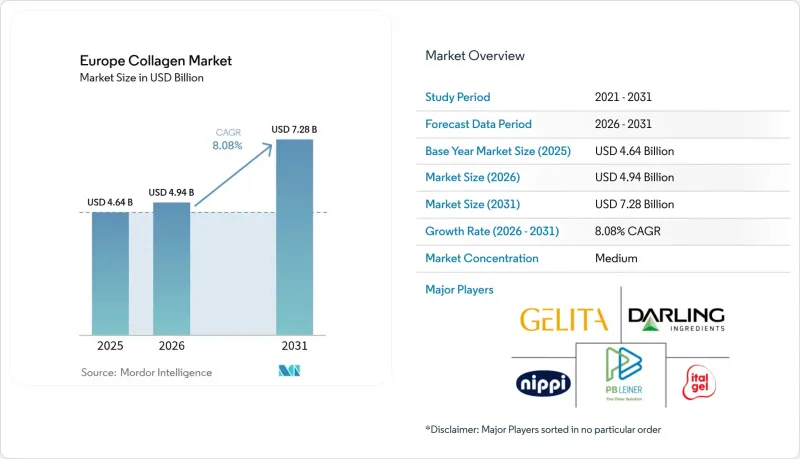
Mordor Intelligence에 따르면 유럽의 콜라겐 시장 규모는 2025년에 46억 4,000만 달러, 2026년에 49억 4,000만 달러에 달하며, 2031년까지 72억 8,000만 달러에 달할 것으로 예측되고 있으며, 2026-2031년에 CAGR 8.08%로 성장할 전망입니다.
유럽 소비자들은 대증요법적인 의약품에서 피부과학과 영양과학을 융합한 예방적 뉴트리코스메틱 습관으로 전환하고 있으며, 이것이 다양한 연령층에서 섭취용 콜라겐 수요를 견인하고 있습니다.
이 보고서는 원료별(동물 유래, 해양 유래), 형태별(분말, 액체), 용도별(식품 및 음료, 영양보조식품, 퍼스널 케어·화장품, 의약품, 동물 사료) 및 지역별(독일, 영국, 이탈리아, 프랑스, 스페인, 네덜란드, 기타 유럽)로 분류되어 있습니다. 시장 전망은 금액(달러)으로 표시되어 있습니다.
유럽 콜라겐 시장의 동향 및 인사이트
관절 관리 및 피부, 뼈, 모발 건강 솔루션을 추구하는 고령화 사회
경제활동인구에 비해 60세 이상 인구가 급속히 증가하고 있다는 특징을 보이는 유럽의 인구 동태 변화가 건강보조식품 수요에 영향을 미치고 있습니다. 관심은 종합 비타민에서 특정 기능성 성분으로 옮겨가고 있습니다. 세계보건기구(WHO)의 데이터에 따르면 2030년까지 전 세계 60세 이상 인구는 14억 명에 달하여 2019년 대비 34% 증가할 전망입니다. 유럽에서는 낮은 출산율과 평균 수명의 연장이 이러한 추세에 크게 기여하고 있습니다. 정형외과 전문의들이 비스테로이드성 항염증약 의존도를 줄이기 위해 제2형 콜라겐 펩티드를 함유한 관절 건강 제제를 권장하는 사례가 늘어나면서, 이러한 제품에 대한 수요가 높아지고 있습니다. 2024년 2월, 에보닉(Evonik)은 관절 가동성을 개선하는 것을 목적으로 한 액상 콜라겐 펩티드 ‘Vecollage Fortify L’을 출시할 예정입니다. 이번 출시는 가수분해 콜라겐을 하루 10그램 섭취할 경우 12주 이내에 연골 합성 지표가 개선된다는 임상적 근거에 지원되고 있습니다. 피부 탄력 및 진피 보습에 관한 효능 표시는 특히 50세 이상 여성층에게 매력적이며, 이들은 콜라겐을 미용 시술에 대체할 수 있는 비침습적 선택지로 인식하고 있습니다. 모발 및 뼈 건강에 대한 응용은 여전히 발전 단계에 있지만, 특히 콜라겐과 비오틴, 실리카, 비타민 D3를 조합해 시너지 효과를 노린 제제에 대한 연구개발 투자가 집중되고 있습니다.
예방 의료 및 전체론적 웰니스로의 전환
독일, 프랑스, 네덜란드 등 각국의 의료제도에서는 예방적 영양 개입에 대한 보험 환급 모델에 대한 평가가 진행되고 있습니다. 이러한 규제 측면의 진전은 질병 치료보다는 건강 유지를 목적으로 하는 콜라겐 보충제를 지원하는 것입니다. 이러한 변화의 배경에는 만성 근골격계 질환이 유럽의 의료 시스템에 막대한 부담을 주고 있다는 재정적 압박이 있습니다. 정책 입안자들은 이러한 질환의 발병을 지연시키기 위한 예방 조치에 점점 더 주력하고 있습니다. 또한 소비자들도 콜라겐에 프로바이오틱스, 아답토젠, 식물성 단백질을 결합한 전체론적인 웰니스 습관을 도입하기 시작했습니다. 이러한 추세는 단일 성분 보충제에서 다기능 제품 조합으로의 전환을 보여줍니다. 게리타(Gerita)사는 12월에 개최된 ‘Food Ingredients Europe(Fi Europe)’에서 ‘OPTIBAR’와 ‘PeptENDURE’를 발표하며 이러한 추세를 강조했습니다. 이 콜라겐 펩티드들은 스포츠 영양 및 회복에 특화되어 있으며, 성능 향상과 예방 관리의 접점을 충족시킵니다. 또한 원격의료와 맞춤형 영양의 적용 범위가 확대됨에 따라 D2C(소비자 직판) 브랜드는 DNA 기반 식단 조언과 함께 콜라겐 제품을 제공할 수 있게 되었습니다. 이 전략을 통해 기존 소매 채널을 우회함으로써 브랜드는 더 높은 이익률을 실현할 수 있게 됩니다.
동물 유래 콜라겐의 복지 및 조달에 관한 윤리적 우려
독일 및 영국(UK)의 동물 복지 옹호 단체들은 소매업체들에게 가축 보호에 관한 유럽연합(EU) 지침 98/58/EC 준수 여부를 감사할 것을 요구하고 있습니다. 이로 인해 인도적인 도살 관행을 입증하지 못하는 브랜드에는 평판상의 위험이 발생하고 있습니다. 집약적인 비육장에서 사육된 소에서 유래한 소 콜라겐은 윤리 의식이 높은 소비자들의 불매 운동에 직면해 있으며, 이러한 소비자들은 비용이 높더라도 목초 사육이나 유기농 인증 제품을 선호하는 경향이 있습니다. 돼지 유래 콜라겐은 종교적·문화적 제약으로 인해 더 큰 과제에 직면해 있습니다. 무슬림과 유대교도들은 돼지 유래 제품을 피하는 경향이 있으며, 런던, 파리, 베를린 등 다양한 도시 지역에서의 시장 침투가 제한되고 있습니다. 게리타(Gerita)사와 게르톨(Gertol)사의 제휴로 대표되는 정밀 발효 및 재조합 콜라겐 기술과 같은 기술적 진보는 동일한 아미노산 서열을 재현하는 비동물성 대체제의 가능성을 보여주고 있습니다. 그러나 2026년 현재, 상업적 규모의 생산에는 여전히 비용 측면의 장벽이 존재합니다. 농장에서 완제품에 이르기까지 블록체인을 활용한 추적성을 포함한 투명성 향상 노력은 경쟁 우위로 부상하고 있습니다. 하지만 도입 비용이 높다는 점은 소규모 공급업체에게 과제로 남아 있습니다. 18세에서 35세 사이의 젊은 소비자들이 가격보다 지속가능성이나 동물 복지를 우선시하게 됨에 따라 콜라겐 조달과 관련된 윤리적 고려 사항은 점점 더 중요해지고 있습니다. 이러한 인구 통계학적 변화는 2031년까지 조달 전략에 영향을 미칠 것으로 예상됩니다.
부문 분석
동물 유래 콜라겐은 확립된 소 및 돼지 공급망과 해양 유래 대체재에 비해 30%에서 50%의 비용 우위를 바탕으로, 2025년에는 유럽 시장 규모의 66.14%를 차지할 것으로 예측됩니다. I형 및 III형 콜라겐이 풍부한 소 유래 콜라겐은 관절 건강 및 스포츠 영양 분야에서 주요 용도로 사용되고 있습니다. 한편, 글리신 함량이 높은 것으로 알려진 돼지 유래 콜라겐은 피부 탄력 향상을 목적으로 한 화장품 배합에 선호되고 있습니다. 해양 유래 콜라겐은 지속가능성에 대한 요구와 펩티드 크기가 작고 제1형 콜라겐 농도가 높아 흡수성이 뛰어나다고 인식되고 있으며, 2031년까지 연평균 성장률(CAGR) 9.31%로 성장할 것으로 예측됩니다.
스페인, 이탈리아, 프랑스 등 연안 국가에서는 어업 부산물을 활용하여 해양 유래 콜라겐을 생산하고 있으며, 이를 통해 폐기물을 줄이는 동시에 수산양식관리협의회(ASC)나 프렌드 오브 더 씨(FoS) 등의 인증 기준을 준수하고 있습니다. 이러한 인증 덕분에 북유럽 시장에서 프리미엄 가격으로 판매가 가능해졌습니다. 정밀 발효 및 재조합 콜라겐 생산과 같은 신규 기술은 콜라겐 원료의 제3의 카테고리가 될 가능성을 내포하고 있습니다. 아직 상용화의 초기 단계에 있지만, 이러한 기술들은 동물 유래 원료에 의존하지 않으면서도 동일한 아미노산 구성을 제공함으로써, 기존의 ‘동물 유래 대 해양 유래’라는 이분법에 혁신을 가져올 가능성이 있습니다. 예를 들어 Gelita사와 Geltor사의 제휴는 이 분야의 진전을 잘 보여주고 있습니다.
기타 혜택:
- 엑셀 형식의 시장 예측(ME) 시트
- 3개월간의 애널리스트 지원
자주 묻는 질문
목차
제1장 서론
제2장 조사 방법
제3장 개요
제4장 시장 구도
제5장 시장 규모와 성장 예측
제6장 경쟁 구도
제7장 시장 기회와 향후 전망
KSA 26.09.02According to Mordor Intelligence, the Europe collagen market size is projected to be USD 4.64 billion in 2025, USD 4.94 billion in 2026, and reach USD 7.28 billion by 2031, growing at a CAGR of 8.08% from 2026 to 2031.European consumers are increasingly transitioning from reactive pharmaceutical solutions to preventive nutricosmetic routines that combine dermatology with nutrition science, which is driving demand for ingestible collagen across various age groups.
This report is Segmented by Source (Animal-Based, and Marine-Based), Form (Powder, and Liquid), Application (Food and Beverages, Dietary Supplements, Personal Care and Cosmetics, Pharmaceuticals, Animal Nutrition), and Geography (Germany, United Kingdom, Italy, France, Spain, Netherlands, Rest of Europe). The Market Forecasts are Provided in Terms of Value (USD).
Europe Collagen Market Trends and Insights
Aging population seeking joint care, skin, bone, and hair health solutions
Europe's demographic shift, characterized by the rapid growth of the 60-plus age group compared to the working-age population, is influencing supplement demand. The focus is shifting from multivitamins to targeted functional ingredients. According to data from the World Health Organization (WHO), by 2030, the global population aged 60 or older will reach 1.4 billion, representing a 34% increase from 2019 . Europe is contributing significantly to this trend due to low fertility rates and increased life expectancy. Joint-health formulations containing Type II collagen peptides are gaining popularity as orthopedic specialists increasingly recommend them to reduce reliance on non-steroidal anti-inflammatory drugs. In February 2024, Evonik plans to launch Vecollage Fortify L, a liquid collagen peptide aimed at improving joint mobility. This launch is supported by clinical evidence showing that a daily intake of 10 grams of hydrolyzed collagen can enhance cartilage synthesis markers within 12 weeks. Claims related to skin elasticity and dermal hydration are particularly appealing to the 50-plus female demographic, who view collagen as a non-invasive alternative to cosmetic procedures. While applications for hair and bone health are still emerging, they are attracting research and development investments, especially in formulations combining collagen with biotin, silica, and vitamin D3 for synergistic benefits.
Shift toward preventive healthcare and holistic wellness approaches
National health systems in Germany, France, and the Netherlands are evaluating reimbursement models for preventive nutrition interventions. These regulatory developments support collagen supplements positioned for wellness maintenance rather than disease treatment. This shift is driven by financial pressures, as chronic musculoskeletal conditions place a significant burden on European healthcare systems. Policymakers are increasingly focusing on preventive measures to delay the onset of such conditions. Consumers are also adopting holistic wellness routines that integrate collagen with probiotics, adaptogens, and plant-based proteins. This trend signifies a move from single-ingredient supplementation to multi-functional product combinations. Gelita highlighted this development by presenting OPTIBAR and PeptENDURE at Food Ingredients Europe (Fi Europe) in December. These collagen peptides are tailored for sports nutrition and recovery, addressing the intersection of performance enhancement and preventive care. Furthermore, the expansion of telemedicine and personalized nutrition applications is enabling direct-to-consumer brands to offer collagen products alongside DNA-based dietary recommendations. This strategy bypasses traditional retail channels, allowing brands to achieve higher profit margins.
Ethical concerns over animal-derived collagen welfare and sourcing
Animal-welfare advocacy groups in Germany and the United Kingdom (UK) are urging retailers to audit collagen supply chains for compliance with European Union (EU) Directive 98/58/EC on livestock protection. This has created reputational risks for brands unable to demonstrate humane slaughter practices. Bovine collagen sourced from cattle raised in intensive feedlots is facing boycotts from ethically conscious consumers, who prefer grass-fed or organic certifications despite their higher costs. Porcine collagen faces additional challenges due to religious and cultural restrictions, as Muslim and Jewish populations avoid porcine-derived products, limiting its market penetration in diverse urban centers such as London, Paris, and Berlin. Technological advancements, such as precision fermentation and recombinant collagen technologies, exemplified by Gelita's collaboration with Geltor, present opportunities for animal-free alternatives that replicate identical amino-acid sequences. However, as of 2026, commercial-scale production remains cost-prohibitive. Transparency initiatives, including blockchain-enabled traceability from farm to finished product, are emerging as competitive advantages. Nevertheless, the high implementation costs pose challenges for smaller suppliers. The ethical considerations surrounding collagen sourcing are becoming increasingly significant as younger consumers (aged 18 to 35) prioritize sustainability and animal welfare over price. This demographic shift is expected to influence sourcing strategies through 2031.
Other drivers and restraints analyzed in the detailed report include:
- Growing preference for beauty-from-within nutricosmetics
- Rising popularity of clean-label and natural products
- Allergenic risks from bovine, porcine, or marine sources
For complete list of drivers and restraints, kindly check the Table Of Contents.
Segment Analysis
Animal-based collagen is projected to account for 66.14% of the European market volume in 2025, supported by well-established bovine and porcine supply chains and cost advantages ranging from 30% to 50% compared to marine alternatives. Bovine collagen, which is rich in Type I and Type III collagen, dominates applications in joint health and sports nutrition. Meanwhile, porcine collagen, known for its high glycine content, is preferred in cosmetic formulations aimed at improving skin elasticity. Marine-based collagen is anticipated to grow at a compound annual growth rate (CAGR) of 9.31% through 2031, driven by sustainability requirements and its perceived superior absorption due to smaller peptide sizes and a high concentration of Type I collagen.
Coastal nations such as Spain, Italy, and France are utilizing byproducts from the fishing industry to produce marine collagen, thereby reducing waste and adhering to certifications like the Aquaculture Stewardship Council and Friend of the Sea. These certifications enable premium pricing opportunities in Northern European markets. Emerging technologies, including precision fermentation and recombinant collagen production, represent a potential third category of collagen sources. Although still in the early stages of commercialization, these technologies could disrupt the traditional animal-versus-marine dichotomy by offering identical amino acid profiles without relying on animal inputs. For instance, Gelita's collaboration with Geltor highlights advancements in this area.
Complete Report Scope:
- By Source
- Animal-based
- Marine-based
- By Form
- Powder
- Liquid
- By Application
- Food and Beverages
- Dietary Supplements
- Personal Care and Cosmetics
- Pharmaceuticals
- Animal Nutrition
- By Geography
- Germany
- United Kingdom
- Italy
- France
- Spain
- Netherlands
- Poland
- Belgium
- Sweden
- Rest of Europe
List of Companies Covered in this Report:
- Gelita AG
- Darling Ingredients Inc.
- PB Leiner
- Italgel S.r.l.
- Nippi Incorporated
- Lapi Gelatine S.p.A.
- Collagen Solutions Plc
- DSM-Firmenich
- Symrise AG
- Weishardt Group
- Gelnex
- Lonza Group Ltd.
- BioCell Technology LLC
- Jellagen Ltd
- CollaSwiss
- Medichema GmbH
- Evonik Industries AG
- Essentia Protein Solutions
- PB Gelatins
- NovaColl
Additional Benefits:
- The market estimate (ME) sheet in Excel format
- 3 months of analyst support
TABLE OF CONTENTS
1 INTRODUCTION
- 1.1 Study Assumptions and Market Definition
- 1.2 Scope of the Study
2 RESEARCH METHODOLOGY
3 EXECUTIVE SUMMARY
4 MARKET LANDSCAPE
- 4.1 Market Overview
- 4.2 Market Drivers
- 4.2.1 Aging population seeking joint-care, skin, bone, and hair health solutions
- 4.2.2 Shift toward preventive healthcare and holistic wellness approaches
- 4.2.3 Growing preference for beauty-from-within nutricosmetics
- 4.2.4 Rising popularity of clean-label and natural products
- 4.2.5 Advancements in collagen bioavailability and peptide technology
- 4.2.6 Shift to sustainable marine collagen sources with higher absorption
- 4.3 Market Restraints
- 4.3.1 Ethical concerns over animal-derived collagen welfare and sourcing
- 4.3.2 Allergenic risks from bovine, porcine, or marine sources
- 4.3.3 Stringent regulatory compliance and novel food approval
- 4.3.4 Taste, odor, and texture issues in supplements
- 4.4 Value Chain Analysis
- 4.5 Regulatory Outlook
- 4.6 Porter's Five Forces
- 4.6.1 Threat of New Entrants
- 4.6.2 Bargaining Power of Buyers
- 4.6.3 Bargaining Power of Suppliers
- 4.6.4 Threat of Substitute Products
- 4.6.5 Intensity of Competitive Rivalry
5 MARKET SIZE AND GROWTH FORECASTS (VALUE)
- 5.1 By Source
- 5.1.1 Animal-based
- 5.1.2 Marine-based
- 5.2 By Form
- 5.2.1 Powder
- 5.2.2 Liquid
- 5.3 By Application
- 5.3.1 Food and Beverages
- 5.3.2 Dietary Supplements
- 5.3.3 Personal Care and Cosmetics
- 5.3.4 Pharmaceuticals
- 5.3.5 Animal Nutrition
- 5.4 By Geography
- 5.4.1 Germany
- 5.4.2 United Kingdom
- 5.4.3 Italy
- 5.4.4 France
- 5.4.5 Spain
- 5.4.6 Netherlands
- 5.4.7 Poland
- 5.4.8 Belgium
- 5.4.9 Sweden
- 5.4.10 Rest of Europe
6 COMPETITIVE LANDSCAPE
- 6.1 Market Concentration
- 6.2 Strategic Moves
- 6.3 Market Ranking Analysis
- 6.4 Company Profiles (includes Global-level Overview, Market-level Overview, Core Segments, Financials (if available), Strategic Information, Market Rank/Share, Products and Services, Recent Developments)
- 6.4.1 Gelita AG
- 6.4.2 Darling Ingredients Inc.
- 6.4.3 PB Leiner
- 6.4.4 Italgel S.r.l.
- 6.4.5 Nippi Incorporated
- 6.4.6 Lapi Gelatine S.p.A.
- 6.4.7 Collagen Solutions Plc
- 6.4.8 DSM-Firmenich
- 6.4.9 Symrise AG
- 6.4.10 Weishardt Group
- 6.4.11 Gelnex
- 6.4.12 Lonza Group Ltd.
- 6.4.13 BioCell Technology LLC
- 6.4.14 Jellagen Ltd
- 6.4.15 CollaSwiss
- 6.4.16 Medichema GmbH
- 6.4.17 Evonik Industries AG
- 6.4.18 Essentia Protein Solutions
- 6.4.19 PB Gelatins
- 6.4.20 NovaColl