
|
시장보고서
상품코드
2113265
프로세스 자동화용 산업용 제어 : 시장 점유율 분석, 업계 동향과 통계, 성장 예측(2026-2031년)Industrial Control For Process Automation - Market Share Analysis, Industry Trends & Statistics, Growth Forecasts (2026 - 2031) |
||||||
 Mordor Intelligence
Mordor Intelligence에 따르면 프로세스 자동화용 산업용 제어 시장 규모는 2025년 764억 2,000만 달러에서 2026년에는 818억 9,000만 달러로 확대하며, 2026-2031년에 CAGR 7.15%로 추이하며, 2031년에는 1,157억 2,000만 달러에 달할 것으로 예측됩니다.
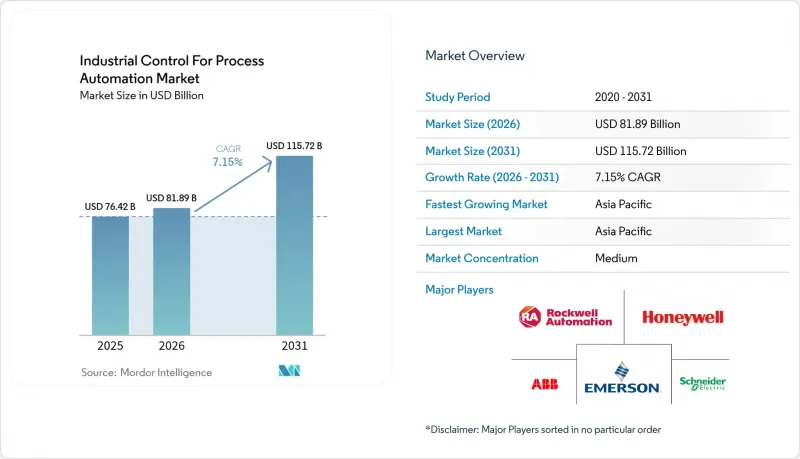
이 보고서는 시스템(SCADA, DCS 등), 구성 요소(하드웨어, 소프트웨어 등), 서비스(컨설팅, 시스템 통합·도입 등), 최종사용자 산업(석유 및 가스 등), 통신 네트워크(유선 네트워크 등) 및 지역(북미, 남미, 유럽 등)별로 분류되어 있습니다. 시장 예측은 금액(달러) 기준으로 제시되어 있습니다.
전 세계 공정 자동화용 산업 제어 시장의 동향 및 인사이트
산업 자동화의 확대
산업 시설에서는 인력 부족을 완화하고 고부가가치 자산의 지속적인 가동을 유지하기 위해 프로그래머블 로직 컨트롤러(PLC) 및 분산 제어 시스템(DCS)의 도입이 계속 진행되고 있습니다. 지멘스(Siemens)는 2024년 Simatic S7-1500 PLC 수주가 전년 대비 18% 증가했다고 보고했으며, 그 주요 요인은 10밀리초 미만의 결정론적 사이클 타임을 필요로 하는 배터리 셀 기가팩토리 때문입니다. 화학 플랜트에서는 예측 유지보수 기능을 갖춘 디지털 밸브 포지셔너로 공압 루프를 대체하고 있으며, 그 결과 예기치 않은 가동 중단이 30% 감소했습니다. 2024년 IEC 61131-3 개정판에서는 객체 지향 구문이 도입되었습니다. 이를 통해 엔지니어는 여러 현장에 코드를 재사용할 수 있게 되어 시운전 일정을 단축하고 수명 주기 비용을 절감할 수 있게 되었습니다. 플랜트 자산 100만 달러당 제어 지점 수로 측정되는 자동화 밀도는 2020년 이후 12% 증가했으며, 이는 배출 규제의 강화와 실시간 배출량 모니터링의 증가를 반영한 것입니다.
스마트 프로세스 산업의 확대
플랜트 소유주는 제어 계층과 전사적 자원 관리(ERP) 시스템을 연동함으로써 데이터 사일로를 해소하고 있습니다. 슈나이더 일렉트릭(Schneider Electric)은 식품 및 음료 가공업체들이 증류 컷포인트를 하류 수요와 일치시키는 폐쇄 루프 최적화를 추구한 결과, 2024년에 자사의 EcoStruxure 플랫폼 라이선스 수가 25% 증가했다고 보고했습니다. Industrial Internet Consortium은 도메인 간 상호 운용성 계층으로 OPC UA를 권장하고 있으며, 이를 통해 벤더에게는 참조용 청사진이 제공되어 통합 위험이 감소하고 있습니다. 중국은 2024년에 150건의 스마트 공정 실증 프로젝트에 자금을 지원하며, 2027년까지 에너지 집약도를 20% 감축하는 것을 목표로 하고 있습니다. 조기 도입 기업으로부터는 이미 투자 회수 기간이 5년 3년으로 단축되었다는 보고가 접수되고 있습니다. 스마트 플랜트 투자에서는 현재 실시간 스케줄링, 전자 배치 기록, 디지털 트윈이 우선시되고 있으며, 가치의 중심은 하드웨어에서 분석 및 데이터 관리로 이동하고 있습니다.
OT 사이버 보안 인력 부족
사이버 위협과 유능한 방어 담당자 간의 격차가 확대되고 있으며, 프로젝트 실행이 지연되고 있습니다. 국제자동화협회(ISA)의 조사에 따르면 2024년에는 IEC 62443 관련 직종의 40%가 6개월 이상 공석으로 남아 있었으며, 그 결과 급여 중앙값이 22% 상승했습니다. 많은 사업자는 생산을 중단하지 않고 펌웨어 검증을 수행할 수 있는 인력이 부족하여 중요한 패치 적용을 미루고 있습니다. 대학이나 벤더가 주최하는 교육 프로그램은 수요를 따라가지 못하고 있으며, 본래라면 강력한 성장이 예상되는 분야에서 수년에 걸친 병목 현상이 고착화되고 있습니다.
부문 분석
제조 실행 시스템(MES)은 2031년까지 연평균 성장률(CAGR) 10.04%로 성장할 것으로 예측되며, 이는 공정 자동화용 산업용 제어 시장 전체의 성장률을 상회할 것으로 보입니다. 2025년 시점에 프로그래머블 로직 컨트롤러(PLC)는 공정 자동화용 산업용 제어 시장에서 31.58%의 점유율을 차지했으나, 기업이 실시간 가시성과 전자 배치 기록을 요구함에 따라 부가가치는 더 높은 수준의 오케스트레이션으로 이동하고 있습니다. 분산 제어 시스템(DCS)은 내결함성과 내장형 모델 예측 제어 기능을 통해 정제 및 펄프 생산과 같은 연속 공정을 지속적으로 지원하고 있습니다. 식품, 음료, 제약 산업 전반에서는 통합 대시보드와 공정 데이터, 품질 지표, 스케줄링을 결합한 하이브리드 아키텍처가 등장하고 있으며, 이를 통해 운영자의 인지적 부하를 줄이고 이상 상황에 대한 대응 능력을 향상시키고 있습니다.
디지털 네이티브 제조 실행 시스템(MES)에 대한 수요는 추적 가능한 전자 기록 작성을 의무화하는 미국 FDA의 21 CFR Part 11과 같은 규제 프레임워크에 의해 지원되고 있습니다. ISA-95의 2024년 개정판에서는 이벤트 기반 메시징이 권장되고 있으며, 이를 통해 기업 자원 계획(ERP) 시스템과 플랜트 현장의 컨트롤러 간의 데이터 전달 속도가 빨라집니다. 그 결과, 제조 실행 시스템과 관련된 공정 자동화용 산업용 제어 시장의 규모는 분석, 품질관리, 디지털 트윈 지원을 기반으로 구독 수익 모델로 전환되고 있습니다. 각 벤더는 배치 계보, 레시피 관리, 시리얼화를 위한 라이브러리를 사전에 통합함으로써 이러한 성장을 포착하고, 도입 주기를 단축하며, 전환 비용을 높이고 있습니다.
소프트웨어는 연평균 성장률(CAGR) 9.37%로 확대되고 있으며, 공정 자동화용 산업 제어 시장에서 하드웨어의 기여도를 상회하고 있습니다. 2025년에도 하드웨어는 여전히 매출의 46.35%를 차지했으나, 컨테이너화를 통해 엣지 측의 표준 서버에서 제어 전략을 실행할 수 있게 됨에 따라 전용 컨트롤러에 대한 수요가 감소하고 있습니다. 식품 및 음료 공장이 유연한 레시피 변경과 신속한 라인 재가동을 우선시한 결과, 2024년에는 Siemens Industrial Edge의 라이선스 매출이 35% 증가했습니다. 한편, IEC 61508 SIL 3 인증을 획득한 고신뢰성 안전 계장 모듈은 높은 가격을 유지하고 있으며, 하드웨어 시장에서는 양극화 경향이 나타나고 있습니다.
레거시 필드버스 트래픽을 이더넷 및 무선 프로토콜로 변환하는 엣지 게이트웨이는 하드웨어 분야에서 두드러진 강점으로 자리 잡고 있으며, Moxa와 Advantech의 두 자릿수 출하량 증가가 그 실례를 보여주고 있습니다. 그러나 하드웨어 부문 전체로는 여전히 상품화와 이익률 압박으로 어려움을 겪고 있으며, 각 벤더들은 분석 및 사이버 보안 구독 서비스를 번들로 제공하는 움직임을 보이고 있습니다. 그 결과, 공정 자동화용 산업 제어 시장의 규모 확대는 고급 분석, 위협 모니터링, 예측 제어를 위한 소프트웨어 모듈에 편중되어 집중되고 있습니다.
지역별 분석
아시아태평양은 2025년 매출의 38.18%를 차지하며 주도적인 위치를 차지하고 있으며, 2031년까지 연평균 성장률(CAGR) 8.89%로 확대될 전망으로, 이는 전 세계 성장 궤도를 크게 상회하는 수치입니다. 중국의 이중 제어 정책은 첨단 제어 시스템의 도입을 촉진하고 있으며, 시범 사업으로 시행된 석유화학 플랜트에서는 단위 생산량당 에너지 소비량을 최대 12%까지 절감했습니다. 인도의 1,500억 루피(18억 달러) 규모의 생산 연계 인센티브(PLI) 제도 덕분에 200곳의 API 시설에서 분산 제어 및 제조 실행 시스템에 대한 급속한 투자가 촉진되었습니다. 일본에서는 노동력 고령화를 배경으로 가공식품 및 화학 산업의 자동화가 가속화되어, 요코가와에 대한 국내 수주가 두 자릿수 성장을 기록했습니다. 한국의 배터리 및 반도체 팹에서는 서브 나노미터급 품질 루프가 도입되어, 지멘스(Siemens) 및 미쓰비시(Mitsubishi)의 컨트롤러를 활용하여 대규모 균일성 실현을 도모하고 있습니다.
북미와 유럽은 여전히 현대화의 중심지입니다. 미국 사이버보안·인프라보안국(CISA)은 2024년에 320건의 산업 제어 시스템 관련 권고 사항을 발표했으며, 이로 인해 약 21억 달러 규모의 개조 서비스 수요가 발생했습니다. 유럽연합(EU)의 NIS2 지침은 IEC 62443에 준거한 위험 관리를 의무화하고 있으며, 독일 화학 업계는 디지털화 구상에 12억 유로(13억 달러)를 투자한 결과, 반응기에서 발생하는 배출량을 톤당 15% 감축하는 데 성공했습니다. 자산 소유자가 사이버 보안 취약점을 수정하고 노후화된 제어 계층에 분석 기능을 추가로 도입함에 따라 브라운필드 도입이 지출의 대부분을 차지하고 있습니다.
중동 및 아프리카에서는 수소 및 탄소 포집 메가 프로젝트와 관련하여 잠재적인 성장이 예상됩니다. 사우디아라비아의 NEOM 그린 수소 플랜트에서는 지멘스의 분산형 제어 시스템을 활용하여 4기가와트 규모의 전해조 배열을 통합적으로 제어할 예정입니다. 아랍에미리트(UAE)는 에머슨(Emerson)의 제어 시스템을 도입하여 알 레이야다(Al Rayyada) 탄소 포집 시설을 확장했습니다. 브라질의 프레솔트 유전에서는 해저용 프로그래머블 로직 컨트롤러(PLC)가 도입되었으며, 남아프리카의 광산 기업에서는 프라이빗 5G 및 엣지 게이트웨이의 시범 운영이 진행되고 있습니다. 환율 변동과 원자재 가격 변동이 광범위한 도입을 저해하고 있는 반면, 수소, CCUS, 광업 분야의 선도적인 프로젝트들이 미래 성장의 초석이 될 것입니다.
기타 혜택:
- 엑셀 형식의 시장 예측(ME) 시트
- 3개월간의 애널리스트 지원
자주 묻는 질문
목차
제1장 서론
제2장 조사 방법
제3장 개요
제4장 시장 구도
제5장 시장 규모와 성장 예측
제6장 경쟁 구도
제7장 시장 기회와 향후 전망
KSA 26.08.25According to Mordor Intelligence, the industrial control for process automation market size is expected to grow from USD 76.42 billion in 2025 to USD 81.89 billion in 2026 and is forecast to reach USD 115.72 billion by 2031 at 7.15% CAGR over 2026-2031.
This report is Segmented by System (SCADA, DCS, and More), Component (Hardware, Software, and More), Service (Consulting, System Integration and Deployment, and More), End-User Vertical (Oil and Gas, and More), Communication Network (Wired Networks, and More), and Geography (North America, South America, Europe, and More). The Market Forecasts are Provided in Terms of Value (USD).
Global Industrial Control For Process Automation Market Trends and Insights
Increasing Industrial Automation
Industrial facilities continue to implement programmable logic controllers and distributed control systems to mitigate labor constraints and maintain continuous operation of high-value assets. Siemens reported an 18% year-over-year increase in Simatic S7-1500 PLC orders in 2024, primarily driven by battery-cell gigafactories that require deterministic sub-10 millisecond cycle times. Chemical plants are replacing pneumatic loops with digital valve positioners that provide predictive diagnostics, resulting in a 30% reduction in unplanned shutdowns. A 2024 update to IEC 61131-3 introduced object-oriented constructs that enable engineers to reuse code across multi-site rollouts, thereby compressing commissioning schedules and reducing lifecycle costs. Automation density-measured as control points per USD million of plant assets-has increased by 12% since 2020, reflecting stricter environmental discharge limits and an uptick in real-time emissions monitoring.
Expansion of Smart Process Industries
Plant owners are collapsing data silos by linking control layers with enterprise resource planning systems. Schneider Electric reported a 25% growth in licenses for its EcoStruxure platform in 2024, as food and beverage processors sought closed-loop optimization that aligns distillation cut points with downstream demand. The Industrial Internet Consortium has endorsed OPC UA as the cross-domain interoperability layer, providing vendors with a reference blueprint and reducing integration risk.China financed 150 smart process pilots in 2024, targeting a 20% reduction in energy intensity by 2027. Early adopters are already reporting payback periods shrinking from five to three years. Smart-plant investments now prioritize real-time scheduling, electronic batch records, and digital twins, shifting value from hardware to analytics and data stewardship.
Shortage of OT-Cybersecurity Talent
The widening gap between cyber threats and qualified defenders is slowing project execution. The International Society of Automation found that 40% of IEC 62443 posts remained vacant beyond six months in 2024, resulting in a 22% increase in median salaries. Many operators postpone critical patching because they lack staff able to validate firmware without halting production. Universities and vendor academies trail demand, locking in a multi-year bottleneck that tempers otherwise strong growth.
Other drivers and restraints analyzed in the detailed report include:
- Integration of IIoT Sensors and Edge AI
- Energy-Efficiency Mandates in Process Plants
- High Capital Investment and ROI Uncertainty
For complete list of drivers and restraints, kindly check the Table Of Contents.
Segment Analysis
Manufacturing execution systems are projected to grow at a 10.04% CAGR to 2031, outpacing the overall industrial control for process automation market. In 2025, programmable logic controllers held a 31.58% share of the industrial control for process automation market, but incremental value is migrating toward higher-level orchestration as firms seek real-time visibility and electronic batch records. Distributed control systems continue to underpin continuous processes, such as refining and pulp production, due to their fault tolerance and embedded model-predictive control capabilities. Across the food, beverage, and pharmaceutical industries, hybrid architectures are emerging that combine a unified dashboard with process data, quality metrics, and scheduling, thereby reducing operator cognitive load and improving response to deviations.
The demand for digitally native manufacturing execution systems is underpinned by regulatory frameworks, such as the United States' FDA 21 CFR Part 11, which mandates the creation of traceable electronic records. The 2024 update to ISA-95 endorsed event-driven messaging, which speeds handoffs between enterprise resource planning systems and plant-floor controllers. As a result, the industrial control for process automation market size tied to manufacturing execution systems is shifting toward subscription revenue, anchored in analytics, quality management, and digital twin support. Vendors court this growth by pre-integrating libraries for batch genealogy, recipe management, and serialization, shortening deployment cycles and raising switching costs.
Software revenue is expanding at a 9.37% CAGR, eclipsing hardware's contribution to the industrial control for process automation market. Although hardware still accounted for 46.35% of revenue in 2025, containerization is enabling control strategies to run on standard servers at the edge, thereby reducing demand for proprietary controllers. Siemens Industrial Edge saw 35% license growth in 2024 as food and beverage plants prioritized flexible recipe changes and rapid line restarts. Meanwhile, high-reliability safety instrumented modules certified to IEC 61508 SIL 3 maintain premium pricing, creating a two-speed hardware landscape.
Edge gateways that translate legacy fieldbus traffic into Ethernet and wireless protocols are a notable strength in hardware, as demonstrated by double-digit unit gains at Moxa and Advantech. Yet the broader hardware segment continues to grapple with commoditization and margin compression, prompting vendors to bundle analytics and cybersecurity subscriptions. Consequently, industrial control for process automation market size growth is disproportionately concentrated in software modules for advanced analytics, threat monitoring, and predictive control.
Complete Report Scope:
- By System
- Supervisory Control and Data Acquisition System (SCADA)
- Distributed Control System (DCS)
- Programmable Logic Controller (PLC)
- Manufacturing Execution System (MES)
- Product Lifecycle Management (PLM)
- Enterprise Resource Planning (ERP)
- Human Machine Interface (HMI)
- Other Systems
- By Component
- Hardware
- Software
- Services
- By Service
- Consulting
- System Integration and Deployment
- Support and Maintenance
- By End-user Vertical
- Oil and Gas
- Chemical and Petrochemical
- Power
- Life Sciences
- Food and Beverage
- Metals and Mining
- Other End-user Verticals
- By Communication Network
- Wired Networks
- Industrial Wireless Networks
- By Geography
- North America
- United States
- Canada
- Mexico
- South America
- Brazil
- Argentina
- Rest of South America
- Europe
- Germany
- United Kingdom
- France
- Italy
- Spain
- Russia
- Rest of Europe
- Asia-Pacific
- China
- Japan
- India
- South Korea
- South-East Asia
- Rest of Asia-Pacific
- Middle East and Africa
- Middle East
- Saudi Arabia
- United Arab Emirates
- Turkey
- Rest of Middle East
- Africa
- South Africa
- Nigeria
- Rest of Africa
- Middle East
- North America
Geography Analysis
Asia-Pacific dominated with 38.18% of 2025 revenue and is poised to advance at a 8.89% CAGR through 2031, comfortably above the global trajectory. China's dual-control policy spurred advanced control rollouts that sliced energy per unit output by up to 12% in pilot petrochemical sites. India's INR 150 billion Production Linked Incentive scheme (USD 1.8 billion) has triggered rapid investments in distributed control and manufacturing execution across 200 API facilities. Japan's aging workforce accelerated automation in the packaged food and chemicals industries, driving double-digit domestic orders for Yokogawa. South Korea's battery and chip fabs adopted sub-nanometer quality loops, leaning on Siemens and Mitsubishi controllers to achieve uniformity at scale.
North America and Europe remain hotspots for modernization. The U.S. Cybersecurity and Infrastructure Security Agency issued 320 industrial control advisories in 2024, sparking an estimated USD 2.1 billion in retrofit services. The European Union's NIS2 directive enforces IEC 62443-aligned risk management, and Germany's chemical sector has invested EUR 1.2 billion (USD 1.3 billion) in digitalization initiatives, resulting in a 15% reduction in reactor emissions per ton. Brownfield adoption dominates spending as asset owners patch cybersecurity gaps and overlay analytics on aging control layers.
The Middle East and Africa exhibit rising potential tied to hydrogen and carbon capture megaprojects. Saudi Arabia's NEOM green-hydrogen plant will utilize Siemens' distributed control system to orchestrate 4-gigawatt electrolyzer arrays. The United Arab Emirates expanded the Al Reyadah carbon capture facility with Emerson controls. Brazil's pre-salt fields have introduced subsea programmable logic controllers, and South Africa's miners are piloting private 5G and edge gateways. While currency swings and commodity price shifts temper broader adoption, lighthouse projects in hydrogen, CCUS, and mining will seed future growth.
- Siemens AG
- ABB Ltd.
- Schneider Electric SE
- Emerson Electric Co.
- Rockwell Automation Inc.
- Honeywell International Inc.
- Yokogawa Electric Corporation
- Mitsubishi Electric Corporation
- Omron Corporation
- General Electric Company
- Endress+Hauser Group Services AG
- Phoenix Contact GmbH and Co. KG
- HIMA Paul Hildebrandt GmbH
- Bosch Rexroth AG
- FANUC Corporation
- Beckhoff Automation GmbH and Co. KG
- B and R Industrial Automation GmbH
- Advantech Co., Ltd.
- MOXA Inc.
- National Instruments Corporation
- ICONICS, Inc.
- CoreTigo Ltd.
- Spectris plc (Yokogawa's partner - HBM/BTM)
- Johnson Controls International plc
- Aspen Technology, Inc.
Additional Benefits:
- The market estimate (ME) sheet in Excel format
- 3 months of analyst support
TABLE OF CONTENTS
1 INTRODUCTION
- 1.1 Study Deliverables
- 1.2 Study Assumptions
- 1.3 Scope of the Study
2 RESEARCH METHODOLOGY
3 EXECUTIVE SUMMARY
4 MARKET LANDSCAPE
- 4.1 Market Overview
- 4.2 Market Drivers
- 4.2.1 Increasing Industrial Automation
- 4.2.2 Expansion of Smart Process Industries
- 4.2.3 Integration of IIoT Sensors and Edge AI
- 4.2.4 Energy-Efficiency Mandates in Process Plants
- 4.2.5 Shift Toward Software-Defined Automation
- 4.2.6 Emerging Hydrogen and CCUS Projects
- 4.3 Market Restraints
- 4.3.1 Shortage of OT-Cybersecurity Talent
- 4.3.2 High Capital Investment and ROI Uncertainty
- 4.3.3 Legacy System Interoperability Issues
- 4.3.4 Rising Threat Surface for ICS Cyberattacks
- 4.4 Industry Value Chain Analysis
- 4.5 Impact of Macroeconomic Factors on the Market
- 4.6 Regulatory Landscape
- 4.7 Technological Outlook
- 4.8 Porter's Five Forces Analysis
- 4.8.1 Bargaining Power of Buyers
- 4.8.2 Bargaining Power of Suppliers
- 4.8.3 Threat of New Entrants
- 4.8.4 Threat of Substitutes
- 4.8.5 Intensity of Competitive Rivalry
5 MARKET SIZE AND GROWTH FORECASTS (VALUE)
- 5.1 By System
- 5.1.1 Supervisory Control and Data Acquisition System (SCADA)
- 5.1.2 Distributed Control System (DCS)
- 5.1.3 Programmable Logic Controller (PLC)
- 5.1.4 Manufacturing Execution System (MES)
- 5.1.5 Product Lifecycle Management (PLM)
- 5.1.6 Enterprise Resource Planning (ERP)
- 5.1.7 Human Machine Interface (HMI)
- 5.1.8 Other Systems
- 5.2 By Component
- 5.2.1 Hardware
- 5.2.2 Software
- 5.2.3 Services
- 5.3 By Service
- 5.3.1 Consulting
- 5.3.2 System Integration and Deployment
- 5.3.3 Support and Maintenance
- 5.4 By End-user Vertical
- 5.4.1 Oil and Gas
- 5.4.2 Chemical and Petrochemical
- 5.4.3 Power
- 5.4.4 Life Sciences
- 5.4.5 Food and Beverage
- 5.4.6 Metals and Mining
- 5.4.7 Other End-user Verticals
- 5.5 By Communication Network
- 5.5.1 Wired Networks
- 5.5.2 Industrial Wireless Networks
- 5.6 By Geography
- 5.6.1 North America
- 5.6.1.1 United States
- 5.6.1.2 Canada
- 5.6.1.3 Mexico
- 5.6.2 South America
- 5.6.2.1 Brazil
- 5.6.2.2 Argentina
- 5.6.2.3 Rest of South America
- 5.6.3 Europe
- 5.6.3.1 Germany
- 5.6.3.2 United Kingdom
- 5.6.3.3 France
- 5.6.3.4 Italy
- 5.6.3.5 Spain
- 5.6.3.6 Russia
- 5.6.3.7 Rest of Europe
- 5.6.4 Asia-Pacific
- 5.6.4.1 China
- 5.6.4.2 Japan
- 5.6.4.3 India
- 5.6.4.4 South Korea
- 5.6.4.5 South-East Asia
- 5.6.4.6 Rest of Asia-Pacific
- 5.6.5 Middle East and Africa
- 5.6.5.1 Middle East
- 5.6.5.1.1 Saudi Arabia
- 5.6.5.1.2 United Arab Emirates
- 5.6.5.1.3 Turkey
- 5.6.5.1.4 Rest of Middle East
- 5.6.5.2 Africa
- 5.6.5.2.1 South Africa
- 5.6.5.2.2 Nigeria
- 5.6.5.2.3 Rest of Africa
- 5.6.5.1 Middle East
- 5.6.1 North America
6 COMPETITIVE LANDSCAPE
- 6.1 Market Concentration
- 6.2 Strategic Moves
- 6.3 Market Share Analysis
- 6.4 Company Profiles (includes Global Level Overview, Market Level Overview, Core Segments, Financials as available, Strategic Information, Market Rank/Share for Key Companies, Products and Services, and Recent Developments)
- 6.4.1 Siemens AG
- 6.4.2 ABB Ltd.
- 6.4.3 Schneider Electric SE
- 6.4.4 Emerson Electric Co.
- 6.4.5 Rockwell Automation Inc.
- 6.4.6 Honeywell International Inc.
- 6.4.7 Yokogawa Electric Corporation
- 6.4.8 Mitsubishi Electric Corporation
- 6.4.9 Omron Corporation
- 6.4.10 General Electric Company
- 6.4.11 Endress+Hauser Group Services AG
- 6.4.12 Phoenix Contact GmbH and Co. KG
- 6.4.13 HIMA Paul Hildebrandt GmbH
- 6.4.14 Bosch Rexroth AG
- 6.4.15 FANUC Corporation
- 6.4.16 Beckhoff Automation GmbH and Co. KG
- 6.4.17 B and R Industrial Automation GmbH
- 6.4.18 Advantech Co., Ltd.
- 6.4.19 MOXA Inc.
- 6.4.20 National Instruments Corporation
- 6.4.21 ICONICS, Inc.
- 6.4.22 CoreTigo Ltd.
- 6.4.23 Spectris plc (Yokogawa's partner - HBM/BTM)
- 6.4.24 Johnson Controls International plc
- 6.4.25 Aspen Technology, Inc.
7 MARKET OPPORTUNITIES AND FUTURE OUTLOOK
- 7.1 White-Space and Unmet-Need Assessment