
|
시장보고서
상품코드
2113299
인도의 치과용 기기 : 시장 점유율 분석, 업계 동향과 통계, 성장 예측(2026-2031년)India Dental Devices - Market Share Analysis, Industry Trends & Statistics, Growth Forecasts (2026 - 2031) |
||||||
 Mordor Intelligence
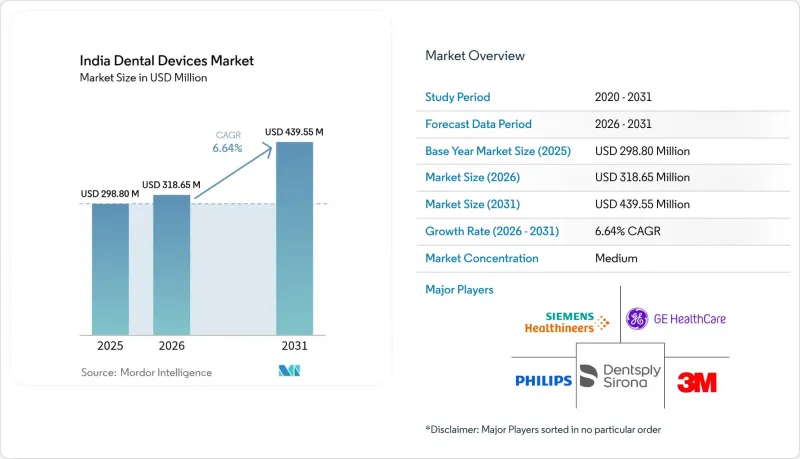
Mordor Intelligence에 따르면 2026년 인도의 치과용 기기 시장 규모는 3억 1,865만 달러로 추정되고 있으며, 2025년 2억 9,880만 달러에서 성장하며, 2031년에는 4억 3,955만 달러에 달할 것으로 예측됩니다.
2026-2031년 동안 연평균 성장률(CAGR) 6.64%로 성장할 것으로 전망됩니다.
이 보고서에서는 산업을 제품별(일반용 및 진단용 기기, 치과용 소모품, 기타 치과용 기기), 치료별(교정치과, 치내치료, 치주병, 보철치과), 최종사용자별(치과병원 및 치과진료소, 학술·연구기관, 기타), 지역별로 분류하고 있습니다. 지난 5년간의 데이터 외에도 향후 5년간의 시장 전망도 수록되어 있습니다.
인도 치과 기기 시장의 동향 및 인사이트
정부 주도의 ‘전국 구강 보건 프로그램’이 예방 검진을 촉진
‘전국 구강 보건 프로그램’은 ‘아유슈만 바라트’의 일환으로 3억 2,800만 건의 구강암 검진을 시행하고, 전국 17만 5,338곳의 ‘아유슈만 알로기아 만디르’에서 정기적인 예방 검진을 강화하고 있습니다. 이러한 규모 확대로 인해 지방의 도입 수요를 충족시키는 동시에, 공공 조달 분야에서도 비용 대비 효과가 높은 휴대용 진단 기기에 대한 지속적인 수요가 발생하고 있습니다. ‘아유슈만 바라트 디지털 미션’의 표준화된 전자건강기록(EHR) 프로토콜은 디지털 영상 진단 및 체어사이드 기록 시스템의 도입을 더욱 촉진하고 있으며, 통합형 기기 플랫폼 제조사들이 수년에 걸친 조달 계약을 수주하는 데 기여하고 있습니다. 외딴 지역에서는 여전히 인프라 격차가 존재하지만, 주 단위의 확산 기세가 소규모 치과 진료소까지 파급될 것으로 예상되며, 이에 따라 중기적으로 인도의 치과 장비 시장이 확대될 것으로 전망됩니다.
소셜미디어에 힘입은 도시 밀레니얼 세대의 심미 치과 붐
도시 지역의 밀레니얼 세대는 치과 치료를 개인 브랜딩의 한 요소로 인식하는 경향이 강해지고 있으며, 투명 교정기 치료나 디지털 스마일 디자인과 같은 선택적 시술이 가속화되고 있습니다. 최근 횡단면 연구에 따르면 치의대생들 사이에서는 의대생이나 파라메디컬 분야 학생들에 비해 얼라이너에 대한 인지도(41.22)와 평가(42.18) 점수가 유의미하게 높았으며, 미래의 치과의사들이 심미적 솔루션을 적극적으로 추진할 준비가 되어 있음을 여실히 보여주었습니다. 제조업체 입장에서 이러한 추세는 고투과성 세라믹 브라켓, 맞춤형 얼라이너 치료 워크플로우, 당일 완성 가능한 베니어를 가능하게 하는 체어사이드 밀링 유닛의 호조 판매로 이어지고 있습니다. 그러나 소셜미디어 광고 경쟁이 치열해짐에 따라 치과 진료소는 외모 중심의 기대에 일관되게 부응해야 한다는 압박을 받고 있으며, 인도 치과 기기 시장에서 고객을 유지하기 위해서는 첨단 영상 진단 기술과 정밀한 수복 재료를 통한 품질 측면의 차별화가 필수적입니다.
일관성 없는 GST 분류가 규정 준수 비용을 상승시키고 있다
GST 세율 구분과 역세율 구조의 불규칙성은 공급망 계획을 복잡하게 만들고 있습니다. 특히 여러 제품 코드에 걸쳐 있는 경우가 많은 중소 제조업체에게는 심각한 문제입니다. 최근 상임위원회의 보고서에서는 역세율이 운전 자금 수요를 부풀려 현지에서 생산된 핸드피스나 인상재의 경쟁력을 저해하고 있는 실태가 부각되었습니다. 판매업체의 경우, 입력세액 공제의 불일치가 재고 회전율을 저하시키고 유통 마진을 상승시켜, 궁극적으로는 기기 가격 상승으로 이어지고 있습니다. 치과 산업 단체들은 세율 구분의 합리화를 위해 로비 활동을 계속하고 있지만, 통일이 실현될 때까지는 규정 준수에 드는 간접비가 인도 치과 기기 시장 전체의 수익성을 압박할 것으로 예상됩니다.
부문 분석
치과 소모품은 일상적인 치료부터 전문적인 증례에 이르기까지 반복적으로 사용되는 경향에 힘입어, 2025년에도 매출 점유율 67.94%를 유지했습니다. 한편, 기기 시장은 2031년까지 연평균 성장률(CAGR) 12.67%로 확대될 것으로 예상되며, 이는 인도 치과 기기 시장에서 가장 빠른 성장 속도입니다. 이러한 변화는 체어사이드 CAD/CAM 밀의 보급에 기인합니다. PLI 제도에 따른 국내 부품 조달이 시작된 이래, 이러한 밀의 현지 조립 비용은 25% 가까이 감소했습니다. 인도 치과 기기 시장에서 디지털 스캐너 시장 규모는 2025년에 1억 2,000만 달러에 달할 것으로 보이며, 클리닉들이 인상 채취가 필요 없는 워크플로우를 추구함에 따라 2031년까지 2억 5,000만 달러를 넘어설 것으로 예측됩니다. 생체활성 수복 재료 및 나노 하이드록시아파타이트 강화 복합재료와 같은 혁신적인 소모품은 단가가 경쟁 수준을 유지하고 있음에도 불구하고 가치 성장을 지원하고 있습니다.
치료용 기기 부문에서 병행된 발전으로는 연조직 관리를 신속하게 하는 전기 수술 기기나 초음파 세척 시스템 등이 꼽히지만, 그 보급은 여전히 대도시권의 멀티 체어 클리닉으로 한정되어 있습니다. 진단 기기, 특히 파노라마 X선 장치나 CBCT 시스템은 정부의 선별 검사 정책과 치과 관광 요건이 X선 촬영의 정확성을 중시하고 있으므로 두 자릿수의 도입률을 기록하고 있습니다. 이에 대응하여 국내 제조사들은 생산 규모 확대를 통해 대처하고 있으며, Dantech Digital Dental Solutions는 2025년에 일일 보철물 생산 능력을 200개에서 1,000개로 늘려 인도에 기반을 둔 생산 생태계의 성숙도를 보여주고 있습니다.
기타 혜택
- 엑셀 형식의 시장 예측(ME) 시트
- 3개월간의 애널리스트 지원
자주 묻는 질문
목차
제1장 서론
제2장 조사 방법
제3장 개요
제4장 시장 구도
제5장 시장 규모와 성장 예측
제6장 경쟁 구도
제7장 시장 기회와 향후 전망
KSA 26.08.25According to Mordor Intelligence, the India dental devices market size in 2026 is estimated at USD 318.65 million, growing from 2025 value of USD 298.80 million with 2031 projections showing USD 439.55 million, growing at 6.64% CAGR over 2026-2031.
This report Segments the Industry Into by Product (General and Diagnostic Equipment, Dental Consumables, Other Dental Devices), by Treatment (Orthodontic, Endodontic, Periodontic, Prosthodontic), by End User (Dental Hospitals and Clinics, Academic and Research Institutions, Other End Users), and Geography. Get Five Years of Historical Data Alongside Five-Year Market Forecasts.
India Dental Devices Market Trends and Insights
Government-led National Oral Health Programme Raising Preventive Visits
The National Oral Health Programme has undertaken 32.80 crore oral-cancer screenings under Ayushman Bharat, reinforcing routine preventive check-ups across 1,75,338 Ayushman Arogya Mandirs nationwide. This scale-up is fostering sustained demand for portable diagnostic devices that match rural deployment needs while remaining cost-efficient for public procurements. Standardized electronic health-record protocols within the Ayushman Bharat Digital Mission further stimulate adoption of digital imaging and chairside documentation systems, helping manufacturers of integrated equipment platforms secure multi-year procurement contracts. Although infrastructure gaps linger in remote districts, the momentum of state-wise roll-outs is expected to permeate smaller practices, thereby broadening the India dental devices market over the medium term.
Urban Millennials' Cosmetic Dentistry Boom Fueled by Social Media
Urban millennials increasingly view dental care as an element of personal branding, accelerating elective procedures such as clear-aligner therapy and digital smile-design workflows. A recent cross-sectional study reported significantly higher awareness (41.22) and perception (42.18) scores for aligners among dental students compared with medical and paramedical peers, underscoring the readiness of future practitioners to champion aesthetic solutions. For manufacturers, this trend translates into brisk sales of high-translucency ceramic brackets, customized aligner workflows and chairside milling units that enable same-day veneers. Intensified social-media advertising, however, places pressure on clinics to consistently meet appearance-oriented expectations, making quality differentiation through advanced imaging and precise restorative materials critical to retaining clientele within the India dental devices market.
Inconsistent GST Classification Raising Compliance Costs
Variable GST slabs and inverted-duty structures complicate supply-chain planning, especially for small and mid-sized manufacturers that frequently straddle multiple product codes. A recent Standing Committee report highlighted how inverted duties inflate working-capital needs and hamper competitiveness for locally-made handpieces and impression materials. For distributors, inconsistent input-tax credits slow inventory turnover, raising channel margins and ultimately equipment prices. The dental-trade associations continue lobbying for slab rationalization, but until harmonization materializes, compliance overheads are expected to temper profitability across the India dental devices market.
Other drivers and restraints analyzed in the detailed report include:
- Ayushman Bharat & Private Dental Insurance Expanding Affordability
- Dental-Tourism Hot-Spots in Goa & Karnataka Driving High-Value Procedures
- Shortfall of Formally-Trained Dental Technicians
For complete list of drivers and restraints, kindly check the Table Of Contents.
Segment Analysis
Dental consumables retained a 67.94% revenue share in 2025, driven by their recurrent usage pattern across routine and specialized cases. Equipment, however, is expected to climb at a 12.67% CAGR to 2031, the fastest pace within the India dental devices market. The shift stems from widespread deployment of chairside CAD/CAM mills, whose local assembly costs have fallen nearly 25% since domestic component sourcing under the PLI scheme began. The India dental devices market size for digital scanners reached USD 0.12 billion in 2025 and is projected to exceed USD 0.25 billion by 2031 as clinics pursue impression-free workflows. Innovative consumables such as bioactive restorative materials and nano-hydroxyapatite-enhanced composites are supporting value growth even as unit prices remain competitive.
Parallel advances within therapeutic equipment include electrosurgery units and sonic irrigation systems that quicken soft-tissue management, although penetration remains limited to multi-chair practices in metropolitan areas. Diagnostic gear, particularly panoramic and CBCT systems, is recording double-digit adoption as government screening initiatives and dental-tourism requirements emphasize radiographic accuracy. Domestic manufacturers have responded by scaling output; Dantech Digital Dental Solutions lifted daily prosthetic-manufacturing capacity from 200 to 1,000 units in 2025, demonstrating the maturation of India-based production ecosystems.
Complete Report Scope:
- By Product
- General and Diagnostic Equipment
- Dental Lasers
- Soft Tissue Dental Lasers
- Hard Tissue Dental Lasers
- Radiology Equipment
- Dental Chair and Equipment
- Other General and Diagnostic Equipment
- Dental Lasers
- Dental Consumables
- Dental Biomaterial
- Dental Implants
- Crowns and Bridges
- Other Dental Consumables
- Other Dental Devices
- General and Diagnostic Equipment
- By Treatment
- Orthodontic
- Endodontic
- Periodontic
- Prosthodontic
- By End User
- Dental Hospitals and Clinics
- Academic and Research Institutions
- Other End Users
List of Companies Covered in this Report:
- 3M
- Canon
- Carestream Health
- GE Healthcare
- Dentsply Sirona
- Koninklijke Philips
- Danaher
- Osstem
- Siemens Healthineers
- Kavo Dental
- Envista Holdings
- BioHorizons
- DENTAURUM
- Planmeca
- GC Corporation
- Coltene Holding
Additional Benefits:
- The market estimate (ME) sheet in Excel format
- 3 months of analyst support
TABLE OF CONTENTS
1 Introduction
- 1.1 Study Assumptions and Market Definition
- 1.2 Scope of the Study
2 Research Methodology
3 Executive Summary
4 Market Landscape
- 4.1 Market Overview
- 4.2 Market Drivers
- 4.2.1 Government-led National Oral Health Programme Raising Preventive Visits
- 4.2.2 Urban Millennials' Cosmetic Dentistry Boom Fueled by Social Media
- 4.2.3 Ayushman Bharat & Private Dental Insurance Expanding Affordability
- 4.2.4 Dental Tourism Hot-Spots in Goa & Karnataka Driving High-Value Procedures
- 4.2.5 PLI Scheme Catalyzing Domestic Manufacturing of Dental Equipment
- 4.2.6 Rapid Chair-side CAD/CAM & Intra-oral Scanner Adoption by Clinics
- 4.3 Market Restraints
- 4.3.1 Shortfall of Formally-Trained Dental Technicians
- 4.3.2 High Import Dependency Exposing Prices to INR/US$ Volatility
- 4.3.3 Fragmented Single-Chair Clinic Base Limiting Cap-Ex Uptake
- 4.3.4 Inconsistent GST Classification Raising Compliance Costs
- 4.4 Value / Supply-Chain Analysis
- 4.5 Regulatory Landscape
- 4.6 Technological Outlook
- 4.7 Porters' Five Forces Analysis
- 4.7.1 Threat of New Entrants
- 4.7.2 Bargaining Power of Buyers/Consumers
- 4.7.3 Bargaining Power of Suppliers
- 4.7.4 Threat of Substitute Products
- 4.7.5 Intensity of Competitive Rivalry
5 Market Size & Growth Forecasts (Value, USD)
- 5.1 By Product
- 5.1.1 General and Diagnostic Equipment
- 5.1.1.1 Dental Lasers
- 5.1.1.1.1 Soft Tissue Dental Lasers
- 5.1.1.1.2 Hard Tissue Dental Lasers
- 5.1.1.2 Radiology Equipment
- 5.1.1.3 Dental Chair and Equipment
- 5.1.1.4 Other General and Diagnostic Equipment
- 5.1.1.1 Dental Lasers
- 5.1.2 Dental Consumables
- 5.1.2.1 Dental Biomaterial
- 5.1.2.2 Dental Implants
- 5.1.2.3 Crowns and Bridges
- 5.1.2.4 Other Dental Consumables
- 5.1.3 Other Dental Devices
- 5.1.1 General and Diagnostic Equipment
- 5.2 By Treatment
- 5.2.1 Orthodontic
- 5.2.2 Endodontic
- 5.2.3 Periodontic
- 5.2.4 Prosthodontic
- 5.3 By End User
- 5.3.1 Dental Hospitals and Clinics
- 5.3.2 Academic and Research Institutions
- 5.3.3 Other End Users
6 Competitive Landscape
- 6.1 Market Concentration
- 6.2 Market Share Analysis
- 6.3 Company Profiles (includes Global level Overview, Market level overview, Core Segments, Financials as available, Strategic Information, Market Rank/Share for key companies, Products & Services, and Recent Developments)
- 6.3.1 3M
- 6.3.2 Canon
- 6.3.3 Carestream Health
- 6.3.4 GE Healthcare
- 6.3.5 Dentsply Sirona
- 6.3.6 Philips Healthcare
- 6.3.7 Danaher Corporation
- 6.3.8 Osstem
- 6.3.9 Siemens Healthineers
- 6.3.10 Kavo Dental
- 6.3.11 Envista Holdings
- 6.3.12 BioHorizons
- 6.3.13 DENTAURUM GmbH
- 6.3.14 Planmeca Oy
- 6.3.15 GC Corporation
- 6.3.16 Coltene Holding AG
7 Market Opportunities & Future Outlook
- 7.1 White-space & Unmet-Need Assessment