|
시장보고서
상품코드
2113342
유럽의 배합사료 : 시장 점유율 분석, 업계 동향과 통계, 성장 예측(2026-2031년)Europe Compound Feed - Market Share Analysis, Industry Trends & Statistics, Growth Forecasts (2026 - 2031) |
||||||
 Mordor Intelligence
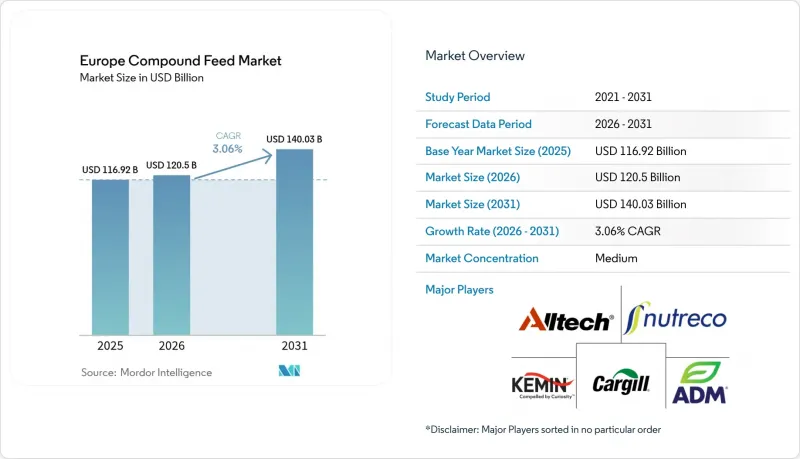
Mordor Intelligence에 따르면 유럽의 배합사료 시장 규모는 2025년 1,169억 2,000만 달러에서 2026년에는 1,205억 달러로 확대되고, 2026년부터 2031년까지 CAGR 3.06%를 기록하며 2031년에는 1,400억 3,000만 달러에 달할 것으로 예측됩니다.
본 보고서는 동물 유형별(반추동물, 가금류, 돼지, 기타), 원료 유형별(곡물, 부산물, 기타), 형태별(매시, 펠릿, 크럼블, 기타), 지역별(프랑스, 독일, 이탈리아, 영국, 기타)로 분류되어 있습니다. 시장 전망은 금액(달러)과 톤으로 제시되어 있습니다.
유럽 배합사료 시장의 동향 및 인사이트
육류 소비량 및 동물성 단백질 수요 증가
2024년에는 가금류 고기의 1인당 소비량이 24.8kg으로 증가한 반면, 돼지고기는 32.4kg으로 보합세를 유지하고 있으며, 도시 지역에서 식물성 대체 식품으로의 전환이 진행되는 가운데, 이 두 가지 요인이 결합되어 유럽 배합사료 시장의 공급에 대한 기초적인 수요를 뒷받침하고 있습니다. 폴란드와 루마니아의 소득 증가에 따라 소비는 가공육에서 신선 닭고기 및 부가가치가 높은 돼지고기로 전환되고 있으며, 이 두 품목 모두 엄격한 사료 전환율 목표를 달성하기 위해 더 높은 아미노산 농도와 효소 첨가에 의존하고 있습니다. 스페인에서는 북아프리카 및 중동으로의 수출 증가로 인해 2024년 육계 생산량이 4.2% 증가하여, 아프리카 돼지열병 봉쇄와 관련하여 독일의 돼지고기 생산량이 2.1% 감소한 영향을 상쇄했습니다. 수산물 양식은 제3의 기둥 역할을 하고 있으며, 2024년 연어와 송어 생산량은 280만 톤에 달해, 육상용 사료보다 20-30% 더 비싼 고품질의 해양 유래 원료를 사용한 사료가 요구되고 있습니다. 고부가가치 단백질로의 전환에 따라, 유럽 배합사료 시장의 제조업체들은 미량 성분의 계량 및 액상 첨가 설비에 대한 투자를 불가피하게 하고 있습니다. 이를 통해 효소, 유기산, 정유 등을 0.5% 미만의 배합 비율로 균일하게 분산시킬 수 있게 되었으며, 이는 범용 사료 제조업체에서는 실현하기 어려운 수준입니다. 이러한 설비 투자는 자본 집약도를 높이지만, 공급업체는 입증된 성능 향상을 통해 이익률을 유지할 수 있게 되어, 품질 중심의 경쟁으로의 시장 전환을 뒷받침하고 있습니다.
통합 제조업체의 전략적 생산능력 투자
2024년, 통합형 기업들은 스페인, 폴란드, 독일에서 18곳의 새로운 사료 공장을 가동하여, 이익률 확보와 생물 보안 강화를 목적으로 연간 처리 능력을 320만 톤 증가시켰습니다. 카길(Cargill)의 크레펠트 공장에서 진행된 설비 현대화에서는 정밀 분쇄 기술과 캡슐화된 부티르산이 도입되어, 사료 전환율 1.85를 목표로 생체중 1kg당 0.09달러(0.08유로)의 비육 비용 절감을 추구하고 있습니다. 이에 이어 포파머스(Four Farmers)사는 근적외선 분석 장치를 갖춘 연간 생산량 24만 톤 규모의 폴란드 공장을 가동하여, 이를 통해 영양소의 편차를 40% 줄였습니다. 독립 사료 제조업체들은 공동 구매 체제를 구축하고, 가금류, 돼지, 수산양식용 사료를 신속하게 전환할 수 있는 모듈식 압출 라인을 도입함으로써 경쟁력을 유지하려고 노력하고 있습니다. 새로운 오프라인 매장형 투자의 대부분은 프랑스의 보세 평원이나 독일의 니더작센주 등 밀과 보리의 산지대에 집중되어 있어, 이를 통해 곡물 반입 물류 비용을 절감하고 있습니다. 이러한 전략적 움직임은 유럽 배합사료 시장에 진출한 기업들이 고품질 곡물의 공급 경로를 확보하고, 신속하게 배합을 변경할 수 있는 유연한 생산능력을 구축하기 위해 얼마나 치열하게 경쟁하고 있는지를 여실히 보여주고 있습니다.
곡물 및 유지종자의 가격 변동
2024년, 가뭄으로 인해 프랑스와 독일의 수확량이 820만 톤 감소한 결과, 유럽산 밀의 평균 가격은 톤당 262.1달러(톤당 245유로)가 되었습니다. 한편, 대두박은 톤당 518.9달러(톤당 485유로)로 정점을 찍은 후, 남미의 공급이 안정화되면서 톤당 449.4달러(톤당 420유로)까지 하락했습니다. 헤지 수단이 없는 소규모 공장은 가장 큰 타격을 입었고, 곡물 거래 부문이나 저장 사일로를 운영하는 대규모 협동조합으로의 구조적 전환이 더욱 가속화되었습니다. 이에 반해 사료 제조업체들은 유채박과 해바라기박의 배합 비율을 높이는 방식으로 대응했으나, 아미노산 농도가 낮기 때문에 합성 라이신과 메티오닌을 추가로 투입해야 했고, 그 결과 보충제 비용이 증가했습니다. 이미 금리가 높은 수준인 가운데, 안전 재고 확충이 필요해지면서 운전 자금이 묶이게 되었습니다. 그 결과, 유럽 배합사료 시장의 구매자들은 가격 변동과 영양 위험 사이의 상충 관계에 직면해 있으며, 밀의 에너지를 효율적으로 활용하기 위해 더 많은 효소가 필요함에도 불구하고 현지산 곡물에 대한 관심이 높아지고 있습니다. 흑해 지역의 물류 상황이 정상화되고 기후 변동이 진정될 때까지는 원자재 가격 변동이 계속해서 단기적인 성장의 걸림돌이 될 것으로 보입니다.
부문별 분석
2025년, 가금류용 사료는 유럽 배합사료 시장 규모에서 40.55%의 점유율을 유지했습니다. 가금류용 배합사료는 더 미세한 분쇄와 더불어 자일라나아제 및 아밀라아제의 첨가로 인해 이점을 얻고 있습니다. 이러한 성분들은 전분의 소화율을 높여 밀 배합 비율이 높은 점을 상쇄하는 역할을 합니다. 돼지 사료는 완만하게 회복되고 있는 반면, 반추동물 사료의 출하량은 메탄 및 암모니아 배출 감축 목표에 따른 사육 두수 감소로 인해 1.2% 감소했습니다. 수산양식용 사료는 2031년까지 연평균 성장률(CAGR) 5.82%로 가장 높은 성장이 예상됩니다. 이는 노르웨이산 및 스코틀랜드산 연어, 그리고 일반적으로 25-35%의 해양 단백질을 함유하는 지중해산 농어와 도미에 필요한 어분이 풍부하게 포함된 사료에 대한 수요가 주도하고 있기 때문입니다. 네덜란드와 스페인에서 높은 소화율과 아스타잔틴을 통한 착색이 필요한 순환식 양식 시스템의 확장이 진행되고 있어, 새우 사료에 대한 수요는 더욱 탄력을 받고 있습니다.
1mm 미만으로 물속에서 2시간 동안 안정적으로 유지되는 마이크로 펠릿에 대한 수요 증가로 인해, 연어 스몰트 및 새우 부화장을 공급하는 각 공장의 설비 수주 상황이 새롭게 바뀌고 있습니다. 독일과 덴마크의 양돈업자들은 건조 사료에 유청 및 제빵 부산물을 조합한 액상 사료 공급 시스템으로 전환하고 있으며, 이를 통해 비용 절감을 도모하고 있습니다. 반추동물용 사료의 경우, 3-니트로옥시프로판올 등의 메탄 차단제가 추가 비용을 수반하면서도 배합되고 있으며, 동시에 탄소 크레딧을 통한 지급을 받을 기회도 얻고 있습니다. 그 결과, 사료 종류가 다양화되는 가운데 설비 투자에도 영향이 미치고 있으며, 사료 공장에서는 가동률을 유지하기 위해 고밀도 어류용 사료와 기존형 펠릿을 번갈아 생산할 수 있는 유연한 생산 라인을 도입하고 있습니다.
기타 혜택
- 엑셀 형식의 시장 예측(ME) 시트
- 3개월간의 애널리스트 지원
자주 묻는 질문
목차
제1장 소개
제2장 조사 방법
제3장 주요 요약
제4장 시장 구도
제5장 시장 규모와 성장 예측
제6장 경쟁 구도
제7장 시장 기회와 향후 전망
KSM 26.08.25According to Mordor Intelligence, the Europe compound feed market size is expected to grow from USD 116.92 billion in 2025 to USD 120.5 billion in 2026 and is forecast to reach USD 140.03 billion by 2031 at 3.06% CAGR over 2026-2031.
This report is Segmented by Animal Type (Ruminants, Poultry, Swine, and More), by Ingredient Type (Cereals, By-Products, and More), by Form (Mash, Pellets, Crumbles, and More), and by Geography (France, Germany, Italy, United Kingdom, and More). The Market Forecasts are Provided in Terms of Value (USD) and Volume (Metric Tons).
Europe Compound Feed Market Trends and Insights
Rising Meat Consumption and Animal Protein Demand
Poultry intake climbed to 24.8 kilograms per capita in 2024 while pork remained steady at 32.4 kilograms, together safeguarding basal demand for Europe compound feed market supplies despite urban shifts toward plant alternatives. Rising incomes in Poland and Romania are shifting consumption from processed meats toward fresh poultry and value-added pork, both of which rely on higher amino acid densities and enzyme enrichment to meet tight feed conversion targets. Spain lifted broiler output 4.2% in 2024 on export gains to North Africa and the Middle East, offsetting a 2.1% decline in German pork linked to African swine fever containment. Aquaculture is acting as a third anchor, with salmon and trout volumes reaching 2.8 million metric tons in 2024 and demanding premium marine-ingredient rations that cost 20 to 30% more than terrestrial formulas. The pivot toward higher value proteins is forcing mills in the Europe compound feed market to invest in micro-ingredient dosing and liquid application equipment so that enzymes, organic acids, and essential oils are dispersed at below 0.5% inclusion with uniformity that commodity producers struggle to match. Those upgrades increase capital intensity, yet enable suppliers to defend their margins through demonstrated performance improvements, reinforcing the market's transition toward quality-led competition.
Strategic Production Capacity Investments by Integrators
During 2024, integrators commissioned eighteen new feed mills across Spain, Poland, and Germany, adding 3.2 million metric tons of annual throughput aimed at securing margins and enhancing biosecurity. Cargill's upgrade in Krefeld introduced precision grinding and encapsulated butyric acid, targeting a 1.85 feed conversion ratio and lowering grow-out costs by USD 0.09 (EUR 0.08) per kilogram of liveweight. ForFarmers followed with a 240,000 metric tons Polish plant equipped with near-infrared analyzers that trim nutrient variance by 40%. Independent mills are attempting to remain relevant by forming purchasing pools and installing modular extrusion lines that are capable of switching quickly between poultry, swine, and aquaculture diets. Most new brick-and-mortar investments are clustered in wheat and barley belts, such as the Beauce plain in France and Lower Saxony in Germany, which cuts inbound grain logistics costs. These strategic moves underscore how Europe compound feed market participants are racing to secure quality grain pipelines and build flexible capacity that can reformulate quickly.
Volatility in Cereal and Oilseed Prices
European wheat averaged USD 262.1 per metric ton (EUR 245 per metric ton) in 2024 after drought cut French and German harvests by 8.2 million metric tons, while soybean meal peaked at USD 518.9 per metric ton (EUR 485 per metric ton) before easing to USD 449.4 per metric ton (EUR 420 per metric ton) as South American supply stabilized. Smaller plants, lacking hedging tools, were hit hardest, amplifying the structural shift toward large cooperatives that operate grain desks and storage silos. Formulators responded by increasing the shares of rapeseed and sunflower meal, yet the lower amino-acid density required additional synthetic lysine and methionine, thereby increasing supplement expenditure. The need to carry higher safety stocks tied up working capital at a time when interest rates were already elevated. Feed buyers in the European compound feed market, therefore, are confronted with a trade-off between price volatility and nutrient risk, prompting greater interest in locally grown cereals, despite the need for more enzymes to unlock wheat energy. Until Black Sea logistics normalize and climate volatility subsides, raw material swings will continue to weigh on near-term growth.
Other drivers and restraints analyzed in the detailed report include:
- Increasing Focus on Feed Efficiency and Gut-Health Additives
- European Union Green Deal Pushes for Low-Carbon Livestock Production
- Stricter Antibiotic-Free Regulations
For complete list of drivers and restraints, kindly check the Table Of Contents.
Segment Analysis
Poultry preserved a 40.55% share of the Europe compound feed market size in 2025. Poultry blends benefit from finer grinding, as well as the addition of xylanase and amylase, which enhance starch digestibility and offset the higher inclusion of wheat. Swine recovers modestly while ruminant tonnage contracts 1.2% amid herd reductions driven by methane and ammonia targets. Aquaculture feeds are projected to grow at the fastest 5.82% CAGR through 2031, driven by the demand for fishmeal-rich formulas, which are required for Norwegian and Scottish salmon, as well as Mediterranean seabass and seabream, which typically contain 25 to 35% marine protein. Shrimp diets add even more momentum, as the Netherlands and Spain expand recirculating systems that need high digestibility and astaxanthin pigmentation.
Rising demand for micro-pellets measuring less than one millimeter, with two-hour water stability, is reshaping equipment orders across mills that serve salmon smolt and shrimp hatcheries. Swine producers in Germany and Denmark are transitioning to liquid feeding systems that combine dry feed with whey and bakery co-products, reducing costs. In ruminant feed, methane blockers such as 3-nitrooxypropanol are being incorporated at an additional cost, while also providing access to carbon credit payments. As a result, species diversification is influencing capital investments, with feed mills installing flexible production lines that can alternate between high-density fish feed and traditional pellets to maintain utilization rates.
Complete Report Scope:
- By Animal Type
- Ruminants
- Beef Cattle
- Dairy Cattle
- Other Ruminants
- Poultry
- Broiler
- Layer
- Other Poultry
- Swine
- Aquaculture
- Fish
- Shrimp
- Other Aquaculture Species
- Other Animal Types
- Ruminants
- By Ingredient Type
- Cereals
- Cakes and Meals
- By-products
- Supplements
- Vitamins
- Amino Acids
- Enzymes
- Prebiotics and Probiotics
- Acidifiers
- Other Supplements
- By Form
- Mash
- Pellets
- Crumbles
- Micro-Pellets
- By Geography
- Spain
- United Kingdom
- France
- Germany
- Russia
- Italy
- Rest of Europe
List of Companies Covered in this Report:
- Cargill, Incorporated
- Alltech
- Archer Daniels Midland Company
- Nutreco N.V.
- ForFarmers N.V.
- Royal De Heus B.V.
- AB Agri Ltd. (Associated British Foods plc)
- Danish Agro a.m.b.a.
- Agrifirm Group
- DLG Group
- Sodrugestvo Group S.A.
- Miavit GmbH
- Veronesi Mangimi (Gruppo Veronesi)
- Sanders Nutrition Animale (Avril SCA)
- Le Gouessant Cooperative
Additional Benefits:
- The market estimate (ME) sheet in Excel format
- 3 months of analyst support
TABLE OF CONTENTS
1 Introduction
- 1.1 Study Assumptions and Market Definition
- 1.2 Scope of the Study
2 Research Methodology
3 Executive Summary
4 Market Landscape
- 4.1 Market Overview
- 4.2 Market Drivers
- 4.2.1 Rising meat consumption and animal protein demand
- 4.2.2 Strategic production capacity investments by integrators
- 4.2.3 Increasing focus on feed efficiency and gut-health additives
- 4.2.4 European Union Green Deal pushes for low-carbon livestock production
- 4.2.5 Digital twin adoption in feed formulation
- 4.2.6 Expansion of insect-meal inclusion in compound feed
- 4.3 Market Restraints
- 4.3.1 Volatility in cereal and oilseed prices
- 4.3.2 Stricter antibiotic-free regulations
- 4.3.3 Accelerating shift toward plant-based diets
- 4.3.4 Slow harmonization of European Union novel-feed approvals
- 4.4 Regulatory Landscape
- 4.5 Technological Outlook
- 4.6 Porter's Five Forces Analysis
- 4.6.1 Bargaining Power of Buyers
- 4.6.2 Bargaining Power of Suppliers
- 4.6.3 Threat of New Entrants
- 4.6.4 Threat of Substitute Products
- 4.6.5 Intensity of Competitive Rivalry
5 Market Size and Growth Forecasts (Value and Volume)
- 5.1 By Animal Type
- 5.1.1 Ruminants
- 5.1.1.1 Beef Cattle
- 5.1.1.2 Dairy Cattle
- 5.1.1.3 Other Ruminants
- 5.1.2 Poultry
- 5.1.2.1 Broiler
- 5.1.2.2 Layer
- 5.1.2.3 Other Poultry
- 5.1.3 Swine
- 5.1.4 Aquaculture
- 5.1.4.1 Fish
- 5.1.4.2 Shrimp
- 5.1.4.3 Other Aquaculture Species
- 5.1.5 Other Animal Types
- 5.1.1 Ruminants
- 5.2 By Ingredient Type
- 5.2.1 Cereals
- 5.2.2 Cakes and Meals
- 5.2.3 By-products
- 5.2.4 Supplements
- 5.2.4.1 Vitamins
- 5.2.4.2 Amino Acids
- 5.2.4.3 Enzymes
- 5.2.4.4 Prebiotics and Probiotics
- 5.2.4.5 Acidifiers
- 5.2.4.6 Other Supplements
- 5.3 By Form
- 5.3.1 Mash
- 5.3.2 Pellets
- 5.3.3 Crumbles
- 5.3.4 Micro-Pellets
- 5.4 By Geography
- 5.4.1 Spain
- 5.4.2 United Kingdom
- 5.4.3 France
- 5.4.4 Germany
- 5.4.5 Russia
- 5.4.6 Italy
- 5.4.7 Rest of Europe
6 Competitive Landscape
- 6.1 Market Concentration
- 6.2 Strategic Moves
- 6.3 Market Share Analysis
- 6.4 Company Profiles (Includes Global-Level Overview, Market-Level Overview, Core Segments, Financials as Available, Strategic Information, Market Rank/Share for Key Companies, Products and Services, and Recent Developments)
- 6.4.1 Cargill, Incorporated
- 6.4.2 Alltech
- 6.4.3 Archer Daniels Midland Company
- 6.4.4 Nutreco N.V.
- 6.4.5 ForFarmers N.V.
- 6.4.6 Royal De Heus B.V.
- 6.4.7 AB Agri Ltd. (Associated British Foods plc)
- 6.4.8 Danish Agro a.m.b.a.
- 6.4.9 Agrifirm Group
- 6.4.10 DLG Group
- 6.4.11 Sodrugestvo Group S.A.
- 6.4.12 Miavit GmbH
- 6.4.13 Veronesi Mangimi (Gruppo Veronesi)
- 6.4.14 Sanders Nutrition Animale (Avril SCA)
- 6.4.15 Le Gouessant Cooperative