|
시장보고서
상품코드
2113368
중국의 바이오 농약 : 시장 점유율 분석, 업계 동향과 통계, 성장 예측(2026-2031년)China Biopesticides - Market Share Analysis, Industry Trends & Statistics, Growth Forecasts (2026 - 2031) |
||||||
 Mordor Intelligence
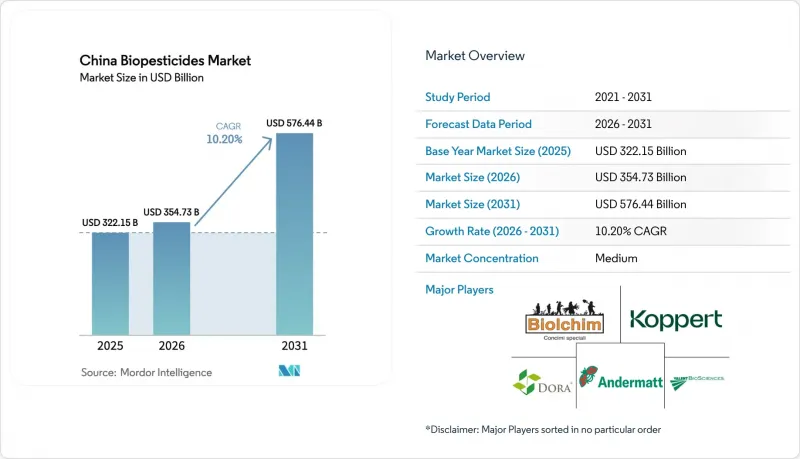
Mordor Intelligence에 따르면 중국의 바이오 농약 시장 규모는 2025년 3,221억 5,000만 달러에서 2026년에는 3,547억 3,000만 달러로 확대되고, 2026년부터 2031년까지 CAGR 10.20%를 기록하며 2031년에는 5,764억 4,000만 달러에 달할 것으로 예측됩니다.
본 보고서는 형태별(바이오 제초제, 바이오 살충제, 바이오 살균제, 기타 바이오 농약) 및 작물 종류별(경제 작물, 밭작물, 원예 작물)로 분류되어 있습니다. 시장 예측은 금액(달러) 및 미터톤으로 표시되어 있습니다.
중국 바이오 농약 시장의 동향 및 인사이트
정책에 따른 보조금이 도입을 가속화
2024년 4월, 농업농촌부는 생산자에게 생물농약 투입 비용의 최대 20%를 환급하는 종합 해충 관리 프로그램에 1억 9,980만 달러를 배정했습니다. 보조금 지급은 합성 유효 성분의 사용량이 전년 대비 10% 감소했음을 문서로 증명하는 것을 조건으로 하고 있으며, 이 규정에 따라 생물농약은 단순한 선택적 추가 품목이 아닌 규정 준수를 위한 필수 요건이 되었습니다. 3.3헥타르 이상의 협동조합 및 가족 경영 농장은 자동으로 대상이 되며, 이는 정확한 살포 프로토콜을 관리할 수 있는 능력이 가장 뛰어난 부문을 포괄합니다. 저장성과 장쑤성 지방 당국은 전자 바우처 시스템을 간소화하고, 청구서 업로드 후 7일 이내에 보조금을 입금함으로써 생산자의 현금 흐름을 개선하고 있습니다. 광둥성 농업 보급 센터에서는 보조금 신청 절차와 저장 및 살포 시기에 관한 강습회를 함께 실시하여, 그동안 도입을 방해하던 지식의 격차를 해소하고 있습니다. 초기 영향 평가에 따르면, 시범 현에서는 첫 시즌에 처리 면적이 32% 증가하여, 이 보조금이 촉매 역할을 하고 있음이 확인되었습니다.
농약 사용 감축 의무 목표
제14차 5개년 계획(2021-2025년)에서는 2016-2020년 기준치와 비교하여 과일·채소의 농약 사용량을 10%, 주요 곡물의 경우 5% 감축하도록 의무화하는 절대적인 톤수 상한선이 설정되어 있습니다. 2017년에 달성된 ‘제로 성장’ 정책과 달리, 새로운 체계에서는 사용 강도가 아닌 사용량을 제한하고 있기 때문에 수요는 고효능 생물농약 제제로 이동하고 있습니다. 1그램당 100억 콜로니 형성 단위(CFU)를 공급하는 바실러스 투린젠시스(Bacillus thuringiensis) 제품은 농가가 효능을 저하시키지 않으면서 사용량 상한선을 충족하는 데 도움이 됩니다. 산동성과 절강성의 수출 지향형 농가들은 2024년에 47종의 합성 유효 성분에 대해 유럽연합(EU)이 잔류 기준을 강화함에 따라 유사한 압박에 직면하고 있으며, 이로 인해 생물농약에 대한 수요가 더욱 공고해지고 있습니다. 현재, 패스트 트랙 심사를 통해 헥타르당 유효 성분 질량이 30% 낮은 것으로 입증된 제제에 대해 18개월 이내에 잠정 승인이 부여되고 있으며, 이에 따라 제조업체들은 포자 수를 늘리기 위해 기존 균주를 재설계하도록 장려받고 있습니다.
살아있는 미생물의 포장에서 나타나는 효능의 편차
남부 지방에서는 기온이 35℃를 넘고 습도가 80%를 초과하면,바실러스 투링겐시스(Bacillus thuringiensis) 및 트리코데르마 하르지아눔(Trichoderma harzianum) 제품의 콜로니 형성 단위(CFU) 생존율이 40-60% 저하될 가능성이 있어, 7-10일 간격으로 살포해야만 합니다. 자외선은 2일 이내에 포자 수를 절반으로 줄이기 때문에 새벽이나 해질녘에 살포해야 하지만, 이는 드론을 이용한 살포 서비스 일정과 충돌합니다. 광둥성 농업과학원의 조사에 따르면, 생물농약을 새벽이 아닌 정오에 살포할 경우 해충의 치사율이 낮아지는 것으로 밝혀졌습니다. 각 제조사는 자외선 차단 보조제나 내열성 균주를 도입하고 있지만, 15-20%의 가격 프리미엄이 가격에 민감한 농가의 구매를 방해하고 있습니다. 효능에 관한 표준화된 표시가 없어 농가들은 입소문을 통해 브랜드를 비교할 수밖에 없으며, 이는 해충 피해가 급증했을 때 신뢰성을 떨어뜨리는 요인이 되고 있습니다.
부문 분석
2025년 매출의 40%를 바이오 살균제가 차지했습니다. 이는 580만 헥타르에 달하는 보호 재배 원예 분야에서 푸사리움, 피시움, 리조크토니아에 효과적인 바실러스 서브틸리스 및 트리코데르마 할지아눔 제품이 주도한 결과입니다. 온실 운영자들은 소매 가격을 50-100% 가산할 수 있을 뿐만 아니라, 유기 인증 기준도 충족하는 잔류물이 없는 방제를 중요시하고 있습니다. Koppert 및 Shandong Sukahan의 트리코데르마 제품군은 85%의 방제 효과를 달성하고 있으며, 이는 합성 농약과 동등한 수준이므로 시장 점유율 1위를 유지하고 있습니다. 바실러스 툴링겐시스가 주류를 차지하는 생물 살충제는, 피레스로이드계 농약에 대한 내성으로 인해 화학 농약의 효과가 저하되고 있는 면화와 채소의 재배 면적에서 연평균 성장률(CAGR) 12%로 성장하고 있습니다. 생물 제초제는 글리포세이트의 85-95%에 비해 잡초 방제율이 40-55%에 그치고 있어, 시장 점유율은 여전히 낮은 수준에 머물러 있습니다. 그러나 농업화학제품관리연구소에 의한 지방산계 및 알레로파시계 제품의 승인은 향후 성장 가능성을 시사하고 있습니다. 청두 뉴썬의 나노캡슐화 시제품은 2027년까지 이러한 효능 격차를 해소하는 것을 목표로 하고 있으며, 이를 통해 중국 바이오 농약 시장에서 제초제 부문의 시장 규모가 확대될 가능성이 있습니다.
2차적인 수요 요인이 바이오 살균제의 주도적 위치를 뒷받침하고 있습니다. 보호 재배 면적의 확대는 병해 압력을 높이지만, 살포 시기를 조절함으로써 살아있는 미생물의 성능을 극대화할 수 있습니다. 공급업체들은 뿌리 주변에 정착하여 한 시즌 내내 병해를 억제하는 소포장 제제를 세트로 판매하고 있어, 엽면 살포에 따른 살포 빈도에 대한 우려를 덜어주고 있습니다. 한편, 생물학적 살충제의 성장은 드론 서비스의 보급률과 신장 위구르 자치구의 면화에서 내성 관리 의무화에 달려 있습니다. 장쑤 루이펑이 개발 중인 바쿠로바이러스를 기반으로 한 제품이 승인되면, 생물학적 살충제 분야의 경쟁은 격화될 것이며, 제조사들은 차별화된 운반체 기술이나 캡슐화 기술의 도입을 강요받게 될 것입니다.
기타 혜택:
- 엑셀 형식의 시장 예측(ME) 시트
- 3개월간의 애널리스트 지원
자주 묻는 질문
목차
제1장 소개
제2장 본 보고서의 내용
제3장 주요 요약 및 주요 조사 결과
제4장 주요 업계 동향
제5장 시장 규모와 성장 예측
제6장 경쟁 구도
제7장 농업용 바이오 제품 기업 CEO를 향한 중요한 전략적 과제
KSM 26.08.25According to Mordor Intelligence, the China biopesticides market size is anticipated to grow from USD 322.15 billion in 2025 to USD 354.73 billion in 2026 and is forecast to reach USD 576.44 billion by 2031 at a 10.20% CAGR over 2026-2031.
This report is Segmented by Form (Bioherbicides, Bioinsecticides, Biofungicides, and Other Biopesticides), and by Crop Type (Cash Crops, Row Crops, and Horticultural Crops). The Market Forecasts in Terms of Value (USD) and Volume (Metric Tons).
China Biopesticides Market Trends and Insights
Policy Subsidies Accelerating Adoption
In April 2024 the Ministry of Agriculture and Rural Affairs earmarked USD 199.8 million for integrated pest-management programs that reimburse growers up to 20% of biological input costs. Disbursement is contingent on documented 10% year-on-year reductions in synthetic active ingredients, a rule that converts biopesticides into compliance essentials rather than optional add-ons. Cooperatives and family farms above 3.3 hectares qualify automatically, capturing the segment most capable of managing precise spray protocols. Provincial bureaus in Zhejiang and Jiangsu have streamlined e-voucher systems that credit reimbursements within seven days of invoice upload, improving cash-flow for growers. Guangdong extension stations bundle subsidy access with storage and timing workshops, closing the knowledge gap that previously curbed uptake. Early impact assessments show treated acreage rising 32% in pilot counties during the first season, confirming the subsidy's catalytic role.
Mandatory Chemical-Use Reduction Targets
The Fourteenth Five-Year Plan (2021-2025) locks in absolute tonnage ceilings that force a 10% cut in pesticide use on fruit and vegetables and 5% on major grains versus the 2016-2020 baseline. Unlike the zero-growth policy achieved in 2017, the new framework caps volume rather than intensity, pushing demand toward high-potency biopesticide formulations. Bacillus thuringiensis products that deliver 10 billion colony-forming units per gram help growers meet tonnage limits without sacrificing efficacy. Export-oriented farmers in Shandong and Zhejiang face parallel pressure from European Union residue limits tightened for 47 synthetic actives in 2024, further locking in biological demand. Fast-track review now grants provisional clearance within 18 months for formulations demonstrating 30% lower active-ingredient mass per hectare, incentivizing manufacturers to redesign legacy strains for higher spore counts.
Variable Field Efficacy of Live Microbes
Colony-forming-unit viability in Bacillus thuringiensis and Trichoderma harzianum products can fall 40-60% when temperatures surpass 35 °C and humidity exceeds 80% in southern provinces, forcing spray intervals of seven to ten days. Ultraviolet light halves spore counts within two days, demanding dawn or dusk applications that clash with drone-service schedules. Guangdong Academy of Agricultural Sciences measured lower pest-mortality when biopesticides were sprayed at noon versus dawn. Manufacturers have introduced UV-shield adjuvants and thermotolerant strains, yet price premiums of 15-20% deter price-sensitive growers. Absence of standardized efficacy labels leaves farmers comparing brands via word-of-mouth, hampering confidence when pest pressure spikes.
Other drivers and restraints analyzed in the detailed report include:
- Rising Organic-Food Premium Demand
- Drone-Enabled Precision Spraying
- Higher Upfront Cost for Smallholders
For complete list of drivers and restraints, kindly check the Table Of Contents.
Segment Analysis
Biofungicides captured 40% of 2025 revenue, driven by Bacillus subtilis and Trichoderma harzianum products effective against Fusarium, Pythium, and Rhizoctonia in 5.8 million hectares of protected horticulture. Greenhouse operators value residue-free protection that secures 50-100% retail premiums and meets organic-label rules. Trichoderma lines from Koppert and Shandong Sukahan reach 85% control efficacy, on par with synthetics and thus maintain share leadership. Bioinsecticides, dominated by Bacillus thuringiensis, are rising at 12% CAGR on cotton and vegetable acreage where pyrethroid resistance erodes chemical efficacy. Bioherbicides remain at fewer share due to 40-55% weed-control levels versus glyphosate's 85-95%, though Institute for the Control of Agrochemicals approvals for fatty-acid and allelopathic products signal future upside. Chengdu Newsun's nano-encapsulated prototypes aim to close the efficacy gap by 2027, which could lift the China biopesticides market size for herbicidal categories.
Second-order demand factors reinforce the leadership of biofungicides. Protected-cultivation acreage increases disease pressure yet offers spray-timing control that maximizes live-microbe performance. Suppliers bundle sachet formulations that colonize root zones for season-long suppression, reducing frequency concerns tied to foliar routes. Meanwhile, bioinsecticide growth will hinge on drone-service density and resistance-management mandates in Xinjiang cotton. Should baculovirus platforms under development by Jiangsu Ruifeng secure approvals, competitive intensity in the bioinsecticide niche will climb, pushing producers toward differentiated carrier and encapsulation technologies.
Complete Report Scope:
- By Form
- Biofungicides
- Bioherbicides
- Bioinsecticides
- Other Biopesticides
- By Crop Type
- Cash Crops
- Horticultural Crops
- Row Crops
List of Companies Covered in this Report:
- Valent Biosciences LLC (Sumitomo Chemical Co. Ltd.)
- Andermatt Group AG
- Dora Agri-Tech
- Biolchim SPA (Hello Nature SpA)
- Koppert Biological Systems Inc.
- Henan Jiyuan Baiyun Industry Co. Ltd.
- King Biotec Corporation
- Zhejiang Qianjiang Biochemical Co. Ltd.
- Shandong Sukahan Bio-Technology Co. Ltd.
- Hebei Zhongbao Green Crop Technology Co. Ltd.
- Rainbow Agro Co. Ltd.
- Wuhan Kono Biological Technology Co. Ltd.
- Chengdu Newsun Crop Science Co. Ltd.
- Jiangsu Ruifeng Bio-Tech Co. Ltd.
- Wuhan Taixin Biological Technology Co. Ltd.
Additional Benefits:
- The market estimate (ME) sheet in Excel format
- 3 months of analyst support
TABLE OF CONTENTS
1 Introduction
- 1.1 Study Assumptions and Market Definition
- 1.2 Scope of the Study
- 1.3 Research Methodology
2 Report Offers
3 Executive Summary and Key Findings
4 Key Industry Trends
- 4.1 Area Under Organic Cultivation
- 4.2 Per Capita Spending on Organic Products
- 4.3 Regulatory Framework
- 4.4 Value Chain and Distribution Channel Analysis
- 4.5 Market Drivers
- 4.5.1 Policy subsidies accelerating adoption
- 4.5.2 Mandatory chemical-use reduction targets
- 4.5.3 Rising organic-food premium demand
- 4.5.4 Drone-enabled precision spraying
- 4.5.5 Synthetic-biology cost reductions
- 4.5.6 Export momentum to Association of Southeast Asian Nations (ASEAN) and Europe
- 4.6 Market Restraints
- 4.6.1 Variable field efficacy of live microbes
- 4.6.2 Higher upfront cost for smallholders
- 4.6.3 Lengthy registration for novel strains
- 4.6.4 Limited agronomic extension services
5 Market Size and Growth Forecasts (Value and Volume)
- 5.1 By Form
- 5.1.1 Biofungicides
- 5.1.2 Bioherbicides
- 5.1.3 Bioinsecticides
- 5.1.4 Other Biopesticides
- 5.2 By Crop Type
- 5.2.1 Cash Crops
- 5.2.2 Horticultural Crops
- 5.2.3 Row Crops
6 Competitive Landscape
- 6.1 Key Strategic Moves
- 6.2 Market Share Analysis
- 6.3 Company Landscape
- 6.4 Company Profiles (Includes Global Level Overview, Market Level Overview, Core Segments, Financials as Available, Strategic Information, Market Rank/Share for Key Companies, Products and Services, and Recent Developments)
- 6.4.1 Valent Biosciences LLC (Sumitomo Chemical Co. Ltd.)
- 6.4.2 Andermatt Group AG
- 6.4.3 Dora Agri-Tech
- 6.4.4 Biolchim SPA (Hello Nature SpA)
- 6.4.5 Koppert Biological Systems Inc.
- 6.4.6 Henan Jiyuan Baiyun Industry Co. Ltd.
- 6.4.7 King Biotec Corporation
- 6.4.8 Zhejiang Qianjiang Biochemical Co. Ltd.
- 6.4.9 Shandong Sukahan Bio-Technology Co. Ltd.
- 6.4.10 Hebei Zhongbao Green Crop Technology Co. Ltd.
- 6.4.11 Rainbow Agro Co. Ltd.
- 6.4.12 Wuhan Kono Biological Technology Co. Ltd.
- 6.4.13 Chengdu Newsun Crop Science Co. Ltd.
- 6.4.14 Jiangsu Ruifeng Bio-Tech Co. Ltd.
- 6.4.15 Wuhan Taixin Biological Technology Co. Ltd.