|
시장보고서
상품코드
2113387
이온 크로마토그래피 : 시장 점유율 분석, 업계 동향과 통계, 성장 예측(2026-2031년)Ion Chromatography - Market Share Analysis, Industry Trends & Statistics, Growth Forecasts (2026 - 2031) |
||||||
 Mordor Intelligence
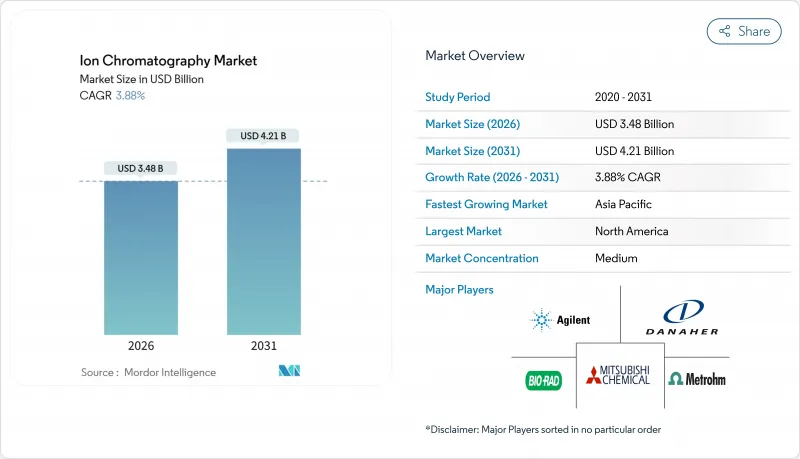
Mordor Intelligence에 따르면 이온 크로마토그래피 시장 규모는 2026년에 34억 8,000만 달러로 추정되며, 예측 기간(2026-2031년) 동안 CAGR 3.88%로 확대되어 2031년에는 42억 1,000만 달러에 달할 것으로 전망됩니다.
본 보고서는 제품 유형(시스템/장비, 소모품, 소프트웨어 및 서비스), 크로마토그래피 기법(이온 교환, 이온 배제, 이온 쌍), 용도(환경 시험, 의약품 및 바이오의약품 등), 지역(북미, 유럽, 아시아태평양, 중동 및 아프리카, 남미)별로 분류되어 있습니다. 시장 전망은 금액(달러) 기준으로 제시되어 있습니다.
세계 이온 크로마토그래피 시장 동향 및 인사이트
환경 및 수질 규제의 강화
2024년 10월 미국 환경보호청(EPA)이 발표한 잠정 건강 권고에 따라 PFOA 및 PFOS의 기준치가 1조분의 4로 설정됨에 따라, 지방 자치 단체의 상수도 사업자들은 실험실 현대화를 추진하고 있습니다. 이러한 엄격한 검출 한계는 기존의 분광법으로는 달성할 수 없습니다. 이온 크로마토그래피-탠덤 질량 분석법이 표준 워크플로우가 되면서, 전미의 지역 상수도 시스템에서 수천 건에 달하는 시스템 업그레이드가 추진되고 있습니다. 2026년 1월에 발효되는 유럽연합(EU)의 개정 ‘음용수 지침’에서는 20종류의 PFAS 화합물에 대한 분기별 모니터링이 의무화되어, 이에 따라 대용량 음이온 컬럼의 대상 시장이 확대되고 있습니다. 2025년 5월에 공표된 중국의 폐수 기준안에서는 음이온성 계면활성제 및 6가 크롬의 보고가 의무화되어 있으며, 2028년까지 약 8,000개의 검사 기관이 추가될 전망입니다. 규제의 초점은 나노플라스틱으로도 확대되고 있으며, 이온 배제 크로마토그래피는 광학 분광법보다 고분해에 의한 카르복실산염을 더 효율적으로 분리할 수 있기 때문에 이 기술의 더 광범위한 도입이 기대되고 있습니다. 이러한 규제 요건들이 결합되어 이온 크로마토그래피 기술이 일상적인 규제 준수에 통합됨에 따라, 이온 크로마토그래피 시장은 확대되고 있습니다.
제약 및 바이오의약품 분야의 품질 관리(QC) 수요 급증
바이오의약품 제조에서는 이온 크로마토그래피를 사용하여 일회용 바이오리액터에서 유래한 용출물, 잔류 숙주 세포 단백질, 그리고 단클론항체의 안정성을 저해할 가능성이 있는 완충액 내의 미량 음이온을 정량하고 있습니다. 2025년 2월, 미국 FDA는 분석 검증 지침을 개정하여 주사용 부형제의 순도를 측정하기 위한 권장 기법으로 이온 크로마토그래피를 명시적으로 언급했습니다. 바이오시밀러 개발 기업들은 전하 변이체 분석에 이온 쌍법으로의 전환을 추진하고 있으며, 이를 통해 전하를 띤 대사 산물의 분리 능력이 향상됩니다. 중국 규제 당국은 2025년에 47개의 생물학적 제제를 승인했으나, 각 제제마다 다단계 이온 크로마토그래피 시험이 필요하며, 이로 인해 연간 약 1억 2,000만 달러의 소모품 구매 비용이 증가할 것으로 추정됩니다.
높은 설비 투자 및 유지 관리 비용
중급 사양의 장비 정가는 48,000-65,000달러이지만, 설치 및 검증 비용으로 12,000-18,000달러가 추가로 발생합니다. 소모품 비용은 더욱 부담스럽습니다. 음이온 교환 컬럼은 400-600회 주입 시 수명이 다하며, 가격은 800-1,200달러이지만, 서프레서는 분기마다 교체해야 하며 그 비용은 약 600달러가 듭니다. 3대의 시스템을 운영하는 위탁 분석 실험실의 경우, 연간 총 소유 비용이 10만 달러에 달하는 것으로 보고되고 있으며, 인도, 브라질 및 아프리카 일부 지역에서는 예산에 부담을 주고 있습니다. 2025년 후반 동남아시아에서 도입된 시마즈 제작소의 ‘샘플 단위 과금 플랜’은 초기 투자가 필요 없지만, 직접 구매에 비해 5년간의 총 비용이 40% 증가합니다. 서비스 계약에는 연간 8,000-15,000달러의 비용이 소요되며, 지방 도시에서 현장 서비스 대응이 지연될 경우 시스템이 며칠 동안 가동 불능 상태가 될 가능성이 있습니다. 이러한 경제적 제약으로 인해 소규모 연구소에서 이온 크로마토그래피의 보급이 저해되고, 신흥 지역의 시장 성장이 둔화되고 있습니다.
부문 분석
2025년, 시스템 및 장비는 매출의 58.11%를 차지하며 이온 크로마토그래피 시장에서 가장 큰 점유율을 기록했습니다. 그러나 소모품은 2031년까지 연평균 성장률(CAGR) 5.81%로 성장할 것으로 예상되며, 이는 장비 성장률의 거의 2배에 해당하여, 이미 도입된 장비를 통한 수익 창출로 전환되고 있음을 나타냅니다. 5개의 플랫폼을 운영하는 평균적인 제약 연구소에서는 컬럼, 서프레서, 용출액 팩에 연간 40,000-55,000달러를 지출하고 있으며, 이는 예측 가능한 안정적인 수익원을 창출하여 공급업체의 수익을 뒷받침하고 있습니다. 2025년 3월에 출시된 써모피셔(Thermo Fisher)사의 ‘Dionex IonPac AS11-HC’ 컬럼은 800회 주입의 수명을 실현하여 시료당 비용을 22% 절감하는 동시에, 사용자를 독자적인 화학 기술에 한 걸음 더 가까이 다가가게 하고 있습니다. 중고 장비 중개업체들은 도입 후 5년이 경과한 시스템을 40% 할인된 가격에 판매하고 있으며, 이는 신제품 판매 대수에 대한 압박을 가중시키고 있습니다. 이에 따라 각 벤더들은 펌프나 오토샘플러를 재사용하면서 검출기만 교체할 수 있는 모듈식 아키텍처를 강조하고 있습니다. 소모품의 혁신은 지속가능성도 염두에 두고 있으며, 토소가 2025년 9월에 출시한 서프레서 카트리지는 물 사용량을 35% 줄여, ISO 14001 인증 취득을 목표로 하는 연구소에게 매력적인 판매 포인트가 되고 있습니다.
소모품의 우위는 수지 생산이나 서프레서 조립을 관리하는 수직 통합형 공급업체에 이익을 가져다주는 반면, 순수한 장비 제조업체는 지속적인 수익 확보에 어려움을 겪고 있습니다. 소프트웨어 및 서비스의 틈새 시장은 규모는 가장 작지만, 클라우드 호스팅, 검증 문서, 예측 유지보수 분석이 구독 기반 서비스로 전환됨에 따라 꾸준히 확대되고 있습니다. Waters의 ‘Empower 4’는 기기당 연간 3,200달러의 요금을 책정하여 일회성 라이선스를 지속적인 요금제로 전환하고 있습니다. 따라서 연구소들이 감사 대응 및 사이버 보안 규정 준수를 간소화하는 SaaS 도입으로 전환함에 따라, 소프트웨어 관련 이온 크로마토그래피 시장 규모는 전체 시장의 성장률을 상회할 것으로 예상됩니다.
지역별 분석
북미는 엄격한 PFAS 규제와 대규모 제약 산업 기반에 힘입어 2025년 전 세계 매출의 39.64%를 차지했습니다. EPA가 정한 4 ppt의 중간 기준치로 인해 2년까지 지출이 급증했으나, 개보수 공사가 완료되는 2027년 말경에는 그 기세가 둔화될 전망입니다. 캐나다에서는 미국의 공급망 다각화 노력에 대응하기 위해 2025년에 14개의 품질 관리(QC) 연구소가 신설되어, 이 지역에서는 한 자릿수 중반의 성장률을 유지하고 있습니다. 테슬라의 몬테레이 기가팩토리로 상징되는 멕시코의 전기자동차 배터리 생산 확대는 전해액 품질 시험에 대한 수요를 창출하고 있으며, 시장 전체가 성숙기에 접어들었음에도 불구하고 분석 장비 수주는 견조한 추세를 보이고 있습니다.
아시아태평양은 가장 성장세가 두드러지는 지역으로, 2031년까지 연평균 성장률(CAGR) 6.65%로 성장할 것으로 예측됩니다. 약전 기준. 대만 및 한국의 반도체 팹에서는 웨이퍼 결함을 줄이기 위해 인라인 이온 크로마토그래피 모니터가 도입되어 있으며, 시스템당 8만 5,000달러의 투자가 정당화되고 있습니다. 일본의 도입 기반은 소모품 사용량이 많은 워크플로로 전환되고 있으며, 시마즈 제작소와 토소는 현지 밀착형 서비스를 활용하여 시장 점유율을 확대하고 있습니다.
유럽의 성장은 환경 규제 준수에 달려 있습니다. 2026년 1월에 시행될 ‘음용수 지침’에서는 PFAS에 대한 분기별 검사가 의무화되어 있으며, 이로 인해 지자체 상수도 네트워크 전체에서 일괄 조달이 촉진되고 있습니다. 독일 화학 업계에서는 새로운 폐수 기준치를 충족하기 위해 2025년에 140개의 시스템을 도입했으며, 이러한 추세는 2028년까지 지속될 것으로 예상됩니다. 영국에서는 브렉시트 이후 의약품·의료제품 규제청(MHRA)의 지침을 준수하기 위해 22개의 품질 관리(QC) 실험실이 신설되었습니다. 남유럽에서는 공공 사업이 세분화되어 있어 뒤처지고 있지만, 2029년까지 지역 통합 기금이 실험실 현대화를 지원하고 있습니다. 중동 및 아프리카는 여전히 발전 단계에 있지만, 해수 담수화 플랜트에 음이온 모니터링이 도입되고 있어 미래가 기대됩니다. 사우디아라비아의 ACWA Power사는 2025년에 6곳의 시설에 장비를 도입했습니다. 남미의 진전은 지역에 따라 편차가 있지만, 브라질의 가공육에 대한 질산염 규제가 소폭이긴 하지만 꾸준한 성장의 기반이 되고 있습니다.
기타 혜택:
- 엑셀 형식의 시장 예측(ME) 시트
- 3개월간 애널리스트 지원
자주 묻는 질문
목차
제1장 소개
제2장 조사 방법
제3장 주요 요약
제4장 시장 구도
제5장 시장 규모와 성장 예측
제6장 경쟁 구도
제7장 시장 기회와 향후 전망
KSM 26.08.25According to Mordor Intelligence, the ion chromatography market size is estimated at USD 3.48 billion in 2026, and is expected to reach USD 4.21 billion by 2031, at a CAGR of 3.88% during the forecast period (2026-2031).
This report is Segmented by Product Type (Systems/Instruments, Consumables, Software & Services), Chromatography Technique (Ion-Exchange, Ion-Exclusion, Ion-Pair), Application (Environmental Testing, Pharmaceutical & Biopharmaceutical, and More), and Geography (North America, Europe, Asia-Pacific, Middle East & Africa, South America). The Market Forecasts are Provided in Terms of Value (USD).
Global Ion Chromatography Market Trends and Insights
Stricter Environmental and Water-Quality Regulations
Municipal utilities are overhauling laboratories after the U.S. Environmental Protection Agency's October 2024 interim health advisory set PFOA and PFOS limits at 4 parts per trillion, a sensitivity that legacy spectroscopy cannot achieve. Ion chromatography-tandem mass spectrometry has become the reference workflow, driving thousands of system upgrades across U.S. community water systems. The European Union's revised Drinking Water Directive, effective January 2026, requires quarterly monitoring of 20 PFAS compounds, thereby expanding the addressable base for high-capacity anion columns. China's draft wastewater standards, published in May 2025, require the reporting of anionic surfactants and hexavalent chromium, adding approximately 8,000 laboratories by 2028. Regulatory focus is widening to nanoplastics, where ion-exclusion chromatography separates polymer-degradation carboxylates more efficiently than optical spectroscopy, positioning the technique for broader adoption. Collectively, these mandates elevate the ion chromatography market by embedding the technology into routine regulatory compliance.
Pharmaceutical and Biopharma QC Demand Surge
Biologics manufacturing uses ion chromatography to quantify leachables from single-use bioreactors, residual host-cell proteins, and trace anions in buffers that can destabilize monoclonal antibodies. In February 2025, the U.S. FDA updated its analytical validation guidance, explicitly listing ion chromatography as a preferred method for determining the purity of injectable excipients. Biosimilar developers are shifting to ion-pair workflows for charge-variant analysis, which improves resolution for charged metabolites. China's regulator approved 47 biologic entities in 2025, each requiring multi-stage ion-chromatography testing that adds an estimated USD 120 million in annual consumable purchases.
High Capital and Maintenance Costs
A mid-specification instrument lists for USD 48,000-65,000, while installation and validation add USD 12,000-18,000. Consumables compound costs: Anion-exchange columns last 400-600 injections and sell for USD 800-1,200, while suppressors require quarterly replacement at approximately USD 600. Contract labs operating three systems report total annual ownership costs of nearly USD 100,000, straining budgets in India, Brazil, and certain parts of Africa. Shimadzu's pay-per-sample plan, introduced in Southeast Asia in late 2025, removes upfront capital but increases the five-year cost by 40% compared to direct purchase. Service contracts incur annual costs of USD 8,000-15,000, and slow field-service coverage in secondary cities can result in systems being idle for days. These economic limitations restrict the penetration of ion chromatography among small laboratories and slow the market's growth in emerging regions.
Other drivers and restraints analyzed in the detailed report include:
- Food and Beverage Safety Compliance Expansion
- Battery-Grade Electrolyte QC for Li-Ion Gigafactories
- Shortage of Trained Chromatographers
For complete list of drivers and restraints, kindly check the Table Of Contents.
Segment Analysis
In 2025, systems and instruments accounted for 58.11% of sales, the largest share of the ion chromatography market. Yet consumables are forecast to grow at a 5.81% CAGR through 2031, nearly double the growth of instruments, illustrating the pivot toward installed-base monetization. The average pharmaceutical lab running five platforms spends USD 40,000-55,000 annually on columns, suppressors, and eluent packs, creating predictable annuity streams that cushion vendor earnings. Thermo Fisher's Dionex IonPac AS11-HC column, introduced in March 2025, achieved 800-injection lifetimes, reducing the per-sample cost by 22% and drawing users closer to proprietary chemistry. Refurbished equipment brokers discount five-year-old systems by 40%, which increases pressure on new-unit volume, so vendors emphasize modular architectures that allow buyers to refresh detectors while reusing pumps and autosamplers. Consumable innovation also targets sustainability; Tosoh's September 2025 suppressor cartridge trims water use by 35%, a selling point for ISO 14001-aspiring labs.
Consumables dominance benefits vertically integrated suppliers that control resin production and suppressor assembly, whereas pure-play instrument makers struggle to capture recurring revenue. The software-and-services niche, although the smallest, is scaling steadily as cloud hosting, validation documentation, and predictive maintenance analytics become subscription-based items. Waters Empower 4 charges USD 3,200 per instrument annually, converting one-time licenses into recurring fees. The ion chromatography market size attached to software is therefore expected to outpace total market growth as laboratories shift to SaaS deployments that simplify audit readiness and cybersecurity compliance.
Complete Report Scope:
- By Product Type
- Systems / Instruments
- Consumables
- Software & Services
- By Chromatography Technique
- Ion-Exchange
- Ion-Exclusion
- Ion-Pair
- By Application
- Environmental Testing
- Pharmaceutical & Biopharmaceutical
- Food & Beverage Quality & Safety
- Other Research Applications
- By Geography
- North America
- United States
- Canada
- Mexico
- Europe
- Germany
- United Kingdom
- France
- Italy
- Spain
- Rest of Europe
- Asia-Pacific
- China
- Japan
- India
- Australia
- South Korea
- Rest of Asia-Pacific
- Middle East & Africa
- GCC
- South Africa
- Rest of Middle East & Africa
- South America
- Brazil
- Argentina
- Rest of South America
- North America
Geography Analysis
North America generated 39.64% of global revenue in 2025, driven by stringent PFAS enforcement and a large pharmaceutical base. The EPA's 4 ppt interim limit triggered a two-year spending surge that will taper by late 2027 as retrofits conclude. Canada added 14 QC labs in 2025 to serve U.S. supply-chain diversification efforts, maintaining mid-single-digit regional growth. Mexico's EV battery expansion, highlighted by Tesla's Monterrey gigafactory, introduces demand for electrolyte-quality testing, keeping instrument orders steady despite a mature overall market.
The Asia Pacific is the fastest-growing region, projected to grow at a 6.65% CAGR through 2031. Pharmacopeia standards. Semiconductor fabs in Taiwan and South Korea deploy inline ion chromatography monitors to reduce wafer defects, justifying investments of USD 85,000 per system. Japan's installed base is shifting toward higher consumable-intensity workflows, with Shimadzu and Tosoh leveraging localized service to win share.
Europe's growth hinges on environmental compliance. The Drinking Water Directive, effective January 2026, mandates quarterly testing for PFAS, sparking bulk procurements across municipal networks. Germany's chemical sector installed 140 systems in 2025 to meet new wastewater caps, a cycle expected to continue through 2028. The United Kingdom added 22 QC labs post-Brexit to align with Medicines and Healthcare products Regulatory Agency guidelines. Southern Europe lags due to fragmented utilities, but cohesion funds are underwriting lab modernization to 2029. The Middle East and Africa remain nascent but show promise as desalination plants adopt anion monitoring; Saudi Arabia's ACWA Power equipped six facilities in 2025. South America progresses unevenly; Brazil's nitrate regulations for processed meats provide a steady, if modest, growth anchor.
- Agilent Technologies
- Bio-Rad Laboratories
- Cecil Instruments
- Danaher
- East & West Analytical Instruments
- Hitachi High-Tech Corp.
- MembraPure
- Merck KGaA (MilliporeSigma)
- Metrohm
- Mitsubishi Chemical
- PerkinElmer
- Phenomenex
- Qingdao Puren Instrument
- Qingdao Shenghan Chromatograph Tech
- Shimadzu
- Sykam GmbH
- Thermo Fisher Scientific
- Tosoh
- Waters Corporation
- YMC Co., Ltd.
Additional Benefits:
- The market estimate (ME) sheet in Excel format
- 3 months of analyst support
TABLE OF CONTENTS
1 Introduction
- 1.1 Study Assumptions & Market Definition
- 1.2 Scope of the Study
2 Research Methodology
3 Executive Summary
4 Market Landscape
- 4.1 Market Overview
- 4.2 Market Drivers
- 4.2.1 Stricter Environmental & Water-Quality Regulations
- 4.2.2 Pharmaceutical & Biopharma QC Demand Surge
- 4.2.3 Food & Beverage Safety Compliance Expansion
- 4.2.4 Battery-Grade Electrolyte QC for Li-ion Gigafactories
- 4.2.5 AI-driven Method Automation Lowering OPEX
- 4.2.6 Micro-Chip IC For Point-Of-Use Water Analysis
- 4.3 Market Restraints
- 4.3.1 High Capital & Maintenance Costs
- 4.3.2 Shortage of Trained Chromatographers
- 4.3.3 Resin & Suppressor Supply-chain Fragility
- 4.3.4 Availability of Alternative Techniques
- 4.4 Regulatory Landscape
- 4.5 Technological Outlook
- 4.6 Porter's Five Forces Analysis
- 4.6.1 Threat of New Entrants
- 4.6.2 Bargaining Power of Buyers
- 4.6.3 Bargaining Power of Suppliers
- 4.6.4 Threat of Substitutes
- 4.6.5 Competitive Rivalry
5 Market Size & Growth Forecasts
- 5.1 By Product Type
- 5.1.1 Systems / Instruments
- 5.1.2 Consumables
- 5.1.3 Software & Services
- 5.2 By Chromatography Technique
- 5.2.1 Ion-Exchange
- 5.2.2 Ion-Exclusion
- 5.2.3 Ion-Pair
- 5.3 By Application
- 5.3.1 Environmental Testing
- 5.3.2 Pharmaceutical & Biopharmaceutical
- 5.3.3 Food & Beverage Quality & Safety
- 5.3.4 Other Research Applications
- 5.4 By Geography
- 5.4.1 North America
- 5.4.1.1 United States
- 5.4.1.2 Canada
- 5.4.1.3 Mexico
- 5.4.2 Europe
- 5.4.2.1 Germany
- 5.4.2.2 United Kingdom
- 5.4.2.3 France
- 5.4.2.4 Italy
- 5.4.2.5 Spain
- 5.4.2.6 Rest of Europe
- 5.4.3 Asia-Pacific
- 5.4.3.1 China
- 5.4.3.2 Japan
- 5.4.3.3 India
- 5.4.3.4 Australia
- 5.4.3.5 South Korea
- 5.4.3.6 Rest of Asia-Pacific
- 5.4.4 Middle East & Africa
- 5.4.4.1 GCC
- 5.4.4.2 South Africa
- 5.4.4.3 Rest of Middle East & Africa
- 5.4.5 South America
- 5.4.5.1 Brazil
- 5.4.5.2 Argentina
- 5.4.5.3 Rest of South America
- 5.4.1 North America
6 Competitive Landscape
- 6.1 Market Concentration
- 6.2 Market Share Analysis
- 6.3 Company Profiles (includes Global level Overview, Market-level Overview, Core Segments, Financials, Strategic Information, Market Rank/Share, Products & Services, Recent Developments)
- 6.3.1 Agilent Technologies
- 6.3.2 Bio-Rad Laboratories Inc
- 6.3.3 Cecil Instruments
- 6.3.4 Danaher Corporation (Cytiva)
- 6.3.5 East & West Analytical Instruments
- 6.3.6 Hitachi High-Tech Corp.
- 6.3.7 MembraPure GmbH
- 6.3.8 Merck KGaA (MilliporeSigma)
- 6.3.9 Metrohm AG
- 6.3.10 Mitsubishi Chemical Corporation
- 6.3.11 PerkinElmer Inc.
- 6.3.12 Phenomenex
- 6.3.13 Qingdao Puren Instrument
- 6.3.14 Qingdao Shenghan Chromatograph Tech
- 6.3.15 Shimadzu Corporation
- 6.3.16 Sykam GmbH
- 6.3.17 Thermo Fisher Scientific
- 6.3.18 Tosoh Bioscience
- 6.3.19 Waters Corporation
- 6.3.20 YMC Co., Ltd.
7 Market Opportunities & Future Outlook
- 7.1 White-space & Unmet-need Assessment