

|
시장보고서
상품코드
2113439
자동차용 나이트 비전 시스템 : 시장 점유율 분석, 업계 동향과 통계, 성장 예측(2026-2031년)Automotive Night Vision System - Market Share Analysis, Industry Trends & Statistics, Growth Forecasts (2026 - 2031) |
||||||
 Mordor Intelligence
Mordor Intelligence에 따르면 자동차용 나이트 비전 시스템 시장 규모는 2025년에 33억 달러로 평가되며, 2026년 36억 8,000만 달러에서 2031년까지 63억 4,000만 달러에 달할 것으로 예측되며, 예측 기간(2026-2031년) 동안 CAGR은 11.52%가 될 전망입니다.
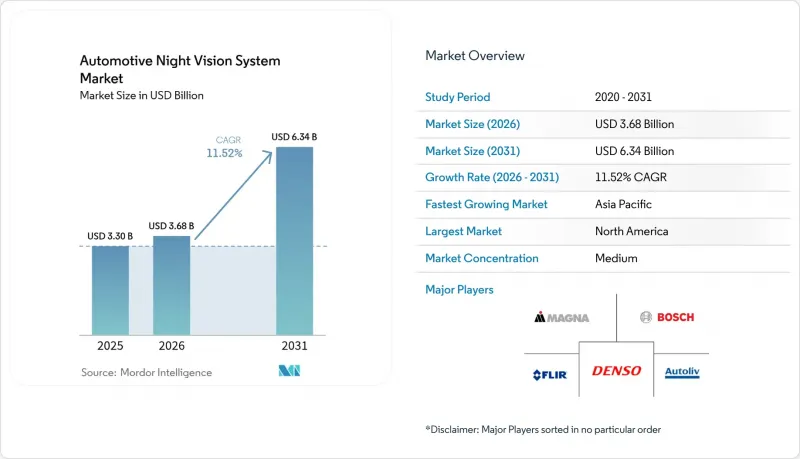
본 보고서는 기술 유형(원적외선, 근적외선, 단파 적외선), 디스플레이 유형(내비게이션 시스템, 계기판 등), 구성요소 유형(야간 투시 카메라 등), 차종(승용차 등), 판매 채널(OEM 순정 장비 등) 및 지역별로 분류되어 있습니다. 시장 전망은 금액(달러) 기준으로 제시되어 있습니다.
세계 자동차용 나이트 비전 시스템 시장의 동향 및 인사이트
미국 FMVSS 111 및 EU GSR 2029에 따른 ADAS 의무화
미국 연방 자동차 안전 기준(FMVSS) 제127호 및 EU 일반 안전 규정(GSR) 2029의 규제 조화를 통해 준수 기한이 통일됨에 따라, 자동차용 나이트 비전 시스템 시장에서 나이트 비전 도입의 경제성이 근본적으로 재구성되고 있습니다. 2029년 9월까지 보행자용 자동 긴급 제동 시스템의 탑재를 의무화하는 NHTSA의 규제는 심각한 성능 격차를 부각시키고 있습니다. Teledyne FLIR 및 VSI Labs의 테스트 결과, 열 융합 방식의 PAEB 시스템이 모든 야간 시나리오에서 합격한 반면, 2024년형 주요 3개 차종은 여러 테스트에서 불합격한 것으로 입증되었습니다. 이러한 규제적 압력으로 인해 나이트 비전은 ‘사치스러운 기능’에서 ‘규정 준수를 위한 필수 요건’으로 전환되고 있습니다. 2022년에 발생한 보행자 사망 사고의 77.7%가 야간에 발생했다는 사실이 그 안전상의 정당성을 뒷받침하고 있습니다. EU의 병행 일정에 따라 전 세계 자동차 제조사들은 지역별 대응을 달리할 수 없게 되었으며, 열화상 공급망 전반에 걸쳐 비용 절감을 가속화하는 규모의 경제가 창출되고 있습니다. 소규모 제조사에는 2030년 9월까지 1년의 유예 기간이 주어졌으며, 이로 인해 양극화된 시장 역학이 형성되어 기존 열감지 기술을 보유한 대형 제조사에 유리하게 작용할 가능성이 있습니다.
BEV 및 고급 내연기관(ICE) 모델에서의 프리미엄 부문 진출
현재, 하이엔드 전기자동차에는 가격 프리미엄을 정당화하고 기존 경쟁 차량과의 차별화를 꾀하기 위해 열화상 카메라가 탑재되어 있습니다. 메르세데스-벤츠의 ‘나이트 뷰 어시스트 플러스(Night View Assist Plus)’는 최대 160미터 앞의 보행자나 야생동물을 감지하여, 마주 오는 차량의 시야를 방해하지 않으면서 스포트라이트를 비춥니다. BMW의 원적외선 솔루션은 300미터까지 도달하며, 외부 조명이 없어도 효과를 발휘합니다. 아우디 A6 및 Q7과 같은 고급 내연기관(ICE) 모델도 유사한 노력을 기울이고 있으며, 모두 2,500달러의 옵션으로 제공됩니다. 프리미엄층 구매자들은 2,300-2,500달러 가격대를 초과하는 사양 목록을 수용하기 때문에 공급망의 학습 곡선에 필요한 초기 판매량을 창출하고, 그 결과 양산 부문에서 비용 최적화된 사양의 도입으로 가는 길을 열어주고 있습니다.
비냉각형 LWIR 모듈의 높은 평균 판매 가격(ASP)과 HUD 통합
열 코어 및 관련 광학 시스템은 카메라나 레이더 장치에 비해 여전히 고가입니다. 헤드업 디스플레이를 통합하면 각 디스플레이에 광학 결합기와 정교한 보정이 필요하기 때문에 비용이 더욱 증가합니다. OEM의 비용 엔지니어링 팀은 LWIR을 통한 완전한 커버리지와 부품 수를 줄이면서 규정 준수를 보장하는 레이더-카메라 융합 방식 중 하나를 선택해야 합니다. 신흥 셔터리스 알고리즘과 웨이퍼 레벨 제조 기술로 인해 비용 압박은 완화될 가능성이 있지만, 전환 기간 동안에는 주류 부문에서 가격 민감도가 지속될 것입니다.
부문 분석
LWIR 솔루션을 위한 자동차용 나이트 비전 시스템은 세계 시장 가치의 62.78%를 차지하고 있습니다. 강한 열 대비 덕분에 헤드라이트의 조사 범위를 벗어나도 보행자를 확실하게 인식할 수 있어, 규제 시험 주기에서 지속적으로 채택되고 있습니다. 웨이퍼 레벨 포토다이오드가 개당 100달러의 가격 수준을 돌파함에 따라, SWIR 센서는 15.88%라는 높은 연평균 성장률(CAGR)로 시장 규모를 확대하고 있습니다. 카메라 제조 공장에서 익숙하게 사용되고 있는 반도체 공정을 통해 매력적인 비용 곡선이 실현되고 있으며, SWIR이 눈보라나 옅은 안개를 뚫고 시인할 수 있는 능력은 고속도로에서의 자율주행에 있어 매우 매력적입니다. LWIR이 차지하는 자동차용 나이트 비전 시스템의 시장 점유율은 규제 적합성 인증 기준으로 여전히 중요하지만, 점차 축소될 것으로 예상됩니다. 능동형 근적외선(ANIR)은 중간적인 위치를 차지하고 있으며, 개별 LED 이미터와 결합하여 600피트 범위 내에서 흑백 이미지를 제공합니다.
연구 개발 파이프라인을 통해 스펙트럼 범위는 지속적으로 확대되고 있습니다. 알토 대학교는 1.55µm에서 감도가 35% 향상된 게르마늄 포토다이오드를 개발했습니다. 이는 자동차용 SWIR 대역에 이상적입니다. 극단적인 예로, 양자점 검출기는 파장 18µm까지의 검출 감도를 기록하고 있으며, 이는 센서 설계자에게 미래의 한계를 제시하고 있습니다. 향후 5년 동안은 공통 로직을 기반으로 LWIR과 SWIR을 융합한 듀얼 밴드 어레이가 프리미엄 패키지의 주력 제품이 될 전망입니다. 이를 통해 중복성을 확보하면서도 총 소유 비용(TCO)을 절감할 수 있게 됩니다.
2025년에는 헤드업 디스플레이(HUD)가 시장 점유율의 43.10%를 차지하며, 자동차용 나이트 비전 시스템의 시장 규모 확대에 기여했습니다. 운전자는 전방 시야 확보와 시선 이동 시간 단축을 중요하게 생각합니다. 하지만 자동차 제조사들은 이미 내비게이션 및 스트리밍 용도로 12인치 이상의 터치스크린을 탑재하고 있어, 센터 스택 디스플레이에 예산이 배정되고 있습니다. 연평균 성장률(CAGR) 18.05%의 속도로, 인포테인먼트 기반 영상 전송은 향후 10년이 끝날 무렵 HUD 탑재 대수와 어깨를 나란히 할 전망입니다. 따라서 자동차용 나이트 비전 시스템 시장에서 HUD 모듈의 점유율은 2031년까지 30%대 중반으로 떨어질 것으로 예측됩니다.
미래의 콕핏에서는 증강 현실(AR)을 통한 오버레이 기능이 더욱 강화될 것입니다. 콘티넨탈, 보쉬, 하만은 색상으로 구분된 경계선을 통해 사람의 실루엣을 강조 표시하는 디스플레이 컨트롤러를 공개했습니다. 저가형 모델의 경우 계기판 표시나 분할 화면 위젯만으로도 충분할 수 있습니다. 앞유리에 데이터를 투사하려면 정밀한 광학 조정이 필요하기 때문에 일부 양산차 제조사는 부품 가격이 내려갈 때까지 HUD 아키텍처 도입을 보류할 가능성이 있습니다. 듀얼 모드 전략을 통해 프리미엄 브랜드는 HUD를 핵심 기능으로 유지할 수 있는 반면, 중급 브랜드는 센터 패널을 재사용함으로써 전체 라인업에 걸쳐 기능적 일관성을 유지할 수 있습니다.
지역별 분석
2025년 자동차용 나이트 비전 시스템 시장의 매출 중 북미가 41.20%를 차지했습니다. 법규의 명확성이 결정적인 우위 요인으로 작용하고 있습니다. NHTSA(미국 도로교통안전국)가 2029년 9월까지 보행자용 AEB(자동 긴급 제동)가 어두운 곳에서도 작동하도록 규정함에 따라, 자동차 제조사들은 지금 당장 조달 로드맵을 확정할 수밖에 없습니다. Teledyne FLIR이나 L3Harris와 같은 국내 공급업체들은 성숙한 열화상 코어를 제공하며, 부가가치를 국내에 유보하고 있습니다. 미국에서 프리미엄 SUV에 대한 수요가 판매 대수를 끌어올리고 있는 반면, 캐나다의 조립 공장에서는 차량 아키텍처가 공통적이기 때문에 미국 사양에 준하는 생산이 이루어지고 있습니다. 또한, 텔라다인 FLIR가 VSI Labs와 제휴하여 FMVSS 제127호 적합성 시험을 진행하고 있는 점은 북미 공급업체들이 세계 시장으로의 확장을 도모하는 데 유리한 입지를 구축하고 있습니다.
아시아태평양에서는 연평균 성장률(CAGR) 14.33%를 기록할 것으로 예측됩니다. 중국은 국내 브랜드를 대상으로 레벨 2+ ADAS를 확대하고 있어 이 지역을 주도하고 있습니다. GAC, NIO, BYD는 AI를 활용한 이미지 보정 기술을 접목하여 표준 CMOS 센서를 유사 열화상 출력 수준으로 향상시키고 있지만, 플래그십 모델에서는 진정한 LWIR의 채택이 가속화되고 있습니다. 수출 규제의 영향을 완화하기 위해 칼코게나이드 렌즈와 저비용 웨이퍼의 현지 생산이 진행되고 있습니다. 일본과 한국은 토요타, 렉서스, 현대, 제네시스 각 브랜드를 통해 프리미엄 시장으로의 진출을 확대하고 있으며, 각 사 모두 나이트 비전과 서라운드 뷰 카메라 시스템을 결합하고 있습니다.
유럽에서는 독자적인 ‘일반 안전 규정 2029’에 따라 균형 잡힌 성장을 보이고 있습니다. 독일 자동차 제조사들은 2000년대 초반부터 도입을 선도해 왔으며, 현재는 조건부 자율주행을 위한 센서 퓨전 개선을 추진하고 있습니다. 발레오(Valeo)와 텔레다인 FLIR(Teledyne FLIR) 간의 공급 계약은 ASIL B 요건을 충족하는 열화상 카메라의 양산을 대상으로 합니다. 프랑스의 린레드(Lynred)는 지정학적 충격에 대비해 검출기 생산능력을 확보하기 위해 8,500만 유로 규모의 프로그램 하에 클린룸 면적을 두 배로 늘리고 있습니다. 스칸디나비아 시장에서는 겨울철 장기간의 어둠을 배경으로 평균 이상의 도입이 진행되고 있지만, 남유럽 시장의 판매 대수는 고급 수입차에 좌우되고 있습니다. 이 지역의 시장 점유율은 북미에 뒤처지고 있지만, 규제 일관성과 공급업체의 투자를 통해 꾸준한 성장이 보장되고 있습니다.
기타 혜택:
- 엑셀 형식의 시장 예측(ME) 시트
- 3개월간의 애널리스트 지원
자주 묻는 질문
목차
제1장 소개
제2장 조사 방법
제3장 주요 요약
제4장 시장 구도
제5장 시장 규모와 성장 예측
제6장 경쟁 구도
제7장 시장 기회와 향후 전망
KSM 26.08.25According to Mordor Intelligence, the automotive night vision systems market size was valued at USD 3.30 billion in 2025 and estimated to grow from USD 3.68 billion in 2026 to reach USD 6.34 billion by 2031, at a CAGR of 11.52% during the forecast period (2026-2031).
This report is Segmented by Technology Type (Far Infrared, Near Infrared, and Short-Wave Infrared), Display Type (Navigation System, Instrument Cluster, and More), Component Type (Night Vision Cameras and More), Vehicle Type (Passenger Cars and More), Sales Channel (OEM Factory-Fit and More), and Geography. The Market Forecasts are Provided in Terms of Value (USD).
Global Automotive Night Vision System Market Trends and Insights
ADAS Mandates in US-FMVSS 111 and EU GSR 2029
Regulatory convergence between US Federal Motor Vehicle Safety Standard No. 127 and EU General Safety Regulation 2029 creates a synchronized compliance deadline that fundamentally reshapes automotive night vision adoption economics in the Automotive Night Vision System Market. The NHTSA mandate requiring pedestrian automatic emergency braking systems by September 2029 exposes a critical performance gap, as testing by Teledyne FLIR and VSI Labs demonstrated that thermal-fused PAEB systems passed all nighttime scenarios while three major 2024 vehicle models failed multiple tests. This regulatory pressure transforms night vision from luxury feature to compliance necessity, with 77.7% of pedestrian fatalities occurring at night in 2022 providing the safety justification. The EU's parallel timeline ensures global automakers cannot regionalize their approach, creating economies of scale that accelerate cost reduction across thermal imaging supply chains. Small-volume manufacturers receive a one-year extension until September 2030, creating a two-tier market dynamic that may advantage established players with existing thermal sensing capabilities.
Premium-segment Penetration in BEVs and Luxury ICE Models
High-end EVs now integrate thermal cameras to justify price premiums and differentiate against conventional rivals. Mercedes-Benz Night View Assist Plus identifies pedestrians and wildlife up to 160 m ahead and applies a spotlight beam without dazzling on-coming traffic. BMW's far-infrared solution reaches 300 m and remains effective without external illumination. Luxury ICE models such as the Audi A6 and Q7 mirror this practice, each offering a USD 2,500 option. Because premium buyers accept equipment lists that push the USD 2,300-2,500 threshold, they provide the seed volumes necessary for supply-chain learning curves, thereby paving the way for cost-optimized trims in volume segments.
High ASP of Uncooled LWIR Modules and HUD Integration
Thermal cores and associated optics remain expensive relative to camera and radar units. Integrating head-up projections adds further expense because each display demands optical combiners and elaborate calibration. OEM cost-engineering teams must choose between full LWIR coverage or radar-camera fusion pathways that promise compliance at lower bill-of-material counts. Emerging shutter-free algorithms and wafer-level manufacturing can relieve pressure, but the transition period keeps mainstream segments price-sensitive
Other drivers and restraints analyzed in the detailed report include:
- Cost Downshift via Wafer-Level Optics and AI-Only Solutions
- Thermal/visible Sensor Fusion Enabling L3 Autonomy at Night
- US ITAR / Wassenaar Export Controls on More Than 9 Hz Thermal Cores
For complete list of drivers and restraints, kindly check the Table Of Contents.
Segment Analysis
The automotive night vision systems for LWIR solutions contributed 62.78% of the global value. Strong thermal contrast enables reliable pedestrian recognition beyond headlight beams, explaining sustained uptake in regulatory test cycles. SWIR sensors are scaling at a high CAGR of 15.88% as wafer-level photodiodes have crossed the USD 100-per-unit threshold. Semiconductor processes familiar to camera fabs supply attractive cost curves, and SWIR's ability to see through snow spray and light fog is compelling for autonomous highway duty. The automotive night vision systems market share held by LWIR is expected to erode gradually, though it remains the benchmark for compliance certification. Active Near-Infrared occupies a middle path, supplying monochrome imagery at 600 ft ranges when paired with discreet LED emitters.
R&D pipelines continue to broaden spectral reach. Aalto University delivered germanium photodiodes with 35% higher responsivity at 1.55 µm, ideal for SWIR automotive bands. At the extreme, quantum-dot detectors have logged detectivity up to 18 µm wavelengths, demonstrating the future ceiling for sensor designers. For the next five years, dual-band arrays that blend LWIR and SWIR on common logic will likely headline premium packages, assuring redundancy while tempering total cost of ownership.
Head-up displays secured 43.10% of the market share in 2025, contributing to the market size of automotive night vision systems. Drivers value forward-view retention and reduced glance time. Even so, center-stack displays capture budget placements because automakers already embed 12-inch or larger touchscreens for navigation and streaming. A CAGR of 18.05% sets infotainment-based feeds on course to meet HUD installations by the decade's end. Therefore, the automotive night vision systems market share of HUD modules is forecast to slip to the mid-30% band by 2031.
Future cockpits will reinforce augmented-reality overlays. Continental, Bosch, and HARMAN previewed display controllers that highlight warm-body silhouettes in color-coded boundaries. In lower trims, instrument-cluster views or split-screen widgets may suffice. Because windshield-projected data demands stringent optical alignment, some mass-volume badges bypass HUD architecture until component prices fall. Dual-mode strategies allow premium marques to sustain HUD as a headline feature while mid-range nameplates repurpose center panels, preserving functional consistency across line-ups.
Complete Report Scope:
- By Technology Type
- Far Infrared (LWIR, uncooled)
- Near Infrared (NIR)
- Short-Wave Infrared (SWIR)
- By Display Type
- Navigation System
- Instrument Cluster
- Head-Up Display (HUD)
- Central Infotainment/IVI Screen
- By Component Type
- Night Vision Cameras (Thermal, NIR)
- Control/Processing Units
- Display Modules
- IR Illumination Sources (LED/VCSEL)
- Sensors and Other Components
- By Vehicle Type
- Passenger Cars
- Light Commercial Vehicles
- Medium and Heavy Commercial Vehicles
- By Sales Channel
- OEM Factory-fit
- Aftermarket Retrofit
- By Geography
- North America
- United States
- Canada
- Rest of North America
- Europe
- Germany
- United Kingdom
- France
- Italy
- Spain
- Rest of Europe
- Asia-Pacific
- China
- Japan
- India
- South Korea
- Australia and New Zealand
- Rest of Asia-Pacific
- South America
- Brazil
- Argentina
- Rest of South America
- Middle East and Africa
- Saudi Arabia
- United Arab Emirates
- South Africa
- Rest of Middle East and Africa
- North America
Geography Analysis
North America controlled 41.20% of the 2025 automotive night vision systems market turnover. Legislative clarity is the decisive edge. The NHTSA stipulation that pedestrian AEB operate in darkness by September 2029 forces automakers to lock in sourcing roadmaps now. Domestic suppliers such as Teledyne FLIR and L3Harris furnish mature thermal cores, keeping value added onshore. Premium-SUV demand in the United States compounds volume, while Canadian assembly plants mirror U.S. specifications thanks to shared vehicle architectures.Teledyne FLIR's collaboration with VSI Labs in FMVSS No. 127 compliance testing positions North American suppliers advantageously for global market expansion.
Asia-Pacific is projected to record a 14.33% CAGR. China leads the regional charge as it scales level-2+ ADAS for domestic brands. GAC, NIO, and BYD incorporate AI-powered image enhancement that elevates standard CMOS sensors toward pseudo-thermal output, yet true LWIR adoption is accelerating in flagship trims. Local fabrication of chalcogenide lenses and low-cost wafers is underway to reduce exposure to export controls. Japan and South Korea add premium penetration via Toyota, Lexus, Hyundai, and Genesis nameplates, each pairing night vision with surround-view camera suites.
Europe exhibits balanced growth built on its own General Safety Regulation 2029. German marques led with early-2000s deployment and now refine sensor fusion for conditional autonomy. Valeo's supply agreement with Teledyne FLIR covers series production thermal cameras that meet ASIL B objectives. France's Lynred is doubling clean-room area under an EUR 85 million program to secure detector capacity against geopolitical shocks. Scandinavian markets display above-average uptake because of prolonged winter darkness, while southern European volume hinges on upscale imports. Although the region trails North America in share, synchronous regulation and supplier investments lock in dependable growth.
- Magna International Inc.
- DENSO Corporation
- Robert Bosch GmbH
- Valeo SA
- Autoliv Inc.
- FLIR Systems Inc.
- L3Harris Technologies Inc.
- Aptiv PLC
- Hella KGaA Hueck and Co.
- Visteon Corporation
- Aisin Corporation
- Raytheon Technologies
- Continental AG
- Mobileye Global Inc.
- Renesas Electronics Corp.
- Veoneer AB
- OmniVision Technologies
- Teledyne Technologies Inc.
- Nidec-ELV Automotive Vision
- Pioneer Corporation
Additional Benefits:
- The market estimate (ME) sheet in Excel format
- 3 months of analyst support
TABLE OF CONTENTS
1 Introduction
- 1.1 Study Assumptions and Market Definition
- 1.2 Scope of the Study
2 Research Methodology
3 Executive Summary
4 Market Landscape
- 4.1 Market Overview
- 4.2 Market Drivers
- 4.2.1 ADAS mandates in US-FMVSS 111 and EU GSR 2029
- 4.2.2 Premium-segment penetration in BEVs and luxury ICE models
- 4.2.3 Cost downshift via wafer-level optics and AI-only solutions
- 4.2.4 Thermal/visible sensor fusion enabling L3 autonomy at night
- 4.2.5 Insurance telematics discounts for infrared-equipped fleets
- 4.2.6 Military-grade LWIR sensors entering civilian supply chains
- 4.3 Market Restraints
- 4.3.1 High ASP of uncooled LWIR modules and HUD integration
- 4.3.2 US ITAR/Wassenaar export controls on more than 9 Hz thermal cores
- 4.3.3 Consumer data-privacy pushback on cabin IR imaging
- 4.3.4 Reliability drift of MEMS shutters in uncooled detectors
- 4.4 Value / Supply-Chain Analysis
- 4.5 Regulatory Landscape
- 4.6 Technological Outlook
- 4.7 Porter's Five Forces
- 4.7.1 Threat of New Entrants
- 4.7.2 Bargaining Power of Buyers/Consumers
- 4.7.3 Bargaining Power of Suppliers
- 4.7.4 Threat of Substitute Products
- 4.7.5 Intensity of Competitive Rivalry
5 Market Size and Growth Forecasts (Value (USD))
- 5.1 By Technology Type
- 5.1.1 Far Infrared (LWIR, uncooled)
- 5.1.2 Near Infrared (NIR)
- 5.1.3 Short-Wave Infrared (SWIR)
- 5.2 By Display Type
- 5.2.1 Navigation System
- 5.2.2 Instrument Cluster
- 5.2.3 Head-Up Display (HUD)
- 5.2.4 Central Infotainment/IVI Screen
- 5.3 By Component Type
- 5.3.1 Night Vision Cameras (Thermal, NIR)
- 5.3.2 Control/Processing Units
- 5.3.3 Display Modules
- 5.3.4 IR Illumination Sources (LED/VCSEL)
- 5.3.5 Sensors and Other Components
- 5.4 By Vehicle Type
- 5.4.1 Passenger Cars
- 5.4.2 Light Commercial Vehicles
- 5.4.3 Medium and Heavy Commercial Vehicles
- 5.5 By Sales Channel
- 5.5.1 OEM Factory-fit
- 5.5.2 Aftermarket Retrofit
- 5.6 By Geography
- 5.6.1 North America
- 5.6.1.1 United States
- 5.6.1.2 Canada
- 5.6.1.3 Rest of North America
- 5.6.2 Europe
- 5.6.2.1 Germany
- 5.6.2.2 United Kingdom
- 5.6.2.3 France
- 5.6.2.4 Italy
- 5.6.2.5 Spain
- 5.6.2.6 Rest of Europe
- 5.6.3 Asia-Pacific
- 5.6.3.1 China
- 5.6.3.2 Japan
- 5.6.3.3 India
- 5.6.3.4 South Korea
- 5.6.3.5 Australia and New Zealand
- 5.6.3.6 Rest of Asia-Pacific
- 5.6.4 South America
- 5.6.4.1 Brazil
- 5.6.4.2 Argentina
- 5.6.4.3 Rest of South America
- 5.6.5 Middle East and Africa
- 5.6.5.1 Saudi Arabia
- 5.6.5.2 United Arab Emirates
- 5.6.5.3 South Africa
- 5.6.5.4 Rest of Middle East and Africa
- 5.6.1 North America
6 Competitive Landscape
- 6.1 Market Concentration
- 6.2 Strategic Moves
- 6.3 Market Share Analysis
- 6.4 Company Profiles (Includes Global level Overview, Market level overview, Core Segments, Financials as available, Strategic Information, Market Rank/Share for key companies, Products and Services, and Recent Developments)
- 6.4.1 Magna International Inc.
- 6.4.2 DENSO Corporation
- 6.4.3 Robert Bosch GmbH
- 6.4.4 Valeo SA
- 6.4.5 Autoliv Inc.
- 6.4.6 FLIR Systems Inc.
- 6.4.7 L3Harris Technologies Inc.
- 6.4.8 Aptiv PLC
- 6.4.9 Hella KGaA Hueck and Co.
- 6.4.10 Visteon Corporation
- 6.4.11 Aisin Corporation
- 6.4.12 Raytheon Technologies
- 6.4.13 Continental AG
- 6.4.14 Mobileye Global Inc.
- 6.4.15 Renesas Electronics Corp.
- 6.4.16 Veoneer AB
- 6.4.17 OmniVision Technologies
- 6.4.18 Teledyne Technologies Inc.
- 6.4.19 Nidec-ELV Automotive Vision
- 6.4.20 Pioneer Corporation
7 Market Opportunities and Future Outlook
- 7.1 White-space and Unmet-Need Assessment


