

|
시장보고서
상품코드
2113494
BFSI 보안 : 시장 점유율 분석, 업계 동향과 통계, 성장 예측(2026-2031년)BFSI Security - Market Share Analysis, Industry Trends & Statistics, Growth Forecasts (2026 - 2031) |
||||||
 Mordor Intelligence
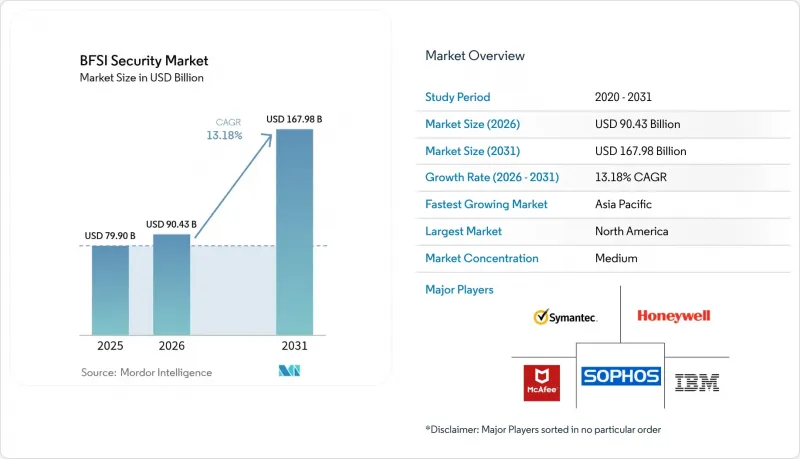
Mordor Intelligence에 따르면 BFSI 보안 시장 규모는 2025년에 799억 달러로 평가되며, 2026년 904억 3,000만 달러에서 2031년까지 1,679억 8,000만 달러에 달할 것으로 예측되며, 예측 기간(2026-2031년) 동안 CAGR은 13.18%가 될 전망입니다.
본 보고서는 보안 유형(정보 보안, 물리적 보안), 서비스 유형(시스템 통합, 유지보수, 지원), 도입 모델(온프레미스, 클라우드 기반), 업종(은행, 보험 등) 및 지역별로 분류되어 있습니다. 시장 예측은 금액(달러)으로 표시되어 있습니다.
세계 BFSI 보안 시장의 동향 및 인사이트
디지털 뱅킹 거래의 급증
전자 결제는 계속해서 수표를 대체하고 있으며, 기존의 부정 탐지 시스템으로는 실시간으로 분석할 수 없을 정도의 거래량을 끌어올리고 있습니다. 싱가포르 금융관리청은 2025년 중반을 전국적인 ‘전자 지연 결제(Electronic Deferred Payment)’ 도입 시기로 설정하고 있는 반면, 인도에서는 현재 은행에 대해 부정 탐지를 위해 AI를 활용한 행동 분석을 도입할 것을 의무화하고 있습니다. 이러한 규제로 인해 클라우드 네이티브 거래 모니터링 및 저지연 코어 뱅킹 API에 대한 투자가 가속화되고 있습니다. BFSI 보안 시장이 확대되는 가운데, 성능 저하를 초래하지 않으면서 밀리초 단위로 페이로드를 검사할 수 있는 벤더들이 선점 우위를 확보하고 있습니다. 또한, 금융 기관들은 고액 송금에 대한 위험 기반의 단계적 인증을 지원하기 위해 인증 절차를 재검토하고 있으며, 이로 인해 플랫폼의 전면적인 개편 움직임이 더욱 가속화되고 있습니다.
사이버 공격의 고도화
LockBit이 Evolve Bank and Trust를 대상으로 감행한 공격은 암호화와 데이터 탈취를 결합한 이중 위협 모델을 드러냈습니다. 한편, Minja의 메모리 주입 공격은 실험실 테스트에서 AI 챗봇을 상대로 95%의 성공률을 기록했습니다. 공격자들은 현재 대규모 언어 모델을 무기로 활용하여 피싱 스크립트를 단 몇 초 만에 정교하게 다듬고 있으며, 시그니처 기반 방어책은 점차 구식이 되어가고 있습니다. 이에 따라 금융 기관들은 행동 분석, 공격자 에뮬레이션, 그리고 자동화된 대응 조정을 우선시하고 있습니다. 이에 대응하여 BFSI(은행·금융·보험·증권) 보안 시장에서는 확장형 탐지 및 대응(XDR)과 위협 인텔리전스 강화를 결합하여, 분석가가 새로운 전술을 몇 시간이 아닌 몇 분 만에 선별할 수 있도록 하고 있습니다. 또한, 양자 해독 기술의 개념 증명 시기가 다가옴에 따라 이사회에 양자 내성 암호화 도입을 위한 초기 예산 확보를 촉구하고 있습니다.
높은 총소유비용(TCO)
전 세계적으로 볼 때, 사이버 보안 프로그램의 예산 증가율은 경제적 역풍과 ROI의 불투명성으로 인해 지출이 정체된 결과, 2021년 16%에서 2024년에는 8%로 둔화되었습니다. 중견 금융 기관은 IT 지출의 13.2%를 보안에 할당하고 있지만, 여전히 준비 태세에 미비한 점이 있다고 보고하고 있으며, 이는 수십 개에 달하는 중복된 도구에 걸친 분산 현상을 반영하고 있습니다. 도구의 난립은 라이선스 비용, 통합 작업 비용 및 SOC 인건비를 부풀려 신규 투자를 억제하고, BFSI 보안 시장의 발목을 잡고 있습니다. 트라이아지 및 사고 대응을 자동화하는 통합 플랫폼은 알림 1건당 비용을 40% 절감할 수 있지만, 전환 예산이 회계 연도 내 절감액을 초과하는 경우가 많아 투자 회수 기간이 길어지고, 구매 승인이 지연되는 원인이 되고 있습니다.
부문 분석
2025년, 정보 보안은 BFSI 보안 시장 점유율의 70.55%를 차지하며, 고객과의 상호작용 방식이 디지털 채널로 전환됨에 따라 물리적 통제를 훨씬 능가했습니다. 수요는 데이터 손실 방지, 엔드포인트 탐지 및 대응(EDR), 그리고 DORA의 규범적 테스트 조항을 충족하는 ID 거버넌스 플랫폼에 집중되어 있습니다. 정보 보안 분야의 BFSI 보안 시장 규모는 위협 중심의 침투 테스트 의무화 및 사기 분석에 AI 도입을 원동력으로 하여 2031년까지 연평균 성장률(CAGR) 16.15%로 확대될 전망입니다.
그럼에도 불구하고 물리적 및 논리적 보호 조치의 융합은 진전되고 있습니다. 지점 및 데이터센터 운영자는 생체 인증을 통한 액세스 로그를 SIEM 대시보드와 통합하여 통합된 위험 점수 산정을 실현하고 있습니다. 제로 트러스트 설계도에서는 도어 리더와 API 게이트웨이를 동등하게 취급하며, 권한을 부여하기 전에 지속적인 검증을 요구합니다. 그 결과, 상호 운용 가능한 인증 정보 관리 볼트를 제공하는 벤더들은 BFSI 보안 시장에서 점유율을 확대하고 있습니다. 또한 금융 기관들은 평균 대응 시간을 규제상 24시간 공개 기준 이하로 단축하기 위해 디셉션 그리드 및 자율적 위협 봉쇄 시스템의 시범 운영도 진행하고 있습니다.
각 은행이 조각난 아키텍처와 규제 기한으로 어려움을 겪는 가운데, 시스템 통합 전문 업체들은 2025년 매출의 40.05%를 차지했습니다. DORA나 NYDFS 요건이 하나씩 추가될 때마다 제어 라이브러리, API 후크, 감사 워크플로우를 이종 혼재 기술 스택에 매핑해야 할 필요가 발생하며, 이로 인해 통합 서비스가 BFSI 보안 시장의 중심적인 위치를 차지하고 있음이 확고해지고 있습니다. 이에 이어 매니지드 보안 서비스가 견조한 추세를 보이고 있으며, 소규모 금융 기관이 사내에서 대응할 수 없는 연중무휴 24시간 모니터링 의무를 배경으로 연평균 성장률(CAGR) 18.55%로 확대될 것으로 예측됩니다.
금융 서비스 사이버 보안 업계에서는 시간 및 자재 기반 계약보다 성과 기반 계약이 점점 더 선호되고 있습니다. 시스코의 ‘HyperShield’는 자율적인 세분화과 전문 서비스를 결합하여 취약점 수정 기간을 보장하고 있습니다. 이에 발맞춰 중견 은행들은 경보 분류 작업을 전문 SOC에 위탁함으로써 사고 처리 시간을 최대 60% 단축하고 있습니다. 각 생태계 파트너사는 감사인의 보고서 형식을 준수하는 규정 준수 대시보드를 통합하고 있으며, 이를 통해 BFSI 보안 시장의 수익 창출에서 통합 서비스가 수행하는 매우 중요한 역할이 더욱 강화되고 있습니다.
지역별 분석
북미는 NYDFS Part 500 및 CISA의 부문별 지침의 조기 도입, 그리고 규정 위반 시 며칠 이내에 벌금이 부과되는 성숙한 정보 유출 통지 제도 덕분에 2025년에 매출의 36.10%를 차지했습니다. Tier 1 은행 간의 경쟁 압력으로 인해 수년에 걸친 플랫폼 개편이 촉진되었으며, 그 영향은 현재 지역 금융 기관 및 핀테크 기업으로까지 파급되어 BFSI 보안 시장에서 이 지역의 선도적 입지를 공고히 하고 있습니다.
아시아태평양은 싱가포르의 ‘공동 책임 프레임워크’와 인도의 AI를 활용한 부정 행위 감시 의무화에 힘입어 연평균 성장률(CAGR) 14.72%로 확대되고 있습니다. 아시아태평양의 BFSI 보안 시장 규모는 이 지역을 표적으로 한 사이버 사고가 전 세계의 31%를 차지함에 따라 2026년에는 264억 달러를 돌파했습니다. commonwealth.int 현지 은행들은 규제 샌드박스 제도 하에서 클라우드 도입을 가속화하고 있는 반면, 일본과 호주는 양자 내성 시범 사업을 추진하며 성숙한 시장과의 성장 격차를 더욱 벌리고 있습니다.
유럽은 DORA, GDPR 및 NIS 2 지침을 통해 막대한 영향력을 행사하고 있습니다. 조화로운 감독 당국의 기대가 국경을 초월한 플랫폼 통합을 촉진하여 범유럽적 관리형 SOC 허브의 탄생으로 이어지고 있습니다. 유럽의 BFSI 보안 시장에서는 지속적인 제3자 위험 평가 및 지역 내 키 보관 등 공급망 전반의 복원력에 대한 공급업체 측의 입증 요구가 점점 더 높아지고 있으며, 향후 10년 동안 지출 성장세는 견조하게 유지될 전망입니다.
기타 혜택:
- 엑셀 형식의 시장 예측(ME) 시트
- 3개월간의 애널리스트 지원
자주 묻는 질문
목차
제1장 소개
제2장 조사 방법
제3장 주요 요약
제4장 시장 구도
제5장 시장 규모와 성장 예측
제6장 경쟁 구도
제7장 시장 기회와 향후 전망
KSM 26.08.25According to Mordor Intelligence, the BFSI security market size was valued at USD 79.9 billion in 2025 and estimated to grow from USD 90.43 billion in 2026 to reach USD 167.98 billion by 2031, at a CAGR of 13.18% during the forecast period (2026-2031).
This report is Segmented by Security Type (Information Security, Physical Security), Services Type (System Integration, Maintenance, Support), Deployment Model (On-Premises, Cloud-Based), Vertical (Banking, Insurance and More), and Geography. The Market Forecasts are Provided in Terms of Value (USD).
Global BFSI Security Market Trends and Insights
Surge in Digital Banking Transactions
Electronic payments continue to cannibalize cheques, driving volumes that legacy fraud-detection stacks cannot analyze in real time. Singapore's Monetary Authority has set mid-2025 for nationwide Electronic Deferred Payment roll-out, while India now obliges banks to deploy AI-powered behavioural analytics for fraud spotting. These mandates are funnelling spending toward cloud-native transaction monitoring and low-latency core-banking APIs. As the BFSI security market broadens, vendors that can inspect payloads at millisecond speed without performance drag secure a first-mover advantage. Institutions are also overhauling authentication flows to support risk-based step-up verification for high-value transfers, further accelerating platform rip-and-replace activity.
Escalating Sophistication of Cyber-Attacks
The LockBit assault on Evolve Bank and Trust laid bare the dual-threat model of encryption plus data theft, while the Minja memory injection exploit reached a 95% success rate against AI chatbots in lab tests. Attackers now weaponize large language models to refine phishing scripts in seconds, leaving signature-based controls obsolete. Financial firms therefore prioritize behavioural analytics, adversary emulation and automated response orchestration. The BFSI security market responds by bundling extended detection and response (XDR) with threat-intelligence enrichment so analysts can triage novel tactics in minutes rather than hours. Proof-of-concept quantum decryption techniques also loom, nudging boards to allocate seed budgets for quantum-resistant encryption roll-outs.
High Total Cost of Ownership
Globally, budget growth for cyber programs decelerated to 8% in 2024, down from 16% in 2021, as economic headwinds and unclear ROI stall spending. Mid-tier institutions earmark 13.2% of IT outlays for security yet still report readiness gaps, reflecting fragmentation across dozens of overlapping tools. Tool sprawl inflates licensing, integration and SOC staffing costs, suppressing net new investment and placing a drag on the BFSI security market. Consolidated platforms that automate triage and incident response can lower per-alert costs by 40%, but migration budgets often exceed in-year savings, prolonging payback windows and delaying purchase approvals.
Other drivers and restraints analyzed in the detailed report include:
- Stringent Data-Protection Regulations
- Cloud Migration of Core-Banking Platforms
- Legacy-System Integration Complexity
For complete list of drivers and restraints, kindly check the Table Of Contents.
Segment Analysis
Information Security captured 70.55% of the BFSI security market share in 2025, far outpacing physical controls as customer engagement shifts to digital channels. Demand concentrates on data-loss prevention, endpoint detection and response, and identity governance platforms that satisfy DORA's prescriptive testing clauses. The BFSI security market size for Information Security will expand at 16.15% CAGR through 2031, powered by mandatory threat-led penetration testing and AI infusion into fraud analytics.
Convergence of physical and logical safeguards is nonetheless advancing. Branch and data-center operators integrate biometric access logs with SIEM dashboards, enabling unified risk scoring. Zero-trust blueprints treat door readers and API gateways alike, requiring continuous verification before granting privileges. Vendors that supply interoperable credential management vaults therefore secure a growing slice of the BFSI security market. Institutions also pilot deception grids and autonomous threat-containment to reduce mean-time-to-respond below the regulatory 24-hour disclosure threshold.
System-integration specialists accounted for 40.05% of 2025 revenue as banks wrestled with patch-work architectures and regulatory deadlines. Every DORA or NYDFS requirement triggers mapping of control libraries, API hooks and audit workflows into heterogeneous tech stacks, solidifying integration services' place at the center of the BFSI security market. Managed Security Services follow closely, forecast to climb 18.55% CAGR on the back of 24/7 monitoring mandates that smaller lenders cannot staff internally.
The financial services cybersecurity industry increasingly favors outcome-based contracts over time-and-materials engagements. Cisco's HyperShield release bundles autonomous segmentation with professional services, offering guaranteed vulnerability remediation windows. In response, mid-market banks outsource alert triage to specialised SOCs, cutting incident dwell times by up to 60%. Ecosystem partners embed compliance dashboards that align with auditors' report formats, reinforcing integration services' pivotal role in capitalization of the BFSI security market.
Complete Report Scope:
- By Security Type
- Information Security
- Physical Security
- By Service Type
- System Integration
- Maintenance
- Support
- By Deployment Model
- On-premises
- Cloud-based
- By Vertical
- Banking
- Insurance
- Other Financial Institutions
- By Geography
- North America
- United States
- Canada
- Mexico
- South America
- Brazil
- Argentina
- Rest of South America
- Europe
- Germany
- United Kingdom
- France
- Spain
- Italy
- Rest of Europe
- Asia-Pacific
- China
- Japan
- South Korea
- India
- Australia and New Zealand
- Rest of Asia-Pacific
- Middle East
- Israel
- Saudi Arabia
- United Arab Emirates
- Turkey
- Rest of Middle East
- Africa
- South Africa
- Egypt
- Nigeria
- Rest of Africa
- North America
Geography Analysis
North America commanded 36.10% of revenue in 2025 thanks to early adoption of NYDFS Part 500, CISA sector directives and a mature breach-notification regime that fines non-compliance within days. Competitive pressure among Tier-1 banks spurred multiyear platform refreshes that now trickle down to regional lenders and fintechs, solidifying the region's leadership in the BFSI security market.
Asia-Pacific is expanding at a 14.72% CAGR, propelled by Singapore's Shared Responsibility Framework and India's AI-based fraud monitoring mandates. The BFSI security market size for Asia-Pacific grew past USD 26.4 billion in 2026, spurred by 31% of global cyber incidents targeting the region commonwealth.int. Local banks accelerate cloud adoption under regulatory sandbox regimes, while Japan and Australia push quantum-safe pilots, further widening growth differentials versus mature markets.
Europe holds significant weight via DORA, GDPR and the NIS 2 Directive. Harmonized supervisory expectations drive cross-border platform consolidation, giving rise to pan-European managed SOC hubs. The BFSI security market in Europe increasingly demands vendor evidence of full supply-chain resilience, including continuous third-party risk scoring and in-region key custody, keeping spending momentum steady through the decade.
- International Business Machines Corporation
- Cisco Systems, Inc.
- Symantec
- Sophos Group plc
- McAfee LLC
- Honeywell International Inc.
- Dell Technologies Inc. (EMC)
- DXC Technology Company
- Trend Micro Incorporated
- Booz Allen Hamilton Holding Corporation
- Palo Alto Networks, Inc.
- Fortinet, Inc.
- Check Point Software Technologies Ltd.
- Mandiant Corporation (Orange Cyberdefense)
- Okta, Inc.
- Darktrace plc
- Rapid7, Inc.
- Proofpoint, Inc.
- Splunk Inc.
- Imperva, Inc.
Additional Benefits:
- The market estimate (ME) sheet in Excel format
- 3 months of analyst support
TABLE OF CONTENTS
1 INTRODUCTION
- 1.1 Study Assumptions and Market Definition
- 1.2 Scope of the Study
2 RESEARCH METHODOLOGY
3 EXECUTIVE SUMMARY
4 MARKET LANDSCAPE
- 4.1 Market Overview
- 4.2 Market Drivers
- 4.2.1 Surge in digital banking transactions
- 4.2.2 Escalating sophistication of cyber-attacks
- 4.2.3 Stringent data-protection regulations
- 4.2.4 Cloud migration of core-banking platforms
- 4.2.5 AI-driven fraud-prevention adoption
- 4.2.6 Open-banking APIs expanding attack surface
- 4.3 Market Restraints
- 4.3.1 High total cost of ownership
- 4.3.2 Legacy-system integration complexity
- 4.3.3 Cyber-security talent shortage
- 4.3.4 Cross-border data-residency ambiguity
- 4.4 Regulatory Landscape
- 4.5 Technological Outlook
- 4.6 Porter's Five Forces Analysis
- 4.6.1 Threat of New Entrants
- 4.6.2 Bargaining Power of Buyers
- 4.6.3 Bargaining Power of Suppliers
- 4.6.4 Threat of Substitutes
- 4.6.5 Intensity of Competitive Rivalry
- 4.7 Investment Analysis
5 MARKET SIZE AND GROWTH FORECASTS (VALUE)
- 5.1 By Security Type
- 5.1.1 Information Security
- 5.1.2 Physical Security
- 5.2 By Service Type
- 5.2.1 System Integration
- 5.2.2 Maintenance
- 5.2.3 Support
- 5.3 By Deployment Model
- 5.3.1 On-premises
- 5.3.2 Cloud-based
- 5.4 By Vertical
- 5.4.1 Banking
- 5.4.2 Insurance
- 5.4.3 Other Financial Institutions
- 5.5 By Geography
- 5.5.1 North America
- 5.5.1.1 United States
- 5.5.1.2 Canada
- 5.5.1.3 Mexico
- 5.5.2 South America
- 5.5.2.1 Brazil
- 5.5.2.2 Argentina
- 5.5.2.3 Rest of South America
- 5.5.3 Europe
- 5.5.3.1 Germany
- 5.5.3.2 United Kingdom
- 5.5.3.3 France
- 5.5.3.4 Spain
- 5.5.3.5 Italy
- 5.5.3.6 Rest of Europe
- 5.5.4 Asia-Pacific
- 5.5.4.1 China
- 5.5.4.2 Japan
- 5.5.4.3 South Korea
- 5.5.4.4 India
- 5.5.4.5 Australia and New Zealand
- 5.5.4.6 Rest of Asia-Pacific
- 5.5.5 Middle East
- 5.5.5.1 Israel
- 5.5.5.2 Saudi Arabia
- 5.5.5.3 United Arab Emirates
- 5.5.5.4 Turkey
- 5.5.5.5 Rest of Middle East
- 5.5.6 Africa
- 5.5.6.1 South Africa
- 5.5.6.2 Egypt
- 5.5.6.3 Nigeria
- 5.5.6.4 Rest of Africa
- 5.5.1 North America
6 COMPETITIVE LANDSCAPE
- 6.1 Market Concentration
- 6.2 Strategic Moves
- 6.3 Market Share Analysis
- 6.4 Company Profiles (includes Global-level Overview, Market-level Overview, Core Segments, Financials as available, Strategic Information, Market Rank/Share for key companies, Products and Services, and Recent Developments)
- 6.4.1 International Business Machines Corporation
- 6.4.2 Cisco Systems, Inc.
- 6.4.3 Symantec
- 6.4.4 Sophos Group plc
- 6.4.5 McAfee LLC
- 6.4.6 Honeywell International Inc.
- 6.4.7 Dell Technologies Inc. (EMC)
- 6.4.8 DXC Technology Company
- 6.4.9 Trend Micro Incorporated
- 6.4.10 Booz Allen Hamilton Holding Corporation
- 6.4.11 Palo Alto Networks, Inc.
- 6.4.12 Fortinet, Inc.
- 6.4.13 Check Point Software Technologies Ltd.
- 6.4.14 Mandiant Corporation (Orange Cyberdefense)
- 6.4.15 Okta, Inc.
- 6.4.16 Darktrace plc
- 6.4.17 Rapid7, Inc.
- 6.4.18 Proofpoint, Inc.
- 6.4.19 Splunk Inc.
- 6.4.20 Imperva, Inc.
7 MARKET OPPORTUNITIES AND FUTURE OUTLOOK
- 7.1 White-space and Unmet-Need Assessment


