

|
시장보고서
상품코드
2099966
BFSI 분야 양자 컴퓨팅 수직 용도 시장 : 시장 점유율 분석, 업계 동향 및 통계, 성장 예측(2026-2031년)Quantum Computing Vertical Applications BFSI - Market Share Analysis, Industry Trends & Statistics, Growth Forecasts (2026 - 2031) |
||||||
 Mordor Intelligence
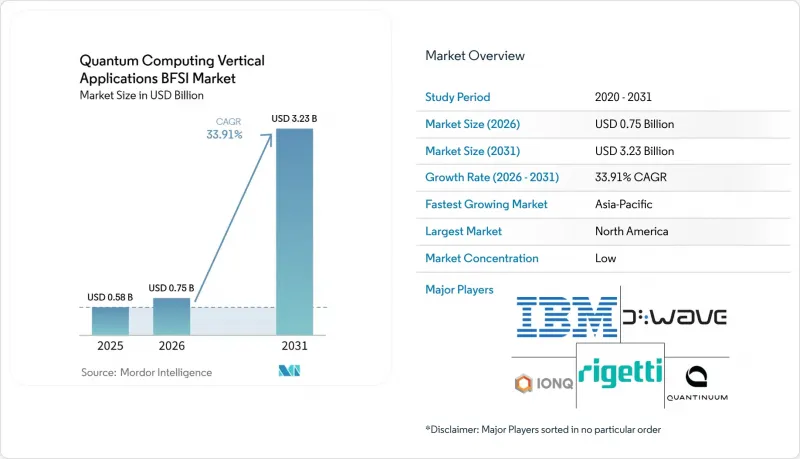
BFSI 분야 양자 컴퓨팅 수직 용도 시장 규모는 2025년에 5억 8,000만 달러로 평가되었고, 2026-2031년 CAGR 33.91%로 확대될 것으로 추정되며, 2031년에는 32억 3,000만 달러에 이를 것으로 예측됩니다.
본 보고서는 솔루션별(소프트웨어 및 서비스), 도입 형태별(클라우드 기반, 하이브리드형, 온프레미스형), 양자 컴퓨팅 패러다임별(게이트형 양자 컴퓨팅, 양자 어닐링 등), 용도별(포트폴리오 및 자산 운용 등), 최종 사용자별(은행, 보험 등), 그리고 지역별로 분류되어 있습니다. 시장 전망은 금액(달러) 기준으로 제시되어 있습니다.
세계의 BFSI 분야 양자 컴퓨팅 수직 용도 시장 동향 및 인사이트
양자 리스크 모델링 및 포트폴리오 최적화에 대한 수요 급증
금융 기관은 다중 요인 포트폴리오에 걸친 대규모 몬테카를로 시뮬레이션을 실행할 때 여전히 긴 계산 주기에 직면하고 있으며, 이로 인해 리스크 분석은 기업 내 양자 컴퓨팅 수요의 최전선에 계속 자리 잡고 있습니다. ESMA는 2026년 5월, 양자 몬테카를로 통합을 통해 금융 워크로드에서 기존 기법에 비해 이론적으로 제곱의 속도 향상을 얻을 수 있다고 밝혔으며, 이로 인해 하드웨어가 완전히 성숙하기 전이라도 이 이용 사례는 상업적으로 의미 있는 것이 되었습니다. 크레디 아그리콜 CIB와 Pasqal은 2026년 6월, 자본 시장용 용도 및 위험 가중 자산 모니터링에 초점을 맞춘 상용화 로드맵을 수립하고 파트너십을 강화했습니다. 이는 양자 컴퓨팅의 수직형 용도 분야에서 BFSI 시장이 일부 금융 기관의 고립된 기술 시험 단계를 넘어서는 중임을 보여줍니다. 또한 각 은행은 더 우수한 최적화와 시나리오 모델링이 동일한 운영 프레임워크 내에서 가격 책정의 질, 자본 효율성 및 응답 시간에 영향을 미칠 수 있음을 인식하고 있습니다. 이로 인해 지금 당장 사내 알고리즘에 대한 전문 지식을 축적해야 할 실질적인 동기가 생겨났습니다. 왜냐하면 조기에 학습한 금융 기관은 실제 운영 수준의 시스템 신뢰성이 높아졌을 때 더 유리한 입장에 설 수 있기 때문입니다.
금융 네트워크에서 포스트 양자암호에 대한 대응 준비의 필요성 증가
금융 기관에는 현재 공식적인 기준과 보다 명확한 전환 지침이 마련되어 있으므로, 포스트 양자암호화는 조사 주제에서 인프라 계획상의 과제로 전환되었습니다. NIST는 2024년 8월에 ML-KEM, ML-DSA 및 SLH-DSA를 최종 확정하고, 은행 및 결제 사업자에게 막연한 기술적 목표가 아닌 전환 작업을 위한 구체적인 기준을 제공했습니다. G7 사이버 전문가 그룹은 2026년 1월, 이러한 방향성을 한층 더 강화하여, 우선순위가 높은 시스템에 대해서는 2030년부터 2032년까지를 중요한 기한으로, 전환의 보다 광범위한 최종 기한으로 2035년을 제시한 협력적 로드맵을 발표했습니다. 이러한 시급성은 겉으로 보이는 것보다 훨씬 심각합니다. ‘지금 수집하고 나중에 복호화한다’는 위험성 때문에 오늘날 수집된 기밀성이 높은 금융 데이터는 성숙한 공격 능력이 전개되기 훨씬 전부터 취약한 상태로 남아 있을 가능성이 있기 때문입니다. 양자 컴퓨팅의 수직 통합형 용도인 BFSI 시장에서 이러한 압박으로 인해 많은 금융 기관들이 당초 계획했던 것보다 더 빨리 보안 예산, 네트워크 재검토 및 조달 일정을 ‘암호 애자일(crypto-agile)’ 아키텍처로 전환할 수밖에 없게 되었습니다.
금융 업무 워크로드를 처리할 수 있는 내결함성 양자 시스템은 존재하지 않습니다.
BFSI 분야 양자 컴퓨팅 수직 용도 시장에 있어 단기적으로 가장 큰 걸림돌은 고객의 인식이 아니라 하드웨어의 준비 상태입니다. ESMA는 2026년 5월, 실제 업계 규모의 금융 문제를 해결하기에는 현재 양자 하드웨어의 능력이 여전히 제한적이라고 지적했습니다. 이 때문에 대부분의 금융 기관은 위험이 높은 실제 운영 환경에서 양자 컴퓨팅의 성과를 활용하는 것을 주저하고 있습니다. 그 결과, 은행들은 많은 양자 계산 결과를 기존 방법과 대조하여 검증해야 하는 자문적·실험적 또는 실제 도입 전 자료로 계속 취급하고 있습니다. 이러한 추가적인 검증 절차는 애초에 양자 기술 도입을 매력적으로 만드는 속도와 효율성 향상을 약화시킵니다. 오류 정정 시스템이 금융 워크로드에 대해 보다 실용적으로 활용될 수 있게 될 때까지는 수요의 대부분이 대규모 배포라기보다는 파일럿 프로젝트, 샌드박스 및 통제된 연구 프로젝트 수준에 머물 것으로 보입니다.
부문 분석
2025년에는 소프트웨어가 매출의 68.42%를 차지했으며, BFSI 분야 양자 컴퓨팅 수직 용도(은행 및 금융 및 보험) 시장에서 가장 큰 솔루션 부문이 되었습니다. 이러한 우위는 대부분의 금융 기관이 하드웨어를 직접 소유하기보다는 개발 키트, 시뮬레이션 도구, 클라우드 인터페이스 및 용도 프로그래밍 계층을 통해 양자 기능을 활용하고 있는 현실을 반영합니다. 또한, 이러한 지출 패턴은 구매자들이 보다 전문적인 인프라 결정을 내리기 전에 모델링, 테스트 및 워크플로우 통합을 위한 실용적인 환경을 원하고 있음을 보여줍니다. 서비스 부문은 2031년까지 연평균 성장률(CAGR) 36.84%로 확대될 것으로 예상되며, 이는 관리형 파일럿, 용도 튜닝, 마이그레이션 작업 및 도입 지원에 대한 수요가 증가하고 있음을 보여줍니다. 양자 컴퓨팅의 수직적 용도 분야에서 BFSI 시장의 현재 단계에서는 소프트웨어가 기존 기업의 구매 패턴에 자연스럽게 부합하기 때문에 여전히 진입하기 가장 쉬운 상업적 진입로입니다.
수요의 두 번째 계층은 실행 지원을 중심으로 형성되고 있습니다. 이는 각 기관이 단편적인 시연이 아닌, 양자 기법을 실제 비즈니스 프로세스에 연계하기 위한 지원을 필요로 하기 때문입니다. 평가, 최적화, 사기 분석 및 암호화 전환 작업을 위한 재사용 가능한 라이브러리를 보유한 벤더는 맞춤형 자문 서비스에만 의존하는 기업보다 더 효과적으로 사업을 확장할 수 있습니다. 이것이 바로 양자 컴퓨팅의 수직적 응용 분야에서 BFSI 업계가 도구에 도메인 지식, 통합 기능을 단일 솔루션으로 결합한 공급업체를 높이 평가하는 이유 중 하나입니다. 파스칼(Pasqal)이 크레디 아그리콜 CIB와 진행한 상세한 협력 사례는 금융 업계 고객들이 기술적 탐색 단계부터 체계적인 도입 계획에 이르기까지 지속적으로 관여할 수 있도록 지원하는 공급업체를 높이 평가하는 이유를 보여줍니다.
2025년에는 클라우드 기반 도입이 매출의 71.26%를 차지한 것으로 평가되었으며, 이는 양자 컴퓨팅의 수직적 용도 분야에서 BFSI 시장이 여전히 원격 액세스 모델에 크게 의존하고 있음을 보여줍니다. 이러한 구조는 초기 자본 투자를 제한하면서도 조사 단계의 작업에서 유연성을 유지할 수 있기 때문에 규제 대상 금융 기관에 적합합니다. 또한 온프레미스에서 전문적인 양자 인프라를 소유, 운영, 유지 관리할 준비가 된 기업이 극히 적다는 현실도 반영하고 있습니다. 사용자들이 양자 도구를 기존 분석, 데이터 파이프라인 및 기업 통제와 보다 직접적으로 연동하기 시작함에 따라, 하이브리드 배포는 2031년까지 연평균 성장률(CAGR) 35.19%로 확대될 것으로 예측됩니다. 그 결과, 접근 편의성이 현재의 규모를 뒷받침하고, 통합의 깊이가 미래의 차별화를 형성하는 시장이 조성될 것입니다.
하이브리드 모델이 탄력을 받고 있는 이유는 순수한 양자 환경보다 금융 기관의 운영 논리에 더 부합하기 때문입니다. 은행 및 기타 사용자는 기밀성이 높은 거버넌스 절차, 검증 루틴, 장애 복구 로직을 기존 시스템 내에 유지하면서 특정 계산 작업을 양자 구성 요소에 처리하도록 할 수 있습니다. 이를 통해 기술적 실험을 수행할 때 기존 아키텍처를 전면적으로 재구축할 필요가 없어지므로, 양자 컴퓨팅의 수직형 용도 분야에서 BFSI 시장 전반에 걸친 조직적 마찰이 완화됩니다. 온프레미스 도입은 비용이나 유연성보다는 통제, 주권 또는 인프라 관련 정책이 우선시되는 경우로 계속 제한될 것입니다.
지역별 분석
2025년, 북미는 매출의 36.41%를 차지했으며, BFSI 분야 양자 컴퓨팅 수직 용도 시장에서 가장 규모가 큰 지역 점유율을 기록했습니다. 이 지역은 Tier 1 은행, 결제 사업자, 자본 시장 기업 및 기업들과 확고한 관계를 구축하고 있는 양자 벤더들이 밀집해 있다는 이점이 있습니다. 또한, 미국은 암호화 기술 준비 태세 면에서도 뚜렷한 우위를 점하고 있습니다. NIST가 2024년 8월 최초의 포스트 양자암호화 표준을 제정함에 따라, 금융 기관들은 전환 계획을 위한 공식적인 기술적 근거를 확보할 수 있게 되었습니다. 이러한 표준 제정의 역할은 양자 컴퓨팅의 수직적 응용 분야 내 BFSI 시장에서 보안, 인프라 재검토 및 시범 사업에 걸친 조기 조달 활동을 촉진하고 있습니다. 남미는 여전히 규모가 훨씬 작지만, 클라우드 기반 제공 및 서비스 주도형 도입을 통해 양자 기술에 대한 제한적인 도입을 목표로 하는 금융 기관의 진입 장벽이 낮아지고 있어, 이 지역은 여전히 중요한 위치를 차지하고 있습니다.
유럽은 양자 컴퓨팅의 수직적 용도 분야 내 BFSI 시장에서 중요한 두 번째 수요 거점으로 부상하고 있으며, 특히 영국, 독일, 프랑스, 스페인이 활발한 시장으로 두각을 나타내고 있습니다. ESMA는 DORA 및 NIS 2의 틀에 따라 양자 관련 암호화 취약성 대응 계획이 유럽 금융 기관들에게 더욱 체계적인 규정 준수 과제로 자리 잡고 있음을 강조했습니다. 이는 중요한 점입니다. 규제 시기가 명확하기 때문에 도입이 자발적인 실험에만 의존하는 시장에 비해 공급업체 입장에서 수요 전망이 더 명확해지기 때문입니다. 또한, 에르스테 그룹이 2026년 2월 비엔나의 기존 은행용 광섬유 인프라에 양자 키 배분(QKD)을 통합한 사례는 유럽이 소프트웨어 주도의 시범 사업뿐만 아니라 물리적 네트워크 보안의 활용 사례도 시험하고 있음을 보여줍니다.
아시아태평양은 2031년까지 연평균 성장률(CAGR) 36.92%로 확대될 것으로 예측되며, BFSI 분야 양자 컴퓨팅 수직 용도 시장에서 가장 빠르게 성장하는 지역 부문이 될 전망입니다. 공적 자금, 대규모 국가 기술 프로그램, 기관의 연구 활동, 그리고 은행 및 금융 인프라 사업자들의 관심 증대가 이러한 성장을 뒷받침하고 있습니다. 2026년 1월 후지쯔와 SC 벤처스가 발표한 Qubitra Technologies의 로드맵은 해당 지역이 단순히 하드웨어의 성숙을 기다리는 데 그치지 않고, 사기 감지 및 거래 이용 사례를 위한 용도 주도형 로드맵을 어떻게 구축하고 있는지를 보여줍니다. 중동 및 아프리카는 절대적인 규모 면에서는 여전히 작지만, 이 지역의 정부 주도 프로그램과 금융 기관들은 파생상품 가격 책정 및 결제 보안을 초기 진입점으로 모색하기 시작했습니다.
기타 혜택 :
- 엑셀 형식 시장 예측(ME) 시트
- 3개월간의 애널리스트 지원
자주 묻는 질문
목차
제1장 서론
제2장 조사 방법
제3장 주요 요약
제4장 시장 구도
제5장 시장 규모 및 성장 예측
제6장 경쟁 구도
제7장 시장 기회 및 향후 전망
AJY 26.08.11According to Mordor Intelligence, the quantum computing vertical applications BFSI market size was USD 0.58 billion in 2025 and is forecast to reach USD 3.23 billion by 2031 at a CAGR of 33.91% from 2026 to 2031.
This report is Segmented by Solution (Software and Services), Deployment (Cloud-Based, Hybrid, and On-Premises), Quantum Computing Paradigm (Gate-Based Quantum Computing, Quantum Annealing, and More), Application (Portfolio and Wealth Management, and More), End-User (Banking, Insurance, and More), and Geography. The Market Forecasts are Provided in Terms of Value (USD).
Global Quantum Computing Vertical Applications BFSI Market Trends and Insights
Surging Demand for Quantum Risk Modeling and Portfolio Optimization
Financial institutions continue to face long compute cycles when running large Monte Carlo simulations across multi-factor portfolios, which keeps risk analytics at the forefront of enterprise quantum demand. ESMA stated in May 2026 that quantum Monte Carlo integration offers a theoretical quadratic speedup over classical approaches for financial workloads, which keeps the use case commercially relevant even before full hardware maturity arrives. Credit Agricole CIB and Pasqal advanced their partnership in June 2026 with a production roadmap focused on capital markets applications and risk-weighted asset monitoring, which shows that the quantum computing vertical applications BFSI market is moving beyond isolated technical tests in selected institutions. Banks also recognize that better optimization and scenario modeling can influence pricing quality, capital efficiency, and response times within the same operating framework. This creates a practical incentive to build internal algorithm knowledge now, because institutions that learn earlier will be better placed when production-grade systems become more dependable.
Rising Need for Post-Quantum Cryptography Readiness in Financial Networks
Post-quantum cryptography has moved from a research topic to an infrastructure planning issue, as financial institutions now have formal standards and clearer migration guidance. NIST finalized ML-KEM, ML-DSA, and SLH-DSA in August 2024, giving banks and payment operators a concrete baseline for transition work rather than a loose technical target. The G7 Cyber Expert Group reinforced this direction in January 2026 with a coordinated roadmap that pointed to 2030-2032 as a critical deadline window for high-priority systems and 2035 as the broader endpoint for migration. The urgency is stronger than it appears because harvest-now-decrypt-later exposure means sensitive financial data captured today can remain vulnerable long before a mature attack capability is deployed. In the quantum computing vertical applications BFSI market, that pressure is pushing security budgets, network reviews, and procurement calendars toward crypto-agile architectures earlier than many institutions had originally planned.
No Fault-Tolerant Quantum Systems for Production Finance Workloads
The biggest near-term brake on the quantum computing vertical applications BFSI market is hardware readiness, not customer awareness. ESMA noted in May 2026 that current quantum hardware capabilities are still limited for real-world, industry-scale financial problems, which keeps most institutions from using quantum outputs in high-stakes production environments. Banks, therefore, continue to treat many quantum results as advisory, experimental, or pre-production material that must be checked against classical methods. Those extra validation steps weaken the speed and efficiency gains that make quantum adoption attractive in the first place. Until error-corrected systems become more practical for financial workloads, a large part of demand will remain tied to pilots, sandboxes, and controlled research engagements rather than scaled deployment.
Other drivers and restraints analyzed in the detailed report include:
- Growing Bank Adoption of Hybrid Quantum-Classical Workflows
- Public-Private Funding for Financial-Grade Quantum Pilots
- Model Validation Risk for Quantum-Derived Financial Outputs
For complete list of drivers and restraints, kindly check the Table Of Contents.
Segment Analysis
Software accounted for 68.42% of revenue in 2025, making it the largest solution segment in the quantum computing vertical applications BFSI market. This lead reflects how most financial institutions access quantum capabilities through development kits, simulation tools, cloud interfaces, and application programming layers rather than through direct hardware ownership. The spending pattern also shows that buyers want usable environments for modeling, testing, and workflow integration before they commit to more specialized infrastructure decisions. Services are projected to expand at a 36.84% CAGR through 2031, indicating rising demand for managed pilots, application tuning, migration work, and implementation support. In the current phase of the quantum computing vertical applications BFSI market, software remains the easiest commercial entry point because it fits more naturally into established enterprise buying patterns.
The second layer of demand is forming around execution support, since institutions need help connecting quantum methods to real business processes rather than isolated demonstrations. Vendors with reusable libraries for valuation, optimization, fraud analytics, and cryptographic transition work can scale more effectively than firms that depend only on bespoke advisory assignments. This is one reason the quantum computing vertical applications BFSI industry is rewarding providers that combine tools, domain knowledge, and integration capabilities in a single offering. Pasqal's deeper work with Credit Agricole CIB shows why financial clients value suppliers that can stay engaged from technical exploration into structured delivery planning.
Cloud-based deployment captured 71.26% of revenue in 2025, which shows that the quantum computing vertical applications BFSI market still depends heavily on remote access models. This structure suits regulated institutions because it limits upfront capital commitments while preserving flexibility for research-stage work. It also reflects the reality that very few firms are prepared to own, operate, and maintain specialized quantum infrastructure on premises. Hybrid deployment is projected to expand at 35.19% CAGR through 2031 as users begin to connect quantum tools more directly with classical analytics, data pipelines, and enterprise controls. The result is a market where access convenience supports current scale, while integration depth shapes future differentiation.
The hybrid model is gaining ground because it better aligns with the operating logic of financial institutions than a pure quantum environment does. Banks and other users can keep sensitive governance steps, validation routines, and failover logic inside classical systems while allowing quantum components to handle selected compute tasks. This lowers organizational friction across the quantum computing vertical applications BFSI market because technical experimentation does not require a full rewrite of existing architecture. On-premises deployment will remain limited to cases where control, sovereignty, or infrastructure policy outweighs cost and flexibility.
Complete Report Scope:
- By Solution
- Software
- Services
- By Deployment
- Cloud-Based
- Hybrid
- On-Premises
- By Quantum Computing Paradigm
- Gate-Based Quantum Computing
- Quantum Annealing
- Hybrid Quantum-Classical Computing
- By Application
- Portfolio and Wealth Management
- Risk Management and Scenario Analysis
- Fraud Detection and Financial Crime Prevention
- Algorithmic and High-Frequency Trading
- Derivatives Pricing
- Credit Scoring and Loan Assessment
- Cybersecurity and Post-Quantum Cryptography
- Customer Analytics and Personalization
- Other Applications
- By End-User
- Banking
- Insurance
- Capital Markets and Investment Firms
- FinTech
- Payment and Digital Financial Services
- By Geography
- North America
- United States
- Canada
- Mexico
- South America
- Brazil
- Argentina
- Rest of South America
- Europe
- Germany
- United Kingdom
- France
- Russia
- Spain
- Rest of Europe
- Asia-Pacific
- China
- Japan
- India
- South Korea
- Southeast Asia
- Rest of Asia-Pacific
- Middle East and Africa
- Middle East
- Saudi Arabia
- United Arab Emirates
- Turkey
- Rest of Middle East
- Africa
- South Africa
- Nigeria
- Egypt
- Rest of Africa
- Middle East
- North America
Geography Analysis
North America accounted for 36.41% of revenue in 2025, giving it the largest regional position in the quantum computing vertical applications BFSI market. The region benefits from a dense concentration of Tier-1 banks, payment operators, capital markets firms, and quantum vendors with established enterprise relationships. The United States also has a clear advantage in cryptographic preparedness, as NIST finalized the first post-quantum cryptography standards in August 2024, providing financial institutions with a formal technical basis for migration planning. That standard-setting role supports earlier procurement activity across security, infrastructure review, and pilot work in the quantum computing vertical applications BFSI market. South America remains much smaller in scale, but the region is still relevant as cloud delivery and service-led adoption lower the barriers for financial firms seeking selective quantum exposure.
Europe forms a substantial secondary demand center in the quantum computing vertical applications BFSI market, with the United Kingdom, Germany, France, and Spain standing out as active markets. ESMA highlighted that DORA and the NIS 2 framework are turning quantum-related cryptographic vulnerability planning into a more structured compliance issue for European financial entities. That matters because regulatory timing gives vendors a clearer demand path than in markets where adoption depends only on voluntary experimentation. Erste Group's February 2026 integration of entangled quantum key distribution into existing banking fiber infrastructure in Vienna also shows that Europe is testing physical network security use cases, not only software-led pilots.
Asia-Pacific is projected to expand at 36.92% CAGR through 2031, making it the fastest-growing regional segment in the quantum computing vertical applications BFSI market. Public funding, large national technology programs, institutional research activity, and rising interest from banks and financial infrastructure players are supporting growth. The roadmap for Qubitra Technologies, announced by Fujitsu and SC Ventures in January 2026, shows how the region is building application-led pathways into fraud detection and trading use cases rather than waiting only for hardware maturity. The Middle East and Africa remain smaller in absolute terms, but sovereign programs and financial institutions in the region are beginning to explore derivatives pricing and payments security as early entry points.
- International Business Machines Corporation
- D-Wave Quantum Inc.
- IonQ, Inc.
- Rigetti Computing, Inc.
- Quantinuum Ltd.
- Xanadu Quantum Technologies Inc.
- Pasqal SAS
- IQM Quantum Computers Oy
- Oxford Quantum Circuits Ltd.
- Alice and Bob SAS
- Alpine Quantum Technologies GmbH
- QuEra Computing Inc.
- Quantum Computing Inc.
- Infleqtion, Inc.
- SEEQC, Inc.
- Quix Quantum B.V.
- Origin Quantum Computing Technology Co., Ltd.
- Shenzhen SpinQ Technology Co., Ltd.
- Anyon Systems Inc.
- Riverlane Ltd.
- Google LLC
- Cambridge Quantum Computing Ltd.
- Intel Corporation
- Fujitsu Limited
- Honeywell International Inc.
Additional Benefits:
- The market estimate (ME) sheet in Excel format
- 3 months of analyst support
TABLE OF CONTENTS
1 INTRODUCTION
- 1.1 Study Assumptions and Market Definition
- 1.2 Scope of the Study
2 RESEARCH METHODOLOGY
3 EXECUTIVE SUMMARY
4 MARKET LANDSCAPE
- 4.1 Market Overview
- 4.2 Market Drivers
- 4.2.1 Surging Demand for Quantum Risk Modeling and Portfolio Optimization
- 4.2.2 Rising Need for Post-Quantum Cryptography Readiness in Financial Networks
- 4.2.3 Growing Bank Adoption of Hybrid Quantum-Classical Workflows
- 4.2.4 Public-Private Funding for Financial-Grade Quantum Pilots
- 4.2.5 Quantum-As-A-Service Lowering Entry Barriers for Mid-Tier BFSI Firms
- 4.2.6 Regulatory Pressure to Modernize Cryptographic Infrastructure
- 4.3 Market Restraints
- 4.3.1 No Fault-Tolerant Quantum Systems for Production Finance Workloads
- 4.3.2 Model Validation Risk for Quantum-Derived Financial Outputs
- 4.3.3 Specialized Talent Shortage in Quantum Finance Stack Integration
- 4.3.4 Long PQC Migration Cycles can Delay Procurement Decisions
- 4.4 Impact of Macroeconomic Factors on the Market
- 4.5 Industry Value Chain Analysis
- 4.6 Technology Outlook
- 4.7 Regulatory Landscape
- 4.8 Porter's Five Forces Analysis
- 4.8.1 Threat of New Entrants
- 4.8.2 Bargaining Power of Suppliers
- 4.8.3 Bargaining Power of Buyers
- 4.8.4 Threat of Substitutes
- 4.8.5 Intensity of Competitive Rivalry
5 MARKET SIZE AND GROWTH FORECASTS (VALUE)
- 5.1 By Solution
- 5.1.1 Software
- 5.1.2 Services
- 5.2 By Deployment
- 5.2.1 Cloud-Based
- 5.2.2 Hybrid
- 5.2.3 On-Premises
- 5.3 By Quantum Computing Paradigm
- 5.3.1 Gate-Based Quantum Computing
- 5.3.2 Quantum Annealing
- 5.3.3 Hybrid Quantum-Classical Computing
- 5.4 By Application
- 5.4.1 Portfolio and Wealth Management
- 5.4.2 Risk Management and Scenario Analysis
- 5.4.3 Fraud Detection and Financial Crime Prevention
- 5.4.4 Algorithmic and High-Frequency Trading
- 5.4.5 Derivatives Pricing
- 5.4.6 Credit Scoring and Loan Assessment
- 5.4.7 Cybersecurity and Post-Quantum Cryptography
- 5.4.8 Customer Analytics and Personalization
- 5.4.9 Other Applications
- 5.5 By End-User
- 5.5.1 Banking
- 5.5.2 Insurance
- 5.5.3 Capital Markets and Investment Firms
- 5.5.4 FinTech
- 5.5.5 Payment and Digital Financial Services
- 5.6 By Geography
- 5.6.1 North America
- 5.6.1.1 United States
- 5.6.1.2 Canada
- 5.6.1.3 Mexico
- 5.6.2 South America
- 5.6.2.1 Brazil
- 5.6.2.2 Argentina
- 5.6.2.3 Rest of South America
- 5.6.3 Europe
- 5.6.3.1 Germany
- 5.6.3.2 United Kingdom
- 5.6.3.3 France
- 5.6.3.4 Russia
- 5.6.3.5 Spain
- 5.6.3.6 Rest of Europe
- 5.6.4 Asia-Pacific
- 5.6.4.1 China
- 5.6.4.2 Japan
- 5.6.4.3 India
- 5.6.4.4 South Korea
- 5.6.4.5 Southeast Asia
- 5.6.4.6 Rest of Asia-Pacific
- 5.6.5 Middle East and Africa
- 5.6.5.1 Middle East
- 5.6.5.1.1 Saudi Arabia
- 5.6.5.1.2 United Arab Emirates
- 5.6.5.1.3 Turkey
- 5.6.5.1.4 Rest of Middle East
- 5.6.5.2 Africa
- 5.6.5.2.1 South Africa
- 5.6.5.2.2 Nigeria
- 5.6.5.2.3 Egypt
- 5.6.5.2.4 Rest of Africa
- 5.6.5.1 Middle East
- 5.6.1 North America
6 COMPETITIVE LANDSCAPE
- 6.1 Market Concentration
- 6.2 Strategic Moves
- 6.3 Market Share Analysis
- 6.4 Company Profiles (includes Global Level Overview, Market Level Overview, Core Segments, Financials as available, Strategic Information, Market Rank/Share, Products and Services, Recent Developments)
- 6.4.1 International Business Machines Corporation
- 6.4.2 D-Wave Quantum Inc.
- 6.4.3 IonQ, Inc.
- 6.4.4 Rigetti Computing, Inc.
- 6.4.5 Quantinuum Ltd.
- 6.4.6 Xanadu Quantum Technologies Inc.
- 6.4.7 Pasqal SAS
- 6.4.8 IQM Quantum Computers Oy
- 6.4.9 Oxford Quantum Circuits Ltd.
- 6.4.10 Alice and Bob SAS
- 6.4.11 Alpine Quantum Technologies GmbH
- 6.4.12 QuEra Computing Inc.
- 6.4.13 Quantum Computing Inc.
- 6.4.14 Infleqtion, Inc.
- 6.4.15 SEEQC, Inc.
- 6.4.16 Quix Quantum B.V.
- 6.4.17 Origin Quantum Computing Technology Co., Ltd.
- 6.4.18 Shenzhen SpinQ Technology Co., Ltd.
- 6.4.19 Anyon Systems Inc.
- 6.4.20 Riverlane Ltd.
- 6.4.21 Google LLC
- 6.4.22 Cambridge Quantum Computing Ltd.
- 6.4.23 Intel Corporation
- 6.4.24 Fujitsu Limited
- 6.4.25 Honeywell International Inc.
7 MARKET OPPORTUNITIES AND FUTURE OUTLOOK
- 7.1 White-Space and Unmet-Need Assessment


