|
시장보고서
상품코드
2113571
나노 바이오센서 : 시장 점유율 분석, 업계 동향 및 통계, 성장 예측(2026-2031년)Nano Biosensors - Market Share Analysis, Industry Trends & Statistics, Growth Forecasts (2026 - 2031) |
||||||
 Mordor Intelligence
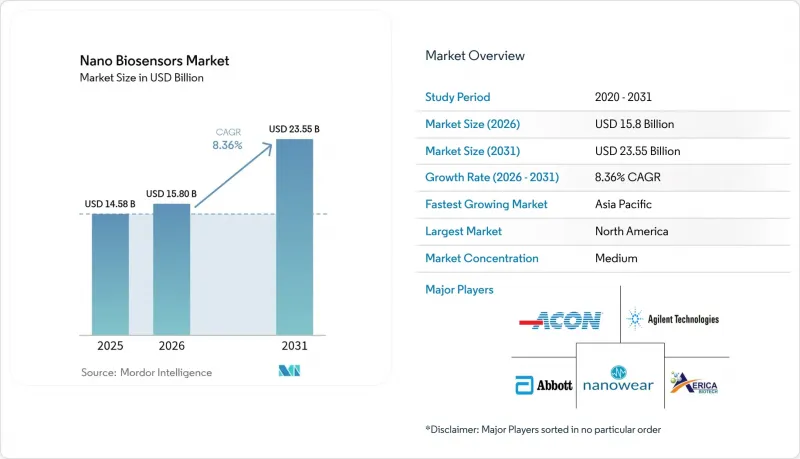
Mordor Intelligence에 의하면, 나노 바이오센서 시장 규모는 2025년 145억 8,000만 달러에서 2026년에는 158억 달러에 이르고, 2026-2031년 CAGR 8.36%로 성장을 지속하여 2031년에는 235억 5,000만 달러에 달할 것으로 예측됩니다.
본 보고서는 유형별(광학 센서, 전기화학 센서 등), 최종 사용자 산업별(의료, 식품 및 음료, 환경 모니터링 등), 기술 플랫폼별(전기화학, 광학, 나노기계 등), 용도별(의료 진단, 식품 안전 검사, 환경 모니터링 등), 그리고 지역별로 분류되어 있습니다. 시장 예측은 금액(달러) 기준으로 제시되어 있습니다.
세계 나노 바이오센서 시장 동향 및 인사이트
포인트 오브 케어(PoC) 의료 진단 분야에서의 채택 확대
검사 결과의 신속성이 임상 결과에 직접적인 영향을 미치기 때문에 응급실, 지방 진료소, 재택 간호 현장에서 중앙 집중식 검사실 검사를 대신하여 현장 진단(PoC) 검사 도구가 도입되고 있습니다. 2024년, 미국 식품의약국(FDA)은 50마이크로리터 미만의 손가락 채혈량을 사용하여 15분 이내에 다중 매개변수 결과를 제공하는 나노 기술을 응용한 23개의 진단 플랫폼을 승인했습니다. 메디케어의 ‘재입원 감소 프로그램(Hospital Readmissions Reduction Program)’과 같은 보상 모델에서는 신속한 분류 데이터를 바탕으로 환자를 퇴원시키는 병원에 인센티브가 제공되며,나노 스케일의 트랜스듀서는 펨토몰 수준의 검출 한계를 실현하여, 기존의 면역 분석법보다 조기에 패혈증 바이오마커를 검출합니다. 그 결과, 합리적인 가격과 사용 편의성을 중시하는 세계보건기구(WHO)의 ASSURED 기준에 따라, 저·중소득 국가에서도 분산형 검사가 확대되고 있습니다. 이러한 보급 확대에 힘입어, 나노 바이오센서 시장에서 소형 휴대용 리더기의 판매 대수는 두 자릿수 성장률을 안정적으로 유지하고 있습니다.
나노 소재 제조 기술의 발전
그래핀, 탄소나노튜브, 양자점의 연속 롤-투-롤 합성으로 인해 2024년 이후 나노 소재의 단가는 10분의 1로 하락했습니다. 잉크젯으로 인쇄된 그래핀 전극은 현재 10 m/min을 넘는 증착 속도로 1제곱당 50Ω 미만의 시트 저항을 달성하여, 저비용의 일회용 테스트 스트립을 실현하고 있습니다. 카드뮴을 포함하지 않는 인화 인듐 양자점은 RoHS 규정을 준수하면서도 60% 이상의 양자 수율을 유지하고 있습니다. 이는 시간적 제약이 엄격한 식품 안전 검사에 사용되는 광학식 바이오 센서에 있어 필수적인 조건입니다. 이러한 진보로 인해 일회용 센서의 경제성이 획기적으로 개선되어, 검사 단가는 0.50달러 미만으로 떨어졌으며, 시료 채취부터 결과 도출까지 소요되는 시간은 30분 미만으로 단축되었습니다. 2024년에 발간된 ISO/TS 80004-2는 나노 물질 용어를 체계화하고, 규제상의 모호함을 해소하는 동시에 제품 등록 주기를 단축합니다.
복잡한 제조 공정과 수율 변동
나노 물질 합성, 전극 패터닝, 마이크로플루이딕스 어셈블리를 포함한 다단계 제조 공정에서는 결함이 누적되어 수율을 저하시킵니다. 시범 생산에서는 85%-92%의 수율을 달성하고 있지만, 라인 속도가 15 m/min을 초과하면 잉크의 점도가 변동하고 기판이 뒤틀리기 때문에 수율률이 저하됩니다. 전극의 위치 오차가 1% 발생하면 센서의 감도가 12% 저하되므로, 유닛당 0.08-0.12달러의 인라인 이미징을 도입할 수밖에 없습니다. 로트 간 재료 편차로 인해 추가적인 재보정 주기가 필요하게 되며, 일회 사용을 전제로 한 가격 책정이 된 시판 검사 스트립의 경우 이는 문제가 됩니다. IEC 62304의 추적성 요건으로 인해 문서화 작업이 복잡해져 소규모 개발 업체의 자원을 압박하고, 양산까지 걸리는 시간을 지연시키고 있습니다.
부문 분석
나노 바이오센서 시장의 광학 센서 플랫폼은 9.48%의 연평균 성장률(CAGR)로 성장하고 있으며, 식품 안전 및 환경 분야의 사용자들이 라벨이 필요 없는 다성분 분석법을 요구하고 있어 시장 전체의 성장률을 상회하고 있습니다. 표면 플라즈몬 공명 칩 및 형광 기반 변환기는 콜드체인의 제약을 받는 효소 표지를 피할 수 있어 물류 비용을 절감합니다. 2025년에도 포도당 및 심장 패널 덕분에 전기화학식 아키텍처가 매출의 39.72%를 차지하며 여전히 시장을 독점하고 있지만, 복잡한 매트릭스 내의 전기활성 화합물에 의한 간섭에 직면하고 있으며, 여과 공정의 추가로 부품 원가가 증가하고 있습니다. 압전 결정의 질량 변화를 감지하는 음향 센서는 발효액 모니터링 등 불투명성으로 인해 광학식 접근법을 채택할 수 없는 분야에서 점차 보급되고 있습니다. 열량 측정법이나 나노 기계적 방법은 장비 비용이 높아 여전히 연구 분야에 국한되어 있지만, 미국 국방부 고급 연구 프로젝트국(DARPA)의 자금 지원으로 2027년까지 휴대용 프로토타입 개발을 목표로 하고 있으며, 이러한 움직임이 제품 로드맵을 혁신할 가능성이 있습니다. 전반적으로, 광학식 다중화로의 전환은 이용 사례의 폭을 넓히고, 높은 가격 책정의 기반이 되어 전문 공급업체의 매출 성장세를 뒷받침하고 있습니다.
광학 센서 중 나노 바이오 센서 시장 규모는 최종 사용자가 총 측정 시간을 단축하는 신속하고 동시적인 검출을 중시하고 있기 때문에 다른 유형보다 빠르게 확대될 전망입니다. 전기화학 플랫폼은 소모품 분야에서 계속해서 규모의 우위를 유지할 전망이지만, 아시아의 저비용 제조 거점으로 인한 상품화 압력으로 인해 간섭 방지 및 시약이 필요 없는 화학 반응 기술에 대한 혁신이 요구되고 있습니다. 기술 선택지가 특정 성능 틈새 시장에 집중되는 가운데, 명확하게 정의된 임상적 또는 산업적 과제에 맞추어 센서 패키지를 맞춤화하는 공급업체가 시장 점유율의 과반수를 차지할 것으로 예측됩니다.
환경 관련 기관들은 새로운 오염 물질 유형에 대처하기 위해 조달 예산을 확대하고 있으며, 이로 인해 환경 모니터링 시장은 연평균 성장률(CAGR) 8.82%를 기록하며 최종 사용자 부문에서 가장 높은 성장률을 보이고 있습니다. 미국 환경보호청(EPA)이 2024년에 시행할 PFAS 허용 한도를 4 ppt로 설정하는 규제에서는 서브 ppm 수준의 감도가 요구되지만, 롤 투 롤(roll-to-roll)형 나노와이어 센서는 현재 20분 이내에 이 감도를 달성하고 있습니다. 의료 분야는 2025년 지출의 35.12%를 차지하며 여전히 최대 구매자이지만, 1형 당뇨병 환자층에서 CGM(연속 혈당 모니터링)의 보급이 포화 상태에 도달함에 따라 그 성장은 둔화되고 있습니다. 식품 및 음료 가공업체들은 하역장 및 콜드체인 허브에서 바이오센서의 활용을 확대하고 있으며, 소매업체들이 요구하는 4시간 이내 병원체 제거 요건을 충족하고 있습니다. 국방 및 치안 기관은 무기화된 화학 물질의 원격 감지를 위한 양자점 어레이의 시범 운영을 진행 중이며, 이는 나노 바이오센서 업계에서 대상 니치 시장의 폭이 넓음을 여실히 보여주고 있습니다.
환경 분야의 도입 기업들은 감시 제어 시스템과 통합되어 세밀한 위험 분석을 제공하며 유지보수 부담이 적은 노드를 중시하고 있습니다. 이러한 기능 덕분에 지자체의 예산 제약이 있음에도 불구하고 단위당 높은 가격 책정이 정당화되고 있습니다. 기준이 되는 오염 물질 목록이 늘어남에 따라 도입 곡선은 계속해서 가파른 상승세를 유지할 것으로 예상되며, 이는 나노 바이오센서 시장을 강화할 것입니다.
지역별 분석
아시아태평양은 2031년까지 연평균 성장률(CAGR) 9.86%를 나타낼 것으로 예측되며, 이는 나노 바이오 센서 시장에서 지역별 가장 높은 성장 속도입니다. 중국의 ‘제14차 5개년 계획’에서는 국내 나노 소재 및 센서 생산 능력 확충을 위해 120억 위안(17억 달러)의 보조금이 배정되었으며, 국가약품감독관리국은 국내에서 개발된 CGM 시스템에 대한 심사를 신속히 진행하고 있습니다. 인도의 ‘아유슈만 바라트 디지털 헬스 미션’은 센서 데이터를 통합된 기록과 연계하여 병원에서 수요를 촉진하고 있습니다. 일본은 2024년 ‘사회 5.0’의 틀 아래 8개의 신규 플랫폼을 승인하며, 웰니스 지향적인 타액·땀 분석 분야로 시장 입지를 확대되고 있습니다.
2025년 매출의 34.55%를 차지한 북미에서는 CGM 사용자의 도입 기반이 확립되어 있으며, 보험 환급 제도도 유리합니다. 그러나 1형 당뇨병 환자에 대한 보급이 정체되고, 판매량이 당뇨병 전 단계 모니터링 및 다항목 측정 패치로 이동함에 따라 성장은 둔화되고 있습니다. 유럽 시장의 성장세는 체외진단용 의료기기 규정(IVDR)에 좌우됩니다. 이 규정은 4억 5,000만 명의 소비자 시장을 창출하는 한편, 적합성 평가 비용을 증가시키고 유럽의약품청(EMA) 시장 출시까지 소요되는 기간을 연장시키고 있습니다. 중동에서는 스마트 시티 플랫폼에 대한 투자가 진행되고 있으며, 두바이는 2024년 스마트 시티 구상의 일환으로 200곳의 실시간 수질 측정 노드를 도입했습니다. 남미 및 아프리카에서는 규제의 파편화와 콜드체인 물류의 제한으로 인해 여전히 시장 침투율이 낮은 상황이지만, 브라질의 ANVISA는 WHO의 사전 승인을 받은 포인트 오브 케어 기기 시장 진입 절차를 완화했습니다.
전반적으로 지역별 정책 지원, 보험 적용 범위 확대, 그리고 제조 역량이 시장 점유율 구도를 재편하고 있습니다. 현재의 확산 추세가 지속된다면, 아시아태평양의 나노 바이오센서 시장 규모는 2030년까지 유럽을 추월할 전망입니다.
기타 혜택:
- 엑셀 형식 시장 예측(ME) 시트
- 3개월간의 애널리스트 지원
자주 묻는 질문
목차
제1장 서론
제2장 조사 방법
제3장 주요 요약
제4장 시장 구도
제5장 시장 규모와 성장 예측
제6장 경쟁 구도
제7장 시장 기회와 향후 전망
LSH 26.08.25According to Mordor Intelligence, the nano biosensors market size is expected to grow from USD 14.58 billion in 2025 to USD 15.8 billion in 2026 and is forecast to reach USD 23.55 billion by 2031 at 8.36% CAGR over 2026-2031.
This report is Segmented by Type (Optical Sensor, Electrochemical Sensor, and More), End User Industry (Healthcare, Food and Beverage, Environmental Monitoring, and More), Technology Platform (Electrochemical, Optical, Nanomechanical, and More), Application (Medical Diagnostics, Food Safety Testing, Environmental Monitoring, and More), and Geography. The Market Forecasts are Provided in Terms of Value (USD).
Global Nano Biosensors Market Trends and Insights
Rising Adoption in Point-of-Care Medical Diagnostics
Point-of-care tools are replacing centralized laboratory testing across emergency departments, rural clinics, and home-care settings because turnaround time directly influences clinical outcomes. In 2024, the United States Food and Drug Administration cleared 23 nano-enabled diagnostic platforms that deliver multiparameter results within 15 minutes using fingerstick volumes under 50 microliters. Reimbursement models such as Medicare's Hospital Readmissions Reduction Program reward hospitals that discharge patients with rapid triage data in hand, and nano-scale transducers offer femtomolar detection limits that catch sepsis biomarkers earlier than conventional immunoassays. As a result, decentralized testing is also scaling in low- and middle-income countries under the World Health Organization's ASSURED criteria, which emphasize affordability and user friendliness. The ensuing uptake supports consistent double-digit unit growth for compact handheld readers in the nano biosensors market.
Advancements in Nanomaterial Fabrication Techniques
Continuous roll-to-roll synthesis of graphene, carbon nanotubes, and quantum dots has reduced per-unit nanomaterial costs ten-fold since 2024. Inkjet-printed graphene electrodes now achieve sheet resistances below 50 Ω per square at deposition speeds above 10 m/min, enabling low-cost disposable test strips. Cadmium-free indium phosphide quantum dots comply with RoHS rules while sustaining quantum yields above 60%, a prerequisite for optical biosensors serving time-critical food-safety assays. These gains transform single-use sensor economics, bringing test prices below USD 0.50 and trimming sample-to-answer windows to under 30 minutes. ISO/TS 80004-2 issued in 2024 codifies nanomaterial terminology, reducing regulatory ambiguity and shortening product-registration cycles
Complex Manufacturing Process and Yield Variability
Multi-step fabrication that includes nanomaterial synthesis, electrode patterning, and microfluidic assembly introduces defect accumulation that suppresses yields. Pilot runs achieve 85%-92% output, yet rates drop once line speed exceeds 15 m/min because ink viscosity fluctuates and substrates distort. A 1% electrode-alignment error can cut sensor sensitivity by 12%, forcing deployment of USD 0.08-to-0.12 inline imaging per unit. Batch-to-batch material variability drives additional recalibration cycles, problematic for over-the-counter strips priced for single use. IEC 62304 traceability mandates compound documentation tasks, stretching smaller developers' resources and delaying time-to-volume ramp-ups.
Other drivers and restraints analyzed in the detailed report include:
- Growing Demand for Continuous Glucose Monitoring Devices
- Integration of Biosensors with IoT Platforms
- Stringent Regulatory Approval Pathways for Clinical Biosensors
For complete list of drivers and restraints, kindly check the Table Of Contents.
Segment Analysis
Optical sensor platforms in the nano biosensors market are advancing at a 9.48% CAGR, eclipsing the broader growth rate as food-safety and environmental users demand label-free, multi-analyte assays. Surface-plasmon-resonance chips and fluorescence-based transducers avoid enzyme labels that suffer cold-chain restrictions, thereby shaving logistics overhead. Electrochemical architectures still dominated 2025 with 39.72% revenue thanks to glucose and cardiac panels, yet they face interference from electroactive compounds in complex matrices, adding filtration steps that inflate bill-of-materials costs. Acoustic sensors, which read mass changes on piezoelectric crystals, are making inroads where opacity sidelines optical approaches, such as fermentation broth monitoring. Calorimetric and nanomechanical variants remain confined to research due to high instrumentation costs, though Defense Advanced Research Projects Agency funding seeks handheld prototypes by 2027, a move that could refresh product roadmaps. Overall, the shift toward optical multiplexing expands use-case breadth and underpins premium pricing, reinforcing revenue momentum for specialized suppliers.
The nano biosensors market size for optical sensors is set to expand more quickly than other types as end users value rapid, simultaneous detection that cuts total assay time. Electrochemical platforms will continue to command scale advantages in consumables, yet commoditization pressures from low-cost Asian fabs necessitate innovation in interference shielding and reagent-free chemistries. As technology choices converge on specific performance niches, vendors that tailor sensor packages to well-defined clinical or industrial problems are expected to capture disproportionate wallet share.
Environmental bodies are opening procurement budgets to tackle new contaminant classes, propelling environmental monitoring to a 8.82% CAGR, the fastest among end users. The U.S. Environmental Protection Agency's 2024 regulation putting PFAS limits at 4 ppt requires sub-ppm sensitivity that roll-to-roll nanowire sensors now achieve in under 20 minutes. Healthcare remained the largest buyer at 35.12% of 2025 spending, yet its growth moderates as CGM penetration saturates type 1 diabetic cohorts. Food and beverage processors are scaling biosensor use at loading docks and cold-chain hubs, satisfying retailer mandates for four-hour pathogen clearance windows. Defense and security agencies trial quantum-dot arrays for standoff detection of weaponized chemicals, underscoring the breadth of addressable niches in the nano biosensors industry.
Environmental adopters value low-maintenance nodes that integrate with supervisory control systems and supply granular risk analytics. These capabilities justify premium per-unit pricing despite municipal budget constraints. As benchmark contaminant lists lengthen, adoption curves are expected to remain steep, strengthening the nano biosensors market.
Complete Report Scope:
- By Type
- Optical Sensor
- Electrochemical Sensor
- Acoustic Sensor
- Other Types
- By End User Industry
- Healthcare
- Food And Beverage
- Environmental Monitoring
- Defence And Security
- Other End Users
- By Technology Platform
- Electrochemical
- Optical
- Nanomechanical
- Calorimetric
- Acoustic
- By Application
- Medical Diagnostics
- Food Safety Testing
- Environmental Monitoring
- Industrial Process Control
- Others Applications
- By Geography
- North America
- United States
- Canada
- Mexico
- Europe
- United Kingdom
- Germany
- France
- Italy
- Rest of Europe
- Asia-Pacific
- China
- Japan
- India
- South Korea
- Rest of Asia
- Middle East
- Israel
- Saudi Arabia
- United Arab Emirates
- Turkey
- Rest of Middle East
- Africa
- South Africa
- Egypt
- Rest of Africa
- South America
- Brazil
- Argentina
- Rest of South America
- North America
Geography Analysis
Asia-Pacific is projected to post a 9.86% CAGR to 2031, the highest regional pace in the nano biosensors market. China's 14th Five-Year Plan allocates CNY 12 billion (USD 1.7 billion) in subsidies for domestic nanomaterial and sensor capacity, while the National Medical Products Administration expedites reviews for locally developed CGM systems.India's Ayushman Bharat Digital Health Mission integrates sensor data with unified records, spurring hospital demand. Japan approved eight novel platforms in 2024 under the Society 5.0 banner, extending market presence into wellness-oriented saliva and sweat assays.
North America, which generated 34.55% of 2025 revenue, enjoys an installed base of CGM users and favorable reimbursement. Growth, however, is moderating as type 1 penetration plateaus, shifting unit volumes toward prediabetic monitoring and multi-analyte patches. European momentum depends on the In Vitro Diagnostic Regulation, which delivers a market of 450 million consumers but raises conformity assessment costs and elongates launch calendars EMA. The Middle East is investing in smart-city platforms; Dubai deployed 200 real-time water-quality nodes in 2024 under its Smart City initiative. South America and Africa remain underpenetrated owing to fragmented rules and limited cold-chain logistics, although Brazil's ANVISA eased pathways for WHO-prequalified point-of-care devices.
Collectively, regional policy support, reimbursement expansion, and manufacturing capability are reshaping market-share contours. The nano biosensors market size in Asia-Pacific is on track to surpass Europe before 2030 if current adoption trajectories persist.
- Abbott Laboratories
- ACON Laboratories, Inc.
- Agilent Technologies Inc.
- NanoScent Ltd.
- Nanowear, Inc.
- AerBetic LLC
- Instant NanoBiosensors Co. Ltd.
- LamdaGen Corporation
- Bruker Corporation
- Honeywell International Inc.
- Analog Devices Inc.
- Omron Corporation
- Biosensors International Group Ltd.
- Universal Biosensors Inc.
- Medtronic plc
- Roche Diagnostics International AG
- Dexcom Inc.
- STMicroelectronics N.V.
Additional Benefits:
- The market estimate (ME) sheet in Excel format
- 3 months of analyst support
TABLE OF CONTENTS
1 INTRODUCTION
- 1.1 Study Assumptions and Market Definition
- 1.2 Scope of the Study
2 RESEARCH METHODOLOGY
3 EXECUTIVE SUMMARY
4 MARKET LANDSCAPE
- 4.1 Market Overview
- 4.2 Market Drivers
- 4.2.1 Rising Adoption In Point-of-Care Medical Diagnostics
- 4.2.2 Advancements In Nanomaterial Fabrication Techniques
- 4.2.3 Growing Demand For Continuous Glucose Monitoring Devices
- 4.2.4 Integration Of Biosensors With IoT Platforms
- 4.2.5 Regulatory Push For Antibiotic Stewardship Using Rapid Nanobiosensor Tests
- 4.2.6 Emergence Of Printable Flexible Substrates Enabling Disposable Food-Safety Biosensors
- 4.3 Market Restraints
- 4.3.1 Complex Manufacturing Process and Yield Variability
- 4.3.2 Stringent Regulatory Approval Pathways For Clinical Biosensors
- 4.3.3 Nanomaterial Supply Chain Constraints For Rare Earth Elements
- 4.3.4 Data Privacy Concerns In Wearable Nanobiosensor Ecosystems
- 4.4 Value-Chain Analysis
- 4.5 Regulatory Landscape
- 4.6 Technological Outlook
- 4.7 Impact of Macroeconomic Factors on the Market
- 4.8 Porter's Five Forces Analysis
- 4.8.1 Threat of New Entrants
- 4.8.2 Bargaining Power of Buyers
- 4.8.3 Bargaining Power of Suppliers
- 4.8.4 Threat of Substitute Products
- 4.8.5 Intensity of Competitive Rivalry
- 4.9 Industry Stakeholders Analysis
- 4.10 Patent Landscape
5 MARKET SIZE AND GROWTH FORECASTS (VALUE)
- 5.1 By Type
- 5.1.1 Optical Sensor
- 5.1.2 Electrochemical Sensor
- 5.1.3 Acoustic Sensor
- 5.1.4 Other Types
- 5.2 By End User Industry
- 5.2.1 Healthcare
- 5.2.2 Food And Beverage
- 5.2.3 Environmental Monitoring
- 5.2.4 Defence And Security
- 5.2.5 Other End Users
- 5.3 By Technology Platform
- 5.3.1 Electrochemical
- 5.3.2 Optical
- 5.3.3 Nanomechanical
- 5.3.4 Calorimetric
- 5.3.5 Acoustic
- 5.4 By Application
- 5.4.1 Medical Diagnostics
- 5.4.2 Food Safety Testing
- 5.4.3 Environmental Monitoring
- 5.4.4 Industrial Process Control
- 5.4.5 Others Applications
- 5.5 By Geography
- 5.5.1 North America
- 5.5.1.1 United States
- 5.5.1.2 Canada
- 5.5.1.3 Mexico
- 5.5.2 Europe
- 5.5.2.1 United Kingdom
- 5.5.2.2 Germany
- 5.5.2.3 France
- 5.5.2.4 Italy
- 5.5.2.5 Rest of Europe
- 5.5.3 Asia-Pacific
- 5.5.3.1 China
- 5.5.3.2 Japan
- 5.5.3.3 India
- 5.5.3.4 South Korea
- 5.5.3.5 Rest of Asia
- 5.5.4 Middle East
- 5.5.4.1 Israel
- 5.5.4.2 Saudi Arabia
- 5.5.4.3 United Arab Emirates
- 5.5.4.4 Turkey
- 5.5.4.5 Rest of Middle East
- 5.5.5 Africa
- 5.5.5.1 South Africa
- 5.5.5.2 Egypt
- 5.5.5.3 Rest of Africa
- 5.5.6 South America
- 5.5.6.1 Brazil
- 5.5.6.2 Argentina
- 5.5.6.3 Rest of South America
- 5.5.1 North America
6 COMPETITIVE LANDSCAPE
- 6.1 Market Concentration
- 6.2 Strategic Moves
- 6.3 Market Share Analysis
- 6.4 Company Profiles {(includes Global Level Overview, Market Level Overview, Core Segments, Financials As Available, Strategic Information, Market Rank/Share For Key Companies, Products And Services, And Recent Developments)}
- 6.4.1 Abbott Laboratories
- 6.4.2 ACON Laboratories, Inc.
- 6.4.3 Agilent Technologies Inc.
- 6.4.4 NanoScent Ltd.
- 6.4.5 Nanowear, Inc.
- 6.4.6 AerBetic LLC
- 6.4.7 Instant NanoBiosensors Co. Ltd.
- 6.4.8 LamdaGen Corporation
- 6.4.9 Bruker Corporation
- 6.4.10 Honeywell International Inc.
- 6.4.11 Analog Devices Inc.
- 6.4.12 Omron Corporation
- 6.4.13 Biosensors International Group Ltd.
- 6.4.14 Universal Biosensors Inc.
- 6.4.15 Medtronic plc
- 6.4.16 Roche Diagnostics International AG
- 6.4.17 Dexcom Inc.
- 6.4.18 STMicroelectronics N.V.
7 MARKET OPPORTUNITIES AND FUTURE OUTLOOK
- 7.1 White-Space and Unmet-Need Assessment