|
시장보고서
상품코드
2113577
인도의 동물 의료 서비스 : 시장 점유율 분석, 업계 동향 및 통계, 성장 예측(2026-2031년)India Veterinary Healthcare - Market Share Analysis, Industry Trends & Statistics, Growth Forecasts (2026 - 2031) |
||||||
 Mordor Intelligence
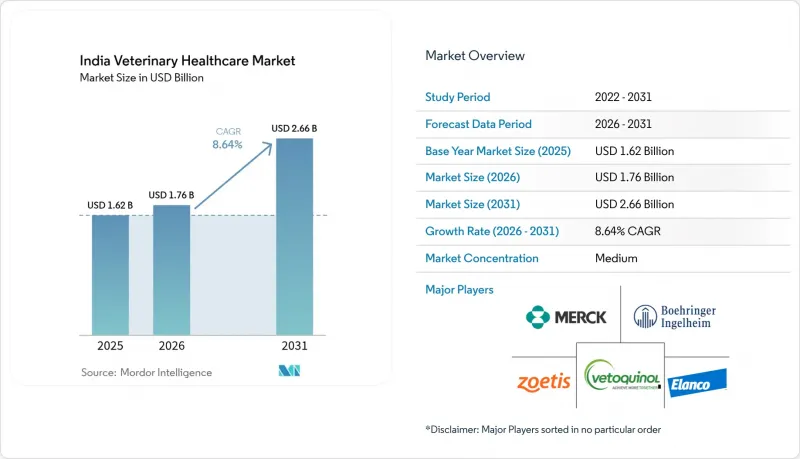
Mordor Intelligence에 의하면, 2026년 인도의 동물 의료 서비스 시장 규모는 17억 6,000만 달러로 추정되고 있으며, 2025년 16억 2,000만 달러에서 2031년에는 26억 6,000만 달러에 달할 것으로 예측됩니다.
또한 2026-2031년 연평균 성장률(CAGR) 8.64%를 기록할 전망입니다.
본 보고서는 제품 유형별(치료제 및 진단제), 동물 종별(개·고양이, 말, 반추동물 등), 투여 경로별(경구, 비경구 등), 최종 사용자별(동물병원 및 진료소, 검사 기관 등)로 분류되어 있습니다. 시장 예측은 금액(달러)으로 표시되어 있습니다.
인도 수의학 헬스케어 시장 동향 및 인사이트
동물 개체 수 및 사육 두수 증가
반려견 수는 2014년 1,260만 마리에서 2023년에는 3,360만 마리로 급증했으며, 2028년까지 5,150만 마리에 달할 것으로 예측되어 웰니스, 진단 및 선택적 수술에 대한 지속적인 수요를 견인하고 있습니다. 도시 지역 가구의 반려동물 보유율은 이미 25%에 달했으며, 2025년까지 35%에 이를 것으로 전망됩니다. 이에 따라 케어에 대한 기대치도 기본적인 예방 접종에서 다학제적 서비스로 전환되고 있습니다. 반려동물의 연간 건강 관리 비용은 평균 70,000-80,000 루피이며, 수술 1회당 비용은 20,000-30,000 루피로, 이는 전반적인 제품 및 서비스의 프리미엄화를 뒷받침하고 있습니다. 이와 병행하여 가축 사육 두수도 증가하고 있으며, 인도의 소 사육 두수는 3억 742만 마리에 달하고, 대규모 예방접종과 영양 지원이 필요함에 따라 수요는 폭넓은 기반을 유지하고 있습니다. 반려동물과 생산용 가축 양쪽에서 나타나는 이러한 이중 성장은 수익원을 다각화함으로써 인도의 헬스케어 시장을 뒷받침하고 있습니다.
정부 주도의 예방 접종 및 질병 대책 프로그램
‘국가 가축 미션’은 번식 농장, 사료 공장 및 진료소에 최대 500만 루피까지 50%의 자본 보조금을 제공하여 백신 및 치료제 구매를 직접적으로 촉진하고 있습니다. 2024년 6월에는 국내에서 생산된 결절성 피부병 백신이 도입되어, 국내 3억 마리 이상의 소를 보호하고 있습니다. ‘국가 원헬스 미션’은 인간과 동물의 질병 감시를 연계하여, 인수공통감염병을 조기에 감지하는 진단 기술의 보급을 가속화하고 있습니다. 2025년 4월에는 H9N2형 가금용 백신의 승인과 농장의 생물안전 규정이 강화되어 예방 의료 체계가 강화되었습니다. 인도는 세계 3위의 계란 생산국인 만큼, 이러한 프로그램들은 감염병 발생으로 인한 경제적 충격을 완화하고, 인도 수의학 시장의 성장 궤도를 유지하고 있습니다.
위조 또는 규격 미달 수의약품의 만연
중앙 및 주 규제 당국의 이중 감독 체제는 법 집행상의 사각지대를 만들어내고 있으며, 불법 제조업체들은 관할 구역을 넘나들며 생산 거점을 옮김으로써 이러한 사각지대를 악용하고 있습니다. 2025년 1월부터는 모든 의약품 승인 신청을 CDSCO에 온라인으로 제출해야 하며, 이를 통해 추적 가능성이 강화될 것으로 예측됩니다. 그럼에도 불구하고, 농촌 시장의 가격에 민감한 구매자들은 품질이 확인되지 않은 저렴한 제품을 선호하는 경우가 많으며, 이는 치료 성과를 저해하고 수의학에 대한 신뢰를 훼손할 우려가 있습니다. 2023년 12월에 시행된 개정판 ‘스케줄 M GMP’ 기준에 따라 중소규모 기업들은 높은 규정 준수 비용에 직면하고 있으며, 자원이 제한된 사업자의 규정 위반 위험이 높아지고 있습니다. 규격에 미달하는 치료제는 질병 대책을 저해하고, 백신 접종 추진을 지연시키며, 궁극적으로 인도 수의학 시장의 연평균 성장률(CAGR)에 부정적인 영향을 미칩니다.
부문 분석
2025년 현재, 치료제는 인도 수의학 헬스케어 시장에서 57.10%의 점유율을 차지하고 있으며, 인도의 3억 마리에 달하는 소 사육 두수에 힘입어 계속해서 시장의 기반을 형성하고 있습니다. 백신 수요는 2024년에 출시된 국내용 결절성 피부병 백신에 의해 뒷받침되고 있는 반면, 구충제는 2024년 4월에 승인된 ‘NexGard Spectra’ 등의 제품으로 인해 성장세가 가속화되고 있습니다. 백신은 하위 카테고리의 매출을 주도하고 있으며, 이는 인도가 전 세계 백신 공급량의 60%를 차지한다는 점을 반영한 것입니다. 또한, ‘국가 가축 미션’ 등의 정책이 도입을 가속화하고 있습니다. 구충제 및 항감염제는 생산 동물의 생산성을 유지하고 반려동물을 기생충으로부터 보호합니다. 의료용 사료 첨가제는 생산자가 항생제 내성 대책 요건을 충족하면서 생산성을 유지하는 데 도움이 됩니다.
진단약은 2031년까지 연평균 성장률(CAGR)이 9.48%로 가장 빠르게 성장하고 있는 제품군입니다. 이 부문은 전문 검사 시설이 부족한 지역에서 매우 중요한, 축사 내 신속한 의사결정을 가능하게 하는 현장 진단(Point-of-Care) 시스템에 의해 뒷받침되고 있습니다. 면역 진단약은 여전히 가장 큰 하위 부문이며, ‘원 헬스(One Health)’ 감시 프로그램에 활용되고 있습니다. 분자 검사는 AI 영상 분석 도구와 결합되어 소의 병변 감지에서 86.54%의 정확도를 달성함으로써 경제적 손실을 최소화하고 있습니다. 기업형 동물병원 체인이 진료 체계를 확충함에 따라, 임상화학 검사 및 영상진단 분야는 호황을 누리고 있습니다. IDEXX사는 2024년 3분기에 ‘inVue’ 분석기 수주 건수 700건을 기록하며, 진료소 내 진단 기술 도입 확대를 뒷받침하고 있습니다. 이러한 기술적 성장세에 힘입어, 예측 기간 동안 진단 분야는 인도 수의학 시장 규모에서 차지하는 비중을 확대해 나갈 전망입니다.
2025년, 인도 수의학 시장의 45.00%를 개와 고양이가 차지하고 있으며, 이는 1마리당 지출액이 높고 보험 가입률이 향상된 데 기인합니다. 연간 평균 지출액 70,000-80,000 루피에는 선택적 치료, 예방 의료, 전문적인 영양 관리가 포함되어 있으며, 이는 의료 제공업체의 이익률을 끌어올리고 있습니다. 마스(Mars)사가 2024년에 크라운 베테리너리 서비스(Crown Veterinary Services)에 투자한 것은 도시 지역의 반려동물 헬스케어 수요가 급증할 것으로 예상된다는 점을 반영한 것입니다. 말 관리 시장은 여전히 틈새 시장이지만, 박람회에서 진행된 복지 프로그램을 통해 주목도가 높아지고 있습니다. 반추동물은 무리 단위 예방접종 이니셔티브에 힘입어 계속해서 백신 판매량의 기반을 형성하고 있습니다.
가금류 부문은 연평균 성장률(CAGR) 8.87%로 가장 빠르게 성장하는 동물 부문이 될 것으로 예측되며, 이는 인도가 세계 계란 생산량 3위를 차지하고 있음을 반영합니다. 빌백(Vilback)사가 2024년에 가금류용 백신 라인을 강화하기 위해 글로비온(Globion)사를 인수한 것은 이 부문에 대한 자신감을 보여줍니다. 2026년까지 처리 능력은 시간당 267,800마리로 확대될 전망이며, 질병 예방에 대한 지출도 증가하고 있습니다. 정부가 권장하는 H9N2 백신에 더해, 양계장 등록 의무화로 인해 예방 건강 관리 프로그램의 보급이 촉진되고 있습니다. AI를 활용한 군집 모니터링 도구는 사료 전환율 향상과 질병 예측 정확도를 높여, 인도 수의학 시장에서 가금 부문의 점유율 확대를 뒷받침하고 있습니다.
기타 혜택:
- 엑셀 형식 시장 예측(ME) 시트
- 3개월간의 애널리스트 지원
자주 묻는 질문
목차
제1장 서론
제2장 조사 방법
제3장 주요 요약
제4장 시장 구도
제5장 시장 규모와 성장 예측
제6장 경쟁 구도
제7장 시장 기회와 향후 전망
LSH 26.08.25According to Mordor Intelligence, India veterinary healthcare market size in 2026 is estimated at USD 1.76 billion, growing from 2025 value of USD 1.62 billion with 2031 projections showing USD 2.66 billion, growing at 8.64% CAGR over 2026-2031.
This report is Segmented by Product (Therapeutics and Diagnostics), Animal Type (Dogs & Cats, Horses, Ruminants, and More), Route of Administration (Oral, Parenteral, and More), End User (Veterinary Hospitals & Clinics, Reference Laboratories, and More). The Market Forecasts are Provided in Terms of Value (USD).
India Veterinary Healthcare Market Trends and Insights
Growing Animal Population and Ownership
Pet dog numbers jumped from 12.6 million in 2014 to 33.6 million in 2023 and are projected to hit 51.5 million by 2028, driving sustained demand for wellness, diagnostics, and elective procedures. Urban households already show 25% pet penetration and are on track to reach 35% by 2025, shifting care expectations from basic vaccinations to multi-specialty services. Annual pet healthcare spending averages INR 70,000-80,000, with surgical episodes costing INR 20,000-30,000, underpinning premiumization across products and services. Parallel livestock expansion keeps demand broad-based as India's cattle herd touches 307.42 million, requiring mass immunization and nutritional support. This dual growth across companion and production animals sustains the India veterinary healthcare market by diversifying revenue streams.
Government-Led Immunization and Disease-Control Programs
The National Livestock Mission offers 50% capital subsidies up to INR 50 lakh for breeding farms, feed units, and clinics, directly stimulating purchases of vaccines and therapeutics. June 2024 saw the rollout of the indigenously produced lumpy skin disease vaccine that safeguards the country's 300 million-plus bovines. The National One Health Mission aligns human and animal disease surveillance, accelerating uptake of diagnostics that detect zoonoses early. April 2025 approvals of H9N2 poultry vaccines and stricter farm biosecurity rules reinforce the preventive health paradigm. Given India's status as the third-largest egg producer, these programs mitigate economic shocks from outbreaks and keep the India veterinary healthcare market growth trajectory intact.
Prevalence of Counterfeit or Substandard Veterinary Products
Dual oversight by central and state regulators creates enforcement blind spots that illicit manufacturers exploit by shifting production across jurisdictions. From January 2025, all drug approvals must be filed online with the CDSCO, a move expected to tighten traceability. Still, price-sensitive buyers in rural markets often favor cheaper products without verified quality, which can compromise treatment outcomes and erode trust in veterinary interventions. Smaller firms face high compliance costs under revised Schedule M GMP norms implemented in December 2023, increasing the risk of non-compliance among resource-constrained players. Substandard therapeutics hamper disease control, slow vaccination drives, and ultimately weigh on the India veterinary healthcare market CAGR.
Other drivers and restraints analyzed in the detailed report include:
- Technological Advancements in Veterinary Diagnostics and Telehealth
- Rising Adoption of Pet Insurance and Health Financing
- High Cost of Advanced Veterinary Treatments and Diagnostics
For complete list of drivers and restraints, kindly check the Table Of Contents.
Segment Analysis
Therapeutics accounted for a 57.10% share of the India veterinary healthcare market in 2025 and remain foundational due to the country's 300 million-head cattle herd. Vaccine demand is buoyed by the domestic lumpy skin disease shot launched in 2024, while parasiticides gain traction from products like NexGard Spectra approved in April 2024. Vaccines dominate sub-category revenues, reflecting India's role as a 60% supplier of global doses, and policies such as the National Livestock Mission accelerate uptake. Parasiticides and anti-infectives keep production animals efficient and companion animals parasite-free. Medical feed additives help producers maintain productivity while managing antimicrobial resistance mandates.
Diagnostics is the fastest-growing product group at a 9.48% CAGR through 2031. The segment rides on point-of-care systems that allow rapid barn-side decision-making, critical in geographies lacking specialist labs. Immunodiagnostics remain the largest sub-segment, tapped by One Health surveillance programs. Molecular tests pair with AI image readers to deliver 86.54% accuracy in bovine lesion detection, minimizing economic losses. Clinical chemistry and imaging thrive as corporate vet chains upscale practices. IDEXX logged 700 orders for its inVue analyzer in Q3 2024, underscoring rising in-clinic diagnostics adoption. This tech momentum is positioning diagnostics to capture a rising proportion of the India veterinary healthcare market size over the forecast horizon.
Dogs & cats generated 45.00% of the India veterinary healthcare market in 2025, underpinned by high per-pet spending and growing insurance penetration. Average annual outlays of INR 70,000-80,000 include elective treatments, preventive care, and specialized nutrition, boosting provider margins. Mars Inc.'s 2024 investment in Crown Veterinary Services reflects the anticipated surge in urban pet healthcare demand. Equine care remains niche but gains visibility through welfare programs at fairs. Ruminants continue to underpin vaccine volume, driven by herd-level immunization initiatives.
Poultry is projected to be the fastest-growing animal segment at an 8.87% CAGR, reflecting India's third-place rank in global egg production. Virbac's 2024 purchase of Globion for its poultry vaccine line signals confidence in this category. Capacity is scaling to 267,800 birds per hour by 2026, increasing disease-prevention spending. Government-endorsed H9N2 vaccines plus farm registration mandates encourage broader adoption of preventive health programs. AI-enhanced flock monitoring tools improve feed conversion and disease prediction, propelling poultry's share of the India veterinary healthcare market upward.
Complete Report Scope:
- By Product
- Therapeutics
- Vaccines
- Parasiticides
- Anti-Infectives
- Medical Feed Additives
- Other Therapeutics
- Diagnostics
- Immunodiagnostic Tests
- Molecular Diagnostics
- Diagnostic Imaging
- Clinical Chemistry
- Other Diagnostics
- Therapeutics
- By Animal Type
- Dogs & Cats
- Horses
- Ruminants
- Swine
- Poultry
- Other Animal Types
- By Route Of Administration
- Oral
- Parenteral
- Topical
- Other Route of Administrations
- By End User
- Veterinary Hospitals & Clinics
- Reference Laboratories
- Point-Of-Care / In-House Testing Settings
- Academic & Research Institutes
List of Companies Covered in this Report:
- Zoetis
- Boehringer Ingelheim
- Merck
- Elanco
- Virbac
- Vetoquinol
- IDEXX
- Indian Immunologicals
- Hester Biosciences Ltd.
- Zydus Animal Health
- Ceva Sante Animale
- Intas Pharma (Sequent Scientific)
- Phibro Animal Health
- Bayer Animal Health
- Neogen Corp.
- Cipla Vet
- Mankind Pharma (PetStar)
- Himalaya Animal Health
- Ayurvet Limited
Additional Benefits:
- The market estimate (ME) sheet in Excel format
- 3 months of analyst support
TABLE OF CONTENTS
1 Introduction
- 1.1 Study Assumptions & Market Definition
- 1.2 Scope of the Study
2 Research Methodology
3 Executive Summary
4 Market Landscape
- 4.1 Market Overview
- 4.2 Market Drivers
- 4.2.1 Growing Animal Population and Ownership
- 4.2.2 Government-Led Immunization and Disease-Control Programs
- 4.2.3 Technological Advancements in Veterinary Diagnostics and Telehealth
- 4.2.4 Rising Adoption of Pet Insurance and Health Financing
- 4.2.5 Expansion of Organized Veterinary Retail and E-Commerce Channels
- 4.2.6 Intensifying Focus on Livestock Productivity and Food Safety
- 4.3 Market Restraints
- 4.3.1 Prevalence of Counterfeit or Substandard Veterinary Products
- 4.3.2 High Cost of Advanced Veterinary Treatments and Diagnostics
- 4.3.3 Shortage of Skilled Veterinary Professionals and Support Staff
- 4.3.4 Inadequate Cold Chain and Rural Distribution Infrastructure
- 4.4 Regulatory Landscape
- 4.5 Porter's Five Forces Analysis
- 4.5.1 Threat of New Entrants
- 4.5.2 Bargaining Power of Buyers
- 4.5.3 Bargaining Power of Suppliers
- 4.5.4 Threat of Substitutes
- 4.5.5 Competitive Rivalry
5 Market Size & Growth Forecasts (Value, USD)
- 5.1 By Product
- 5.1.1 Therapeutics
- 5.1.1.1 Vaccines
- 5.1.1.2 Parasiticides
- 5.1.1.3 Anti-Infectives
- 5.1.1.4 Medical Feed Additives
- 5.1.1.5 Other Therapeutics
- 5.1.2 Diagnostics
- 5.1.2.1 Immunodiagnostic Tests
- 5.1.2.2 Molecular Diagnostics
- 5.1.2.3 Diagnostic Imaging
- 5.1.2.4 Clinical Chemistry
- 5.1.2.5 Other Diagnostics
- 5.1.1 Therapeutics
- 5.2 By Animal Type
- 5.2.1 Dogs & Cats
- 5.2.2 Horses
- 5.2.3 Ruminants
- 5.2.4 Swine
- 5.2.5 Poultry
- 5.2.6 Other Animal Types
- 5.3 By Route Of Administration
- 5.3.1 Oral
- 5.3.2 Parenteral
- 5.3.3 Topical
- 5.3.4 Other Route of Administrations
- 5.4 By End User
- 5.4.1 Veterinary Hospitals & Clinics
- 5.4.2 Reference Laboratories
- 5.4.3 Point-Of-Care / In-House Testing Settings
- 5.4.4 Academic & Research Institutes
6 Competitive Landscape
- 6.1 Market Concentration
- 6.2 Market Share Analysis
- 6.3 Company Profiles (includes Global level Overview, Market level overview, Core Segments, Financials as available, Strategic Information, Market Rank/Share, Products & Services, Recent Developments)
- 6.3.1 Zoetis Inc.
- 6.3.2 Boehringer Ingelheim GmbH
- 6.3.3 Merck Animal Health
- 6.3.4 Elanco Animal Health
- 6.3.5 Virbac
- 6.3.6 Vetoquinol
- 6.3.7 IDEXX Laboratories Inc.
- 6.3.8 Indian Immunologicals Ltd.
- 6.3.9 Hester Biosciences Ltd.
- 6.3.10 Zydus Animal Health
- 6.3.11 Ceva Sante Animale
- 6.3.12 Intas Pharma (Sequent Scientific)
- 6.3.13 Phibro Animal Health
- 6.3.14 Bayer Animal Health
- 6.3.15 Neogen Corp.
- 6.3.16 Cipla Vet
- 6.3.17 Mankind Pharma (PetStar)
- 6.3.18 Himalaya Animal Health
- 6.3.19 Ayurvet Limited
7 Market Opportunities & Future Outlook
- 7.1 White-space & Unmet-need Assessment