

|
시장보고서
상품코드
2113643
건선 치료제 : 시장 점유율 분석, 업계 동향 및 통계, 성장 예측(2026-2031년)Psoriasis Drugs - Market Share Analysis, Industry Trends & Statistics, Growth Forecasts (2026 - 2031) |
||||||
 Mordor Intelligence
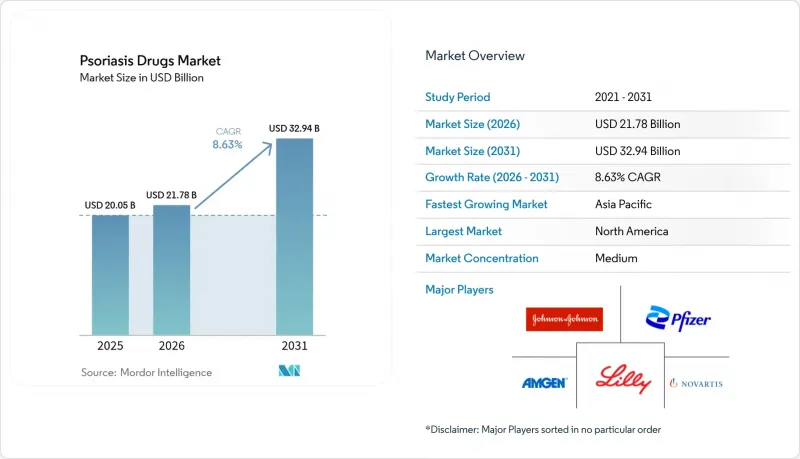
Mordor Intelligence에 의하면, 건선 치료제 시장 규모는 2025년 200억 5,000만 달러에서 2026년에는 217억 8,000만 달러에 이르고, 2026-2031년 CAGR 8.63%로 성장을 지속하여 2031년까지 329억 4,000만 달러에 달할 것으로 예측됩니다.
본 보고서는 치료법(생물학적 제제, 저분자 전신용 약물 등), 약물 분류별(TNF-α 억제제 등), 투여 경로(비경구, 경구, 외용),유통 채널(병원 약국 등), 지역(북미, 유럽, 아시아태평양, 중동 및 아프리카, 남미)별로 분류되어 있습니다. 시장 예측은 금액(달러) 기준으로 제시되어 있습니다.
전 세계 건선 치료제 시장 동향 및 인사이트
신흥 경제국에서의 질병 부담 증가와 건선 치료제에 대한 수요 증가
인프라 확충, 보험 제도 개혁, 그리고 질환에 대한 인식 제고로 인해 중국, 인도, 브라질 및 걸프 국가에서 치료에 대한 큰 수요가 촉발되고 있습니다. 중국 규제 당국은 혁신 의약품의 심사 기간을 2년에서 6개월로 단축하여, 2023년에는 여러 건의 건선용 바이오의약품을 포함한 40건의 신규 승인을 실현했습니다. 브라질에서는 2023년에 바이오시밀러 처방량이 43% 증가하여, 아달리무맙과 에타넬셉트의 가격적 이점이 부각되었습니다. 인도에서도 유사한 움직임을 보이고 있으며, 바이오콘(Biocon)사의 우스테키누맙 바이오시밀러는 스텔라라와 동등한 효능을 그 비용의 몇 분의 일 수준에서 실현했습니다. 사회적 편견과 진단 부족은 여전히 남아 있지만, AI를 활용한 피부과 플랫폼은 현재 89%의 진단 정확도를 달성하여 임상의들이 치료 격차를 해소하는 데 일조하고 있습니다. 이러한 요인들이 맞물려 건선 치료제 시장에 활력을 불어넣는 동시에, 오랫동안 해결되지 않았던 미충족 의료 수요에 대한 대응도 진전되고 있습니다.
병용 요법 증가
임상의들은 난치성 반점 병변이나 관절 증상의 치료 효과 지속성을 높이기 위해 주사용 바이오로직스와 경구용 JAK1 또는 TYK2 억제제를 병용하고 있습니다. 다기관 공동 사례 시리즈에서는 특히 치료가 어려운 표현형에서 이러한 이중 작용기전을 채택했을 때 현저한 개선이 보고되었습니다. 작용기전 측면에서는 IL-23/Th17 및 JAK 의존성 사이토카인 캐스케이드를 동시에 차단함으로써 보다 광범위한 염증 조절이 가능해집니다. 5,932개 치료 과정을 대상으로 한 후향적 분석에서는 병용 요법이 단일 요법에 비해 약물 지속률 측면에서 우수한 것으로 나타났습니다. 네트워크 메타분석에 따르면, 작용기전이 중복되지 않고 상호 보완적인 경우 유효성 향상이 가장 높으므로, 이는 향후 임상시험 설계의 지침이 될 것입니다. 실제 임상 데이터와 대조군 시험 데이터가 일치하는 추세에 따라 가이드라인에의 채택이 가속화되고 있으며, 복합제의 혁신도 촉진되고 있습니다.
기존 약물의 부작용
생물학적 제제의 첨부문서에서는 결핵 등 중증 감염증에 대한 주의가 환기되어 있으며, 치료 전 철저한 선별 검사와 지속적인 모니터링이 필수적이지만, 이러한 조치들은 비용을 증가시켜 일부 처방 의사가 주저하게 만들고 있습니다. JAK 억제제의 경우, 심혈관계 위험 및 악성 종양 위험과의 관련성을 지적하는 FDA의 안전성 정보가 발표되었습니다. TYK2 선택성으로 인해 이러한 우려는 완화될 가능성이 있지만, 완전히 해소되는 것은 아닙니다. 고령 환자나 여러 가지 동반 질환을 가진 환자는 여전히 특히 취약하며, 그 결과 1년 이내 투여 중단률은 20-30%에 달하고 있습니다. 외용제는 안전성 면에서 우수하지만, 중등도에서 중증 질환에서의 치료 효과가 제한적이기 때문에 그 유용성은 제한적입니다. 파이프라인에서 동등한 효능을 가지면서도 더 안전한 대안이 등장하기 전까지는 안전성 문제로 인한 개발 중단이 건선 치료제 시장의 성장을 둔화시킬 것입니다.
부문 분석
생물학적 제제는 2025년 매출의 47.05%를 차지하며, 중등도에서 중증 환자의 경우 높은 PASI 클리어런스를 달성하는 데 핵심적인 역할을 하는 것으로 확인되었습니다. 최초의 IL-17A/IL-17F 이중 억제제인 비메키주맙은 16주 시점에서 85-91%의 환자에게 ‘완치’ 또는 ‘거의 완치’된 피부 상태를 가져다주며, 생물학적 제제의 유효성 면에서 우위를 유지하고 있습니다. 한편, 저분자 전신용 약물은 2031년까지 연평균 성장률(CAGR)이 14.94%로 가장 빠르게 성장하고 있는 치료법이며, 건선 치료제 시장 전체에 있어 결정적인 역할을 하고 있습니다. 생물학적 제제에 대한 반응을 예측하는 Mindera Health사의 정밀의료 진단 기술은 시행착오의 주기를 단축하고, 장기적인 복약 순응도를 높일 가능성이 있습니다.
경구용 TYK2 또는 JAK1 억제제와 주사제를 병용하는 병용 요법은 특히 난치성 사례에서 치료 순서를 혁신하고 있습니다. 실제 임상 데이터에 따르면, 단일 요법과 비교하여 약물의 지속 효과 및 기능 점수가 향상된 것으로 나타났습니다. 이코트로킨라의 거대고리 펩타이드 골격으로 대표되는 경구용 약물의 혁신은 주사 바늘을 사용하지 않고도 강력한 억제 효과를 발휘할 수 있는 미래를 시사합니다. 약제 선정 위원회가 이러한 편의성 향상을 인식함에 따라, 저분자 화합물에 기인한 건선 치료제 시장 규모는 꾸준히 확대될 전망입니다.
TNF-α 억제제는 2025년에 40.84%의 시장 점유율을 차지했으나, 현재 여러 아달리무맙 바이오시밀러가 오리지널 제품의 가격을 밑돌며 판매량을 잠식하고 있습니다. IL-17 억제제는 효과가 빠르게 나타나는 점을 바탕으로 연평균 성장률(CAGR) 12.31%로 성장하고 있으며, 익세키주맙과 브로달맙은 PASI 목표 달성까지 걸리는 기간을 수 주간 단축시키고 있습니다. 구셀쿠맙이나 리산키주맙과 같은 IL-23 억제제는 지속적인 클리어런스율과 분기별 투여라는 편의성 덕분에 계속해서 지지를 넓혀가고 있습니다. 또한, PDE4, TYK2, IL-36과 같이 틈새 시장성 작용기전을 가진 약제가 시장에 다양성을 더하며, 건선 치료제 업계의 장기적인 탄력성을 뒷받침하고 있습니다.
바이오시밀러의 진입으로 인해 참조 제품의 비용은 최대 90%까지 절감되었으며, 이는 의료 시스템에는 기여하는 한편, 선발 기업의 이익률을 압박하고 있습니다. 경쟁은 효과 발현 속도, 지속성, 또는 피부 이외의 효과와 같은 차별화 요인을 중심으로 집중되고 있습니다. ESK-001과 같은 신흥 TYK2 억제제는 효능의 정도나 지속 기간 면에서 데우클라바티닙을 능가하는 것을 목표로 하고 있으며, 이로 인해 약물 군의 서열에 변화가 생길 가능성이 있습니다.
지역별 분석
북미는 2025년에 37.31%의 시장 점유율로 최대 매출을 기록했습니다. 이는 충실한 보험 적용 범위, 적극적인 선별 검사, 그리고 TYK2 억제제와 같은 퍼스트-인-클래스 약물의 보급을 가속화하는 FDA의 신속한 승인이 뒷받침한 결과입니다. 2023년, 미국에서는 790만 명의 성인이 건선을 앓고 있으며, BMI가 30 이상인 개인의 유병률이 증가하고 있어 비만과 관련된 수요가 급증하고 있음을 뒷받침하고 있습니다. 바이오시밀러에 의한 경쟁, 특히 대폭 할인된 가격으로 출시되는 여러 우스테키누맙 대체 약물은 판매량의 성장세를 유지하면서도 가격 동향을 변화시키고 있습니다.
유럽은 두 번째로 큰 시장 규모를 자랑하며, EMA(유럽의약품청)의 집중 심사, 탄탄한 피부과 의사 네트워크, 그리고 비용 절감과 환자의 조기 도입을 가능하게 하는 바이오시밀러에 대한 신뢰 증대에 힘입고 있습니다. 독일, 프랑스, 영국의 의료 기술 평가에서는 실제 임상 결과가 점점 더 중요시되고 있어, 제약사들은 가치 기반 계약을 지지할 수밖에 없는 상황입니다. 브렉시트 이후의 규제 분열로 인해 기업들은 이중 체제를 유지할 수밖에 없지만, 의약품 접근성이 실질적으로 지연되지는 않으며, 유럽의 주요 경제권 전반에서 건선 치료제 시장은 치열한 경쟁 상태를 유지하고 있습니다.
아시아태평양은 2026년부터 2031년까지 연평균 성장률(CAGR) 9.03%를 기록하며 여전히 가장 빠르게 성장하는 지역입니다. 중국은 NMPA의 심사 효율화, 신속한 보험 적용, 그리고 제리게키맙으로 대표되는 국내 혁신을 통해 이 지역의 성장을 주도하고 있습니다. 일본은 지속적으로 높은 생물학적 제제 이용률과 세계적 획기적 치료법의 신속한 도입을 보여주고 있으며, 데우클라바시티닙은 인종에 관계없이 유효성이 확인되었습니다. 인도의 바이오시밀러 주도적 입지와 지불 제도 개선으로 인해 치료의 경제적 부담이 점차 경감되고 있습니다. 호주와 한국은 성숙한 인프라를 갖추고 있으며, 환자 본인 부담금 인하로 인해 생물학적 제제의 보급률이 현저히 향상되고 있습니다. 전반적으로 아시아태평양 국가들의 다양성이 건선 치료제 시장에 상당한 성장을 가져오고 있습니다.
기타 혜택:
- 엑셀 형식 시장 예측(ME) 시트
- 3개월간의 애널리스트 지원
자주 묻는 질문
목차
제1장 서론
제2장 조사 방법
제3장 주요 요약
제4장 시장 구도
제5장 시장 규모와 성장 예측
제6장 경쟁 구도
제7장 시장 기회와 향후 전망
LSH 26.08.25According to Mordor Intelligence, the psoriasis drugs market size is expected to grow from USD 20.05 billion in 2025 to USD 21.78 billion in 2026 and is forecast to reach USD 32.94 billion by 2031 at 8.63% CAGR over 2026-2031.
This report is Segmented by Treatment Modality (Biologic Drugs, Small-Molecule Systemic Drugs, and More), Drug Class (TNF-A Inhibitors, and More), Route of Administration (Parenteral, Oral, Topical), Distribution Channel (Hospital Pharmacies, and More), and Geography (North America, Europe, Asia-Pacific, Middle East & Africa, South America). The Market Forecasts are Provided in Terms of Value (USD).
Global Psoriasis Drugs Market Trends and Insights
Increasing Disease Burden and Demand for Psoriasis Medicines in Emerging Economies
Improved infrastructure, payer reforms, and greater disease awareness are unlocking sizable therapy demand across China, India, Brazil, and the Gulf. China's regulator shortened innovative-drug review from two years to six months, enabling 40 novel approvals in 2023, including multiple psoriasis biologics. Brazil's biosimilar prescriptions expanded 43% in 2023, underscoring affordability benefits for adalimumab and etanercept. India is moving in parallel; Biocon's ustekinumab biosimilar matched Stelara efficacy at a fraction of the cost. Although stigma and underdiagnosis persist, AI-enabled dermatology platforms now achieve 89% diagnostic accuracy, helping clinicians close the treatment gap. Collectively, these factors add momentum to the psoriasis drugs market while addressing longstanding unmet needs.
Increasing Use of Combination Therapies
Clinicians are pairing injectable biologics with oral JAK1 or TYK2 inhibitors to heighten response durability in recalcitrant plaques and joint symptoms. A multi-center case series reported pronounced improvements when such dual mechanisms were employed, especially in difficult-to-treat phenotypes. Mechanistically, simultaneous blockade of IL-23/Th17 and JAK-dependent cytokine cascades yields broader inflammatory control. Retrospective analysis of 5,932 courses showed superior drug-survival for combination regimens versus monotherapy. Network meta-analysis indicates that efficacy gains are highest when mechanisms are complementary rather than duplicative, informing future trial designs. The convergence of real-world and controlled evidence is accelerating guideline inclusion and fueling innovation in co-formulated products.
Adverse Side Effects of Existing Medications
Biologic labels caution about serious infections such as tuberculosis, compelling robust pre-treatment screening and ongoing monitoring that inflate costs and deter some prescribers. JAK inhibitors faced FDA safety communications linking them to cardiovascular and malignancy risks; TYK2 selectivity may ease but not erase such concerns. Elderly patients and those with multiple comorbidities remain especially vulnerable, driving discontinuation rates of 20-30% within a year. Although topical agents offer favourable safety, limited depth of response in moderate-to-severe disease restricts their utility. Until pipelines deliver equally potent yet safer options, safety-related attrition will temper the psoriasis drugs market growth.
Other drivers and restraints analyzed in the detailed report include:
- Increase in Psoriasis Research and Pipeline Drugs
- Accelerated Approvals for First-in-Class TYK2 Inhibitors
- High Cost of Psoriasis Treatments
For complete list of drivers and restraints, kindly check the Table Of Contents.
Segment Analysis
Biologic therapies captured 47.05% of 2025 revenue, confirming their centrality in achieving high PASI clearance for moderate-to-severe patients. Bimekizumab, the first dual IL-17A/IL-17F inhibitor, delivered 85-91% clear or almost clear skin at week 16, sustaining the biologic edge in efficacy. Meanwhile, small-molecule systemic agents form the fastest-growing modality at a 14.94% CAGR through 2031, decisive for the broader psoriasis drugs market. Precision-medicine diagnostics from Mindera Health that forecast biologic response may decrease trial-and-error cycles and bolster long-term adherence.
Combination regimens integrating oral TYK2 or JAK1 inhibitors with injectables are rewriting treatment sequences, particularly for refractory phenotypes. Real-world data show improved drug-survival and functional scores versus monotherapy. Oral innovation, epitomised by icotrokinra's macrocyclic peptide backbone, points to a future where high-potency blockade can be delivered without needles. As formulary committees recognise these convenience gains, the psoriasis drugs market size attributed to small molecules should expand steadily.
TNF-a blockers held 40.84% market share in 2025, but multiple adalimumab biosimilars now undercut originator prices and are eroding volume. IL-17 agents are rising at a 12.31% CAGR on speed-to-response, with ixekizumab and brodalumab shaving weeks off PASI milestones. IL-23 inhibitors like guselkumab and risankizumab continue gaining traction through sustained clearance rates and convenient quarterly dosing. Otherwise, niche mechanisms PDE4, TYK2, and IL-36 inject diversity that supports long-term resilience for the psoriasis drugs industry.
Biosimilar entry is slashing reference-product costs by up to 90%, aiding health systems but squeezing innovator margins. Competitive intensity centres on differentiation claims such as rapidity, durability, or extra-cutaneous benefits. Emerging TYK2 contenders like ESK-001 hope to surpass deucravacitinib in terms of the magnitude and duration of response, potentially shifting class hierarchies.
Complete Report Scope:
- By Treatment Modality
- Biologic Drugs
- Small-molecule Systemic Drugs
- Topical Agents
- Combination Regimens
- By Drug Class
- TNF-a Inhibitors
- IL-12/23 Inhibitors
- IL-17 Inhibitors
- IL-23 Inhibitors
- PDE4 Inhibitors
- TYK2 Inhibitors
- Other Classes
- By Route of Administration
- Parenteral
- Oral
- Topical
- By Distribution Channel
- Hospital Pharmacies
- Retail Pharmacies
- Online Pharmacies
- By Geography
- North America
- United States
- Canada
- Mexico
- Europe
- Germany
- United Kingdom
- France
- Italy
- Spain
- Rest of Europe
- Asia-Pacific
- China
- Japan
- India
- Australia
- South Korea
- Rest of Asia-Pacific
- Middle East & Africa
- GCC
- South Africa
- Rest of Middle East & Africa
- South America
- Brazil
- Argentina
- Rest of South America
- North America
Geography Analysis
North America generated the highest revenue with market share of 37.31% in 2025, buoyed by advanced insurance coverage, proactive screening, and rapid FDA approvals, which accelerate uptake of first-in-class agents like TYK2 inhibitors. Psoriasis affected 7.9 million US adults in 2023, with heightened prevalence among individuals with BMI >=30, reinforcing the obesity-linked demand surge. Biosimilar competition, notably multiple ustekinumab alternatives launching at deep discounts, is reshaping price dynamics while maintaining volume momentum.
Europe follows as the second-largest region, supported by the EMA's centralised review, robust dermatologist networks, and growing biosimilar trust that lowers costs and can speed patient onboarding. Health technology assessments across Germany, France, and the UK increasingly prioritise real-world outcomes, compelling manufacturers to support value-based contracting. The post-Brexit regulatory split obliges companies to maintain dual frameworks yet has not materially slowed access, keeping the psoriasis drugs market competitive across major European economies.
Asia-Pacific remains the fastest-growing geography with 9.03% CAGR between 2026 and 2031. China leads regional expansion thanks to streamlined NMPA reviews, fast reimbursement listings, and domestic innovation exemplified by Xeligekimab. Japan consistently demonstrates high biologic utilisation and swift adoption of global breakthroughs, with deucravacitinib showing cross-ethnic efficacy. India's biosimilar leadership and improving payer systems are broadening affordability. Australia and South Korea offer mature infrastructures where reduced patient copays have meaningfully lifted biologic penetration. Collectively, the heterogeneity of Asia-Pacific nations delivers a sizeable incremental lift to the psoriasis drugs market.
- Abbvie
- Johnson & Johnson
- Novartis
- Eli Lilly and Company
- Amgen
- UCB
- Bristol-Myers Squibb
- Pfizer
- Sun Pharmaceuticals Industries
- Boehringer Ingelheim Intl. GmbH
- Leo Pharma
- Dr. Reddy's Laboratories Ltd.
- Takeda Pharmaceuticals
- Incyte
- Almirall S.A.
- Dermavant Sciences Ltd.
- Arctic Bioscience AS
- Qyuns Therapeutics Co., Ltd.
- Sanofi
- Glenmark Pharmaceuticals
Additional Benefits:
- The market estimate (ME) sheet in Excel format
- 3 months of analyst support
TABLE OF CONTENTS
1 Introduction
- 1.1 Study Assumptions & Market Definition
- 1.2 Scope of the Study
2 Research Methodology
3 Executive Summary
4 Market Landscape
- 4.1 Market Overview
- 4.2 Market Drivers
- 4.2.1 Increasing Disease Burden and Demand for Psoriasis Medicines in Emerging Economies
- 4.2.2 Increasing Use of Combination Therapies
- 4.2.3 Increase in Psoriasis Research and Pipeline Drugs
- 4.2.4 Accelerated Approvals for First-in-Class TYK2 Inhibitors
- 4.2.5 Obesity-Linked Growth in Moderate-Severe Psoriasis Pool
- 4.2.6 Improved Diagnostic Capabilities and Patient Monitoring
- 4.3 Market Restraints
- 4.3.1 Adverse Side Effects of Existing Medications
- 4.3.2 High Cost of Psoriasis Treatments
- 4.3.3 Extensive Drug Development and Approval Process
- 4.3.4 Stigma and Underdiagnosis in Developing Nations
- 4.4 Regulatory Landscape
- 4.5 Porter's Five Forces Analysis
- 4.5.1 Threat of New Entrants
- 4.5.2 Bargaining Power of Buyers
- 4.5.3 Bargaining Power of Suppliers
- 4.5.4 Threat of Substitutes
- 4.5.5 Intensity of Competitive Rivalry
5 Market Size & Growth Forecasts (Value in USD)
- 5.1 By Treatment Modality
- 5.1.1 Biologic Drugs
- 5.1.2 Small-molecule Systemic Drugs
- 5.1.3 Topical Agents
- 5.1.4 Combination Regimens
- 5.2 By Drug Class
- 5.2.1 TNF-a Inhibitors
- 5.2.2 IL-12/23 Inhibitors
- 5.2.3 IL-17 Inhibitors
- 5.2.4 IL-23 Inhibitors
- 5.2.5 PDE4 Inhibitors
- 5.2.6 TYK2 Inhibitors
- 5.2.7 Other Classes
- 5.3 By Route of Administration
- 5.3.1 Parenteral
- 5.3.2 Oral
- 5.3.3 Topical
- 5.4 By Distribution Channel
- 5.4.1 Hospital Pharmacies
- 5.4.2 Retail Pharmacies
- 5.4.3 Online Pharmacies
- 5.5 By Geography
- 5.5.1 North America
- 5.5.1.1 United States
- 5.5.1.2 Canada
- 5.5.1.3 Mexico
- 5.5.2 Europe
- 5.5.2.1 Germany
- 5.5.2.2 United Kingdom
- 5.5.2.3 France
- 5.5.2.4 Italy
- 5.5.2.5 Spain
- 5.5.2.6 Rest of Europe
- 5.5.3 Asia-Pacific
- 5.5.3.1 China
- 5.5.3.2 Japan
- 5.5.3.3 India
- 5.5.3.4 Australia
- 5.5.3.5 South Korea
- 5.5.3.6 Rest of Asia-Pacific
- 5.5.4 Middle East & Africa
- 5.5.4.1 GCC
- 5.5.4.2 South Africa
- 5.5.4.3 Rest of Middle East & Africa
- 5.5.5 South America
- 5.5.5.1 Brazil
- 5.5.5.2 Argentina
- 5.5.5.3 Rest of South America
- 5.5.1 North America
6 Competitive Landscape
- 6.1 Market Concentration
- 6.2 Market Share Analysis
- 6.3 Company Profiles (includes Global level Overview, Market level overview, Core Segments, Financials as available, Strategic Information, Market Rank/Share for key companies, Products & Services, and Recent Developments)
- 6.3.1 AbbVie Inc.
- 6.3.2 Johnson & Johnson Services Inc.
- 6.3.3 Novartis AG
- 6.3.4 Eli Lilly and Company
- 6.3.5 Amgen Inc.
- 6.3.6 UCB SA
- 6.3.7 Bristol Myers Squibb Company
- 6.3.8 Pfizer Inc.
- 6.3.9 Sun Pharmaceutical Industries Ltd.
- 6.3.10 Boehringer Ingelheim Intl. GmbH
- 6.3.11 Leo Pharma A/S
- 6.3.12 Dr. Reddy's Laboratories Ltd.
- 6.3.13 Takeda Pharmaceutical Co. Ltd.
- 6.3.14 Incyte Corporation
- 6.3.15 Almirall S.A.
- 6.3.16 Dermavant Sciences Ltd.
- 6.3.17 Arctic Bioscience AS
- 6.3.18 Qyuns Therapeutics Co., Ltd.
- 6.3.19 Sanofi S.A.
- 6.3.20 Glenmark Pharmaceuticals Ltd.
7 Market Opportunities & Future Outlook
- 7.1 White-space & Unmet-need Assessment


