
|
시장보고서
상품코드
2113671
수의용 백신 : 시장 점유율 분석, 업계 동향 및 통계, 성장 예측(2026-2031년)Veterinary Vaccines - Market Share Analysis, Industry Trends & Statistics, Growth Forecasts (2026 - 2031) |
||||||
 Mordor Intelligence
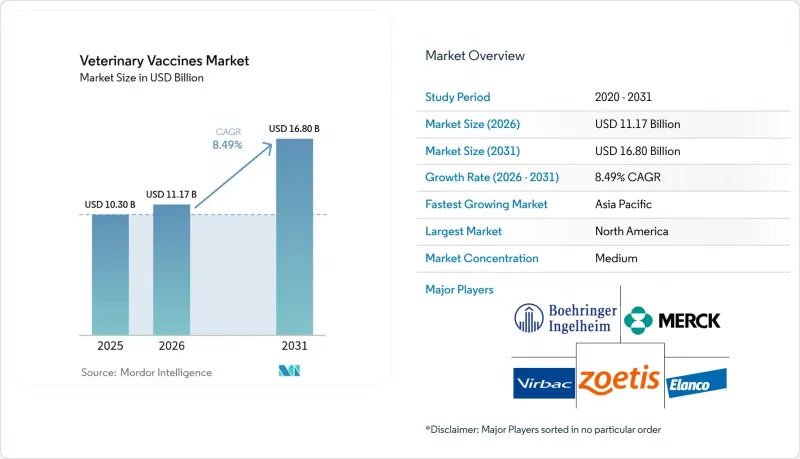
Mordor Intelligence에 의하면, 수의용 백신 시장 규모는 2025년에 103억 달러로 평가되었습니다. 2026년 111억 7,000만 달러에서 2031년까지 168억 달러에 이를 것으로 예상되며, 예측 기간(2026-2031년) CAGR은 8.49%를 나타낼 전망입니다.
본 보고서는 동물 종(가축용 백신, 반려동물용 백신), 기술(약독 생백신, 토ксо이드 등), 대상 질병(구제역, 뉴캐슬병 등),투여 경로(비경구 투여, 경구 투여 등), 유통 채널(동물병원 및 진료소 등) 및 지역별로 분류되어 있습니다. 시장 예측은 금액(달러) 기준으로 제시되어 있습니다.
세계의 수의용 백신 시장 동향 및 인사이트
국경을 넘는 가축 전염병의 확산
국경을 넘는 동물 질병은 이제 지속적인 수요 충격처럼 작용하여 백신 접종의 기준량을 영구적으로 끌어올리고 있습니다. 국제수역사무국(OIE)은 2024년부터 2025년에 걸쳐 76개국에서 4,782건의 고병원성 조류인플루엔자 발생을 기록했습니다. 여기에는 미국에서 낙농용 가축에서 사상 최초로 검출된 사례도 포함되어 있으며, 그 결과 1억 마리 이상의 가금류가 살처분되었습니다. 독일은 2024년 6월 국내 최초의 아프리카 돼지열병(ASF) 발생을 확인했으며, 필리핀은 같은 기간 동안 사육 중인 돼지 수의 15%를 잃었습니다. 이러한 위기에 대응하여 유엔 식량농업기구(FAO)와 세계동물보건기구(WOAH)는 2025년에 5억 달러 규모의 아프리카 돼지열병 대책 프로그램을 출범시키고, 가격 변동의 영향을 받지 않는 다년 계약을 통해 백신 공급을 확보했습니다.
반려동물 사육 마릿수 및 지출 증가
2025년, 미국 가구가 기르는 개는 8,970만 마리, 고양이는 7,380만 마리에 달했으나, 반려인들이 원격 진료와 온라인 약국을 이용하기 시작하면서 수의 의료비는 전년 대비 4% 감소했습니다. 현재 많은 주에서 면허를 소지한 수의사가 화상 진료를 통해 필수 백신을 처방할 수 있게 되었으며, 이를 통해 전자상거래(EC) 플랫폼이 광견병 및 디스템퍼 추가 접종용 백신을 가정에 직접 배송할 수 있게 되었습니다. 그러나 2025년에 수의사의 진료를 받은 고양이 반려인은 고작 57.3%에 그쳤으며, 이는 고양이의 백신 접종률이 여전히 미흡함을 시사합니다. 따라서 연평균 성장률(CAGR) 12.32%를 기록하는 전자상거래 채널을 공략하고자 하는 제조업체들은 적절한 시기에 예방접종을 받는 것의 중요성을 설명하는 소비자 교육에 투자해야 합니다.
신흥 시장의 콜드체인 과제
FAO의 추정에 따르면, 사하라 사막 이남의 아프리카에서는 운송 중 장시간 8℃를 넘는 온도에 노출되어 가축용 백신의 최대 40%가 사용 전에 효능을 상실하는 것으로 알려져 있습니다. 열안정성이 뛰어난 DNA 형태에 대한 기대가 높아지고 있지만, 각국 당국은 안정성에 관한 자료를 평가할 능력이 부족한 경우가 많아, 이로 인해 등록까지 최대 5년이 소요될 수도 있습니다. 통일된 기준이 확립되기 전까지는 미비한 인프라가 더운 기후 지역에서의 보급을 저해할 것입니다.
부문 분석
2025년, 가축용 제품은 수의학 백신 시장 점유율의 63.55%를 차지했으며, 항생제 내성 문제로 인해 일상적인 항생제 사용이 단계적으로 폐지되는 가운데, 이 부문은 연평균 성장률(CAGR) 9.85%로 성장할 것으로 전망됩니다. 인도, 브라질 및 일부 아프리카 국가에서 정부 자금을 통한 브루셀라증 및 구제역 근절 대책으로 인해, 소용 백신 프로그램은 계속해서 견조한 추세를 보이고 있습니다. 미국에서는 농장별로 승인되는 돼지용 자가 제조 제제를 통해 생산자가 시판 백신 업데이트 버전보다 더 신속하게 바이러스 변이에 대응할 수 있습니다. 가금류용 백신은 부화장에서의 분무 및 난내 주사 프로토콜을 통해 생후 1일 된 병아리에 대해 거의 100%의 접종률을 달성하고 있기 때문에 수량 기준으로는 가금류용 백신이 주류를 차지하고 있습니다.
2025년에는 반려동물용 백신이 시장 점유율의 36.45%를 차지했으나, 추가 접종 간격 연장 및 진료소에서의 진료를 원격의료가 부분적으로 대체하고 있는 점으로 인해 역풍에 직면해 있습니다. 개용 핵심 백신인 광견병 및 디스템퍼 주사는 대부분의 관할 구역에서 여전히 의무화되어 있어 안정적인 수익 기반이 되고 있지만, 라임병 부스터 접종과 같은 선택적 제품은 항체 역가 검사의 보급으로 인해 시장 점유율이 하락하고 있습니다. 고양이의 백신 접종률은 개에 비해 낮은 경향이 있는데, 이는 실내에서 기르는 고양이는 위험이 낮다고 인식되기 때문입니다. 각 공급업체들은 소비자에 대한 직접적인 계몽 활동을 통해 이러한 격차를 해소하고자 하고 있습니다.
2025년에는 생백신이 매출의 50.53%를 차지했으며, 이는 가금류와 소에서 수십 년에 걸친 사용 실적을 반영한 것입니다. 재조합 백신 및 서브유닛 제제의 수의학용 백신 시장은 박멸 캠페인에서 DIVA(진단용 바이러스) 준수가 요구됨에 따라 2031년까지 연평균 성장률(CAGR) 10.75%로 급속히 확대될 것으로 예측됩니다. 유럽에서 승인된 재조합 ASF 백신 후보는 진단용 표적 유전자를 제거하여, 이를 통해 가축 무리가 감염되지 않았음을 증명하고 수출 자격을 회복할 수 있게 됩니다.
불활성화 백신은 다회 접종 프로토콜로 인해 인건비가 증가하는 경우나, 임신 중인 동물, 역변이 위험을 우려하는 지역에서 계속해서 사용되고 있습니다. DNA, mRNA 및 VLP 기술은 2024년에 발표된 지침에 힘입어 신흥 틈새 시장을 점유하고 있지만, 제조 비용은 기존 제품 라인에 비해 여전히 5배에서 10배 더 높습니다. 보다 광범위한 도입은 아시아태평양의 제조 규모와 승인 절차의 효율화에 달려 있습니다.
지역별 분석
북미는 2025년에 전 세계 매출의 32.62%를 차지했으며, 그 배경에는 같은 해 90억 마리 이상의 육계에 백신 접종을 실시한 수직 통합형 가금류 생산 시스템이 있었습니다. 반려동물 시장의 포화 상태와 동물병원 내원 건수 감소로 인해 상승 여력은 제한적이지만, 2024년부터 2025년에 걸쳐 고병원성 조류 인플루엔자(HPAI) 대책으로 8억 2,400만 달러의 긴급 자금이 투입되면서 수주가 일시적으로 급증했습니다. 멕시코에서는 돼지고기 및 가금류 부문이 확대되고 있으며, 콜드체인이 개선되면 추가적인 성장이 예상됩니다.
아시아태평양은 성장세가 가장 두드러지는 지역으로, 2031년까지 연평균 성장률(CAGR)이 9.72%로 성장을 지속하고 있습니다. 아프리카 돼지열병(ASF) 이후 중국의 양돈군 재건과 인도의 구제역 및 브루셀라증 백신 공공 조달이 수요의 기반을 형성하고 있습니다. 일본과 한국은 생산량 안정화를 위해 가금류에 대한 백신 접종을 의무화하고 있는 반면, 호주 및 뉴질랜드는 수출 대상 시장의 엄격한 위생 기준을 충족해야 하는 수출 지향형 가축에 중점을 두고 있습니다.
유럽은 규제 측면에서의 리더십을 발휘하여 2024년에 DNA 백신 지침을 발표했고, 2025년에는 재조합 ASF 백신 후보를 승인했습니다. 독일, 프랑스, 스페인은 가축 사육 두수가 많아 사용량이 다른 국가들을 압도하고 있지만, 환경 정책의 압력으로 인해 전체 가축 사육 두수는 계속 줄어들고 있습니다. 영국이 1,250만 파운드를 투자하는 백신 이니셔티브는 브렉시트 이후 자국 내 생산을 위한 노력을 보여줍니다.
중동 및 아프리카에서는 FAO(유엔 식량농업기구)가 지원하는 프로그램을 통해 최후발 개발도상국에서의 백신 접종이 지원되고 있어, 그 보급이 확대되고 있습니다. GCC(걸프협력회의) 국가들은 사우디아라비아의 새로운 ‘국립동물보건센터’를 필두로, 국내 바이오 제조에 대한 투자를 추진하고 있습니다. 남미에서는 브라질의 가금류 수출과 아르헨티나의 급속히 확대되는 양돈 생산 능력을 배경으로 시장이 성장하고 있으며, 두 국가 모두 아시아의 구매자에게 백신 접종 증명서를 제출해야 합니다.
기타 혜택 :
- 엑셀 형식 시장 예측(ME) 시트
- 3개월간의 애널리스트 지원
자주 묻는 질문
목차
제1장 서론
제2장 조사 방법
제3장 주요 요약
제4장 시장 구도
제5장 시장 규모 및 성장 예측
제6장 경쟁 구도
제7장 시장 기회 및 향후 전망
KTH 26.08.26According to Mordor Intelligence, the veterinary vaccines market size was valued at USD 10.30 billion in 2025 and is estimated to grow from USD 11.17 billion in 2026 to reach USD 16.80 billion by 2031, at a CAGR of 8.49% during the forecast period (2026-2031).
This report is Segmented by Animal Type (Livestock Animal Vaccines, Companion Animal Vaccines), Technology (Live Attenuated, Toxoid, and More), Disease Indication (FMD, Newcastle Disease, and More), Route of Administration (Parenteral, Oral, and More), Distribution Channel (Veterinary Hospitals & Clinics, and More), and Geography. The Market Forecasts are Provided in Terms of Value (USD).
Global Veterinary Vaccines Market Trends and Insights
Growing Transboundary Livestock Outbreaks
Cross-border animal diseases now behave like rolling demand shocks, permanently raising baseline vaccination volumes. The World Organisation for Animal Health logged 4,782 highly pathogenic avian influenza events across 76 countries during 2024-2025, including first-ever detections in United States dairy herds that led to the cull of more than 100 million poultry. Germany confirmed its first domestic ASF case in June 2024, and the Philippines lost 15% of its swine inventory in the same period. These crises pushed the FAO and WOAH to launch a USD 500 million ASF control pathway in 2025, locking in multi-year vaccine contracts that are insensitive to price swings.
Rising Companion-Animal Ownership and Spend
United States households owned 89.7 million dogs and 73.8 million cats in 2025, yet veterinary spending declined 4% year over year as owners embraced telemedicine and online pharmacies. Many states now allow licensed practitioners to prescribe core vaccines through video consultations, enabling e-commerce platforms to dispatch rabies and distemper boosters directly to homes. However, just 57.3% of cat owners saw a veterinarian in 2025, suggesting feline coverage remains suboptimal. Manufacturers that hope to capture the 12.32% CAGR e-commerce channel must therefore invest in consumer education that explains the preventive value of timely shots.
Cold-Chain Gaps in Emerging Markets
The FAO estimates that up to 40% of livestock doses in sub-Saharan Africa lose potency before use because transport exceeds 8 °C for extended periods. Thermostable DNA formats hold promise, but national authorities often lack the capacity to evaluate stability dossiers, prolonging registration by as much as five years. Until uniform standards emerge, poor infrastructure will cap penetration in hot climates.
Other drivers and restraints analyzed in the detailed report include:
- Government-Funded Mass-Vaccination Programs
- Commercial Poultry Integration Boosting Biosecurity Demand
- Shortage of Large-Animal Veterinarians and Vaccinators
For complete list of drivers and restraints, kindly check the Table Of Contents.
Segment Analysis
Livestock products captured 63.55% of the Veterinary vaccines market share in 2025, and the segment is projected to grow at a 9.85% CAGR as antimicrobial resistance drives the phase-out of routine antibiotics. Bovine programs remain buoyed by state-funded brucellosis and FMD eradication drives in India, Brazil, and several African nations. Porcine autogenous formulations, licensed on a farm-by-farm basis in the United States, let producers match viral drift faster than commercial updates. Poultry doses dominate volume terms because hatchery spray and in-ovo injection protocols deliver near-universal coverage for day-old chicks.
Companion-animal vaccines held 36.45% in 2025 but confront headwinds from longer booster intervals and telemedicine's partial substitution for in-clinic care. Core canine rabies and distemper injections remain mandatory in most jurisdictions, anchoring a steady revenue floor, yet discretionary products such as Lyme disease boosters lose ground to antibody titre testing. Feline uptake trails canine because indoor cats are perceived as lower risk, a gap that suppliers hope to close through direct-to-consumer education.
Live attenuated formats owned 50.53% of revenue in 2025, reflecting decades of use in poultry and cattle. The Veterinary vaccines market for recombinant and subunit products is expected to grow rapidly, expanding at a 10.75% CAGR through 2031 as eradication campaigns demand DIVA compliance. Recombinant ASF candidates approved in Europe delete diagnostic target genes, allowing herds to prove freedom from infection and regain export access.
Inactivated doses continue to serve pregnant animals and regions wary of reversion risk, though multi-shot protocols inflate labor costs. DNA, mRNA, and VLP technologies occupy an emerging niche supported by guidelines issued in 2024, yet production expenses remain five to ten times higher than conventional lines. Wider rollout depends on manufacturing scale and streamlined approval pathways in the Asia-Pacific.
Complete Report Scope:
- By Animal Type
- Livestock Animal Vaccines
- Bovine
- Porcine
- Poultry
- Other Livestock (Small Ruminants, Aquaculture, etc.)
- Companion Animal Vaccines
- Canine
- Feline
- Equine
- Livestock Animal Vaccines
- By Technology
- Live Attenuated
- Inactivated / Killed
- Toxoid
- Recombinant / Sub-unit
- Other Technologies (DNA, mRNA, VLP, etc.)
- By Disease Indication
- Foot-and-Mouth Disease (FMD)
- Newcastle Disease
- Porcine Reproductive & Respiratory Syndrome (PRRS)
- Rabies
- Brucellosis
- Avian Influenza
- Canine Parvovirus
- Other Indications
- By Route of Administration
- Parenteral (Injection)
- Oral
- Intranasal
- Transdermal / Needle-free
- Other Routes
- By Distribution Channel
- Veterinary Hospitals & Clinics
- Retail Pharmacies & Agri-Stores
- Online / e-Commerce
- By Geography
- North America
- United States
- Canada
- Mexico
- Europe
- Germany
- United Kingdom
- France
- Italy
- Spain
- Rest of Europe
- Asia-Pacific
- China
- India
- Japan
- Australia
- South Korea
- Rest of Asia-Pacific
- Middle East and Africa
- GCC
- South Africa
- Rest of Middle East and Africa
- South America
- Brazil
- Argentina
- Rest of South America
- North America
Geography Analysis
North America held 32.62% of global revenue in 2025, supported by vertically integrated poultry systems that vaccinated more than 9 billion broilers during the year. Companion-animal saturation and declining clinic visits limit upside, yet emergency funding worth USD 824 million for HPAI during 2024-2025 produced a temporary spike in orders. Mexico's expanding pork and poultry sectors promise incremental growth once cold-chain improvements roll out.
Asia-Pacific is the fastest-growing territory, registering a 9.72% CAGR to 2031. China's hog-herd reconstruction after ASF and India's public procurement of FMD and brucellosis vaccines underpin demand. Japan and South Korea enforce mandatory poultry vaccination to improve volume stability, while Australia and New Zealand focus on export-oriented livestock that must meet stringent health rules at destination markets.
Europe benefits from regulatory leadership, having released DNA-vaccine guidelines in 2024 and approved recombinant ASF candidates in 2025. Germany, France, and Spain dominate usage due to large animal populations, though overall herd sizes continue to shrink under environmental policy pressure. The United Kingdom's GBP 12.5 million vaccine initiative indicates a post-Brexit drive for sovereign production.
The Middle East and Africa are catching up as FAO-backed programs subsidize doses in least-developed economies. The GCC is investing in domestic biomanufacturing, led by Saudi Arabia's new National Center for Animal Health facility. South America grows on the back of Brazil's poultry exports and Argentina's fast-rising swine capacity, both of which must document vaccination for Asian buyers.
- AdvaCare Pharma USA LLC
- Bimeda Biologicals, LLC
- Biogenesis Bago S.A.
- Boehringer Ingelheim
- Ceva Sante Animale S.A.
- Colorado Serum Company
- Elanco
- Hester Biosciences
- HIPRA, S.A.
- Huvepharma
- Indian Immunologicals
- Laboratorios Calier, S.A.
- Merck & Co., Inc. (MSD Animal Health)
- Neogen
- Ourofino Saude Animal
- Phibro Animal Health
- Qingdao Yebio Bioengineering Co., Ltd.
- Vaxxinova International B.V.
- Virbac S.A.
- Zoetis
Additional Benefits:
- The market estimate (ME) sheet in Excel format
- 3 months of analyst support
TABLE OF CONTENTS
1 Introduction
- 1.1 Study Assumptions & Market Definition
- 1.2 Scope of the Study
2 Research Methodology
3 Executive Summary
4 Market Landscape
- 4.1 Market Overview
- 4.2 Market Drivers
- 4.2.1 Growing Transboundary Livestock Outbreaks
- 4.2.2 Rising Companion-Animal Ownership and Spend
- 4.2.3 Government-Funded Mass-Vaccination Programs
- 4.2.4 Commercial Poultry Integration Boosting Biosecurity Demand
- 4.2.5 Precision-Livestock Analytics Enabling Micro-Targeted Immunization
- 4.2.6 Emergence of Autogenous and Thermostable Vaccines Amid AMR Curbs
- 4.3 Market Restraints
- 4.3.1 Cold-Chain Gaps in Emerging Markets
- 4.3.2 Shortage of Large-Animal Veterinarians and Vaccinators
- 4.3.3 Regulatory Bottlenecks for Novel Vector and Mrna Veterinary Vaccines
- 4.3.4 Rising Anti-Vaccination Sentiment among Smallholders
- 4.4 Supply-Chain Analysis
- 4.5 Regulatory Landscape
- 4.6 Technological Outlook
- 4.7 Porter's Five Forces Analysis
- 4.7.1 Threat of New Entrants
- 4.7.2 Bargaining Power of Buyers
- 4.7.3 Bargaining Power of Suppliers
- 4.7.4 Threat of Substitutes
- 4.7.5 Intensity of Competitive Rivalry
5 Market Size & Growth Forecasts (Value, USD)
- 5.1 By Animal Type
- 5.1.1 Livestock Animal Vaccines
- 5.1.1.1 Bovine
- 5.1.1.2 Porcine
- 5.1.1.3 Poultry
- 5.1.1.4 Other Livestock (Small Ruminants, Aquaculture, etc.)
- 5.1.2 Companion Animal Vaccines
- 5.1.2.1 Canine
- 5.1.2.2 Feline
- 5.1.2.3 Equine
- 5.1.1 Livestock Animal Vaccines
- 5.2 By Technology
- 5.2.1 Live Attenuated
- 5.2.2 Inactivated / Killed
- 5.2.3 Toxoid
- 5.2.4 Recombinant / Sub-unit
- 5.2.5 Other Technologies (DNA, mRNA, VLP, etc.)
- 5.3 By Disease Indication
- 5.3.1 Foot-and-Mouth Disease (FMD)
- 5.3.2 Newcastle Disease
- 5.3.3 Porcine Reproductive & Respiratory Syndrome (PRRS)
- 5.3.4 Rabies
- 5.3.5 Brucellosis
- 5.3.6 Avian Influenza
- 5.3.7 Canine Parvovirus
- 5.3.8 Other Indications
- 5.4 By Route of Administration
- 5.4.1 Parenteral (Injection)
- 5.4.2 Oral
- 5.4.3 Intranasal
- 5.4.4 Transdermal / Needle-free
- 5.4.5 Other Routes
- 5.5 By Distribution Channel
- 5.5.1 Veterinary Hospitals & Clinics
- 5.5.2 Retail Pharmacies & Agri-Stores
- 5.5.3 Online / e-Commerce
- 5.6 By Geography
- 5.6.1 North America
- 5.6.1.1 United States
- 5.6.1.2 Canada
- 5.6.1.3 Mexico
- 5.6.2 Europe
- 5.6.2.1 Germany
- 5.6.2.2 United Kingdom
- 5.6.2.3 France
- 5.6.2.4 Italy
- 5.6.2.5 Spain
- 5.6.2.6 Rest of Europe
- 5.6.3 Asia-Pacific
- 5.6.3.1 China
- 5.6.3.2 India
- 5.6.3.3 Japan
- 5.6.3.4 Australia
- 5.6.3.5 South Korea
- 5.6.3.6 Rest of Asia-Pacific
- 5.6.4 Middle East and Africa
- 5.6.4.1 GCC
- 5.6.4.2 South Africa
- 5.6.4.3 Rest of Middle East and Africa
- 5.6.5 South America
- 5.6.5.1 Brazil
- 5.6.5.2 Argentina
- 5.6.5.3 Rest of South America
- 5.6.1 North America
6 Competitive Landscape
- 6.1 Market Concentration
- 6.2 Market Share Analysis
- 6.3 Company Profiles (includes Global level Overview, Market level overview, Core Segments, Financials as available, Strategic Information, Market Rank/Share for key companies, Products & Services, and Recent Developments)
- 6.3.1 AdvaCare Pharma USA LLC
- 6.3.2 Bimeda Biologicals, LLC
- 6.3.3 Biogenesis Bago S.A.
- 6.3.4 Boehringer Ingelheim International GmbH
- 6.3.5 Ceva Sante Animale S.A.
- 6.3.6 Colorado Serum Company
- 6.3.7 Elanco Animal Health Incorporated
- 6.3.8 Hester Biosciences Limited
- 6.3.9 HIPRA, S.A.
- 6.3.10 Huvepharma
- 6.3.11 Indian Immunologicals Ltd.
- 6.3.12 Laboratorios Calier, S.A.
- 6.3.13 Merck & Co., Inc. (MSD Animal Health)
- 6.3.14 Neogen Corporation
- 6.3.15 Ourofino Saude Animal
- 6.3.16 Phibro Animal Health Corporation
- 6.3.17 Qingdao Yebio Bioengineering Co., Ltd.
- 6.3.18 Vaxxinova International B.V.
- 6.3.19 Virbac S.A.
- 6.3.20 Zoetis Inc.
7 Market Opportunities & Future Outlook
- 7.1 White-space & Unmet-Need Assessment