
|
시장보고서
상품코드
2113674
자동차 진단 툴 : 시장 점유율 분석, 업계 동향 및 통계, 성장 예측(2026-2031년)Automotive Diagnostic Tools - Market Share Analysis, Industry Trends & Statistics, Growth Forecasts (2026 - 2031) |
||||||
 Mordor Intelligence
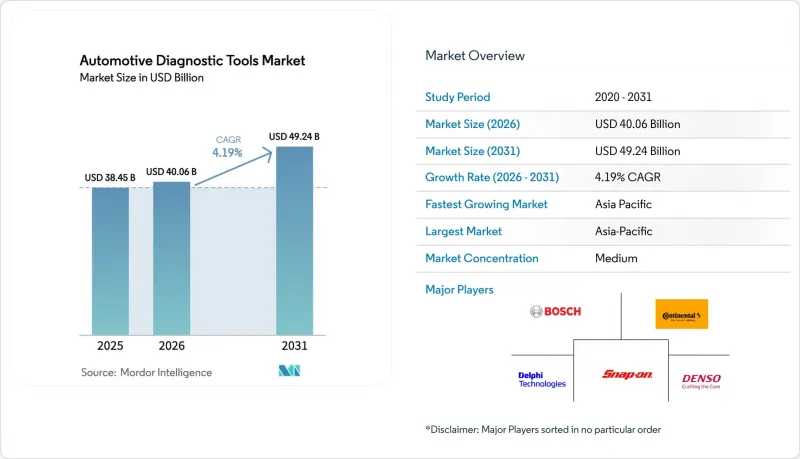
Mordor Intelligence에 의하면, 2026년 자동차 진단 툴 시장 규모는 400억 6,000만 달러로 추정되고 2025년 384억 5,000만 달러에서 확대해, 2031년에는 492억 4,000만 달러에 이를 것으로 예측됩니다.
2026년부터 2031년까지의 연평균 성장률(CAGR)은 4.19%를 나타낼 전망입니다.
본 보고서는 도구 유형(OBD 스캐너, 전문가용 스캔 도구 등), 차종(승용차, 소형 상용차 등), 추진 방식(내연기관 등), 연결 방식(유선·무선 및 블루투스/Wi-Fi),최종 사용자(OEM 딜러 등), 그리고 지역별로 분류되어 있습니다. 시장 전망은 금액(미 달러) 및 수량(대수)으로 제시되어 있습니다.
세계의 자동차 진단 툴 시장 동향 및 인사이트
파워트레인의 급속한 전기화
배터리식 전기차 모델에서는 표준 OBD-II 리더기로는 읽을 수 없는 고전압 회로, 열 관리 시스템, 양방향 충전기가 사용되고 있습니다. 캘리포니아주에서는 2026년까지 통일된 EV 진단 인터페이스가 의무화될 예정이며, 공급업체는 브랜드에 관계없이 배터리 상태, 절연 저항, 충전기 고장을 분석해야 합니다. Fluke FEV150과 같은 충전소용 분석기가 전력망과의 상호 작용을 검증하기 위해 정비소에 도입되기 시작했습니다. 이에 대응하여 공급업체들은 80개 이상의 브랜드를 지원하는 THINKTOOL CE EVD와 같이 전기차 전용으로 설계된 테스터를 통해 대응하고 있습니다. 정비사의 자격 취득이 차량 도입 속도를 따라가지 못하고 있어, 경험이 부족한 기술자를 지원하는 데이터가 풍부한 도구가 시장 점유율을 확대되고 있습니다.
OBD-III/원격 진단 규제 강화
SAE J1979-2 규격에서는 2027년 이후 판매되는 내연기관 차량에 대해 통일된 진단 서비스 지원을 의무화하고 있으며, 향후 도입될 J1979-3 규격은 제로 배출 차량을 대상으로 합니다. 또한 CARB 및 EU 규제 당국도 실시간 클라우드 기반 고장 보고를 추진하고 있어, 이에 따라 서비스는 정비소에서 데이터센터로 이전되고 있습니다. 대형 도구 제조업체들은 소규모 경쟁사들이 자금 조달하기 어려운 보안 게이트웨이 인증 및 ISO/SAE 21434 프로세스에 투자하고 있습니다. GVWR(총 차량 중량)이 14,000파운드를 초과하는 대형 엔진은 40 CFR 86.010-18에 따라 병렬 모니터링이 의무화되어 있습니다. 원격 아키텍처를 통해 차량 운영사는 고장이 발생하기 전에 정비 일정을 잡을 수 있어 예기치 않은 가동 중단 시간을 줄일 수 있습니다.
고급 스캔 도구의 높은 초기 비용
최고급 ADAS 보정 장비나 고전압 분석기는 작업 베이 1대당 5만 달러를 초과하는 경우도 있어, 소규모 정비소에게는 큰 부담이 됩니다. 일본 정부가 제공하는 점포당 최대 16만 엔의 보조금도 하드웨어 및 교육에 드는 총 비용의 극히 일부에만 충당될 뿐입니다. 구독 기반 업데이트는 소유 비용을 증가시키지만, 보안 게이트웨이에 접근하기 위해서는 필수적입니다. 이러한 경제적 요인으로 인해 독립 정비소는 프랜차이즈 네트워크나 asTech와 같이 OEM 도구를 온디맨드로 대여할 수 있는 원격 서비스 플랫폼으로 전환하는 경향을 보이고 있습니다.
부문 분석
OBD 스캐너는 1996년 이후의 모든 승용차 모델에 대응하기 때문에 2025년에는 자동차 진단 툴 시장에서 44.12%라는 최대 점유율을 차지했습니다. 이 범주에 속하는 자동차 진단 툴 시장 규모는 여전히 확대되고 있지만, 현대의 정비 현장에서는 기존의 휴대용 진단 툴에는 없는 ADAS, 고전압, 클라우드 동기화 기능을 겸비한 도구가 요구되고 있습니다. Snap-on이 2025년 봄에 출시한 코드 라이브러리에는 메르세데스-벤츠용 수백만 건의 테스트 항목과 보안 게이트웨이가 추가되어, 범용 하드웨어에 OEM 수준의 기능을 통합하기 위한 경쟁이 치열해지고 있음을 여실히 보여주고 있습니다.
전기 시스템 분석기는 5.88%라는 가장 높은 연평균 성장률(CAGR)을 기록하고 있으며, 라이브 텔레메트리 업로드 중에도 처리량을 유지하는 블루투스 5.0 및 듀얼 밴드 Wi-Fi 모듈이 핵심 요소로 작용하고 있습니다. 압력 누출 테스터와 배터리 절연 프로브는 EV 팩의 열 안전성을 확보함으로써 코어 스캐너를 보완하고 있으며, Redline Detection사의 장비는 차량 안전 인증을 획득했습니다. 공급업체들은 여러 센서 하네스를 하나의 섀시에 통합함으로써 비용을 각 작업에 분산시키고, 예산에 민감한 정비소에서도 가격 프리미엄을 정당화하고 있습니다.
2025년, 승용차는 정기적인 배기가스 검사 및 안전 검사에 힘입어 자동차 진단 툴 시장 점유율의 60.74%를 유지했습니다. 그러나 도구 사양 동향을 주도하고 있는 것은 차량 함대용 밴과 트럭입니다. 전자상거래의 확장으로 배송 주기가 가속화되고 가동 중단이 허용되지 않는 상황이 되는 가운데, 소형 상용차는 2031년까지 연평균 성장률(CAGR) 6.05%를 나타낼 것으로 예측됩니다. 인터내셔널 트럭(International Truck)의 ‘OnCommand Connection’과 같은 플랫폼은 실시간 성능 데이터를 클라우드 대시보드로 전송하고 예방적 정비 요청을 촉진함으로써, 도로변에서 발생하는 고장을 줄이고 있습니다.
총중량(GVWR)이 1만 4,000파운드를 초과하는 대형 트럭은 더욱 엄격한 CFR 진단 기준을 준수하고 있으며, 멀티 브랜드 지원 장치에 대한 프로토콜 지원 요건이 확대되고 있습니다. 보쉬의 ‘Vehicle Health’ 보고서는 현재 혼합 차량 군에서 냉각수 및 오일의 이상 수치를 강조 표시하고 있어, 유지보수 관리자가 엔진 손상이 발생하기 전에 문제를 해결할 수 있도록 지원하고 있습니다. 배송용 밴에서도 전동화가 진행되는 가운데, 도구 제조업체는 내연 기관과 배터리의 분석을 단일 워크플로우로 통합하여 기술자의 학습 곡선을 완화하고 재고 관리를 원활하게 해야 합니다.
지역별 분석
아시아태평양은 2025년에 자동차 진단 툴 시장 점유율의 36.05%를 차지했으며, 연평균 성장률(CAGR) 7.52%로 가장 빠르게 성장하고 있습니다. 2023년 중국의 전기차 생산 대수가 50% 급증한 데 더해, 10조 위안 규모의 자동차 매출 기준이 도구 수요를 견고하게 뒷받침하고 있습니다. 2025년까지 자율주행 차량 함대를 추진하려는 베이징의 노력에는 출동 전 레이더 위치 조정 및 라이더의 오염 여부를 확인하는 V2X 지원 진단 툴이 필요합니다. 일본은 2024년 10월부터 OBD 검사를 의무화하고, 규제 준수를 확보하기 위해 정비 공장의 스캔 툴 구매를 지원하고 있습니다. 인도에서는 ASK Auto와 아이신(Aisin)의 애프터마켓 분야 합작 사업을 통해 남아시아 전역으로 부품 및 서비스 네트워크가 확대되면서, 2급 도시에서의 스캔 툴 보급률이 향상되고 있습니다.
북미에서도 규제 측면의 강력한 추세가 이어지고 있습니다. 캘리포니아주의 ‘Advanced Clean Cars II’ 규정에 따라 2026년까지 전기차(EV) 진단 표준화가 의무화되었으며, CARB(캘리포니아 대기자원국)는 현장 검사의 필요성을 없애는 원격 OBD 개념을 시범적으로 도입하고 있습니다. 플릿 사업자들은 유지보수 예산을 최적화하기 위해 Uptake사의 AI 헬스 보고서를 채택하고 있으며, 데이터를 클라우드 대시보드로 전송하는 도구의 업그레이드를 촉진하고 있습니다. OEM 딜러는 Snap-on사의 2025년 소프트웨어 업데이트를 통해 메르세데스-벤츠 등 브랜드를 대상으로 보안 게이트웨이 잠금 해제 기능을 추가하고 있습니다.
유럽에서는 진단 인터페이스의 형식 인증 감사를 의무화하는 유엔 R155 사이버 보안 규정을 준수하고 있습니다. 주요 공급업체들은 이러한 감사 요건을 충족하기 위해 ISO/SAE 21434 프레임워크를 도입하고 있으며, 프랜차이즈 정비소는 기업의 규정 준수 대응의 혜택을 받고 있습니다. 자동차산업협회(IMI)가 인증하는 교육 프로그램을 통해, 특히 고전압 시스템 정비와 관련된 기술 격차가 해소되고 있습니다.
기타 혜택 :
- 엑셀 형식 시장 예측(ME) 시트
- 3개월간의 애널리스트 지원
자주 묻는 질문
목차
제1장 서론
제2장 조사 방법
제3장 주요 요약
제4장 시장 구도
제5장 시장 규모 및 성장 예측
제6장 경쟁 구도
제7장 시장 기회 및 향후 전망
KTH 26.08.26According to Mordor Intelligence, automotive diagnostic tools market size in 2026 is estimated at USD 40.06 billion, growing from 2025 value of USD 38.45 billion with 2031 projections showing USD 49.24 billion, growing at 4.19% CAGR over 2026-2031.
This report is Segmented by Tool Type (OBD Scanners, Professional Scan Tools, and More), Vehicle Type (Passenger Cars, Light Commercial Vehicles, and More), Propulsion (Internal Combustion Engine and More), Connectivity (Wired and Wireless and Bluetooth / Wi-Fi), End User (OEM Dealerships and More), and Geography. The Market Forecasts are Provided in Terms of Value (USD) and Volume (Units).
Global Automotive Diagnostic Tools Market Trends and Insights
Rapid electrification of powertrains
Battery-electric models use high-voltage circuits, thermal packs, and bidirectional chargers that standard OBD-II readers cannot interrogate. California will require a unified EV diagnostic interface by 2026, forcing tool vendors to decode battery health, insulation resistance, and charger faults across brands. Charging-station analyzers such as Fluke FEV150 now join service bays to validate grid interaction. Suppliers answer with purpose-built EV testers like THINKTOOL CE EVD, covering more than 80 brands. Workforce certification lags vehicle rollout, so data-rich tools that guide less-experienced technicians win share.
Tightening OBD-III/remote diagnostics rules
SAE J1979-2 obliges combustion-engine vehicles sold from 2027 to support unified diagnostic services, while the forthcoming J1979-3 standard targets zero-emission models. CARB and EU regulators also press for real-time, cloud-based fault reporting that shifts service from the garage to the data center. Large tool makers invest in secure-gateway credentials and ISO/SAE 21434 processes that small rivals may struggle to fund. Heavy-duty engines above 14,000 lb GVWR face parallel monitoring mandates under 40 CFR 86.010-18. Remote architecture enables fleets to schedule service before breakdowns, reducing unplanned downtime.
High up-front cost of advanced scan tools
Top-tier ADAS calibration rigs and high-voltage analyzers can exceed USD 50,000 per bay, a stretch for small garages. Japan's subsidy of up to JPY 160,000 per shop offsets only a fraction of the total hardware plus training spend. Subscription updates compound ownership cost yet remain essential for secure-gateway access. These economics push independents toward franchise networks or remote-service platforms such as asTech that rent OEM tools on demand.
Other drivers and restraints analyzed in the detailed report include:
- Growing demand for predictive maintenance analytics
- Rising global light-vehicle parc
- Cyber-security certification hurdles
For complete list of drivers and restraints, kindly check the Table Of Contents.
Segment Analysis
OBD scanners secured the largest slice of the automotive diagnostic tools market at 44.12% in 2025 because they work on every post-1996 passenger model. The automotive diagnostic tools market size attached to this category still grows, yet modern service bays demand combined ADAS, high-voltage, and cloud-sync features that legacy handhelds lack. Snap-on's spring 2025 code library adds millions of tests and secure gateways for Mercedes-Benz, underscoring the race to embed OEM depth inside universal hardware.
Electric-System analyzers, posting the fastest 5.88% CAGR, hinge on Bluetooth 5.0 and dual-band Wi-Fi modules that maintain throughput during live telemetry uploads. Pressure leak testers and battery insulation probes complement the core scanner by ensuring thermal safety in EV packs, with Redline Detection equipment gaining fleet-safety endorsements. Suppliers integrate multiple sensor harnesses into one chassis to spread cost across tasks and justify price premiums amid budget-sensitive workshops.
Passenger cars retained 60.74% of the automotive diagnostic tools market share in 2025, supported by routine emissions and safety inspections. Fleet-oriented vans and trucks, however, drive tool specification trends. Light commercial vehicles grow at 6.05% CAGR to 2031 as e-commerce accelerates delivery cycles that punish downtime. Platforms like International Trucks' OnCommand Connection feed real-time performance data to cloud dashboards, prompting proactive service orders that cut roadside events.
Heavy rigs over 14,000 lb GVWR comply with stricter CFR diagnostics, expanding protocol support requirements inside multi-brand devices. Bosch Vehicle Health reports now highlight coolant and oil deviations on mixed fleets, letting maintenance managers address issues before engine damage. As electrification reaches delivery vans, tool makers must bridge combustion and battery analytics in a single workflow, smoothing technician learning curves and inventory.
Complete Report Scope:
- By Tool Type
- OBD Scanners
- Professional Scan Tools
- Electric-System Analyzers
- Pressure & Leak Testers
- Code Readers
- By Vehicle Type
- Passenger Cars
- Light Commercial Vehicles
- Medium and Heavy Commercial Vehicles
- By Propulsion
- Internal Combustion Engine
- Battery-Electric Vehicle
- Hybrid & Plug-in Hybrid
- By Connectivity
- Wired
- Wireless / Bluetooth / Wi-Fi
- By End User
- OEM Dealerships
- Independent Aftermarket Garages
- Fleet Operators
- Geography
- North America
- United States
- Canada
- Rest of North America
- South America
- Brazil
- Argentina
- Rest of South America
- Europe
- Germany
- United Kingdom
- France
- Italy
- Russia
- Rest of Europe
- Asia-Pacific
- China
- Japan
- India
- South Korea
- Australia
- Middle East and Africa
- GCC
- South Africa
- Rest of Middle East and Africa
- North America
Geography Analysis
Asia-Pacific holds 36.05% of the automotive diagnostic tools market share in 2025 and expands the fastest at 7.52% CAGR. China's 50% surge in EV production during 2023, plus a 10 trillion-yuan automotive revenue base, keeps tool demand buoyant. Beijing's push toward autonomous-mobility fleets by 2025 requires V2X-aware diagnostics that validate radar alignment and lidar cleanliness before dispatch. Japan begins obligatory OBD inspections in October 2024 and subsidizes scan-tool purchases for workshops to ensure compliance. India's aftermarket joint ventures between ASK Auto and AISIN extend parts and service networks across South Asia, lifting scan-tool penetration in tier-2 cities.
North America follows with strong regulatory momentum. California's Advanced Clean Cars II rule forces standardized EV diagnostics by 2026, and CARB pilots remote-OBD concepts that remove the need for physical inspection visits. Fleets adopt Uptake's AI health reports to optimize maintenance budgets, reinforcing tool upgrades that push data into cloud dashboards. OEM dealerships add secure-gateway unlocks for brands like Mercedes-Benz through Snap-on's 2025 software wave.
Europe aligns with UN R155 cybersecurity rules that demand type-approval audits for diagnostic interfaces. Large suppliers embed ISO/SAE 21434 frameworks to meet these audits, and franchise workshops benefit from corporate compliance coverage. Training schemes certified by the Institute of the Motor Industry close skill gaps, especially for high-voltage servicing.
- Robert Bosch GmbH
- Snap-on Inc.
- Continental AG
- Delphi/BorgWarner Technologies
- ACTIA Group
- Autel Intelligent Tech
- Launch Tech Co.
- Softing AG
- Vector Informatik GmbH
- KPIT Technologies Ltd.
- Hella KGaA Hueck & Co.
- Texa S.p.A.
- Siemens Digital Industries Software
- Foxwell Tech
- OBD Solutions LLC
- Denso Corporation
- Innova Electronics
- Pico Technology Ltd.
Additional Benefits:
- The market estimate (ME) sheet in Excel format
- 3 months of analyst support
TABLE OF CONTENTS
1 Introduction
- 1.1 Study Assumptions & Market Definition
- 1.2 Scope of the Study
2 Research Methodology
3 Executive Summary
4 Market Landscape
- 4.1 Market Overview
- 4.2 Market Drivers
- 4.2.1 Rapid electrification of powertrains
- 4.2.2 Tightening OBD-III/remote diagnostics regulations (U.S., EU)
- 4.2.3 Growing demand for predictive maintenance analytics
- 4.2.4 Rising global light-vehicle parc
- 4.2.5 Integration of OTA software update diagnostics
- 4.2.6 Escalating in-vehicle electronics complexity
- 4.3 Market Restraints
- 4.3.1 High up-front cost of advanced scan tools
- 4.3.2 Cyber-security certification hurdles for connected tools
- 4.3.3 Skills gap in independent aftermarket workshops
- 4.3.4 Fragmented communication standards across OEMs
- 4.4 Value/Supply-Chain Analysis
- 4.5 Regulatory Landscape
- 4.6 Technological Outlook
- 4.7 Porter's Five Forces
- 4.7.1 Threat of New Entrants
- 4.7.2 Bargaining Power of Buyers
- 4.7.3 Bargaining Power of Suppliers
- 4.7.4 Threat of Substitutes
- 4.7.5 Competitive Rivalry Intensity
5 Market Size & Growth Forecasts (Value (USD) and Volume (Units))
- 5.1 By Tool Type
- 5.1.1 OBD Scanners
- 5.1.2 Professional Scan Tools
- 5.1.3 Electric-System Analyzers
- 5.1.4 Pressure & Leak Testers
- 5.1.5 Code Readers
- 5.2 By Vehicle Type
- 5.2.1 Passenger Cars
- 5.2.2 Light Commercial Vehicles
- 5.2.3 Medium and Heavy Commercial Vehicles
- 5.3 By Propulsion
- 5.3.1 Internal Combustion Engine
- 5.3.2 Battery-Electric Vehicle
- 5.3.3 Hybrid & Plug-in Hybrid
- 5.4 By Connectivity
- 5.4.1 Wired
- 5.4.2 Wireless / Bluetooth / Wi-Fi
- 5.5 By End User
- 5.5.1 OEM Dealerships
- 5.5.2 Independent Aftermarket Garages
- 5.5.3 Fleet Operators
- 5.6 Geography
- 5.6.1 North America
- 5.6.1.1 United States
- 5.6.1.2 Canada
- 5.6.1.3 Rest of North America
- 5.6.2 South America
- 5.6.2.1 Brazil
- 5.6.2.2 Argentina
- 5.6.2.3 Rest of South America
- 5.6.3 Europe
- 5.6.3.1 Germany
- 5.6.3.2 United Kingdom
- 5.6.3.3 France
- 5.6.3.4 Italy
- 5.6.3.5 Russia
- 5.6.3.6 Rest of Europe
- 5.6.4 Asia-Pacific
- 5.6.4.1 China
- 5.6.4.2 Japan
- 5.6.4.3 India
- 5.6.4.4 South Korea
- 5.6.4.5 Australia
- 5.6.5 Middle East and Africa
- 5.6.5.1 GCC
- 5.6.5.2 South Africa
- 5.6.5.3 Rest of Middle East and Africa
- 5.6.1 North America
6 Competitive Landscape
- 6.1 Market Concentration
- 6.2 Strategic Moves
- 6.3 Market Share Analysis
- 6.4 Company Profiles (includes Global Level Overview, Market Level Overview, Core Segments, Financials as Available, Strategic Information, Market Rank/Share for Key Companies, Products and Services, SWOT Analysis, and Recent Developments)
- 6.4.1 Robert Bosch GmbH
- 6.4.2 Snap-on Inc.
- 6.4.3 Continental AG
- 6.4.4 Delphi/BorgWarner Technologies
- 6.4.5 ACTIA Group
- 6.4.6 Autel Intelligent Tech
- 6.4.7 Launch Tech Co.
- 6.4.8 Softing AG
- 6.4.9 Vector Informatik GmbH
- 6.4.10 KPIT Technologies Ltd.
- 6.4.11 Hella KGaA Hueck & Co.
- 6.4.12 Texa S.p.A.
- 6.4.13 Siemens Digital Industries Software
- 6.4.14 Foxwell Tech
- 6.4.15 OBD Solutions LLC
- 6.4.16 Denso Corporation
- 6.4.17 Innova Electronics
- 6.4.18 Pico Technology Ltd.
7 Market Opportunities & Future Outlook
- 7.1 Remote Diagnostics-as-a-Service
- 7.2 ADAS & Autonomous Calibration Tools
- 7.3 Subscription-based Software Licensing