

|
시장보고서
상품코드
2113761
마이크로 관개 시스템 : 시장 점유율 분석, 업계 동향과 통계, 성장 예측(2026-2031년)Micro-Irrigation Systems - Market Share Analysis, Industry Trends & Statistics, Growth Forecasts (2026 - 2031) |
||||||
 Mordor Intelligence
마이크로 관개 시스템 시장 규모는 2026년에 161억 달러에 달하며, 2031년까지 약 225억 달러에 달하며, CAGR은 7%를 기록할 것으로 예측됩니다.
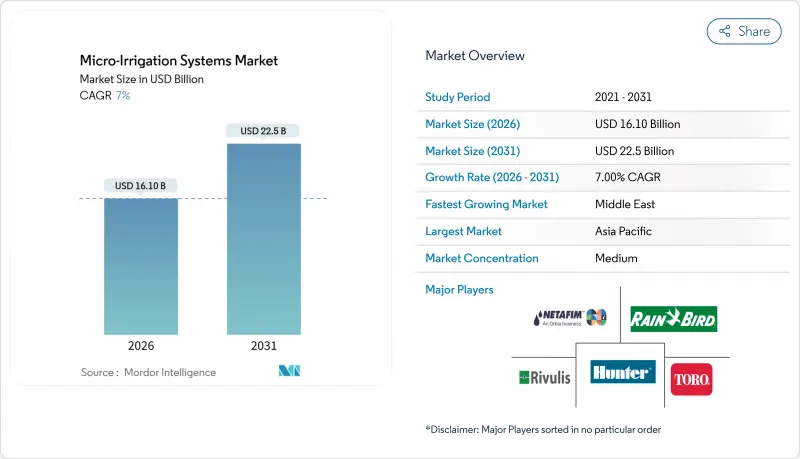
이 보고서는 방식별(점적 관개, 마이크로 스프링클러 관개 등), 구성 부품별(드리퍼 및 에미터, 튜브 및 점적 라인 등),작물별(밭작물 등), 최종사용자별(소규모 농가, 대규모 상업 농장 등) 및 지역별(북미, 유럽 등)로 분류되어 있습니다. 시장 규모 및 전망은 금액(달러) 기준으로 제시되어 있습니다.
전 세계 마이크로 관개 시스템 시장의 동향 및 인사이트
절수형 농업에 대한 정부 보조금
공적 자금 덕분에 투자 회수 기간이 단축되어, 담보가 없는 농가에서의 도입이 확대되고 있습니다. 인도의 ‘프라단 만트리 크리시 신차이 요자나(Pradhan Mantri Krishi Sinchayee Yojana)’에서는 2025 회계연도에 400억 인도 루피(4억 8,000만 달러)를 배정하여,소규모 농가의 시스템 비용 중 최대 55%를 보조하며, 추가로 50만 헥타르를 대상으로 하고 있습니다. 중국은 가뭄에 취약한 성에 대해 150억 위안(21억 달러)의 보조금을 지급했습니다. 사우디아라비아의 ‘비전 2030’에서는 자본 지출의 50%를 대추야자 및 채소 생산자에게 배정하고 있습니다. 이러한 인센티브로 인해 실질적인 자본 비용이 절감되어, 상품 가격이 침체된 시기에도 투자가 가능해졌습니다. 현재 요건에서는 센서의 번들화가 중시되고 있으며, 이것이 디지털화의 확산을 가속화하고 있습니다. 각국이 수자원 제약이 심화되는 가운데 식량안보 목표를 추구함에 따라 보조금의 기세는 앞으로도 지속될 전망이며, 이는 미세 관개 시스템에 대한 장기적인 수요를 지원하게 될 것입니다.
심화되는 물 부족과 빈번한 가뭄
이미 17개국이 재생 가능한 담수 자원의 80% 이상을 양수하고 있으며, 중력식 범람 관개에서 가압식 정밀 관개로 전환해야 한다는 구조적인 압력이 발생하고 있습니다. 모로코는 30년 만에 최악의 가뭄을 겪으면서 신규 과수원에 점적 관개 사용을 의무화하고, 2028년까지 범람 관개 시스템을 단계적으로 폐지하겠다고 공약했습니다. 캘리포니아주 규제 당국은 2025년, 새크라멘토-산호아킨 델타 지역의 취수권을 엄격히 규제하여 아몬드와 피스타치오 과수원의 지하 점적 관개로 전환을 촉진했습니다. 물 이용 효율의 향상은 결정적인 요소입니다. 점적 관개를 통한 채소 관개 용수 사용량은 헥타르당 3,000m³인 반면, 범람 관개를 통한 밀 재배는 8,000m³를 소비하지만, 채소의 매출 총이익은 3배나 더 높습니다. 이러한 경제적 이점으로 인해 건조 지역 전체에서 작물 선택이 재검토되고 있으며, 향후 10년 동안 미세 관개 시스템 시장을 주도할 것입니다.
소규모 농가에게 부담되는 높은 초기 도입 비용
턴키식의 점적 관개 시스템 비용은 헥타르당 1,200-1,800달러로, 남아시아나 동아프리카에서 2헥타르 미만의 농지를 소유한 농가에게는 6-12개월 치의 순농업소득에 해당합니다. 50%의 보조금을 받더라도 생산자들은 종자나 비료와 같은 필수품에 써야 할 귀중한 자금을 이 비용에 충당할 수밖에 없습니다. 또한 토지 소유권이 불안정하므로 자본을 회수하기도 전에 농지를 잃을까 두려워하는 농가는 투자 의욕을 더욱 잃고 있습니다. 모듈식 키트는 도입 장벽을 낮추지만, 그 대신 수력 효율이 떨어지고 유지보수도 복잡해집니다. 사하라 이남 아프리카에서는 은행 대출에서 농업이 차지하는 비중이 5% 미만이며, 무담보 대출 금리가 20%를 초과하여 대출 이용을 제한하고 있습니다. 자금 조달 혁신이 빠르게 확산되지 않는 한, 높은 가격으로 인한 충격이 소규모 관개 시스템 시장의 보급을 계속해서 저해할 것입니다.
부문 분석
점적 관개 기술은 줄 재배, 과수원, 채소 재배 등 폭넓은 용도에 대응할 수 있으므로 2025년 마이크로 관개 시스템 시장 매출의 약 55%를 차지했습니다. 지하 점적 관개는 증발량 감소와 기계 왕래 감소를 중시하는 다년생 작물 생산자들의 지지를 받아, 2031년까지 연평균 성장률(CAGR) 9%로 모든 카테고리를 능가하는 성장세를 보이고 있습니다. 2025년 캘리포니아 대학교의 실험에 따르면 지하 점적 관개를 도입한 아몬드 농장에서 증발량이 22% 감소한 것으로 보고되었으며, 그 결과 1헥타르당 180m³의 물 절약 효과를 얻었습니다. 지하 매설에는 1헥타르당 300-500달러의 추가 비용이 소요되지만, 유지 관리 비용이 저렴하고 내구 연수가 15년에 달하므로 비용 대비 효율성 측면에서는 지하 매설 테이프가 유리합니다. 캘리포니아주의 ‘지속가능한 지하수 관리법’이 양수 상한선을 이미 입증된 물 이용 효율과 연계하고 있으므로 정책적인 지원이 이러한 전환을 가속화하고 있습니다. 한편, 이스라엘에서는 네게브 지역의 신규 과수원에 지하식 시스템 도입이 의무화되어 있으며, 금융 지원과 기술 지원이 결합되어 있습니다. 이러한 꾸준한 규제 움직임에 힘입어 지하식 점적 관개는 베스트 프랙티스의 기준으로 자리 잡으며, 미량 관개 시스템 시장에서의 점유율을 확대하고 있습니다.
지표형 마이크로 스프링클러는 감귤류, 아보카도, 그리고 서리 피해를 입기 쉬운 과수원에서 여전히 중요한 역할을 하고 있지만, 증발률이 높아 그 성장이 저해되고 있습니다. 버블러 관개는 주로 묘상이나 공공 녹지에서 사용되며, 그 이용량은 그리 많지 않습니다. 그럼에도 불구하고 혁신은 계속되고 있으며, Valmont사의 2024년형 저압 테이프는 불과 4-6 psi에서 작동하므로 에너지 가격 변동에 직면한 중서부 지역의 옥수수 및 대두 생산자들에게 지지를 받고 있습니다.
컨트롤러와 센서는 하드웨어 판매에서 데이터 서비스로의 전환을 반영하여, 2031년까지 연평균 성장률(CAGR) 11.2%로 가장 빠르게 성장할 것으로 예측됩니다. 드립퍼와 에미터는 경사지에서도 균일한 관수에 필수적인 압력 보정 기능과 사이폰 방지 설계를 갖추고 있으며, 시장을 독점하고 있으며, 매출의 34%를 차지하고 있습니다. 튜브 시장은 중국의 압출 성형 라인으로 인한 치열한 가격 압박에 직면해 있으며, 이로 인해 고급 제품 공급업체들은 UV 안정화 처리를 거친 프리미엄 제품으로의 전환을 추진하고 있습니다. 필터와 비료 관개 시스템은 수질 문제와 영양염 규제가 중첩되는 지역, 특히 고밀도 채소 생산 지역에서 최적의 성능을 발휘합니다. 펌프, 밸브 및 부속품이 시스템 구성을 완성하고 있으며, 에너지 절약형 업그레이드가 점차 시장 점유율을 확대하고 있습니다.
디지털화에 따른 경제적 효과는 농장 규모와 상관없이 확산되고 있습니다. 스페인의 200헥타르 규모 토마토 재배 시설에서는 센서 개량에 4만 5,000달러를 투자했으나, 물 사용량을 14%, 비료 사용량을 10%, 인건비를 87% 절감함으로써 18개월 만에 투자금을 회수했습니다. 정전용량식 프로브 가격이 80달러 미만으로, IoT 모듈이 50달러 미만으로 떨어짐에 따라 인도와 아프리카의 공동 구매 그룹에서는 장비를 공동 구매하여 데이터를 공유하고 있습니다. 현재 각 벤더들은 고객을 구독형 대시보드에 정착시키기 위해 센서 가격을 보조하고 있으며, 이를 통해 미세 관개 시스템 업계의 고객 생애 가치(CLV)가 향상되고 있습니다.
지역별 분석
아시아태평양은 2025년 매출의 45%를 차지하며, 미세 관개 시스템 시장의 중추적인 역할을 계속하고 있습니다. 인도는 비용의 최대 55%를 충당하는 연방 및 주 정부의 보조금에 힘입어 2026년까지 1,000만 헥타르에 미세 관개 시스템을 도입하는 것을 목표로 하고 있습니다. 중국은 지하수 고갈 문제에 대처하기 위해 황하 및 탈림강 유역에서의 보급 확대에 200억 위안(28억 달러)을 투자했습니다. Jain Irrigation 및 Chinadrip과 같은 국내 제조업체들은 비용 경쟁력이 있는 부품을 공급하고, 현지 서비스 네트워크 및 예비 부품 확보를 실현하고 있습니다. 일본, 한국, 호주에서는 보급률이 높지만 경작 가능한 토지가 제한적이기 때문에 절대적인 판매량은 소규모에 그치고 있습니다.
중동 지역은 2031년까지 연평균 성장률(CAGR) 9%를 기록할 것으로 예측되며, 이는 세계에서 가장 빠른 속도입니다. 사우디아라비아의 ‘비전 2030’은 국내 채소 생산을 목표로 하고 있으며, 50%의 자본 보조금을 제공하고 있습니다. 한편, 아랍에미리트(UAE)는 ‘식량안보 전략 2051’에 따라 국내 식량 생산을 50% 늘리는 것을 목표로 하고 있습니다. 이스라엘은 지역적 수자원 공유 협정에 따라 인접 국가들에 지하 점적 관개 기술을 수출하며 혁신 수준을 높이고 있습니다. 탈염수의 높은 염분 농도는 에미터의 마모를 가속화하지만, 리야드와 텔아비브의 연구 센터에서는 내식성 폴리머에 대한 조사가 진행되고 있습니다.
유럽에서는 스페인, 이탈리아, 그리스가 공동농업정책(CAP)의 물 효율 기준에 부합하기 위해 포도밭과 올리브 농장의 개보수를 추진하고 있으며, 높은 성장률로 시장이 확대되고 있습니다. 독일과 프랑스는 인건비 절감과 질산염 유출 억제를 목적으로 보호 재배에 투자하고 있습니다. 북미에서는 지하수 규제가 강화되고 있는 캘리포니아주와 애리조나주를 필두로 현저한 성장이 나타나고 있습니다. 남미에서는 브라질의 사탕수수 재배와 아르헨티나의 커피 재배에서의 전환을 원동력으로 삼아 강력한 성장을 보이고 있습니다. 아프리카의 성장은 케냐, 에티오피아, 세네갈에서 원조 자금을 통해 소규모 농가를 위한 키트가 도입되면서 견인되고 있지만, 보급률은 여전히 낮아 마이크로 관개 시스템 시장에 미개발 잠재력이 있음을 보여줍니다.
기타 혜택:
- 엑셀 형식의 시장 예측(ME) 시트
- 3개월간의 애널리스트 지원
자주 묻는 질문
목차
제1장 서론
제2장 조사 방법
제3장 개요
제4장 시장 구도
제5장 시장 규모와 성장 예측
제6장 경쟁 구도
제7장 시장 기회와 향후 전망
KSA 26.08.25According to Mordor Intelligence, the micro irrigation systems market size stood at USD 16.1 billion in 2026 and is projected to reach nearly USD 22.5 billion by 2031, registering a 7% CAGR.
This report is Segmented by Mechanism (Drip Irrigation, Micro-Sprinkler Irrigation, and More), by Component (Drippers and Emitters, Tubing and Drip Lines, and More), by Crop Type (Field Crops, and More), by End User (Smallholder Farms, Large Commercial Farms, and More) and by Geography (North America, Europe, and More). The Market Sizes and Forecasts are Provided in Terms of Value (USD).
Global Micro-Irrigation Systems Market Trends and Insights
Government Subsidies for Water-Efficient Agriculture
Public funding is compressing payback periods and expanding adoption among farmers lacking collateral. India's Pradhan Mantri Krishi Sinchayee Yojana allocated INR 40 billion (USD 480 million) in fiscal 2025 to subsidize up to 55% of the system costs for smallholders, covering an additional 500,000 hectares. China disbursed CNY 15 billion (USD 2.1 billion) in grants to drought-prone provinces. Saudi Arabia's Vision 2030 allocates 50% of its capital expenditure to date palm and vegetable growers. These incentives reduce the effective cost of capital, making investments viable even during periods of commodity price slumps. Requirements now emphasize sensor bundles, which accelerate digital penetration. Subsidy momentum is likely to continue as countries pursue food security goals under tightening water budgets, supporting long-term demand for micro irrigation systems.
Intensifying Water Scarcity and Drought Frequency
Seventeen countries have already withdrawn more than 80% of their renewable freshwater resources, creating structural pressure to switch from gravity flood to pressurized precision delivery. Morocco, following its worst drought in 30 years, now mandates the use of drip irrigation in new orchards and vows to phase out flood irrigation systems by 2028. California's regulators tightened pumping rights in the Sacramento-San Joaquin Delta in 2025, catalyzing conversions to subsurface drip irrigation in almond and pistachio orchards. Water-productivity gains are decisive, as drip-irrigated vegetables consume 3,000 m3 per hectare, versus 8,000 m3 for flood-irrigated wheat, yet deliver triple the gross margin. This economic arbitrage is reshaping crop choices across arid zones, propelling the micro irrigation systems market through the decade.
High Upfront Installation Cost for Small Farmers
Turnkey drip systems run USD 1,200-1,800 per hectare, equal to 6-12 months of net farm income for landholdings under 2 hectares in South Asia or East Africa. Even after a 50% subsidy, growers must divert scarce liquidity from essentials such as seed and fertilizer. Land-tenure uncertainty further depresses the willingness to invest because farmers fear losing plots before recouping their capital. Modular kits lower entry thresholds, but they sacrifice hydraulic efficiency and complicate maintenance. In sub-Saharan Africa, agriculture accounts for less than 5% of bank lending, unsecured interest rates exceed 20%, limiting credit uptake. Unless financing innovations spread swiftly, sticker shock will continue to slow penetration in the micro irrigation systems market.
Other drivers and restraints analyzed in the detailed report include:
- Need to Maximize Crop Yield per Drop
- Rising Adoption of Precision Agriculture and Smart Farming Tools
- Emitter Clogging and Maintenance Complexity
For complete list of drivers and restraints, kindly check the Table Of Contents.
Segment Analysis
Drip technology accounted for about 55% of the 2025 revenue in the micro irrigation systems market, supported by its versatility across row crops, orchards, and vegetables. Subsurface drip irrigation outpaces all categories at a 9% CAGR through 2031, spurred by permanent-crop growers who value evaporation cuts and reduced equipment traffic. In 2025, a University of California trial reported 22% lower evapotranspiration in subsurface-drip almonds, resulting in a savings of 180 m3 per hectare. Although subsurface installation adds USD 300-500 per hectare, lower upkeep and 15-year lifespans tip the cost-benefit in favor of buried tape. Policy levers amplify the shift as California's Sustainable Groundwater Management Act ties pumping caps to proven water efficiency. Meanwhile, Israel mandates subsurface systems in new Negev orchards, pairing loans with technical assistance. This steady regulatory drumbeat solidifies subsurface drip as a best-practice standard, expanding its share of the micro irrigation systems market.
Surface micro-sprinklers remain key in citrus, avocado, and frost-prone orchards, but their growth is hindered due to higher evaporation rates. Bubbler irrigation is primarily used in nurseries and public landscapes, yielding modest volumes. Nonetheless, innovation continues as Valmont's 2024 low-pressure tape operates at just 4-6 psi, appealing to Midwest corn and soybean growers facing energy-price volatility.
Controllers and sensors are projected to grow the fastest at an 11.2% CAGR through 2031, reflecting a shift from hardware sales to data services. Drippers and emitters dominate the market, accounting for 34% of revenue, due to their pressure-compensating and anti-siphon designs, which are essential for uniform discharge across slopes. Tubing faces intense price pressure from Chinese extrusion lines, prompting high-end suppliers to shift toward UV-stabilized, premium products. Filters and fertigation systems perform optimally where water quality issues and nutrient regulations intersect, particularly in high-intensity vegetable production areas. Pumps, valves, and accessories complete the system architecture, with energy-efficient upgrades capturing an incremental share.
Digitization economics resonate across farm sizes. A 200-hectare Spanish tomato complex recouped its USD 45,000 sensor retrofit investment in 18 months by reducing water usage by 14%, fertilizer usage by 10%, and labor costs by 87%. As capacitance probes drop below USD 80 and IoT modules under USD 50, cooperative buying circles in India and Africa pool equipment to share data. Vendors now subsidize sensors to lock customers into subscription dashboards, increasing customer lifetime value in the micro irrigation systems industry.
Complete Report Scope:
- By Irrigation Type
- Drip Irrigation
- Micro-sprinkler Irrigation
- Subsurface Drip Irrigation
- Bubbler Irrigation
- By Component
- Drippers and Emitters
- Tubing and Drip Lines
- Filters and Fertigation Systems
- Valves and Pressure Regulators
- Controllers and Sensors
- Pumps and Accessories
- By Crop Type
- Field Crops
- Orchard and Vineyards
- Plantation Crops
- Vegetables
- Turf and Ornamental
- By End User
- Smallholder Farms
- Large Commercial Farms
- Greenhouses
- Landscape and Turf
- Others
- By Geography
- North America
- United States
- Canada
- Rest of North America
- South America
- Brazil
- Argentina
- Rest of South America
- Europe
- Germany
- France
- Italy
- Spain
- Russia
- Rest of Europe
- Asia-Pacific
- China
- India
- Japan
- Australia
- South Korea
- Rest of Asia-Pacific
- Middle East
- Saudi Arabia
- United Arab Emirates
- Rest of Middle East
- Africa
- South Africa
- Egypt
- Rest of Africa
- North America
Geography Analysis
The Asia-Pacific region contributed 45% of the 2025 revenue and remains the anchor of the micro irrigation systems market. India aims to equip 10 million hectares with micro-irrigation by 2026, supported by federal and state subsidies that cover up to 55% of the costs. China invested CNY 20 billion (USD 2.8 billion) to expand coverage in the Yellow River and Tarim River basins, countering groundwater depletion. Domestic manufacturers, such as Jain Irrigation and Chinadrip, supply cost-competitive components, ensuring local service networks and spare part availability. Japan, South Korea, and Australia post high penetration but smaller absolute volumes due to limited arable land.
The Middle East is projected to post a 9% CAGR through 2031, the fastest worldwide. Saudi Arabia's Vision 2030 targets domestic vegetable output and offers 50% capital subsidies, while the United Arab Emirates aims for a 50% rise in local food production under its Food Security Strategy 2051. Israel exports subsurface drip know-how to neighbors under regional water-sharing agreements, elevating the innovation baseline. High salinity in desalinated water accelerates emitter wear, but research centers in Riyadh and Tel Aviv are trialing corrosion-resistant polymers.
Europe is expanding at a high growth rate as Spain, Italy, and Greece retrofit vineyards and olive groves to comply with the Common Agricultural Policy's water-efficiency metrics. Germany and France invest in protected horticulture to mitigate labor costs and nitrate runoff. North America is experiencing significant growth, led by California and Arizona, where groundwater regulations are tightening. South America posts a strong growth, fueled by conversions in Brazilian sugarcane and Argentine coffee. Africa's growth is driven by donor-funded smallholder kits in Kenya, Ethiopia, and Senegal, yet penetration remains low, indicating untapped potential for the micro irrigation systems market.
- Netafim Ltd. (Orbia Advance Corporation)
- Rivulis Irrigation Ltd. (Temasek Holdings)
- The Toro Company
- Rain Bird Corporation
- Hunter Industries
- Valmont Industries Inc.
- N-Drip
- Mahindra EPC Irrigation Ltd. (Mahindra Group)
- Nelson Irrigation Corporation
- Antelco Pty Ltd.
- Chinadrip Irrigation Equipment Co. Ltd.
- Irritec S.p.A.
- Elgo Irrigation Ltd.
- Raindrip Inc. (NDS Inc.)
- Lindsay Corporation
Additional Benefits:
- The market estimate (ME) sheet in Excel format
- 3 months of analyst support
TABLE OF CONTENTS
1 Introduction
- 1.1 Study Assumptions and Market Definition
- 1.2 Scope of the Study
2 Research Methodology
3 Executive Summary
4 Market Landscape
- 4.1 Market Overview
- 4.2 Market Drivers
- 4.2.1 Government subsidies for water-efficient agriculture
- 4.2.2 Intensifying water scarcity and drought frequency
- 4.2.3 Need to maximize crop yield per drop
- 4.2.4 Rising adoption of precision agriculture and smart farming tools
- 4.2.5 Solar-powered micro-irrigation packages gaining traction
- 4.2.6 Pay-as-you-go micro-irrigation financing models for smallholders
- 4.3 Market Restraints
- 4.3.1 High upfront installation cost for small farmers
- 4.3.2 Emitter clogging and maintenance issues
- 4.3.3 Shortage of skilled micro-irrigation technicians
- 4.3.4 End-of-life plastic tubing waste management issues
- 4.4 Regulatory Landscape
- 4.5 Technological Outlook
- 4.6 Porter's Five Forces
- 4.6.1 Threat of New Entrants
- 4.6.2 Bargaining Power of Suppliers
- 4.6.3 Bargaining Power of Buyers
- 4.6.4 Threat of Substitutes
- 4.6.5 Intensity of Competitive Rivalry
5 Market Size and Growth Forecasts (Value)
- 5.1 By Irrigation Type
- 5.1.1 Drip Irrigation
- 5.1.2 Micro-sprinkler Irrigation
- 5.1.3 Subsurface Drip Irrigation
- 5.1.4 Bubbler Irrigation
- 5.2 By Component
- 5.2.1 Drippers and Emitters
- 5.2.2 Tubing and Drip Lines
- 5.2.3 Filters and Fertigation Systems
- 5.2.4 Valves and Pressure Regulators
- 5.2.5 Controllers and Sensors
- 5.2.6 Pumps and Accessories
- 5.3 By Crop Type
- 5.3.1 Field Crops
- 5.3.2 Orchard and Vineyards
- 5.3.3 Plantation Crops
- 5.3.4 Vegetables
- 5.3.5 Turf and Ornamental
- 5.4 By End User
- 5.4.1 Smallholder Farms
- 5.4.2 Large Commercial Farms
- 5.4.3 Greenhouses
- 5.4.4 Landscape and Turf
- 5.4.5 Others
- 5.5 By Geography
- 5.5.1 North America
- 5.5.1.1 United States
- 5.5.1.2 Canada
- 5.5.1.3 Rest of North America
- 5.5.2 South America
- 5.5.2.1 Brazil
- 5.5.2.2 Argentina
- 5.5.2.3 Rest of South America
- 5.5.3 Europe
- 5.5.3.1 Germany
- 5.5.3.2 France
- 5.5.3.3 Italy
- 5.5.3.4 Spain
- 5.5.3.5 Russia
- 5.5.3.6 Rest of Europe
- 5.5.4 Asia-Pacific
- 5.5.4.1 China
- 5.5.4.2 India
- 5.5.4.3 Japan
- 5.5.4.4 Australia
- 5.5.4.5 South Korea
- 5.5.4.6 Rest of Asia-Pacific
- 5.5.5 Middle East
- 5.5.5.1 Saudi Arabia
- 5.5.5.2 United Arab Emirates
- 5.5.5.3 Rest of Middle East
- 5.5.6 Africa
- 5.5.6.1 South Africa
- 5.5.6.2 Egypt
- 5.5.6.3 Rest of Africa
- 5.5.1 North America
6 Competitive Landscape
- 6.1 Market Concentration
- 6.2 Strategic Moves
- 6.3 Market Share Analysis
- 6.4 Company Profiles (includes Global Level Overview, Market Level Overview, Core Segments, Financials as Available, Strategic Information, Market Rank/Share for Key Companies, Products and Services, and Recent Developments)
- 6.4.1 Netafim Ltd. (Orbia Advance Corporation)
- 6.4.2 Rivulis Irrigation Ltd. (Temasek Holdings)
- 6.4.3 The Toro Company
- 6.4.4 Rain Bird Corporation
- 6.4.5 Hunter Industries
- 6.4.6 Valmont Industries Inc.
- 6.4.7 N-Drip
- 6.4.8 Mahindra EPC Irrigation Ltd. (Mahindra Group)
- 6.4.9 Nelson Irrigation Corporation
- 6.4.10 Antelco Pty Ltd.
- 6.4.11 Chinadrip Irrigation Equipment Co. Ltd.
- 6.4.12 Irritec S.p.A.
- 6.4.13 Elgo Irrigation Ltd.
- 6.4.14 Raindrip Inc. (NDS Inc.)
- 6.4.15 Lindsay Corporation


