

|
시장보고서
상품코드
2113793
유럽의 생물 유기 비료 : 시장 점유율 분석, 업계 동향 및 통계, 성장 예측(2026-2031년)Europe Biological Organic Fertilizers - Market Share Analysis, Industry Trends & Statistics, Growth Forecasts (2026 - 2031) |
||||||
 Mordor Intelligence
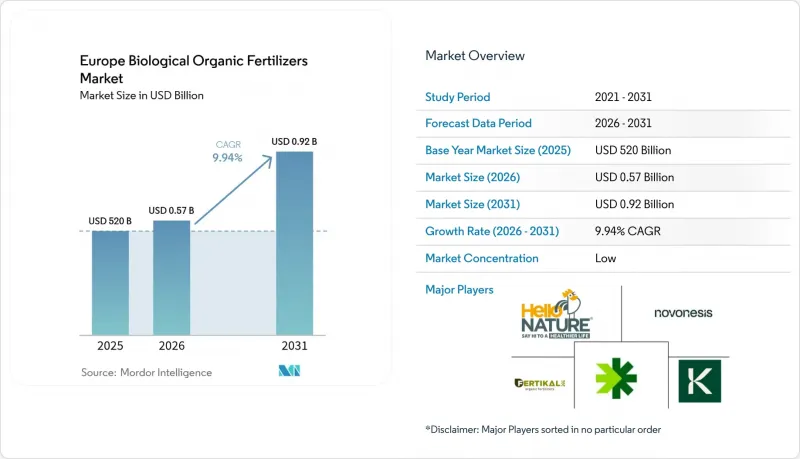
Mordor Intelligence에 의하면, 2026년 유럽의 생물 유기 비료 시장 규모는 5억 7,169만 달러로 추정되고 2025년 5억 2,000만 달러에서 확대해, 2031년에는 9억 1,760만 달러에 이를 것으로 예측됩니다.
2026년부터 2031년에 걸쳐 연평균 성장률(CAGR) 9.94%로 성장할 것으로 전망됩니다.
본 보고서는 유형별(미생물 및 유기 잔류물), 형태별(건조 및 액체), 작물 유형별(곡물, 과일 및 채소, 유지종자 및 콩류 등),시비 방법별(토양 살포, 시비 관개 등), 지역별(독일, 영국 등)로 분류되어 있습니다. 시장 전망은 금액(달러) 기준으로 제시되어 있습니다.
유럽의 생물 유기 비료 시장 동향 및 인사이트
유럽연합(EU)의 ‘팜 투 포크(Farm to Fork)’ 이니셔티브와 유기농지 이용 촉진
‘그린 딜(Green Deal)’에서는 2030년까지 유럽연합 농지의 4분의 1을 유기농법으로 전환할 것을 규정하고 있으며, 이에 따라 2024년 인증 면적은 3배로 확대되어 생물 유래 비료 수요가 구조적으로 증가했습니다. 각국 정부는 예산을 통해 이러한 확대를 뒷받침하고 있으며, 독일은 농장 내 퇴비화에 대한 보조금으로 3,000만 유로(3,200만 달러)를 편성했고, 프랑스에서는 2024년에 인증 헥타르 수가 14% 증가했습니다. 유기 잔여물을 원료로 하는 제품은 농장 폐기물을 효과적으로 활용할 수 있다는 점에서 가장 큰 장점이 있지만, 규정 2019/848에 따른 제품 승인 절차의 신속화로 인해 미생물 균주 시장 출시도 가속화되고 있습니다. 추적 가능성 체계를 통해 규정 준수가 강화되고 있지만, 동유럽 내 시행 상황의 편차로 인해 통일된 보급이 지연될 가능성이 있습니다.
합성 비료에 대한 유럽연합(EU)의 영양염류 유출 상한선 강화
개정된 질산염 규제로 인해 취약 지역의 허용 질소량이 1헥타르당 170kg으로 축소되어, 생산자들은 요소 대신 서방형 소화 잔여물이나 미생물성 인 용해제로 전환할 수밖에 없게 되었습니다. 독일의 조례에서는 수지 균형에 기반한 벌칙이 추가되어, 2024년에는 액체 소화 잔여물의 판매량이 22% 증가했습니다. 네덜란드에서 인 사용량이 감소함에 따라, 원예 분야에서는 바실러스균과 트리코데르마균 혼합제로의 전환이 진행되고 있습니다. 축산업이 집중된 지역에서는 규제 준수 위험이 높아지고 있어, 바이오가스 협동조합이나 접종제 전문 업체에 공급망 내 우위성이 부여되고 있습니다.
부피가 큰 유기 자재의 높은 운송 비용
영양분 밀도가 낮기 때문에 퇴비나 소화 잔여물을 200km 운송하는 데 1메트르톤당 25유로(27달러)의 비용이 소요되며, 이는 요소 운송비를 훨씬 상회하여 외딴 지역의 곡창 지대에서의 도입을 저해하고 있습니다. 2024년에는 디젤 연료 가격이 전년 대비 18% 상승하여 운송비 인플레이션을 가속화했습니다. 펠릿화하면 부피는 줄어들지만, 생산 라인 비용이 0.5-200만 유로(0.54-210만 달러)에 달하고, 주로 대규모 협동조합에서만 도입이 가능하기 때문에 주요 지역과 주변 지역 간의 격차가 확대되고 있습니다.
부문 분석
2025년 매출액 기준, 유기 잔여물 비료는 시장 점유율의 57.45%를 차지했습니다. 이는 곡물 및 윤작에서 헥타르당 비용을 낮추는 데 도움이 되는 확립된 퇴비, 가축 분뇨, 소화 잔여물의 유통 경로에 힘입은 결과입니다. 소매업체들이 합성 잔류물의 사용을 제한하고, 규정 2019/1009에 따라 승인 기간이 절반으로 단축됨에 따라, 미생물 제품은 연평균 성장률(CAGR) 12.55%로 다른 제품들을 능가하는 성장을 보일 것으로 예측됩니다. 덴마크의 현장 데이터에 따르면, 내한성 바실러스 균주를 통해 밀 수확량이 8% 향상된 것으로 나타났습니다.
잔여물 투입에는 운송 및 영양분의 균일성과 관련된 과제가 있는 반면, 미생물 제품에는 저장 기간 및 농가의 신뢰와 관련된 문제가 있습니다. Symborg사와 Fertiberia사 간의 2024년 합의와 같은 번들링(통합) 노력은 기존 유통 채널을 활용하여 접종제를 주류 사용에 통합하는 것을 목표로 하고 있습니다. 곤충 배설물은 그 경계를 모호하게 만들며, 하나의 SKU(재고 관리 단위)에 미생물의 풍부함과 유기물을 겸비하여 온실 채소 및 관상용 식물 분야에서 틈새 시장을 개척하고 있으며, 이는 유럽의 생물 유기 비료 시장이 하이브리드 솔루션으로 진화해 나갈 것임을 시사합니다.
2025년, 건조 제품은 63.20%의 점유율을 유지했으며, 이는 1억 8,000만 헥타르의 경작지에서 수십년동안 살포 기계가 사용되어 온 사실을 반영합니다. 반면, 액상 제품은 연평균 성장률(CAGR) 14.61%로 가장 빠르게 성장하고 있습니다. 스페인과 이탈리아의 비료 관개 시스템 개조를 통해 알메리아 대학의 실험에서 질소 침출이 23% 감소했습니다. 유럽의 생물 유기 비료 시장에서 액상 제품 시장 규모는 2031년까지 상당한 시장 가치를 달성할 것으로 예측됩니다. 코퍼트(Coppert)사는 온실 토마토용 액상 트리코데르마 제품 덕분에 2024년에 매출이 35% 증가했습니다.
저장 및 살포 규모가 중요한 상황에서는 건조형 제품이 여전히 필수적입니다. 독일과 프랑스에서의 최근 생산 능력 확충으로 인해 펠릿화된 퇴비는 현재 건조 부문의 18%를 차지하고 있습니다. 생산자들은 특히 고부가가치 원예 분야에서 건조 기반 비료와 액체 추비제를 조합하는 사례가 늘고 있습니다. 두 제품 라인을 모두 잘 파악하고 있는 공급업체는 유럽의 생물 유기 비료 시장 전체에서 차별화된 수요 곡선을 확보하게 될 것입니다.
기타 혜택 :
- 엑셀 형식 시장 예측(ME) 시트
- 3개월간의 애널리스트 지원
자주 묻는 질문
목차
제1장 서론
제2장 조사 방법
제3장 주요 요약
제4장 시장 구도
제5장 시장 규모 및 성장 예측
제6장 경쟁 구도
제7장 시장 기회 및 향후 전망
KTH 26.08.26According to Mordor Intelligence, Europe biological organic fertilizers market size in 2026 is estimated at USD 571.69 million, growing from 2025 value of USD 520 million with 2031 projections showing USD 917.6 million, growing at 9.94% CAGR over 2026-2031.
This report is Segmented by Type (Microorganisms and Organic Residues), by Form (Dry and Liquid), by Crop Type (Cereals and Grains, Fruits and Vegetables, Oilseeds and Pulses, and More), by Application Method (Soil Broadcasting, Fertigation, and More), and by Geography (Germany, United Kingdom, and More). The Market Forecasts are Provided in Terms of Value (USD).
Europe Biological Organic Fertilizers Market Trends and Insights
European Union Farm-to-Fork Initiative and Organic Land Use Promotion
The Green Deal stipulates that one-quarter of European Union farmland must be organic by 2030, tripling 2024 certified acreage and structurally lifting biological fertilizer demand . National budgets back the ramp-up, Germany earmarked EUR 30 million (USD 32 million) for on-farm composting subsidies, and France logged a 14% jump in certified hectares in 2024. Organic-residue inputs benefit most because they valorize farm waste, yet faster product approvals under Regulation 2019/848 also accelerate microbial-strain launches. Traceability frameworks tighten compliance, though uneven enforcement in Eastern Europe could delay uniform uptake.
Stricter European Union Nutrient-Loss Caps on Synthetic Fertilizers
Revised nitrate rules trim allowable nitrogen to 170 kg per hectare in vulnerable zones, forcing growers to replace urea with slow-release digestate and microbial phosphorus-solubilizers . Germany's ordinance adds balance-sheet penalties, pushing liquid digestate sales up 22% in 2024. Netherlands phosphorus cutbacks are steering horticulture toward Bacillus and Trichoderma blends. Compliance risk is rising for livestock-dense areas, giving supply-chain leverage to biogas cooperatives and inoculant specialists.
High Transport Costs for Bulky Organic Inputs
Low nutrient density means moving compost or digestate 200 km can cost EUR 25 (USD 27) per metric ton, dwarfing urea freight bills and deterring adoption in remote grain belts. Diesel was up 18% year-on-year in 2024, compounding freight inflation. Pelletization shrinks volume, but lines cost EUR 0.5-2 million (USD 0.54-2.1 million), affordable mainly to large co-ops, widening the gap between core and fringe regions.
Other drivers and restraints analyzed in the detailed report include:
- Rapid Expansion of Anaerobic-Digestate Supply Chains
- Precision Fertigation Driving Liquid Biofertilizer Demand
- Nutrient Variability and Lack of European Union-wide Quality Standard
For complete list of drivers and restraints, kindly check the Table Of Contents.
Segment Analysis
Organic-residue fertilizers accounted for 57.45% of the market share in 2025 revenue, driven by established compost, manure, and digestate channels that help maintain low costs per hectare in cereal and grain rotations. Microorganism products are set to outpace at a 12.55% CAGR as retailers penalize synthetic residues and Regulation 2019/1009 halves approval times. Field data from Denmark showed cold-tolerant Bacillus strains lifting wheat yields 8%.
Residue inputs encounter challenges related to haulage and nutrient uniformity, while microbial products face issues with shelf life and farmer trust. Bundling initiatives, such as the 2024 agreement between Symborg and Fertiberia, aim to integrate inoculants into mainstream use by leveraging conventional distribution channels. Insect frass blurs the line, bringing microbial richness and organic matter in one Stock Keeping Unit (SKU) and carving niches in greenhouse vegetables and ornamentals, indicating that the Europe biological organic fertilizers market will evolve toward hybrid solutions.
Dry products kept a 63.20% share in 2025, reflecting decades of broadcast machinery across 180 million hectares of arable land. Liquids, however, are rising fastest with a CAGR of 14.61%. Fertigation retrofits in Spain and Italy reduced nitrogen leaching by 23% in University of Almeria trials. The Europe biological organic fertilizers market size for liquids is set to reach a significant market value by 2031. Koppert recorded a 35% sales jump in 2024 on liquid Trichoderma for greenhouse tomatoes.
Dry formats remain crucial where storage and spreading scale matter. Pelletized manure now covers 18% of the dry segment after recent capacity additions in Germany and France. Growers increasingly pair a dry base with liquid top-dressings, particularly in high-value horticulture. Suppliers that master both lines will capture differentiated demand curves across the Europe biological organic fertilizers market.
Complete Report Scope:
- By Type
- Microorganism
- Organic-Residues
- By Form
- Dry
- Liquid
- By Crop Type
- Cereals and Grains
- Fruits and Vegetables
- Oilseeds and Pulses
- Commercial Crops
- Turf and Ornamentals
- By Application Method
- Soil Broadcasting
- Fertigation
- Foliar Spray
- By Geography
- Germany
- France
- Italy
- Spain
- United Kingdom
- Russia
- Rest of Europe
List of Companies Covered in this Report:
- Hello Nature International Srl (Italpollina S.p.A.)
- Fertikal N.V.
- Novonesis Group
- RovensaNext
- Koppert Biological Systems BV
- ILSA S.p.A.
- Sustane Natural Fertilizer Inc.
- Andermatt Group AG
- Symborg, Inc.
- Lallemand Inc.
- Darling Ingredients Inc. (NatureSafe)
- Tata Chemicals Europe (Tata Chemicals Ltd.)
- BASF SE
- Corteva Agriscience
- BioBest Group
- DE SANGOSSE Group
Additional Benefits:
- The market estimate (ME) sheet in Excel format
- 3 months of analyst support
TABLE OF CONTENTS
1 Introduction
- 1.1 Study Assumptions and Market Definition
- 1.2 Scope of the Study
2 Research Methodology
3 Executive Summary
4 Market Landscape
- 4.1 Market Overview
- 4.2 Market Drivers
- 4.2.1 European Union Farm-to-Fork Initiative and Organic Land Use Promotion
- 4.2.2 Stricter European Union Nutrient-Loss Caps on Synthetic Fertilizers
- 4.2.3 Rapid Expansion of Anaerobic-Digestate Supply Chains
- 4.2.4 Commercial Scale-Up of Insect-Frass Fertilizer Plants
- 4.2.5 Common Agricultural Policy (CAP) Eco-scheme Carbon-Farming Payments
- 4.2.6 Precision Fertigation Driving Liquid Biofertilizer Demand
- 4.3 Market Restraints
- 4.3.1 High Transport Costs for Bulky Organic Inputs
- 4.3.2 Nutrient Variability and Lack of European Union-wide Quality Standard
- 4.3.3 Limited Shelf-Life of Microbial Inoculants
- 4.3.4 Peat Extraction Limits Constrain Certified Feedstocks
- 4.4 Regulatory Landscape
- 4.5 Technological Outlook
- 4.6 Porter's Five Forces Analysis
- 4.6.1 Bargaining Power of Suppliers
- 4.6.2 Bargaining Power of Buyers
- 4.6.3 Threat of New Entrants
- 4.6.4 Threat of Substitutes
- 4.6.5 Intensity of Competitive Rivalry
5 Market Size & Growth Forecasts (Value)
- 5.1 By Type
- 5.1.1 Microorganism
- 5.1.2 Organic-Residues
- 5.2 By Form
- 5.2.1 Dry
- 5.2.2 Liquid
- 5.3 By Crop Type
- 5.3.1 Cereals and Grains
- 5.3.2 Fruits and Vegetables
- 5.3.3 Oilseeds and Pulses
- 5.3.4 Commercial Crops
- 5.3.5 Turf and Ornamentals
- 5.4 By Application Method
- 5.4.1 Soil Broadcasting
- 5.4.2 Fertigation
- 5.4.3 Foliar Spray
- 5.5 By Geography
- 5.5.1 Germany
- 5.5.2 France
- 5.5.3 Italy
- 5.5.4 Spain
- 5.5.5 United Kingdom
- 5.5.6 Russia
- 5.5.7 Rest of Europe
6 Competitive Landscape
- 6.1 Market Concentration
- 6.2 Strategic Moves
- 6.3 Market Share Analysis
- 6.4 Company Profiles (Includes Global Level Overview, Market Level Overview, Core Segments, Financials as Available, Strategic Information, Market Rank/Share for Key Companies, Products & Services, and Recent Developments)
- 6.4.1 Hello Nature International Srl (Italpollina S.p.A.)
- 6.4.2 Fertikal N.V.
- 6.4.3 Novonesis Group
- 6.4.4 RovensaNext
- 6.4.5 Koppert Biological Systems BV
- 6.4.6 ILSA S.p.A.
- 6.4.7 Sustane Natural Fertilizer Inc.
- 6.4.8 Andermatt Group AG
- 6.4.9 Symborg, Inc.
- 6.4.10 Lallemand Inc.
- 6.4.11 Darling Ingredients Inc. (NatureSafe)
- 6.4.12 Tata Chemicals Europe (Tata Chemicals Ltd.)
- 6.4.13 BASF SE
- 6.4.14 Corteva Agriscience
- 6.4.15 BioBest Group
- 6.4.16 DE SANGOSSE Group


