

|
시장보고서
상품코드
2113833
아시아태평양의 돼지 사료 프리믹스 : 시장 점유율 분석, 업계 동향 및 통계, 성장 예측(2026-2031년)Asia-Pacific Swine Feed Premix - Market Share Analysis, Industry Trends & Statistics, Growth Forecasts (2026 - 2031) |
||||||
 Mordor Intelligence
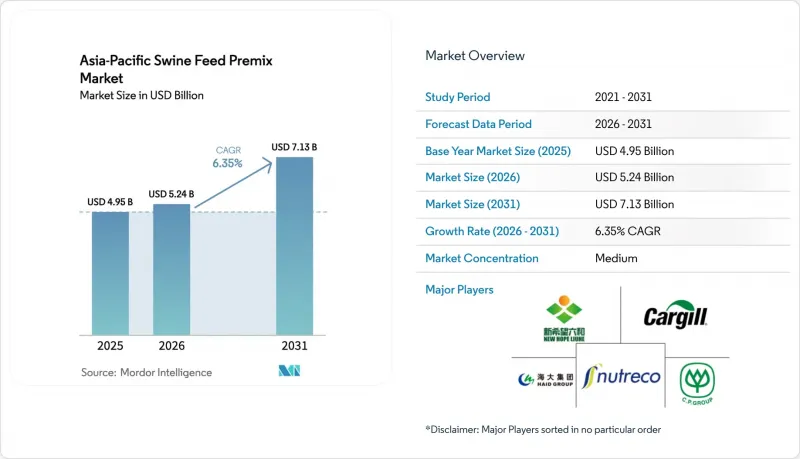
Mordor Intelligence에 의하면, 아시아태평양의 돼지 사료 프리믹스 시장 규모는 2025년 49억 5,000만 달러로 평가되었습니다. 2026년 52억 4,000만 달러에서 2031년까지 71억 3,000만 달러로 확대되어 2026-2031년에 걸쳐 CAGR 6.35%를 나타낼 것으로 예측됩니다.
본 보고서는 제품 유형별(비타민, 아미노산, 기타), 형태별(건조, 액체), 기능별(성장 촉진, 면역력 향상, 기타), 원료 조달처별(천연, 합성),구매자 유형별(상업용 통합업체, 협동조합 계열 사료 공장, 기타), 유통 채널별(직접 판매, 기타), 지역별(중국, 인도, 기타)로 분류되어 있습니다. 시장 전망은 금액(달러)으로 표시되어 있습니다.
아시아태평양의 돼지 사료 프리믹스 시장 동향 및 인사이트
아프리카 돼지열병(ASF)을 계기로 한 바이오시큐리티 대책에 따른 강화형 프리믹스 수요 증가
아프리카 돼지열병은 중국의 양돈 산업에 치명적인 타격을 입혔으며, 모돈 사육 두수를 감소시키는 동시에 산업화된 바이오시큐리티 기준으로의 전환을 촉진했습니다. 현재 통합형 양돈업체들은 고밀도 사육 시설에서 면역력을 강화하기 위해 비타민 A, D, E, 아연, 셀레늄의 배합 비율을 높이고 있습니다. 동나이성과 롱안성에서 진행 중인 돼지 사육군 재건이 2025년 베트남의 고단백 프리믹스 및 특수 사료 수요를 견인하여, 배합 사료 생산량은 2,212만 톤에 달했습니다. 필리핀에서는 2024년 아프리카 돼지열병의 영향을 받은 지역의 농장에서 영양 강화가 요구되면서 수요가 즉시 급증했습니다. 동남아시아의 축산 시스템 현대화는 아시아태평양의 돼지 사료 시장의 성장을 견인할 것으로 예상되며, 2028년까지 생물 보안 및 사료 효율에 대한 집중에 힘입어 특수 프리믹스 및 첨가제 부문이 시장을 주도할 전망입니다.
항생제를 사용하지 않은 돼지고기에 대한 정부의 규제로 인한 기능성 첨가제 보급 가속화
중국은 2020년 7월부터 사료에 항생제계 성장 촉진제 사용을 금지했으며, 이에 따라 효소, 프로바이오틱스, 유기산의 사용이 증가했습니다. 그 결과, 대형 통합 축산 기업에서는 사료 전환율이 최대 5% 향상되었습니다. 2024년 주요 축산성에서 실시된 시범 프로그램에 따라, 베트남은 2026년까지 성장 촉진용 항생제 사용을 금지할 계획이며, 콜리스틴 및 아연 바시트라신의 대체재로 효소 칵테일과 프로바이오틱스에 대한 수요가 증가하고 있습니다. 태국의 수출 지향형 양돈장에서는 항생제계 성장 촉진제 사용을 금지하는 ‘적정 제조 기준 플러스(GMP+)’ 인증 취득이 요구되고 있으며, 이에 따라 천연 유래 성장 촉진 프리믹스에 대한 수요가 증가하고 있습니다. 2024년부터 2025년에 걸쳐 규제 준수로 인해 사료 배합 비용이 8-10% 상승했으나, 통합형 양돈 업체들은 영양소의 소화율 향상을 통해 수익성을 회복했습니다. 중국 및 동남아시아의 생산자들이 장 건강용 영양 첨가제에 주력하고 있는 만큼, 항생제를 사용하지 않는 사료로의 전환은 아시아태평양의 돼지 사료 프리믹스 시장을 활성화시킬 것으로 예측됩니다.
비타민 A·E 가격 변동으로 인한 사료 배합업체의 이익률 압박
2024년 7월, BASF SE의 루트비히스하펜 공장에서 발생한 화재로 인해 전 세계 전구체 생산 능력의 상당 부분이 중단되었고, 연말까지 비타민 A 가격이 2배 이상 치솟았습니다. 공급 수준이 정상으로 돌아온 것은 2025년 4월 생산이 재개된 이후였습니다. 동시에, 절강의약(Zhejiang Medicine)이 환경 대책용 개보수 공사를 위해 샤오싱 공장을 일시 폐쇄함에 따라 비타민 E 가격이 38% 상승했습니다. 2025년 말까지 중국의 돼지고기 가격이 수년 만에 최저치(1kg당 11위안 이하)를 기록하면서 이익률에 심각한 영향을 미쳤고, 돼지 사료 프리믹스 제조업체들은 비타민류 가격을 최대 50% 인하하는 협상을 진행하는 한편, 첨가제 구매를 2026년까지 연기하게 되었습니다. 마찬가지로, 인도의 구매자들도 원료 가격 변동을 완화하기 위해 발주를 연기했습니다. 전 세계 첨가제 가격은 돼지 생산 주기가 정상 패턴으로 돌아옴에 따라 2027년 초까지 완전히 안정될 것으로 예측됩니다.
부문 분석
2025년, 아시아태평양의 돼지 사료 프리믹스 시장에서 비타민이 34%의 점유율을 차지했습니다. 이는 최적의 성장과 번식력을 확보하기 위해 지용성 비타민의 사용이 규제로 의무화되어 있기 때문입니다. 한편, 효소는 피타제와 자일라나제의 혼합이 항생제 사용 금지 이후 저하된 사료 효율을 회복시켜 주기 때문에 2031년까지 연평균 성장률(CAGR) 8.9%로 확대될 것으로 예측되며, 이는 제품 유형 중 가장 높은 성장률입니다. 아미노산과 미네랄은 합쳐서 수요의 대부분을 차지하고 있으며, 무지방 조직 축적 및 면역 지원에 필수적인 요소로 계속 자리 잡고 있습니다. 항생제는 시장 점유율이 제한적이며, 중국과 베트남에서는 혼합 치료에 국한되어 있습니다.
미네랄은 그 본질적인 특성상 효소 시장의 성장에 이어 확대될 것으로 더욱 예상됩니다. 공급업체들은 취급 편의성을 높이고 정밀 투여 시스템에 대응하기 위해 효소와 프로바이오틱스를 1회 투여용 소포장으로 묶어 판매하고 있습니다. 중국의 위생 기준인 ‘GB 13078’에 따라 신규 유효 성분의 승인 주기가 장기화되고 있어, 첨단 실험실을 운영하는 다국적 기업이 유리한 입장에 있습니다. 이러한 동향으로 인해 아시아태평양의 돼지 사료 프리믹스 시장은 경쟁이 치열하고 혁신이 활발한 상태를 유지하고 있습니다.
2025년 기준 아시아태평양의 돼지 사료 프리믹스 시장 규모에서 드라이 프리믹스는 71.5%를 차지했습니다. 이는 기존 방식의 배치 믹서에 의존하는 협동조합이나 가족 경영 농장이 많기 때문입니다. 대조적으로, 액상 제품은 2031년까지 연평균 성장률(CAGR) 7.6%를 나타낼 것으로 예측됩니다. 이는 인력을 15-20% 절감하고, 투여 정확도를 허용 오차 1% 이내로 줄일 수 있는 자동 주입 시스템의 혜택을 받고 있기 때문입니다. 아시아태평양의 돼지 사료 프리믹스 시장에서 액상 제제는 급속한 성장을 이루고 있습니다. 이는 인건비 절감을 이유로 도입을 주도하고 있는 일본과 한국의 통합형 기업(인테그레이터) 사이에서 채택이 확대되고 있는 것이 원동력이 되고 있습니다.
인도 및 인도네시아에서도 도입이 진행되고 있으며, 이들 지역에서는 디스펜서의 단가가 5만-8만 달러에 달하고, 온도 관리가 가능한 보관 시설이 필요합니다. 자금 조달의 부담을 완화하기 위해 리스 모델이 등장하고 있습니다. 또한 공급업체들은 운송 중량을 최대 40% 줄이고 운송 비용을 절감하는 농축 액상 첨가제도 활용하고 있습니다. 임금 상승이 확산됨에 따라 아시아태평양의 돼지 사료 프리믹스 산업 전반에서 액상 제품의 점유율은 상승할 전망입니다.
기타 혜택
- 엑셀 형식 시장 예측(ME) 시트
- 3개월간 애널리스트 지원
자주 묻는 질문
목차
제1장 서론
제2장 조사 방법
제3장 주요 요약
제4장 시장 구도
제5장 시장 규모 및 성장 예측
제6장 경쟁 구도
제7장 시장 기회 및 향후 전망
KTH 26.08.26According to Mordor Intelligence, the Asia-Pacific swine feed premix market size is projected to expand from USD 4.95 billion in 2025 and USD 5.24 billion in 2026, to USD 7.13 billion by 2031, registering a CAGR of 6.35% between 2026 to 2031.
This report is Segmented by Product Type (Vitamins, Amino Acids, and More), Form (Dry and Liquid), Functionality (Growth Promotion, Immunity Enhancement, and More), Ingredient Source (Natural and Synthetic), Purchaser Type (Commercial Integrators, Cooperative Feed Mills, and More), Distribution Channel (Direct and More), and Geography (India, China, and More). Market Forecasts are in Value (USD).
Asia-Pacific Swine Feed Premix Market Trends and Insights
African Swine Fever (ASF)-Driven Biosecurity Protocols Elevating Fortified Premix Demand
African Swine Fever devastated China's hog industry, cutting the sow herd and prompting a shift to industrialized biosecurity standards . Integrators now raise vitamin A, D, E, zinc, and selenium inclusion rates to strengthen immunity in densely stocked facilities. Herd rebuilding in Dong Nai and Long An drove Vietnam's demand for high-protein premix and specialized feeds in 2025, raising compound feed production to 22.12 million metric tons. The Philippines required enhanced nutrition on farms in African Swine Fever (ASF)-affected areas in 2024, triggering immediate demand spikes. The modernization of livestock systems in Southeast Asia is anticipated to drive growth in the Asia-Pacific swine feed market, with specialized premix and additive segments leading the way, driven by a focus on biosecurity and feed efficiency through 2028.
Government Mandates for Antibiotic-Free Pork Accelerating Functional Additives
China banned antibiotic growth promoters in feed from July 2020, prompting increased use of enzymes, probiotics, and organic acids that boosted feed conversion by up to 5% for leading integrators. Following 2024 pilot programs in key livestock provinces, Vietnam plans to ban growth-promoting antibiotics by 2026, boosting demand for enzyme cocktails and probiotics as alternatives to Colistin and Zinc Bacitracin. Thailand's export-oriented farms need Good Manufacturing Practice Plus certification that forbids antibiotic promoters, pushing natural growth-promoting premixes. Though compliance raised formulation costs by 8-10% in 2024-2025, integrators regained profitability through improved nutrient digestibility. The shift toward antibiotic-free feed is anticipated to boost the Asia-Pacific swine feed premix market, as producers in China and Southeast Asia focus on nutritional additives for gut health.
Volatile Vitamin A and E Prices Compressing Formulator Margins
In July 2024, a fire at BASF SE's Ludwigshafen plant disrupted a significant portion of global precursor capacity, causing vitamin A prices to more than double by the end of the year. Supply levels returned to normal only after production resumed in April 2025. Concurrently, Zhejiang Medicine temporarily closed its Shaoxing site for environmental upgrades, leading to a 38% increase in vitamin E prices. By late 2025, multi-year low hog prices in China (below ¥11/kg) severely impacted margins, prompting swine feed premix manufacturers to delay additive purchases until 2026 while negotiating price reductions of up to 50% on vitamins. Similarly, Indian buyers postponed orders to mitigate volatility in raw material prices. Global additive prices are anticipated to stabilize fully by early 2027 as swine cycles return to normal patterns.
Other drivers and restraints analyzed in the detailed report include:
- Rising Pork Consumption Among Emerging Middle Class Expanding Commercial Feed Penetration
- Digitized On-Farm Dispensers Reducing Labor Needs and Dosing Errors
- Strict Chinese Ban on Antibiotic Growth Promoters Raising Formulation Cost
For complete list of drivers and restraints, kindly check the Table Of Contents.
Segment Analysis
Vitamins secured 34% of the Asia-Pacific swine feed premix market share in 2025, as regulations mandate the use of fat-soluble vitamins for optimal growth and fertility. Enzymes, however, are projected to expand at an 8.9% CAGR through 2031, the fastest among product types, as phytase and xylanase blends recapture feed efficiency lost after antibiotic bans. Amino acids and minerals together meet a significant portion of the demand and remain indispensable for lean tissue deposition and immune support. Antibiotics accounted for a limited market share, limited to prescription therapy in China and Vietnam.
Minerals are further anticipated to follow the growth of Enzymes, owing to their natural positioning. Suppliers bundle enzymes with probiotics in single-dose sachets to ease handling and align with precision dosing systems. China's GB 13078 hygiene code lengthens approval cycles for new actives, favoring multinational firms that operate advanced labs. These dynamics keep the Asia-Pacific swine feed premix market competitive and innovation-rich.
Dry premixes occupied 71.5 % of the Asia Pacific swine feed premix market size during 2025, owing to the cooperative mills and family farms that rely on conventional batch mixers. In contrast, liquid products are forecast to post a 7.6% CAGR through 2031, benefiting from automated injection systems that reduce labor by 15-20% and tighten dosing to within 1% tolerance. The Asia-Pacific swine feed premix market for liquid formulations is experiencing rapid growth, driven by growing adoption among Japanese and South Korean integrators, who are leading rollouts, citing labor cost savings.
The adoption persists in India and Indonesia, where dispensers cost USD 50,000-80,000 per unit and require temperature-controlled storage. Leasing models are emerging to ease funding hurdles. Suppliers also use concentrated liquid additives that reduce freight weight by up to 40%, improving landed economics. As wage inflation spreads, the liquid share should rise across the Asia-Pacific swine feed premix industry.
Complete Report Scope:
- By Product Type
- Vitamins
- Minerals
- Amino Acids
- Antibiotics
- Enzymes
- Other Types (Probiotics, Essential Oils)
- By Form
- Dry
- Liquid
- By Functionality
- Growth Promotion
- Immunity Enhancement
- Reproductive Performance
- Feed Conversion Efficiency
- By Ingredient Source
- Natural
- Synthetic
- By Purchaser Type
- Commercial Integrators
- Cooperative Feed Mills
- Independent Family Farms
- By Distribution Channel
- Direct (Mill-Gate)
- Third-Party Distributors
- By Geography
- China
- India
- Japan
- South Korea
- Vietnam
- Thailand
- Philippines
- Indonesia
- Australia
- New Zealand
- Rest of Asia-Pacific
List of Companies Covered in this Report:
- Charoen Pokphand Group Co., Ltd.
- Cargill, Incorporated
- Guangdong Haid Group Co., Ltd.
- New Hope Liuhe Co., Ltd. (New Hope Group)
- SHV Holdings N.V. (Nutreco)
- Dsm-Firmenich AG
- BASF SE
- Archer Daniels Midland Company
- Bluestar Adisseo Company (Sinochem Holdings)
- Evonik Industries AG
- Beijing Dabeinong Technology Group Co., Ltd.
- CJ CheilJedang Corp. (CJ Corp.)
- Associated British Foods plc
- Alltech, Inc.
- Tongwei Co., Ltd.
Additional Benefits:
- The market estimate (ME) sheet in Excel format
- 3 months of analyst support
TABLE OF CONTENTS
1 Introduction
- 1.1 Study Assumptions and Market Definition
- 1.2 Scope of the Study
2 Research Methodology
3 Executive Summary
4 Market Landscape
- 4.1 Market Overview
- 4.2 Market Drivers
- 4.2.1 African Swine Fever (ASF)-driven biosecurity protocols elevating fortified premix demand
- 4.2.2 Government mandates for antibiotic-free pork accelerating functional additives
- 4.2.3 Rising pork consumption among emerging middle class expanding commercial feed penetration
- 4.2.4 Expansion of integrator-owned mega-farms consolidating premix procurement
- 4.2.5 Adoption of precision-nutrition micro-dosing systems improving feed efficiency
- 4.2.6 Digitized on-farm dispensers reducing labor needs and dosing errors
- 4.3 Market Restraints
- 4.3.1 Volatile vitamin A and E prices compressing formulator margins
- 4.3.2 Strict Chinese ban on antibiotic growth promoters raising formulation cost
- 4.3.3 El Nino-driven grain shortfalls disrupting supply chains
- 4.3.4 Consumer skepticism toward synthetic additives steering demand to natural
- 4.4 Regulatory Landscape
- 4.5 Technological Outlook
- 4.6 Porter's Five Forces
- 4.6.1 Bargaining Power of Suppliers
- 4.6.2 Bargaining Power of Buyers
- 4.6.3 Threat of New Entrants
- 4.6.4 Threat of Substitutes
- 4.6.5 Intensity of Competitive Rivalry
5 Market Size and Growth Forecasts (Value)
- 5.1 By Product Type
- 5.1.1 Vitamins
- 5.1.2 Minerals
- 5.1.3 Amino Acids
- 5.1.4 Antibiotics
- 5.1.5 Enzymes
- 5.1.6 Other Types (Probiotics, Essential Oils)
- 5.2 By Form
- 5.2.1 Dry
- 5.2.2 Liquid
- 5.3 By Functionality
- 5.3.1 Growth Promotion
- 5.3.2 Immunity Enhancement
- 5.3.3 Reproductive Performance
- 5.3.4 Feed Conversion Efficiency
- 5.4 By Ingredient Source
- 5.4.1 Natural
- 5.4.2 Synthetic
- 5.5 By Purchaser Type
- 5.5.1 Commercial Integrators
- 5.5.2 Cooperative Feed Mills
- 5.5.3 Independent Family Farms
- 5.6 By Distribution Channel
- 5.6.1 Direct (Mill-Gate)
- 5.6.2 Third-Party Distributors
- 5.7 By Geography
- 5.7.1 China
- 5.7.2 India
- 5.7.3 Japan
- 5.7.4 South Korea
- 5.7.5 Vietnam
- 5.7.6 Thailand
- 5.7.7 Philippines
- 5.7.8 Indonesia
- 5.7.9 Australia
- 5.7.10 New Zealand
- 5.7.11 Rest of Asia-Pacific
6 Competitive Landscape
- 6.1 Market Concentration
- 6.2 Strategic Moves
- 6.3 Market Share Analysis
- 6.4 Company Profiles (Includes Global Level Overview, Market Level Overview, Core Segments, Financials as Available, Strategic Information, Market Rank/Share for Key Companies, Products and Services, and Recent Developments)
- 6.4.1 Charoen Pokphand Group Co., Ltd.
- 6.4.2 Cargill, Incorporated
- 6.4.3 Guangdong Haid Group Co., Ltd.
- 6.4.4 New Hope Liuhe Co., Ltd. (New Hope Group)
- 6.4.5 SHV Holdings N.V. (Nutreco)
- 6.4.6 Dsm-Firmenich AG
- 6.4.7 BASF SE
- 6.4.8 Archer Daniels Midland Company
- 6.4.9 Bluestar Adisseo Company (Sinochem Holdings)
- 6.4.10 Evonik Industries AG
- 6.4.11 Beijing Dabeinong Technology Group Co., Ltd.
- 6.4.12 CJ CheilJedang Corp. (CJ Corp.)
- 6.4.13 Associated British Foods plc
- 6.4.14 Alltech, Inc.
- 6.4.15 Tongwei Co., Ltd.


