

|
시장보고서
상품코드
2113853
수의 진단 : 시장 점유율 분석, 업계 동향 및 통계, 성장 예측(2026-2031년)Veterinary Diagnostics - Market Share Analysis, Industry Trends & Statistics, Growth Forecasts (2026 - 2031) |
||||||
 Mordor Intelligence
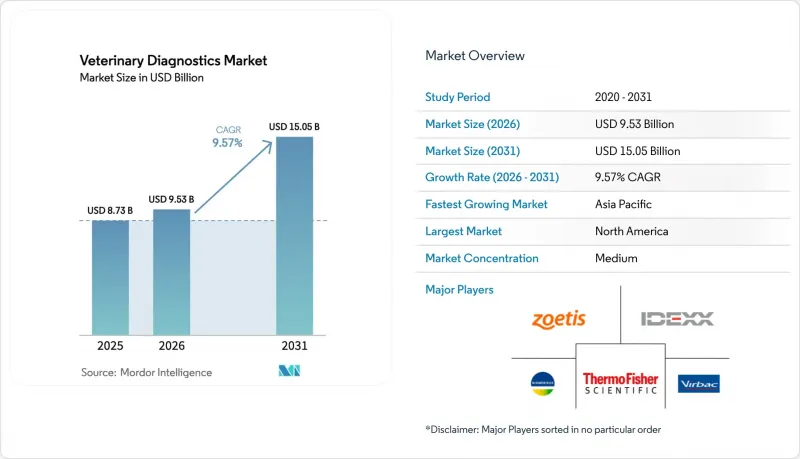
Mordor Intelligence에 의하면, 수의 진단 시장 규모는 2025년에 87억 3,000만 달러로 평가되었습니다. 2026년 95억 3,000만 달러에서 2031년까지 150억 5,000만 달러에 이를 것으로 예상되며, 예측 기간(2026-2031년) CAGR은 9.57%를 나타낼 전망입니다.
본 보고서는 제품 유형(기기 등), 기술(면역진단, 임상생화학 등), 동물 종(반려동물 및 가축), 최종 사용자(동물병원 및 진료소 등), 지역(북미, 유럽, 아시아태평양, 중동 및 아프리카, 남미)별로 분류되어 있습니다. 시장 예측은 금액(달러) 기준으로 제시되어 있습니다.
세계의 수의 진단 시장 동향 및 인사이트
반려동물 사육 마릿수 및 의료비 증가
중국의 도시 지역 반려동물 소유자들은 1인 가구 증가에 따라 2020년부터 2025년에 걸쳐 연간 수의 의료비를 2배인 8,200위안(1,150달러)으로 늘렸습니다. 밀레니얼 세대와 Z세대 반려동물 주인들은 정기 건강 검진 시 혈액 검사, 갑상선 검사, 소변 검사를 요구하고 있으며, 이로 인해 진료소 내 생화학 분석 장비는 거의 풀가동 상태를 유지하고 있습니다. 특히 북미와 스칸디나비아 국가에서 반려동물 보험 보급률이 높아짐에 따라, 첨단 영상 진단 및 분자 검사에 드는 비용 장벽이 해소되고 있습니다. 이러한 요인들이 맞물려 수의 진단 시장의 기반은 꾸준히 확대되고 있습니다.
인수공통전염병 및 식중독 증가
동남아시아 및 동유럽에서 아프리카 돼지열병이 발생함에 따라, 2024년부터 살아있는 돼지 운송에 대한 PCR 선별 검사가 의무화되었으며, 이로 인해 농장에서 견고하고 휴대용 분석 장치의 도입이 촉진되었습니다. 인도의 ‘국가 동물 질병 대책 프로그램’은 현재 6억 마리의 소를 대상으로 하고 있으며, 브루셀라증 및 구제역(FMD)에 대한 분기별 혈청학적 검사가 의무화되어 있습니다. 2025년에는 미국 16개 주에서 H5N1형 조류 인플루엔자가 검출됨에 따라, 바이러스 배출로 인해 식량 공급이 오염되기 전에 감염된 가축 무리를 격리하는 데 도움이 되는 15분 만에 결과가 나오는 항원 검사에 대한 긴급 승인이 이루어졌습니다. 감시 예산 증액으로 인해 수의 진단 시장은 거시경제의 둔화 영향에서 벗어날 수 있었습니다.
첨단 진단 기기 및 검사의 높은 비용
5가지 항목을 측정하는 혈액 검사 기기의 가격은 2만 5,000-4만 5,000달러이며, 시약비로 연간 8,000-1만 2,000달러가 추가로 소요됩니다. 이는 1회 진료비가 평균 30달러인 동물병원에게는 감당하기 어려운 금액입니다. 2025년 시점에서 케냐 동물병원 중 자동 생화학 분석 시스템을 보유한 곳은 고작 18%에 불과하여, 그 결과 수동 검사에 의존할 수밖에 없으며, 결과가 나오기까지 3-5일이 소요됩니다. 미국에서는 매개성 질환의 분자 검사 패널 1건당 비용이 80-120달러이지만, 보험에 가입하지 않은 반려인은 대신 경험적 치료를 선택하는 경우가 많아, 약물의 적정 사용 목표를 저해하는 요인이 되고 있습니다. 구독형 패키지나 시약 대여 제도가 등장하고 있지만, 여전히 장비 비용을 상각할 수 있을 만큼 검사 건수가 많은 진료소에 집중되어 있습니다.
부문 분석
2025년 매출액 중 키트 및 시약이 46.54%를 차지하여, 공급업체에 지속적인 현금 흐름을 확보해 주는 소모품 중심의 비즈니스 모델을 강화했습니다. 대조적으로, 소프트웨어 및 서비스는 연평균 11.45%의 성장이 예상되며, 이는 수의 진단 시장에서 분석 서비스의 구독형 모델로의 전략적 전환이 진행되고 있음을 보여줍니다. 장비 시장 점유율은 작지만, 현재는 응고 및 전해질 등의 모듈식 추가 패널이 탑재되어 있어 장비 전체를 교체하지 않고도 수명을 연장할 수 있게 되었습니다.
클라우드 네이티브 검사 정보 플랫폼은 여러 진료소의 데이터를 통합하고, 품질 관리를 표준화하며, 병원 체인 전체에 걸친 벤치마킹을 가능하게 합니다. 조에티스의 ‘Vetscan Cloud’나 헤스카의 시약·유지보수·AI를 묶은 패키지는 설비 투자를 운영비로 전환하여 예측 가능한 이익률을 추구하는 업계 재편 기업들에게 매력적인 요소로 작용하고 있습니다. 이러한 서비스 주도형 진화를 통해 각 벤더들은 예측 기간 동안 수의진단 시장에서 더 높은 점유율을 확보할 수 있는 입지에 있습니다.
2025년에는 면역 진단이 매출의 38.64%를 차지한 반면, 분자진단은 시약 가격 하락과 전문 기술자가 필요 없는 ‘시료에서 결과까지’의 자동화를 활용하여 연평균 성장률(CAGR) 11.32%를 나타낼 것으로 예측됩니다. 기존의 생화학 및 혈액학 플랫폼은 여전히 자리 잡고 있지만, 마이크로 샘플 대응 기술로 인해 필요한 검체량이 1mL에서 불과 수 마이크로리터로 줄어들어, 고양이 및 이국적인 반려동물 검사 시의 제약이 완화되고 있습니다.
IDEXX사의 ‘RealPCR’은 구강액을 이용한 돼지 생식 호흡기 증후군(PRRS)의 비침습적 선별 검사에 대해 미국 농무부(USDA)의 승인을 획득했으며, 이는 분자진단 워크플로가 검사 기관에서 축사나 진료실로 이동하고 있음을 보여줍니다. 써모피셔사의 12개월간 안정성을 유지하는 동결건조 PCR 시약은 콜드체인의 신뢰성이 낮은 지역에서도 더욱 폭넓게 활용될 수 있게 되었습니다. 이러한 진전이 수의진단 시장의 지속적인 성장을 견인하고 있습니다.
지역별 분석
2025년, 북미는 수의 진단 시장 매출의 41.45%를 차지했으며, 미국에서는 42억 달러가 지출되었습니다. 이는 기업 체인이 프로토콜을 표준화하고 시약 대량 구매 계약을 활용하고 있는 것이 원동력이 되고 있습니다. 캐나다에서 소 결핵 및 만성 소모성 질환 감시를 위한 연방 정부의 보조금도 검사실 수요를 더욱 부추기고 있습니다. FDA 및 캐나다 보건부의 엄격한 검증 절차는 시장 출시까지의 기간을 길게 만들지만, 승인을 획득하면 프리미엄 가격 책정을 정당화하는 요인이 됩니다.
아시아태평양은 2031년까지 연평균 성장률(CAGR) 10.54%를 기록하며 가장 빠르게 성장하는 지역이 될 것으로 예측됩니다. 중국에서는 1억 2,000만 마리에 달하는 반려동물 수가 이미 1급 도시에서 서유럽 수준에 버금가는 1마리당 지출 수준에 도달한 반면, 인도에서는 이동식 검사실과 새로 설립된 지역 진단센터가 목축 지역 내 검사 격차를 해소해 나가고 있습니다. 일본에서는 반려동물의 고령화에 따라 만성 질환 검사 패널에 대한 수요가 증가하고 있으며, 한국에서는 반려동물 보험 보급률이 12%에 달함에 따라 고가의 영상 진단 도입이 촉진되고 있습니다.
유럽에서는 반려동물 보험 가입률이 높고 EU가 의무화한 가축 추적 제도의 뒷받침으로 안정적인 성장이 예상됩니다. 독일에서는 멧돼지 사체에 대한 아프리카 돼지열병 PCR 검사에 보조금을 지급하고 있으며, 스페인과 프랑스에서는 수출 시즌을 앞두고 조류 인플루엔자 감시 체제를 강화하고 있습니다. 중동 및 아프리카에서는 현재 시점에서 매출액이 소규모에 그치고 있습니다. 하지만 걸프 국가들이 식량 안보에 투자하고, 아프리카 국가들이 감염병 대책을 위해 세계동물보건기구(WOAH)와 유엔식량농업기구(FAO)로부터 지원을 받음에 따라, 이들 지역의 성장은 가속화될 것으로 예측됩니다. 남미에서는 브라질의 가금류·돼지 통합 생산 기업을 필두로, 수출 대상국의 병원체 무감염 인증 요건을 충족하기 위해 현장에 PCR 검사실이 설치되어 있습니다.
기타 혜택 :
- 엑셀 형식 시장 예측(ME) 시트
- 3개월간의 애널리스트 지원
자주 묻는 질문
목차
제1장 서론
제2장 조사 방법
제3장 주요 요약
제4장 시장 구도
제5장 시장 규모 및 성장 예측
제6장 경쟁 구도
제7장 시장 기회 및 향후 전망
KTH 26.08.26According to Mordor Intelligence, the veterinary diagnostics market size was valued at USD 8.73 billion in 2025 and is estimated to grow from USD 9.53 billion in 2026 to reach USD 15.05 billion by 2031, at a CAGR of 9.57% during the forecast period (2026-2031).
This report is Segmented by Product Type (Instruments, and More), Technology (Immunodiagnostics, Clinical Biochemistry, and More), Animal Type (Companion Animals and Livestock Animals), End-User (Veterinary Hospitals & Clinics, and More), and Geography (North America, Europe, Asia-Pacific, Middle East and Africa, and South America). The Market Forecasts are Provided in Terms of Value (USD).
Global Veterinary Diagnostics Market Trends and Insights
Rising Companion Animal Ownership and Healthcare Spending
Urban Chinese pet owners doubled their annual veterinary spending to CNY 8,200 (USD 1,150) between 2020 and 2025, as the number of single-person households increased. Millennials and Generation Z owners now demand laboratory blood work, thyroid panels, and urinalyses during routine wellness exams, keeping in-clinic chemistry analyzers running near capacity. Enhanced pet-insurance penetration, particularly in North America and Scandinavia, removes cost barriers for advanced imaging and molecular testing. Together, these factors secure a growing baseline for the veterinary diagnostics market.
Growing Prevalence of Zoonotic and Foodborne Diseases
African swine fever outbreaks in Southeast Asia and Eastern Europe triggered compulsory PCR screening for live-pig transport, beginning in 2024, which drove the adoption of rugged, portable analyzers on farms. India's National Animal Disease Control Programme now covers 600 million bovines, requiring quarterly serological assays for brucellosis and FMD. In 2025, H5N1 detections across 16 U.S. states prompted emergency authorizations for 15-minute antigen tests that help isolate infected herds before viral shedding contaminates food supplies. Heightened surveillance budgets are shielding the veterinary diagnostics market from macroeconomic slowdowns.
High Cost of Advanced Diagnostic Instruments and Tests
Five-part-differential hematology analyzers list between USD 25,000 and USD 45,000, while reagents add USD 8,000-12,000 annually - out of reach for clinics where a visit averages USD 30. Only 18% of Kenyan practices owned automated chemistry systems in 2025, resulting in a reliance on manual assays and 3- to 5-day result times. Molecular panels for vector-borne diseases run USD 80-120 per test in the United States, and uninsured clients frequently opt for empirical therapy instead, undermining stewardship goals. Subscription bundles and reagent-rental schemes are emerging but remain concentrated in high-volume clinics able to amortize equipment costs.
Other drivers and restraints analyzed in the detailed report include:
- Technological Advancements in Point-of-Care and Molecular Diagnostics
- Government Surveillance Programs Mandating Livestock Screening
- Shortage of Skilled Veterinary Diagnostic Professionals
For complete list of drivers and restraints, kindly check the Table Of Contents.
Segment Analysis
Kits and reagents generated 46.54% of 2025 revenue, reinforcing a consumable-driven model that secures continuous cash flow for vendors; in contrast, software and services are on track to grow at 11.45% annually, signaling a strategic pivot toward analytics subscriptions within the veterinary diagnostics market. Instruments, although a smaller slice, now feature modular add-on panels such as coagulation or electrolyte modules - that extend their useful life without requiring full replacement.
Cloud-native laboratory information platforms aggregate multi-clinic data, standardize quality control, and enable benchmarking across corporate hospital chains. Zoetis' Vetscan Cloud and Heska's bundled reagent-maintenance-AI packages convert capital expenditure into operating expenses, a draw for consolidators seeking predictable margins. This services-led evolution positions vendors to capture a higher share of the veterinary diagnostics market over the forecast window.
Immunodiagnostics accounted for 38.64% of the revenue in 2025, while molecular diagnostics are expected to post an 11.32% CAGR, leveraging declining reagent prices and sample-to-answer automation that eliminates the need for specialized technicians. Classic biochemistry and hematology platforms remain entrenched, although micro-sample capabilities now reduce the required volumes from 1 mL to mere microliters, easing constraints in feline and exotic-pet testing.
IDEXX's RealPCR has earned USDA approval for non-invasive screening of porcine reproductive and respiratory syndrome (PRRS) via oral fluids, illustrating how molecular workflows are moving from reference labs into barns and exam rooms. Thermo Fisher's 12-month-stable lyophilized PCR reagents further democratize access in regions with unreliable cold chains. These advances underpin sustained momentum for the veterinary diagnostics market.
Complete Report Scope:
- By Product Type
- Instruments
- Kits And Reagents
- Software And Services
- By Technology
- Immunodiagnostics
- Clinical Biochemistry
- Molecular Diagnostics
- Hematology
- Other Technologies
- By Animal Type
- Companion Animals
- Dogs
- Cats
- Other Companion Animals
- Livestock Animals
- Cattle
- Swine
- Poultry
- Other Livestock Animals
- Companion Animals
- By End-User
- Veterinary Hospitals & Clinics
- Reference Laboratories
- Ambulatory & Mobile Vet Services
- Research Institutes & Universities
- Geography
- North America
- United States
- Canada
- Mexico
- Europe
- Germany
- United Kingdom
- France
- Italy
- Spain
- Rest Of Europe
- Asia-Pacific
- China
- Japan
- India
- Australia
- South Korea
- Rest Of Asia-Pacific
- Middle East And Africa
- GCC
- South Africa
- Rest Of Middle East And Africa
- South America
- Brazil
- Argentina
- Rest Of South America
- North America
Geography Analysis
North America accounted for 41.45% of the veterinary diagnostics market revenue in 2025, with the U.S. spending USD 4.2 billion, driven by corporate chains standardizing protocols and leveraging bulk-buy reagent contracts. Canada's federal subsidies for bovine tuberculosis and chronic wasting disease surveillance further buoy laboratory demand. Strict FDA and Health Canada validation pathways do elongate the time-to-market, but they justify premium pricing once approvals are obtained.
The Asia-Pacific region is projected to be the fastest-growing region, with a 10.54% CAGR through 2031. China's 120 million-strong pet population already mirrors Western per-pet spending in Tier-1 cities, while India's mobile labs and new district diagnostic centers are closing testing gaps in pastoral belts. Japan's aging pets create demand for chronic-disease panels, and South Korea's 12% pet-insurance penetration eases the adoption of high-ticket imaging.
Europe enjoys stable growth, underpinned by high pet insurance take-up and EU-mandated livestock tracking. Germany subsidizes PCR testing for African swine fever in wild boar carcasses, while Spain and France ramp up avian-influenza monitoring ahead of export seasons. The Middle East and Africa register smaller revenues today. Still, they are expected to accelerate as Gulf states invest in food security and African nations receive WOAH-FAO aid for outbreak control. South America, led by Brazil's poultry and swine integrators, installs on-site PCR labs to meet export-buyer pathogen-free certifications.
- Abaxis
- Biochek
- bioMerieux
- BioNote Inc.
- Bio-Rad Laboratories
- Boehringer Ingelheim
- Covetrus
- Danaher
- Esaote
- Heska
- IDEXX
- IDVet
- Indical Bioscience
- Mindray
- Neogen
- QIAGEN
- Randox Laboratories
- Thermo Fisher Scientific
- Virbac
- Zoetis
Additional Benefits:
- The market estimate (ME) sheet in Excel format
- 3 months of analyst support
TABLE OF CONTENTS
1 Introduction
- 1.1 Study Assumptions & Market Definition
- 1.2 Scope Of The Study
2 Research Methodology
3 Executive Summary
4 Market Landscape
- 4.1 Market Overview
- 4.2 Market Drivers
- 4.2.1 Rising Companion Animal Ownership and Healthcare Spending
- 4.2.2 Growing Prevalence of Zoonotic and Foodborne Diseases
- 4.2.3 Technological Advancements in Point-of-Care and Molecular Diagnostics
- 4.2.4 Expansion of Pet Insurance Coverage and Veterinary Expenditure
- 4.2.5 Integration of Artificial Intelligence for Automated Image and Data Analysis
- 4.2.6 Government Surveillance Programs Mandating Livestock Disease Screening
- 4.3 Market Restraints
- 4.3.1 High Cost of Advanced Diagnostic Instruments and Tests
- 4.3.2 Shortage of Skilled Veterinary Diagnostic Professionals
- 4.3.3 Limited Data Interoperability Slowing Adoption of Connected Diagnostic Platforms
- 4.3.4 Import Tariffs and Supply Chain Disruptions Affecting Consumable Availability
- 4.4 Value / Supply-Chain Analysis
- 4.5 Regulatory Landscape
- 4.6 Technological Outlook
- 4.7 Porter's Five Forces Analysis
- 4.7.1 Threat Of New Entrants
- 4.7.2 Bargaining Power Of Buyers
- 4.7.3 Bargaining Power Of Suppliers
- 4.7.4 Threat Of Substitute Products
- 4.7.5 Intensity Of Competitive Rivalry
5 Market Size & Growth Forecasts (Value, USD)
- 5.1 By Product Type
- 5.1.1 Instruments
- 5.1.2 Kits And Reagents
- 5.1.3 Software And Services
- 5.2 By Technology
- 5.2.1 Immunodiagnostics
- 5.2.2 Clinical Biochemistry
- 5.2.3 Molecular Diagnostics
- 5.2.4 Hematology
- 5.2.5 Other Technologies
- 5.3 By Animal Type
- 5.3.1 Companion Animals
- 5.3.1.1 Dogs
- 5.3.1.2 Cats
- 5.3.1.3 Other Companion Animals
- 5.3.2 Livestock Animals
- 5.3.2.1 Cattle
- 5.3.2.2 Swine
- 5.3.2.3 Poultry
- 5.3.2.4 Other Livestock Animals
- 5.3.1 Companion Animals
- 5.4 By End-User
- 5.4.1 Veterinary Hospitals & Clinics
- 5.4.2 Reference Laboratories
- 5.4.3 Ambulatory & Mobile Vet Services
- 5.4.4 Research Institutes & Universities
- 5.5 Geography
- 5.5.1 North America
- 5.5.1.1 United States
- 5.5.1.2 Canada
- 5.5.1.3 Mexico
- 5.5.2 Europe
- 5.5.2.1 Germany
- 5.5.2.2 United Kingdom
- 5.5.2.3 France
- 5.5.2.4 Italy
- 5.5.2.5 Spain
- 5.5.2.6 Rest Of Europe
- 5.5.3 Asia-Pacific
- 5.5.3.1 China
- 5.5.3.2 Japan
- 5.5.3.3 India
- 5.5.3.4 Australia
- 5.5.3.5 South Korea
- 5.5.3.6 Rest Of Asia-Pacific
- 5.5.4 Middle East And Africa
- 5.5.4.1 GCC
- 5.5.4.2 South Africa
- 5.5.4.3 Rest Of Middle East And Africa
- 5.5.5 South America
- 5.5.5.1 Brazil
- 5.5.5.2 Argentina
- 5.5.5.3 Rest Of South America
- 5.5.1 North America
6 Competitive Landscape
- 6.1 Market Concentration
- 6.2 Market Share Analysis
- 6.3 Company Profiles {(Includes Global Level Overview, Market Level Overview, Core Segments, Financials as Available, Strategic Information, Market Rank/Share for Key Companies, Products & Services, and Recent Developments)}
- 6.3.1 Abaxis
- 6.3.2 BioChek BV
- 6.3.3 BioMerieux SA
- 6.3.4 BioNote Inc.
- 6.3.5 Bio-Rad Laboratories Inc.
- 6.3.6 Boehringer Ingelheim GmbH
- 6.3.7 Covetrus Inc.
- 6.3.8 Danaher Corporation
- 6.3.9 Esaote SpA
- 6.3.10 Heska Corporation
- 6.3.11 IDEXX Laboratories Inc.
- 6.3.12 IDVet
- 6.3.13 INDICAL Bioscience GmbH
- 6.3.14 Mindray Medical International Ltd.
- 6.3.15 Neogen Corporation
- 6.3.16 QIAGEN N.V.
- 6.3.17 Randox Laboratories Ltd.
- 6.3.18 Thermo Fisher Scientific Inc.
- 6.3.19 Virbac SA
- 6.3.20 Zoetis Inc.
7 Market Opportunities & Future Outlook
- 7.1 White-Space & Unmet-Need Assessment


