|
시장보고서
상품코드
2114067
전투기 : 시장 점유율 분석, 업계 동향 및 통계, 성장 예측(2026-2031년)Fighter Aircraft - Market Share Analysis, Industry Trends & Statistics, Growth Forecasts (2026 - 2031) |
||||||
 Mordor Intelligence
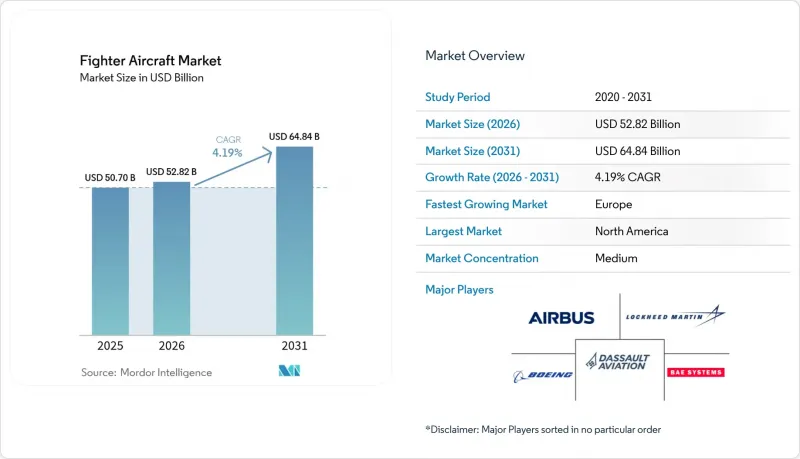
Mordor Intelligence에 의하면, 전투기 시장 규모는 2025년에 507억 달러, 2026년 528억 2,000만 달러에서 2031년까지 648억 4,000만 달러에 이를 것으로 예측되며, 예측 기간(2026년-2031년) CAGR은 4.19%를 기록할 전망입니다.
본 보고서는 이착륙 방식(기존 이착륙 등), 전투기 세대(4세대 등), 엔진 구성(단발 및 쌍발), 임무 역할(제공권 확보 등), 최종 사용자(공군, 해군용 항공 등), 지역(북미, 유럽 등)별로 분류되어 있습니다. 시장 전망은 금액(달러) 기준으로 제시되어 있습니다.
전 세계 전투기 시장 동향 및 인사이트
아시아태평양 신흥 경제국의 국방 예산 증가
2023년, 동아시아의 군사 지출은 4,110억 달러에 달하여 전년 대비 6.2% 증가세를 보이며 세계 평균을 상회했습니다. 인도는 2024-25 회계연도에 국방비로 750억 달러를 편성했으며, 그 중 약 30%를 AMCA 프로그램 등의 자본 프로젝트에 할당했습니다. 한국은 2024년도 예산을 442억 달러로 증액하고, 지역적 위협을 견제하기 위해 KF-21 생산과 F-35A 도입 확대를 우선시했습니다. 이러한 지속적인 지출은 국산 전투기 및 대외 군사 판매(FMS)를 위한 다년간의 조달 계획을 뒷받침하고 있습니다. 한편, 현지 생산을 통한 오프셋 조치는 새로운 합작을 통한 조립 라인 가동을 촉진하고, 전투기 시장에서 장기적인 MRO(정비·수리·오버홀) 작업량을 증가시키고 있습니다.
노후화된 4세대 기체를 5세대 기체로 교체*
미국 공군 주방위군은 2025년에 54대의 F-15C/D를 42대의 F-35A 및 21대의 F-15EX로 교체하는 승인을 받았습니다. 이는 정비 부담이 큰 기체를 퇴역시켜야 할 시급성을 여실히 보여줍니다. 유럽에서도 유사한 추세가 나타나고 있으며, 스페인은 2024년에 ‘타이푼’ 25대를 추가 발주했고, 핀란드의 64대 규모 F-35A 프로그램도 2030년 완료를 향해 순조롭게 진행되고 있습니다. 구형 전투기의 유지 비용 급등-대부분의 경우 부품 전용으로 인해 더욱 악화되고 있습니다-은 예산 압박에도 불구하고 현대화 일정을 가속화하고 있습니다. 운용국들은 또한 단계적 업그레이드만으로는 달성할 수 없는 스텔스 성능, 센서 융합, 전자전(EW) 성능의 획기적인 향상을 요구하고 있습니다. 이러한 추세가 향후 10년 동안 5세대 전투기에 대한 안정적인 수요 기반을 뒷받침하고 있습니다.
긴 개발 리드타임과 비용 초과
무기 통합에는 하나의 무기·항공기 조합당 평균 38개월이 소요되고 있으며, 이는 누적적인 지연을 초래하여 수명 주기 비용의 예상액을 부풀리고 있습니다. 유럽의 FCAS(차세대 전투기 시스템)는 능력 면에서의 야심과 비용 대비 효과의 균형을 맞추는 데 어려움을 겪고 있어, 주요 단계 달성 시기가 연기되고 있습니다. NGAD(차세대 공격기) 역시 유사한 역풍에 직면해 있으며, 기체당 비용이 3억 달러에 육박한다는 소문으로 인해 프로그램 범위 재검토를 요구하는 목소리가 나오고 있습니다. 설계 단계가 장기화되면, 인증 절차 대기열보다 위협의 범위가 더 빠르게 변화하기 때문에 기체가 구식이 될 위험도 있습니다. 따라서 고객은 차세대 기체의 성숙도를 파악하는 동시에, 실적이 입증된 4.5세대 플랫폼을 혼합한 기체 편성으로 위험을 헤지하고 있습니다.
부문 분석
기존의 CTOL(일반 이착륙) 기종은 2025년 전투기 시장 규모의 57.96%를 차지하고 있으며, 이는 광범위한 활주로 인프라와 검증된 물류망을 반영한 것입니다. F-35B를 필두로 하는 VTOL(수직 이착륙) 전투기는 유럽 해군과 인도-태평양 지역이 분산 작전을 위한 함상 이륙 능력을 추구하고 있기 때문에 연평균 성장률(CAGR) 6.27%로 증가하고 있습니다.
VTOL에 대한 수요는 활주로를 이용할 수 없는 상황에서 유연성을 추구하는 ‘애자일 컴뱃 임플로이먼트(ACE)’ 전술 이념에 힘입어 더욱 가속화되고 있습니다. STOL 기종은 여전히 틈새 시장으로 남아 있지만, 분산 배치가 보편화됨에 따라 수요가 확대될 가능성이 있습니다. 이러한 동향에 따라 OEM 각사의 연구개발 예산은 항공모함 및 원정 임무에서 미래 전투기 시장 점유율을 확보하기 위해 소형 추진 시스템과 추력 벡터링 모듈로 전환되고 있습니다.
2025년에는 ‘타이푼’, ‘라팔’, ‘슈퍼 호넷’의 지속적인 업그레이드가 진행되는 가운데, 4.5세대 설계가 전투기 시장 점유율의 41.37%를 차지했습니다. 그러나 적응형 엔진, 협업형 전투기, AI를 활용한 센서 융합을 특징으로 하는 NGAD 및 GCAP 로드맵에 힘입어 6세대 프로그램은 연평균 성장률(CAGR) 8.16%로 성장을 지속하고, 있습니다.
기존 4세대 기종을 생산하는 제조업체들은 유지비 상승에 따라 수주 잔고가 감소하고 있어, 수명 연장이나 수출 금융 솔루션으로의 전환을 불가피하게 맞이하고 있습니다. 대조적으로, 5세대 기종의 수주 잔고는 견조한 추세를 유지하고 있으나, 생산 병목 현상에 제약을 받고 있어 6세대 기종의 시연기가 성숙 단계에 도달하더라도 2030년까지는 납품 일정이 모두 채워진 상태가 지속될 것으로 전망됩니다.
지역별 분석
북미는 F-35A, F-15EX 및 향후 예정된 CCA의 수주를 견인력으로 삼아 2025년 전 세계 전투기 시장 매출의 36.62%를 차지했습니다. 이 지역의 점유율은 안정적이지만, 생산량 확대가 정체되고 정부의 중점이 지속가능성과 효율성으로 이동함에 따라 성장세는 완만해지고 있습니다.
유럽의 전투기 시장 규모는 연평균 성장률(CAGR) 6.43%로 확대될 것으로 예측됩니다. 러시아의 우크라이나 침공을 계기로, 여러 회원국에서 NATO가 제시한 GDP 대비 2%라는 국방비 목표를 상회하는 지출 증가가 가속화되었습니다. FCAS 및 GCAP 컨소시엄은 막대한 연구개발비를 투입하고 있는 반면, 타이푼 트랜치 4 및 라팔 F4의 단기 납품이 즉각적인 대응 태세를 뒷받침하고 있습니다.
아시아태평양에서는 양극화된 동향이 나타나고 있습니다. 미국의 동맹국들은 F-35 도입을 지속하는 반면, 중국은 J-20 및 J-31의 생산을 추진하고 있습니다. 인도와 한국은 2030년 이후까지 이어지는 국산화 프로그램을 추진하고 있으며, 국내 부가가치 비율을 60% 이상으로 끌어올리겠다는 방침을 내놓고 있습니다. 중동의 운용국들은 턴키 방식의 능력을 우선시하고 있으며, 원유 가격에 연동된 재정 변동에도 불구하고 F-15SA, F-35I, 라팔 계약을 지속적으로 발주하고 있습니다.
기타 특전:
- 엑셀 형식 시장 예측(ME) 시트
- 3개월간 애널리스트 지원
자주 묻는 질문
목차
제1장 서론
제2장 조사 방법
제3장 주요 요약
제4장 시장 구도
제5장 시장 규모와 성장 예측
제6장 경쟁 구도
제7장 시장 기회와 향후 전망
LSH 26.08.25According to Mordor Intelligence, the fighter aircraft market size was valued at USD 50.70 billion in 2025 and estimated to grow from USD 52.82 billion in 2026 to reach USD 64.84 billion by 2031, at a CAGR of 4.19% during the forecast period (2026-2031).
This report is Segmented by Take-Off and Landing (Conventional Take-Off and Landing, and More), Fighter Generation (4th Generation, and More), Engine Configuration (Single-Engine and Twin-Engine), Mission Role (Air-Superiority, and More), End User (Air Force, Naval Aviation, and More), and Geography (North America, Europe, and More). The Market Forecasts are Provided in Terms of Value (USD).
Global Fighter Aircraft Market Trends and Insights
Increasing Defense Budgets in Emerging APAC Economies
East Asian military spending rose to USD 411 billion in 2023, marking 6.2% annual growth that eclipsed the global average. India allocated USD 75 billion for defense in FY 2024-25, funneling roughly 30% of that toward capital projects such as the AMCA program. South Korea boosted its 2024 budget to USD 44.2 billion, prioritizing KF-21 production and F-35A expansion to deter regional threats. These sustained outlays underpin multi-year procurement pipelines for indigenous fighters and foreign military sales (FMS). Local production offsets, meanwhile, are catalyzing new joint-venture assembly lines and increasing long-term MRO workloads in the fighter aircraft market.
Recapitalization of Aging 4th-Generation Fleets with 5th-Generation Aircraft*
The US Air National Guard secured approval in 2025 to swap 54 F-15C/D jets for 42 F-35As and 21 F-15EXs, underscoring the urgency to retire maintenance-intensive airframes. Similar patterns prevail in Europe, where Spain ordered 25 additional Typhoons in 2024 and Finland's 64-unit F-35A program stays on track for 2030 completion. Escalating sustainment costs for legacy fighters-often aggravated by component cannibalization-are accelerating replacement schedules despite budget pressure. Operators also seek step-change stealth, sensor fusion, and electronic warfare (EW) performance unattainable via incremental upgrades. These tendencies anchor a stable demand baseline for 5th-generation jets through the decade.
Long Development Lead-Times and Cost Overruns
Weapons integration averages 38 months per store-aircraft combo, driving cumulative delays that balloon life-cycle cost projections. Europe's FCAS struggles to reconcile capability ambition with affordability, pushing milestone dates to the right. NGAD faces similar headwinds, with a unit-cost whisper number near USD 300 million sparking calls for program rescope. Prolonged design phases also risk obsolescence as threat envelopes evolve faster than certification queues. Customers, therefore, hedge with mixed fleets of proven 4.5th-generation platforms while monitoring next-gen maturation.
Other drivers and restraints analyzed in the detailed report include:
- Advanced Avionics Enabling Multi-Domain Operations
- Indigenous Fighter Programs for Strategic Sovereignty
- High Pilot-Training and Retention Costs
For complete list of drivers and restraints, kindly check the Table Of Contents.
Segment Analysis
Conventional CTOL aircraft generated 57.96% of the 2025 fighter aircraft market size, reflecting broad runway infrastructure and proven logistics chains. VTOL fighters, led by the F-35B, are rising at a 6.27% CAGR as European navies and the Indo-Pacific seek deck-launched capabilities for dispersed operations.
VTOL demand is further boosted by Agile Combat Employment doctrines that require flexibility under runway-denied conditions. STOL platforms remain niche but could see uplift as dispersed basing gains traction. These trends reshape OEM R&D budgets toward compact propulsion and thrust-vectoring modules to secure future fighter aircraft market share in carrier and expeditionary roles.
4.5th-generation designs controlled 41.37% of the fighter aircraft market share in 2025 amid ongoing upgrades to Typhoon, Rafale, and Super Hornet. Yet 6th-generation programs post an 8.16% CAGR, fueled by NGAD and GCAP roadmaps that feature adaptive engines, collaborative combat aircraft, and AI-enabled sensor fusion.
Producers of legacy 4th-generation fleets face dwindling order books as sustainment costs climb, pushing them toward service-life extensions and export financing solutions. In contrast, 5th-generation backlogs remain robust but are constrained by production chokepoints, keeping delivery slots full through 2030 even as 6th-generation demonstrators mature.
Complete Report Scope:
- By Take-off and Landing
- Conventional Take-off and Landing (CTOL)
- Short Take-off and Landing (STOL)
- Vertical Take-off and Landing (VTOL/STOVL)
- By Fighter Generation
- 4th Generation
- 4.5th Generation
- 5th Generation
- 6th Generation/NGAD
- By Engine Configuration
- Single-Engine
- Twin-Engine
- By Mission Role
- Air-Superiority
- Multi-Role
- Close-Air-Support/Strike
- By End User
- Air Force
- Naval Aviation
- Marine/Army Aviation
- By Geography
- North America
- United States
- Canada
- Mexico
- Europe
- United Kingdom
- France
- Germany
- Russia
- Rest of Europe
- Asia-Pacific
- China
- India
- Japan
- South Korea
- Rest of Asia-Pacific
- South America
- Brazil
- Rest of South America
- Middle East and Africa
- Middle East
- United Arab Emirates
- Saudi Arabia
- Rest of Middle East
- Africa
- South Africa
- Rest of Africa
- Middle East
- North America
Geography Analysis
North America generated 36.62% of the global fighter aircraft market revenue in 2025, anchored by F-35A, F-15EX, and forthcoming CCA orders. The region's share is stable, yet growth moderates as production ramps plateau and governmental focus tilts toward sustainability efficiencies.
Europe's fighter aircraft market size is forecasted to rise at a 6.43% CAGR. Russia's invasion of Ukraine catalyzed defense-spending uplifts exceeding NATO's 2% GDP pledge across multiple member states. FCAS and GCAP consortia inject substantial R&D outlays, while short-run deliveries of Typhoon Tranche 4 and Rafale F4 support immediate readiness.
Asia-Pacific exhibits bifurcated trajectories: US allies continue F-35 adoption, whereas China advances J-20 and J-31 production. India and South Korea pursue indigenous programs that stretch beyond 2030 but redirect local value addition upwards of 60%. Middle East operators prioritize turnkey capability, sustaining repeat F-15SA, F-35I, and Rafale contracts despite fiscal volatility linked to oil prices.
- Lockheed Martin Corporation
- The Boeing Company
- Airbus SE
- Saab AB
- Dassault Aviation SA
- BAE Systems plc
- United Aircraft Corporation
- Hindustan Aeronautics Limited
- Mitsubishi Heavy Industries, Ltd.
- Korea Aerospace Industries, Ltd.
- Turkish Aerospace Industries, Inc.
- Leonardo S.p.A.
- Embraer S.A.
- Textron Inc.
- Northrop Grumman Corporation
- Kawasaki Heavy Industries, Ltd.
Additional Benefits:
- The market estimate (ME) sheet in Excel format
- 3 months of analyst support
TABLE OF CONTENTS
1 INTRODUCTION
- 1.1 Study Assumptions and Market Definition
- 1.2 Scope of the Study
2 RESEARCH METHODOLOGY
3 EXECUTIVE SUMMARY
4 MARKET LANDSCAPE
- 4.1 Market Overview
- 4.2 Market Drivers
- 4.2.1 Increasing defense budgets in emerging APAC economies
- 4.2.2 Recapitalization of aging 4th-gen fleets with 5th-gen aircraft
- 4.2.3 Advanced avionics enabling multi-domain operations
- 4.2.4 Indigenous fighter programs for strategic sovereignty
- 4.2.5 Rapid prototyping and digital-twin design workflows
- 4.2.6 Export-credit and G-to-G financing packages
- 4.3 Market Restraints
- 4.3.1 Long development lead-times and cost overruns
- 4.3.2 High pilot-training and retention costs
- 4.3.3 Environmental/noise-emission regulations at airbases
- 4.3.4 Geopolitical export and ITAR compliance hurdles
- 4.4 Value Chain Analysis
- 4.5 Regulatory Landscape
- 4.6 Technological Outlook
- 4.7 Porter's Five Forces Analysis
- 4.7.1 Threat of New Entrants
- 4.7.2 Bargaining Power of Buyers
- 4.7.3 Bargaining Power of Suppliers
- 4.7.4 Threat of Substitutes
- 4.7.5 Intensity of Competitive Rivalry
5 MARKET SIZE AND GROWTH FORECASTS (VALUE)
- 5.1 By Take-off and Landing
- 5.1.1 Conventional Take-off and Landing (CTOL)
- 5.1.2 Short Take-off and Landing (STOL)
- 5.1.3 Vertical Take-off and Landing (VTOL/STOVL)
- 5.2 By Fighter Generation
- 5.2.1 4th Generation
- 5.2.2 4.5th Generation
- 5.2.3 5th Generation
- 5.2.4 6th Generation/NGAD
- 5.3 By Engine Configuration
- 5.3.1 Single-Engine
- 5.3.2 Twin-Engine
- 5.4 By Mission Role
- 5.4.1 Air-Superiority
- 5.4.2 Multi-Role
- 5.4.3 Close-Air-Support/Strike
- 5.5 By End User
- 5.5.1 Air Force
- 5.5.2 Naval Aviation
- 5.5.3 Marine/Army Aviation
- 5.6 By Geography
- 5.6.1 North America
- 5.6.1.1 United States
- 5.6.1.2 Canada
- 5.6.1.3 Mexico
- 5.6.2 Europe
- 5.6.2.1 United Kingdom
- 5.6.2.2 France
- 5.6.2.3 Germany
- 5.6.2.4 Russia
- 5.6.2.5 Rest of Europe
- 5.6.3 Asia-Pacific
- 5.6.3.1 China
- 5.6.3.2 India
- 5.6.3.3 Japan
- 5.6.3.4 South Korea
- 5.6.3.5 Rest of Asia-Pacific
- 5.6.4 South America
- 5.6.4.1 Brazil
- 5.6.4.2 Rest of South America
- 5.6.5 Middle East and Africa
- 5.6.5.1 Middle East
- 5.6.5.1.1 United Arab Emirates
- 5.6.5.1.2 Saudi Arabia
- 5.6.5.1.3 Rest of Middle East
- 5.6.5.2 Africa
- 5.6.5.2.1 South Africa
- 5.6.5.2.2 Rest of Africa
- 5.6.5.1 Middle East
- 5.6.1 North America
6 COMPETITIVE LANDSCAPE
- 6.1 Market Concentration
- 6.2 Strategic Moves
- 6.3 Market Share Analysis
- 6.4 Company Profiles (includes Global level Overview, Market level overview, Core Segments, Financials as available, Strategic Information, Market Rank/Share for key companies, Products and Services, and Recent Developments)
- 6.4.1 Lockheed Martin Corporation
- 6.4.2 The Boeing Company
- 6.4.3 Airbus SE
- 6.4.4 Saab AB
- 6.4.5 Dassault Aviation SA
- 6.4.6 BAE Systems plc
- 6.4.7 United Aircraft Corporation
- 6.4.8 Hindustan Aeronautics Limited
- 6.4.9 Mitsubishi Heavy Industries, Ltd.
- 6.4.10 Korea Aerospace Industries, Ltd.
- 6.4.11 Turkish Aerospace Industries, Inc.
- 6.4.12 Leonardo S.p.A.
- 6.4.13 Embraer S.A.
- 6.4.14 Textron Inc.
- 6.4.15 Northrop Grumman Corporation
- 6.4.16 Kawasaki Heavy Industries, Ltd.
7 MARKET OPPORTUNITIES AND FUTURE OUTLOOK
- 7.1 White-space and Unmet-need Assessment