|
시장보고서
상품코드
2115029
아시아태평양의 전투기 시장 : 점유율 분석, 업계 동향과 통계, 성장 예측(2026-2031년)Asia-Pacific Fighter Aircraft - Market Share Analysis, Industry Trends & Statistics, Growth Forecasts (2026 - 2031) |
||||||
 Mordor Intelligence
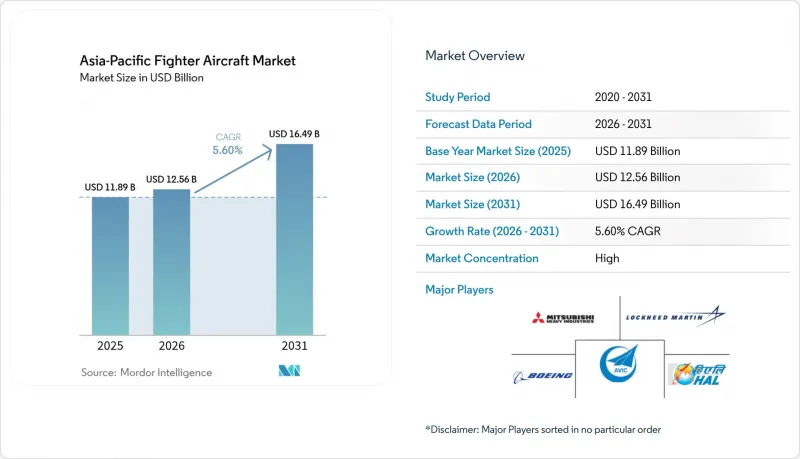
Mordor Intelligence에 의하면, 아시아태평양 전투기 시장 규모는 2025년에 118억 9,000만 달러로 평가되었고 2026년 125억 6,000만 달러에서 2031년까지 164억 9,000만 달러에 이를 것으로 추정되고 있어 예측 기간(2026-2031년) CAGR은 5.60%를 나타낼 전망입니다.
본 보고서는 이착륙 방식(기존 이착륙 등), 전투기 세대(4세대, 4.5세대 등), 엔진 구성(단발 및 쌍발), 임무 역할(제공권 확보 등), 최종 사용자(공군 등), 지역(중국, 인도, 일본 등)별로 분류되어 있습니다. 시장 전망은 금액(달러) 기준으로 제시되어 있습니다.
아시아태평양 전투기 시장 동향 및 인사이트
지역적 긴장 고조를 배경으로 한 국방 예산 확대
2024년, 이 지역의 국방비는 4,330억 달러에 달하여 7.80% 증가했습니다. 이는 전투기 조달 증가를 직접 뒷받침하는 요소입니다. 중국은 3,140억 달러를 배정했고, 일본은 예산을 21% 증액한 553억 달러로 늘려 아시아태평양 전투기 시장에서 생산량을 확보할 수 있는 다년 계약을 체결할 수 있게 되었습니다. 대만의 165억 달러 지출은 방공 플랫폼에 중점을 두고 있는 반면, 한국이 29억 달러를 투입한 F-15K 개조는 확대된 자금이 구형 기체 교체에 사용되고 있음을 보여줍니다. 정책 입안자들은 항공 전력을 잠재적인 다영역 분쟁에서의 비대칭적 수단으로 간주하며, 전투기에 대한 막대한 설비 투자를 지속하고 있습니다. 인도의 30% 오프셋 기준과 같은 국내 조달 요건은 새로운 자금을 국내 산업 생태계로 더욱 유입시켜 단기적인 수요를 뒷받침하고 있습니다.
3세대 전투기 교체를 수반하는 기체 현대화
재규어(Jaguar)나 MiG-29, 그 밖의 구형 기체의 퇴역으로 인해 신형 제트기의 꾸준한 도입이 시급해지면서, 아시아태평양의 전투기 시장은 단순한 기체 수 확대를 훨씬 뛰어넘는 기반을 다지고 있습니다. 인도만 해도 노후 기체의 단계적 퇴역에 따라 비행대 규모를 유지하기 위해 매년 35-40대의 신형 기체가 필요합니다. 경쟁사들의 입찰을 제치고 태국이 36억 5,000만 달러 규모의 그리펜 E/F를 수주한 것, 나아가 인도네시아의 81억 달러 규모 라팔 발주는 성능은 물론 기술 이전을 우선시하는 현대화 전략을 여실히 보여주고 있습니다. 업그레이드 계획은 생산 라인을 유지하고 차세대 플랫폼의 연구 개발(R&D) 자금을 조달하는 한편, HAL이 2027년까지 테자스 Mk1A를 연간 30대 생산하겠다는 목표는 국내 공급업체들이 유사한 현대화 흐름에 동참하고 있음을 보여줍니다.
높은 조달 비용과 수명 주기 비용
기체당 4,000만-1억 1,600만 달러에 달하는 단가에 더해, 프로그램 비용의 2배에 달하기도 하는 수명 주기 비용이 제한된 국방 예산을 압박하고 있어, 아시아태평양 전투기 시장의 발주를 위축시키고 있습니다. 방위비가 인도네시아의 GDP 대비 0.78%에서 미얀마의 4.09%까지 폭이 넓은 가운데, 재정적 격차로 인해 각국은 경량 전투기, 중고기, 혹은 리스로 눈을 돌리고 있습니다. KAI의 FA-50에 대한 필리핀의 7억 달러 추가 발주는 물류 패키지가 포함된 저비용 전투기가 예산에 제약이 있는 구매자에게 얼마나 매력적인지를 여실히 보여주고 있습니다. OEM 각사는 성과 기반 물류 및 수출신용융자를 통해 대응하고 있지만, 자본 집약성은 여전히 구조적인 걸림돌로 작용하고 있습니다.
부문 분석
2025년에는 기존 CTOL(일반 이착륙) 항공기가 아시아태평양 전투기 시장에서 57.92%의 점유율을 차지하며, 확고한 지상 배치 부대 구성을 반영하여 시장을 독점했습니다. VTOL(수직 이착륙) 기종은 틈새 시장으로 남아 있지만, 항공모함 프로그램과 분산 배치 개념이 수요를 끌어올림에 따라 연평균 성장률(CAGR) 6.62%를 나타낼 것으로 전망됩니다. 일본이 ‘이즈모’급 함정에 F-35B를 탑재하기로 결정한 것은 새로운 초대형 항공모함을 건조하지 않고도 VTOL 능력을 통해 작전 범위를 확대할 수 있음을 보여줍니다. 한편, 중국의 003형 ‘푸젠’ 항공모함과 구상 중인 004형 원자력 항공모함은 국산 설계가 성숙해지면 VTOL기 조달을 더욱 확대할 것입니다.
추력 벡터링 기술의 발전으로 인해 기존 VTOL에 따르던 탑재량 및 항속 거리 제약이 완화되면서 원정 임무에서의 매력이 높아지고 있습니다. 관리된 민간 공역에서 군용 VTOL 운용을 가능하게 하는 ICAO(국제민간항공기구) 지침의 발전과 맞물려, 지역 인도적 지원 분야에서 이 부문의 역할은 아시아태평양 전투기 시장의 성장 궤도를 더욱 뒷받침하고 있습니다.
4.5세대 제트기는 입증된 신뢰성과 업그레이드된 항공 전자 장비의 균형 덕분에 2025년 아시아태평양 전투기 시장에서 41.25%의 점유율을 차지했습니다. GCAP 및 NGAD와 같은 6세대 개발 프로젝트는 시제기가 아직 개발 단계에 있음에도 불구하고 연평균 성장률(CAGR) 8.15%를 나타낼 것으로 예측됩니다. 4세대 기단의 지속적인 유용성이 업그레이드 수요를 뒷받침하는 한편, 5세대 기체 구매가 당면한 능력 격차를 메우고 있습니다.
각 제조업체는 6세대 전투기의 등장 이전에 기존 기종의 경쟁력을 유지하기 위해 브리지 업그레이드(능동형 전자주사배열 레이더, 적외선 감지·추적 장치, 네트워크 게이트웨이 등)를 활용하고 있습니다. 중국의 첨단 시제기 공개는 경쟁 압력을 강화하고 있으며, 이로 인해 차세대 플랫폼에 대한 조기 도입 결정이 촉진되어 아시아태평양의 전투기 시장 규모를 확대시키고 있습니다.
기타 혜택:
- 엑셀 형식 시장 예측(ME) 시트
- 3개월간 애널리스트 지원
자주 묻는 질문
목차
제1장 서론
제2장 조사 방법
제3장 주요 요약
제4장 시장 구도
제5장 시장 규모와 성장 예측
제6장 경쟁 구도
제7장 시장 기회와 향후 전망
JHS 26.08.26According to Mordor Intelligence, the Asia-Pacific fighter aircraft market size was valued at USD 11.89 billion in 2025 and estimated to grow from USD 12.56 billion in 2026 to reach USD 16.49 billion by 2031, at a CAGR of 5.60% during the forecast period (2026-2031).
This report is Segmented by Take-Off and Landing (Conventional Take-Off and Landing, and More), Fighter Generation (4th Generation, 4. 5th Generation, and More), Engine Configuration (Single-Engine and Twin-Engine), Mission Role (Air-Superiority, and More), End User (Air Force, and More), and Geography (China, India, Japan, and More). The Market Forecasts are Provided in Terms of Value (USD).
Asia-Pacific Fighter Aircraft Market Trends and Insights
Escalating Defense Budgets Amid Rising Regional Tensions
Regional defense outlays climbed to USD 433 billion in 2024, a 7.80% jump that directly underwrites higher fighter procurement lines. China allocated USD 314 billion and Japan boosted its budget by 21% to USD 55.3 billion, enabling multi-year contract awards that lock in output for the Asia-Pacific fighter aircraft market. Taiwan's USD 16.50 billion spending emphasizes air-defense platforms, while South Korea's USD 2.9 billion F-15K upgrade shows legacy fleet refresh absorbing expanded funding. Policymakers see airpower as an asymmetric lever in potential multi-domain conflicts, sustaining high capital expenditure on combat aircraft. Local-content mandates, such as India's 30% offset threshold, further channel new money into domestic industrial ecosystems, reinforcing near-term demand.
Fleet Modernization Replacing 3rd-Generation Fighters
Retirement of Jaguars, MiG-29s, and other legacy assets compels steady intake of newer jets, anchoring the Asia-Pacific fighter aircraft market well beyond pure fleet expansion. India alone needs 35-40 fresh airframes each year to hold squadron numbers as older types phase out. Thailand's USD 3.65 billion Gripen E/F award over rival bids, plus Indonesia's USD 8.1 billion Rafale order, highlight modernization choices that prioritize technology transfer alongside performance. Upgrade paths sustain production lines and fund R&D for next-step platforms, while HAL's goal of 30 Tejas Mk1A jets annually by 2027 illustrates how domestic suppliers ride the same replacement wave.
Steep Acquisition and Life-Cycle Costs
Unit prices between USD 40-116 million and life-cycle expenses that often double program outlays squeeze smaller defense budgets, slowing orders within the Asia-Pacific fighter aircraft market. With defense spending ranging from 0.78% of GDP in Indonesia to 4.09% in Myanmar, affordability gaps push nations toward light combat jets, used platforms, or leasing. The KAI FA-50's USD 700 million Philippine follow-on order underlines how lower-cost fighters with logistics packages appeal to constrained buyers. OEMs respond through performance-based logistics and export-credit financing, yet capital intensity remains a structural brake.
Other drivers and restraints analyzed in the detailed report include:
- 6th-Generation R&D Collaborations Accelerate Procurement Cycles
- Export-Linked Financing and Tech-Transfer Packages Widen Buyer Base
- ITAR and Export-Control Constraints on Critical Subsystems
For complete list of drivers and restraints, kindly check the Table Of Contents.
Segment Analysis
Conventional CTOL aircraft dominated the Asia-Pacific fighter aircraft market with 57.92% share in 2025, mirroring entrenched land-based force structures. VTOL platforms, although niche, are forecast to record a 6.62% CAGR as carrier programs and distributed basing concepts raise demand. Japan's decision to embark F-35Bs on Izumo-class vessels demonstrates how VTOL capability extends reach without new supercarriers. Meanwhile, China's Type 003 Fujian carrier and envisioned Type 004 nuclear ship will amplify VTOL procurement once indigenous designs mature.
Technological advances in thrust-vectoring reduce the payload-range penalties historically associated with VTOL, enhancing attractiveness for expeditionary roles. Combined with evolving ICAO guidelines that enable military VTOL operations in controlled civil airspace, the segment's role in regional humanitarian response augments its growth trajectory within the Asia-Pacific fighter aircraft market.
4.5th-generation jets held 41.25% Asia-Pacific fighter aircraft market share in 2025, thanks to a balance of proven reliability and upgraded avionics. 6th-generation efforts such as GCAP and NGAD are projected to post an 8.15% CAGR, even though prototypes remain in development. The lingering utility of 4th-generation fleets sustains upgrade business, while 5th-generation purchases fill interim capability gaps.
Manufacturers capitalize on bridge upgrades-active electronically scanned array radars, infrared search-track, and network gateways-to keep incumbents relevant ahead of 6th-generation arrival. China's unveiling of advanced prototypes exerts competitive pressure, prompting earlier commitments that bolster the Asia-Pacific fighter aircraft market size for next-generation platforms.
Complete Report Scope:
- By Take-off and Landing
- Conventional Take-off and Landing (CTOL)
- Short Take-off and Landing (STOL)
- Vertical Take-off and Landing (VTOL/STOVL)
- By Fighter Generation
- 4th Generation
- 4.5th Generation
- 5th Generation
- 6th Generation/NGAD
- By Engine Configuration
- Single-Engine
- Twin-Engine
- By Mission Role
- Air-Superiority
- Multi-Role
- Close-Air-Support/Strike
- By End User
- Air Force
- Naval Aviation
- Marine/Army Aviation
- By Geography
- China
- India
- Japan
- South Korea
- Indonesia
- Rest of Asia-Pacific
List of Companies Covered in this Report:
- Hindustan Aeronautics Limited (HAL)
- Mitsubishi Heavy Industries, Ltd.
- Korea Aerospace Industries, Ltd.
- PT Dirgantara Indonesia
- Kawasaki Heavy Industries, Ltd.
- The Boeing Company
- Airbus SE
- Aviation Industry Corporation of China
- United Aircraft Corporation
- Lockheed Martin Corporation
- Saab AB
Additional Benefits:
- The market estimate (ME) sheet in Excel format
- 3 months of analyst support
TABLE OF CONTENTS
1 INTRODUCTION
- 1.1 Study Assumptions and Market Definition
- 1.2 Scope of the Study
2 RESEARCH METHODOLOGY
3 EXECUTIVE SUMMARY
4 MARKET LANDSCAPE
- 4.1 Market Overview
- 4.2 Market Drivers
- 4.2.1 Escalating defense budgets amid rising regional tensions
- 4.2.2 Fleet modernization replacing 3rd-generation fighters
- 4.2.3 6th-generation R&D collaborations accelerate procurement cycles
- 4.2.4 Export-linked financing and tech-transfer packages widen buyer base
- 4.2.5 Indigenous fighter programs unlock domestic spending
- 4.2.6 Carrier-air-wing expansion (China, India, Japan) drives naval fighter demand
- 4.3 Market Restraints
- 4.3.1 Steep acquisition and life-cycle costs
- 4.3.2 ITAR and export-control constraints on critical subsystems
- 4.3.3 Engine and semiconductor supply-chain bottlenecks
- 4.3.4 Production backlogs and delivery slippages
- 4.4 Value Chain Analysis
- 4.5 Regulatory Landscape
- 4.6 Technological Outlook
- 4.7 Porter's Five Forces Analysis
- 4.7.1 Threat of New Entrants
- 4.7.2 Bargaining Power of Buyers
- 4.7.3 Bargaining Power of Suppliers
- 4.7.4 Threat of Substitutes
- 4.7.5 Intensity of Competitive Rivalry
5 MARKET SIZE AND GROWTH FORECASTS (VALUE)
- 5.1 By Take-off and Landing
- 5.1.1 Conventional Take-off and Landing (CTOL)
- 5.1.2 Short Take-off and Landing (STOL)
- 5.1.3 Vertical Take-off and Landing (VTOL/STOVL)
- 5.2 By Fighter Generation
- 5.2.1 4th Generation
- 5.2.2 4.5th Generation
- 5.2.3 5th Generation
- 5.2.4 6th Generation/NGAD
- 5.3 By Engine Configuration
- 5.3.1 Single-Engine
- 5.3.2 Twin-Engine
- 5.4 By Mission Role
- 5.4.1 Air-Superiority
- 5.4.2 Multi-Role
- 5.4.3 Close-Air-Support/Strike
- 5.5 By End User
- 5.5.1 Air Force
- 5.5.2 Naval Aviation
- 5.5.3 Marine/Army Aviation
- 5.6 By Geography
- 5.6.1 China
- 5.6.2 India
- 5.6.3 Japan
- 5.6.4 South Korea
- 5.6.5 Indonesia
- 5.6.6 Rest of Asia-Pacific
6 COMPETITIVE LANDSCAPE
- 6.1 Market Concentration
- 6.2 Strategic Moves
- 6.3 Market Share Analysis
- 6.4 Company Profiles (includes Global level Overview, Market level overview, Core Segments, Financials as available, Strategic Information, Market Rank/Share for key companies, Products and Services, and Recent Developments)
- 6.4.1 Hindustan Aeronautics Limited (HAL)
- 6.4.2 Mitsubishi Heavy Industries, Ltd.
- 6.4.3 Korea Aerospace Industries, Ltd.
- 6.4.4 PT Dirgantara Indonesia
- 6.4.5 Kawasaki Heavy Industries, Ltd.
- 6.4.6 The Boeing Company
- 6.4.7 Airbus SE
- 6.4.8 Aviation Industry Corporation of China
- 6.4.9 United Aircraft Corporation
- 6.4.10 Lockheed Martin Corporation
- 6.4.11 Saab AB
7 MARKET OPPORTUNITIES AND FUTURE OUTLOOK
- 7.1 White-space and Unmet-need Assessment