|
시장보고서
상품코드
2114073
간염 진단 검사 : 시장 점유율 분석, 업계 동향 및 통계, 성장 예측(2026-2031년)Hepatitis Diagnostic Test - Market Share Analysis, Industry Trends & Statistics, Growth Forecasts (2026 - 2031) |
||||||
 Mordor Intelligence
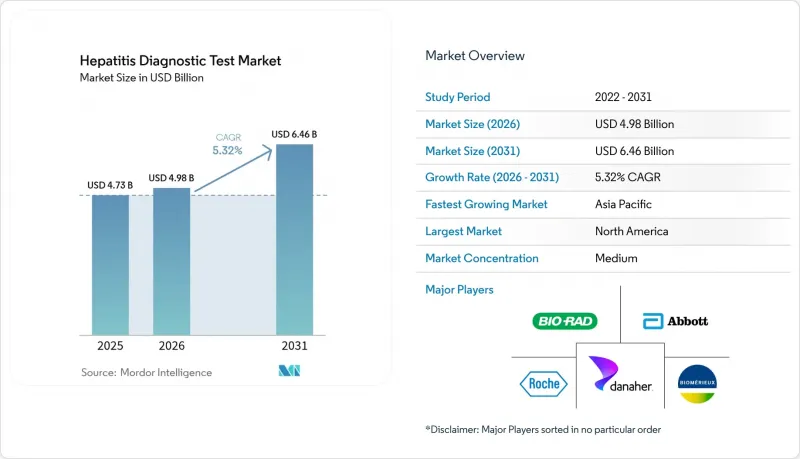
Mordor Intelligence에 의하면, 2026년 간염 진단 검사 시장 규모는 49억 8,000만 달러로 추정되고 있으며, 2025년 47억 3,000만 달러에서 2031년에는 64억 6,000만 달러에 달할 것으로 예측됩니다.
또한 2026-2031년 연평균 성장률(CAGR) 5.32%를 기록할 전망입니다.
본 보고서는 제품 유형(시약 및 키트 등), 질환 유형(B형 간염 등), 기술(혈청학적 검사 등), 검체 유형(혈액 등), 검사 환경(병원 검사실 등), 지역(북미, 유럽, 아시아태평양 등)별로 분류되어 있습니다. 시장 전망은 금액(달러) 기준으로 제시되어 있습니다.
전 세계 간염 진단 검사 시장 동향 및 인사이트
전 세계 HBV 및 HCV 유병률 증가
2억 5,400만 명 이상이 만성 B형 간염을, 5,000만 명이 만성 C형 간염을 앓고 있으며, 만성 B형 간염 환자의 75%는 아시아태평양에 집중되어 있습니다. 발병률의 상승으로 인해 진단 수요는 계속해서 높은 수준을 유지하고 있으며, 특히 중국에서는 2030년까지 C형 간염의 신규 감염률이 10만 명당 17.92명에 달할 것으로 예측됩니다. 지역 간 격차는 여전히 존재하며, 한국 남부에서는 전국적인 감소 추세에도 불구하고 여전히 높은 HCV 유병률이 보고되고 있습니다. 인도 서벵골 주에서는 만성 신장 질환 환자들 사이에서 HCV 1c형과 같은 드문 유전자형이 우세하여, 확실한 유전자형 판정의 필요성을 부각시키고 있습니다. 이러한 경향들이 결합되어, 정확하고 반복적인 검사가 필요한 고위험 환자군이 지속적으로 존재하게 됩니다.
혈청학적 검사에서 고감도 분자 검사 플랫폼으로의 전환
표적형 차세대 염기서열 분석(NGS)은 기존 검사법으로는 검출이 어려웠던 간외 조직에서도 현재 간염 바이러스를 검출할 수 있게 되었습니다. 또한, 고처리량 염기서열 분석을 통해 치료 중인 E형 간염에서 A1343V 등의 내성 관련 돌연변이도 추적할 수 있습니다. 인공지능(AI) 도구를 활용함으로써, 보다 신속한 결과 보고와 저비용을 실현하는 동시에 고정밀 간질환 진단이 가능해집니다. 규제 측면에서의 지원도 도입을 가속화하고 있으며, FDA는 HBV 검사를 클래스 III에서 클래스 II로 재분류하고 510(k) 신청 절차를 간소화했습니다. 이 플랫폼이 진료소 및 지역 의료 현장에 보급됨에 따라, 간염 진단 검사 시장은 눈부신 성장을 이루고 있습니다.
저소득 국가에서 분자 검사의 검사당 높은 비용
23개 중저소득 국가를 대상으로 한 조사에 따르면, 바이러스학적 검사가 여전히 부담스러운 가격대이기 때문에 많은 프로그램에서 간염 검사를 헌혈자에게만 제한하고 있는 것으로 확인되었습니다. 복잡한 확정 진단 알고리즘으로 인해 환자 1인당 비용은 1단계 혈청학적 검사 비용을 훨씬 초과하고 있습니다. 환경적 요인과 규제 분절화로 인해 검증 비용이 증가하고 있어, 제품 개발자들은 ‘혁신에서 접근성까지의 격차’에 직면해 있습니다. 단계적 가격 책정, 일괄 조달 또는 보조금 모델이 확대되기 전까지는 간염 부담이 크지만 자금이 부족한 시장에서 첨단 플랫폼의 보급은 지연될 것입니다.
부문 분석
2025년, 간염 진단 검사 시장 규모에서 시약 및 키트가 매출의 62.05%를 차지하며 가장 큰 점유율을 기록했습니다. 이는 검사실 워크플로우를 뒷받침하는 ‘반복 사용 소모품’ 모델을 뒷받침하는 결과입니다. 장비 분야에서는 손바닥 크기의 엘라스토그래피 등 소형화 추세가 호재로 작용했으나, 설비 투자 예산은 여전히 경기 변동의 영향을 받기 쉬운 상황이 지속되었습니다. 소프트웨어 및 서비스는 여전히 규모는 작지만, 검사실이 판정 효율화 및 보고서 작성 자동화를 위해 AI 엔진을 도입함에 따라 2031년까지 연평균 성장률(CAGR) 6.21%로 성장할 전망입니다. 클라우드 기반 분석 기능을 자사의 시약 사업과 연계하는 벤더들은 고객을 확보하면서 추가적인 구독 수익을 창출하고 있습니다.
시약 부문은 가격 투명화 및 제네릭 제품의 부상이라는 과제에 직면해 있지만, 동결 건조된 분자 마스터믹스 및 다항목 포인트 오브 케어 검사 키트에 대한 지속적인 혁신 덕분에 수요는 견조한 추세를 보이고 있습니다. 기기 벤더들은 연결 기능과 의사결정 지원 대시보드를 세트로 제공하는 사례가 늘어나고 있으며, 과거에는 단독으로 가동되던 분석 장치를 네트워크 연결형 기기로 변모시키고 있습니다. 2025년 1월 BioMerieux사가 SpinChip Diagnostics사를 1억 1,100만 유로에 인수한 사례는 1차 진료 현장에 적합한 초고속 ‘시료에서 결과까지’ 플랫폼을 확보하기 위한 경쟁이 격화되고 있음을 보여줍니다. 소프트웨어 계층이 확대됨에 따라 서비스 모델은 성과 기반 계약으로 전환되고 있으며, 이로 인해 B형 간염 진단 검사 시장에는 디지털 성과와 연동된 새로운 수익원이 창출되고 있습니다.
2025년 매출에서 B형 간염이 주도적인 위치를 차지하며, B형 간염 진단 검사 시장 점유율의 48.40%를 차지했습니다. 이는 2억 5,400만 명의 환자 수라는 유병률을 반영한 것입니다. 검사 패널은 여전히 복잡하며, 임산부는 CDC 지침에 따라 임신할 때마다 HBsAg, anti-HBc, anti-HBs 선별 검사를 받아야 합니다. C형 간염 검사 건수는 근절 프로그램에 따라 검사 알고리즘이 간소화됨에 따라 급속히 증가하고 있습니다. Cepheid사의 손가락 채혈을 통한 RNA 검사로 인해 1차 진료 현장에서 단 한 번의 내원만으로 진단이 가능해졌습니다. ‘기타 간염’(A형, E형, D형)은 연평균 성장률(CAGR) 6.33%로 가장 빠르게 성장하는 그룹이며, A형 간염 바이러스(HAV) 및 E형 간염 바이러스(HEV)의 집단 감염 증가와 더 광범위한 지리적 확산을 확인하는 새로운 염기서열 분석 데이터에 힘입고 있습니다.
새로운 데이터에 따르면 특정 A형 간염 바이러스(HAV) III형 A 및 E형 간염 바이러스(HEV-1) 균주가 더 심각한 예후와 관련이 있는 것으로 나타나, 병원들은 분자 검사 및 유전자형 판정으로의 전환을 서두르고 있습니다. 이와 동시에, 미국 내 C형 간염 퇴치를 위한 자금은 보편적인 선별 검사를 지원하고 있으며, 시약에 대한 안정적인 수요를 견인하고 있습니다. D형 간염에 대한 새로운 치료법이 도입됨에 따라 HDV 반사 검사에 대한 수요는 증가할 것으로 예측됩니다. 만성 B형 간염의 부담, C형 간염 근절 가속화, 그리고 기타 바이러스성 간염에 대한 인식 확산이 맞물려 간염 진단 검사 시장의 장기적인 성장 기반이 확보되고 있습니다.
지역별 분석
북미는 체계적인 정부 주도 선별 검사와 분자진단 플랫폼의 조기 도입으로 2025년 전 세계 간염 진단 검사 시장 점유율의 39.88%를 차지했습니다. 123억 달러 규모의 C형 간염 근절 예산안을 포함한 미국 정책의 추진력에 힘입어, 이 지역의 간염 진단 검사 시장은 4.84%라는 안정적인 연평균 성장률(CAGR)을 확보하고 있습니다. Cepheid사의 HCV 현장 진단(Point-of-Care) RNA 검사 등의 FDA 승인은 분산형 도입을 가속화하고 있습니다. 검사실 네트워크는 iLFT와 같은 AI를 활용한 판정 프로세스를 통합하여 만성 간 질환의 검출률을 향상시키고 있으며, 혁신을 신속하게 확대하는 성숙한 생태계를 구현하고 있습니다.
유럽에서는 규제 조화와 견고한 임상 지침이 투자를 뒷받침하며, 연평균 성장률(CAGR)은 5.17%로 성장을 지속하고, 있습니다. EASL(유럽간학회)이 개정된 B형 간염 관리 프로토콜에서는 첨단 진단법이 의무화되어 분자 패널에 대한 수요가 더욱 높아지고 있습니다. 로슈사의 18분 만에 결과가 나오는 ‘Elecsys PRO-C3’ 섬유화 검사는 신속하고 비침습적인 도구에 대한 이 지역의 높은 수요를 여실히 보여주고 있습니다. 그러나 의료 격차는 여전히 존재하며, 스페인 병원 중 HBV 반사 검사를 실시하는 곳은 70%, HDV의 경우 50% 미만에 그치고 있어 워크플로우 개선의 여지가 부각되고 있습니다. 웨어러블 초음파 모니터링의 혁신은 유럽의 제품 라인업을 더욱 차별화하고 있습니다.
아시아태평양은 B형 간염의 과도한 부담과 의료 투자 증가에 힘입어 2031년까지 연평균 성장률(CAGR) 6.23%로 가장 빠르게 성장하는 지역입니다. 중국, 일본, 한국에는 만성 B형 간염 환자의 절반이 집중되어 있어, 타의 추종을 불허하는 검사 수요를 창출하고 있습니다. 중국의 C형 간염(HCV) 유병률은 2030년까지 10만 명당 17.92에 달할 것으로 예측되어, 고처리량 진단으로의 전환이 시급한 과제가 되고 있습니다. 일본에서는 ‘Enhanced Liver Fibrosis Score(ELF 점수)’에 대한 보험 적용이 첨단 진단 도구에 대한 정책적 지원을 뒷받침하고 있습니다. 인도에서는 HCV 1c형과 같은 희귀한 아형이 존재하기 때문에 정밀한 유전자형 판정에 대한 수요가 증가하고 있습니다. 아세안(ASEAN) 및 동아시아 규제 당국 간의 협력을 통해 의료기기 승인까지의 기간이 단축되어 시장 접근성이 더욱 확대되고 있습니다.
기타 혜택:
- 엑셀 형식 시장 예측(ME) 시트
- 3개월간의 애널리스트 지원
자주 묻는 질문
목차
제1장 서론
제2장 조사 방법
제3장 주요 요약
제4장 시장 구도
제5장 시장 규모와 성장 예측
제6장 경쟁 구도
제7장 시장 기회와 향후 전망
LSH 26.08.25According to Mordor Intelligence, hepatitis diagnostic test market size in 2026 is estimated at USD 4.98 billion, growing from 2025 value of USD 4.73 billion with 2031 projections showing USD 6.46 billion, growing at 5.32% CAGR over 2026-2031.
This report is Segmented by Product Type (Reagents & Kits and More), Disease Type (Hepatitis B and More), Technology (Serology Tests and More), Sample Type (Blood and More), Test Setting (Hospital Laboratories and More), and Geography (North America, Europe, Asia-Pacific, and More). The Market Forecasts are Provided in Terms of Value (USD).
Global Hepatitis Diagnostic Test Market Trends and Insights
Escalating Global HBV & HCV Prevalence
More than 254 million people live with chronic hepatitis B and 50 million with hepatitis C, with Asia-Pacific bearing 75% of chronic HBV cases. Rising incidence keeps diagnostic demand high, particularly in China where new HCV infections are projected to reach 17.92 per 100,000 by 2030. Regional disparities linger-southern Korea still reports elevated HCV prevalence despite national declines. Uncommon genotypes such as HCV 1c dominate among chronic kidney-disease patients in West Bengal, India, underscoring the need for robust genotyping. Combined, these patterns ensure a sustained base of at-risk patients requiring accurate and repeat testing.
Migration from Serology to High-Sensitivity Molecular Platforms
Targeted next-generation sequencing (NGS) now detects hepatitis viruses, even in extrahepatic tissue, where classical assays fail. High-throughput sequencing also tracks resistance-associated variants such as A1343V in hepatitis E during treatment. Artificial intelligence tools enable high-accuracy liver disease diagnosis with faster turnaround times and lower costs. Regulatory support accelerates adoption: the FDA reclassified HBV assays from Class III to Class II, streamlining the 510(k) pathway. As platforms migrate to clinics and community settings, the hepatitis diagnostic test market experiences a notable increase.
High Per-Test Cost of Molecular Assays in Low-Income Settings
Surveys across 23 low- and middle-income countries confirm that many programs still limit hepatitis testing to blood donors because virological assays remain unaffordable. Complex confirmation algorithms push per-patient costs well beyond those of single-step serology. Product developers face an innovation-to-access gap, as environmental factors and regulatory fragmentation raise validation expenses. Until tiered pricing, pooled procurement or subsidy models expand, penetration of advanced platforms will lag in high-burden but cash-strapped markets.
Other drivers and restraints analyzed in the detailed report include:
- Government-Funded Screening & Vaccination Programs
- Emergence of Microfluidic Point-of-Care Viral-Load Analyzers
- Weak Cold-Chain Logistics for Sample Transport in Remote Areas
For complete list of drivers and restraints, kindly check the Table Of Contents.
Segment Analysis
Reagents and kits generated the largest slice of the hepatitis diagnostic test market size in 2025 with 62.05% revenue, underscoring the recurrent-consumables model that underpins laboratory workflows. Instruments benefited from miniaturization trends such as palm-sized elastography, yet capital budgets remained cyclical. Software and services, though still a smaller base, are on track for a 6.21% CAGR to 2031 as laboratories embed AI engines that streamline interpretation and automate reporting. Vendors that link cloud-based analytics to their reagent franchises lock-in customers while creating incremental subscription income.
The reagents segment faces mounting price transparency and generics, but demand persists through continuous innovation in lyophilized molecular master mixes and multiplex point-of-care kits. Instrument vendors increasingly bundle connectivity and decision-support dashboards, transforming once-stand-alone analyzers into networked devices. BioMerieux's January 2025 purchase of SpinChip Diagnostics for EUR 111 million illustrates the race to secure ultra-fast sample-to-answer platforms that fit primary-care settings. As software layers expand, service models shift toward outcome-based contracts, giving the hepatitis diagnostic test market a new revenue vector tied to digital performance.
Hepatitis B dominated 2025 revenue with a 48.40% of the hepatitis diagnostic test market share in 2025, mirroring its 254 million-patient prevalence. Testing panels remain complex-pregnant women require HBsAg, anti-HBc and anti-HBs screening every pregnancy under CDC guidance. Hepatitis C volumes are scaling quickly as elimination programs simplify algorithms; the Cepheid finger-stick RNA test enables single-visit diagnosis in primary care. "Other hepatitis" (A, E, D) is the fastest-growing group at 6.33% CAGR, propelled by increasing HAV and HEV outbreaks and new sequencing data confirming wider geographic spread.
Emerging data link specific HAV genotype IIIA and HEV-1 strains to more severe outcomes, pressuring hospitals to upgrade to molecular assays and genotyping. In parallel, hepatitis C elimination funding in the U.S. supports universal screening, driving consistent reagent pull-through. As novel therapies for hepatitis D roll out, demand for HDV reflex testing is likely to rise. This mix of chronic HBV burden, HCV elimination acceleration and broader recognition of other viral hepatitides secures long-term breadth for the hepatitis diagnostic test market.
Complete Report Scope:
- By Product Type
- Reagents & Kits
- Instruments & Analyzers
- Software & Services
- By Disease Type
- Hepatitis B
- Hepatitis C
- Other Hepatitis
- By Technology
- Serology Tests
- Rapid Diagnostic Tests
- Molecular Tests
- Next-Gen Sequencing Panels
- By Sample Type
- Blood
- Saliva / Oral Fluid
- Urine
- By Test Setting
- Hospital Laboratories
- Reference Laboratories
- Blood Banks
- Point-of-Care / Physician Offices
- Home Testing & Self-Collection
- By Geography
- North America
- United States
- Canada
- Mexico
- Europe
- Germany
- United Kingdom
- France
- Italy
- Spain
- Rest of Europe
- Asia-Pacific
- China
- Japan
- India
- Australia
- South Korea
- Rest of Asia-Pacific
- Middle East and Africa
- GCC
- South Africa
- Rest of Middle East and Africa
- South America
- Brazil
- Argentina
- Rest of South America
- North America
Geography Analysis
North America held 39.88% of the global hepatitis diagnostic test market share in 2025 due to structured government screening and early adoption of molecular platforms. U.S. policy momentum, including the proposed USD 12.3 billion hepatitis C elimination budget, ensures a steady 4.84% CAGR for the regional hepatitis diagnostic test market. FDA approvals, such as Cepheid's HCV point-of-care RNA test, accelerate decentralized uptake. Laboratory networks integrate AI-enhanced interpretation pathways like iLFT to boost chronic liver-disease detection, demonstrating a mature ecosystem that rapidly scales innovation.
Europe posts a 5.17% CAGR as harmonized regulations and robust clinical guidelines sustain investment. EASL's updated hepatitis B management protocol mandates advanced diagnostics, reinforcing demand for molecular panels. Roche's 18-minute Elecsys PRO-C3 fibrosis test exemplifies the region's appetite for rapid, non-invasive tools. Yet, care gaps remain, with only 70% of Spanish hospitals performing reflex tests for HBV and under 50% for HDV, spotlighting workflow opportunities. Innovation in wearable ultrasound monitoring further differentiates European offerings.
Asia-Pacific is the fastest-expanding territory at 6.23% CAGR to 2031, fueled by its disproportionate hepatitis burden and rising healthcare investment. China, Japan, and South Korea host half of all chronic HBV patients, creating unparalleled testing demand. China's HCV incidence is projected to reach 17.92 per 100,000 by 2030, urging an upgrade to high-throughput diagnostics. Japan's reimbursement for the Enhanced Liver Fibrosis score underscores policy support for advanced tools. Sophisticated genotyping needs are rising in India due to uncommon subtypes like HCV 1c. Regulatory collaboration across ASEAN and East-Asia regulators is improving device approval timelines, fostering broader market access.
- Abbott Laboratories
- Avantor
- Beckton Dickinson
- bioMerieux
- Bio-Rad Laboratories
- Danaher
- DiaSorin
- Roche
- Fujirebio Inc.
- Grifols
- Helena Laboratories
- Hologic
- Orasure Technologies
- Ortho Clinical Diagnostics
- QIAGEN
- Revvity Inc.
- Siemens Healthineers
- Sysmex
- Thermo Fisher Scientific
- Trinity Biotech plc
Additional Benefits:
- The market estimate (ME) sheet in Excel format
- 3 months of analyst support
TABLE OF CONTENTS
1 Introduction
- 1.1 Study Assumptions & Market Definition
- 1.2 Scope of the Study
2 Research Methodology
3 Executive Summary
4 Market Landscape
- 4.1 Market Overview
- 4.2 Market Drivers
- 4.2.1 Escalating Global HBV & HCV Prevalence
- 4.2.2 Rapid Migration from Serology to High-Sensitivity Molecular Platforms
- 4.2.3 Expansion of Government-Funded Screening & Vaccination Programs
- 4.2.4 Emergence of Microfluidic POC Viral-Load Analyzers
- 4.2.5 AI-Assisted Elastography Improving Non-Invasive Liver Assessment
- 4.2.6 Adoption of Self-Collection Dried-Blood-Spot Kits for Remote Testing
- 4.3 Market Restraints
- 4.3.1 High Per-Test Cost of Molecular Assays in Low-Income Settings
- 4.3.2 Regulatory Ambiguity Around Direct-To-Consumer Viral-Load Kits
- 4.3.3 Undetected Occult Infections Causing False-Negatives in Immunocompromised Patients
- 4.3.4 Weak Cold-Chain Logistics for Sample Transport in Remote Areas
- 4.4 Supply Chain Analysis
- 4.5 Regulatory Landscape
- 4.6 Technological Outlook
- 4.7 Porter's Five Forces Analysis
- 4.7.1 Threat of New Entrants
- 4.7.2 Bargaining Power of Buyers
- 4.7.3 Bargaining Power of Suppliers
- 4.7.4 Threat of Substitutes
- 4.7.5 Competitive Rivalry
5 Market Size & Growth Forecasts (Value)
- 5.1 By Product Type
- 5.1.1 Reagents & Kits
- 5.1.2 Instruments & Analyzers
- 5.1.3 Software & Services
- 5.2 By Disease Type
- 5.2.1 Hepatitis B
- 5.2.2 Hepatitis C
- 5.2.3 Other Hepatitis
- 5.3 By Technology
- 5.3.1 Serology Tests
- 5.3.2 Rapid Diagnostic Tests
- 5.3.3 Molecular Tests
- 5.3.4 Next-Gen Sequencing Panels
- 5.4 By Sample Type
- 5.4.1 Blood
- 5.4.2 Saliva / Oral Fluid
- 5.4.3 Urine
- 5.5 By Test Setting
- 5.5.1 Hospital Laboratories
- 5.5.2 Reference Laboratories
- 5.5.3 Blood Banks
- 5.5.4 Point-of-Care / Physician Offices
- 5.5.5 Home Testing & Self-Collection
- 5.6 By Geography
- 5.6.1 North America
- 5.6.1.1 United States
- 5.6.1.2 Canada
- 5.6.1.3 Mexico
- 5.6.2 Europe
- 5.6.2.1 Germany
- 5.6.2.2 United Kingdom
- 5.6.2.3 France
- 5.6.2.4 Italy
- 5.6.2.5 Spain
- 5.6.2.6 Rest of Europe
- 5.6.3 Asia-Pacific
- 5.6.3.1 China
- 5.6.3.2 Japan
- 5.6.3.3 India
- 5.6.3.4 Australia
- 5.6.3.5 South Korea
- 5.6.3.6 Rest of Asia-Pacific
- 5.6.4 Middle East and Africa
- 5.6.4.1 GCC
- 5.6.4.2 South Africa
- 5.6.4.3 Rest of Middle East and Africa
- 5.6.5 South America
- 5.6.5.1 Brazil
- 5.6.5.2 Argentina
- 5.6.5.3 Rest of South America
- 5.6.1 North America
6 Competitive Landscape
- 6.1 Market Concentration
- 6.2 Competitive Benchmarking
- 6.3 Market Share Analysis
- 6.4 Company Profiles (includes Global level Overview, Market level overview, Core Segments, Financials as available, Strategic Information, Market Rank/Share for key companies, Products & Services, and Recent Developments)
- 6.4.1 Abbott Laboratories
- 6.4.2 Avantor, Inc.
- 6.4.3 Becton Dickinson and Company
- 6.4.4 bioMerieux SA
- 6.4.5 Bio-Rad Laboratories
- 6.4.6 Danaher Corporation
- 6.4.7 DiaSorin SpA
- 6.4.8 F. Hoffmann-La Roche AG
- 6.4.9 Fujirebio Inc.
- 6.4.10 Grifols, S.A.
- 6.4.11 Helena Laboratories Corporation
- 6.4.12 Hologic Inc.
- 6.4.13 OraSure Technologies Inc.
- 6.4.14 Ortho Clinical Diagnostics
- 6.4.15 QIAGEN N.V.
- 6.4.16 Revvity Inc.
- 6.4.17 Siemens Healthineers
- 6.4.18 Sysmex Corporation
- 6.4.19 Thermo Fisher Scientific, Inc.
- 6.4.20 Trinity Biotech plc
7 Market Opportunities & Future Outlook
- 7.1 White-space & Unmet-Need Assessment