

|
시장보고서
상품코드
2114102
목재용 내화 코팅 시장 : 시장 점유율 분석, 업계 동향 및 통계, 성장 예측(2026-2031년)Fireproofing Coatings For Wood - Market Share Analysis, Industry Trends & Statistics, Growth Forecasts (2026 - 2031) |
||||||
 Mordor Intelligence
Mordor Intelligence에 의하면, 목재용 내화 코팅 시장 규모는 2025년에 6억 1,482만 달러로 평가되었고, 2026년에 6억 4,083만 달러로 추정되고, 2031년까지 8억 2,044만 달러에 이를 것으로 예측되며, 2026-2031년 CAGR 4.23%로 성장할 전망입니다.
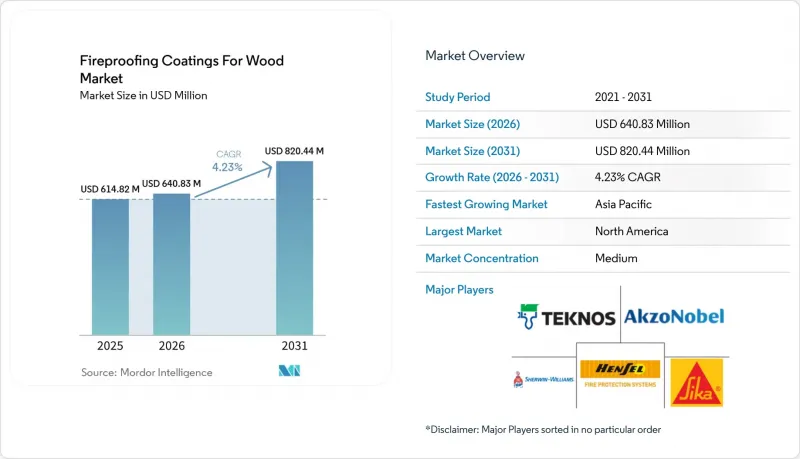
본 보고서는 기술별(수성, 용제계, UV 경화형, 기타 기술), 수지 유형별(아크릴, 폴리우레탄/우레탄, 실리콘,알키드, 기타 수지 유형), 코팅 유형별(무할로겐 및 할로겐계), 용도별(건축용 및 비건축용), 그리고 지역별(아시아태평양, 북미, 기타)로 분류되어 있습니다. 시장 전망은 금액(달러) 기준으로 제시되어 있습니다.
세계의 목재용 내화 코팅 시장 동향 및 인사이트
엄격한 방화 기준 및 인증 요건
2024년판 국제 건축 기준(International Building Code)에 따르면, 노출된 목재의 화염 전파 지수가 허용 기준 내에 포함되는 것을 조건으로 대규모 목조 구조물을 중층 및 고층 수준까지 건설할 수 있게 됩니다. 이 기준은 팽창성 도료를 도포함으로써만 달성할 수 있습니다. 한편, 유로우코드 5(Eurocode 5)의 2025년 개정판은 설계자에게 경제적 이점을 제공합니다. 이러한 도료에 의한 보호 탄화층이 인정됨으로써 목재의 단면 치수를 축소할 수 있기 때문입니다. 일본에서는 지진이 빈번한 지역의 중층 CLT 주택에도 유사한 규정이 적용되고 있습니다. 여기에서는 인증된 도료가 ASTM E119 규격에 기반한 평가 기준을 충족해야 합니다. 또한, NFPA 703에서는 제3자 인증 의무화가 도입되어, 이에 따라 인증 시험소를 보유한 공급업체 시장 점유율이 확대되었습니다. 이러한 규제가 맞물리면서 팽창성 도료는 중층·고층 목조 건축물의 설계 체계에 확고하게 자리 잡았습니다.
아시아태평양의 대규모 목조 건축 확대
2024년부터 2025년에 걸쳐 일본에서는 CLT 건축물의 건설이 대폭 증가하여, 10층을 초과하는 건물이 몇 동 더 늘어났습니다. 호주에서는 ‘2025년 국가 건축 기준’에 따라, 도장면이 BAL 40의 유동 조건을 충족하는 것을 전제로 산불 발생 위험이 높은 지역에서 CLT 사용이 허용되었습니다. 2027년까지 중국은 목조 주택 공급을 목적으로 새로운 CLT 생산 라인 가동을 승인했습니다. 1제곱미터당 내화 성능을 갖춘 코팅이 의무화됩니다. 2025년, 한국은 CLT를 활용한 학교 건설에 대한 보조금을 지원하며 KS F 3111 규격 준수를 확보했습니다. 이러한 노력들이 맞물려 목재용 내화 코팅에 대한 수요를 크게 끌어올리고 있습니다.
용제 기술에 대한 VOC/HAP 규제
캘리포니아주 규정 1113에 따라, 기존에 크실렌을 다량 함유한 에폭시 수지는 사실상 사용할 수 없게 되었습니다. 한편, EU에서는 2027년까지 상한치를 더욱 강화할 예정입니다. 미국에서는 2024년 HAP 규정에 따라 메틸에틸케톤의 허용 수준이 대폭 낮아졌습니다. 이 변경으로 인해 습도가 높은 지역에서는 경화 시간이 길어져 시공 업체의 일정에 차질이 발생하고 있습니다. 중국에서는 GB 38507-2020의 도입으로 규제가 마련되었습니다. 그러나 1선 도시 이외의 지역에서는 규제 집행이 미흡하여, 용제를 다량 사용하는 그레이 마켓이 여전히 번성하고 있습니다. 업계가 수성 화학 기술로 급속히 전환되는 가운데, 분산 기술에 대한 전문 지식이 부족한 중소 배합 제조업체들은 점점 더 큰 부담을 떠안고 있습니다.
부문 분석
2025년 현재, 목재용 내화 코팅 시장에서 수성 시스템의 점유율은 68.09%를 차지했으며, 2031년까지 연평균 성장률(CAGR) 4.47%를 나타낼 것으로 예측됩니다. 이러한 시스템은 규제 기준을 준수할 뿐만 아니라, 목재의 수분 함량을 관리하면서 팽창 현상 없이 시공이 가능합니다. 1액형 패키지의 도입으로 포트라이프 위험이 경감되고 시공 업체의 작업 공정이 간소화됨에 따라, 이 기술의 우위는 더욱 공고해지고 있습니다. 한편, 철도 차량의 내장재나 선박의 격벽에 주로 사용되는 용제형 제품은 수요의 상당 부분을 차지해 왔으나, 규제 강화에 직면하여 성장이 제약을 받고 있습니다. UV 경화형 도료는 공장에서의 신속한 경화로 인해 스칸디나비아의 패널 제조업체들로부터 주목을 받고 있지만, 팽창성 필름이 두꺼워 빛의 투과가 제한되기 때문에 여전히 틈새 시장 수준에 머물러 있습니다.
수성 시스템으로의 전환은 물류 동향에 변화를 가져옵니다. 고밀도 배합으로 인해 1리터당 운송 비용은 상승하지만, 현장에서의 환기 요건이 완화되어 인허가 절차가 효율화됩니다. 분산 생산 라인을 갖춘 대형 제조업체는 이러한 추가 비용을 흡수할 수 있지만, 중소기업에게는 과제가 되어 경쟁 구도에 변화를 가져오고 있습니다. 규제가 신흥 지역으로 확대됨에 따라, 수성 시스템의 우위는 목재용 내화 코팅 분야에서 통합형 다국적 기업 시장 규모 우위를 더욱 공고히 할 전망입니다.
아크릴 수지는 2025년에 소비량의 74.69%를 차지한 것으로 평가되었으며, 2031년까지 연평균 성장률(CAGR) 4.37%를 유지할 전망입니다. 특정 온도에서 활성화되고 가마 건조 목재 내부의 습기에 내성을 지닌, 인을 풍부하게 함유한 탄화 발포체 덕분에 아크릴 수지는 건축가들이 선호하는 선택지가 되고 있습니다. 폴리우레탄은 학교나 병원에서 특히 중요시되는 내마모성을 자랑합니다. 그러나 2액 혼합 공정은 인건비 부담이 되고 있습니다. 실리콘의 소수성 네트워크는 해안 지역이나 열대 기후에서 매우 뛰어난 성능을 발휘합니다. 하지만 가격이 비싸기 때문에 산불 위험이 높은 지역으로 채택이 제한되고 있습니다. 에폭시 및 비닐 에스테르는 VOC 규제보다 내화학성이 우선시되는 해상 플랫폼에서 선호되며, 완만한 성장세를 보이고 있습니다.
아크릴계 도료의 우위는 특히 폴리인산암모늄이나 팽창성 흑연과 같은 원자재공급을 안정시키고 있습니다. 이러한 동향은 지역 배합 업체들의 학습 곡선을 평준화하는 데에도 기여하고 있습니다. 또한, 아크릴계 도료는 ‘목재용 내화 코팅’ 시장의 장기적인 전망을 뒷받침하고 있습니다. 특히, 향후 건축 기준 개정에 따라 VOC 허용 기준이 더욱 엄격해질 전망이며, 이러한 과제에 아크릴계 솔루션이 가장 적합하기 때문입니다.
지역별 분석
2025년, 북미는 39.98%의 점유율로 목재용 내화 코팅 시장을 주도했습니다. 이는 미국 농무부(USDA)의 보조금 프로그램 하에서 시작된 수많은 매스 팀버(대규모 목조) 프로젝트에 힘입은 결과입니다. 캘리포니아주에서 ASTM E84 클래스 A 목재에 대한 프리미엄 할인은 산불이 발생하기 쉬운 지역에서 그 기세를 더욱 강화했습니다. 캐나다에서는 2025년에 개정된 건축 기준에 따라 전국적으로 12층 건물 건축이 허용되는 한편, 브리티시컬럼비아주에서는 새로운 공공 건축물에 목재 사용을 대폭 의무화하고 있어 리모델링 공사에 대한 견조한 수요가 예상됩니다. 이러한 요인들이 맞물려 2031년까지 꾸준한 성장이 예상됩니다.
아시아태평양은 연평균 성장률(CAGR) 4.87%로 가장 빠르게 성장하고 있는 지역입니다. 2024-2025년 일본에서는 10층을 초과하는 CLT 고층 빌딩이 몇 동 건설되었습니다. 호주에서는 산불이 빈번하게 발생하는 지역의 건축 허가가 지역 수요를 더욱 부추기고 있으며, 중국에서는 목조 주택에 대한 노력이, 한국에서는 막대한 보조금 제도가 수요를 견인하고 있습니다. 한편, 인도네시아와 베트남에서는 습도와 관련된 풍화 문제에 직면해 있지만, 실록산 커플러 등의 기술적 해결책이 이러한 과제를 해소해 나가고 있습니다.
2025년에는 유럽이 큰 점유율을 차지했습니다. 대규모 목조 건축의 도입을 주도하고 있는 것은 독일, 영국, 그리고 북유럽 국가들로, 이들은 유로우코드 5의 ‘단면 축소법’을 활용하고 있습니다. 영국의 ‘화재 안전법’은 리모델링 공사의 물결을 일으키고 있으며, 프랑스의 RE2020 탄소 규제는 주택 건설업자들이 목조 건축으로 전환하도록 장려하고 있습니다. 한편, 남유럽은 내진성에 대한 우려로 주저하는 한편, 미적 매력을 이유로 코팅 목재를 선호하는 하이브리드 설계 실험을 진행하고 있습니다. 이 지역은 꾸준한 성장이 예상됩니다.
남미는 중동 및 아프리카와 함께 전체적으로 주목할 만한 시장 점유율을 차지하고 있습니다. 2024년, 브라질이 목조 고층 건축을 승인함에 따라 상파울루에서 수요가 급증했습니다. 반면, 두바이와 리야드에서는 보다 광범위한 지속가능성 노력의 일환으로 목재 사용률 목표가 설정되었으며, 기존에는 철강이 주류를 이루던 지역에 ‘목재용 내화 코팅’ 시장이 도입되었습니다. 현지 CLT 생산량 제한이나 수입 관세와 같은 과제가 성장을 저해하는 요인으로 작용하고 있습니다.
기타 혜택 :
- 엑셀 형식 시장 예측(ME) 시트
- 3개월간의 애널리스트 지원
자주 묻는 질문
목차
제1장 서론
제2장 조사 방법
제3장 주요 요약
제4장 시장 구도
제5장 시장 규모 및 성장 예측
제6장 경쟁 구도
제7장 시장 기회 및 향후 전망
AJY 26.08.26According to Mordor Intelligence, the fireproofing coatings for wood market size is projected to be USD 614.82 million in 2025, USD 640.83 million in 2026, and reach USD 820.44 million by 2031, growing at a CAGR of 4.23% from 2026 to 2031.
This report is Segmented by Technology (Water-Borne, Solvent-Borne, UV-Cured, and Other Technologies), Resin Type (Acrylic, Polyurethane/Urethane, Silicone, Alkyd, and Other Resin Types), Coating Type (Halogen-Free and Halogenated), Application (Architectural and Non-Architectural), and Geography (Asia-Pacific, North America, and More). Market Forecasts are Provided in Terms of Value (USD).
Global Fireproofing Coatings For Wood Market Trends and Insights
Stringent Fire-Safety Codes and Certification Mandates
Under the 2024 International Building Code, mass-timber structures can rise to mid- and high-rise levels, provided the exposed wood achieves a flame-spread index within acceptable standards. This benchmark is only attainable through the application of intumescent coatings. Meanwhile, Eurocode 5's 2025 update offers designers a financial edge: by recognizing the protective char from these coatings, they can reduce timber dimensions. In Japan, similar provisions apply to mid-rise CLT residences in seismic zones. Here, the stipulation is that certified coatings must achieve a rating on the ASTM E119 scale. Furthermore, NFPA 703 has introduced a mandate for third-party certification, a move that has bolstered market share for suppliers with accredited laboratories. Together, these regulations firmly integrate intumescent coatings into the design framework for mid- and high-rise timber structures.
Expansion of Mass-Timber Construction in Asia-Pacific
Between 2024 and 2025, Japan saw a significant increase in the construction of CLT buildings, adding several structures taller than 10 stories. Under its 2025 National Construction Code, Australia now permits the use of CLT in bushfire-prone areas, provided the coated surfaces adhere to BAL 40 flow conditions. By 2027, China greenlit new CLT production lines, targeting a supply for timber housing; each square meter will require fire-rated coating. In 2025, South Korea allocated funding to subsidize CLT schools, ensuring they meet the KS F 3111 standards. Collectively, these initiatives are significantly boosting the demand for Fireproofing Coatings for Wood.
VOC/HAP Limits on Solvent Technologies
California's Rule 1113 effectively sidelines traditional xylene-rich epoxies. Meanwhile, the EU is set to tighten its caps by 2027. In the U.S., a 2024 HAP rule drastically reduced permissible levels of methyl ethyl ketone. This change has led to extended cure times in humid areas, throwing contractor schedules into disarray. Over in China, the introduction of GB 38507-2020 set limits. However, with weak enforcement outside of tier-1 cities, a solvent-heavy gray market continues to thrive. As the industry rapidly shifts towards water-borne chemistries, smaller formulators, lacking expertise in dispersion, find themselves increasingly burdened.
Other drivers and restraints analyzed in the detailed report include:
- Shift Toward Halogen-Free, Low-VOC Formulations
- Insurance Discounts for Coated Structural Wood
- Premature Weathering in Tropical Humidity
For complete list of drivers and restraints, kindly check the Table Of Contents.
Segment Analysis
Water-borne systems accounted for 68.09% of the Fireproofing Coatings For Wood market share in 2025 and are projected to grow at a 4.47% CAGR through 2031. These systems not only adhere to compliance standards but also manage timber moisture without blistering. The adoption of single-component packaging mitigates pot-life risks and simplifies contractor tooling, further solidifying this technology's lead. While solvent-borne products, preferred for rail interiors and marine bulkheads, commanded a significant portion of the demand, they grapple with tightening regulations, constraining their growth. UV-cured coatings, though enticing Scandinavian panel makers with rapid factory cures, remain a niche due to thick intumescent films limiting light penetration.
Transitioning to water-borne systems alters logistics dynamics: denser formulations elevate freight costs per liter, yet reduce onsite ventilation needs, streamlining permitting processes. Major producers, equipped with dispersion lines, can absorb these added costs, posing challenges for smaller firms and shifting the competitive balance. As regulations extend into emerging regions, the dominance of water-borne systems is poised to bolster the market size advantage for integrated multinationals in the Fireproofing Coatings for Wood sector.
Acrylic resins captured 74.69% of consumption in 2025 and will maintain a 4.37% CAGR to 2031. Their phosphorus-rich char foams, which activate at specific temperatures and resist moisture in kiln-dried lumber, have made them the preferred choice for architects. Polyurethane boasts abrasion strength that is particularly valued in schools and hospitals. However, its two-component mixing process strains labor budgets. Silicone's hydrophobic network performs exceptionally in coastal and tropical climates. Still, its pricing limits its adoption to premium bushfire zones. Epoxy and vinyl ester are favored on offshore platforms, where chemical resistance is prioritized over VOC limits, and they are witnessing modest growth.
Acrylic's dominance is stabilizing the supply of raw materials, particularly ammonium polyphosphate and expandable graphite. This trend is also streamlining the learning curves for regional blenders. Furthermore, acrylics are bolstering long-term forecasts for the Fireproofing Coatings For Wood market, especially as upcoming code changes seem to favor increasingly stringent VOC thresholds, a challenge best addressed by acrylic solutions.
Complete Report Scope:
- By Technology
- Water-borne
- Solvent-borne
- UV-cured
- Other technologies
- By Resin Type
- Acrylic
- Polyurethane/Urethane
- Silicone
- Alkyd
- Other Resin Types
- By Coating Type
- Halogen-free
- Halogenated
- By Application
- Architectural
- Non-architectural
- By Geography
- Asia-Pacific
- China
- India
- Japan
- South Korea
- Malaysia
- Indonesia
- Vietnam
- Thailand
- Australia and New Zealand
- Rest of Asia-Pacific
- North America
- United States
- Canada
- Mexico
- Europe
- Germany
- United Kingdom
- France
- Italy
- Nordics
- Rest of Europe
- South America
- Brazil
- Argentina
- Rest of South America
- Middle-East and Africa
- Saudi Arabia
- South Africa
- United Arab Emirates
- Egypt
- Iran
- Turkey
- Morocco
- Rest of Middle-East and Africa
- Asia-Pacific
Geography Analysis
North America led the Fireproofing Coatings for Wood market with a 39.98% share in 2025. This was bolstered by numerous mass-timber projects initiated under the USDA grant program. California's premium discount for ASTM E84 Class A timber invigorated momentum in areas prone to wildfires. Canada's updated 2025 code permits 12-story structures across the nation, while British Columbia mandates a significant timber usage in new public buildings, ensuring a robust stream for retrofitting. Collectively, these factors contribute to steady growth projected until 2031.
Asia-Pacific is the fastest-growing region at a 4.87% CAGR. Between 2024 and 2025, Japan constructed several CLT towers exceeding 10 stories. Australia's approvals in bushfire zones further amplify regional demand, China's commitment to timber housing, and South Korea's substantial subsidy. While Indonesia and Vietnam grapple with humidity-related weathering issues, technological solutions like siloxane couplers are bridging the gap.
Europe commanded a significant share in 2025. Leading the charge in mass-timber adoption are Germany, the UK, and Nordic countries, utilizing Eurocode 5's reduced cross-section method. The UK's Fire Safety Act has spurred a wave of retrofits, and France's RE2020 carbon regulations are nudging residential builders towards timber. While Southern Europe hesitates due to seismic worries, it's experimenting with hybrid designs, favoring coated timber for its aesthetic appeal. The region is projected to grow steadily.
South America, alongside the Middle-East and Africa, collectively holds a notable share. In 2024, Brazil greenlit multi-story timber structures, igniting demand in Sao Paulo. Meanwhile, Dubai and Riyadh, under broader sustainability agendas, have established timber content targets, introducing the Fireproofing Coatings For Wood market to regions traditionally dominated by steel. Challenges like limited local CLT production and import tariffs moderate growth.
- Akzo Nobel N.V.
- ASTRA VERNICI SRL
- Contego International Inc.
- Envirograf
- Jazeera Paints
- Remmers GmbH
- Rudolf Hensel GmbH
- Sika AG
- Teknos Group
- The Sherwin-Williams Company
- Tikkurila Oyj
- Treet
Additional Benefits:
- The market estimate (ME) sheet in Excel format
- 3 months of analyst support
TABLE OF CONTENTS
1 Introduction
- 1.1 Study Assumptions and Market Definition
- 1.2 Scope of the Study
2 Research Methodology
3 Executive Summary
4 Market Landscape
- 4.1 Market Overview
- 4.2 Market Drivers
- 4.2.1 Stringent fire-safety codes and certification mandates
- 4.2.2 Expansion of mass-timber construction in Asia-Pacific
- 4.2.3 Shift toward halogen-free, low-VOC formulations
- 4.2.4 Insurance discounts for coated structural wood
- 4.2.5 BIM-integrated digital fire-rating specifications
- 4.3 Market Restraints
- 4.3.1 High cost differential vs. conventional finishes
- 4.3.2 VOC/HAP limits on solvent technologies
- 4.3.3 Premature weathering in tropical humidity
- 4.4 Value Chain Analysis
- 4.5 Regulatory Landscape
- 4.6 Porter's Five Forces
- 4.6.1 Bargaining Power of Suppliers
- 4.6.2 Bargaining Power of Buyers
- 4.6.3 Threat of New Entrants
- 4.6.4 Threat of Substitutes
- 4.6.5 Degree of Competition
5 Market Size and Growth Forecasts (Value)
- 5.1 By Technology
- 5.1.1 Water-borne
- 5.1.2 Solvent-borne
- 5.1.3 UV-cured
- 5.1.4 Other technologies
- 5.2 By Resin Type
- 5.2.1 Acrylic
- 5.2.2 Polyurethane/Urethane
- 5.2.3 Silicone
- 5.2.4 Alkyd
- 5.2.5 Other Resin Types
- 5.3 By Coating Type
- 5.3.1 Halogen-free
- 5.3.2 Halogenated
- 5.4 By Application
- 5.4.1 Architectural
- 5.4.2 Non-architectural
- 5.5 By Geography
- 5.5.1 Asia-Pacific
- 5.5.1.1 China
- 5.5.1.2 India
- 5.5.1.3 Japan
- 5.5.1.4 South Korea
- 5.5.1.5 Malaysia
- 5.5.1.6 Indonesia
- 5.5.1.7 Vietnam
- 5.5.1.8 Thailand
- 5.5.1.9 Australia and New Zealand
- 5.5.1.10 Rest of Asia-Pacific
- 5.5.2 North America
- 5.5.2.1 United States
- 5.5.2.2 Canada
- 5.5.2.3 Mexico
- 5.5.3 Europe
- 5.5.3.1 Germany
- 5.5.3.2 United Kingdom
- 5.5.3.3 France
- 5.5.3.4 Italy
- 5.5.3.5 Nordics
- 5.5.3.6 Rest of Europe
- 5.5.4 South America
- 5.5.4.1 Brazil
- 5.5.4.2 Argentina
- 5.5.4.3 Rest of South America
- 5.5.5 Middle-East and Africa
- 5.5.5.1 Saudi Arabia
- 5.5.5.2 South Africa
- 5.5.5.3 United Arab Emirates
- 5.5.5.4 Egypt
- 5.5.5.5 Iran
- 5.5.5.6 Turkey
- 5.5.5.7 Morocco
- 5.5.5.8 Rest of Middle-East and Africa
- 5.5.1 Asia-Pacific
6 Competitive Landscape
- 6.1 Market Concentration
- 6.2 Strategic Moves
- 6.3 Market Share/Ranking Analysis
- 6.4 Company Profiles {(includes Global level Overview, Market level overview, Core Segments, Financials as available, Strategic Information, Products and Services, and Recent Developments)}
- 6.4.1 Akzo Nobel N.V.
- 6.4.2 ASTRA VERNICI SRL
- 6.4.3 Contego International Inc.
- 6.4.4 Envirograf
- 6.4.5 Jazeera Paints
- 6.4.6 Remmers GmbH
- 6.4.7 Rudolf Hensel GmbH
- 6.4.8 Sika AG
- 6.4.9 Teknos Group
- 6.4.10 The Sherwin-Williams Company
- 6.4.11 Tikkurila Oyj
- 6.4.12 Treet
7 Market Opportunities and Future Outlook
- 7.1 White-space and Unmet-need Assessment


