

|
시장보고서
상품코드
2122488
방화 도료 : 시장 점유율 분석, 업계 동향과 통계, 성장 예측(2026-2031년)Fire Retardant Coatings - Market Share Analysis, Industry Trends & Statistics, Growth Forecasts (2026 - 2031) |
||||||
 Mordor Intelligence
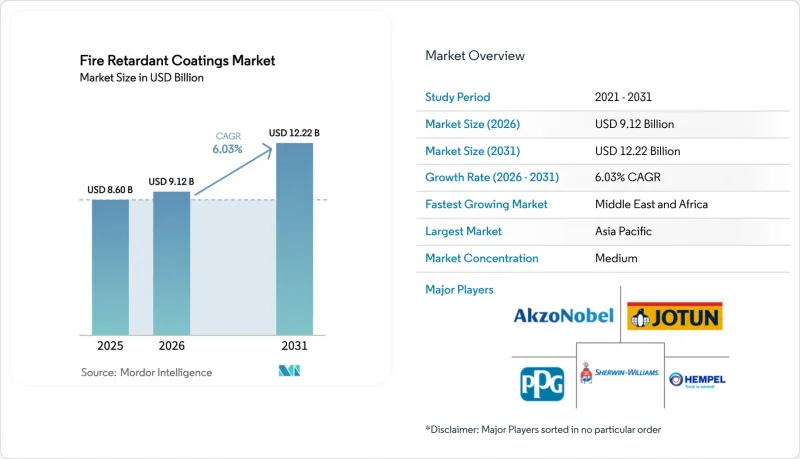
Mordor Intelligence에 의하면, 방화 도료 시장 규모는 2025년에 86억 달러로 평가되었고, 2026년 91억 2,000만 달러에서 2031년까지 122억 2,000만 달러에 이를 것으로 예측되며, 예측 기간(2026년-2031년) CAGR은 6.03%를 기록할 전망입니다.
본 보고서는 수지 유형(실리콘 엘라스토머, 에폭시, 아크릴, 비닐, 폴리우레탄, 기타),기술(수성, 용제형, 분체, 기타), 코팅 유형(팽창성, 시멘트계), 최종 사용자 산업(건축 및 건설, 석유 및 가스, 전력 등), 지역(아시아태평양, 북미 등)별로 분류되어 있습니다. 시장 예측은 금액(달러) 기준으로 제시되어 있습니다.
전 세계 난연성 도료 시장 동향 및 인사이트
전 세계 건설 활동 증가
2024년, 중국의 건설 생산량 증가로 인해 다층 철골 구조용 GB 14907-2018 규격에 부합하는 에폭시계 팽창성 도료에 대한 수요가 견조한 추세를 보였습니다. 한편, 인도의 ‘스마트 시티 미션’의 일환으로 대규모 공공 주택 프로젝트에서는 국가 건축 기준에 부합하는 수성 혼합제의 사용이 의무화되어 있습니다. 사우디아라비아에서는 NEOM, 레드시, 키디야 각 프로젝트에서 코팅 강판에 대한 수요가 맞물리면서, 유럽의 주요 공급업체들이 현지에서 혼합 시설을 설립하는 움직임이 나타나고 있습니다. 유럽 및 북미에서는 모듈식 건축의 추세가 강해지는 가운데, 공장에서 미리 도포된 분말 팽창성 도료가 주류를 이루고 있어, 이로 인해 현장에서의 노동력이 대폭 절감되고 있습니다. 이 틈새 시장에서는 현재 극히 일부 OEM 도포 업체 간의 경쟁만 나타나고 있습니다. 그 결과, 난연성 도료 시장은 면적(제곱미터)의 확대뿐만 아니라, 고효율 화학 기술을 중시하는 공정 전환으로부터도 혜택을 받고 있습니다.
석유 및 가스 인프라 확장이 가속화
API 권장 실무 기준 752(2024)에서는 정유시설 내 영구 건물에 대한 열적 위험성이 정량화됨에 따라, 엔지니어들은 1,100°C의 탄화수소 화재에 4시간 동안 견딜 수 있는 어브레이티브 시스템이나 하이브리드 시스템을 선정하고 있습니다. 카타르와 사우디아라비아에서 LNG 프로젝트가 확대됨에 따라 사양 범위도 넓어지고 있습니다. 동시에 북미의 셰일 사업자들은 개정된 49 CFR 194 비상 대응 규정을 준수하기 위해 기존 플랜트의 개보수를 진행하고 있습니다. 케이블 트레이와 소구경 배관에는 분체 도장이 점차 보급되고 있습니다. 이러한 도장은 밀폐된 공간에서의 용제 노출을 줄일 뿐만 아니라, 턴어라운드 시간 단축에도 기여합니다. 현재 채택률은 여전히 낮은 편이지만, 수동적 방화 대책에 대한 지출과 공급업체의 교육 투자로 인해 2028년까지 이러한 격차가 해소될 것으로 보이며, 그 결과 방화 도료 시장이 확대될 전망입니다.
저비용 대체재의 이용 가능성
인도, 인도네시아, 나이지리아에서는 비용을 중시하는 개발업자들이 스프레이식 팽창성 방화재에 비해 가격이 저렴한 석고 보드를 점점 더 많이 선택하고 있습니다. 시멘트계 플라스터는 4시간의 내화 성능이라는 뛰어난 성능을 갖추고 있지만, 그 무게 때문에 내진 보강 공사에 사용하기에는 한계가 있습니다. 건물의 안전성을 높이기 위해 보험사들은 인증된 코팅이 적용되지 않은 건물에 대해 보험료를 가산하기 시작했습니다. 이러한 전략으로 인해 점차 팽창성 방화 도료에 유리한 상황이 조성되고 있으며, 가격과 성능 간의 격차가 좁혀지고 있습니다. 시장 점유율을 유지하기 위해 각 공급업체들은 현재 턴키 시공 및 다년간의 보증을 포함한 패키지형 서비스를 제공합니다. 초기 자재비만을 고려하는 관점에서 라이프사이클 경제성이라는 더 넓은 관점으로 논의의 초점을 전환함으로써, 이들은 난연성 도료 분야에서 지속적인 수요를 확보하고 있습니다.
부문 분석
실리콘 엘라스토머는 2031년까지 연평균 성장률(CAGR) 6.24%로 성장하고 있으며, 에폭시 수지가 구조적 무결성을 상실하는 600°C를 초과하는 온도 영역에서 배터리 팩 및 항공우주 분야의 요구를 충족시키고 있습니다. 아크릴계는 건축 분야의 틈새 시장을 채우고 있는 반면, 폴리우레탄계는 방화 장벽이 일체화된 스프레이 폼 단열재로 부상하고 있습니다. 에폭시와 실리콘을 결합한 하이브리드 시스템은 2027년 출시를 목표로 독일 및 한국의 배터리 공장에서 시범 테스트가 진행되고 있습니다. 이러한 다양화는 공급업체의 연구개발 파이프라인을 확대하고, 방화 도료 시장의 상품화를 방지하는 데 기여합니다.
에폭시 수지는 여전히 가격 대비 성능이 뛰어나지만, 그 원료인 비스페놀 A가 환경 측면에서 엄격한 감시의 대상이 되고 있기 때문에 배합 개발자들은 리그닌계 경화제 탐색을 진행하고 있습니다. 실리콘은 가격이 비싸지만, 타의 추종을 불허하는 내열충격성을 갖추고 있어 e-모빌리티 분야의 용도 확대에 따라 총 소비량이 증가하고 있습니다. 틈새 시장인 페놀 수지와 폴리에스테르 수지는 선박의 격벽이나 철도 차량의 내장재로 계속 사용되고 있지만, 성능 기준이 강화됨에 따라 그 합계 점유율은 감소하고 있습니다. 따라서 수지의 진화는 난연성 도료 업계의 이해관계자들에게 위험인 동시에 기회이기도 합니다.
수성 제품은 EU 및 캘리포니아주의 VOC 상한치 250 g/L 규제의 뒷받침을 받아 2025년 매출의 46.37%를 차지했습니다. 분체 제품은 점유율은 작지만, 원패스·무용제 공정을 선호하는 자동차 및 가전제품 분야의 견인에 힘입어 연평균 성장률(CAGR) 6.18%를 나타낼 것으로 예측됩니다. 용제형 시스템은 표면 처리가 불충분한 부식된 강재의 유지보수 작업에서 여전히 활용되고 있습니다. 방사선 경화형 및 고고형분 배합 제품은 한랭지나 납기 기한이 짧은 프로젝트에서 틈새 시장을 차지하고 있습니다.
분말 팽창성 도료에는 엄격한 입자 크기 관리와 정전기 조절이 필요하며, 이러한 과제를 극복하고 있는 공급업체는 극소수에 불과합니다. 그럼에도 불구하고 이 기술은 폐기물 발생률이 낮고 노동력을 대폭 절감할 수 있어 총비용 측면에서 매우 매력적인 선택지가 되고 있습니다. 열대 지역에서는 습도로 인한 경화 시간 연장이 여전히 수성 도료의 약점으로 남아 있으며, 이에 대응하기 위해 배합 개발자들은 플래시 부식 방지제를 첨가하고 있습니다. 규제가 더욱 강화됨에 따라, 도입 곡선은 방화 도료 시장의 가치 확대를 지속적으로 뒷받침할 것입니다.
지역별 분석
아시아태평양은 중국의 눈부신 건설 생산량과 인도의 야심 찬 국가 인프라 계획에 힘입어 2025년에는 45.28%의 점유율을 차지했습니다. 일본의 보수 공사 급증과 한국의 전기차 생산이 맞물리면서 실리콘이 풍부하게 함유된 배합에 대한 수요가 높아지고 있습니다. 한편, 동남아시아에서는 공급망 다각화로 이어지는 전략적 조치인 산업단지에 대한 투자가 결실을 맺고 있습니다. ‘일대일로’ 이니셔티브에 따라 분체 도장된 조립식 모듈이 출하되면서 지역 수출 흐름이 확대되는 동시에, 신흥 시장의 프로젝트에 첨단 도료가 도입되고 있습니다.
북미에서는 미국의 인프라 법안에 힘입어 성장세가 가속화되고 있습니다. 이에 더해 수동적 방화 대책이 필요한 교량 개보수 및 송전망 업그레이드까지 더해져, 해당 지역의 활발한 활동이 두드러지고 있습니다. 캐나다의 오일샌드 사업과 멕시코의 눈부신 자동차 조립 생산이 이러한 수요를 더욱 끌어올리고 있습니다. 그러나 인증 시공업체의 심각한 부족으로 인해 도급업체들은 수개월 앞까지 일정을 조정할 수밖에 없는 상황입니다. 이러한 인력 부족은 때때로 프로젝트 연기를 초래하고 수요의 급증으로 이어지기도 하여, 기동성이 뛰어난 이동식 작업팀을 보유한 공급업체에게는 호재가 되고 있습니다.
유럽의 야심 찬 ‘리노베이션 웨이브’는 수백만 건에 달하는 건물에서 방화 대책과 탄소 감축 노력을 조화시키고 있습니다. 독일과 북유럽 국가들에서는 무할로겐 배합이 추진되고 있습니다. 이는 자재 비용을 증가시키지만, 보험사 입장에서는 위험 보험료의 대폭적인 절감으로 이어집니다. 글렌펠 화재 사고를 계기로, 영국은 제3자에 의한 제품 검증을 의무화하는 개혁을 통해 시장 진입 요건을 강화했습니다. 프랑스는 저탄소 목표에 따라 바이오 난연제를 추진하고 있습니다. 한편, 제재 조치로 인해 러시아의 서유럽산 화학물질 접근이 제한됨에 따라 현지 생산자들은 에폭시 수지의 리버스 엔지니어링을 시도하고 있으나, 품질 면에서는 성과에 편차가 나타나고 있습니다.
중동 및 아프리카는 연평균 성장률(CAGR) 5.94%를 기록하며 가장 빠르게 성장하고 있는 지역입니다. 이러한 급속한 성장은 주로 NEOM에 의한 막대한 철강 수요와, 2시간의 내화 성능을 의무화하는 UAE의 엄격한 고층 건축 기준에 기인합니다. 남아프리카공화국은 SANS 10177 규격에 따라 석유화학 플랜트의 현대화를 추진하고 있습니다. 그러나 주요 주 이외의 지역에서는 물류상의 문제가 있어 신속한 도입에 걸림돌이 되고 있습니다. 많은 아프리카 국가에서는 인증 시험소가 부족하여 수입된 인증서를 사용하는 것이 일반적입니다. 이로 인해 비용은 상승하지만, 품질에 대한 기대치도 높아지고 있습니다.
남미에서는 시장이 확대되는 추세입니다. 브라질에서는 4층 이상의 건물에 대해 ABNT NBR 14432 규격의 적용이 의무화되어 있는 반면, 아르헨티나에서는 VOC 규제로 인해 공장이 수성 도료 시스템으로의 전환을 강요받고 있습니다. 환율 변동을 배경으로 원자재에 대한 헤지 및 비축을 하는 동향이 나타나고 있습니다. 칠레의 광업 부문에서는 안전성을 중시하여 중요한 지지 구조물에 대해 4시간의 내화 성능을 갖춘 도료의 사용을 의무화하고 있으며, 이로 인해 아브레이티브 제품에 대한 틈새 수요가 촉진되고 있습니다. 이러한 동향들이 맞물려 난연성 도료 시장의 시야를 넓히고, 수익원의 다각화가 진행되고 있습니다.
기타 혜택:
- 엑셀 형식 시장 예측(ME) 시트
- 3개월간의 애널리스트 지원
자주 묻는 질문
목차
제1장 서론
제2장 조사 방법
제3장 주요 요약
제4장 시장 구도
제5장 시장 규모와 성장 예측
제6장 경쟁 구도
제7장 시장 기회와 향후 전망
LSH 26.09.03According to Mordor Intelligence, the fire retardant coatings market size was valued at USD 8.60 billion in 2025 and is estimated to grow from USD 9.12 billion in 2026 to reach USD 12.22 billion by 2031, at a CAGR of 6.03% during the forecast period (2026-2031).
This report is Segmented by Resin Type (Silicone Elastomers, Epoxy, Acrylics, Vinyl, Polyurethane, and Others), Technology (Water-Borne, Solvent-Borne, Powder, and Others), Coating Type (Intumescent and Cementitious), End-User Industry (Building and Construction, Oil and Gas, Power, and More), and Geography (Asia-Pacific, North America, and More). Market Forecasts are Provided in Terms of Value (USD).
Global Fire Retardant Coatings Market Trends and Insights
Increasing Construction Activities Across the Globe
In 2024, China's construction output bolstered consistent demand for epoxy-based intumescent coatings that meet GB 14907-2018 standards for multi-story steel frames. Meanwhile, as part of India's Smart Cities Mission, large-scale municipal housing projects are now mandating water-borne formulas in line with the National Building Code. In Saudi Arabia, the NEOM, Red Sea, and Qiddiya projects have a combined requirement for coated steel, leading European suppliers to establish local blending facilities. In Europe and North America, the trend towards modular construction is leaning towards factory-applied powder intumescent layers, which significantly reduce on-site labor. This niche market currently sees competition from only a select few OEM applicators. As a result, the fire retardant coatings market is not just witnessing growth in square meters but is also benefiting from procedural shifts that emphasize high-efficiency chemistries.
Accelerating Oil and Gas Infrastructure Expansion
API Recommended Practice 752 (2024) now quantifies thermal hazards for permanent buildings in refineries, leading engineers to select ablative and hybrid systems able to withstand 1,100 °C hydrocarbon fires for four hours. As LNG projects expand in Qatar and Saudi Arabia, the specification scope broadens. Simultaneously, North American shale operators are retrofitting legacy plants to align with the updated 49 CFR 194 emergency-response regulations. Powder coatings are becoming popular for cable trays and small-bore piping. These coatings not only reduce solvent exposure in confined spaces but also expedite turnaround times. While current adoption remains low, passive fire-protection spending and supplier investments in training are poised to bridge this gap by 2028, thereby enlarging the market for fire-retardant coatings.
Availability of Low-Cost Substitutes
In India, Indonesia, and Nigeria, cost-sensitive developers are increasingly opting for gypsum boards, which are more affordable compared to spray intumescents. While cementitious plasters offer a commendable four-hour fire rating, their weight limits their application in seismic retrofits. In a bid to enhance building safety, insurance firms have begun levying premium penalties on structures without certified coatings. This strategy is gradually tipping the scales in favor of intumescents, narrowing the price-performance divide. To maintain their market share, suppliers are now offering bundled services, including turnkey applications and multi-year warranties. By shifting the conversation from just the upfront material cost to the broader perspective of lifecycle economics, they are ensuring sustained demand in the fire retardant coatings sector.
Other drivers and restraints analyzed in the detailed report include:
- Stricter Fire-Safety Regulations and Building Codes
- Rising Demand for Passive Fire Protection in E-Mobility and Battery Systems
- Volatile Epoxy and Silicone Raw-Material Prices
For complete list of drivers and restraints, kindly check the Table Of Contents.
Segment Analysis
Epoxy resins sustained 34.48% of the fire-retardant coatings market share in 2025 due to robust adhesion and predictable intumescence. Silicone elastomers, expanding at 6.24% CAGR to 2031, answer battery-pack and aerospace needs beyond 600 °C, a temperature realm where epoxies lose structural integrity. Acrylics fill architectural niches, while polyurethane systems are emerging in spray-foam insulation with integrated fire barriers. Hybrid epoxy-silicone stacks are under pilot in German and Korean battery plants for 2027 launches. Such diversification enlarges supplier research and development pipelines and helps guard against commoditization in the fire retardant coatings market.
Epoxies remain cost-effective, yet their bisphenol-A feedstock lines up alongside environmental scrutiny, motivating formulators to explore lignin-based hardeners. Silicones, though premium-priced, offer unmatched thermal shock resistance, and their expanding use in e-mobility raises total consumption. Niche phenolics and polyesters continue to serve marine bulkheads and rail interiors, but their collective share slips as performance standards climb. Resin evolution, therefore, signals both risk and opportunity for stakeholders across the fire retardant coatings industry.
Water-borne products held 46.37% of 2025 revenue, aided by EU and California VOC caps of 250 g/L. Powder variants, although a small share, are forecast to grow at a 6.18% CAGR, powered by automotive and appliance lines that favor single-pass, zero-solvent processes. Solvent-borne systems still serve maintenance jobs on corroded steel where surface prep is imperfect. Radiation-cured and high-solids blends occupy small niches in cold-weather or rapid-turnaround projects.
Powder intumescents require tight particle-size control and electrostatic tuning, challenges that only a limited number of suppliers have mastered. Nonetheless, the technology's low waste rate and significant labor savings render a compelling total-cost argument. Extended humidity cure times remain the Achilles heel for water-borne layers in tropical regions, prompting formulators to add flash-rust inhibitors. As regulations tighten further, adoption curves will continue to support value growth in the fire-retardant coatings market.
Complete Report Scope:
- By Resin Type
- Silicone Elastomers
- Epoxy Resins
- Acrylics
- Vinyl Resins
- Polyurethane
- Other Resin Types
- By Technology
- Water-borne
- Solvent-borne
- Powder Coatings
- Others
- By Coating Type
- Intumescent
- Cementitious
- By End-user Industry
- Building and Construction
- Oil and Gas
- Power Generation
- Transportation
- Industrial and Manufacturing
- Other End-User Industries
- By Geography
- Asia-Pacific
- China
- India
- Japan
- South Korea
- Rest of Asia-Pacific
- North America
- United States
- Canada
- Mexico
- Europe
- Germany
- United Kingdom
- France
- Italy
- Spain
- Russia
- NORDIC Countries
- Rest of Europe
- South America
- Brazil
- Argentina
- Rest of South America
- Middle-East and Africa
- Saudi Arabia
- South Africa
- Rest of Middle-East and Africa
- Asia-Pacific
Geography Analysis
Asia-Pacific commanded a 45.28% share in 2025, bolstered by China's impressive construction output and India's ambitious National Infrastructure Pipeline. Japan's surge in retrofitting, coupled with South Korea's production of electric vehicles, has heightened the demand for silicone-rich formulations. Meanwhile, Southeast Asia is reaping the rewards of industrial park investments, a strategic move linked to supply-chain diversification. The Belt and Road initiative sees powder-coated prefab modules being shipped, expanding regional export flows, and integrating advanced coatings into projects in emerging markets.
North America is riding a wave of momentum, fueled by the United States' infrastructure law. This, alongside bridge rehabilitations and grid upgrades necessitating passive fire protection, underscores the region's robust activity. Canada's oil sands and Mexico's impressive vehicle assembly bolster these volumes. However, a notable shortage of certified applicators has led contractors to negotiate schedules months in advance. This scarcity sometimes results in project deferrals and creates spikes in demand, benefiting suppliers with agile mobile crews.
Europe's ambitious Renovation Wave is harmonizing fire safety with carbon reduction efforts across millions of properties. In Germany and the Nordics, there's a push for halogen-free formulas. While these add extra material costs, they offer insurers significant savings on risk premiums. Following the Grenfell incident, the UK has tightened its market entry with reforms mandating third-party product verification. France is championing bio-based retardants, aligning them with its low-carbon objectives. Meanwhile, sanctions have curtailed Russia's access to Western chemistries, prompting local producers to attempt reverse-engineering of epoxies, though with mixed results in quality.
The Middle East and Africa are the fastest-expanding regions at 5.94% CAGR. This surge is largely attributed to NEOM's colossal steel demands and the UAE's stringent high-rise codes, which mandate two-hour fire ratings. South Africa is modernizing its petrochemical sites in line with SANS 10177 standards. However, logistical challenges outside major provinces are hindering swift adoption. A scarcity of accredited test labs in many African nations means imported certifications are the norm. While this elevates costs, it also raises the bar for quality expectations.
South America is on the upswing. Brazil is enforcing the ABNT NBR 14432 standard for buildings taller than four stories, while Argentina's VOC restrictions are nudging factories towards water-borne systems. In the face of currency fluctuations, there's a trend of hedging and stockpiling raw materials. Chile's mining sector, emphasizing safety, mandates four-hour coatings on critical supports, spurring a niche demand for ablative products. Together, these developments are expanding the horizons of the fire retardant coatings market and diversifying its revenue streams.
- 3M
- Akzo Nobel N.V.
- Albi Protective Coatings
- Benjamin Moore & Co.
- Carboline
- Contego International Inc.
- Hempel AS
- Isolatek International
- Jotun
- NIPPON PAINT (M) SDN. BHD.
- No-Burn, Inc.
- PPG Industries, Inc.
- RPM International Inc
- The Sherwin-Williams Company
- TREMCO ILLBRUCK
Additional Benefits:
- The market estimate (ME) sheet in Excel format
- 3 months of analyst support
TABLE OF CONTENTS
1 Introduction
- 1.1 Study Assumptions and Market Definition
- 1.2 Scope of the Study
2 Research Methodology
3 Executive Summary
4 Market Landscape
- 4.1 Market Drivers
- 4.1.1 Increasing construction activities across the globe
- 4.1.2 Accelerating oil and gas (incl. shale) infrastructure expansion
- 4.1.3 Stricter fire-safety regulations and building codes
- 4.1.4 Rising demand for passive fire protection in e-mobility and battery systems
- 4.1.5 Shift toward bio-based/halogen-free coating chemistries
- 4.2 Market Restraints
- 4.2.1 Availability of low-cost substitutes (cementitious plasters, FR boards)
- 4.2.2 Volatile epoxy/silicone resin and additive prices
- 4.2.3 Shortage of qualified applicators causing installation defects
- 4.3 Value Chain Analysis
- 4.4 Porter's Five Forces
- 4.4.1 Bargaining Power of Suppliers
- 4.4.2 Bargaining Power of Consumers
- 4.4.3 Threat of New Entrants
- 4.4.4 Threat of Substitute Products and Services
- 4.4.5 Degree of Competition
5 Market Size and Growth Forecasts (Value)
- 5.1 By Resin Type
- 5.1.1 Silicone Elastomers
- 5.1.2 Epoxy Resins
- 5.1.3 Acrylics
- 5.1.4 Vinyl Resins
- 5.1.5 Polyurethane
- 5.1.6 Other Resin Types
- 5.2 By Technology
- 5.2.1 Water-borne
- 5.2.2 Solvent-borne
- 5.2.3 Powder Coatings
- 5.2.4 Others
- 5.3 By Coating Type
- 5.3.1 Intumescent
- 5.3.2 Cementitious
- 5.4 By End-user Industry
- 5.4.1 Building and Construction
- 5.4.2 Oil and Gas
- 5.4.3 Power Generation
- 5.4.4 Transportation
- 5.4.5 Industrial and Manufacturing
- 5.4.6 Other End-User Industries
- 5.5 By Geography
- 5.5.1 Asia-Pacific
- 5.5.1.1 China
- 5.5.1.2 India
- 5.5.1.3 Japan
- 5.5.1.4 South Korea
- 5.5.1.5 Rest of Asia-Pacific
- 5.5.2 North America
- 5.5.2.1 United States
- 5.5.2.2 Canada
- 5.5.2.3 Mexico
- 5.5.3 Europe
- 5.5.3.1 Germany
- 5.5.3.2 United Kingdom
- 5.5.3.3 France
- 5.5.3.4 Italy
- 5.5.3.5 Spain
- 5.5.3.6 Russia
- 5.5.3.7 NORDIC Countries
- 5.5.3.8 Rest of Europe
- 5.5.4 South America
- 5.5.4.1 Brazil
- 5.5.4.2 Argentina
- 5.5.4.3 Rest of South America
- 5.5.5 Middle-East and Africa
- 5.5.5.1 Saudi Arabia
- 5.5.5.2 South Africa
- 5.5.5.3 Rest of Middle-East and Africa
- 5.5.1 Asia-Pacific
6 Competitive Landscape
- 6.1 Market Concentration
- 6.2 Strategic Moves
- 6.3 Market Share/Ranking Analysis
- 6.4 Company Profiles (includes Global level Overview, Market level overview, Core Segments, Financials as available, Strategic Information, Market Rank/Share for key companies, Products and Services, and Recent Developments)
- 6.4.1 3M
- 6.4.2 Akzo Nobel N.V.
- 6.4.3 Albi Protective Coatings
- 6.4.4 Benjamin Moore & Co.
- 6.4.5 Carboline
- 6.4.6 Contego International Inc.
- 6.4.7 Hempel AS
- 6.4.8 Isolatek International
- 6.4.9 Jotun
- 6.4.10 NIPPON PAINT (M) SDN. BHD.
- 6.4.11 No-Burn, Inc.
- 6.4.12 PPG Industries, Inc.
- 6.4.13 RPM International Inc
- 6.4.14 The Sherwin-Williams Company
- 6.4.15 TREMCO ILLBRUCK
7 Market Opportunities and Future Outlook
- 7.1 White-space and Unmet-Need Assessment


