
|
시장보고서
상품코드
2114143
셀프 스토리지 : 시장 점유율 분석, 산업 동향 및 통계 데이터, 성장 예측(2026-2031년)Self Storage - Market Share Analysis, Industry Trends & Statistics, Growth Forecasts (2026 - 2031) |
||||||
 Mordor Intelligence
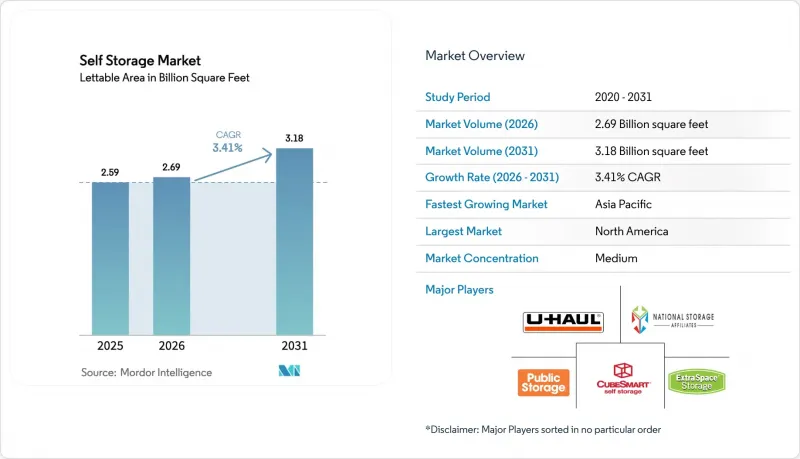
Mordor Intelligence에 따르면 임대 가능 면적 기반으로 본 셀프 스토리지(트렁크룸) 시장 규모는 2025년 25억 9,000만 평방피트로부터 2026년에는 26억 9,000만 평방피트로 확대하며, 2031년까지 31억 8,000만 평방피트에 달할 것으로 예상되고 있으며, 2026-2031년에 CAGR 3.41%로 성장할 전망입니다.
이 보고서는 사용자 유형(개인, 법인), 스토리지 유형(온도 관리형, 비온도 관리형, 기타), 임대 기간(단기, 중기, 장기), 유닛 크기(소형, 중형, 대형, 메가) 및 지역(북미, 남미, 유럽, 아시아태평양, 중동 및 아프리카)별로 분류되어 있습니다. 시장 전망은 용량(제곱피트) 단위로 제시되어 있습니다.
글로벌 셀프 스토리지 시장 동향 및 인사이트
도시화와 주거 공간의 축소
2025년, 도쿄, 홍콩, 상하이의 아파트 바닥 면적은 500제곱피트 미만으로 줄어들었고, 주민들은 부피가 큰 소지품을 외부에 보관할 수밖에 없게 되었습니다. 이 도시들의 셀프 스토리지 보급률은 1인당 1.5제곱피트에 달해, 차고 공간이 있는 교외 지역의 3배 수준이 되었습니다. 싱가포르와 뭄바이의 개발업자들은 복합 용도 타워에 부지내 스토리지 공간을 통합하고 있으며, 이로 인해 임대료가 8% 가산되고 있습니다. 아시아태평양의 도시화율이 65%를 넘는 가운데, 셀프 스토리지는 단순한 선택 사항이 아니라 구조적인 필요성이 되었습니다. 북미 도심 지역도 유사한 추세를 보이고 있으며, 거시경제 상황이 둔화되더라도 수요는 유지되고 있습니다.
E-Commerce 소규모 판매업자의 급증
2025년 조사에 따르면 연간 매출 50만 달러 미만의 온라인 판매업체 중 38%가 창고가 아닌 셀프 스토리지에 재고를 보관하고 있습니다. 이들 임차인은 평균 체류 기간이 40% 더 길며, 차량으로 화물을 싣거나 소포를 수령할 수 있으므로 25%-35%의 추가 요금을 지불하고 있습니다. 전자제품이나 화장품에는 온도·습도 관리가 필수적이며, 이로 인해 운영사는 일반 공간보다 50%-80% 높은 요금을 책정할 수 있습니다. 소규모 사업자는 경기 순환에 역행하는 회복력을 갖추고 있으며, 해고가 부업 창출을 촉진하고 경기 침체기에 스토리지 수요를 끌어올리기 때문입니다.
엄격한 구역 지정 및 토지 이용 규제
포틀랜드, 시애틀, 샌프란시스코에서는 2025년에 셀프 스토리지 시설을 산업용지로 재분류하고, 세트백, 주차장 설치 의무, 설계 심사 등을 부과함으로써 승인까지 18-36개월의 지연이 발생하고 있습니다. 런던이나 파리 등 유럽의 지자체들은 수요가 5%-7% 상승하고 있음에도 불구하고 스토리지 시장의 성장률을 2% 미만으로 제한하고 있습니다. 기존 사업자는 기득권이 있는 부지를 통해 가격 결정력을 보유하고 있지만, 신규 진입자는 법적 비용 및 보유 비용 부담이 커 용량 확대가 저해되고 있으며, 이로 인해 전 세계 연평균 성장률(CAGR)이 약 0.6포인트 하락하고 있습니다.
부문 분석
2025년에는 법인 임차인이 수용 능력의 29.88%를 차지하여 2031년까지 연평균 성장률(CAGR) 5.81%로 확대되었으나, 평균 임대 기간이 2년을 초과했으므로 총 수익의 40% 이상을 창출하고 있었습니다. 이 고객들은 24시간 이용, 화물 취급, 보강된 바닥과 같은 서비스에 대해 25%-35%의 추가 요금을 지불하고 있으며, 이로 인해 상업용 셀프 스토리지 시장 규모는 시장 전체의 성장률을 웃도는 속도로 확대되고 있습니다. E-Commerce 사업자, 도급업자, 계절 한정 소매업자는 수년에 걸친 창고 임대차 계약을 피하고 월 단위 계약을 선호합니다. 개인 고객은 시장 점유율의 70.12%를 차지하고 있지만, 높은 해지율로 인해 청소 및 재판매 촉진에 드는 비용이 증가하여 이익률을 압박하고 있습니다.
현재 운영사는 1층의 법인용 유닛이 상층의 개인용 사물함을 상호 보완하는 복합 용도 레이아웃을 설계하고 있습니다. 뉴저지주나 남부 캘리포니아와 같은 물류 허브에서는 기업 임차인이 이미 온도 관리형 재고의 50%-60%를 차지하고 있으며, 개인 사용자와의 수익성 차이가 뚜렷하게 드러나고 있습니다. 더 많은 REIT가 법인 고객 확보에 주력함에 따라 경쟁의 초점은 가격에서 워크플로 통합으로 이동하고 있으며, 셀프 스토리지 시장내 가치의 원천이 더욱 심화되고 있습니다.
총 수용 능력의 54.64%를 차지하는 온도 조절 시설은 2025년에 수익의 과반수를 차지할 것으로 예상되며, 2031년까지 연평균 성장률(CAGR) 6.71%로 확대될 것으로 전망됩니다. 기상 이변으로 인한 피해와 보험사의 요건 강화로 인해 온도 관리 시설로의 전환이 가속화되고 있으며, 셀프 스토리지 시장에서 온도 관리 공간의 점유율은 해마다 확대되고 있습니다. 운영 사업자는 상온 보관 유닛에 비해 50%-80%의 추가 요금을 부과하고 있으며, 법인 임차인들은 고가 재고를 보호하기 위해 기꺼이 그 비용을 지불하고 있습니다.
한편, 공조 설비가 없는 유닛은 개보수 비용을 회수할 수 없는 온대 지역이나 지방에서 수요가 증가하고 있습니다. 이동식 컨테이너 서비스는 물류 측면의 복잡성으로 인해 여전히 틈새 시장에 머물러 있으며, 차량 보관 서비스는 사유지 주차를 엄격하게 규제하는 주택 소유자 협회(HOA) 규정이 있는 주에서 지역적인 수요가 나타나고 있습니다. 따라서 운영상의 초점은 각 거점에서 확보할 수 있는 셀프 스토리지 시장의 규모를 극대화하기 위해 미기후 위험과 자산 구성을 적절하게 매칭하는 데 있습니다.
지역별 분석
2025년 기준, 북미는 전 세계 총 수용 능력의 52.48%를 차지했으며, 1인당 보급률은 9.5제곱피트였습니다. 피닉스나 댈러스와 같이 포화 상태에 이른 선벨트 지역의 대도시권(이용률 82% 전후)과, 구역 지정 규제로 인해 시설 이용률이 95%를 유지하며 연간 4%-6%의 임대료 인상이 가능한 해안 도시들 사이에서 이용률 격차가 발생하고 있습니다. 캐나다는 미국과 유사한 경향을 보이고 있지만, 멕시코에서는 중산층 소비자들이 외부 보관 서비스를 이용하기 시작하면서 시장이 급속히 확대되고 있습니다.
아시아태평양은 5.09%라는 가장 높은 성장률을 기록하고 있으며, 그 원동력은 아파트 면적이 보통 500제곱피트 미만이고 도시화율이 60%를 넘는 중국과 인도의 도시들입니다. 일본은 고령화가 진행되는 가운데, 습도 관리가 필요한 수요에 힘입어 꾸준한 성장을 이어가고 있습니다. 호주와 뉴질랜드는 신규 건설보다 기존 시설의 통합에 중점을 두고 있으며, 그 결과 2.8%라는 완만한 성장에 그치고 있습니다.
유럽의 성장률은 3.6%이지만, 지역 간 격차는 여전히 존재합니다. 영국은 1인당 4.5제곱피트로 성숙기 중반의 북미 시장과 유사하지만, 독일, 프랑스, 스페인에서는 이 수치가 낮아 슈어가드나 세이프스토어에게 성장의 여지가 있습니다. 최근 폴란드에서의 인수합병이 주목받고 있는 중부 유럽에서는 E-Commerce 사업자들의 수요가 서서히 확대되고 있습니다. 주요 지역 이외에서는 라틴아메리카, 중동 및 아프리카 3개 지역을 합쳐도 공급량의 8% 미만에 불과하지만, 상파울루나 두바이 등의 도시에서 해외 거주자 증가와 E-Commerce 보급이 진행됨에 따라 6%-8%의 성장이 예상됩니다.
기타 혜택:
- Excel 형식의 시장 예측(ME) 시트
- 3개월간의 애널리스트 지원
자주 묻는 질문
목차
제1장 서론
제2장 분석 방법
제3장 개요
제4장 시장 구도
제5장 시장 규모·성장률 예측
제6장 경쟁 구도
제7장 시장 기회와 향후 전망
KSA 26.08.26According to Mordor Intelligence, the self storage market size in terms of lettable area is expected to increase from 2.59 Billion square feet in 2025 to 2.69 Billion square feet in 2026 and reach 3.18 Billion square feet by 2031, growing at a CAGR of 3.41% over 2026-2031.
This report is Segmented by User Type (Personal, and Business), Storage Type (Climate-Controlled, Non-Climate-Controlled, and More), Lease Duration (Short-Term, Mid-Term, and Long-Term), Unit Size (Small, Medium, Large, Mega), and Geography (North America, South America, Europe, Asia Pacific, Middle East, Africa). The Market Forecasts are Provided in Terms of Volume (Square Feet).
Global Self Storage Market Trends and Insights
Urbanization and Shrinking Living Spaces
Apartment footprints in Tokyo, Hong Kong, and Shanghai dropped below 500 square feet in 2025, forcing residents to externalize bulky possessions. Penetration climbed to 1.5 square feet per capita in these cities, triple rates in suburban locations with garage space. Developers in Singapore and Mumbai incorporate onsite storage into mixed-use towers that command an 8% rent premium. As Asia Pacific urbanization tops 65%, self storage becomes a structural need rather than a discretionary choice. North American downtowns follow a similar path, sustaining demand even when macro conditions soften.
Proliferation of E-commerce Micro-Merchants
A 2025 survey found 38% of online sellers under USD 500,000 annual revenue stage inventory in self storage rather than warehouses. These tenants stay 40% longer and pay 25%-35% premiums for drive-up loading and parcel acceptance. Climate control is essential for electronics and cosmetics, enabling operators to charge rates 50%-80% above ambient space. Micro-merchants offer counter-cyclical resilience because layoffs prompt side-hustle formation that inflates storage demand during downturns.
Stringent Zoning and Land-Use Regulations
Portland, Seattle, and San Francisco reclassified self storage as industrial in 2025, imposing setbacks, parking mandates, and design reviews that delay approvals 18-36 months. European councils in London and Paris cap storage growth below 2% even as demand climbs 5%-7%. Incumbents with grandfathered sites obtain pricing power, but new entrants face steep legal and holding costs that deter capacity additions, shaving roughly 0.6 percentage points from the global CAGR.
Other drivers and restraints analyzed in the detailed report include:
- Climate-Resilient Asset Preservation Demand
- Digitized, Contact-Free Leasing Platforms
- Oversupply Pockets in Mature Metros
For complete list of drivers and restraints, kindly check the Table Of Contents.
Segment Analysis
Business tenants occupied 29.88% of capacity in 2025 and were advancing at a 5.81% CAGR through 2031, yet generated more than 40% of total revenue, as their average lease term exceeded two years. These customers pay 25%-35% premiums for 24-hour access, package handling, and reinforced floors, lifting the self storage market size for commercial users faster than the headline rate. E-commerce sellers, contractors, and seasonal retailers prefer month-to-month contracts that avoid multi-year warehouse leases. Personal customers account for 70.12% of the share, but their churn raises cleaning and remarketing costs, which dilute margins.
Operators now design mixed-use layouts where ground-floor commercial units cross-subsidize upper-floor personal lockers. In logistics hubs such as New Jersey and Southern California, business tenants already control 50%-60% of climate-controlled inventory, underscoring the profitability gap with personal users. As more REITs court corporate accounts, competitive emphasis shifts from price to workflow integration, deepening the value pool inside the self storage market.
Climate-controlled facilities, which represented 54.64% of the total capacity, captured an outsized share of revenue in 2025 and are expected to expand at a 6.71% CAGR through 2031. Extreme weather losses and rising insurer requirements accelerate conversions, expanding the self storage market share for conditioned space each year. Operators charge premiums of 50%-80% over ambient units, and business tenants willingly pay to protect their high-value inventory.
Conversely, non-climate stock thrives in temperate or rural settings where upgrade costs would not be recouped. Portable container services remain a niche due to logistical complexity, and vehicle storage experiences regional strength in states with strict homeowner association rules against driveway parking. Execution focus, therefore, revolves around matching micro-climate risk to asset mix in order to maximize the self-storage market size captured per location.
Complete Report Scope:
- By User Type
- Personal
- Business
- By Storage Type
- Climate-Controlled
- Non-Climate-Controlled
- Portable / Container-Based
- Vehicle and Specialty (RV, Boat, Wine)
- By Lease Duration
- Short-Term (Below 3 Months)
- Mid-Term (3-12 Months)
- Long-Term (Above 12 Months)
- By Unit Size
- Small (Below 50 sq ft)
- Medium (50-100 sq ft)
- Large (100-200 sq ft)
- Mega (Above 200 sq ft)
- By Geography
- North America
- United States
- Canada
- Mexico
- South America
- Brazil
- Argentina
- Rest of South America
- Europe
- Germany
- United Kingdom
- France
- Italy
- Spain
- Russia
- Rest of Europe
- Asia Pacific
- China
- Japan
- South Korea
- India
- Australia
- New Zealand
- Rest of Asia Pacific
- Middle East
- United Arab Emirates
- Saudi Arabia
- Turkey
- Rest of Middle East
- Africa
- South Africa
- Nigeria
- Kenya
- Rest of Africa
- North America
Geography Analysis
North America held 52.48% of the global capacity in 2025, with a per-capita penetration of 9.5 square feet. Occupancy gaps emerged between saturated Sunbelt metros, such as Phoenix and Dallas, which hovered near 82%, and coastal cities, where zoning barriers keep facilities full at 95% and allow for 4%-6% annual rent increases. Canada mirrors the United States profile, while Mexico advances quickly as middle-class consumers embrace external storage.
The Asia Pacific region posts the fastest growth rate of 5.09%, driven by Chinese and Indian cities where apartment sizes typically fall below 500 square feet, and urbanization surpasses 60%. Japan continues to expand steadily amid an aging population and a climate-controlled demand for humidity protection. Australia and New Zealand focus on consolidating existing facilities rather than undertaking greenfield builds, resulting in a moderate 2.8% growth.
Europe growth rate is 3.6%, although disparities persist. The United Kingdom resembles a mid-maturity North American market, with 4.5 square feet per capita, whereas Germany, France, and Spain have lower figures, offering a runway for Shurgard and Safestore. Central Europe, highlighted by recent Polish acquisitions, unlocks incremental demand among e-commerce merchants. Beyond the core regions, Latin America, the Middle East, and Africa together account for less than 8% of supply but expand 6%-8% as expatriate populations and e-commerce adoption scale in cities such as Sao Paulo and Dubai.
- Public Storage
- Extra Space Storage Inc.
- U-Haul International Inc.
- CubeSmart LP
- National Storage Affiliates Trust
- Life Storage Inc.
- Safestore Holdings PLC
- StorageMart
- Shurgard Self-Storage SA
- Big Yellow Group PLC
- Prime Storage Group
- Metro Storage LLC
- SmartStop Asset Management LLC
- Clutter Inc.
- MakeSpace Inc.
- Kennards Self Storage
- Access Self Storage Ltd.
- Urban Self Storage Inc.
- Global Self Storage Inc.
- World Class Capital Group LLC (Great Value Storage)
- Amsdell Cos./Compass Self Storage
- All Storage
- Storage King Pty Ltd.
- Storefriendly Self Storage Group
Additional Benefits:
- The market estimate (ME) sheet in Excel format
- 3 months of analyst support
TABLE OF CONTENTS
1 INTRODUCTION
- 1.1 Study Assumptions and Market Definition
- 1.2 Scope of the Study
2 RESEARCH METHODOLOGY
3 EXECUTIVE SUMMARY
4 MARKET LANDSCAPE
- 4.1 Market Overview
- 4.2 Market Drivers
- 4.2.1 Urbanization and Shrinking Living Spaces
- 4.2.2 Proliferation of E-commerce Micro-Merchants
- 4.2.3 Rising Residential Real Estate Costs
- 4.2.4 Digitized, Contact Free Leasing Platforms
- 4.2.5 Self-Storage as Micro Fulfillment Hubs
- 4.2.6 Climate Resilient Asset Preservation Demand
- 4.3 Market Restraints
- 4.3.1 Stringent Zoning and Land Use Regulations
- 4.3.2 Oversupply Pockets in Mature Metros
- 4.3.3 Escalating Insurance Premiums from Extreme Weather
- 4.3.4 Cyber-Security Risks for Smart Facilities
- 4.4 Industry Value Chain Analysis
- 4.5 Regulatory Landscape
- 4.6 Technological Outlook
- 4.7 Impact of Macroeconomic Factors on the Market
- 4.8 Porter's Five Forces Analysis
- 4.8.1 Bargaining Power of Buyers
- 4.8.2 Bargaining Power of Suppliers
- 4.8.3 Threat of New Entrants
- 4.8.4 Threat of Substitutes
- 4.8.5 Intensity of Competitive Rivalry
5 MARKET SIZE and GROWTH FORECASTS (UNITS)
- 5.1 By User Type
- 5.1.1 Personal
- 5.1.2 Business
- 5.2 By Storage Type
- 5.2.1 Climate-Controlled
- 5.2.2 Non-Climate-Controlled
- 5.2.3 Portable / Container-Based
- 5.2.4 Vehicle and Specialty (RV, Boat, Wine)
- 5.3 By Lease Duration
- 5.3.1 Short-Term (Below 3 Months)
- 5.3.2 Mid-Term (3-12 Months)
- 5.3.3 Long-Term (Above 12 Months)
- 5.4 By Unit Size
- 5.4.1 Small (Below 50 sq ft)
- 5.4.2 Medium (50-100 sq ft)
- 5.4.3 Large (100-200 sq ft)
- 5.4.4 Mega (Above 200 sq ft)
- 5.5 By Geography
- 5.5.1 North America
- 5.5.1.1 United States
- 5.5.1.2 Canada
- 5.5.1.3 Mexico
- 5.5.2 South America
- 5.5.2.1 Brazil
- 5.5.2.2 Argentina
- 5.5.2.3 Rest of South America
- 5.5.3 Europe
- 5.5.3.1 Germany
- 5.5.3.2 United Kingdom
- 5.5.3.3 France
- 5.5.3.4 Italy
- 5.5.3.5 Spain
- 5.5.3.6 Russia
- 5.5.3.7 Rest of Europe
- 5.5.4 Asia Pacific
- 5.5.4.1 China
- 5.5.4.2 Japan
- 5.5.4.3 South Korea
- 5.5.4.4 India
- 5.5.4.5 Australia
- 5.5.4.6 New Zealand
- 5.5.4.7 Rest of Asia Pacific
- 5.5.5 Middle East
- 5.5.5.1 United Arab Emirates
- 5.5.5.2 Saudi Arabia
- 5.5.5.3 Turkey
- 5.5.5.4 Rest of Middle East
- 5.5.6 Africa
- 5.5.6.1 South Africa
- 5.5.6.2 Nigeria
- 5.5.6.3 Kenya
- 5.5.6.4 Rest of Africa
- 5.5.1 North America
6 COMPETITIVE LANDSCAPE
- 6.1 Market Concentration
- 6.2 Strategic Moves
- 6.3 Market Share Analysis
- 6.4 Company Profiles (includes Global Level Overview, Market Level Overview, Core Segments, Financials as Available, Strategic Information, Market Rank/Share for Key Companies, Products and Services, and Recent Developments)
- 6.4.1 Public Storage
- 6.4.2 Extra Space Storage Inc.
- 6.4.3 U-Haul International Inc.
- 6.4.4 CubeSmart LP
- 6.4.5 National Storage Affiliates Trust
- 6.4.6 Life Storage Inc.
- 6.4.7 Safestore Holdings PLC
- 6.4.8 StorageMart
- 6.4.9 Shurgard Self-Storage SA
- 6.4.10 Big Yellow Group PLC
- 6.4.11 Prime Storage Group
- 6.4.12 Metro Storage LLC
- 6.4.13 SmartStop Asset Management LLC
- 6.4.14 Clutter Inc.
- 6.4.15 MakeSpace Inc.
- 6.4.16 Kennards Self Storage
- 6.4.17 Access Self Storage Ltd.
- 6.4.18 Urban Self Storage Inc.
- 6.4.19 Global Self Storage Inc.
- 6.4.20 World Class Capital Group LLC (Great Value Storage)
- 6.4.21 Amsdell Cos./Compass Self Storage
- 6.4.22 All Storage
- 6.4.23 Storage King Pty Ltd.
- 6.4.24 Storefriendly Self Storage Group
7 MARKET OPPORTUNITIES and FUTURE OUTLOOK
- 7.1 White-Space and Unmet-Need Assessment