|
시장보고서
상품코드
2125629
독일의 셀프 스토리지 시장 : 점유율 분석, 업계 동향과 통계, 성장 예측(2026-2031년)Germany Self Storage - Market Share Analysis, Industry Trends & Statistics, Growth Forecasts (2026 - 2031) |
||||||
 Mordor Intelligence
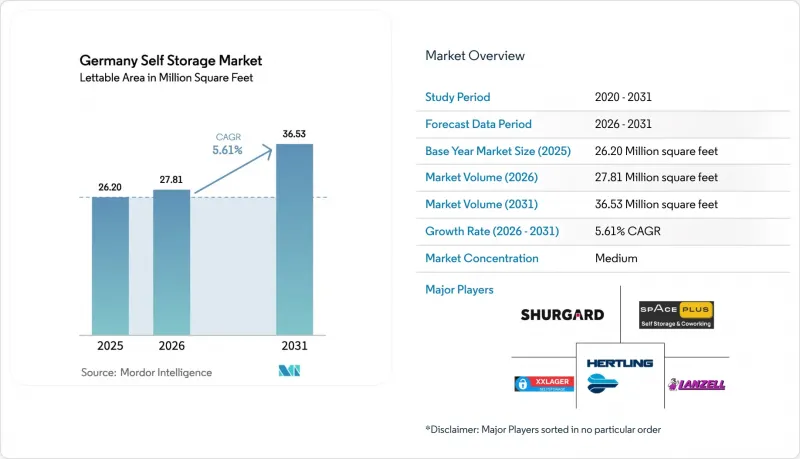
Mordor Intelligence에 의하면, 독일 셀프 스토리지 시장 규모는 2025년 2,620만 제곱피트에서 2026년에는 2,781만 제곱피트로 확대되어 2031년까지 3,653만 제곱피트에 이를 것으로 예상되고 있어 2026년부터 2031년까지 CAGR 5.61%로 성장할 전망입니다.
본 보고서는 최종 사용자별(개인 및 법인), 보관 공간 크기별(소·중규모 유닛(40제곱피트 미만), 대규모 유닛(40제곱피트 이상), 기타), 보관 유형별(공조 관리형 및 비공조 관리형), 소유 형태별(소유 및 임대)로 분류되어 있습니다. 시장 전망은 수량(백만 제곱피트) 단위로 제시되어 있습니다.
독일 셀프 스토리지 시장 동향 및 인사이트
도시화와 평균 주거 면적의 축소
독일에서 지속되는 도시로의 인구 이동으로 인해 1인당 주거 면적이 축소되고 있으며, 이로 인해 잉여 소유물을 외부 시설로 옮기는 구조적인 변화가 일어나고 있습니다. 2024년에는 1인 가구가 전체 가구의 41.9%에 달하는 반면, 2020년부터 2024년까지 신축 아파트의 평균 면적은 약 3제곱미터 축소되었습니다. 베를린과 뮌헨에서는 1제곱미터당 20유로(21.4달러)를 넘는 임대료 프리미엄이 형성되어, 입주자들은 셀프 스토리지를 합리적인 가격의 ‘별도 공간’으로 이용하고 있습니다. 사업자 측은 컨시어지에 의한 짐 꺼내기 서비스, 디지털 재고 관리, 보험을 세트로 제공하여 고객을 다년간의 계약에 묶어두고 있습니다. 거주 기간의 장기화는 입주율의 안정성을 높이고, 소유주가 인플레이션 연동형 임대료 인상을 전가할 수 있게 하여, 이러한 경향이 독일 셀프 스토리지 시장의 견조한 성장을 뒷받침하고 있습니다. 지자체들의 고밀도화 계획으로 인해 주거 공간이 더욱 좁아질 전망인 만큼, 이러한 요인에 따른 수요 전망은 적어도 2030년까지는 계속해서 높은 수준을 유지할 것으로 예측됩니다.
전자상거래의 성장과 중소기업의 재고 수요
2024년, 독일 소매 매출에서 전자상거래가 차지하는 비중은 15.1%에 달했으며, 소포 처리량은 43억 건을 돌파했습니다. 전용 창고를 보유하지 않은 소규모 사업자들은 고속도로 인터체인지 인근의 보관 공간을 임대하여 잘 팔리는 SKU를 보관하고, 다음 날 발송에 대비하고 있습니다. 라인-룰 지역 사업자 중에는 팔레트 랙과 하역 도크를 갖춘 유닛을 제공함으로써 두 자릿수의 임대료 프리미엄과 거의 만실 상태를 실현하고 있으며, 이는 독일 셀프 스토리지 시장의 단기적인 성장을 뒷받침하고 있습니다. 사업용 임차인이 업무상의 편의성을 위해 추가 요금을 지불하려는 의지는 개인 수요의 계절적 변동을 상쇄하는 데 일조하며, 고정된 바닥 면적이 아닌 시간 단위 이용으로 요금을 책정하는 수익 관리 시스템에 있어 수익 증대의 여지를 제공합니다.
엄격한 용도지역 규제와 장기화되는 계획 승인
독일의 『건축법(Baugesetzbuch)』 체계 하에서는 많은 복합 용도 지구에서 셀프 스토리지가 제외되어 있어, 개발업자들은 교외의 산업용지로 밀려나고 있습니다. 바이에른주에서는 의무화된 영향 평가와 지역 주민 대상 공청회로 인해 그린필드 시설의 인가를 취득하는 데 18-24개월이 소요됩니다. 베를린과 함부르크에서는 역사적 건축물 보호 구역 규정에 따라 외관 변경이 금지되어 있어, 기존 건물의 용도 변경을 통한 재개발 기회가 차단되고 있습니다. 허가 절차가 장기화되는 동안 발생하는 보유 비용은 수익률을 저하시켜, 토지를 장기적으로 보유할 수 있는 자금력을 갖춘 투자자에게 유리하게 작용하며, 독일 셀프 스토리지 시장의 자연스러운 확장 속도를 저해하고 있습니다. 한편, 소규모 신규 진출기업들은 구역 지정상의 장벽이 낮은 임대 건물의 용도 변경에 치중하고 있지만, 이러한 입지는 눈에 잘 띄지 않는 곳이 많아 수요를 확보하기 위해서는 디지털 마케팅에 의존할 수밖에 없습니다.
부문 분석
2025년에는 개인 임차인이 수용 능력의 73.92%를 차지하고 있어, 독일 셀프 스토리지 시장이 가정의 수납 공간을 확장하는 솔루션으로 발전해 왔음을 여실히 보여주고 있습니다. 도시 지역의 개인 이용자들은 계절별 스포츠 용품, 보관해 둔 기념품, 가보로 물려받은 가구 등을 보관하고 있으며, 많은 경우 외부 보관실을 반영구적인 주거의 부속 공간으로 취급하고 있습니다. 사업자 측은 엄선된 보험, 품목별 바코드 관리, 연중무휴 24시간 이용 가능한 스마트폰 기반 출입 시스템 등을 도입하여 대응하고 있으며, 성장률은 완만하지만 개인 수요가 안정적인 수익의 주축으로 계속 유지될 것임을 보장하고 있습니다. 법인 이용자는 현재 규모는 작지만 연평균 성장률(CAGR) 6.37%로 확대되고 있으며, 이는 전자상거래 사업자, 건설업체, 그리고 고객 파일을 보관하는 전문 서비스 기업 수요를 반영하고 있습니다. 슈어가드(SureGuard)에 따르면, 법인 임차인은 독일 매출의 28%를 차지하는 반면, 점유 면적은 22%에 그치고 있어 수익성 향상의 여지가 크다는 점이 부각되고 있습니다.
예측 기간 동안 개인 수요의 성장세는 둔화되겠지만, 도시의 밀집화와 인구 동향의 변화에 의해 구조적으로 계속 뒷받침될 전망입니다. 시설 운영사는 건물을 층별로 구분하여 1층 및 드라이브업 베이(drive-up bay)를 매일 팔레트 단위의 재고를 발송하는 중소기업에 할당하고, 상층부는 1년에 몇 번만 유닛을 이용하는 일반 가정에 제공합니다. 이러한 공간적 계층화를 통해 평방피트당 수익이 극대화되고, 이용 피크 부하의 균형이 맞추어집니다. 이는 독일 셀프 스토리지 업계가 동적 가격 책정(다이나믹 프라이싱)을 도입함에 따라 점점 더 중요해지고 있는 전략입니다. 법인 이용자는 평일 방문객 수를 늘리고, 수령 처리 및 소포 발송 등의 부대 서비스 이용률을 높임으로써 순수 임대료 이외의 수입원 다각화에 기여하고 있습니다.
2025년에는 40제곱피트 미만의 유닛이 총 재고의 47.34%를 차지하고 있는데, 이는 도시 지역의 주거 공간 부족을 반영하는 한편, 세밀한 가격 조정이 가능한 높은 회전율의 이점도 누리고 있습니다. 40제곱피트를 초과하는 대형 구획은 5.84%라는 더 높은 연평균 성장률(CAGR)을 기록하고 있습니다. 이는 중소기업들이 도심 배송 경로와 가까운 팔레트 랙 설치 공간을 필요로 하기 때문입니다. 센서버그 기술이 탑재된 스마트 잠금장치를 통해 대형 구획의 무인 관리가 가능해졌으며, 배송 기사의 접근이 효율화되고 보안 관리 부담이 경감되고 있습니다. 운영사는 구식 레이아웃을 개조하고 내부 벽을 제거하여 연속된 구역을 통합함으로써, 재고량이 변동하는 법인 임차인의 요구에 부응하고 있습니다.
대형 베이(bay)는 평방피트당 임대료가 소폭 둔화되고 있음에도 불구하고 절대적인월임대료가 우수하여, 기업 이용이 증가하고 있는 지역에서는 시설 전체의 NOI를 끌어올리고 있습니다. 한편, 인구 밀도가 높은 지역에서는 마이크로 로커나 2단 적재 구조가 택배 수거함으로 활발히 이용되고 있어, 독일 셀프 스토리지 시장에서 크기 전략의 범용성을 입증하고 있습니다. 소유주는 IoT 입주 센서를 통해 파악한 분기별 수요 동향에 따라 모듈식 칸막이를 활용해 크기 구성을 전환함으로써, 개인의 수납 공간 축소 수요와 기업의 재고 급증이라는 두 가지 추세를 모두 포착할 수 있는 기동성이 뛰어난 자산 기반을 구축하고 있습니다.
기타 혜택:
- 엑셀 형식 시장 예측(ME) 시트
- 3개월간 애널리스트의 지원
자주 묻는 질문
목차
제1장 서론
제2장 조사 방법
제3장 주요 요약
제4장 시장 구도
제5장 시장 규모와 성장 예측(단위)
제6장 경쟁 구도
제7장 시장 기회와 향후 전망
JHSAccording to Mordor Intelligence, the Germany self storage market size is expected to increase from 26.2 million square feet in 2025 to 27.81 million square feet in 2026 and reach 36.53 million square feet by 2031, growing at a CAGR of 5.61% over 2026-2031.
This report is Segmented by End-User (Personal, and Business), Storage Size (Small and Medium Units (Less Than 40 Sq Ft), Large Units (Above 40 Sq Ft), and More), Storage Type (Climate-Controlled, and Non-Climate-Controlled), Ownership Pattern (Owned, and Leased). The Market Forecasts are Provided in Terms of Volume (Million Sq Ft).
Germany Self Storage Market Trends and Insights
Urbanization and Shrinking Average Dwelling Size
Germany's sustained urban migration is compressing per-capita living area, triggering a structural hand-off of surplus belongings to external facilities. Single-person households reached 41.9% of total dwellings in 2024, while average new-build apartment sizes fell by roughly 3 square meters during 2020-2024. Berlin and Munich command rent premiums above EUR 20 (USD 21.4) per square meter, nudging tenants to treat self-storage as an affordable annex. Operators are bundling concierge retrieval, digital inventories, and insurance to lock customers into multi-year contracts. Longer dwell durations lift occupancy stability and let owners pass through inflation-linked escalators, a pattern that underpins the resilience of the Germany self-storage market. With room sizes set to tighten further under municipal densification plans, demand visibility on this driver remains high through at least 2030.
Growth in E-Commerce and SME Inventory Requirements
E-commerce penetration hit 15.1% of German retail sales in 2024 and parcel throughput topped 4.3 billion consignments. Small merchants that lack dedicated warehouses are leasing storage bays near autobahn interchanges to stage fast-moving SKUs for next-day dispatch. Rhine-Ruhr operators outfitting units with pallet racking and loading docks command double-digit rent premiums and near-full occupancy, reinforcing the short-cycle growth of the Germany self-storage market. Business tenants' willingness to pay for operational features helps balance seasonal volatility in personal demand and provides upside for revenue-management systems that price space by hourly access rather than static square footage.
Restrictive Zoning and Lengthy Planning Approvals
Germany's Baugesetzbuch framework excludes self-storage from many mixed-use zones, pushing developers to outlying industrial parcels. In Bavaria, approvals for greenfield facilities stretch 18-24 months due to mandatory impact assessments and community hearings. Heritage overlays in Berlin and Hamburg bar facade changes, stalling adaptive-reuse opportunities. Carrying costs during protracted entitlements erode returns and favor deep-pocketed investors that can warehouse land, hampering the organic scaling pace of the Germany self-storage market. Smaller entrants instead gravitate toward leased conversions where zoning hurdles are lower, but those sites often lack prime visibility and must rely on digital marketing to capture demand.
Other drivers and restraints analyzed in the detailed report include:
- Investor Appetite and Institutional Capital Driving Rapid Facility Expansion
- Accelerating Residential Mobility Among Students and Professionals
- Escalating Urban Land and Construction Costs
For complete list of drivers and restraints, kindly check the Table Of Contents.
Segment Analysis
Personal tenants occupied 73.92% of capacity in 2025, underscoring how the Germany self-storage market evolved as a household space-extension solution. Urban renters store seasonal sports gear, archived memorabilia, and heirloom furniture, often treating external units as semi-permanent home annexes. Operators have responded with curated insurance, item-level barcoding, and 24/7 smartphone-based entry, ensuring that personal demand remains a stable revenue pillar despite modest growth. Business users, although currently smaller, are scaling at a 6.37% CAGR, reflecting e-commerce sellers, trades contractors, and professional-services firms archiving client files. Shurgard notes that corporate renters deliver 28% of German revenue while occupying 22% of square footage, highlighting stronger yield potential.
Over the forecast horizon, personal demand growth moderates but remains structurally supported by urban densification and demographic churn. Facility operators segment buildings by floor, dedicating ground-level and drive-up bays to SMEs shipping palletized inventory daily, while upper floors cater to households that access units only a few times per year. This spatial stratification maximizes revenue per square foot and balances peak usage loads, a tactic increasingly critical as the Germany self-storage industry integrates dynamic pricing engines. Business occupants reinforce weekday traffic and raise ancillary-service uptake, such as receipt-handling and parcel dispatch, thereby diversifying income streams beyond pure rent.
Units below 40 square feet held 47.34% of total inventory in 2025, mirroring tight urban living but also benefiting from high turnover that enables granular repricing. Large bays above 40 square feet enjoy a faster 5.84% CAGR because SMEs need pallet-racked space close to urban delivery corridors. Sensorberg-enabled smart locks now allow unmanned control of oversized units, streamlining access for van drivers and reducing security overhead. Operators retrofit older layouts, removing internal walls to stitch together contiguous zones that appeal to commercial renters with variable inventory volumes.
Larger bays deliver superior absolute monthly rent even though square-foot rates moderate slightly, lifting facility-level NOI where enterprise adoption is rising. Conversely, micro-lockers and double-stacked configurations are flourishing as courier drop-boxes in dense neighborhoods, underlying the versatility of sizing strategies within the Germany self-storage market. Owners leverage modular partitions to pivot between size mixes according to quarterly demand signals captured via IoT occupancy sensors, creating a nimble asset base that can capture both personal downsizing waves and business inventory bursts.
Complete Report Scope:
- By End-User
- Personal
- Business
- By Storage Size
- Small and Medium Units (Less than 40 sq ft)
- Large Units (Above 40 sq ft)
- Others (Lockers/Double-Stacked)
- By Storage Type
- Climate-Controlled
- Non-Climate-Controlled
- By Ownership Pattern
- Owned
- Leased
List of Companies Covered in this Report:
- Shurgard Self-Storage SA
- SelfStorage Dein Lagerraum GmbH (MyPlace Self-Storage)
- Space Plus Store GmbH
- Rousselet Groupe SA (HOMEBOX)
- Pickens Selfstorage GmbH
- Lagerbox Holding GmbH and Co. KG
- 1BOX Deutschland GmbH
- Storebox Holding GmbH
- ZeitLager GmbH
- XXLAGER Selfstorage GmbH
- BOXIE24 Deutschland GmbH
- Store Room Self-Storage
- SecurCare Self Storage
- KingBox Self-Storage GmbH
- CityBox24 GmbH
- CubeStorage Deutschland GmbH
- Jojo-Lagerhaus GmbH
- Easy-Selfstorage GmbH
- Container Self-Storage AG
Additional Benefits:
- The market estimate (ME) sheet in Excel format
- 3 months of analyst support
TABLE OF CONTENTS
1 INTRODUCTION
- 1.1 Study Assumptions and Market Definition
- 1.2 Scope of the Study
2 RESEARCH METHODOLOGY
3 EXECUTIVE SUMMARY
4 MARKET LANDSCAPE
- 4.1 Market Overview
- 4.2 Market Drivers
- 4.2.1 Urbanisation and Shrinking Average Dwelling Size
- 4.2.2 Growth in E-Commerce and SME Inventory Requirements
- 4.2.3 Accelerating Residential Mobility Among Students and Professionals
- 4.2.4 Investor Appetite and Institutional Capital Driving Rapid Facility Expansion
- 4.2.5 Corporate Archiving Mandates Boosting Off-Site Document Storage
- 4.2.6 Smart-Lock and App-Based 24/7 Access Enabling Unmanned Micro-Stores in Tier-2 Cities
- 4.3 Market Restraints
- 4.3.1 Restrictive Zoning and Lengthy Planning Approvals
- 4.3.2 Escalating Urban Land and Construction Costs
- 4.3.3 Intensifying Competition from On-Demand Mobile Storage Start-Ups
- 4.3.4 Stricter ESG Retrofit Requirements Inflating CapEx Budgets
- 4.4 Industry Value Chain Analysis
- 4.5 Regulatory Landscape
- 4.6 Impact of Macroeconomic Factors
- 4.7 Porter's Five Forces Analysis
- 4.7.1 Bargaining Power of Suppliers
- 4.7.2 Bargaining Power of Buyers
- 4.7.3 Threat of New Entrants
- 4.7.4 Threat of Substitutes
- 4.7.5 Intensity of Competitive Rivalry
- 4.8 Investment Analysis
- 4.9 PESTEL Analysis
- 4.10 Key Considerations of Consumers while Selecting a Self-Storage Facility
- 4.11 Market Dynamics in Germany
- 4.11.1 Analysis of Occupancy Rates
- 4.11.2 Average Rental Trends
- 4.11.3 Profitability Analysis
- 4.11.4 Average Facility Size
5 MARKET SIZE AND GROWTH FORECASTS (UNIT)
- 5.1 By End-User
- 5.1.1 Personal
- 5.1.2 Business
- 5.2 By Storage Size
- 5.2.1 Small and Medium Units (Less than 40 sq ft)
- 5.2.2 Large Units (Above 40 sq ft)
- 5.2.3 Others (Lockers/Double-Stacked)
- 5.3 By Storage Type
- 5.3.1 Climate-Controlled
- 5.3.2 Non-Climate-Controlled
- 5.4 By Ownership Pattern
- 5.4.1 Owned
- 5.4.2 Leased
6 COMPETITIVE LANDSCAPE
- 6.1 Market Concentration
- 6.2 Strategic Moves
- 6.3 Market Share Analysis
- 6.4 Company Profiles (includes Global Level Overview, Market Level Overview, Core Segments, Financials as available, Strategic Information, Market Rank/Share, Products and Services, Recent Developments)
- 6.4.1 Shurgard Self-Storage SA
- 6.4.2 SelfStorage Dein Lagerraum GmbH (MyPlace Self-Storage)
- 6.4.3 Space Plus Store GmbH
- 6.4.4 Rousselet Groupe SA (HOMEBOX)
- 6.4.5 Pickens Selfstorage GmbH
- 6.4.6 Lagerbox Holding GmbH and Co. KG
- 6.4.7 1BOX Deutschland GmbH
- 6.4.8 Storebox Holding GmbH
- 6.4.9 ZeitLager GmbH
- 6.4.10 XXLAGER Selfstorage GmbH
- 6.4.11 BOXIE24 Deutschland GmbH
- 6.4.12 Store Room Self-Storage
- 6.4.13 SecurCare Self Storage
- 6.4.14 KingBox Self-Storage GmbH
- 6.4.15 CityBox24 GmbH
- 6.4.16 CubeStorage Deutschland GmbH
- 6.4.17 Jojo-Lagerhaus GmbH
- 6.4.18 Easy-Selfstorage GmbH
- 6.4.19 Container Self-Storage AG
7 MARKET OPPORTUNITIES AND FUTURE OUTLOOK
- 7.1 White-Space and Unmet-Need Assessment