
|
시장보고서
상품코드
2116006
베트남의 셀프 스토리지 시장 : 점유율 분석, 업계 동향과 통계, 성장 예측(2026-2031년)Vietnam Self-Storage - Market Share Analysis, Industry Trends & Statistics, Growth Forecasts (2026 - 2031) |
||||||
 Mordor Intelligence
베트남 셀프 스토리지 시장 규모는 2026년에 1억 2,752만 달러로 추정되고 있어 2025년 1억 1,000만 달러에서 확대해, 2031년에는 2억 6,665만 달러에 이를 것으로 예측됩니다.
2026년부터 2031년까지 연평균 성장률(CAGR) 15.93%로 성장할 것으로 전망됩니다.
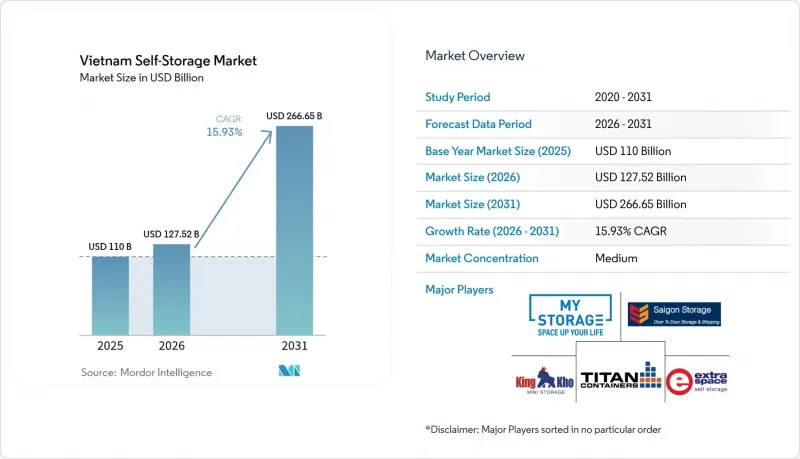
본 보고서는 최종 사용자(개인, 법인), 시설 유형(공조 관리형, 비공조 관리형, 발렛/풀서비스형, 컨테이너식 야외형), 유닛 크기(100제곱피트), 이용 사례(개인 가정, 계절용품, 가구 보관, 사업용 재고, 전자상거래)별로 분류되어 있습니다. 시장 전망은 금액(달러) 기준으로 제시되어 있습니다.
베트남 셀프 스토리지 시장 동향 및 인사이트
도시 지역의 주거 공간 축소가 오프사이트 보관을 촉진
베트남의 주요 도시에서는 원룸이나 1베드룸 임대 주택이 꾸준히 증가하고 있으며, 호치민시의 신규 임대 계약 중 40%가 이에 해당합니다. 주택 가격의 중앙값이 가구 소득 중앙값의 32.5배에 달한다는 점을 고려하면, 주민들은 필연적으로 집 밖에서 안전한 보관 장소를 찾게 됩니다. 이에 대응하여 베트남 셀프 스토리지 시장 사업자들은 토지 가격이 비교적 저렴하면서도 인구 밀집 주거지와 가까운 순환도로변에 다층 시설을 배치함으로써 대응하고 있습니다. 도시 지역의 토지 부족은 장기적인 추세이므로, 사업자들은 24시간 365일 이용 가능하며 원격 모니터링 기능을 갖춘 전용 시설에 대한 투자에 자신감을 보이고 있습니다. 예측 기간 동안, 이러한 시설들은 도시 확장에 발맞추어 확장되는 분산형 네트워크를 형성하며, 베트남 셀프 스토리지 시장의 장기적인 성장에 크게 기여할 것입니다.
전자상거래 중소기업의 마이크로 풀필먼트 공간 수요
2023년 국내 온라인 소매 시장 규모가 200억 달러를 돌파하고 연간 약 29%의 속도로 성장을 이어가는 가운데, 소규모 판매업체들에게는 고객 근처에 확장 가능한 재고 보관 거점이 필요해졌습니다. 유연한 임대 계약, 종량제 요금, 내장형 바코드 추적 기능 덕분에 셀프 스토리지 서비스는 집의 빈 방을 임시 재고 보관 장소로 사용하는 것과 본격적인 창고를 이용하는 것 사이의 매력적인 중간 대안으로 부상하고 있습니다. 주요 운영 사업자들은 현재 클라우드 기반 관리 대시보드, 라스트 마일 배송 업체와의 제휴, 안전한 하역 구역을 결합하여 보관 공간을 사실상 마이크로 풀필먼트 거점으로 변모시키고 있습니다. 상품의 입출고 주기가 빨라짐에 따라 동일한 면적에서도 더 높은 회전율을 실현할 수 있어, 베트남의 셀프 스토리지 시장은 그 혜택을 누리고 있습니다. 수요가 가장 집중된 곳은 호치민시와 하노이이지만, 지방의 전자상거래 물류가 성숙해짐에 따라 지방 도시에서도 유사한 경향이 나타나기 시작하고 있습니다.
도심 지역의 토지 부족이 시설 비용을 상승시키고
제1구 및 제3구 내의 입지가 좋은 부지는 주변 지역에 비해 가격이 수 배나 비싸기 때문에 신규 건설의 실현 가능성이 위축되고 있습니다. 노후화된 소매·상업용 건물을 다층 시설로 개조함으로써 토지 부족을 부분적으로 보완할 수는 있지만, 구조 개조에 드는 비용이 많이 듭니다. 많은 사업자들은 진입 비용이 저렴한 순환도로변 부지로 무게중심을 옮기고, 고객의 편의성을 유지하기 위해 셔틀 차량을 이용한 수거에 의존하고 있습니다. 이러한 대응책 덕분에 베트남의 셀프 스토리지 시장은 계속해서 확대되고 있지만, 특히 장기적인 자금력이 부족한 신규 진출기업들에게는 잠재적인 연평균 성장률(CAGR)이 몇 포인트 하락하는 요인이 되고 있습니다.
부문 분석
소비자 부문은 도시 중산층의 구매력 향상을 배경으로 2025년 기준 베트남 셀프 스토리지 시장 점유율의 67.20%를 차지했습니다. 주거 공간의 축소로 인해 가족들은 부피가 큰 가구, 계절별 장식품, 레크리에이션 용품 등을 외부 보관 시설에 맡기게 되었으며, 이것이 기본 가동률의 기반이 되고 있습니다. 도시 지역 주민에 기인한 베트남 셀프 스토리지 시장 규모는 꾸준히 확대될 것으로 예상되지만, 그 속도는 비즈니스 수요에 비해 완만할 전망입니다. 현재 규모는 작지만, 법인 부문은 2031년까지 연평균 성장률(CAGR) 18.58%로 확대되고 있으며, 이는 사업 운영을 정식화하고 규정을 준수하는 보관 장소를 찾는 중소기업의 급증세를 반영하고 있습니다. 이 부문을 공략하려는 사업자들은 새로운 포장 규정 및 EPR(생산자 책임 회수) 규정을 준수하는 플러그 앤 플레이 방식의 재고 관리 포털, 바코드 스캔, 온도 조절이 가능한 통로 등을 도입하고 있습니다.
비즈니스 부문의 성장세는 가정용 제품보다 물품 회전율이 빠르기 때문에 평방피트당 수익 증대로 직접 연결됩니다. 피킹 및 포장, 라스트 마일 배송 데스크와 같은 부가가치형 물류 서비스는 기본 임대료 외의 추가 수익원을 창출하고 있습니다. 조사 기간 동안 베트남 셀프 스토리지 업계에서는 보험 교차 판매, 계절적 잉여 공간 활용, 심야 이용 패키지 등이 평균 단위 수익을 더욱 끌어올리는 요인으로 작용했습니다. 성공적인 시설들은 주요 교통망 근처에 위치해 있어 접근 편의성을 해치지 않으면서 도시 지역의 택배 업체와 주택 고객 모두에게 서비스를 제공합니다. 이러한 수요의 융합은 가동률 변동을 완화하고, 베트남 셀프 스토리지 시장의 장기적인 성장 궤도를 뒷받침하고 있습니다.
2025년, 베트남 셀프 스토리지 시장 규모의 56.40%를 비냉방실이 차지했습니다. 이는 합리적인 가격대로 일상적인 수요의 대부분을 충족시키고 있기 때문입니다. 그러나 높은 습도와 급격한 온도 변화는 전자기기, 미술품, 목재 골동품 등에 위험을 초래합니다. 현재, 습도를 55% 미만으로, 주변 온도를 25°C 이하로 유지하는 공조 관리형 보관 공간에서는 부유층 수집가나 기업의 아카이브를 위한 예약이 점유율을 확대되고 있습니다. 차별화 전략으로는 HEPA 필터를 갖춘 환기 시스템, 원격 환경 모니터링, 업셀링을 촉진하는 단계적 가격 책정 등이 있습니다. 사업자들은 프리미엄 계층이 일반 계층보다 빠르게 성장하여 베트남 셀프 스토리지 시장의 유닛 수와 총 수익 모두를 확대할 것으로 예측했습니다.
연평균 성장률(CAGR) 22.85%를 예상하는 발렛 서비스나 풀서비스형 컨셉은 고객으로부터 직접 짐을 수거하여 중앙 집중형 보관 시설에 보관함으로써 ‘라스트 원 마일’ 문제를 해결하고 있습니다. 이 형태는 매장 공간에 대한 자본 부담이 적은 반면, 경로 최적화 소프트웨어나 다온도대 대응 배송 차량이 필요하지만, 이러한 기능은 기술 기업과의 제휴를 통해 점점 더 많이 제공되고 있습니다. 야외 컨테이너형 스토리지(outdoor container-type storage)는 초대형 또는 불규칙한 형태의 공간을 필요로 하는 건설 회사나 이벤트 계약업체를 대상으로 하며, 대부분의 경우 도시권 외곽의 산업 단지에 위치해 있습니다. 각 시설 유형은 서로 다른 고객층을 대상으로 하고 있으며, 이는 베트남 셀프 스토리지 시장이 핵심적인 제안 가치를 훼손하지 않으면서 다층적인 수요를 흡수하기 위해 얼마나 다양화되고 있는지를 여실히 보여줍니다.
기타 혜택:
- 엑셀 형식 시장 예측(ME) 시트
- 3개월간의 애널리스트 지원
자주 묻는 질문
목차
제1장 서론
제2장 조사 방법
제3장 주요 요약
제4장 시장 구도
제5장 시장 규모와 성장 예측
제6장 경쟁 구도
제7장 시장 기회와 향후 전망
JHS 26.09.03According to Mordor Intelligence, the Vietnam self-storage market size in 2026 is estimated at USD 127.52 million, growing from 2025 value of USD 110 million with 2031 projections showing USD 266.65 million, growing at 15.93% CAGR over 2026-2031.
This report is Segmented by End-User (Consumer, Business), Facility Type (Climate-Controlled, Non-Climate-Controlled, Valet/Full-Service, Containerised Outdoor), Unit Size ( 100 Sq Ft), and Application Use-Case (Personal Household, Seasonal Items, Furniture Storage, Business Inventory, E-Commerce). The Market Forecasts are Provided in Terms of Value (USD).
Vietnam Self-Storage Market Trends and Insights
Shrinking Urban Living Space Boosting Off-Site Storage
Vietnam's largest cities see a steady rise in studio and one-bedroom rentals, with 40% of new leases in Ho Chi Minh City fitting that description. When coupled with median home prices equal to 32.5 times median household income, residents inevitably look beyond their walls for secure storage. Operators in the Vietnam self-storage market respond by positioning multi-story sites along ring roads where land is cheaper yet still close to dense residential clusters. The long-run nature of urban land compression gives providers the confidence to invest in purpose-built facilities equipped with 24/7 access and remote monitoring. Over the forecast horizon, these sites form a distributed grid that expands in step with city sprawl and contributes materially to the long-term growth of the Vietnam self-storage market.
E-Commerce SMEs' Need for Micro-Fulfillment Space
With national online retail surpassing USD 20 billion in 2023 and rising roughly 29% each year, small sellers require scalable inventory points near customers. Flexible leases, pay-as-you-go fees, and embedded barcode tracking make self-storage an attractive middle ground between improvised spare-room stockpiles and full-scale warehousing. Leading operators now bundle cloud-based management dashboards, last-mile courier tie-ups, and secure unloading bays, effectively turning storage corridors into micro-fulfillment nodes. The Vietnam self-storage market benefits because the same square footage can earn higher turnover as goods cycle in and out more rapidly. Demand is densest in Ho Chi Minh City and Hanoi, yet secondary cities begin to emulate this pattern as regional e-commerce logistics mature.
Scarce Central-District Land Elevating Facility Costs
Prime sites inside District 1 and District 3 cost multiples of peripheral zones, squeezing feasibility for ground-up builds. Multi-story conversions of obsolete retail and commercial property partially offset land scarcity but carry higher structural retrofit expenses. Many operators pivot to ring-road parcels where entry costs are affordable, then rely on shuttle pickup to maintain customer convenience. These work-arounds keep the Vietnam self-storage market expanding yet shave a few points off potential CAGR, especially for entrants lacking patient capital.
Other drivers and restraints analyzed in the detailed report include:
- Expat and Digital-Nomad Influx Driving Short-Term Demand
- Home-Renovation and Hybrid-Work Furniture Storage Spike
- Ambiguous Licensing Framework Causing Permitting Delays
For complete list of drivers and restraints, kindly check the Table Of Contents.
Segment Analysis
The consumer segment retained 67.20% of Vietnam self-storage market share in 2025 on the back of rising urban middle-class purchasing power. Shrinking apartments mean families send bulky furniture, seasonal decor, and recreational gear to off-site units, anchoring baseline occupancy. Vietnam self-storage market size attributable to urban residents is expected to advance steadily but at a lower clip than business demand. The business cohort, currently smaller, is expanding at an 18.58% CAGR to 2031, reflecting the surge of SMEs formalizing operations and seeking compliant storage. Operators courting this segment roll out plug-and-play inventory portals, barcode scanning, and temperature-monitored aisles that align with new packaging and EPR rules.
Momentum in the business segment feeds directly into higher revenue per square foot because turnover of parcels is faster than household belongings. Value-added logistics, such as pick-and-pack or last-mile dispatch desks, generate fee layers beyond core rent. Throughout the review period, the Vietnam self-storage industry sees cross-selling of insurance, seasonal surplus space, and late-night access packages as incremental boosters of average unit revenue. Successful facilities locate near arterial transport links to serve both city couriers and residential customers without sacrificing accessibility. This blend of demand cushions occupancy cycles and sustains the long-term trajectory of the Vietnam self-storage market.
Non-climate-controlled rooms commanded 56.40% of Vietnam self-storage market size in 2025 because they satisfy the majority of everyday needs at accessible price points. High humidity and temperature swings, however, pose risks to electronics, artwork, and wooden antiques. Wealthier collectors and corporate archives now account for a growing slice of bookings in climate-controlled aisles where humidity remains under 55% and ambient temperature stays below 25 °C. Differentiation strategies involve HEPA-filtered ventilation, remote environmental monitoring, and tiered pricing that encourages upsell. Operators forecast the premium tier to grow faster than the general pool, widening both unit spread and total revenue within the Vietnam self-storage market.
Valet and full-service concepts, on track for 22.85% CAGR, solve last-mile pain points by picking up items directly from customers and storing them in centralized depots. This format is capital-light on storefront space yet demands route-optimization software and multi-temperature vans, capabilities increasingly sourced through tech partnerships. Outdoor containerized storage targets construction firms and event contractors needing oversized or irregular-shape space, often in industrial belts outside the urban ring. Each facility archetype serves a distinct client set, underscoring how the Vietnam self-storage market diversifies to capture multiple layers of demand without diluting its core proposition.
Complete Report Scope:
- By End-User
- Consumer
- Business
- By Facility Type
- Climate-Controlled Facilities
- Non-Climate-Controlled Facilities
- Valet / Full-Service Storage
- Containerised Outdoor Storage
- By Unit Size
- Greater than 25 sq ft (Locker)
- 26 - 50 sq ft (Small)
- 51 - 100 sq ft (Medium)
- Less than 100 sq ft (Large)
- By Application Use-Case
- Personal Household Goods
- Seasonal Items and Sports Gear
- Furniture and Renovation Storage
- Business Inventory and Documents
- E-commerce Micro-Fulfillment
- By Geography (City)
- Ho Chi Minh City
- Hanoi
- Da Nang and Central Coast
- South-East Industrial Provinces (Binh Duong, Dong Nai)
- Other Regions (Can Tho and Mekong, Northern Provinces)
List of Companies Covered in this Report:
- KingKho Mini Storage
- MyStorage
- Saigon Storage
- TITAN Containers Vietnam
- Extra Space Asia
- Cube Self Storage Vietnam
- StorHub Self Storage
- SpaceBox Self Storage
- Boxful
- WorkStore Enabler Vietnam
- Keep It Storage
- Kho247
- Self Storage Co Vietnam
- 247Boxes Storage
- StorageTree Vietnam
- FlexStorage VN
- OneBox Self Storage
- U-Space Vietnam
- Central Self Storage VN
- Vietnam Moving and Self Storage
Additional Benefits:
- The market estimate (ME) sheet in Excel format
- 3 months of analyst support
TABLE OF CONTENTS
1 INTRODUCTION
- 1.1 Study Assumptions and Market Definition
- 1.2 Scope of the Study
2 RESEARCH METHODOLOGY
3 EXECUTIVE SUMMARY
4 MARKET LANDSCAPE
- 4.1 Market Overview
- 4.2 Market Drivers
- 4.2.1 Shrinking Urban Living Space in Tier-1 Cities Boosting Off-Site Storage
- 4.2.2 E-commerce SMEs' Need for Micro-Fulfillment Space
- 4.2.3 Expat and Digital-Nomad Influx Driving Short-Term Storage Demand
- 4.2.4 Home-Renovation and Hybrid-Work Furniture Storage Spike
- 4.2.5 Government Push to Formalize Micro-Businesses Requiring Compliant Storage
- 4.2.6 Rising Affluent Collectors Seeking Climate-Controlled Units
- 4.3 Market Restraints
- 4.3.1 Scarce Central-District Land Elevating Facility Rental Costs
- 4.3.2 Ambiguous Licensing Framework Causing Permitting Delays
- 4.3.3 Low Consumer Awareness Beyond Ho Chi Minh City
- 4.3.4 FX-Driven Capex Volatility for Imported Modular Units
- 4.4 Value / Supply-Chain Analysis
- 4.5 Regulatory and Licensing Outlook
- 4.6 Porter's Five Forces Analysis
- 4.6.1 Threat of New Entrants
- 4.6.2 Bargaining Power of Buyers/Consumers
- 4.6.3 Bargaining Power of Suppliers
- 4.6.4 Threat of Substitutes
- 4.6.5 Intensity of Competitive Rivalry
- 4.7 Impact of COVID-19 on the Vietnam Self-Storage Market
- 4.8 Investment and Funding Analysis
5 MARKET SIZE AND GROWTH FORECASTS (VALUE)
- 5.1 By End-User
- 5.1.1 Consumer
- 5.1.2 Business
- 5.2 By Facility Type
- 5.2.1 Climate-Controlled Facilities
- 5.2.2 Non-Climate-Controlled Facilities
- 5.2.3 Valet / Full-Service Storage
- 5.2.4 Containerised Outdoor Storage
- 5.3 By Unit Size
- 5.3.1 Greater than 25 sq ft (Locker)
- 5.3.2 26 - 50 sq ft (Small)
- 5.3.3 51 - 100 sq ft (Medium)
- 5.3.4 Less than 100 sq ft (Large)
- 5.4 By Application Use-Case
- 5.4.1 Personal Household Goods
- 5.4.2 Seasonal Items and Sports Gear
- 5.4.3 Furniture and Renovation Storage
- 5.4.4 Business Inventory and Documents
- 5.4.5 E-commerce Micro-Fulfillment
- 5.5 By Geography (City)
- 5.5.1 Ho Chi Minh City
- 5.5.2 Hanoi
- 5.5.3 Da Nang and Central Coast
- 5.5.4 South-East Industrial Provinces (Binh Duong, Dong Nai)
- 5.5.5 Other Regions (Can Tho and Mekong, Northern Provinces)
6 COMPETITIVE LANDSCAPE
- 6.1 Market Concentration
- 6.2 Strategic Moves
- 6.3 Market Share Analysis
- 6.4 Company Profiles (includes Global-level Overview, Market-level Overview, Core Segments, Financials as available, Strategic Information, Market Rank/Share, Products and Services, Recent Developments)
- 6.4.1 KingKho Mini Storage
- 6.4.2 MyStorage
- 6.4.3 Saigon Storage
- 6.4.4 TITAN Containers Vietnam
- 6.4.5 Extra Space Asia
- 6.4.6 Cube Self Storage Vietnam
- 6.4.7 StorHub Self Storage
- 6.4.8 SpaceBox Self Storage
- 6.4.9 Boxful
- 6.4.10 WorkStore Enabler Vietnam
- 6.4.11 Keep It Storage
- 6.4.12 Kho247
- 6.4.13 Self Storage Co Vietnam
- 6.4.14 247Boxes Storage
- 6.4.15 StorageTree Vietnam
- 6.4.16 FlexStorage VN
- 6.4.17 OneBox Self Storage
- 6.4.18 U-Space Vietnam
- 6.4.19 Central Self Storage VN
- 6.4.20 Vietnam Moving and Self Storage
7 MARKET OPPORTUNITIES AND FUTURE OUTLOOK
- 7.1 White-Space and Unmet-Need Assessment