
|
시장보고서
상품코드
2114324
모터사이클용 첨단 라이더 지원 시스템(ARAS) : 시장 점유율 분석, 업계 동향 및 통계, 성장 예측(2026-2031년)Motorcycle Advanced Rider Assistance System - Market Share Analysis, Industry Trends & Statistics, Growth Forecasts (2026 - 2031) |
||||||
 Mordor Intelligence
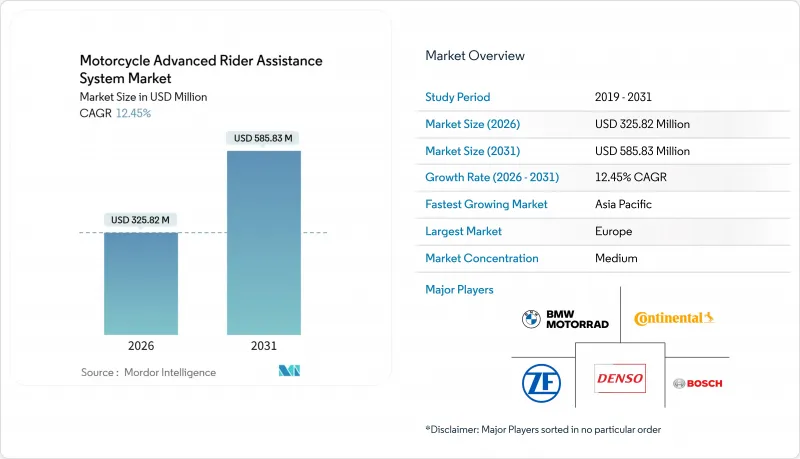
Mordor Intelligence에 의하면, 모터사이클용 첨단 라이더 지원 시스템(ARAS) 시장 규모는 2026년에 3억 2,582만 달러에 달하고, 2031년까지 5억 8,583만 달러에 이를 것으로 예상되며, 예측 기간 동안 CAGR 12.45%를 나타낼 전망입니다.
본 보고서는 제품 유형(적응형 크루즈 컨트롤 시스템, 오토바이용 안정성 제어 시스템, 전방 충돌 경고 등), 센서(LiDAR, 이미지 등), 유통 채널(OEM 및 애프터마켓), 구성 요소(전자 제어 장치, 센서 등) 및 지역별로 분류되어 있습니다. 시장 예측은 금액(달러) 기준으로 제시되어 있습니다.
세계의 모터사이클용 첨단 라이더 지원 시스템(ARAS) 시장 동향 및 인사이트
오토바이용 LiDAR 센서 가격의 급격한 하락
자동차용 LiDAR 모듈의 가격은 2015년 당시와 비교해 대폭 하락했으며, 공급업체들은 이륜차용으로 최적화된 솔리드 스테이트 유닛을 77GHz 레이더에 필적하는 가격으로 제공할 수 있게 되었습니다. 보쉬의 최신 세대 전면 레이더는 210미터의 감지 범위를 실현하여, 이전 세대 모델에 비해 감지 범위를 50미터 확대하고, 투어링 시 반응 시간을 개선했습니다. 중국의 조화 규격 ‘T/CECC 028-2024’에서는 6가지 ARAS 기능 레벨이 정의되어 있으며, 이에 따라 현지 OEM 각사는 크로스 플랫폼 아키텍처에 원활하게 통합할 수 있는 모듈형 센서의 조달을 서두르고 있습니다. 500cc를 초과하는 프리미엄 투어링 바이크나 어드벤처 바이크에 이러한 센서가 채택됨에 따라, 규모의 경제 효과로 인해 비용이 더욱 절감되어 저가대에서의 보급이 가속화되고 있습니다. 이러한 동향은 모터사이클용 첨단 라이더 지원 시스템(ARAS) 시장에서 두 자릿수 성장을 지속시킬 수 있는 구조적인 비용 우위의 기반을 뒷받침하고 있습니다.
ARAS 제품군을 대규모로 통합하기 위한 OEM 간의 플랫폼 공유
주요 오토바이 제조업체들은 여러 모델에 표준화된 프레임, 엔진, 전자 시스템을 채택하고 있으며, 이를 통해 라이더 지원 하드웨어를 전체 라인업에 적용할 수 있게 되었습니다. 대표적인 사례로, 어댑티브 크루즈 컨트롤,그룹 주행 지원, 주행 거리 지원, 긴급 제동 지원을 동일한 ECU 및 하네스에 통합함으로써 단가, 개발 기간, 인증 비용을 절감하고 있습니다. 야마하 발동기사의 ‘첨단 이륜차 안정화 어시스트 시스템(AMSAS)’은 사내 수직 통합의 좋은 사례입니다. 6축 관성 측정 장치(IMU)와 듀얼 액추에이터를 통해 저속 시의 균형 제어를 실현하며, 섀시 변경 없이 기존 YZF-R25 프레임에 매끄럽게 통합되어 있습니다. 자동차용 ISO 26262 툴체인을 기반으로 한 공급업체와 OEM 간의 협력을 통해 기능 안전 검증 기간이 단축되어, 아시아태평양에서 판매 대수를 차지하는 중배기량 클래스 전체에 걸쳐 신속한 규모 확대가 가능해집니다. 이를 통해 플랫폼 공유를 바탕으로 예측 기간 동안 ARAS 모듈에 대한 지속적인 수요가 확보됩니다.
급경사 시 센서 퓨전에서의 지속적인 지연
급커브를 주행할 때 오토바이의 기울기 각도가 45도를 초과할 수 있으며, 이때 레이더나 카메라의 시야가 전방 노면에서 벗어나게 됩니다. 검토를 거친 연구에 따르면, 롤 각도, 피치 각도, 요 각도가 급격히 변화하면 오탐이 급증하거나 물체 분류 지연이 발생하며, 그 결과 보수적인 경고 임계값이 설정되어 라이더의 신뢰도가 저하되는 것으로 나타났습니다. ISO 26262에서는 종단 간 지연 시간을 200밀리초 미만으로 규정하고 있지만, 많은 멀티 센서 스택은 공격적인 스포츠 주행 조건에서 이 기준을 충족하는 데 어려움을 겪고 있습니다. 보쉬의 긴급 제동 보조 기능은 추돌 회피 성능을 향상시키지만, 능동적인 기울기 상태에서 자동 제동이 작동하면 라이더의 안정성에 대한 우려가 발생합니다. 이러한 물리적 과제를 해결하려면 IMU 데이터와 예측 궤적 모델링을 융합하는 적응형 알고리즘이 필요하며, 이 연구 개발에는 몇 차례의 제품 주기가 소요될 것으로 예측됩니다.
부문별 분석
2025년 모터사이클용 첨단 라이더 지원 시스템(ARAS) 시장 점유율의 34.79%를 차지한 어댑티브 크루즈 컨트롤(ACC) 시스템은 혼합 교통 상황에서 차량 간 거리 유지를 중시하는 투어링 라이더들 덕분에 여전히 지배적인 위치를 유지하고 있습니다. 전방 충돌 경고 시스템은 2026년부터 2031년까지 연평균 15.04%의 성장률을 보일 것으로 예상되며, 이는 제품 카테고리 중 가장 빠른 성장 속도입니다. 이러한 부상은 유로 7의 모니터링 의무 및 인도의 ABS 규정안과 맥을 같이하며, OEM 각사에 예측 제동 알고리즘과 연동된 전면 레이더 모듈의 탑재를 촉진하고 있습니다. 경사 감지 브레이크와 트랙션 관리를 통합한 오토바이용 안정성 제어 시스템은 센서 비용의 하락과 스포츠 투어링 사용자들 사이에서 코너링 시 안전한 제동 조작에 대한 수요가 증가함에 따라 확대되고 있습니다. 이전에는 승용차에만 국한되었던 사각지대 감지 기능은 현재는 후방 레이더를 사용하여 추월해 오는 차량을 경고하는 고급 어드벤처 오토바이에도 탑재되고 있습니다.
그룹 라이딩 어시스트나 주행 거리 어시스트와 같은 틈새 기능은 조직적인 투어링 커뮤니티의 요구를 충족시키는 것으로, 현재 규모는 작지만 이 생태계가 순수한 안전 기능에서 편의성 및 소셜 라이딩 기능으로 전환되고 있음을 보여줍니다. 제품 포트폴리오는 두 가지 경로를 따라 진화하고 있습니다. 충돌 완화 기능은 규제 준수 및 보험 우대 조치의 기준이 되어, 중·대배기량 오토바이 전체에 걸쳐 광범위한 보급을 확실히 하고 있습니다. 편의성을 중시한 기능은 프리미엄 모델의 차별화 요소가 되며, 각 OEM 업체는 등급을 구분하여 OTA 업데이트를 통해 구독 형식으로 기능을 해제해 판매할 수 있게 됩니다. 따라서 모터사이클용 첨단 라이더 지원 시스템(ARAS) 시장에서 경쟁 우위를 확립하기 위해서는 규제 당국, 라이더, 그리고 지속적인 수익 창출에 대한 의욕을 모두 충족시키는 균형 잡힌 제품 제공이 핵심이 됩니다.
레이더 모듈은 검증된 전천후 성능과 비교적 저렴한 비용 덕분에 2025년 모터사이클용 첨단 라이더 지원 시스템(ARAS) 시장에서 32.74%의 점유율을 차지했습니다. 한편, LiDAR의 매출은 솔리드 스테이트 설계의 가격이 200달러 미만으로 떨어짐에 따라 연평균 성장률(CAGR) 18.42%로 증가할 것으로 예측되며, 오토바이에 3D 포인트 클라우드 데이터를 제공함으로써 차선 합류 및 후방 충돌 예측 정확도를 향상시킵니다. 이미지 센서의 경우, 장착 옵션이 제한적이고 눈부심, 비, 진동의 영향을 받는 것이 여전히 과제로 남아 있지만, 머신러닝을 활용한 노이즈 제거 기술 덕분에 알고리즘에서 사용할 수 있는 프레임 수가 증가하고 있습니다. 5미터 미만의 거리에서 유용한 초음파 센서는 여전히 주차 지원용 애드온으로만 제한되어 있습니다. 적외선 나이트 비전은 일부 장거리 투어링 오토바이를 위한 사치스러운 옵션에 그치고 있습니다.
기술의 융합으로 인해 이 분야는 레이더를 핵심으로, 고해상도 매핑을 위한 라이다(LiDAR)와 시각 분류를 위한 카메라를 결합한 시스템으로 전환되고 있습니다. 표준화 기구는 센서군의 통합을 추진하고 있으며, 이를 통해 맞춤형 설계를 줄이고 여러 공급업체에 의한 공급 안정성을 확보하고 있습니다. 자동차 업계의 지속적인 대량 생산으로 비용이 절감됨에 따라, 모터사이클용 첨단 라이더 지원 시스템(ARAS) 시장에서 수익성을 해치지 않으면서도 센서의 다양화가 보장되고 있습니다.
지역별 분석
유럽은 2025년 모터사이클용 첨단 라이더 지원 시스템(ARAS) 시장 점유율의 31.72%를 차지했으며, 2031년까지 연평균 9.78%의 성장이 예상됩니다. 이 대륙의 엄격한 ‘유로 7’ 규제로 인해 차량 내 모니터링 및 데이터 로깅이 의무화되어, 각 OEM 업체들은 멀티 센서 대응 ECU 및 고도화된 진단 기능을 탑재해야 하는 상황에 놓여 있습니다. 독일, 이탈리아, 오스트리아에 본사를 둔 프리미엄 브랜드들은 투어링 모델과 어드벤처 모델에 어댑티브 크루즈 컨트롤, 사각지대 감지, 긴급 제동 보조 기능을 기본 사양으로 탑재하여, 규제 준수를 확보하는 동시에 소비자의 기대에도 부응하고 있습니다. 유럽의 GDPR(EU 개인정보보호규정)에 기반한 데이터 개인정보 보호 지침에 따라 로컬 동영상 저장, 동의 화면, 자동 익명화 등의 소프트웨어 기능이 도입되어 비용은 증가하지만, 사용자의 신뢰 향상으로 이어지고 있습니다. 보험사는 ARAS가 탑재된 오토바이에 대해 두 자릿수의 보험료 할인을 제공함으로써 도입을 가속화하고, 안전성과 상업적 인센티브 간의 선순환을 강화하고 있습니다.
아시아태평양은 2031년까지 연평균 성장률(CAGR) 13.15%를 나타낼 것으로 예측되며, 이는 세계에서 가장 빠른 속도입니다. 인도의 L2 등급 이륜차에 대한 ABS 장착 의무화, 중국의 6단계 지능 분류, 그리고 동남아시아 전역에서 확대되는 전동화 목표가 맞물려 라이더 보조 기술의 보급에 이상적인 여건이 조성되었습니다. 현지 제조업체들은 지역 특유의 낮은 인건비와 제조 비용을 활용하여 센서 패키지를 통근용 및 스포츠 모델로 확대하고 있으며, 센서 1개당 150달러 미만의 가격 수준을 달성하고 있습니다. 일본의 각 OEM 업체들은 현재 중배기량 모델에 트랙션 컨트롤과 경사 감지 브레이크를 통합하고 있는 반면, 하이엔드 오토바이 시장에 진출하는 중국 자동차 브랜드들은 자동차 등급의 디지털 콕핏과 ADAS 스택을 이식하고 있습니다. 전기 오토바이 충전 인프라가 정비됨에 따라, 48V 아키텍처가 충분한 전력 여유를 창출하여 주류 플랫폼에 레이더 및 LiDAR를 통합할 수 있게 되었습니다.
북미에서는 뿌리 깊은 투어링 문화에 더해, ARAS를 탑재한 라이더의 보험료를 최대 절반까지 인하하는 보험 텔레매틱스 우대 조치 덕분에 8.88%의 성장률을 보이고 있습니다. 미국 규제 당국은 시험의 표준화를 도모하기 위해 UN DCAS 프로토콜을 채택하여 대서양을 횡단하는 모델의 OEM 형식 인증 절차를 간소화하고 있습니다. 서아시아에서는 걸프 지역 부유층이 장거리 고속도로 주행을 위해 차선 변경 및 사각지대 경고 기능을 갖춘 프리미엄 투어링 바이크를 선호함에 따라 11.61%의 성장률을 기록하고 있습니다. 한편, 남미,아프리카, 러시아에서는 프리미엄 부문으로의 침투가 여전히 제한적이며, 사후 장착 키트의 형식 인증 절차가 아직 정비 단계에 있기 때문에 성장세가 둔화되고 있습니다. 그럼에도 불구하고 가처분 소득 증가와 안전 기능의 초기 도입 사례는 자금 조달 및 규제 명확화가 진전된다면 가속화될 가능성이 있는 잠재적 수요를 시사하고 있습니다.
기타 혜택 :
- 엑셀 형식 시장 예측(ME) 시트
- 3개월간의 애널리스트 지원
자주 묻는 질문
목차
제1장 서론
제2장 조사 방법
제3장 주요 요약
제4장 시장 구도
제5장 시장 규모 및 성장 예측
제6장 경쟁 구도
제7장 시장 기회 및 향후 전망
KTH 26.08.28According to Mordor Intelligence, the motorcycle advanced rider assistance system market size stands at USD 325.82 million in 2026 and is projected to reach USD 585.83 million by 2031, advancing at an impressive 12.45% CAGR during the forecast period.
This report is Segmented by Product Type (Adaptive Cruise Control System, Motorcycle Stability Control System, Forward Collision Warning System, and More), Sensor (LiDAR, Image, and More), Distribution Channel (OEM and Aftermarket), Component (Electronic Control Unit, Sensors, and More), and Geography. The Market Forecasts are Provided in Terms of Value (USD).
Global Motorcycle Advanced Rider Assistance System Market Trends and Insights
Rapid Decline in Motorcycle LiDAR Sensor Pricing
Automotive-grade LiDAR modules cost significantly less than they did in 2015, allowing suppliers to offer solid-state units tailored for two-wheelers at prices that rival those of 77 GHz radar. The latest generation of Bosch front-radar achieves a 210-meter detection range, extending coverage by 50 meters relative to the prior unit and improving reaction time in touring scenarios. Chinese harmonization standard T/CECC 028-2024 defines six ARAS capability levels, pushing local OEMs to source modular sensors that drop seamlessly into cross-platform architectures. As premium touring and adventure motorcycles above 500 cc adopt these sensors, economies of scale further compress costs, accelerating adoption in lower price bands. The trajectory confirms a structural cost-advantage pathway that sustains double-digit growth for the motorcycle advanced rider assistance system market.
OEM Platform-Sharing to Embed ARAS Suites at Scale
Major motorcycle makers deploy standard frames, engines, and electronic systems across multiple models, enabling rider-assist hardware to spread across entire line-ups. A flagship case integrates adaptive cruise, group-ride assist, riding-distance assist, and emergency-brake assist within the same ECU and harness, cutting unit costs, engineering time, and certification fees. Yamaha Motor's Advanced Motorcycle Stabilisation Assist System (AMSAS) illustrates in-house verticalization: a 6-axis inertial measurement unit (IMU) and dual actuators deliver low-speed balance control and seamlessly plug into existing YZF-R25 frames without chassis changes. Supplier-OEM collaborations built on automotive ISO 26262 toolchains shorten functional-safety validation, allowing rapid scale-ups across mid-displacement categories that dominate sales volumes in Asia-Pacific. Platform-sharing thereby locks in sustained demand for ARAS modules throughout the forecast period.
Persistent Sensor-Fusion Latency at Lean Angles
During steep cornering, motorcycles can exceed 45-degree lean angles, shifting the radar and camera fields of view away from the road ahead. Peer-reviewed work shows false-positive spikes and longer object-classification latency when roll, pitch, and yaw change rapidly, forcing conservative warning thresholds that diminish rider confidence. ISO 26262 demands sub-200-millisecond end-to-end latency, yet many multi-sensor stacks struggle to meet this standard under aggressive sport-riding. Bosch's emergency-brake assist improves rear-end collision avoidance but raises rider-stability concerns when automatic braking triggers during active lean. Solving these physics-driven challenges requires adaptive algorithms that blend IMU data with predictive trajectory modeling, an R&D priority expected to take several product cycles.
Other drivers and restraints analyzed in the detailed report include:
- Rising Demand for Premium Touring and Adventure Bikes in ASEAN
- Stricter Euro 7 and Bharat Stage 7 Motorcycle-Safety Mandates
- Limited 12-V Electrical Headroom on Commuter Motorcycles
For complete list of drivers and restraints, kindly check the Table Of Contents.
Segment Analysis
Adaptive cruise control systems, which held 34.79% of the motorcycle advanced rider assistance system market share in 2025, remain dominant thanks to touring riders who value automatic gap-keeping in mixed traffic. Forward-collision warning systems are projected to grow at 15.04% annually from 2026 to 2031, the quickest pace within product categories. Their ascent aligns with Euro 7 monitoring mandates and draft Indian ABS rules, pushing OEMs to embed front-radar modules coupled with predictive braking algorithms. Motorcycle stability control systems, integrating tilt-aware braking and traction management, expand as sensor costs fall and sport-touring customers demand corner-safe braking. Blind-spot detection, previously a passenger-car exclusive, is now available on high-trim adventure bikes that use rear radar to flag overtaking vehicles.
Niche features such as group-ride assist and riding-distance assist cater to organized touring communities and, though small today, illustrate the ecosystem's shift from pure safety to convenience and social riding features. The product portfolio paints a two-track evolution. Collision-mitigation capabilities become baseline for regulatory compliance and insurance incentives, ensuring broad penetration across mid- and high-displacement motorcycles. Comfort-oriented features differentiate premium models, allowing OEMs to tier trim levels and sell subscription-based feature unlocks via OTA updates. Competitive positioning, therefore, hinges on a balanced offering that satisfies regulators, riders, and recurring-revenue ambitions inside the motorcycle advanced rider assistance system market.
Radar modules held 32.74% of the motorcycle advanced rider assistance system market share in 2025 due to proven all-weather performance and a relatively low cost. Yet LiDAR revenue is forecast to rise at an 18.42% CAGR as solid-state designs fall below USD 200, providing motorcycles with 3-D point clouds that improve lane-merging and rear-collision estimation accuracy. Image sensors remain hampered by limited mounting options and exposure to glare, rain, and vibration, although machine-learning-enhanced de-noising now salvages more frames for algorithmic use. Ultrasonic sensors, useful at distances of less than 5 meters, remain confined to parking-assist add-ons. Infrared night-vision remains a luxury option for a small subset of long-distance touring bikes.
Technological convergence steers the sector toward radar-centric arrays complemented by LiDAR for high-resolution mapping and cameras for visual classification. Standard-setting bodies encourage harmonized sensor suites, reducing bespoke engineering and securing multi-vendor supply resilience. Continued automotive volume drives down costs, ensuring sensor diversification without jeopardizing profit margins inside the motorcycle advanced rider assistance system market.
Complete Report Scope:
- By Product Type
- Adaptive Cruise Control System
- Motorcycle Stability Control System
- Forward Collision Warning System
- Blind Spot Detection System
- Other Product Types
- By Sensor
- LiDAR
- Image
- Ultrasonic
- Radar
- Infrared
- By Distribution Channel
- Original Equipment Manufacturer (OEM)
- Aftermarket
- By Component
- Electronic Control Unit (ECU)
- Sensors
- Gear Assistors
- Others
- By Geography
- North America
- United States
- Canada
- Rest of North America
- South America
- Brazil
- Argentina
- Rest of South America
- Europe
- United Kingdom
- Germany
- Spain
- Italy
- France
- Russia
- Rest of Europe
- Asia-Pacific
- India
- China
- Japan
- South Korea
- Rest of Asia-Pacific
- Middle East and Africa
- United Arab Emirates
- Saudi Arabia
- Turkey
- Egypt
- South Africa
- Rest of Middle-East and Africa
- North America
Geography Analysis
Europe controlled 31.72% of the motorcycle advanced rider assistance system market share in 2025 and is projected to expand at 9.78% through 2031. The continent's strict Euro 7 mandates obligate on-board monitoring and data logging, pushing OEMs to embed multi-sensor ECUs and advanced diagnostics. Premium brands headquartered in Germany, Italy, and Austria equip touring and adventure models with adaptive cruise, blind-spot detection, and emergency-brake assist as standard, ensuring regulatory compliance while meeting consumer expectations. Data-privacy directives under Europe's GDPR prompt software features such as local video storage, consent screens, and automatic anonymization, adding cost but also boosting user trust. Insurance carriers accelerate uptake by offering double-digit policy discounts for ARAS-equipped bikes, reinforcing a virtuous cycle of safety and commercial incentives.
Asia-Pacific is forecast to grow at a 13.15% CAGR through 2031, the fastest worldwide. India's impending ABS requirement for L2 motorcycles, China's six-tier intelligence classification, and expanding electrification targets across Southeast Asia jointly create the ideal conditions for rider-assist proliferation. Local producers scale sensor packages into commuter and sport models, leveraging regionally low labor and manufacturing costs to hit sub-USD 150 sensor unit thresholds. Japanese OEMs now integrate traction control and tilt-aware braking across mid-displacement offerings, while Chinese automotive brands migrating into high-end motorcycles port over car-grade digital cockpits and ADAS stacks. As charging infrastructure for electric bikes improves, 48-V architectures unlock ample electrical headroom, enabling the integration of radar and LiDAR on mainstream platforms.
North America advances at 8.88% owing to an entrenched motorcycle touring culture and insurance telematics incentives that slash premiums by as much as half for ARAS-equipped riders. Stateside regulators adopt UN DCAS protocols to harmonize testing, simplifying OEM homologation for cross-Atlantic models. Western Asia posts an 11.61% rise amid affluent consumers in the Gulf who favor premium touring machines with lane-change and blind-spot alerts for long stretches of highway. South America, Africa, and Russia lag, with premium-segment penetration remaining limited and homologation pathways for retrofit kits still in development. Even so, improving disposable income and early pilots of safety features hint at latent demand that could accelerate should financing and regulatory clarity emerge.
- Robert Bosch GmbH
- Continental AG
- ZF Friedrichshafen AG
- Denso Corporation
- Mitsubishi Electric Corporation
- BMW Motorrad
- Ducati Motor Holding
- Honda Motor Co.
- Yamaha Motor Co.
- Kawasaki Heavy Industries
- KTM AG
- Triumph Motorcycles
- Harley-Davidson
- Piaggio Group (Aprilia)
- Autoliv Inc.
Additional Benefits:
- The market estimate (ME) sheet in Excel format
- 3 months of analyst support
TABLE OF CONTENTS
1 Introduction
- 1.1 Study Assumptions and Market Definition
- 1.2 Scope of the Study
2 Research Methodology
3 Executive Summary
4 Market Landscape
- 4.1 Market Overview
- 4.2 Market Drivers
- 4.2.1 Rapid Decline in Motorcycle LiDAR Sensor Pricing
- 4.2.2 OEM Platform-Sharing to Embed ARAS Suites at Scale
- 4.2.3 Rising Demand for Premium Touring and Adventure Bikes in ASEAN
- 4.2.4 Stricter Euro 6e / Bharat Stage 7 Motorcycle-Safety Mandates
- 4.2.5 V2X-Enabled Over-the-Air Updates Unlocking Subscription Revenue
- 4.2.6 Insurance-Linked Telematics Discounts for ARAS-Equipped Bikes
- 4.3 Market Restraints
- 4.3.1 Persistent Sensor-Fusion Latency at Lean Angles
- 4.3.2 Limited 12-V Electrical Headroom on Commuter Motorcycles
- 4.3.3 Consumer Privacy Concerns Over Continuous Vision Data Capture
- 4.3.4 Aftermarket Retro-Fit Kit Regulatory Ambiguity
- 4.4 Value / Supply-Chain Analysis
- 4.5 Regulatory Landscape
- 4.6 Technological Outlook
- 4.7 Porter's Five Forces
- 4.7.1 Threat of New Entrants
- 4.7.2 Bargaining Power of Suppliers
- 4.7.3 Bargaining Power of Buyers
- 4.7.4 Threat of Substitutes
- 4.7.5 Industry Rivalry
5 Market Size and Growth Forecasts (Value (USD))
- 5.1 By Product Type
- 5.1.1 Adaptive Cruise Control System
- 5.1.2 Motorcycle Stability Control System
- 5.1.3 Forward Collision Warning System
- 5.1.4 Blind Spot Detection System
- 5.1.5 Other Product Types
- 5.2 By Sensor
- 5.2.1 LiDAR
- 5.2.2 Image
- 5.2.3 Ultrasonic
- 5.2.4 Radar
- 5.2.5 Infrared
- 5.3 By Distribution Channel
- 5.3.1 Original Equipment Manufacturer (OEM)
- 5.3.2 Aftermarket
- 5.4 By Component
- 5.4.1 Electronic Control Unit (ECU)
- 5.4.2 Sensors
- 5.4.3 Gear Assistors
- 5.4.4 Others
- 5.5 By Geography
- 5.5.1 North America
- 5.5.1.1 United States
- 5.5.1.2 Canada
- 5.5.1.3 Rest of North America
- 5.5.2 South America
- 5.5.2.1 Brazil
- 5.5.2.2 Argentina
- 5.5.2.3 Rest of South America
- 5.5.3 Europe
- 5.5.3.1 United Kingdom
- 5.5.3.2 Germany
- 5.5.3.3 Spain
- 5.5.3.4 Italy
- 5.5.3.5 France
- 5.5.3.6 Russia
- 5.5.3.7 Rest of Europe
- 5.5.4 Asia-Pacific
- 5.5.4.1 India
- 5.5.4.2 China
- 5.5.4.3 Japan
- 5.5.4.4 South Korea
- 5.5.4.5 Rest of Asia-Pacific
- 5.5.5 Middle East and Africa
- 5.5.5.1 United Arab Emirates
- 5.5.5.2 Saudi Arabia
- 5.5.5.3 Turkey
- 5.5.5.4 Egypt
- 5.5.5.5 South Africa
- 5.5.5.6 Rest of Middle-East and Africa
- 5.5.1 North America
6 Competitive Landscape
- 6.1 Market Concentration
- 6.2 Strategic Moves
- 6.3 Market Share Analysis
- 6.4 Company Profiles (Includes Global Level Overview, Market Level Overview, Core Segments, Financials as Available, Strategic Information, Market Rank/Share for Key Companies, Products and Services, SWOT Analysis, and Recent Developments)
- 6.4.1 Robert Bosch GmbH
- 6.4.2 Continental AG
- 6.4.3 ZF Friedrichshafen AG
- 6.4.4 Denso Corporation
- 6.4.5 Mitsubishi Electric Corporation
- 6.4.6 BMW Motorrad
- 6.4.7 Ducati Motor Holding
- 6.4.8 Honda Motor Co.
- 6.4.9 Yamaha Motor Co.
- 6.4.10 Kawasaki Heavy Industries
- 6.4.11 KTM AG
- 6.4.12 Triumph Motorcycles
- 6.4.13 Harley-Davidson
- 6.4.14 Piaggio Group (Aprilia)
- 6.4.15 Autoliv Inc.
7 Market Opportunities and Future Outlook
- 7.1 White-space and Unmet-Need Assessment