|
시장보고서
상품코드
2114340
인도의 파티클 보드 : 시장 점유율 분석, 업계 동향과 통계, 성장 예측(2026-2031년)India Particle Board - Market Share Analysis, Industry Trends & Statistics, Growth Forecasts (2026 - 2031) |
||||||
 Mordor Intelligence
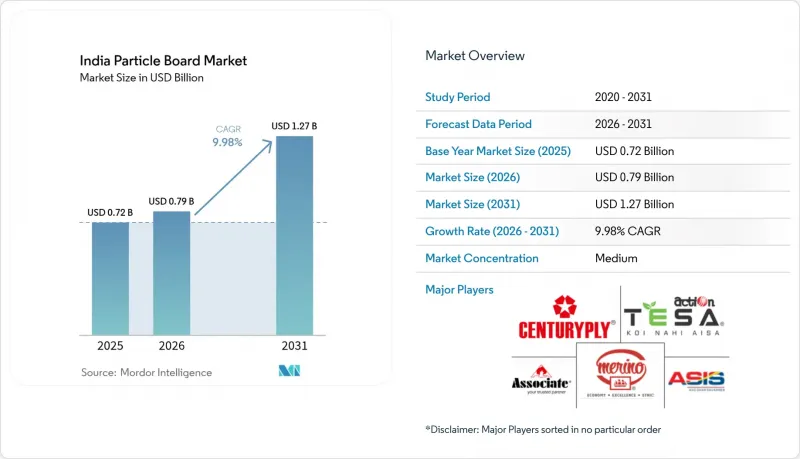
Mordor Intelligence에 따르면 인도의 파티클 보드 시장 규모는 2025년에 7억 2,000만 달러로 평가되며, 2026년 7억 9,000만 달러에서 2031년까지 12억 7,000만 달러에 달할 것으로 예측되고 있으며, 예측 기간(2026-2031년)에 CAGR은 9.98%에 달할 전망입니다.
이 보고서는 원료(목재[톱밥, 부스러기, 플레이크, 칩], 바가스, 기타)와 용도(가구 및 캐비닛, 건설, 인프라, 기타)별로 분류되어 있습니다. 시장 전망은 금액(달러) 기준으로 제시되어 있습니다.
인도 파티클보드 시장의 동향 및 인사이트
사무실, 호텔·관광, 소매용 가구 수요 증가
기업이 표준화된 보드 치수에 의존하는 모듈식 워크스테이션을 채택함에 따라 상업 시설의 개보수 주기가 단축되고, 패널 공급업체에 대한 안정적인 주문이 확보되고 있습니다. 주문 제작 목공 제품을 교체가 용이한 파티클보드(칩보드)로 만든 비품으로 대체하고 있는 호텔 체인들은 현재, 공장의 생산량을 안정화하기 위해 수년에 걸친 포괄적인 주문을 진행하고 있습니다. 조직형 소매업체들은 조립식 가구 라인업을 확대하고 있으며, 플랫팩(평평한 포장) 방식의 물류에서는 무게와 비용 면에서 유리한 파티클 보드가 합판보다 선호되고 있습니다. E-Commerce 판매업체들은 예산을 중시하는 소비자의 요구에 부응하기 위해, 미리 라미네이트 가공된 패널에 금속 부품이나 고정 장치를 세트로 판매하고 있으며, 이로 인해 2급 성장 지역의 소비가 더욱 확대되고 있습니다. 지방 도시로 이전하는 기업 입점업체들의 존재로 인해 이러한 수요의 견인력은 기존 주요 도시권의 범위를 넘어 확대되고 있습니다.
도시 주택 건설 추진 및 스마트 시티 프로젝트
스마트 시티 사업에서는 대중교통 역, 행정 기관, 커뮤니티 센터의 인테리어 공사가 토목 공사 예산에 포함되어 있으며, 인증된 보드에 대한 비경기순환적 수요층이 형성되고 있습니다. PMAY(총리 저렴한 주택 구상)에 따른 저소득층 주택 계획에서는 E1 등급 파티클 보드를 지정한 모듈식 주방이 도입되어, 사회 정책과 산업 성장이 연계되고 있습니다. 산업 회랑의 거점에서는 주택과 상업용 부동산의 허가·인가가 융합되어 있으며, 보드제 캐비닛에 대한 지속적인 수요층을 창출하고 있습니다. 그린 빌딩 평가 기준에서는 저배출 집성재가 점점 더 높이 평가받고 있으며, 기준을 충족하는 생산자는 프리미엄 가격으로 입찰할 수 있게 되었습니다. 12곳의 새로운 산업 거점 계획에 따라 장기적인 수주 전망이 유지되고 있으며, 새로운 연속 프레스 라인 도입이 정당화되고 있습니다.
고급 캐비닛 시장에서 MDF의 캐니발리제이션
MDF의 더 미세한 섬유 매트릭스는 라우터 가공시 가장자리가 날카롭게 처리되어 고급 주방 제조업체들이 셰이커 스타일의 문에 선호하여 채택하고 있으므로 캐비닛 시장의 상위 부문에서 시장 점유율의 변화가 일어나고 있습니다. 도시권 소비자들은 품질 향상이라는 인식이 가처분 소득의 증가와 일치할 경우, 15-20%의 가격 인상을 용인하는 경향이 있습니다. 파티클보드 공급업체들은 납품 비용을 MDF보다 8-10% 낮게 유지하면서, 고밀도 등급을 제공하고 표면 연마를 개선하여 외관상의 차이를 줄이는 방식에 대응하고 있습니다. 싱크대 아래 패널 등 습기의 영향을 받기 쉬운 부분은 여전히 MDF의 강세 영역이지만, 보드 제조사들은 시장 점유율을 되찾기 위해 발수성 첨가제의 연구개발을 가속화하고 있습니다. 따라서 캐니발리제이션은 대중 시장용 가구가 아닌 프리미엄 SKU로 한정된 상태가 지속되고 있습니다.
부문 분석
2025년, 인도의 파티클보드 시장에서 목재계 원료는 61.20%의 점유율을 유지했습니다. 이는 칩의 품질을 보장하는 수 세기에 걸친 제재소와의 협력을 통해 제조 공정의 수율이 지원되고 있기 때문입니다. 그러나 기후 변화 대응 노력과 바이오매스에 대한 인센티브로 인해 바가스(사탕수수 찌꺼기)는 연평균 성장률(CAGR) 12.32%를 기록하며 다른 모든 소재를 능가하는 속도로 성장하고 있으며, 해가 갈수록 목재의 우위를 좁혀가고 있습니다. 계획 중인 저장 사일로와 건조기가 가동을 시작하면, 바가스에 기인한 인도의 파티클보드 시장 규모는 제당 공장의 폐기물을 수익화하는 것만으로도 확대될 가능성이 있습니다. 동시에, 건설 폐자재에서 유래한 재활용 목재 칩도 원료로 추가되어, 수입 원목 부족에 대비한 원료 확보 수단이 될 것입니다.
바가스를 주원료로 하는 공장에서는 온실가스 상쇄를 수익화하기 위해 탄소 크레딧 서류를 작성하고 있으며, 이는 가격 변동의 영향을 완화하는 추가적인 수입원이 되고 있습니다. 대학의 검사 결과, 프레스 매개변수가 최적화될 경우 바가스 보드와 유칼립투스 보드 간의 파단 강도와 내부 결합 강도가 동등한 것으로 입증되어, 이전의 품질에 대한 우려는 해소되었습니다. 인도 서부의 여러 제재소는 그린 라벨을 획득한 가구 수출업체로부터 우선적으로 원자재를 조달할 수 있을 것으로 기대하며, 전용 껍질 벗기기 및 세척 설비에 대한 설비 투자를 결정했습니다. 2025년 이후, BIS 감사팀이 확대됨에 따라 원료 추적성 기준에 따라 바가스 조달 기록을 디지털화하고 있는 제재소가 유리한 입장에 설 것으로 보입니다.
기타 혜택
- 엑셀 형식의 시장 예측(ME) 시트
- 3개월간의 애널리스트 지원
자주 묻는 질문
목차
제1장 서론
제2장 조사 방법
제3장 개요
제4장 시장 구도
제5장 시장 규모와 성장 예측
제6장 경쟁 구도
제7장 시장 기회와 향후 전망
KSA 26.08.26According to Mordor Intelligence, the India particle board market size was valued at USD 0.72 billion in 2025 and estimated to grow from USD 0.79 billion in 2026 to reach USD 1.27 billion by 2031, at a CAGR of 9.98% during the forecast period (2026-2031).
This report is Segmented by Raw Material (Wood [Sawdust, Shavings, Flakes, and Chips], Bagasse, and Other Raw Materials) and Application (Furniture and Cabinetry, Construction, Infrastructure, and Others). The Market Forecasts are Provided in Terms of Value (USD).
India Particle Board Market Trends and Insights
Rising Office, Hospitality, and Retail Furniture Demand
Commercial refurbishment cycles have shortened as enterprises adopt modular workstations that rely on standardized board dimensions, ensuring steady call-offs from panel suppliers. Hospitality chains replacing custom millwork with easily replaceable particle board (chip board) fixtures now place multi-year blanket orders that stabilize factory throughput. Organized retail is scaling ready-to-assemble furniture lines whose flat-pack logistics favor particle board over plywood because of weight and cost advantages. E-commerce sellers bundle fittings and fasteners with pre-laminated panels to serve budget-conscious consumers, deepening consumption in Tier-2 growth corridors. Corporate occupiers migrating to secondary cities extend this driver beyond traditional metropolitan catchments.
Urban-Housing Push and Smart-City Projects
Smart-city spending packages interior fit-outs for public transit stations, administrative offices, and community centers into the civil works budget, adding a non-cyclical layer of demand for certified boards. Affordable-housing schemes under PMAY integrate modular kitchens that specify E1-grade particle board, linking social policy with industrial growth. Industrial corridor nodes blend residential and commercial real-estate approvals, creating contiguous demand pools for board-based cabinetry. Green-building scorecards increasingly reward low-emission engineered wood, allowing compliant producers to bid at premium prices. The pipeline of 12 new industrial nodes sustains long-range order visibility that justifies new continuous-press lines.
MDF Cannibalisation in Premium Cabinets
MDF's finer fiber matrix yields crisper routed edges that premium kitchen makers prefer for shaker-style doors, leading to a share shift at the cabinetry market's upper end. Urban consumers tolerate a 15-20% price uplift when the perceived quality jump aligns with rising disposable incomes. Particle board suppliers respond with higher-density grades and improved surface sanding to shrink the aesthetic gap, while staying 8-10% below MDF on delivered cost. Moisture-prone zones such as under-sink panels remain MDF strongholds, but board makers accelerate research and development on hydrophobic additives to claw back share. Cannibalisation, therefore, remains contained to premium SKUs rather than mass-market furniture.
Other drivers and restraints analyzed in the detailed report include:
- Government PLI Incentives for Furniture Components
- EU/US Low-Emission Export Opportunity
- Volatile Imported Log and Resin Prices
For complete list of drivers and restraints, kindly check the Table Of Contents.
Segment Analysis
Wood-based feedstocks retained 61.20% of India particle board market share in 2025, anchoring process yields through centuries-old sawmill linkages that guarantee chip consistency. However, climate commitments and biomass incentives propel bagasse to a 12.32% CAGR, outpacing all other materials and narrowing wood's hegemony each successive year. The India particle board market size attributable to bagasse could grow purely on the back of sugar-mill waste monetization once planned storage silos and dryers come online. Simultaneously, recycled wood chips from construction debris enter the mix, providing feedstock hedges against imported log shortages.
Bagasse-centric plants compile carbon-credit dossiers to monetize greenhouse-gas offsets, adding a supplementary revenue stream that cushions price cycles. University trials demonstrate comparable rupture and internal-bond strength modulus between bagasse and eucalyptus boards when press parameters are optimized, nullifying earlier quality concerns. Several western-India mills have committed capex for dedicated depithing and cleaning units, anticipating preferential procurement from green-label furniture exporters. As BIS audit teams expand post-2025, feedstock traceability standards will favor mills with digitized bagasse procurement records.
Complete Report Scope:
- By Raw Material
- Wood
- Sawdust
- Shavings
- Flakes
- Chips
- Bagasse
- Other Raw Materials
- Wood
- By Application
- Furniture and Cabinetry
- Construction
- Infrastructure
- Others
List of Companies Covered in this Report:
- Action TESA
- ARCHIDPLY DECOR
- Asian Prelam Industries Pvt. Ltd
- Associate Decor Ltd.
- Bajaj Hindusthan Sugar Ltd
- CenturyPly (Century Prowud)
- DMK Particleboard LLP
- Evergreen Boardlam Pvt. Ltd.
- Krifor Industries Pvt. Ltd.
- Lamikon Woodlam LLP
- Merino Industries
- Niramay Woodlam
- Shirdi Panel Industries Ltd.(ASIS)
Additional Benefits:
- The market estimate (ME) sheet in Excel format
- 3 months of analyst support
TABLE OF CONTENTS
1 Introduction
- 1.1 Study Assumptions and Market Definition
- 1.2 Scope of the Study
2 Research Methodology
3 Executive Summary
4 Market Landscape
- 4.1 Market Overview
- 4.2 Market Drivers
- 4.2.1 Rising office, hospitality and retail furniture demand
- 4.2.2 Urban-housing push and smart-city projects
- 4.2.3 Government PLI incentives for furniture components
- 4.2.4 EU/US low-emission export opportunity
- 4.2.5 AI-enabled panel-line automation cuts unit cost
- 4.3 Market Restraints
- 4.3.1 MDF cannibalisation in premium cabinets
- 4.3.2 Volatile imported log and resin prices
- 4.3.3 Tightening global formaldehyde limits
- 4.4 Value Chain Analysis
- 4.5 Porter's Five Forces
- 4.5.1 Bargaining Power of Suppliers
- 4.5.2 Bargaining Power of Buyers
- 4.5.3 Threat of New Entrants
- 4.5.4 Threat of Substitutes
- 4.5.5 Degree of Competition
- 4.6 Trade Analysis
5 Market Size and Growth Forecasts (Value)
- 5.1 By Raw Material
- 5.1.1 Wood
- 5.1.1.1 Sawdust
- 5.1.1.2 Shavings
- 5.1.1.3 Flakes
- 5.1.1.4 Chips
- 5.1.2 Bagasse
- 5.1.3 Other Raw Materials
- 5.1.1 Wood
- 5.2 By Application
- 5.2.1 Furniture and Cabinetry
- 5.2.2 Construction
- 5.2.3 Infrastructure
- 5.2.4 Others
6 Competitive Landscape
- 6.1 Market Concentration
- 6.2 Strategic Moves
- 6.3 Market Share(%)/Ranking Analysis
- 6.4 Company Profiles (includes Global level Overview, Market level overview, Core Segments, Financials as available, Strategic Information, Market Rank/Share for key companies, Products and Services, and Recent Developments)
- 6.4.1 Action TESA
- 6.4.2 ARCHIDPLY DECOR
- 6.4.3 Asian Prelam Industries Pvt. Ltd
- 6.4.4 Associate Decor Ltd.
- 6.4.5 Bajaj Hindusthan Sugar Ltd
- 6.4.6 CenturyPly (Century Prowud)
- 6.4.7 DMK Particleboard LLP
- 6.4.8 Evergreen Boardlam Pvt. Ltd.
- 6.4.9 Krifor Industries Pvt. Ltd.
- 6.4.10 Lamikon Woodlam LLP
- 6.4.11 Merino Industries
- 6.4.12 Niramay Woodlam
- 6.4.13 Shirdi Panel Industries Ltd.(ASIS)
7 Market Opportunities and Future Outlook
- 7.1 White-space and Unmet-need Assessment