

|
시장보고서
상품코드
2114341
북미의 연속 혈당 모니터링 : 시장 점유율 분석, 업계 동향과 통계, 성장 예측(2026-2031년)North America Continuous Glucose Monitoring - Market Share Analysis, Industry Trends & Statistics, Growth Forecasts (2026 - 2031) |
||||||
 Mordor Intelligence
Mordor Intelligence에 따르면 북미의 연속 혈당 모니터링 시장 규모는 2025년 89억 6,000만 달러에서 2026년에는 103억 8,000만 달러로 확대하며, 2026-2031년에 CAGR 15.80%로 추이하며, 2031년에는 215억 6,000만 달러에 달할 것으로 예측됩니다.
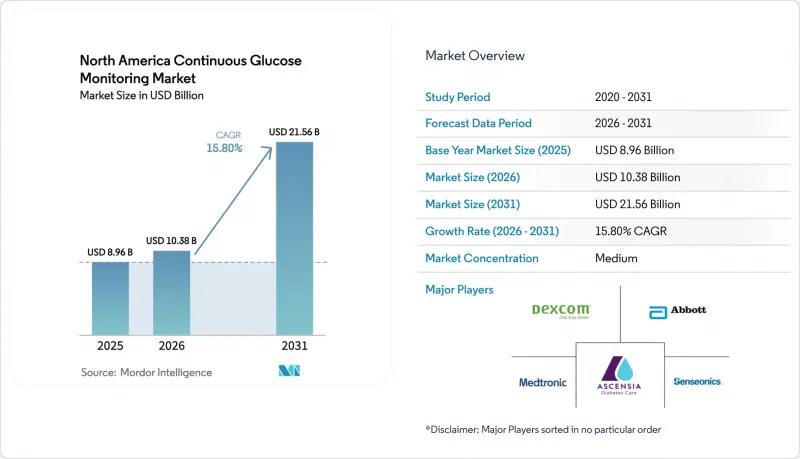
이 보고서는 구성 요소(센서, 송신기, 수신기), 인구 통계(소아, 성인), 최종사용자(병원·클리닉, 외래 수술 센터 및 당뇨병 전문 센터, 재택 의료), 국가(미국, 캐나다, 멕시코)별로 분류되어 있습니다. 시장 전망은 금액(달러) 기준으로 제시되어 있습니다.
북미 연속 혈당 모니터링 시장의 동향 및 인사이트
당뇨병 유병률 증가 및 조기 진단
2024년 미국의 당뇨병 환자 수는 3,840만 명에 달했으며, 2025년 캐나다에서는 370만 명, 2025년 멕시코에서는 1,240만 명으로 집계되었습니다. 현재 선별 검사 지침에서는 35세 이상의 모든 성인과 위험 요인이 있는 과체중 성인에게 검사를 권장하고 있으며, 이로 인해 대상 환자층이 약 1,500만 명 확대되었습니다. 신규로 진단받은 성인은 90일 이내에 CGM(연속 혈당 모니터링)을 도입하고 있습니다. 이는 무작위 대조 시험 결과, 손가락 채혈을 통한 모니터링과 비교했을 때 HbA1c 수치가 0.9% 추가로 감소하는 것으로 나타났기 때문입니다. 민간 보험사들도 이러한 과학적 근거를 반영하여, 2025년부터 인슐린 비사용자에 대한 1차 선택 치료법으로 CGM의 보험 적용을 추가했습니다. 그 결과, 북미의 연속 혈당 모니터링 시장 전체에 걸쳐 지속적이고 장기적인 성장 요인으로 작용하고 있습니다.
원격 모니터링과 원격의료 통합의 급속한 확산
CPT 코드 99453, 99454, 99457은 원격 생리학적 데이터 검토에 대해 보상을 지급하는 것으로, CGM 환자 1명당 월 64달러의 지속적인 수입원을 창출하고 있습니다. 재향군인 보건국(VHA)은 2025년에 시스템 전반에 CGM과 원격의료를 도입한 후, 혈당 관리 성과를 유지하면서 내분비과 대면 진료 횟수를 38% 줄였습니다. 카이저 퍼머넌트의 가상 클리닉에서는 CGM과 비동기형 코칭을 결합함으로써 4,800명의 등록자에서 평균 A1c 수치가 1.2% 감소한 것으로 확인되었습니다. FDA의 지침을 통해 클라우드 연결형 CGM 플랫폼이 RPM(원격 환자 모니터링) 청구 대상이 됨이 명확해지면서, 보험사 측의 모호함이 해소되었습니다. 이러한 요인들이 보험 급여와 원격의료의 성장을 상호 촉진하며, 북미의 연속 혈당 모니터링 시장을 촉진하고 있습니다.
보험사와 환자에게 부담되는 의료기기 및 소모품의 높은 비용
10일치 센서의 도매 가격은 75-95달러이며, 보험 적용 전 연간 소모품 비용은 최대 3,467달러에 달합니다. 메디케어 파트 B의 20% 본인 부담률이라도 이용자는 연간 547-693달러의 본인 부담을 감당해야 합니다. 메디케이드의 적용 범위는 단편적입니다. 38개 주가 제1형 당뇨병 환자의 CGM 비용을 보상하고 있지만, 인슐린 비의존성 제2형 당뇨병 환자의 경우 22개 주에 불과하여 1,400만 명의 수급자가 대상에서 제외되고 있습니다. 멕시코의 사회보장 급여 대상 품목 리스트에는 CGM이 완전히 제외되어 있으며, 소매 가격이 월 최저 임금의 12-16%에 해당하는 수준으로 치솟았으며, 도입은 도시 지역의 부유층 소비자로 한정되어 있습니다. 따라서 높은 비용이 보급을 저해하고 있으며, 북미 연속 혈당 모니터링 시장의 연평균 성장률(CAGR)을 끌어내리고 있습니다.
부문 분석
2025년 현재, 센서는 북미 연속 혈당 모니터링 시장 점유율의 68.9%를 차지하고 있으며, 2031년까지 연평균 성장률(CAGR) 16.87%로 확대될 것으로 예측됩니다. Bluetooth Low Energy(BLE)의 통합으로 일회용 센서가 스마트폰과 직접 통신할 수 있게 되어 송신기가 불필요해짐에 따라 부품 원가를 22% 절감하고 있습니다. 웨어러블 센서는 매출의 92%를 차지하고 있지만, 이식형 센서는 피부염 관련 불만을 줄임으로써 21.3%라는 더 높은 성장률을 보이고 있습니다. 송신기와 수신기는 단독 카테고리로는 감소 추세를 보이고 있지만, 스마트폰을 소유하지 않은 소아 및 고령 사용자들 사이에서는 여전히 이용되고 있습니다.
지속적인 소형화가 경쟁의 기반이 되고 있습니다. 애보트(Abbott)사의 5mm ‘Libre 3’ 디스크형 센서나 덱스콤(Dexcom)사의 더 슬림한 ‘G7’은 모두 ISO 15197:2013의 정확도 기준을 충족하고 있으며, 당분간 센서가 북미 연속 혈당 모니터링 시장 규모에서 하드웨어의 핵심이 될 것으로 보입니다. FDA의 상호 운용성 관련 규제로 인해 송신기는 더욱 범용화될 것이며, 가치 창출은 센서의 화학 기술, 착용 기간, 알고리즘에 의한 신호 처리에 집중될 것입니다.
기타 혜택
- 엑셀 형식의 시장 예측(ME) 시트
- 3개월간의 애널리스트 지원
자주 묻는 질문
목차
제1장 서론
제2장 조사 방법
제3장 개요
제4장 시장 구도
제5장 시장 규모와 성장 예측
제6장 경쟁 구도
제7장 시장 기회와 향후 전망
KSA 26.08.26According to Mordor Intelligence, the North America continuous glucose monitoring market size is expected to grow from USD 8.96 billion in 2025 to USD 10.38 billion in 2026 and is forecast to reach USD 21.56 billion by 2031 at 15.80% CAGR over 2026-2031.
This report is Segmented Into Components (Sensors, Transmitters, and Receivers), Demography (Pediatrics and Adults), End User (Hospitals & Clinics, Ambulatory Surgical & Specialty Diabetes Centers, and Home Care). Country (United States, Canada, and Mexico). The Market Forecasts are Provided in Terms of Value (USD).
North America Continuous Glucose Monitoring Market Trends and Insights
Rising Prevalence Of Diabetes & Earlier Diagnosis
Diabetes prevalence reached 38.4 million in the United States in 2024, 3.7 million in Canada in 2025, and 12.4 million in Mexico in 2025. Screening guidelines now recommend testing all adults aged 35+ and overweight adults with a risk factor, expanding the addressable base by roughly 15 million individuals. Newly diagnosed adults receive CGM within 90 days because randomized evidence shows a 0.9% additional A1c reduction versus finger-stick monitoring. Commercial insurers mirrored the science by adding first-line CGM coverage for non-insulin users in 2025. The result is a durable, long-tail driver across the North American continuous glucose monitoring market.
Rapid Uptake of Remote Monitoring & Telehealth Integration
CPT codes 99453, 99454, and 99457 reimburse remote physiologic data review, creating a recurring USD 64 monthly revenue stream per CGM patient. The Veterans Health Administration cut in-person endocrinology visits 38% after systemwide CGM-telehealth rollout in 2025 while sustaining glycemic outcomes. Kaiser Permanente's virtual clinic documented a 1.2% mean A1c drop among 4,800 enrollees by pairing CGM with asynchronous coaching. FDA guidance clarified that cloud-connected CGM platforms qualify for RPM billing, ending payer ambiguity . These forces intertwine reimbursement and telehealth growth, lifting the North American continuous glucose monitoring market.
High Device & Consumable Costs to Payers & Patients
A 10-day sensor wholesales for USD 75-95, producing yearly consumable costs up to USD 3,467 before insurance. Medicare Part B's 20% coinsurance still leaves users with USD 547-693 out-of-pocket annually. Medicaid coverage is fragmentary: 38 states reimburse CGM for type 1, only 22 for non-insulin type 2, excluding 14 million beneficiaries. Mexico's social-security formulary omits CGM entirely, forcing retail prices equal to 12-16% of the monthly minimum wage, restricting adoption to affluent urban consumers. Elevated cost, therefore, moderates penetration and dampens the North America continuous glucose monitoring market CAGR.
Other drivers and restraints analyzed in the detailed report include:
- Sensor Miniaturization & Accuracy Breakthroughs
- Integration With Automated Insulin Delivery Systems
- GLP-1 Weight-Loss Drugs Reducing Testing Frequency
For complete list of drivers and restraints, kindly check the Table Of Contents.
Segment Analysis
Sensors accounted for 68.9% of the North America continuous glucose monitoring market share in 2025 and are projected to expand at a 16.87% CAGR through 2031. Their integration of Bluetooth Low Energy allows disposable form factors to communicate directly with smartphones, removing transmitters and trimming bill-of-material cost by 22%. Wearable sensors represent 92% of revenue; implantables grow faster at 21.3% by alleviating dermatitis complaints. Transmitters and receivers decline as stand-alone categories but persist among pediatric and senior users who lack smartphones.
Continued miniaturization underpins the competitive edge: Abbott's 5-mm Libre 3 disk and Dexcom's sleeker G7 both meet ISO 15197:2013 accuracy thresholds, positioning sensors as the hardware linchpin of the North America continuous glucose monitoring market size for the foreseeable future. FDA interoperability rules will further commoditize transmitters, concentrating value creation in sensor chemistry, wear duration, and algorithmic signal processing.
Complete Report Scope:
- By Component
- Sensors
- Wearable
- Implantable
- Transmitters
- Receivers
- Sensors
- By Demography
- Paediatric
- Adult
- By End User
- Hospitals & Clinics
- Ambulatory Surgical & Specialty Diabetes Centers
- Home Care
- By Country
- United States
- Canada
- Mexico
List of Companies Covered in this Report:
- Abbott Laboratories
- Ascensia
- Beta Bionics
- Biolinq
- Dexcom
- Eversense (Senseonics)
- Insulet
- Lifescan
- Medtronic PLC (MiniMed)
- Nemaura Medical
- Novo Nordisk
- Roche
- Senseonics
Additional Benefits:
- The market estimate (ME) sheet in Excel format
- 3 months of analyst support
TABLE OF CONTENTS
1 Introduction
- 1.1 Study Assumptions & Market Definition
- 1.2 Scope of the Study
2 Research Methodology
3 Executive Summary
4 Market Landscape
- 4.1 Market Overview
- 4.2 Market Drivers
- 4.2.1 Rising Prevalence of Diabetes & Earlier Diagnosis
- 4.2.2 Rapid Uptake of Remote Monitoring & Tele-Health Integration
- 4.2.3 Sensor Miniaturization & Accuracy Breakthroughs
- 4.2.4 Employer-Sponsored Wellness Plans Subsidising CGM
- 4.2.5 Pharmacy-Chain Subscription Programs Accelerating First-Time Users
- 4.3 Market Restraints
- 4.3.1 High Device & Consumable Costs to Payers & Patients
- 4.3.2 GLP-1 Weight-Loss Drugs Reducing Testing Frequency
- 4.3.3 Rising Reports of Sensor-Adhesive Skin Dermatitis
- 4.3.4 Regulatory Uncertainty Around Multi-Analyte Sensors
- 4.4 Supply-Chain Analysis
- 4.5 Regulatory Landscape
- 4.6 Technological Outlook
- 4.7 Porter's Five Forces
- 4.7.1 Threat of New Entrants
- 4.7.2 Bargaining Power of Buyers
- 4.7.3 Bargaining Power of Suppliers
- 4.7.4 Threat of Substitutes
- 4.7.5 Intensity of Competitive Rivalry
5 Market Size & Growth Forecasts (Value USD Billion)
- 5.1 By Component
- 5.1.1 Sensors
- 5.1.1.1 Wearable
- 5.1.1.2 Implantable
- 5.1.2 Transmitters
- 5.1.3 Receivers
- 5.1.1 Sensors
- 5.2 By Demography
- 5.2.1 Paediatric
- 5.2.2 Adult
- 5.3 By End User
- 5.3.1 Hospitals & Clinics
- 5.3.2 Ambulatory Surgical & Specialty Diabetes Centers
- 5.3.3 Home Care
- 5.4 By Country
- 5.4.1 United States
- 5.4.2 Canada
- 5.4.3 Mexico
6 Competitive Landscape
- 6.1 Market Concentration
- 6.2 Market Share Analysis
- 6.3 Company Profiles (includes Global level Overview, Market level overview, Core Segments, Financials as available, Strategic Information, Market Rank/Share for key companies, Products & Services, and Recent Developments)
- 6.3.1 Abbott Laboratories
- 6.3.2 Ascensia
- 6.3.3 Beta Bionics
- 6.3.4 Biolinq
- 6.3.5 Dexcom
- 6.3.6 Eversense (Senseonics)
- 6.3.7 Insulet
- 6.3.8 LifeScan
- 6.3.9 Medtronic PLC (MiniMed)
- 6.3.10 Nemaura Medical
- 6.3.11 Novo Nordisk
- 6.3.12 F. Hoffmann-La Roche Ltd.
- 6.3.13 Senseonics
7 Market Opportunities & Future Outlook
- 7.1 White-Space & Unmet-Need Assessment


